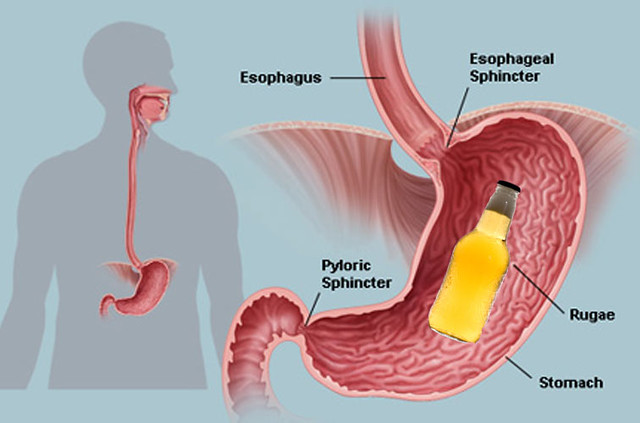
Today’s infographic concerns the subject of How Alcohol Travels Through the Body, each stage of the way and what happens at each place alcohol travels from mouth to liver and out again. Remember, you don’t buy alcohol, you just rent it. Just click on the image to view it full screen.
Tag Archives: Health & Beer
You’re In The Clear: The Health Benefits Of Moderate Consumption

Here’s a great infographic about the Health Benefits of Moderate Consumption entitled Beer You’re in the Clear. It was produced a few years ago by the design firm Belancio, and highlights many of the benefit of the moderate consumption of beer, something the anti-alcohol folks continue to decry and deny. They’ve also made a limited edition with, in my opinion, better contrast, making it easier to read.

You can see a larger, easier-to-read, version at Belancio and an even larger one at Fast Company.
Beer In Ads #769: To Guard Your Well-Being

Thursday’s ad is for Budweiser, from 1942. It’s a funny ad that would be totally illegal today thanks to the work of the prohibitionists and neo-prohibitionists, who have turned from trying to ban alcohol after the failure of Prohibition to instead making it as difficult as possible to sell, including increasingly stringent advertising restrictions, including that making health claims are banned, even true ones. But this ad is all about the healthy nature of beer, and the necessary vitamins and foodstuffs in beer, not to mention how R&D on beer has led to other discoveries.
Beer Birthday: Rick Lyke

Today is the 52nd birthday of Rick Lyke, a fellow drinks writer in North Carolina. Rick writes for a variety of publications and online at Lyke 2 Drink. It’s especially terrific that we can all celebrate Rick’s 52nd today, because he recently fought and won a battle with prostate cancer, which prompted him to found the grassroots organization Pints For Prostates. Rick is a terrific champion for both great beer and men’s health. Join me in wishing Rick a very happy birthday.

Rick at the first Rare Beer Tasting at Wynkoop during GABF Week in 2009.

Rick with Carol Stoudt and Amy Dalton at the first Rare Beer tasting at Wynkoop to raise money for his Pints for Prostates organization.

Lew Bryson and Rick at the World Beer Festival in Durham in 2008.

Jeff Bearer, Stan Hieronymus, Stephen Beaumont and me with Rick at the Great Divide open house on the first day of GABF a couple of years ago.

And finally, the ubiquitous Sam Adams brunch photo I use four times a year, with Daniel Bradford, of All About Beer, Jim Koch, Amy Dalton (also with All About Beer) and Rick.
Disrespecting Low-Calorie Light Beer

Ugh, why do people keep defending low-calorie light diet beer? It’s an abomination. It should go away. It’s a marketing trick. It’s the best selling kind of beer in America, and defending it is the equivalent of complaining about the “War on Christmas” or the “War on White People.” Yes, sales have been slipping lately, with more people choosing beer with flavor, but certainly not enough to put much of a dent in the sheer volume of this dreck. Yes, many, if not most, craft beer drinkers choose not to drink it and some even bash it as something not worthy of respect. Well, I am one of those people. Not everything deserves our respect. I respect how difficult it is to make, but in the end that’s not the standard I want to use for how I choose what to drink. Degree of difficulty may be fine for Olympic gymnastics or diving, but taste is far more important to me when it comes to my beer.
So please stop telling me I must love it because it’s really, really hard to make. I get that. I marvel at the technology that must be employed, the sacrifice of ingredients to keep it lighter in color and flavor, the loving care taken to make something that … should … not … exist, and would not exist if not for the Herculean effort to make it. It’s unnatural. So why go to such an effort to make something nobody wanted in the first place? Why spend millions of dollars to convince people they should be drinking it? Why create new processes to create Frankenbrew in the laboratory when ordinary beer was perfectly fine, thank you very much? Anyone, anyone? Bueller? Did anyone say “money?” Show ‘em what they win. They win a beer landscape dominated by beer that tastes as close to water as technologically possible. Hooray! Drop the balloons, throw the confetti and start the singing and dancing.
Earlier this summer, David Ryder, Vice-President of Brewing for MillerCoors wrote an op-ed piece in the Chicago Sun-Times entitled In Defense of Light Beer, in which he trotted out the old saws about light beer. The fact that the two top-selling products his company makes are Coors Light and Miller Lite should, of course, have made anyone suspicious of his motives and question any arguments in his editorial piece. The fact that the Sun-Times ran such an obviously biased piece is rather sad, I think. It’s a bit like asking Lee Iacocca to defend the Pinto. You can’t expect objectivity.
But now there’s another article telling me I have to respect light beer, this time in a magazine I actually read, and usually enjoy: Mental Floss. The piece, Scientific Reasons to Respect Light Beer is written by Jed Lipinski, who appears to not be a frequent writer about beer, not that that should matter. After a few anecdotes from craft beer fans disparaging light beer, he launches into his defense:
What few drinkers know, however, is that quality light beers are incredibly difficult to brew. The thin flavor means there’s little to mask defects in the more than 800 chemical compounds within. As Kyler Serfass, manager of the home-brew supply shop Brooklyn Homebrew, told me, “Light beer is a brewer’s beer. It may be bland, but it’s really tough to do.” Belgian monks and master brewers around the world marvel at how macro-breweries like Anheuser-Busch InBev and MillerCoors have perfected the process in hundreds of factories, ensuring that every pour from every brewery tastes exactly the same. Staring at a bottle, it’s staggering to consider the effort that goes into producing each ounce of the straw-colored liquid. But perhaps the most impressive thing about light beer isn’t the time needed or the craftsmanship or even the consistency, but how many lives the beverage has saved.
And there’s degree of difficulty again. Is light beer really a “brewer’s beer?” I have to question that one. But even more of a howler is how “Belgian monks and master brewers around the world marvel at how macro-breweries like Anheuser-Busch InBev and MillerCoors have perfected the process.” They may find the technology or the process interesting, they may even be impressed by the effort, but I think you’d be hard-pressed to find a brewing monk who prefers Bud Light to Duvel, or Orval, or Westmalle. Can anyone really think the average German brewer “marvels” at Miller Lite when compared to the average everyday Bavarian beer? Or that the brewers of England think Coors Light better than the average cask hand-pulled from their local pub? In fact, until the rise of low-calorie diet beer, most Europeans, when referring to “light” beer, thought of light in terms of color, as the German helles (which means “bright” or “light”) or hell (an adjective for “light”). Also, he begins by referring to light beer as having “thin flavors.” Since when has that ever been a positive attribute for anything? When is “less flavor” something to strive for? Name another food product where the goal is to create a version with not as much flavor.
But then there’s that last bit, about how light beer has saved lives. Huh? Yeah, that was my response, too. Huh? And here’s the reason.
“Before it was light beer, it was “small beer.” A popular drink in late-medieval Europe and colonial America, small beer was necessary for certain civilizations to grow. In the days before Brita filters, beer staved off disease and dehydration by packing just enough alcohol to kill off pathogens found in drinking water.
Except that it wasn’t. One didn’t evolve into the other, in some natural progression. The two are not the same, apart from both being low-alcohol and beers. He even contradicts himself by saying that it was popular in medieval times and allowed “civilizations to grow.” Given that civilization was around for thousands of years before that period of history and that beer was there at the very dawn of civilization, I think we can safely say that “small beer” didn’t save mankind. Beer generally had a hand in keeping people healthier longer, allowing those with a tolerance for alcohol to prosper and procreate, but it wasn’t “light beer” that saved the day. If those people had to wait around for brewers to figure out they could use the second runnings of their strong beer to make a lower strength beer that they could sell for less, they would not have survived. Small beer was essentially a way to make more money, to re-use part of the brewing waste, first created by English brewers, although most brewing cultures also made a beer of lower strength that was essentially a table beer. Anchor Brewing has continued the English tradition by making a Small Beer from their Old Foghorn Barleywine Style Ale, and despite it being 3.3% a.b.v., it’s about as far from a low-calorie light diet beer as one could be.
Light beer was the brainchild of one man, who thought people would want diet beer. He was wrong, though he did come up with the process of how to make a low-calorie diet beer. Here’s the story, from an earlier post of mine:
The first low-calorie beer was created by Joe Owedes, who, it must be said, had some very strong opinions about beer. He once told me that all ale yeast was dead and inferior to lager yeast. Around 1967, he created Gablinger’s diet beer, the first light beer, while working for Rheingold. It flopped. Big time. Not everybody agrees on what happened next. Some accounts credit Owedes with sharing his recipe for light beer with Meister Brau of Chicago while others claim that the Peter Hand Brewing Company (which marketed Meister Brau) came up with it independently on their own. However it happened, Meister Brau Lite proved somewhat more successful than Gablinger’s, primarily due to its superior marketing. Miller Brewing later acquired Meister Brau, and in 1975 debuted Miller Lite, complete with the distinctive, trademark-able spelling.
But it took marketing the new low-calorie beer in a new way so that it removed the “diet” stigma to make it work. They had to trick people into drinking it. Miller’s famously successful “tastes great, less filling” campaign was the primary reason for the category’s success. But it was hardly overnight. It took fifteen years — from 1975 to 1990 — for Miller Lite to reach 10% of the market. Over that time, the other big brewers (loathe to miss out on any market share) introduced their own versions, such as Coors Light and Bud Light, so that whole segment of low-calorie beer was nearly 30% of the beer market by 1990.
Today, seven of the top ten big brands are light beers. Despite its recent dip in sales, it remains a $50 billion segment of the business and still hovers close to half of all beer sold in the United States. That fact, I find to be incredibly sad, frankly. What a great triumph of marketing over common sense and actual taste.
Which is why I hardly think anyone needs to be rushing to its defense. People are willingly drinking it in frighteningly high numbers. I can only assume they’re the same people who buy Wonder Bread, Kraft cheese, TV dinners and every other popular product, even when everybody knows better, healthier, tastier alternatives are available.
Owedes supposedly saw the focus group data indicating that people were giving up beer to save calories. Remember, this was the 1950s. Of course, it seems to me the smarter decision would have been to persuade people that beer is not as fattening as they thought. That this is true means it probably would have been a much easier sell. The idea that beer is so fattening is something of a myth, just like the beer belly. It seems to me that if the beer companies at that time had thrown their millions of ad dollars into that message, things might be a lot better today. But they chose the harder path, one we’re all still paying for. Instead of changing the message, they went with “the customer is always right” approach and created a beer to satisfy the consumer’s misconceptions and incorrect assumptions. In other words, when the customer was wrong, they just went with it. When it tanked, instead of cutting their losses, they instead spent millions persuading customers something that wasn’t true; that beer was fattening, but drinking this “magic diet beer” would fix that. The first thing they learned was not to call it “diet beer.” It’s what pharmaceutical companies have learned how to do so well. They first come up with the drug, then create the condition it will cure, even if it didn’t exist before. Anybody remember “restless leg syndrome” before the drug that treats it came on the market?
Lipinski goes on to detail the technology and the steps in the process that big breweries take to create low-calorie diet beer. And even he admits it was a tough sell at the beginning, and how a barrage of advertising was necessary to make it succeed. So tell me again why I have to respect something that had to be sold to the American people through advertising and marketing and which would probably not exist had that advertising failed? If those ads had not worked, low-calorie diet beer could have just as easily ended up on the scrap heap with dry beer, ice beer or tequila-flavored beer.
Peter Kraemer, a VP at ABI, seems to believe part of the problem is with definitions. He claims that “‘light beer’ has lost all meaning over the years” and he “considers [regular Budweiser and Bud Light] both light beers.” In that, he may be on to something. Regular Bud and Bud Light were once judged at GABF as separate categories, but today are sub-categories under the umbrella “American-Style Lager, Light Lager or Premium Lager,” a category I judged a first round of this year. Indeed, even the technical differences in the four sub-categories are slight. I suspect that they may have been more different at one time, but as Anheuser-Busch finally revealed in a 2006 Wall Street Journal article, Budweiser Admits Flavor “Drifted” Over the Years. So regular Bud has been slowly “creeping” closer to Bud Light over the years. But the fact is they taste pretty similar, have not much difference in terms of calories and are separated only in the way they’re marketed. They remind me of the choice between 87 regular octane gasoline and 91 premium octane. I’m told they’re not the same gasoline but damned if it makes any difference to my car, and I’ve long suspected that it’s like an old Dave Berg cartoon I saw in Mad magazine where all the gas actually comes out of one big tank below the pumps, and really is all the same.
And why not, the driving force in these changes is being able to use less ingredients, making the profits higher. It’s not rocket science. Use less malt and hops, and it will cost less to produce the beer, all other costs being equal. Over a small batch or two, it’s probably not that much, but in vats the size of Montana, it makes a big difference to the bottom line. And that’s plenty of incentive to spend the ad dollars to convince people that the flavor you’re not tasting is what you really want, because it’s better for you, won’t fill you up and, besides, it still tastes great. Trust us.
The other reason, or incentive, that the big brewers have for light beer is that having convinced people that they have less calories, people feel that they can actually drink more of them. And that’s what they end of doing. So by promoting them as healthier, diet beer, people end up actually drinking more calories. As The Litigation Consulting Report explains, in order to get the same buzz, that is the same amount of alcohol (which is also lower in most light beers), you’d have to drink 15 light beers to get the same alcohol that’s in six regular beers. According to them, this is known as the “compensation” effect and “is an issue in some product liability cases.”
But the diet aspects of beer already work for all beer, no reason to even sacrifice the flavor between the two. But since they’re admittedly both the same, you may as well avoid both regular and the diet versions in favor of something with actual flavor. That’s one of the biggest reasons I hate low-calorie diet beer: there’s simply no reason for it to exist. For most beers, have two instead of three and you’ll be ahead of the game. Drink smarter, drink better.
I realize I’m in the minority here, as every time I write about counting calories, people comment that they do actually watch their caloric intake, but I do not, and never have. I’ve gone over 50 years without counting a single calorie and, while I may not be the world’s healthiest man, I’m not the world’s worst either. And I’ve certainly never regretted choosing to eat or drink whatever I want. I find the slavish obsession to calorie counting absurd, but have come to recognize that many people really do care about them. I’ve written about this issue before, in Calories In Beer: Can We Please Stop?, Calories In Beer: Can We Please Stop, Part 2 and Read This, Not That. Life is undoubtedly about making choices, assessing risks and deciding what’s best for you.
Still, if you love beer, why defend low-calorie diet beer that is in every way as far from actual beer as possible? Everyone acknowledges it has less flavor. It has a few less calories, but stripping calories also strips … wait for it … flavor. But the difference between regular and diet beer seems so slight to me to be almost meaningless, especially when simply drinking one less beer would have roughly the same effect. If Budweiser has 145 calories in a 12 oz. bottle, and Bud Light has 110, drinking three diet beers would save you 105 calories. But have just two Buds, and you’d save 40 calories over three Bud Lights. Better still, choose two Samuel Adams Boston Lagers (160 calories) and you’d still save 10 calories over three Bud Lights or choose two Sierra Nevada Pale Ales (175 calories) and it will cost you only 20 more calories than drinking three Bud Lights would, though you’d still save 85 calories drinking two Sierra Nevada Pale Ales instead of three regular Budweisers. The point is that the caloric savings in diet beers are a sham. The differences are too slight to sacrifice so much flavor and enjoyment.
To sum up, diet beers were created in a laboratory to fill a need that didn’t exist. Making the beer that nobody wanted is incredibly difficult, and much harder than just making normal beer. To be successful, millions of dollars had to be spent on marketing and advertising to convince people to buy the thing that’s harder to make that they didn’t want in the first place. Finally, after nearly 40 years, and at least 20 that they’ve dominated the market, sales are starting to slip as people are choosing beer with more flavor instead. But rather than follow the shifting marketplace, pleas are being made that we should respect the beer nobody wanted that’s harder to make because … well, just because it is so danged hard to make and is a technological marvel deserving our respect.
As Lipinski wittily remarks in his closing sentence, he hopes his efforts at persuading you to respect light beer will “help you see the brew in a new light,” but there’s really nothing new in his arguments. His “scientific reasons” can only command your respect up to a point. I can respect the process, I can respect the technology, I can respect the effort made, but I still can’t respect the results. I honestly don’t understand how anyone can, quite frankly. With no disrespect to the many wonderful brewers who make low-calorie light diet beer, you can do better. You know you can. I have no truck with your skill as brewers or with the technology you wield so impressively. But I want a beer with more flavor. So until diet beer, like so many other diet products, tastes exactly the same as the more flavorful beers I prefer, I can’t give it the respect you insist it deserves.
Drinkers Half As Likely To Get Lou Gehrig’s Disease
![]()
Though contracting ALS (or Amyotrophic Lateral Sclerosis) is relatively rare, according to a new Dutch study, your risk is cut in half if you drink moderately, when compared to abstainers. Better known, at least in North America, as Lou Gehrig’s Disease — since the New York Yankees first baseman famously contracted it in 1938 — the ABMRF is reporting about the new study. According to their information, the Risk of ALS Seen to be Lower in Drinkers than Abstainers. Their full article is below:
A Dutch population-based case-control study of the rare but devastating neurological disease amyotrophic lateral sclerosis (ALS) suggests that the risk of such disease is increased among smokers, as has been shown previously. However, surprisingly, the risk of ALS was seen to be markedly lower among consumers of alcohol than among abstainers.
The study conducted between 2006 and 2009 included surveying 494 patients with incident ALS, a large sample for the rare disease, and 1,599 controls. Investigators compared results with those from cohorts including patients with prevalent ALS and referral patients.
Results highlight the importance of lifestyle factors in the risk for ALS. Current smoking is associated with an increased risk of ALS and a worse prognosis. However, alcohol consumption is associated with a reduced risk of ALS, as the risk among drinkers was about one half that of non-drinkers.
You can see the abstract for the study itself, Smoking, Alcohol Consumption, and the Risk of Amyotrophic Lateral Sclerosis: A Population-based Study, at PubMed.
Moderate Drinking Prevents Bone Loss In Women

The ABMRF is reporting the results of a new study conducted at Oregon State University published in Menopause, the Journal of the North American Menopause Society. The study, Moderate alcohol intake lowers biochemical markers of bone turnover in postmenopausal women, appears to conclude that “Drinking alcohol in moderation with a healthy lifestyle may benefit women’s bone health, lowering their risk of developing osteoporosis.”
From the abstract:
Objective: Epidemiological studies indicate that higher bone mass is associated with moderate alcohol consumption in postmenopausal women. However, the underlying cellular mechanisms responsible for the putative beneficial effects of alcohol on bone are unknown. Excessive bone turnover, combined with an imbalance whereby bone resorption exceeds bone formation, is the principal cause of postmenopausal bone loss. This study investigated the hypothesis that moderate alcohol intake attenuates bone turnover after menopause.
Methods: Bone mineral density was determined by dual-energy x-ray absorptiometry in 40 healthy postmenopausal women (mean +/- SE age, 56.3 +/- 0.5 y) who consumed alcohol at 19 +/- 1 g/day. Serum levels of the bone formation marker osteocalcin and the resorption marker C-terminal telopeptide (CTx) were measured by immunoassay at baseline (day 0) and after alcohol withdrawal for 14 days. Participants then consumed alcohol and were assayed on the following morning.
Results: Bone mineral density at the trochanter and total hip were positively correlated to the level of alcohol consumption. Serum osteocalcin and CTx increased after abstinence (4.1 +/- 1.6%, P = 0.01 and 5.8 +/- 2.6%, P = 0.02 compared with baseline, respectively). Osteocalcin and CTx decreased after alcohol readministration, compared with the previous day (-3.4 +/- 1.4%, P = 0.01 and -3.5 +/- 2.1%, P = 0.05, respectively), to values that did not differ from baseline (P > 0.05).
Conclusions: Abstinence from alcohol results in increased markers of bone turnover, whereas resumption of alcohol reduces bone turnover markers. These results suggest a cellular mechanism for the increased bone density observed in postmenopausal moderate alcohol consumers. Specifically, the inhibitory effect of alcohol on bone turnover attenuates the detrimental skeletal consequences of excessive bone turnover associated with menopause.
The ABMRF report on the study:
Bones are in a constant state of remodeling with old bone being removed and replaced. In people with osteoporosis, more bone is lost than reformed resulting in porous, weak bones. About 80% of all people with osteoporosis are women, and postmenopausal women face an even greater risk because estrogen, a hormone that helps keep bone remodeling in balance, decreases after menopause.
A study by Oregon State University researchers assessed the effects of alcohol withdrawal on bone turnover in postmenopausal women who drank one or two drinks per day several times a week. A significant increase in blood markers of bone turnover was measured in women after they stopped drinking for just two weeks. Alcohol appears to behave similarly to estrogen in that it reduces bone turnover, the researchers said.
Investigators studied 40 early postmenopausal women who regularly had one or two drinks a day, were not on any hormone replacement therapies, and had no history of osteoporosis-related fractures.
Results suggest evidence for increased bone turnover, a risk factor for osteoporotic fractures, during the two week period when the participants stopped drinking. Less than a day after the women resumed their normal drinking, their bone turnover rates returned to previous levels.
“Drinking moderately as part of a healthy lifestyle that includes a good diet and exercise may be beneficial for bone health, especially in postmenopausal women,” said researchers. “After less than 24 hours to see such a measurable effect was really unexpected.”
Beer Fights Obesity

Here’s an interesting one, if I’m reading it correctly. A new study published in the journal Cell Metabolism with the inscrutable title The NAD+ Precursor Nicotinamide Riboside Enhances Oxidative Metabolism and Protects against High-Fat Diet-Induced Obesity appears to suggest that beer (and milk) contain a molecule that helps fight against weight-gain, especially in high-fat diets. The wonder molecule is known as nicotinamide riboside, or NR. Here’s the abstract. See if you can get through it without your head spinning:
As NAD+ is a rate-limiting cosubstrate for the sirtuin enzymes, its modulation is emerging as a valuable tool to regulate sirtuin function and, consequently, oxidative metabolism. In line with this premise, decreased activity of PARP-1 or CD38—both NAD+ consumers—increases NAD+ bioavailability, resulting in SIRT1 activation and protection against metabolic disease. Here we evaluated whether similar effects could be achieved by increasing the supply of nicotinamide riboside (NR), a recently described natural NAD+ precursor with the ability to increase NAD+ levels, Sir2-dependent gene silencing, and replicative life span in yeast. We show that NR supplementation in mammalian cells and mouse tissues increases NAD+ levels and activates SIRT1 and SIRT3, culminating in enhanced oxidative metabolism and protection against high-fat diet-induced metabolic abnormalities. Consequently, our results indicate that the natural vitamin NR could be used as a nutritional supplement to ameliorate metabolic and age-related disorders characterized by defective mitochondrial function.
A mouthful, to be sure, but Jenny Hope, at the UK’s Daily Mail, who presumably had access to the full text, valiantly makes more sense of it in The miracle molecule: Hidden vitamin found in BEER and MILK can make you stronger, slimmer and healthier, and the story starts out very promisingly:
If you were planning on having a quick pint tonight, then this will be welcome news.
Beer may contain a vitamin which can fight obesity and improve muscle strength, scientists claim.
The ‘miracle molecule’, which has been found in milk and may also be present in beer and some foods, has no side effects and could even lengthen lifespan, they say.
The bad news — why does there always have to be bad news? — is that NR is found in vanishingly small quantities, so infinitesimal that you couldn’t really drink enough beer (or milk) to take advantage of NR’s positive effects. Oh, you could try, but such immoderate drinking would no doubt land you on MADD’s most wanted and possibly lead you to an early grave, as well, thus defeating the purpose.
Nonetheless, the results were impressive. In addition to fighting weight gain and improving muscle strength, NR also helped combat diabetes and improved endurance. And did I mention no side effects were found, not even in high doses? Apparently, NR “works by becoming trapped in cells where it boosts the metabolism, much like resveratrol, which is found in wine.”
In a statement, one of the study’s authors, Carles Canto said. “It really appears that cells use what they need when they need it, and the rest is set aside without being transformed into any kind of deleterious form.”
The next steps, besides human testing, will be figuring out how to better detect it and, more importantly, discovering if it can be synthesized economically so that sufficiently large quantities can be taken. I sure like the idea of Vitamin Beer. Flintstones chewable beer vitamins, anyone?
Moderate Elderly Beer Drinkers Less Prone To Dementia

The Foundation for Alcohol Research (ABMRF) recently highlighted a study that appears to show that elderly persons who drink moderately are at a lower or reduced risk of “cognitive decline or dementia and provide cardiovascular benefits.” The study, Alcohol and Cognition in the Elderly: A Review, was published in Psychiatry Investigation. Here’s ABMRF’s report of the study:
Alzheimer’s disease and other types of dementia are most common in the very elderly, and are associated with huge health costs. With a rapidly aging global population, factors influencing the risk of cognitive decline and dementia are important.
A review of the association between alcohol consumption and cognition in the elderly suggests alcohol may have both a neurotoxic and neuroprotective effect, depending on the dose and drinking pattern. Longitudinal and brain imaging studies in the elderly show that excessive alcohol consumption may increase the risk of cognitive dysfunction and dementia, but regular low to moderate alcohol intake may protect against cognitive decline and dementia and provide cardiovascular benefits.
Investigators reviewed studies published from 1971 to 2011 related to alcohol and cognition in the elderly. At present, there are no proven agents to prevent cognitive decline or dementia, although a number of prospective epidemiological studies have shown a lower risk of such conditions among light to moderate drinkers in comparison with non-drinkers.
Other studies suggest that beneficial effects are seen only among certain sub-groups of subjects. A recent meta-analysis by Peters et al of subjects over the age of 65 in longitudinal studies concluded that light-to-moderate alcohol consumption, in comparison with abstinence, was associated with approximately 35-45% lower risk of cognitive decline or dementia.
They also found that heavy drinking has the opposite effect, so that too much alcohol may increase such risks, so it appears that moderation is the key.
And here’s the abstract from the published paper:
Consumption of large amounts of alcohol is known to have negative effects, but consumption in smaller amounts may be protective. The effect of alcohol may be greater in the elderly than in younger adults, particularly with regard to cognition. However, the drinking pattern that will provide optimal protection against dementia and cognitive decline in the elderly has not been systematically investigated. The present paper is a critical review of research on the effect of alcohol on cognitive function and dementia in the elderly. Studies published from 1971 to 2011 related to alcohol and cognition in the elderly were reviewed using a PubMed search. Alcohol may have both a neurotoxic and neuroprotective effect. Longitudinal and brain imaging studies in the elderly show that excessive alcohol consumption may increase the risk of cognitive dysfunction and dementia, but low to moderate alcohol intake may protect against cognitive decline and dementia and provide cardiovascular benefits. Evidence suggesting that low to moderate alcohol consumption in the elderly protects against cognitive decline and dementia exists; however, because of varying methodology and a lack of standardized definitions, these findings should be interpreted with caution. It is important to conduct more, well-designed studies to identify the alcohol drinking pattern that will optimally protect the elderly against cognitive decline and dementia.
And here’s their conclusion, from the full text of the article:
Evidence suggesting that LMD in the elderly protects against cognitive decline and dementia exists. The present review of evidence-based research may help determine the optimal alcohol drinking pattern to prevent cognitive decline and dementia in the elderly and provide an alternative to existing therapeutic interventions, which have limited effectiveness. However, the varying results of several evidence-based studies of the benefits and risks of alcohol on cognition should be interpreted with caution. Furthermore, the cognitive benefit of LMD may vary from person to person; thus, it is difficult to make a clinical recommendation for abstainers to drink alcohol. Nevertheless, it is important to conduct well-designed studies to determine the optimal alcohol drinking pattern for the elderly as the alternative against cognitive decline and dementia.
It sounds like the key is finding the right dosage for each person, the alcohol sweet spot or goldilocks amount. I’m certainly open to experimentation. Because that’s some seriously tasty medicine I can get behind, especially as I age ever closer to my dotage. I think when I have grandkids, I’m going to teach them to call the refrigerator in the garage, stocked with beer, “grandpa’s medicine cabinet.”
My Home County Healthiest In State Despite Higher Than Average Binge Drinking

My family and I live just north of San Francisco, in Marin County. We moved here a number of years ago to be closer to my wife’s family, who live in Sonoma County. When she was working in San Francisco, Marin was in the middle of work and family, so it made sense. There’s a lot of good things to recommend here, though it is a very expensive place to live, and in fact a few years ago I saw that it was the third-most expensive county for real estate in the United States.
Our local newspaper, the Marin Independent Journal (or I.J.) — which in the interest of full disclosure is part of the Bay Area Newsgroup, the group I write my newspaper column for — had an interesting headline today about the health of Marin’s residents. In Marin County ranked healthiest county in state for third year in a row, despite residents’ love of alcohol, the author reports on a new study recently released by the neo-prohibitionist Robert Wood Johnson Foundation, along with the University of Wisconsin Population Health Institute. This is the third year of the survey, which ranks the health of America’s counties. For the third straight year Marin County was declared the most healthy California county. For an equal number of years, Marin also has the dubious distinction of a higher than average level of binge drinking.
The percentage of Marin residents who told the pollsters they had engaged in binge drinking within the past 30 days — 24 percent — exceeded the state average of 17 percent and the national benchmark of 8 percent. The survey defines binge drinking as consuming more than four alcoholic beverages on a single occasion, if you’re a women, and five drinks if you’re a man.
But maybe that’s the case because there’s little or no correlation between the two, or at least not the correlation that the neo-prohibitionists who funded the study would prefer. They assume, for primarily political and philosophical reasons, that binge drinking is unhealthy. But what if it’s not? What if it has more to do with the way it’s now defined, which again has more to do with politics than reality. The way “binge drinking” is defined has greatly narrowed over the past few decades which is at least one reason why anti-alcohol groups keep insisting that binge-drinking is such a growing societal problem. But at the same time, several recent studies and meta-studies have revealed that people who drink moderately tend to live longer than those who abstain, an inconvenient fact that is rarely mentioned by neo-prohibitionist groups because it doesn’t fit with their agenda. But even worse, from their point of view, some of these same studies have concluded that even people who binge drink tend to be healthier and live longer than the total abstainers. So perhaps binge drinking and health are more closely associated than we think, just not in the way that neo-prohibitionists would prefer. The least healthy county for which there’s data, Del Norte, has a lower rate of binge drinking (10%) than the healthiest.
But as even the Robert Wood Johnson Foundation makes clear in the own press release about the survey, “healthier counties are no more likely than unhealthy counties to have lower rates of excessive drinking.”
Here’s the top counties in states, followed by the county’s “excessive drinking” percentage, followed by their state’s average, with the “national benchmark” being 8%:
- Alabama (Shelby): 13%/12%
- Alaska (Southeast Fairbanks): 13%/19%
- Arizona (Santa Cruz): 18%/19%
- Arkansas (Benton): 12%/12%
- California (Marin): 24%/17%
- Colorado (Pitkin): 30%/18%
- Connecticut (Tolland): 17%/18%
- Delaware (New Castle): 21%/19%
- Florida (St. Johns): 21%/16%
- Georgia (Fayette): 18%/14%
- Hawaii (Honolulu): 18%/19%
- Idaho (Blaine): 23%/15%
- Illinois (Kendall): 23%/19%
- Indiana (Hamilton): 17%/16%
- Iowa (Winneshiek): 19%/20%
- Kansas (Riley): 22%/15%
- Kentucky (Oldham): 16%/11%
- Louisiana (St. Tammany): 19%/15%
- Maine (Sagadahoc): 17%/17%
- Maryland (Howard): 14%/15%
- Massachusetts (Dukes): 29%/19%
- Michigan (Leelanau): 20%/18%
- Minnesota (Steele): 18%/19%
- Mississippi (DeSoto): 10%/11%
- Missouri (St. Charles): 24%/17%
- Montana (Gallatin): 22%/19%
- Nebraska (Cedar): 23%/19%
- Nevada (Douglas): 20%/19%
- New Hampshire (Merrimack): 16%/18%
- New Jersey (Hunterdon): 18%/16%
- New Mexico (Los Alamos): 11%/13%
- New York (Putnam): 21%/17%
- North Carolina (Wake): 15%/13%
- North Dakota (Griggs): 19%/22%
- Ohio (Delaware): 20%/17%
- Oklahoma (Cleveland): 16%/14%
- Oregon (Benton): 15%/16%
- Pennsylvania (Union): 16%/18%
- Rhode Island (Bristol): 17%/19%
- South Carolina (Beaufort): 20%/14%
- South Dakota (Brookings): 20%/19%
- Tennessee (Williamson): 15%/9%
- Texas (Collin): 13%/16%
- Utah (Morgan): 9%/9%
- Vermont (Chittenden): 20%/19%
- Virginia (Fairfax): 20%/16%
- Washington (San Juan): 21%/17%
- West Virginia (Pendelton): 12%/10%
- Wisconsin (St. Croix): 31%/24%
- Wyoming (Teton): 22%/17%
In every single case, for the healthiest county in every one of the 50 states, their “excessive drinking” percentage is above the national benchmark, and in many cases well above it. 38 of the 50 states’ healthiest counties are at least twice the national benchmark and six are within a point, or more, of tripling it. Every state’s binge drinking average is well above the national average, which seems strange. And in 35 of the states, the healthiest county also has a binge drinking percentage that’s the same or higher than the state average, too. But the obvious takeaway is what you’d expect given total mortality studies, which is that there’s an inverse correlation between binge drinking and health. The counties with the healthiest residents also have higher numbers of binge drinkers. That much is obvious and is supported by the data, despite the story being spun being very different, even the opposite of what conclusions can be drawn from the numbers. Not that they’re making it easy to see. I had to look at each state and then each county’s records to make a chart of this somewhat damning data.
Of course, part of this is how meaningless our definition of binge drinking has become. Including people who drink five or more drinks in a single setting once a month or even once a year distorts the real issues of problem drinkers. It inflates the numbers, which is good if your agenda is to make false accusations about how bad alcohol is for society but terrible if you really want to adress those problems.
Here in California, the five healthiest counties are:
- Marin
- Santa Clara
- San Benito
- Placer
- San Mateo
Every single one of the ten healthiest counties in California have an excessive drinking rate above national benchmark, too.
Larry Meredith, director of the Marin County Department of Health and Human Services, is quoted in the IJ’s article, saying. “Our strategy must continue — to eliminate health disparities, and conditions that undermine a long and happy life.” Except that he keeps insisting that binge drinking, as defined by the study, “continues to be an issue,” despite the fact that the same study’s numbers seem to indicate the opposite. In the healthiest counties across the nation, binge drinking, as they define it, is higher in every instance.
Real binge drinkers, the more undefinable people who simply keep drinking and rarely ever stop, are not really captured by this type of survey, because they’re lumped together with responsible people who on occasion drink a little more than usual, whether in celebration of something or to drown their sorrows. As long as we keep drawing more and more people into the category of “binge drinkers,” we dilute the real problem. When that mistake is obvious even by a study conducted by an anti-alcohol organization, and then those results all but ignored, it exposes the propaganda and dishonesty of their agenda.
It’s almost funny to see Marin County’s own anti-alcohol organization, Alcohol Justice (who until last year were the Marin Institue) try to distance themselves from this. Their public affairs director, Michael Scippa, says AJ “shouldn’t be faulted for not being more effective in reducing Marin County’s alcohol consumption.” He lists a number of excuses, such as “availability and Marin being a mostly affluent community” and that “[they're] constantly battling an industry that has enormous resources.” But what is he apologizing for? That Marin County has the state’s healthiest people living in it, despite ignoring his group’s propaganda? Maybe it’s not the people, but the propaganda that’s wrong? Because people all over the country are ignoring his advice and are all the healthier for it.