Brookston Beer Bulletin

Jay R. Brooks on Beer

  • Home
  • About
  • Editorial
  • Birthdays
  • Art & Beer

Socialize

  • Dribbble
  • Email
  • Facebook
  • Flickr
  • GitHub
  • Instagram
  • LinkedIn
  • Pinterest
  • RSS
  • Twitter
  • YouTube

Powered by Genesis

Patent No. 3212854A: Estimate Of Hop Bitter Substance In Beer

October 19, 2015 By Jay Brooks

patent-logo
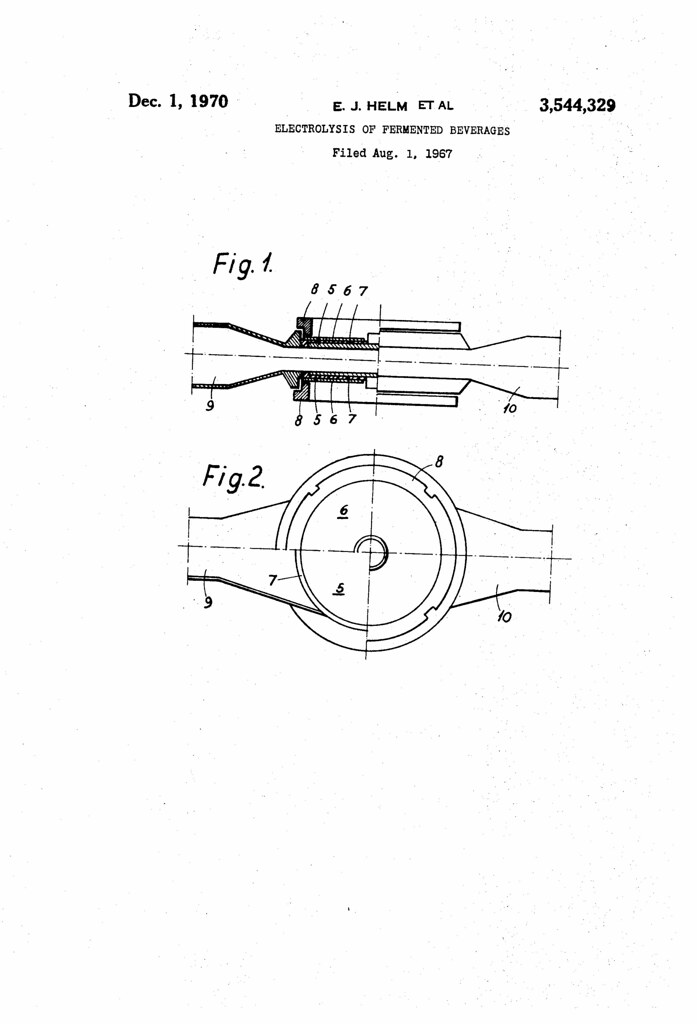
Today in 1965, US Patent 3212854 A was issued, an invention of Mohd Akhtar and Max William Betts, for their “Estimate of Hop Bitter Substance in Beer.” There’s no Abstract, although in the description it includes this summary:

This invention relates to the extraction of substances which impart the distinctive bitter taste to beer and to their estimation.

In this specification by hop bitter substances we mean all isohumulones, and humulones as well as humulinic and isohurnulinic acids as well as any other substances which may contribute to the bitter taste of been In this specification by the term beer (except where otherwise stated) we mean hopped wort or beer or any other liquid used in a brewing process whose hop bitter content is required to be known. We also intend the term beer to include any beer in the complete range from light beers such as lagers to heavy beers such as stouts.

The percentage of hop bitter substances in hops varies sufficiently to affect the bitterness of a beer, but until recently no satisfactory chemical method for estimating hop bitter substances was known. Therefore, to keep the bitterness of a beer produced constant, experts had to taste it during the brewing process and advise on what additions were needed. This not only made the product dependent on human judgment but also necessitated brewing beer in batches.

According to the present invention a process for estimating the hop bitter substances in beer comprises passing beer through a water-insoluble solvent for the hop bitter substances, in such a manner that drops of beer are formed, said drops moving at a velocity less than that at which an emulsion is formed but at a velocity sufficient “ice to cause turbulence inside the drops of beer so that more than 60 percent of the hop bitter substances passes from the beer to said water-insoluble solvent, continuously supplying and removing said water-insoluble solvent and estimating the percentage of hop bitter substances in the water-insoluble solvent removed.

The percentage of hop bitter substances in the water insoluble solvent removed may be estimated by any convenient method. We prefer to use an ultra violet spectrophotometer to measure the absorption of the solution of the hop bitter substances. The solution in the water insoluble solvent may be used direct or the hop bitter substances may be extracted into an alkali and then estimated in an ultra violet spectrophotometer.

In order to improve the partition coefficient of the hop bitter substances between the beer and the water-insoluble solvent, the beer is preferably acidified, prior to undergoing the process of the present invention. The preferred acids used are sulphuric acid or hydrochloric acid. We have found that to get the best results the pH of the beer solution should be less than about 3.5.

A large number of water-insoluble organic solvents effectively extract hop bitter substances from beer, but considerable quantities of accompanying materials may also be extracted which interfere with the subsequent spectrophotometric measurement. Hydrocarbon solvents such as light petroleum, hexane or iso-octane extract a relatively low amount of these interfering substances compared with extractions using chloroform or diethyl ether. Preferably the water-insoluble solvent used is optically suitable iso-octane.

The beer (here the term beer is used to exclude hopped wort which is already degassed) must be thoroughly degassed by any convenient method.

The peak optical density of a neutral solution of hop bitter substances and water-insoluble solvent occurs at 275 An alkaline solution of hop bitter substances and water-insoluble solvent has a peak optical density at 255 We prefer to carry out the ultra violet spectrophotometer analysis on an alkaline solution, since the interference of any background effect is reduced at this wavelength, and also because the lamps for generating this wavelength generally have a much longer life than those used for generating a wavelength of 275 ,u.

A method of making the solution of hopped bitter substances alkaline is to add aqueous alkali, for example caustic soda, to the solution followed by mixing. We prefer to pass this mixture to a separator, for example a gravity separator, whereupon pure or nearly pure water insoluble solvent is separated leaving a solution of hop bitter substances and alkali to be passed to the ultra violet spectrophotometer. If necessary further alkali may be added after the separation step.

The temperature at which the extraction takes place will of course have an effect on the partition coefficient of the hop bitter substances between beer and the water insoluble solvent, however, we have found it quite convenient to operate the process at room temperature.

Previous methods of extracting hop bitter substances from beer have involved the use of a counter-current flow column. We have found that substantially the same percentage of hop bitter substances can be extracted by using the process of our invention by using a comparatively short chamber which we call a jet chamber. A jet chamber of as short as 2 inches has been found to have an extraction efficiency of the same order as that obtained by using a counter-current flow column over 8 feet long. However, we prefer to use a jet chamber 3 inches to 4 inches long, especially when extracting from a stout.

Instead of operating on the counter-current flow principle our extraction process depends on the turbulence created in the beer droplets by the velocity with which they emerge from the orifices into the jet chamber and pass through the water-insoluble solvent. must be very carefully regulated. If, for instance, the beer droplets have a Reynolds number of above about 2,000, cavitation will occur in the water-insoluble solvent and an emulsion will be formed. This emulsion as previously stated is very difficult to break and its formation must be prevented, hence the beer droplets must initially have a Reynolds number below about 2,000. On the other hand, if the velocity of the beer drops is too low, only the beer at the surface of the beer drops will ever be in contact with the water-insoluble solvent and all the hop bitter substances in the centre of the drops will remain in the beer. The velocity of the drops must therefore be high enough to create turbulence inside the said drops. By turbulence in this context we mean that there is a continuous circulation of beer inside the drops to and from the surface of said drops. This will result in equilibrium, as defined by the partition coefficients of the hop bitter substances between beer and the water insoluble solvent, being approached very rapidly. As far as we can gather turbulence occurs inside the beer drops to a useful degree for our purposes provided that the drops have a Reynolds number of over 70.

Any method of creating drops and passing them at a suitable velocity, as defined above, through a water insoluble solvent may be used in the process of this invention. For example the beer may be passed into the water-insoluble solvent through a jet head containing one or more jets. Another method which may be employed is to pass a stream of beer substantially towards the centre of a rapidly rotating plate immersed in the water-insoluble solvent which sends drops of beer outwards from its circumference.

It is not necessary to obtain 100 percent extraction of the hop bitter substances from beer in order to obtain a useful result, provided the process results in a substantially similar percentage of the hop bitter substances being extracted every time a beer containing approximately the same percentage of hop bitter substances, for example a stout, is passed through the apparatus.

If the beer is passed through a small jet it is essential that the beer does not contain any particles of solid matter having a diameter of over about half the diameter of the orifices used, otherwise the orifices are likely to become blocked easily. The particles in the beer may be removed by any convenient filtering process, for example by centrifuging or by using a mesh filter.

Untitled
Untitled

Filed Under: Beers, Breweries, Just For Fun, Politics & Law, Related Pleasures Tagged With: History, Hops, Law, Patent, Science of Brewing

Anderson Valley Featured In PG&E Commercial

October 18, 2015 By Jay Brooks

PG&E avbc-new-2
So I’m watching the Mets beating the Cubs in game 2 of the NLCS and happened to look up as the commercials came on between innings, as I heard something in the voiceover that I wasn’t expecting: Anderson Valley Brewing Company. People in the Bay Area know that PG&E has a P.R. problem after a pipe blew up in a San Bruno neighborhood (on the peninsula north of Silicon Valley and south of San Francisco). The blast registered 1.1 on the Richter scale when a segment of pipe 28 feet long blew out onto the street, thrown about 100 feet and creating a crater 167 feet long and 26 feet wide, killing eight people in the process. They stonewalled after the incident, but eventually the “Public Utilities Commission fined PG&E $1.6 billion,” and there was civil litigation by many of the people directly effected by the explosion.

So for the last few years there’s been a lot of TV commercials portraying PG&E as a company that cares. A lot. A lot of ads, I mean. I don’t know if it’s been a successful campaign or not, certainly I’m not buying it and the fact that they’re still creating new ones and running them frequently suggests that not everyone has been convinced, either. Anyway, the ad I just saw during the baseball game featured Rod DeWitt, who’s the Director of Plant Engineering & Process Control for Anderson Valley Brewing, the drummer for Rolling Boil Blues Band, and an old friend. Here’s the commercial:

This is Rod giving me a tour of the brewery back in 2006

P1000409
This is the scene shown on every Anderson Valley beer label.

Filed Under: Breweries, Just For Fun, Related Pleasures Tagged With: Advertising, California, Northern California, Video

Patent No. 973087A: Equalizing Device For Beer Filtration

October 18, 2015 By Jay Brooks

patent-logo
Today in 1910, US Patent 973087 A was issued, an invention of Ferdinand Turek, for his “Equalizing Device For Beer Filtration.” There’s no Abstract, although in the description it includes this summary:

This invention relates to apparatus used in the filtration or purification of beer, and has for its object to provide means for causing a steady fiow of’beer from the chip cask and through the filter.

Untitled

Filed Under: Beers, Breweries, Just For Fun, Politics & Law, Related Pleasures Tagged With: Brewing Equipment, History, Law, Patent, Science of Brewing

Patent No. 3279534A: Percolator For A Brew Kettle

October 18, 2015 By Jay Brooks

patent-logo
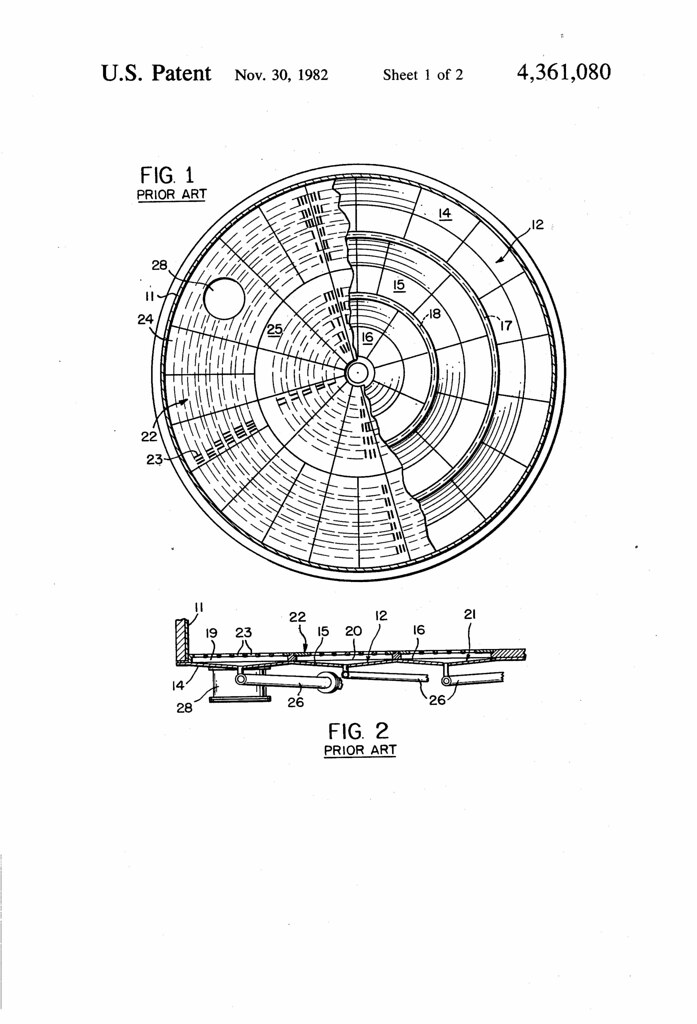
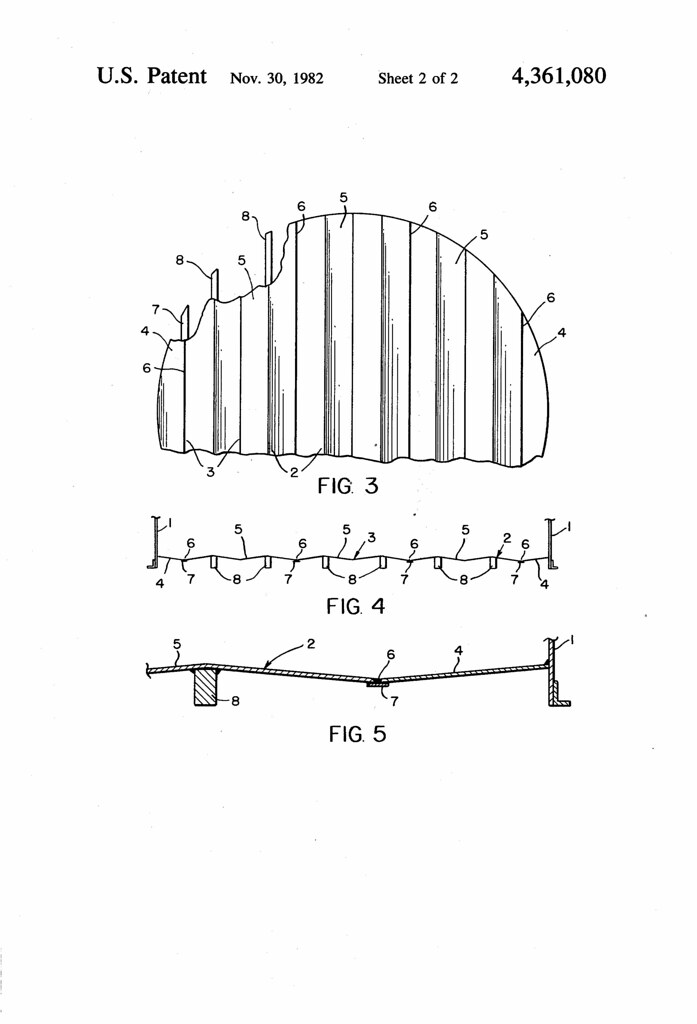
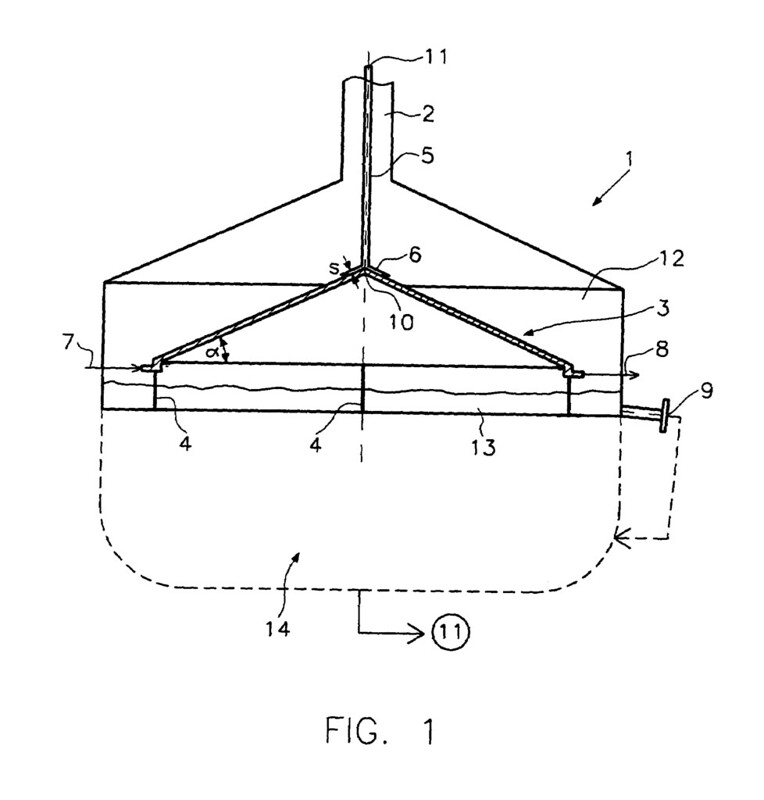
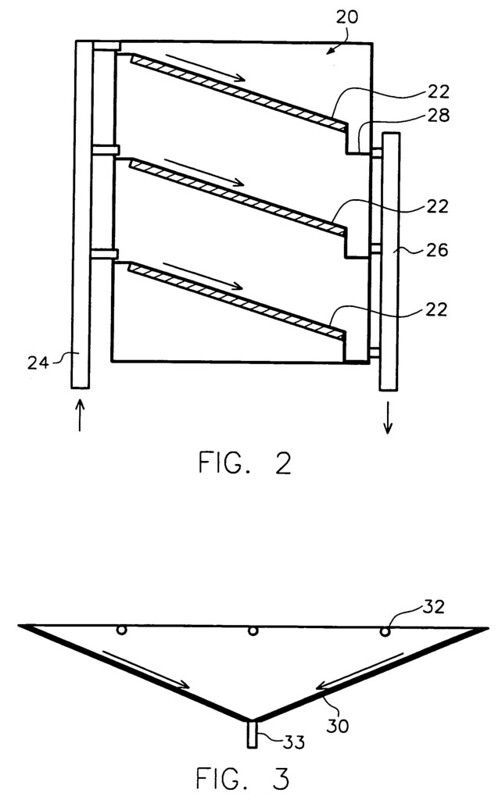
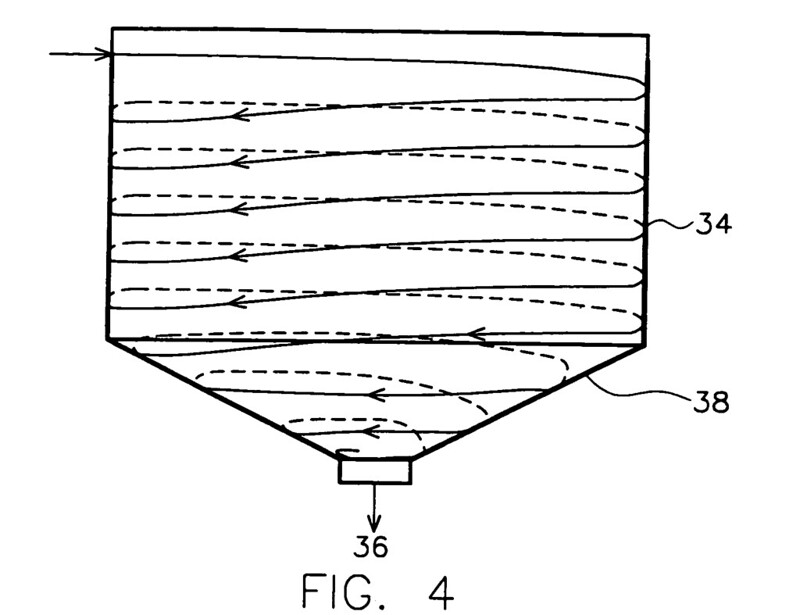
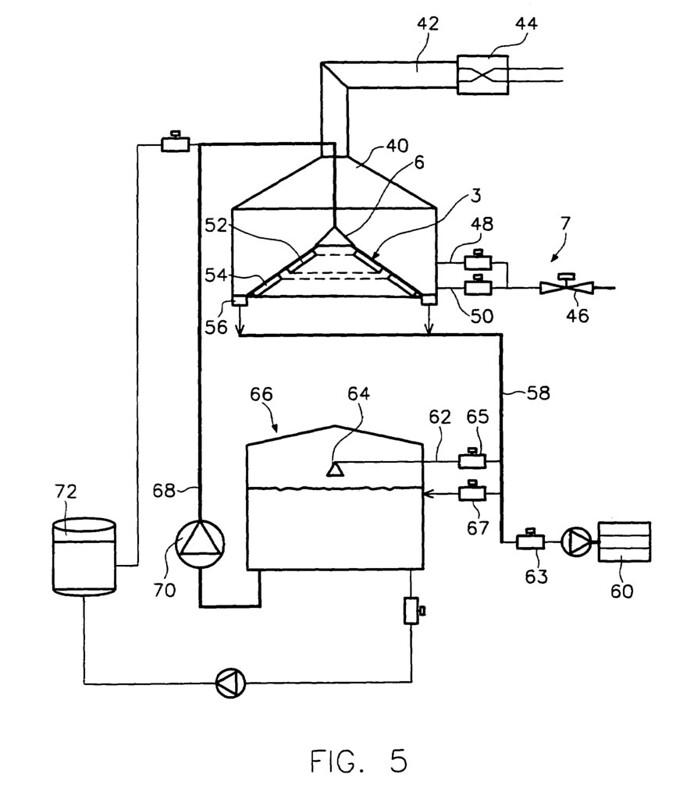
Today in 1966, US Patent 3279534 A was issued, an invention of Robert C. Gadsby, Joseph Schwaiger and Frank H. Schwaiger, assigned to Anheuser-Busch, for their “Percolator for a Brew Kettle.” There’s no Abstract, although in the description it includes this summary:

One of the principal objects of the present invention is to provide an improved percolator for brew kettles, such as are used in the brewing industry. Another object is to provide in such a percolator a plurality of flat heating sections which can be easily cleaned and replaced or repaired if necessary. Another object is to provide an improved percolator design which is shaped to distribute heat in a predetermined manner :and which is shaped so as to create a natural flow of the liquid being heated within the percolator. Another object is to provide a percolator of a design in which there is little likelihood of trapping condensate therein. Another object is to provide connectors between the relatively flat heater sections which prevent entrapment of the liquid so as to prevent the overheating of any liquid which might otherwise become entrapped.

Untitled
Untitled
Untitled

Filed Under: Beers, Breweries, Just For Fun, Politics & Law, Related Pleasures Tagged With: Brewing Equipment, History, Law, Patent, Science of Brewing

Patent No. 3765903A: Isomerised Hop Extract

October 16, 2015 By Jay Brooks

patent-logo
Today in 1973, US Patent 3765903 A was issued, an invention of Brian Clarke, Robert Hildebrand, David Lance, and Alexander White, assigned to Carton and United Breweries Ltd, for their “Isomerised Hop Extract.” Here’s the Abstract:

A process for the preparation of an isomerised hop extract for use in the flavouring of food or beverages which comprises adding to a solution of humulones or their salts a metal ion of calcium, magnesium, nickel, manganese or zinc, which metal ion forms with the humulones a metal ion-humulone complex which then precipitates from the solution. The metal ion-humulone complex is then heated in solid or paste state or in suspension or dissolved in an organic solvent to form a metal ion-isohumulone complex in high yield. The metal ion-isohumulone complex is substantially insoluble and can be used as a bittering additive, without regeneration to a soluble salt of isohumulone, by finely grinding such metal ion-isohumulone complex.

Untitled

Filed Under: Beers, Breweries, Just For Fun, Politics & Law, Related Pleasures Tagged With: History, Hops, Law, Patent, Science of Brewing

Watney’s Happy Families

October 16, 2015 By Jay Brooks

playing-cards
The other night Boak & Bailey tweeted a photo of a UK eBay listing for a card game published in the 1930s by Watney Combe Reid & Co. LTD, brewers of Watney’s Red Barrel.

One of the many things I’m obsessed with is games. Since I was a kid, I’ve played them, collected them, and even created them. It’s just one more thing to add to the ever-growing list of things about which I’m particularly geeky. So I was already familiar with the card game Happy Families, which is a fairly simple game, and is somewhat similar to “Go Fish.” But I had no idea that a brewery had made their own version of the game.

watneys-happy-families-box watneys-happy-families-back

Based on the box, it was obviously a giveaway to advertise the Watney’s brand. Intrigued, I would have bought it on the spot, except that, as Boak & Bailey noted, the “Buy It Now” price was a hefty £64.95, or about $100. Beer writing, unfortunately, doesn’t pay well enough to indulge all of my whims. Still, I wanted to know more about the game, and set out to see what I could find.

It was apparently created in England in 1851, by John Jaques II, who was also responsible for inventing “Snakes and Ladders,” “Tiddlywinks,” “Ludo” and the pub favorite “Shove Ha’penny.” It often uses a custom deck of 32 cards, although the game can be played with a standard deck of 52 cards. Cartamundi has the rules online. In the Watney’s version, the rules are printed on the back of the cardboard box:

watneys-happy-families-4

In the Watney’s version, the families are the Barrels, the Cheerilads, the Combes, the Hops, the Malts, the Reids, the Stouts, and the Watneys. According to The World of Playing Cards:

Although the 1920s was a decade of optimism after the Great War, the Great Depression made the 1930s a difficult time. In Britain unemployment was widespread. As we see from these images, the woman was the homemaker and had a hairdo, and the man worked. The generation of children who grew up in the 1930s would go on to fight in World War II. They had their share of hardships and built strong values of hard work.

Below are the 32 cards from deck:

watneys-happy-families

For two of them, they apparently didn’t have a finished card, so here’s those cards taken from the eBay listing photos.

Mrs-Reid Miss-Watney

Hopefully, I can find a less expensive deck of these cards. Great, another item to add to my Wishlist.

Filed Under: Breweries, Just For Fun, Related Pleasures Tagged With: England, Games, Great Britain, UK

Patent No. 5676369A: Method Of Playing A Brewing Game

October 14, 2015 By Jay Brooks

patent-logo
Today in 1997, US Patent 5676369 A was issued, an invention of Mark Keathon DeWeese, for his “Method of Playing a Brewing Game.” Here’s the Abstract:

A method of playing a board game related to brewing procedures and the science of brewing. The game includes a board having an endless path divided into a plurality of continuous spaces including a starting space and spaces with indicia upon them corresponding to hops, barley, yeast, brewing science and speciality beer styles. At least two players start by moving their playing pieces along a path according to a roll of the die. Upon landing on a space, a player must pick a card corresponding to that space. The card may require the player to correctly answer a question or may award or hinder his progress in the game. If the card requires an answer, which is correctly answered, the player is allowed to roll again and continue around the board. Upon passing the starting point the player is awarded a piece of brewery equipment. Players continue collecting brewing equipment while moving around the board. Play is terminated when a player receives all of the equipment necessary to operate a brewery.

The finished game was released. I have a copy of it, though I don’t recall where I got it. I think I only tried it one time, and I honestly don’t remember how it played, which I suppose in and of itself isn’t a ringing endorsement.
Untitled
Untitled

Untitled Untitled

Filed Under: Beers, Breweries, Just For Fun, Related Pleasures, Reviews Tagged With: Games, History, Law, Patent

Patent No. 438328A: Apparatus For Brewing

October 14, 2015 By Jay Brooks

patent-logo
Today in 1890, US Patent 438328 A was issued, an invention of William J. Seib, for his “Apparatus For Brewing.” There’s no Abstract, although in the description it includes this summary:

My invention relates to an improvement in apparatus for use in collecting, condensing, and storing the essential oil and aromatic properties of hops to save them, and which is, therefore, especially serviceable for the particular purpose for which I have invented it namely, that of saving the aforesaid properties of the hops while they are being boiled with the wort in the manufacture of beer.

My present invention is particularly designed to afford an improvement in the construction of an apparatus for the same purpose as that set forth in the application of Carl Hoefner for Letters Patent of the United States No. 301,482, allowed on the 22d day of March, 1890. The construction of the apparatus therein described necessitates that the vapor from the kettle shall pass to the condenser and return by the same course to the storage-reservoir, which impairs the effectiveness of the condensation, since the liquid thereof has to pass under the influence of the rising heated vapor to gain access to the receptacle.

My object is to provide an apparatus for the purpose stated whereby this objection shall be obviated; and to this end my invention consists in the construction hereinafter set forth and claimed.

Untitled

Filed Under: Beers, Breweries, Just For Fun, Politics & Law, Related Pleasures Tagged With: Brewing Equipment, History, Law, Patent, Science of Brewing

SABMiller and Anheuser-Busch InBev Reach “Agreement In Principle”

October 13, 2015 By Jay Brooks

abib sabmiller
While most of us were sleeping, it appears SABMiller and Anheuser-Busch InBev were quite busy, and announced this morning SABMiller and Anheuser-Busch InBev [Reach] Agreement in principle and extension of PUSU. The New York Times has an analysis of the deal, or you can read the entire Press Release from SABMiller:

ABI-SABM

LONDON–The Boards of AB InBev (Euronext: ABI) (NYSE: BUD) and SABMiller (LSE: SAB) (JSE: SAB) announce that they have reached agreement in principle on the key terms of a possible recommended offer to be made by AB InBev for the entire issued and to be issued share capital of SABMiller (the “Possible Offer”).

Terms of Possible Offer

Under the terms of the Possible Offer, SABMiller shareholders would be entitled to receive GBP 44.00 per share in cash, with a partial share alternative (“PSA”) available for approximately 41% of the SABMiller shares.

The all-cash offer represents a premium of approximately 50% to SABMiller’s closing share price of GBP 29.34 on 14 September 2015 (being the last business day prior to renewed speculation of an approach from AB InBev).

The PSA consists of 0.483969 unlisted shares and GBP 3.7788 in cash for each SABMiller share, equivalent to a value of GBP 39.03 per SABMiller share on 12 October 2015, representing a premium of approximately 33% to the closing SABMiller share price of GBP 29.34 as of 14 September 2015. Further details of the PSA are set out below.

In addition, under the Possible Offer, SABMiller shareholders would be entitled to any dividends declared or paid by SABMiller in the ordinary course in respect of any completed six-month period ended 30 September or 31 March prior to completion of the possible transaction, which shall not exceed USD 0.2825 per share for the period ended 30 September 2015 and a further USD 0.9375 per share for the period ended 31 March 2016 (totalling USD 1.22 per share) and shall not exceed an amount to be agreed between AB InBev and SABMiller in respect of periods thereafter (which shall be disclosed in any announcement of a firm intention to make an offer).

The Board of SABMiller has indicated to AB InBev that it would be prepared unanimously to recommend the all-cash offer of GBP 44.00 per SABMiller share to SABMiller shareholders, subject to their fiduciary duties and satisfactory resolution of the other terms and conditions of the Possible Offer.

Antitrust and reverse break fee

In connection with the Possible Offer, AB InBev would agree to a “best efforts” commitment to obtain any regulatory clearances required to proceed to closing of the transaction. In addition, AB InBev would agree to a reverse break fee of USD 3 billion payable to SABMiller in the event that the transaction fails to close as a result of the failure to obtain regulatory clearances or the approval of AB InBev shareholders.

Pre-conditions

The announcement of a formal transaction would be subject to the following matters:

  1. a) unanimous recommendation by the Board of SABMiller in respect of the all-cash offer, and the execution of irrevocable undertakings to vote in favour of the transaction from members of the SABMiller Board, in a form acceptable to AB InBev;
  2. b) the execution of irrevocable undertakings to vote in favour of the transaction and to elect for the PSA from SABMiller’s two major shareholders, Altria Group, Inc. and BevCo Ltd., in each case in respect of all of their shareholding and in a form acceptable to AB InBev and SABMiller;
  3. c) the execution of irrevocable undertakings to vote in favour of the transaction from AB InBev’s largest shareholders, the Stichting Anheuser-Busch InBev, EPS Participations SaRL and BRC SaRL in a form acceptable to AB InBev and SABMiller;
  4. d) satisfactory completion of customary due diligence; and
  5. e) final approval by the Board of AB InBev.

The Board of AB InBev fully supports the terms of this Possible Offer and expects (subject to the matters above) to give its formal approval immediately prior to announcement.

AB InBev reserves the right to waive in whole or in part any of the pre-conditions to making an offer set out in this announcement, other than c) above which will not be waived.

The conditions of the transaction will be customary for a combination of this nature, and will include approval by both companies’ shareholders and receipt of antitrust and regulatory approvals.

In view of the timetable for obtaining some of these approvals, AB InBev envisages proceeding by way of a pre-conditional scheme of arrangement in accordance with the Code.

The cash consideration under the transaction would be financed through a combination of AB InBev’s internal financial resources and new third party debt.

Further details of the PSA

The PSA comprises up to 326 million shares, which will be available for approximately 41% of the SABMiller shares. These shares would take the form of a separate class of AB InBev shares (the “Restricted Shares”)[1], with the following characteristics:

  • Unlisted and not admitted to trading on any stock exchange;
  • Subject to a five-year lock-up from closing;
  • Convertible into AB InBev ordinary shares on a one for one basis after the end of that five year period;
  • Ranking equally with AB InBev ordinary shares with regards to dividends and voting rights; and
  • Director nomination rights.

SABMiller shareholders who elect for the partial share alternative will receive 0.483969 Restricted Shares[2] and GBP 3.7788 in cash for each SABMiller share.

Extension of the PUSU deadline

In accordance with Rule 2.6(a) of the Code, AB InBev was required, by not later than 5.00 pm on 14 October 2015, to either announce a firm intention to make an offer for SABMiller in accordance with Rule 2.7 of the Code or announce that it does not intend to make an offer for SABMiller, in which case the announcement will be treated as a statement to which Rule 2.8 of the Code applies.

In accordance with Rule 2.6(c) of the Code, the Board of SABMiller has requested that the Panel on Takeovers and Mergers (the “Panel”) extends the relevant deadline, as referred to above, to enable the parties to continue their talks regarding the Possible Offer. In the light of this request, an extension has been granted by the Panel and AB InBev must, by not later than 5.00 pm on 28 October 2015, either announce a firm intention to make an offer for SABMiller in accordance with Rule 2.7 of the Code or announce that it does not intend to make an offer for SABMiller, in which case the announcement will be treated as a statement to which Rule 2.8 of the Code applies. This deadline will only be extended with the consent of the Panel in accordance with Rule 2.6(c) of the Code.

AB InBev reserves the following rights:

  1. a) to introduce other forms of consideration and/or to vary the composition of consideration;
  2. b) to implement the transaction through or together with a subsidiary of AB InBev or NewCo or a company which will become a subsidiary of AB InBev or NewCo;
  3. c) to make an offer (including the all-cash offer and PSA) for SABMiller at any time on less favourable terms:

(i) with the agreement or recommendation of the Board of SABMiller;
(ii) if a third party announces a firm intention to make an offer for SABMiller on less favourable terms; or
(iii) following the announcement by SABMiller of a whitewash transaction pursuant to the Code; and

  1. d) to reduce its offer (including the all-cash offer and PSA) by the amount of any dividend that is announced, declared, made or paid by SABMiller prior to completion, save for ordinary course dividends declared or paid prior to completion, which shall not exceed USD 0.2825 per share for the period ended 30 September 2015 and a further USD 0.9375 per share for the period ended 31 March 2016 (totalling USD 1.22 per share) and shall not exceed an amount to be agreed between AB InBev and SABMiller in respect of periods thereafter (which shall be disclosed in any announcement of a firm intention to make an offer).

The announcement does not constitute an offer or impose any obligation on AB InBev to make an offer, nor does it evidence a firm intention to make an offer within the meaning of the Code. There can be no certainty that a formal offer will be made.

A further announcement will be made when appropriate.

biz-beer-merger

Filed Under: Breweries, News, Politics & Law Tagged With: Anheuser-Busch InBev, Business, International, Press Release, SABMiller

Kurt Widmer Announces His Retirement

October 12, 2015 By Jay Brooks

widmer
Kurt Widmer, the older brother in Widmer Brothers Brewing, announced today he will be retiring at the end of 2015 from the day-to-day work with the business he founded with his brother Rob in 1984, 31 years ago.

Here’s the press release from the Craft Brew Alliance:

Kurt R. Widmer, 63, co-founder of Widmer Brothers Brewing, announced today that he will retire from Craft Brew Alliance, Inc. (“CBA”) and will be leaving CBA’s Board of Directors at the end of the year. At that time, he will assume the honorary title of Chairman Emeritus. Mr. Widmer has served as Chairman of the Board since Craft Brew Alliance was formed in 2008 through the merger of pioneering Pacific Northwest craft brewing companies Redhook Brewery and Widmer Brothers Brewing. Previously, Mr. Widmer served as President, Chief Executive Officer and Chairman of the Board of Widmer Brothers Brewing Company from 1984 until 2008.

Mr. Widmer will remain in his role through December 31, 2015 to support the transition as CBA’s Board of Directors engages in the process of selecting a new Chairperson.

“Since my brother Rob and I founded Widmer Brothers Brewing over 31 years ago, this extraordinary industry that we helped create has grown and evolved in ways I couldn’t even imagine,” said Mr. Widmer. “Many of us who set the foundation for today’s booming craft beer market are thinking about the next chapter in our lives, and my wife Ann and I have been discussing the fact that there’s still a lot we want to do. So while I’ll miss walking into my office at the brewery every day, I’m admittedly looking forward to more time with my family and doing more of what I love to do – whether it’s traveling around the world or home brewing in the basement.”

He continued, “In terms of timing, I feel really good about where CBA is today. Looking back on how CBA has grown from two craft beer companies to a powerful alliance of great beers, brands, breweries and partners, I couldn’t be more confident in the future. The focus, expertise, and vision of the leadership team, under the helm of Andy Thomas, are further proof that CBA, its people, and its shareholders are in great hands. People who know me will probably not believe that I’m stepping away from Widmer Brothers and CBA. As a Widmer Brother, I will always look forward to that next innovative collaboration or a chance to connect with Widmer fans over a pint of Hefe at a local account.”

Kurt and Rob Widmer co-founded Widmer Brothers Brewing in Portland, Oregon in 1984 with help from their father Ray. They are among a handful of brewers in the United States credited with creating a universally recognized new style in 1986 with Hefe, the original American-style Hefeweizen and the #1 selling craft beer in Oregon.

“I’ve been fortunate to meet a number of truly remarkable people in this industry, and Kurt Widmer is definitely at the top of the list,” said Andy Thomas, Chief Executive Officer, CBA. “From his role in creating the craft beer category, to his foresight and vision in bringing together CBA to secure his brands’ route to market — and the adversity he faced as a direct result — to the role he continues to play as an impassioned advocate of our industry, Kurt has made a profound impact on many of us. CBA wouldn’t be CBA without Kurt Widmer, and I am grateful for his support and confidence as we continue forward.”

IMG_4085
Kurt (center) with Gary Fish and Fred Eckhardt at the Horse Brass for Don Younger’s memorial in 2011.

Filed Under: Breweries, News Tagged With: Business, Oregon

« Previous Page
Next Page »

Find Something

Northern California Breweries

Please consider purchasing my latest book, California Breweries North, available from Amazon, or ask for it at your local bookstore.

Recent Comments

  • Bob Paolino on Beer Birthday: Grant Johnston
  • Gambrinus on Historic Beer Birthday: A.J. Houghton
  • Ernie Dewing on Historic Beer Birthday: Charles William Bergner 
  • Steve 'Pudgy' De Rose on Historic Beer Birthday: Jacob Schmidt
  • Jay Brooks on Beer Birthday: Bill Owens

Recent Posts

  • Beer Birthday: Rod DeWitt August 4, 2026
  • Historic Beer Birthday: Julius Deglow August 4, 2026
  • Beer In Ads #5310: From Behind Heute Bock August 3, 2026
  • Historic Beer Birthday: Emanuel Bernheimer August 3, 2026
  • Historic Beer Birthday: Ellis Wainwright August 3, 2026

BBB Archives

Feedback

Head Quarter
This site is hosted and maintained by H25Q.dev. Any questions or comments for the webmaster can be directed here.