Brookston Beer Bulletin

Jay R. Brooks on Beer

  • Home
  • About
  • Editorial
  • Birthdays
  • Art & Beer

Socialize

  • Dribbble
  • Email
  • Facebook
  • Flickr
  • GitHub
  • Instagram
  • LinkedIn
  • Pinterest
  • RSS
  • Twitter
  • YouTube

Powered by Genesis

Urthel is Cooking in San Francisco

December 8, 2006 By Jay Brooks

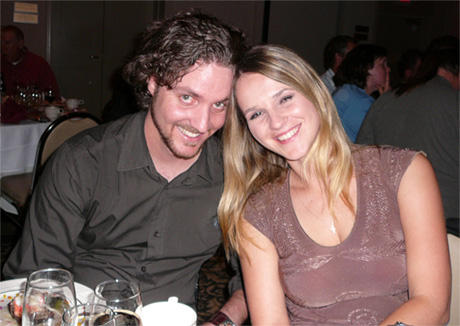
Save the date! Beer Chef Bruce Paton’s next beer dinner will feature brewster Hildegard van Ostaden and the Urthel beers of Brouwerij de Leyerth from Belgium. Hildegard made the first Imperial IPA in Belgium and as far as I know the first double outside of the U.S. It will be another four-course dinner, though Bruce is still working out the menu. I’ll get it up as soon as it’s available. It will be held at the Cathedral Hill Hotel on Monday, January 8, beginning with a reception at 6:30 p.m. Call 415.674.3406 for reservations. Make your reservations soon, because this dinner should fill up fast and you won’t want to miss this one. I met Bas and Hildegard in Denver a couple of years ago and they’re wonderful people, who make some very excellent beers. They’re part of a new breed of Belgian brewers who have taken some of their inspiration from their American counterparts.
 

Hildegard and Bas van Ostaden, owners of the Belgian-based Brouwerij de Leyerth.
 

1.8

Dinner with the Brewmaster: Urthel

Cathedral Hill Hotel, 1101 Van Ness Avenue, San Francisco, California
415.674.3406 [ website ]

Filed Under: Food & Beer Tagged With: Announcements, Belgium, California, San Francisco

Cooking with Beer

December 6, 2006 By Jay Brooks

There’s a nice, short little article with some suggestions on cooking with beer this holiday season in today’s News Tribune from Tacoma, Washington. There’s nothing particularly new there, but it’s certainly nice to see the effort. Anything that helps spread the word of how well beer works with food is appreciated.

Filed Under: Food & Beer, News Tagged With: Mainstream Coverage

Cellerman?

November 25, 2006 By Jay Brooks

In award-winning Philadelphia beer writer Don Russell’s Joe Sixpack column Friday, he argues persuasively that the term “beer sommelier” is oxymoronic because the word “sommelier” by definition refers specifically to wine. He’s right about that, of course. Here’s the dictionary definition:

a waiter, as in a club or restaurant, who is in charge of wines.

“sommelier.” Dictionary.com Unabridged (v 1.0.1). Based on the Random House Unabridged Dictionary, © Random House, Inc. 2006.

Other dictionaries also mention wine specifically in their definitions, too. It’s clear the word is clumsy at best. It’s only usefulness stems from being a word most people already understand, at least in wine terms.

But Russell also argues that we should not borrow from the wine industry’s terms, which he describes as “the winofication of beer.” I heartily agree with that sentiment. It seems a shame that wine analogies are often so effective and it’s for that reason I’m guilty of using them, too. But we should be able to describe beer using its own vocabulary.

Don’s suggestion to replace beer sommelier with the term Cellarman, which has a rich history in the brewing world. I’m not quite convinced that’s the right word, but he’s definitely on to something and like the direction he’s taking the debate.

Filed Under: Editorial, Food & Beer

No Fish: The Dogfish Head Beer Dinner

November 12, 2006 By Jay Brooks

The latest beer dinner from beer chef Bruce Paton took place Friday evening at the Cathedral Hill Hotel in San Francisco. The delicious four-course dinner was paired with the beers of Dogfish Head Brewing from Milton, Delaware. Owner Sam Calagione was at the dinner to talk about his beers. Another great night with beer and food.

Sam Calagione tells the assembled crowd or over 80 people about his philosophy of brewing and about each of the five beers poured Friday night. There was no fish on the menu, however, and instead we enjoyed poached foie gras with caviar, duck parsnip nodle pho with charred ginger broth, and angus short ribs with lobster medallions.

Table-mates Vinnie and Natalie Cilurzo from Russian River Brewing.

And Justin and Daniella from the Brewing Network.

The dessert was a delicious Ginger Scented Banana Custard with Citrus Caramel Sauce paired with Dogfish Head’s newest historical beer, Chateau Jiahu, a beer based on a 9,000 beverage discovered in pottery jars found in the Neolithic villiage of Jiahu in Northern China. It was determined to be a mixed fermented beverage of rice, honey and fruit.

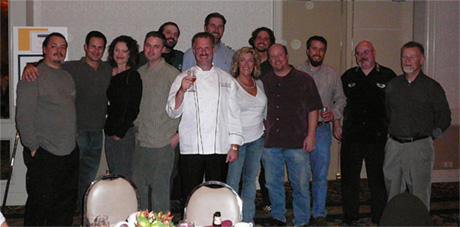
Brewers and beer people at the Dogfish Head dinner.

Sam Calagione and beer chef Bruce Paton, our hosts for the evening.

The next beer dinner should be sometime in January. Watch for more details here or on Bruce Paton’s website, the Beer Chef.

Filed Under: Events, Food & Beer Tagged With: California, Eastern States, Photo Gallery, San Francisco

Black Strap Stout, Black Strap Cookies

November 4, 2006 By Jay Brooks

Today is BridgePort Brewing’s 22nd anniversary so I thought it was time to pull out the cookies they sent me that are made using their Black Strap Stout. This is the second year that Cougar Mountain cookies has made the “cocoa-based cookie with chocolate chunks” for their “flavor of the month.”

The stout is inky black with a thick tan head and subtle aromas of ginger, molasses and milk chocolate. The beer slides smoothly on the tongue with flavors of bitter chocolate, molasses and malt and just a touch of sweetness. The cookies are dry, soft and chewy with bursts of chocolate in the chunks. The chocolate notes and molasses in the beer perfectly compliments the cookies and even dipping them in the beer works nicely. The interplay of dry and wet, not surprisingly, leaves you wanting one and then the other almost as a tonic, but it has the effect of making the combination highly addictive.

From the combined press release:

The cocoa-based cookie with chocolate chunks accentuates the flavor profile found in BridgePort’s Black Strap Stout, specifically chocolate, molasses, and coffee. The alcohol bakes out of the cookie, but the flavors found in the beer remain, adding considerable interest to an already tasty cookie.

The combination is not as odd as it might seem. For years, beer lovers have explored the extraordinary flavors that come from combining malty, craft-brewed beers with fine chocolates and decadent desserts. Stout floats are dessert mainstay in brewpubs across the nation.

More from the press release

According to David Saulnier, president of Cougar Mountain Baking Co., the subtleties and complexities of the cookie’s flavor appeal to an adult audience. “Last year when we first introduced the Double Chocolate Stout, we had quadruple the normal number of customer comments, nearly all of those being positive. People were wowed by such an original flavor, and they thought the resulting cookie was great!”

Saulnier, who founded Cougar Mountain Baking Co. in 1988, enjoys collaborating with other Northwest companies who share his philosophy of producing high-quality, handcrafted products. He has been a fan of BridgePort Ales for some time, and the alliance between the two companies seemed a natural fit.

As Oregon’s oldest craft brewery, BridgePort has evolved over the past 22 years from a microbrewery to a regional leader in the craft brewing market, while remaining faithful to its commitment to producing high-quality, innovative craft ales that are true to their heritage. Its Black Strap Stout features a malty, caramel flavor up front with a distinctive dry-roasted bitterness in the finish. A generous dose of Northwest hops mingles with the sweetness of black strap molasses to yield a full-bodied ale that pours with a rich, creamy head.

Cougar Mountain’s Flavor of the Month item has been in existence for 15 years, and the company uses it as a way to experiment with flavors, take advantage of seasonal ingredients, and have fun. Like all of Cougar Mountain’s cookies, Double Chocolate Stout does not contain any hydrogenated oils or trans fats. Cougar Mountain Gourmet Cookies come eight cookies to a box, which is made from 100% recycled paper. Each of the regular varieties is named for Seattle-area neighborhoods, parks or landmarks. The cookies may also be purchased individually at select locations.


Filed Under: Food & Beer, News, Reviews Tagged With: Oregon, Portland

What’s That Smell? Fermentation or Incompetence?

November 3, 2006 By Jay Brooks

newspaper
The “smell of fermentation?” More like the smell of incompetence, as respected wine writer Thom Elkjer bumbles wildly through a new beer article in today’s San Francisco Chronicle, apparently angling to become the Sergeant Schultz of beer. His first impression upon entering the Russian River Brewery is the stainless steel tanks and the “smell of fermentation.” When I read his article, the only scent I get is of his ignorance.

The article is titled Artisan brewers thrive in the Wine Country and in it he profiles Russian River Brewing Co. of Santa Rosa and Anderson Valley Brewing Co. of Boonville, and also talks more generally about craft beer in the Bay Area.

He begins by sampling Russian River Brewing’s wonderfully complex Damnation and spits out the sample into the floor drain, thus missing half the beer’s flavor! That’s only the first outrage in what I believe quite possibly may be the most ignorant piece of writing on the subject of beer that I’ve read all year. I’m glad that the Chronicle is once more writing about beer after Linda Murphy, the one wine writer that knew something about it, left in August. But there are so many mistakes and insults in Elkjer’s feature article that I almost feel embarrassed for him. And the Chronicle likewise should feel embarrassed for doing such a disservice to its many beer-loving readers.

There are so many things to call attention to in the article that I could spend all day on it, but I’ll confine myself to just a few and leave it to others to discover the rest.

He claims that early craft brewers originally “went into the commercial business to make a fresh, draft version of their favorite bottled import.” But most early craft brewers made a pale ale or amber ale as their flagship beer, while a majority of imports were still lagers. To be sure there were some pale ales — Bass Ale springs to mind — but they were a relative minority. Imports certainly “inspired” many early brewers, but for a variety of reasons making ales was a much more cost effective way to start a microbrewery in those days.

Elkjer goes on to describe “stout and ale” as some of the “time-honored categories” to describe “their beers — just as winemakers do.” I’m pretty sure wines are usually described by the primary grape or the region (appellation) they come from. Wouldn’t that mean that Sierra Nevada Pale Ale should be called “Cascade Ale.” And when did ale and stout become distinct categories? They’re not, of course, and I can’t even bring myself to insult my readers by explaining this.

After reporting how Vinnie Cilurzo is embracing Brettanomyces to create many of Russian River’s bolder beers, unlike winemakers who generally hate the stuff, he says its odor reminds “most people of barnyard manure.” So is he saying Vinnie’s beer using that yeast tastes or smells “shitty?” I think the more common description of Brett is “horse blanket” or similar allusions and while I accept that many people find it off-putting, I’ve never considered scatological descriptors. I think that’s a little insulting, frankly.

Elkjer next explains that Russian River is not the only brewer making this type of beer, and mentions Tomme Arthur, too, before dropping this bombshell. “There are, for example, more than 400 different beers made at Belgium’s Trappist monasteries.” Wow, that’s a lot of different beers made at a grand total of seven — count ’em — seven Trappist breweries in the world (6 in Belgium, 1 in The Netherlands). Some very simple fact-checking would likely have revealed this error, but it suggests a lack of follow-up or research, along with a careless disregard for the subject matter.

The author then talks about the history of hops in northern California’s past, explaining how hops were once “roasted” throughout the region. I don’t know what they did with the hops after they roasted them — assuming they didn’t catch on fire — because they’d be all but useless in making beer. While I can’t say some hop pellets have never been put in a frying pan for a few seconds to get some different qualities out of the hops in dry-hopping by some eccentric brewer, generally speaking nobody in their right mind roasts hops. There are far better and safer ways to get roasted flavors in your beer. But to Thom, “[r]oasted hops are one of the two essential ingredients in most beer (the other is malted barley).” I’m not sure what happened to the yeast and water, perhaps they’re not as essential?

And apparently it’s not just beer that Elkjer is ignorant about, he’s not so hot at math, either. In discussing the alcohol (a.b.v.) in Russian River’s beers, he claims Deification at 6.35% is “around twice the average of mass-produced beers.” Budweiser weighs in at 4.9%. You do the math, does that add up? He later refers to a 5.5% beer as a “session beer,” which he also defines as a beer to drink “during a long meal.” I didn’t realize “length of meal time” was one of the criteria you should use in choosing the right beer pairing for your dinner.

Later, he reveals the target demographic for “session beers” are “women as well as immigrants” and that’s who microbreweries are focusing on appealing to. Now, do female immigrants want a beer that’s twice as low-alcohol since they’re both “women as well as immigrants” or are they just twice as likely to want one? It’s amazing how dismissive and insulting that sounds, but frankly that’s how the whole things strikes me. This just seems to be written by someone who all but hates what he’s writing about.

But there’s more condescension around the next corner where Elkjer writes off brewpub food as “simple, hearty and well matched with the beverages,” implying, of course that the “beverages” are simple, too. Oh, and if you spend the entire day drinking beer, by all means learn from the adults, your betters, and, as Elkjer suggests, “do what the wine tasters do: rent a limousine or choose a designated driver.” Thanks Thom, that would never have occurred to me, what a thoughtful suggestion. We beer folk are such simple people, we sure do need your sophisticated guidance, by golly.

Elkjer ends his article, at least online (in the paper I believe it’s probably a sidebar), with a list and short description of wine country craft breweries, though curiously he omits Dempsey’s in Petaluma, among others. Here are just a couple of his comments:

Bear Republic has “a goofy gift shop.”

Calistoga Inn Restaurant & Brewery is a “real restaurant that happens to make 400 barrels of beer.” So the other brewpub restaurants aren’t “real?”

Now apparently Thom Elkjer is a very well-respected wine writer who writes for numerous wine magazines and newspapers, including, according to his biography on WineCountry.com, “Wine Spectator, Wine Enthusiast, Wine Country Living, VINE Napa Valley, and WINE.” He’s also written several books about wine. But from some simple searching, I can’t find another instance where he’s written about beer before and, if that’s true, boy does it show. But as some of my own critics have pointed out, the fault lies more properly with the editors, the publication handing out the assignment rather than the author. And that certainly may be true to a certain extent. Because I, too, would probably not turn down an assignment that paid well in a prominent publication, even if they asked me to write about something outside my area of expertise. But I also would have done a lot of research, fact-checked the piece to death, and asked people who did know the subject to look at it first. I would have gone over it with a fine tooth comb if for no other reason than simply to not embarrass myself and also insure that it wasn’t the last assignment I ever got from the publication.

Elkjer’s piece, on the other hand, is so riddled with simple, laughable errors and insulting, dismissive rhetoric that I’m truly perplexed that his article moved from the editor’s desk to the copy editor and on the printing press without somebody noticing something might be amiss. I know these are busy people. I know they have deadlines. I know they don’t know jack about beer. But how do you miss insulting “women and immigrants” by reinforcing stereotypes and suggesting they both prefer low-alcohol beers. I need look no farther than my own wife to know how wrong that stereotype is. And by now isn’t it fairly common knowledge that while wine tasters spit out the samples, beer aficionados do not?

This is or should be, I think, a source of much embarassment to the San Francisco Chronicle. Their newspaper is smack dab in the middle of one the most exciting places on Earth for craft brewing, where there are countless innovations taking place right under their noses. Yet the largest news organization in the Bay Area remains blissfully ignorant of what’s going on all around them, or even that it’s going on at all. More and more people are discovering craft beer in all its wonderfully varied diversity despite the Chronicle’s best efforts to keep their readers in the dark. And that may be the saddest commentary of all.

Filed Under: Editorial, Food & Beer, News Tagged With: Bay Area, California, Mainstream Coverage, Northern California

Craft Beer at Salone del Gusto

November 1, 2006 By Jay Brooks

If you’re not familiar with the Slow Food organization or its American counterpart, Slow Food USA, you should be. The idea started in Italy but has spread around the world. Essentially, they celebrate food in its more traditional guise, using natural and local ingredients, taking time to both prepare and enjoy the meal, paired with the finest beverages, whether it’s beer, wine or something else that compliments the meal perfectly. Their three guiding principles are good, clean and fair.

It’s also a perfect fit for the craft beer industry and the Brewers Association has been sending a team of representatives armed with some of our best beers to the Salone del Gusto in Torino (a.k.a. Turin), Italy for the last four times the event has been held, which is every two years. This year’s event was the sixth biennial festival and celebrates all manner of great food and drink from around the world. The five-day event includes opportunities to taste hundreds of flavors, taste workshops, full dinner experiences, lectures, education along with much more.

In addition, another event was taking place the same week nearby, called Terra Madre, that is a world meetup of people and organizations that produce good, clean and fair food with an emphasis on sustainable farming and food. The city of Santa Rosa selected Vinne and Natalie Cilurzo from Russian River Brewing to be their representatives at Terra Madre. The whole experience sounds fantastic and hopefully I’ll be able to attend one of these years. The pictures below are courtesy of Shaun O’Sullivan from 21st Amendment Brewery. Thanks Shaun.

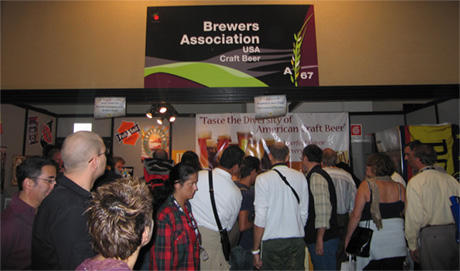
The Brewers Association booth at Salone del Gusto in Torino, Italy

Eric Wallace from Left Hand Brewing works the booth. It was very popular with the Italians, Expats, students and visitors from the U.S. You could get a taster of three beers for 3 Euros. Half the proceeds from the booth were donated to the Slow Food Movement. You could also purchase beer which was very popular with the Americans living abroad.

Shaun O’Sullivan from 21st Amendment in San Francisco, California poses with Charlie Papazian and a fuzzy Nancy Johnson of the Brewers Association.

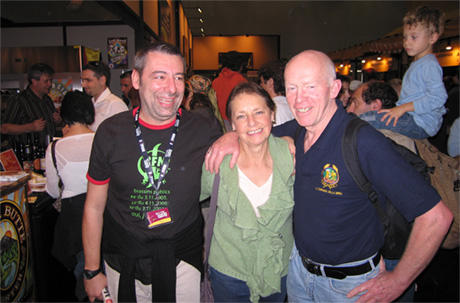
Lorenzo Dabove, the “Michael Jackson” of Italy, along with Cantillon owners Claude and Jean-Pierre Van Roy.

Filed Under: Events, Food & Beer Tagged With: Europe, Festivals, International, Photo Gallery

Reeling in the Dogfish Head Beer Dinner

November 1, 2006 By Jay Brooks

Beer Chef Bruce Paton’s next beer dinner will feature Sam Calagione and the beers of Dogfish Head Brewing from Delaware. Brewmaster Sam Calagione will be there in person to discuss his beers, along with his new book, Extreme Beers. It’s another four-course dinner and well worth the $80 price of admission, and maybe we can persuade Sam to do some rapping. It will be held at the Cathedral Hill Hotel on Friday, November 10, beginning with a reception at 6:30 p.m. Call 415.674.3406 for reservations. Make your reservations soon, because the dinner is filling up fast and you don’t want to miss this one.
 

The Menu:


Reception: 6:30 PM

Beer Chef’s Hors D’Oeuvre
60 Minute IPA

Dinner: 7:30 PM

First Course

Poached Foie Gras with Toasted Five Spice Syrup and California Osetra Caviar

Beer: Midas Touch Golden Elixir

Second Course:

Duck Pho with Charred Ginger Broth and Parsnip Noodles

Beer: 90 Minute IPA

Third Course:

Red Cooked Angus Short Ribs with Lobster Medallions

Beer: World Wide Stout

Fourth Course:

Ginger Scented Banana Custard with Citrus Caramel Sauce

Beer: Chateau Jiahu

One of the beers that will be served at the Dogfish Head Brewing Beer Dinner.


11.10

Dinner with the Brewmaster: Sam Calagione of Dogfish Head Brewing Beer Dinner

Cathedral Hill Hotel, 1101 Van Ness Avenue, San Francisco, California
415.674.3406 [ website ]
Filed Under: Food & Beer, News Tagged With: Announcements, California, Eastern States, San Francisco

Pete’s Wicked Stout Marinade?

October 26, 2006 By Jay Brooks

In today’s North Coast Journal, a weekly alernative rag for Humboldt County, California, in the food section called Talk of the Table, Joseph Byrd has an article titled Texas Chili. The food information looks sound enough, but I’m no expert on chili. He begins by detailing what chili is, where it originated (San Antonio, according to the article), and begins going through detailed instructions on how to make it, all well and good. However, mid-way through his piece he writes the following:

The meat is put into a marinade of dark bitter stout overnight. There is a dark beer called “Pete’s Wicked Ale” which I find nasty and undrinkable, but it’s perfect for this purpose.

Now Pete’s Wicked Ale began its life as an American Brown Ale. Now that the original Pete has left for more chocolatey pastures, my memory is that under Gambrinus these days it more resembles an amber ale. And it’s ironic that Pete’s Wicked Ale today is brewed in San Antonio, Texas, the home of chili. But either way, it’s hardly a stout, and frankly I have a hard time calling it a dark beer. But I suppose if industral light lager is your standard — which is my guess — (with something like 1 lovibond) then I suppose Pete’s Wicked Ale is at least much darker.

I can certainly imagine it would make a fine marinade — after all, many beers do — but to describe the beer as “nasty and undrinkable” seems downright pernicious, and not just to the beer but also to the author’s own reputation. I say that because such a description shows a certain ignorance for the subject matter and calls into question his qualifications overall, in my opinion. It’s one thing to dislike a particular beer — I dislike plenty — but to label it “undrinkable” and confuse it with a stout shows a certain lack of sophistication regarding his beer knowledge. And it begs the question why such an aside was even necessary? What was the purpose of offering how distasteful the author found the beer? It doesn’t really add anything to the story, unless he wanted to be sure none of his readers might mistake his endorsement of the beer as a marinade for actually liking to drink it, too.

At first, I thought the story originated in Texas, before later realizing he’s right here in California, just a short drive up the coast from me. If he’d been a Texas native, I might more easily forgive his apparent lack of beer savvy, but here in California as a food writer it’s an unpardonable sin.

Filed Under: Editorial, Food & Beer, News

Beer Chips

October 23, 2006 By Jay Brooks

Also at the Anchor event for Maureen’s book, Ambitious Brew, I had my second encounter with Beer Chips, a new snack food on the market.

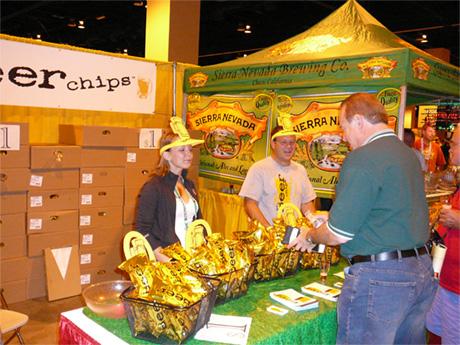
I first noticed them at their own booth next to the Sierra Nevada Brewing tent at GABF last month where, at $1 a bag, they were selling like hot cakes. Now I should make yet another confession here from the start. There are few foods I like more than potato chips. I am quite passionate about my potato chips. I can still get worked up about chips that have been off the market for decades; brands like Tommy Dale’s or Uncle Don’s. Where I grew up in southeastern Pennsylvania, the average grocery store carried at least a dozen local brands of potato chips, and some had many more. My favorite chips growing up were a brand called “Good’s Original Chips,” or “Good’s in the Blue” to distinguish them from a rival brand, “Good’s in the Red.” My “Good’s Potato Chips” could be bought only one day a week and, except for visiting the farm, at only one place on Earth, the Shillington Farmer’s Market, which was open every Friday less than a mile from my childhood home. They were made by Mennonite farmers who appeared to make just enough to sell each week (they never made more for the rush during various holidays) and when they sold out, packed up and went home. You could buy them in bags, but the best way was in a returnable can. Every Friday, I’d pick up a 5-lb. can, pay for the chips and a deposit on the can. The following week, I’d return the empty can and get a new one, this time paying just for the chips inside. It was a beautifully simple system, ecologically as well economically sound.

Sadly, they don’t do the cans anymore, not since the company was taken over by a nephew and moved from the farm to an actual plant. Happily, they still taste as good but I must say some of the magic in them is gone. But I bring this up only to illustrate that potato chips are one of the other things I know something about. So when someone makes chips with beer — combining two of my great loves — then attention must be paid.

The creator of Beer Chips, Brett Stern, who’s a native New Yorker, flew down from Portland, Oregon (where he makes his chips) with boxes of his chips in tow. That gave me a better chance to try the chips, and I must say my first reaction is that they’re very tasty and highly addictive. Of course, that may be the added sugar, itself an unusual ingredient in potato chips. Generally, there are only three ingredients in what I’ll refer to as “craft chips” — let’s call it the spudheitsgebot — which are potatoes cooked in oil (either a vegetable oil or lard, most commonly) with salt added. I’m told the beer used is a bock style that is reduced to a powder and sprinkled on the chips during the cooking phase. And for the most part it works. They do seem to have just a hint of beer flavor and happily it’s not overpowering the way it is in barbecue or some other strongly flavored chip. I brought some home for my wife to try and she loves them, as well, and has become quite addicted. Now if I can only get BevMo to get off their bureaucratic arses and carry them in my neighborhod …

Here’s another review of Beer Chips from Chipworld.

These potato chips had a kettle-cooked texture and were crisp with varying levels of crunch. They earned praise around the chip bowl for being quite tasty. Most of our tasters thought that the chips did taste like beer, though some thought the beer taste was most noticeable on first bite and faded away after that. The chips were generally smallish with wiggly, irregular shapes, some folded over.

The Beer Chips table at GABF.

Filed Under: Beers, Food & Beer, News Tagged With: California, Oregon, Portland, San Francisco

« Previous Page
Next Page »

Find Something

Northern California Breweries

Please consider purchasing my latest book, California Breweries North, available from Amazon, or ask for it at your local bookstore.

Recent Comments

  • Bob Paolino on Beer Birthday: Grant Johnston
  • Gambrinus on Historic Beer Birthday: A.J. Houghton
  • Ernie Dewing on Historic Beer Birthday: Charles William Bergner 
  • Steve 'Pudgy' De Rose on Historic Beer Birthday: Jacob Schmidt
  • Jay Brooks on Beer Birthday: Bill Owens

Recent Posts

  • Beer In Ads #5135: What Record’s Bock Beer Is February 27, 2026
  • Historic Beer Birthday: Albert Braun February 27, 2026
  • Historic Beer Birthday: John J. Schlawig February 27, 2026
  • Beer In Ads #5134: Lord Bushkill On Bushkill Bock February 27, 2026
  • Historic Beer Birthday: William Henry Beadleston February 27, 2026

BBB Archives

Feedback

Head Quarter
This site is hosted and maintained by H25Q.dev. Any questions or comments for the webmaster can be directed here.