Today in 1889, US Patent 403130 A was issued, an invention of Otto Neuman, for his “Beer Chest or Refrigerator.” There’s no Abstract, but it’s described as an “invention relat[ing] to what are commonly termed beer chests or refrigerators, and more especially to certain new and useful attachments connected and combined therewith for increasing the efficiency and utility thereof.

Patent No. 3443958A: Method Of Preparing Ground Cereal Grains In The Production Of Brewery Mash
Today in 1969, US Patent 3443958 A was issued, an invention of George E. Dennis, Richard C. Quittenton, and Kenneth R. Robinson, assigned to John Labatt Ltd., for their “Method of Preparing Ground Cereal Grains in the Production of Brewery Mash.” There’s no Abstract, but the invention is described as a “process for producing brewers wort in which cereal grains are dehulled, the dehulled grain is ground to form a fine grist and at least part of the hulls removed before grinding are recombined with the ground dehulled grain and passed through the mashing stage in the usual manner.” Here’s why they think their method is better.
According to this invention it has been determined that the above difficulties [milling problems] can be overcome by removing the hull from the grain before the milling operation. With the hulls removed the kernels of grain can now be more finely ground than was possible in the past and then the finely ground kernels can be recombined with the hulls at any point before the lautering stage. The result of this is an increased yield without any significant sacrifice in run-off time. A series of pilot plant tests indicated that an average yield increase of up to 2% could be obtained with a less than a 15% increase in lautering time.
The degree to which the kernels can be more finely ground according to this invention will be entirely dependent upon the particular situation. Thus, the actual particle size will be dependent upon the nature of the grain, the balance of the lautering time against yield permissible in a given situation, etc.

Patent No. 3443397A: Barrel Cooler
Today in 1969, US Patent 3443397 A was issued, an invention of Thomas A. Donovan and William E. Miltenberger, assigned to Anheuser Busch, for their “Barrel Cooler.” There’s no Abstract, but the invention is described as a “barrel cooler which is inexpensive, pleasing in appearance, leakproof, and collapsible so that it may be stored in a small space or transported in collapsed condition.” They continue with more:
The present invention is embodied in a collapsible barrel cooler made from water impervious material, said cooler having inner and outer walls adapted to be positioned in spaced relation for receiving a coolant there between such as ice and water, said inner wall being adapted to be secured over the top of a barrel positioned therein to retain said inner wall in an upright position, said inner and outer walls having an opening therein near the bottom thereof for receiving a faucet for drawing off the contents from the barrel, said opening being leakproof so that no ice or water leaks out of the space between said walls.


American Craft Beer Week 2015

Today begins the 10th annual American Craft Beer Week, which is themed this year as Cheers to the Sweet Land of Li-beer-ty. This year it will take place May 11-17, and “all 50 states will hold events including exclusive brewery tours, special craft beer releases, food and beer pairings, tap takeovers and more to honor the ever-advancing craft beer culture and unite tens of thousands of beer lovers nationwide.”
“American Craft Beer Week has provided independent beer fans across the country a chance to support their local breweries since 2006,” said Julia Herz, publisher of CraftBeer.com and craft beer program director at the Brewers Association. “With celebrations happening in all 50 states, this is truly an annual national event that recognizes all those involved in making craft beer from small breweries in the U.S. such a success.”
You can also follow news of ACBW and see what events have been scheduled and the list can be searched by state. The BA this year has also “created an interactive graphic with fun facts to commemorate each state and their commitment to craft brewing.”
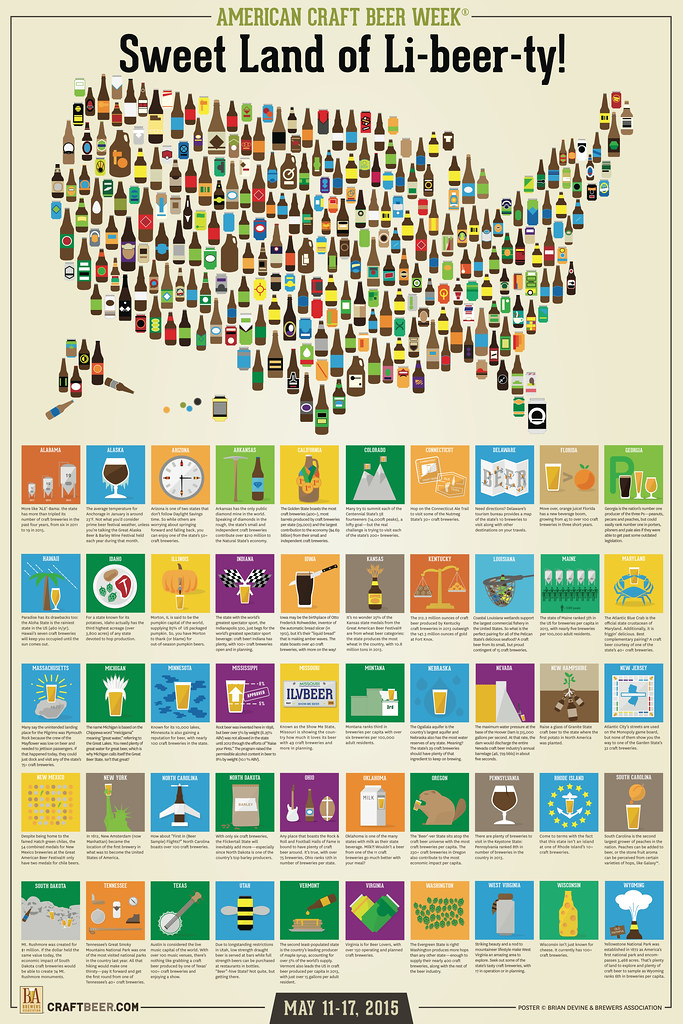
Click here to see the ACBW poster full size.
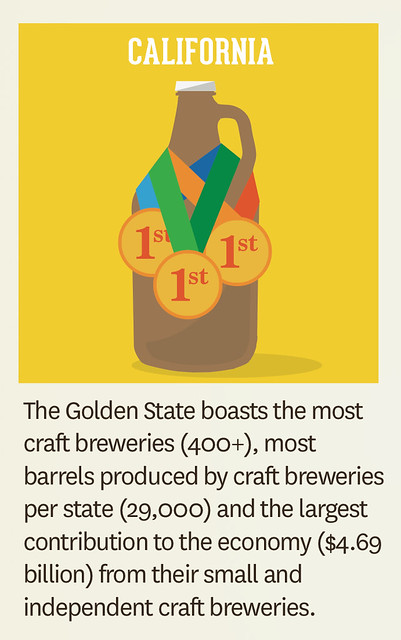
And here’s a larger view of what they had to say about California.
Patent No. 921032A: Counter-Pressure Bottling-Machine For Beer
Today in 1909, US Patent 921032 A was issued, an invention of Ralph Waldo Webster and Leuig Chew, for their “Counter-Pressure Bottling-Machine for Beer, Mineral Waters, and the Like.” There’s no Abstract, and all it says in the description is that Schwartz “invented new and useful Improvements in Counter-Pressure Bottling-Machines for Beer, Mineral Waters, and the Like,” which is essentially the title. A bit more is subsequently added, saying the “invention relates to improvements in machines for filling bottles, jars, and other like vessels, in which a counter-pressure is created to enable beers, mineral waters, and the like, having a natural or artificial condition or pressure, to be bottled Without undue foaming or loss of condition.” For the rest, you have to dive into a full reading of the application.


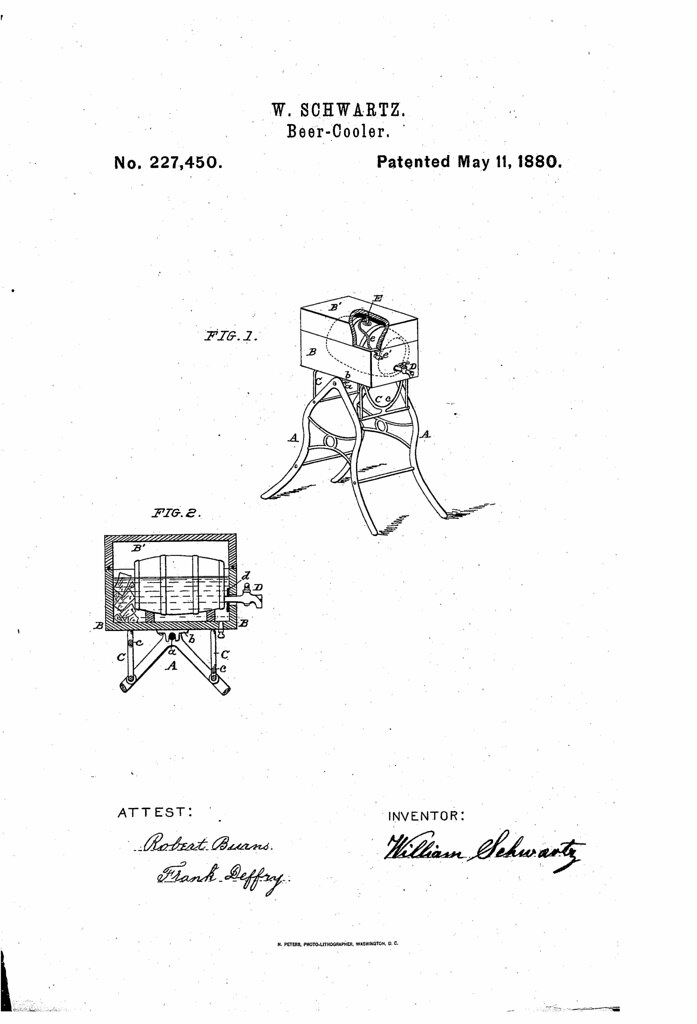
Patent No. 227450A: Beer-Cooler
Today in 1880, US Patent 227450 A was issued, an invention of William Schwartz, for his “Beer-Cooler.” There’s no Abstract, and all it says in the description is that Schwartz “invented certain Improvements in Beer-Keg Receptacles.” I guess you have to read through the rest of it to figure it out.
Patent No. 20120111874A1: Plastic Beer Keg
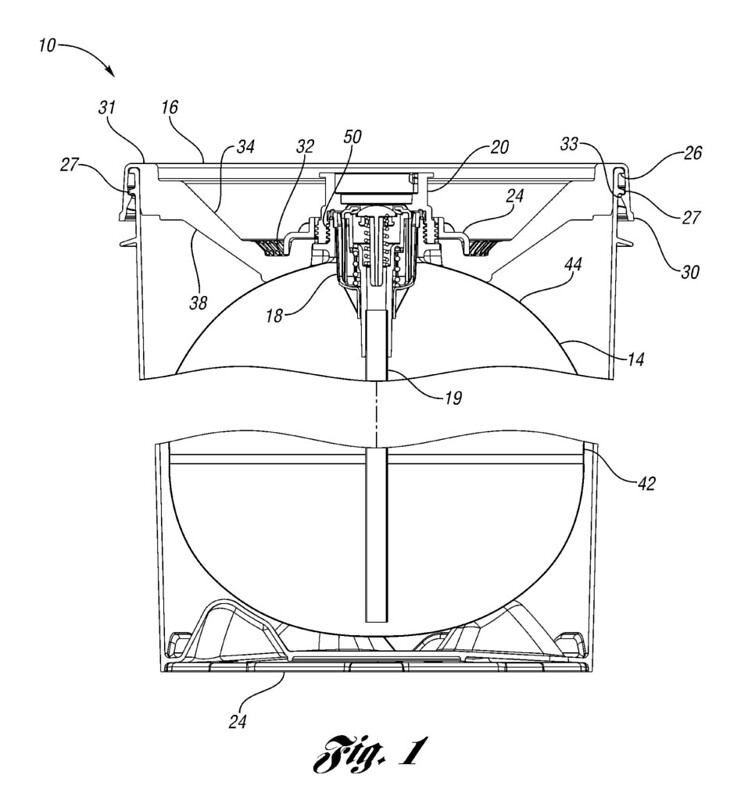
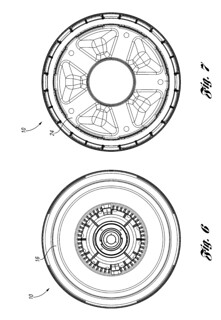
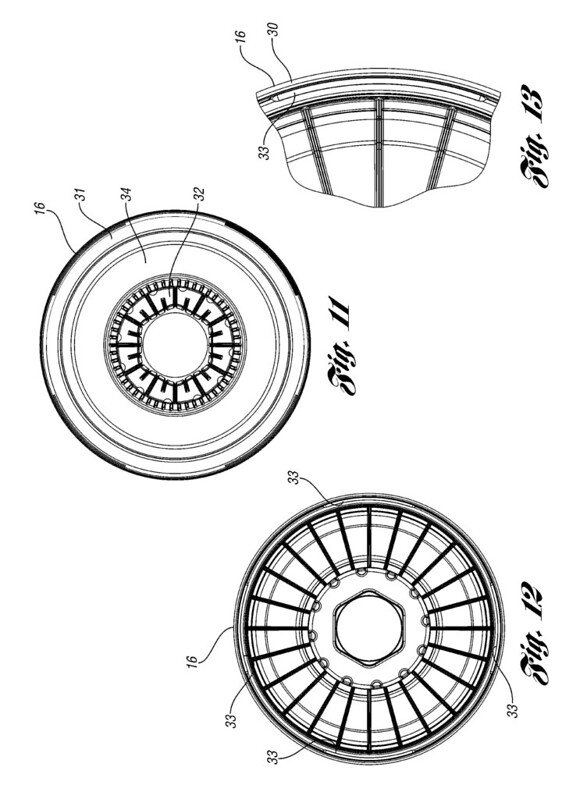
Today in 2012, US Patent 20120111874 A1 was issued, an invention of William P. Apps, for his “Plastic Beer Keg.” Here’s the Abstract:
A plastic keg includes a liner including a neck portion and a body portion. A lid having an opening is disposed at least partially over the liner. The liner is disposed in an outer container having a wall with at least one locking rib projecting therefrom. The locking rib angles downward and the lid secured to the outer container by the at least one locking rib. Optionally, a locking ring securing the neck portion of the liner to the lid may be configured to release the liner when the filled keg is dropped.


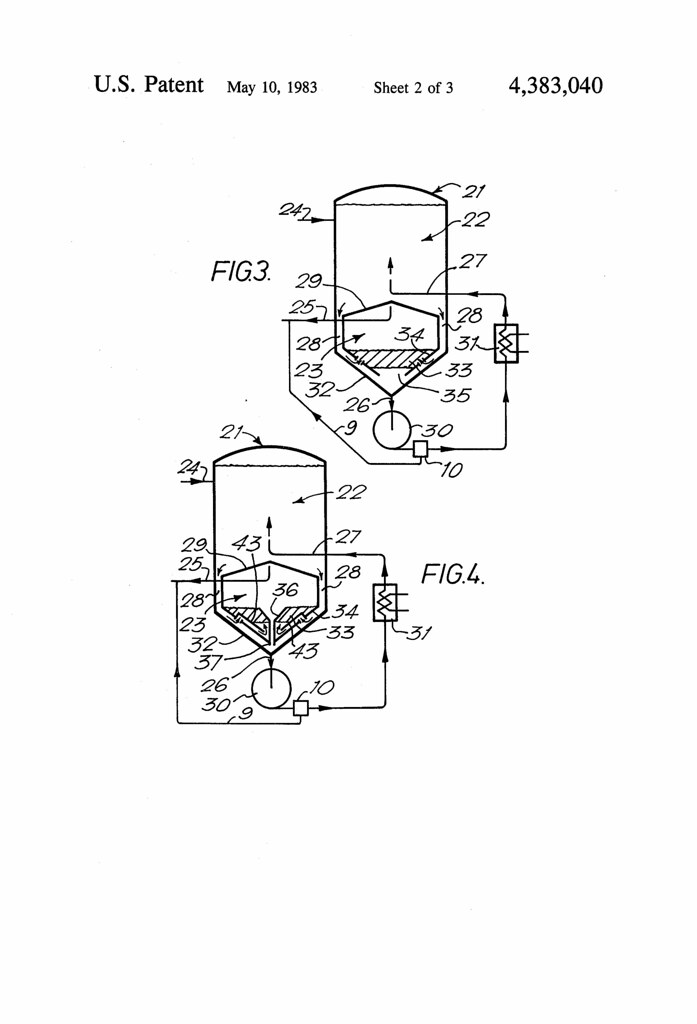
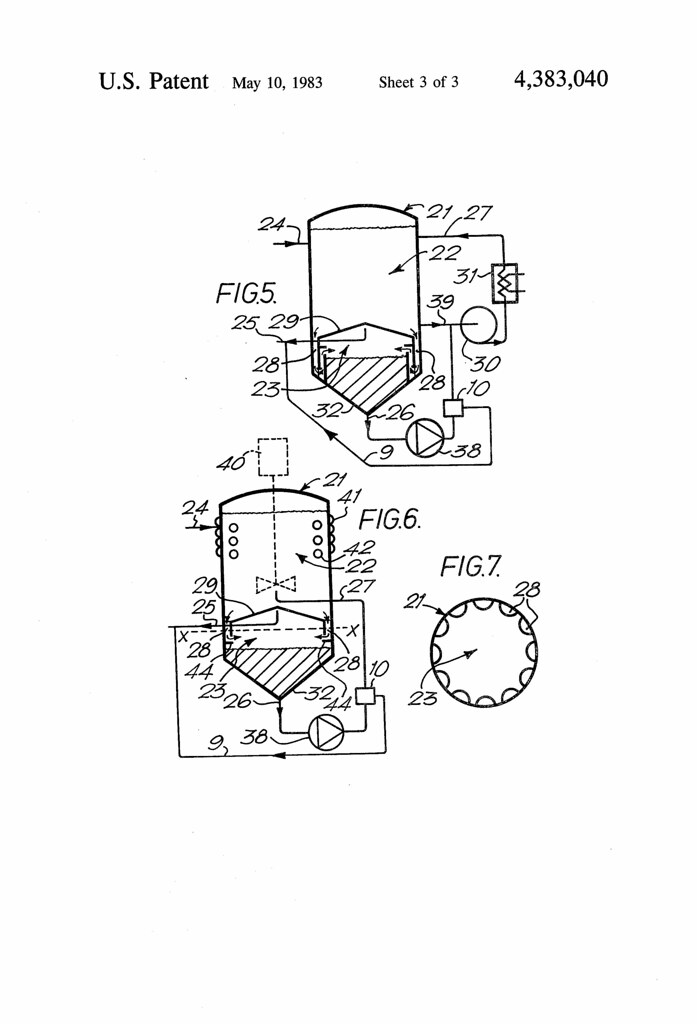
Patent No. 4383040A: Fermentation Process And Apparatus
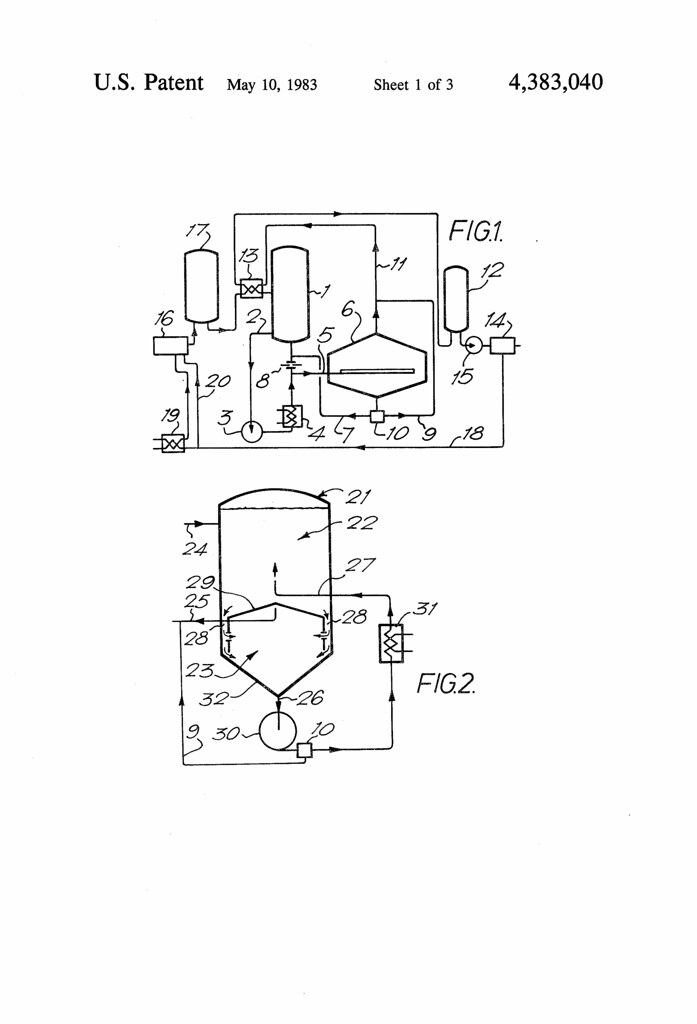
Today in 1983, US Patent 4383040 A was issued, an invention of Richard Fricker, for his “Fermentation Process and Apparatus.” Here’s the Abstract:
A method for continuous fermentation in which carbohydrate solution is fed continuously into a fermentation zone containing substantially homogeneously distributed yeast and carbohydrate solution whereby the carbohydrate is fermented to ethanol, a proportion of the fermenting liquid continuously passing to a pressurized settling tank, yeast depleted liquid being withdrawn from the upper part of the settling tank and yeast enriched liquid being withdrawn from the lower part of said tank and returned to the fermentation zone, a proportion of yeast being withdrawn without being returned to the fermentation zone, said proportion being such that the concentration of yeast in the fermentation zone is substantially constant, and the pressure within the settling tank is sufficient to prevent the formation of gaseous carbon dioxide. The method enables rapid continuous fermentation to take place using high concentrations of yeast.
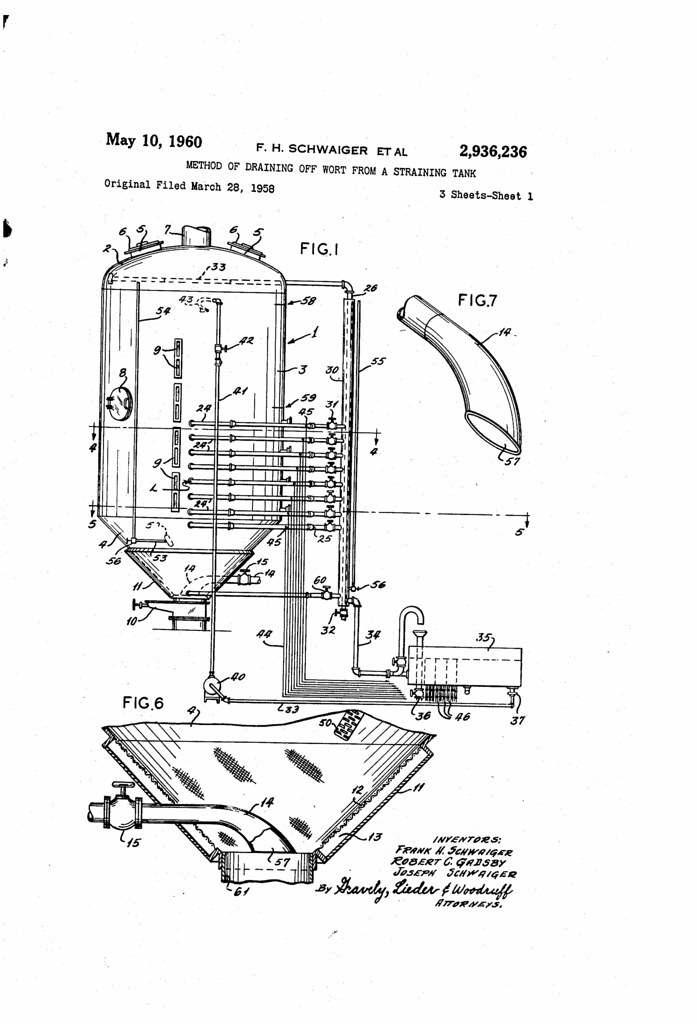
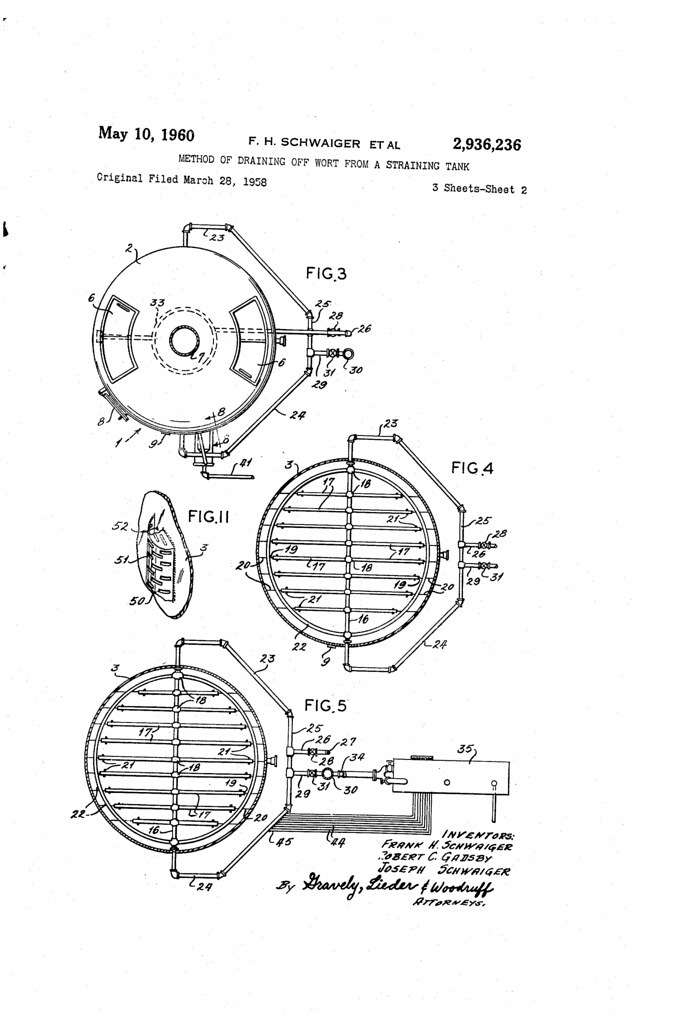
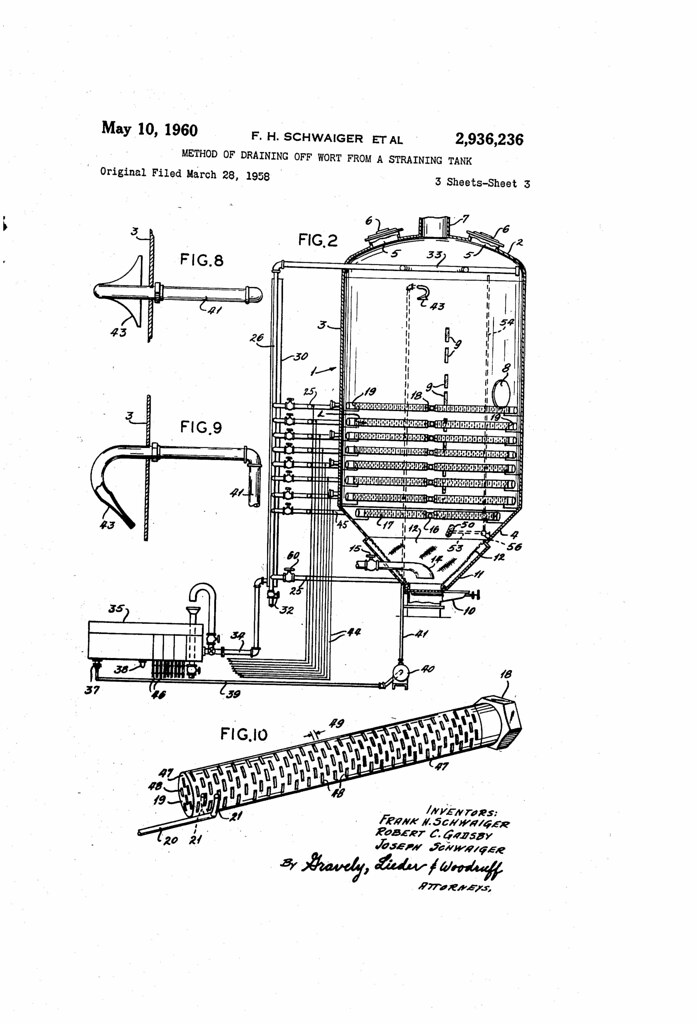
Patent No. 2936236A: Method Of Draining Off Wort From A Straining Tank
Today in 1960, US Patent 2936236 A was issued, an invention of Robert C. Gadsby, Schwaiger Joseph, and Frank H. Schwaiger, assigned to Anheuser Busch, for their “Method of Draining Off Wort From a Straining Tank.” There’s no Abstract, but the description states that the “invention relates to a straining tank or grain extractor or lauter tub, and more particularly to a new type of straining tank for use in the brewing industry to remove extract from brewers grains. This divisional application relates to the method of straining employed by said straining tank.”
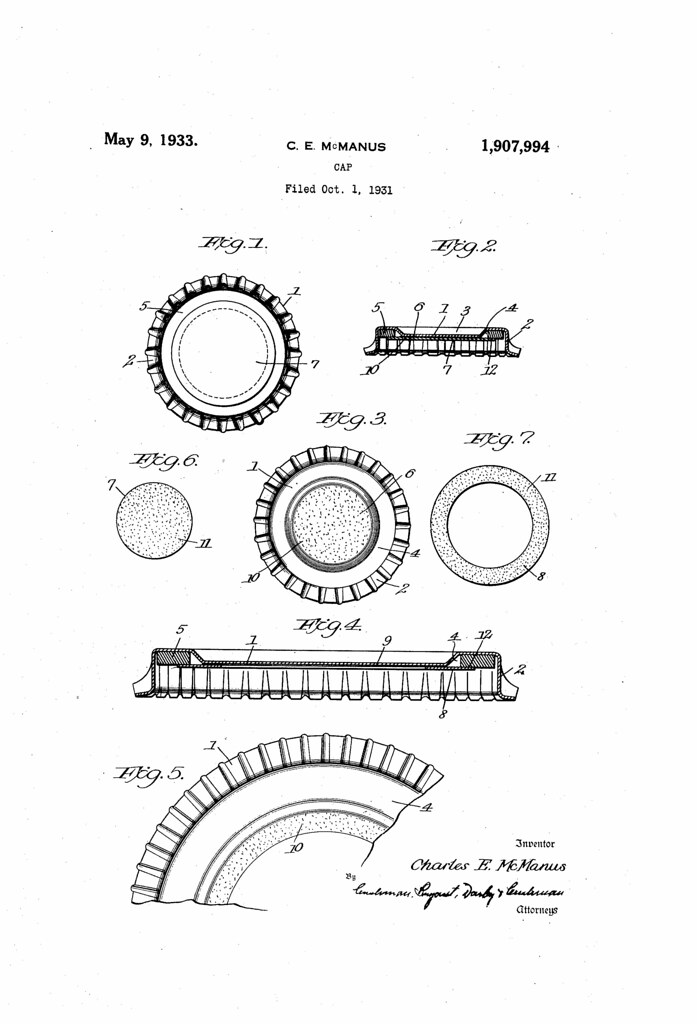
Patent No. 1907994A: Cap
Today in 1933, US Patent 1907994 A was issued, an invention of Edward McManus Charles, assigned to Crown Cork & Seal Co., for his “Cap.” There’s no Abstract, but in the description they talk about an “invention relat[ing] to caps for containers and particularly contemplates a cap wherein a sealing ring or cushion is usually employed.” If you keep reading, it’s explained that this crown works better than previous ones for a variety of reasons, even though it looks pretty much the same as other crowns.