Brookston Beer Bulletin

Jay R. Brooks on Beer

  • Home
  • About
  • Editorial
  • Birthdays
  • Art & Beer

Socialize

  • Dribbble
  • Email
  • Facebook
  • Flickr
  • GitHub
  • Instagram
  • LinkedIn
  • Pinterest
  • RSS
  • Twitter
  • YouTube

Powered by Genesis

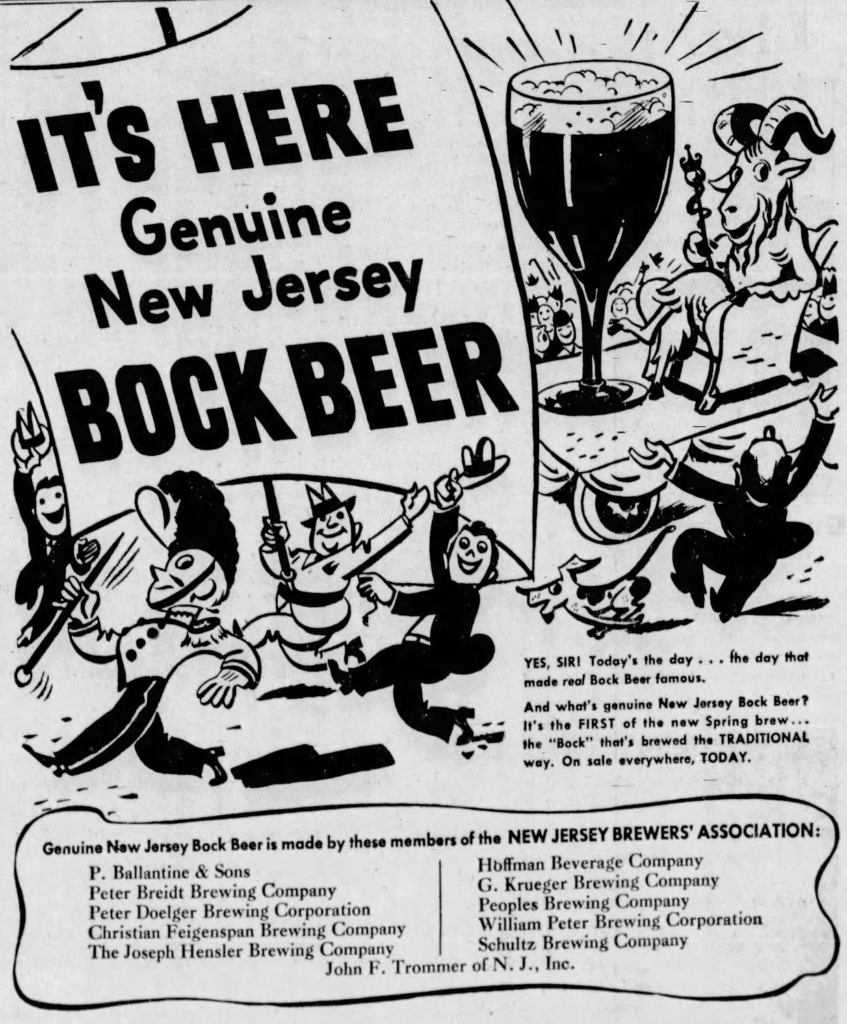
Beer In Ads #5163: It’s Here Genuine New Jersey Bock Beer

March 14, 2026 By Jay Brooks Leave a Comment

Two years ago I decided to concentrate on Bock ads for awhile. Bock, of course, may have originated in Germany, in the town of Einbeck. Because many 19th century American breweries were founded by German immigrants, they offered a bock at certain times of the year, be it Spring, Easter, Lent, Christmas, or what have you. In a sense they were some of the first seasonal beers. “The style was later adopted in Bavaria by Munich brewers in the 17th century. Due to their Bavarian accent, citizens of Munich pronounced ‘Einbeck’ as ‘ein Bock’ (a billy goat), and thus the beer became known as ‘Bock.’ A goat often appears on bottle labels.” And presumably because they were special releases, many breweries went all out promoting them with beautiful artwork on posters and other advertising. With Spring approaching, there are so many great examples that I’m going to post two a day for a few months.

Saturday’s first ad is for various New Jersey Bock Beers, which was published on March 14, 1938. This ad was for not one brewery, but for eleven different brewery members of the New Jersey Brewers’ Association. This ad ran in The Press of Atlantic City, also of Atlantic City, New Jersey.
Filed Under: Art & Beer, Beers, Breweries, Just For Fun Tagged With: Advertising, Bock, History, New Jersey

Beer In Ads #5162: Bock Beer Time Is Here gain March 13-18

March 13, 2026 By Jay Brooks Leave a Comment

Two years ago I decided to concentrate on Bock ads for awhile. Bock, of course, may have originated in Germany, in the town of Einbeck. Because many 19th century American breweries were founded by German immigrants, they offered a bock at certain times of the year, be it Spring, Easter, Lent, Christmas, or what have you. In a sense they were some of the first seasonal beers. “The style was later adopted in Bavaria by Munich brewers in the 17th century. Due to their Bavarian accent, citizens of Munich pronounced ‘Einbeck’ as ‘ein Bock’ (a billy goat), and thus the beer became known as ‘Bock.’ A goat often appears on bottle labels.” And presumably because they were special releases, many breweries went all out promoting them with beautiful artwork on posters and other advertising. With Spring approaching, there are so many great examples that I’m going to post two a day for a few months.

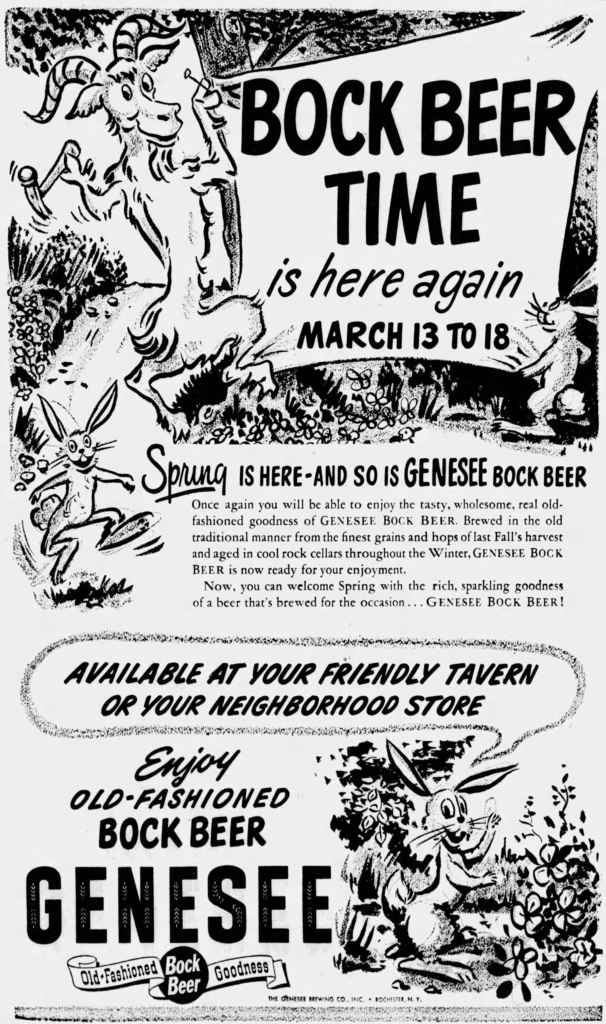
Friday’s second ad is for Genesee Bock Beer, which was published on March 13, 1950. This ad was for Genesee Brewing Co. of Rochester, New York, which was originally founded in 1878. This ad ran in The Post Standard, of Syracuse, New York.

Filed Under: Art & Beer, Beers, Breweries, Just For Fun Tagged With: Advertising, Bock, History, New York

Beer In Ads #5161: Aged … Ready … And Rarin’ To Go!

March 13, 2026 By Jay Brooks Leave a Comment

Two years ago I decided to concentrate on Bock ads for awhile. Bock, of course, may have originated in Germany, in the town of Einbeck. Because many 19th century American breweries were founded by German immigrants, they offered a bock at certain times of the year, be it Spring, Easter, Lent, Christmas, or what have you. In a sense they were some of the first seasonal beers. “The style was later adopted in Bavaria by Munich brewers in the 17th century. Due to their Bavarian accent, citizens of Munich pronounced ‘Einbeck’ as ‘ein Bock’ (a billy goat), and thus the beer became known as ‘Bock.’ A goat often appears on bottle labels.” And presumably because they were special releases, many breweries went all out promoting them with beautiful artwork on posters and other advertising. With Spring approaching, there are so many great examples that I’m going to post two a day for a few months.

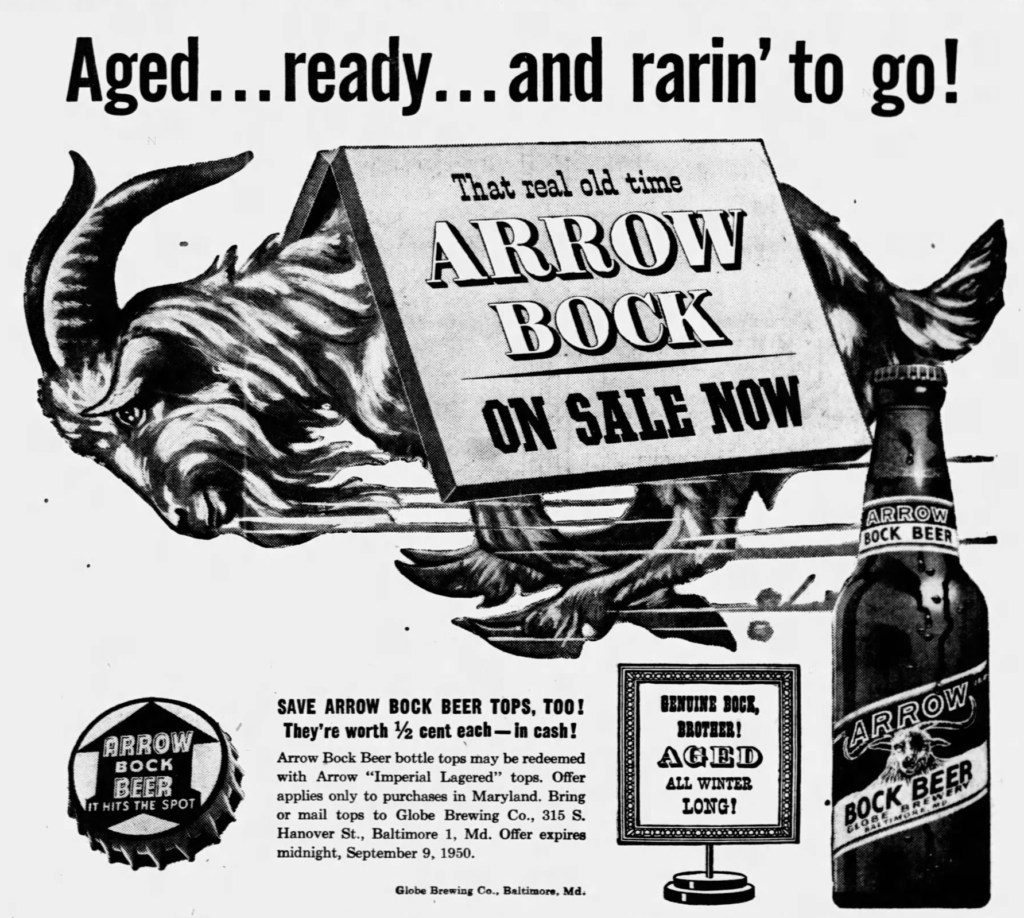
Friday’s First ad is for Acme Bock Beer, which was published on March 13, 1950. This ad was for the Globe Brewing Co., of Baltimore, Maryland, which was originally founded in 1748 by John Leonard Barnitz and Elias Daniel Barnitz, though the Globe name doesn’t appear until around 1899. This ad ran in The Salisbury Times, of Salisbury, Maryland.

Filed Under: Art & Beer, Beers, Breweries, Just For Fun Tagged With: Advertising, Bock, History, Maryland

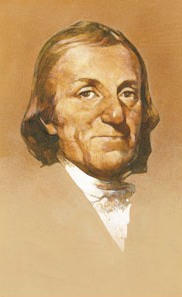
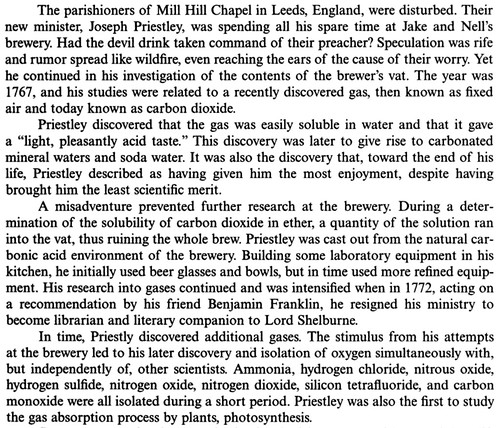
Historic Beer Birthday: Joseph Priestley

March 13, 2026 By Jay Brooks Leave a Comment

oxygen
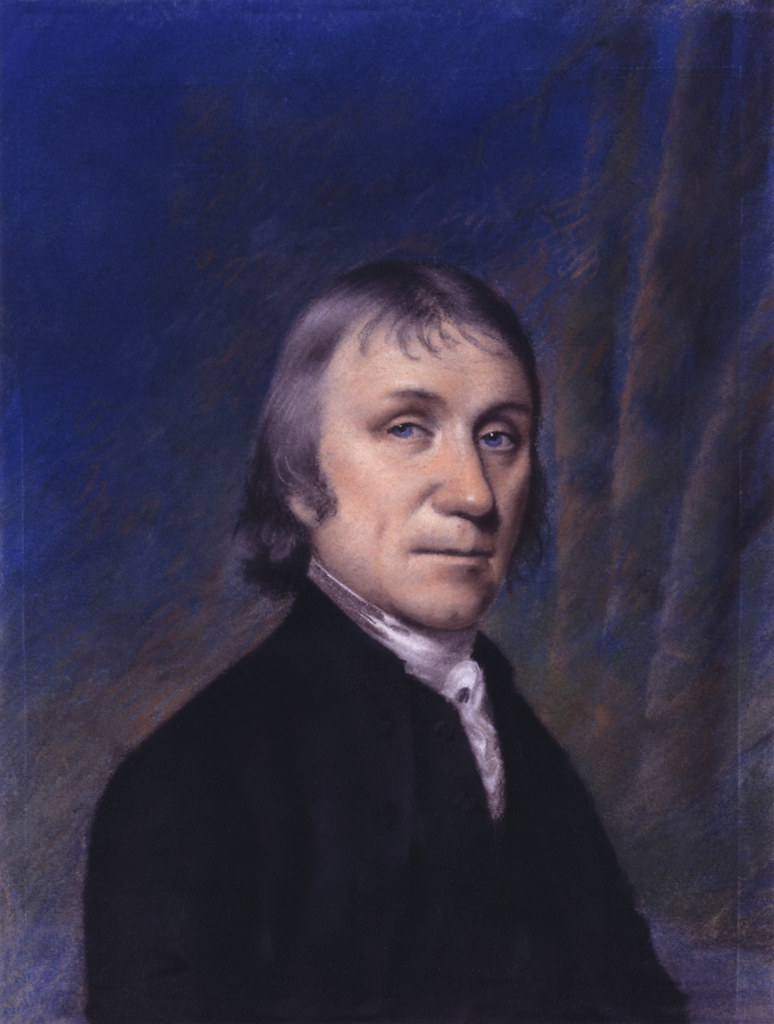
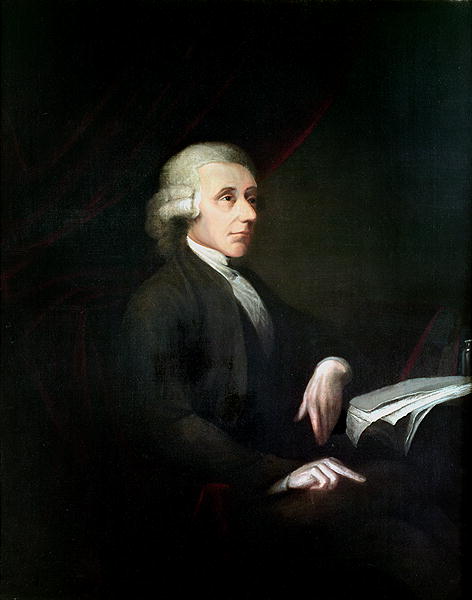
Today is the birthday of English scientist Joseph Priestley (March 13, 1733-February 6, 1804). While he was also a “clergyman, natural philosopher, chemist, educator, and Liberal political theorist,” he’s perhaps best known for discovering oxygen (even though a few others lay claim to that honor). According to Wikipedia, “his early scientific interest was electricity, but he is remembered for his later work in chemistry, especially gases. He investigated the ‘fixed air’ (carbon dioxide) found in a layer above the liquid in beer brewery fermentation vats. Although known by different names at the time, he also discovered sulphur dioxide, ammonia, nitrogen oxides, carbon monoxide and silicon fluoride. Priestley is remembered for his invention of a way of making soda-water (1772), the pneumatic trough, and recognising that green plants in light released oxygen. His political opinions and support of the French Revolution, were unpopular. After his home and laboratory were set afire (1791), he sailed for America, arriving at New York on 4 Jun 1794

Priestley

In the biography of Priestley at the American Chemistry Society has a sidebar about his work with fermentation:

Bubbling Beverages

In 1767, Priestley was offered a ministry in Leeds, Englane, located near a brewery. This abundant and convenient source of “fixed air” — what we now know as carbon dioxide — from fermentation sparked his lifetime investigation into the chemistry of gases. He found a way to produce artificially what occurred naturally in beer and champagne: water containing the effervescence of carbon dioxide. The method earned the Royal Society’s coveted Copley Prize and was the precursor of the modern soft-drink industry.

Even Michael Jackson, in 1994, wrote about Priestley connection to the brewing industry.

“It has been suggested that the Yorkshire square system was developed with the help of Joseph Priestley who, in 1722, delivered a paper to the Royal Society on the absorption of gases in liquids. In addition to being a scientist, and later a political dissident, he was for a time the minister of a Unitarian church in Leeds. During that period he lived next to a brewery on a site that is now Tetley’s.”

ZIN42670

In the New World Encyclopedia, during his time in Leeds, it explains his work on carbonation.

Priestley’s house was next to a brewery, and he became fascinated with the layer of dense gas that hung over the giant vats of fermenting beer. His first experiments showed that the gas would extinguish lighted wood chips. He then noticed that the gas appeared to be heavier than normal air, as it remained in the vats and did not mix with the air in the room. The distinctive gas, which Priestley called “fixed air,” had already been discovered and named “mephitic air” by Joseph Black. It was, in fact, carbon dioxide. Priestley discovered a method of impregnating water with the carbon dioxide by placing a bowl of water above a vat of fermenting beer. The carbon dioxide soon became dissolved in the water to produce soda water, and Priestley found that the impregnated water developed a pleasant acidic taste. In 1773, he published an article on the carbonation of water (soda water), which won him the Royal Society’s Copley Medal and brought much attention to his scientific work.

He began to offer the treated water to friends as a refreshing drink. In 1772, Priestley published a paper entitled Impregnating Water with Fixed Air, in which he described a process of dripping sulfuric acid (or oil of vitriol as Priestley knew it) onto chalk to produce carbon dioxide and forcing the gas to dissolve by agitating a bowl of water in contact with the gas.

Joseph_Priestley

And here’s More About Priestley from the Birmingham Jewellry Quarter, whatever that is:

But his most important work was to be in the field of gases, which he called ‘airs’ (he would later chide James Keir for giving himself airs (oh dear!) by adopting the term ‘gases’ in his Dictionary of Chemistry, saying ‘I cannot help smiling at his new phraseology’). Living, as he did at the time, next to a brewery, he noticed that the gas given off from the fermenting vats drifted to the ground, implying that it was heavier than air. Moreover, he discovered that it extinguished lighted wood chips. He had discovered carbon dioxide, which he called ‘fixed air’. Devising a method of making the gas at home without brewing beer, he discovered that it produced a pleasant tangy taste when dissolved in water. By this invention of carbonated water, he had become the father of fizzy drinks!

PriestleyStamp

But perhaps my favorite retelling comes from the riveting History of Industrial Gases:

priestley-gases

The relevant findings were published in 1772, in Impregnating Water with Fixed Air

20. By this process may fixed air be given to wine, beer, and almost any liquor whatever: and when beer is become flat or dead, it will be revived by this means; but the delicate agreeable flavour, or acidulous taste communicated by the fixed air, and which is manifest in water, will hardly be perceived in wine, or other liquors which have much taste of their own.

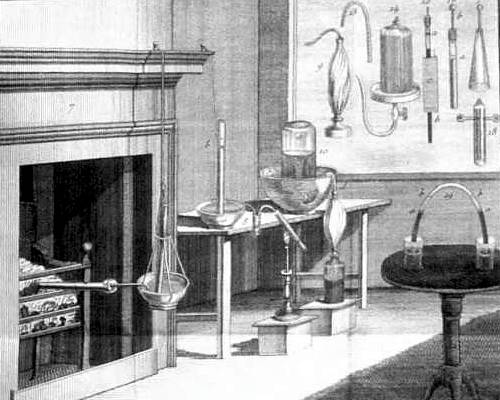
PriestleyJoseph-Lab
Priestley’s apparatus for experimenting with ‘airs.’

Filed Under: Beers, Birthdays, Just For Fun, Politics & Law, Related Pleasures Tagged With: History, Science of Brewing

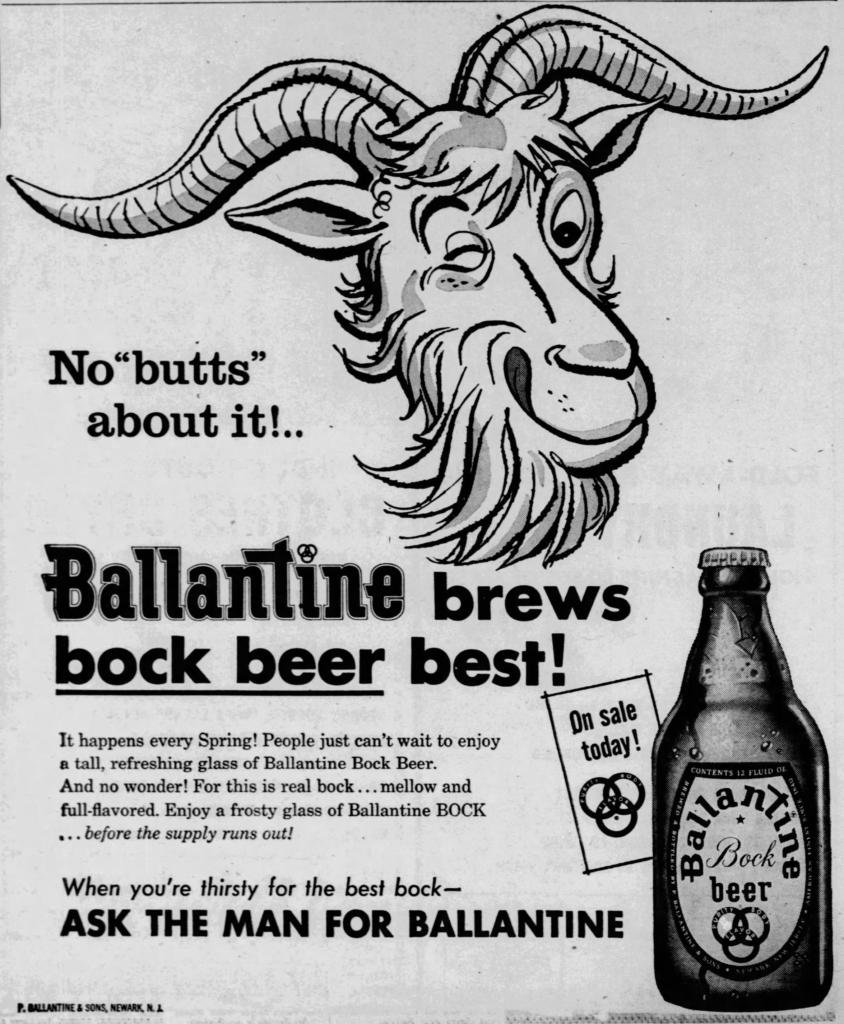
Beer In Ads #5160: No ‘Butts’ About It!.. Ballantine Brews Bock Beer Best!

March 12, 2026 By Jay Brooks Leave a Comment

Two years ago I decided to concentrate on Bock ads for awhile. Bock, of course, may have originated in Germany, in the town of Einbeck. Because many 19th century American breweries were founded by German immigrants, they offered a bock at certain times of the year, be it Spring, Easter, Lent, Christmas, or what have you. In a sense they were some of the first seasonal beers. “The style was later adopted in Bavaria by Munich brewers in the 17th century. Due to their Bavarian accent, citizens of Munich pronounced ‘Einbeck’ as ‘ein Bock’ (a billy goat), and thus the beer became known as ‘Bock.’ A goat often appears on bottle labels.” And presumably because they were special releases, many breweries went all out promoting them with beautiful artwork on posters and other advertising. With Spring approaching, there are so many great examples that I’m going to post two a day for a few months.

Thursday’s second ad is for Blatz Bock Beer, which was published on March 12, 1956. This ad was for the P. Ballantine & Sons Brewing Co., of Newark, New Jersey, which was originally founded in 1840. This ad ran in The Daily News, of New York, New York.

Filed Under: Art & Beer, Beers, Breweries, Just For Fun Tagged With: Advertising, Ballantine, Bock, History, New Jersey, New York

Beer In Ads #5159: Blatz Bock Beer

March 12, 2026 By Jay Brooks Leave a Comment

Two years ago I decided to concentrate on Bock ads for awhile. Bock, of course, may have originated in Germany, in the town of Einbeck. Because many 19th century American breweries were founded by German immigrants, they offered a bock at certain times of the year, be it Spring, Easter, Lent, Christmas, or what have you. In a sense they were some of the first seasonal beers. “The style was later adopted in Bavaria by Munich brewers in the 17th century. Due to their Bavarian accent, citizens of Munich pronounced ‘Einbeck’ as ‘ein Bock’ (a billy goat), and thus the beer became known as ‘Bock.’ A goat often appears on bottle labels.” And presumably because they were special releases, many breweries went all out promoting them with beautiful artwork on posters and other advertising. With Spring approaching, there are so many great examples that I’m going to post two a day for a few months.

Thursday’s first ad is for Blatz Bock Beer, which was published on March 12, 1942. This ad was for the Valentin Blatz Brewing Co., of Milwaukee, Wisconsin, which was originally founded in 1846 as the Cedar Brewery by Johann Braun. Valentin Blatz took over the business in 1851, calling it the City Brewery before adding his name . This ad ran in The Burlington Free Press, of Burlington, Vermont.

Filed Under: Art & Beer, Beers, Breweries, Just For Fun Tagged With: Advertising, Bock, History, Vermont, Wisconsin

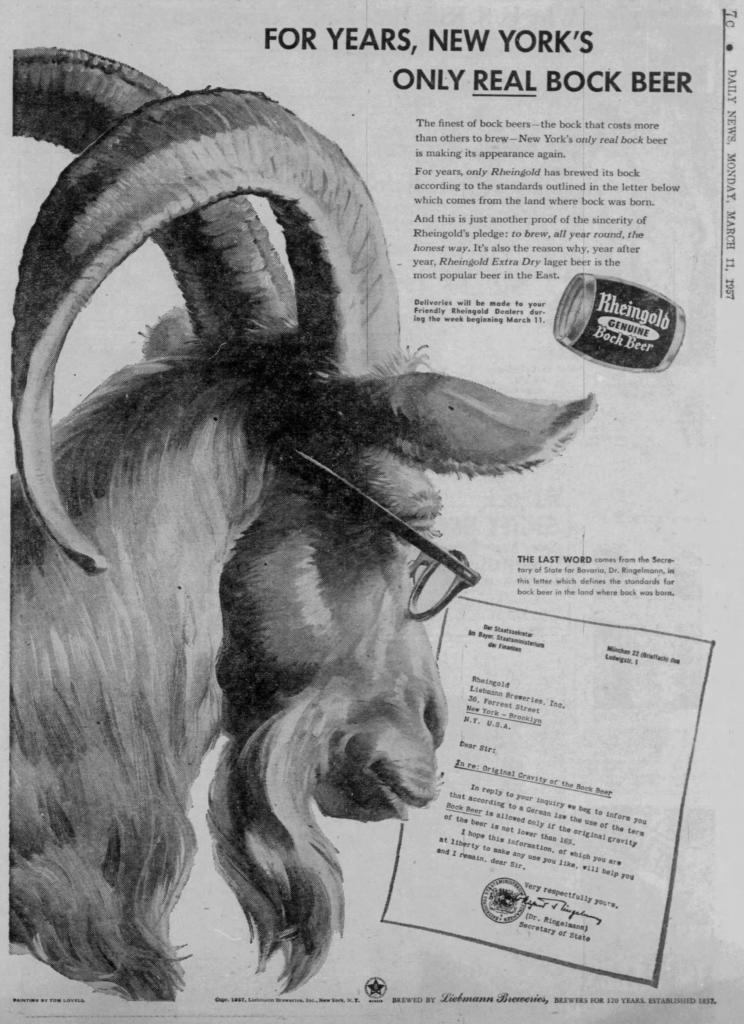
Beer In Ads #5158: For Years, New York’s Only Real Bock Beer

March 11, 2026 By Jay Brooks Leave a Comment

Two years ago I decided to concentrate on Bock ads for awhile. Bock, of course, may have originated in Germany, in the town of Einbeck. Because many 19th century American breweries were founded by German immigrants, they offered a bock at certain times of the year, be it Spring, Easter, Lent, Christmas, or what have you. In a sense they were some of the first seasonal beers. “The style was later adopted in Bavaria by Munich brewers in the 17th century. Due to their Bavarian accent, citizens of Munich pronounced ‘Einbeck’ as ‘ein Bock’ (a billy goat), and thus the beer became known as ‘Bock.’ A goat often appears on bottle labels.” And presumably because they were special releases, many breweries went all out promoting them with beautiful artwork on posters and other advertising. With Spring approaching, there are so many great examples that I’m going to post two a day for a few months.

Wednesday’s second ad is for Rheingold Bock Beer, which was published on March 11, 1957. This ad was for the Liebmann Breweries, of New York, New York, a.k.a. Rheingold Brewery, which was originally founded in 1854 by Samuel Liebmann. This ad ran in The Herald News, also of New York, New York.

Filed Under: Art & Beer, Beers, Breweries, Just For Fun Tagged With: Advertising, Bock, History, New York, Rheingold

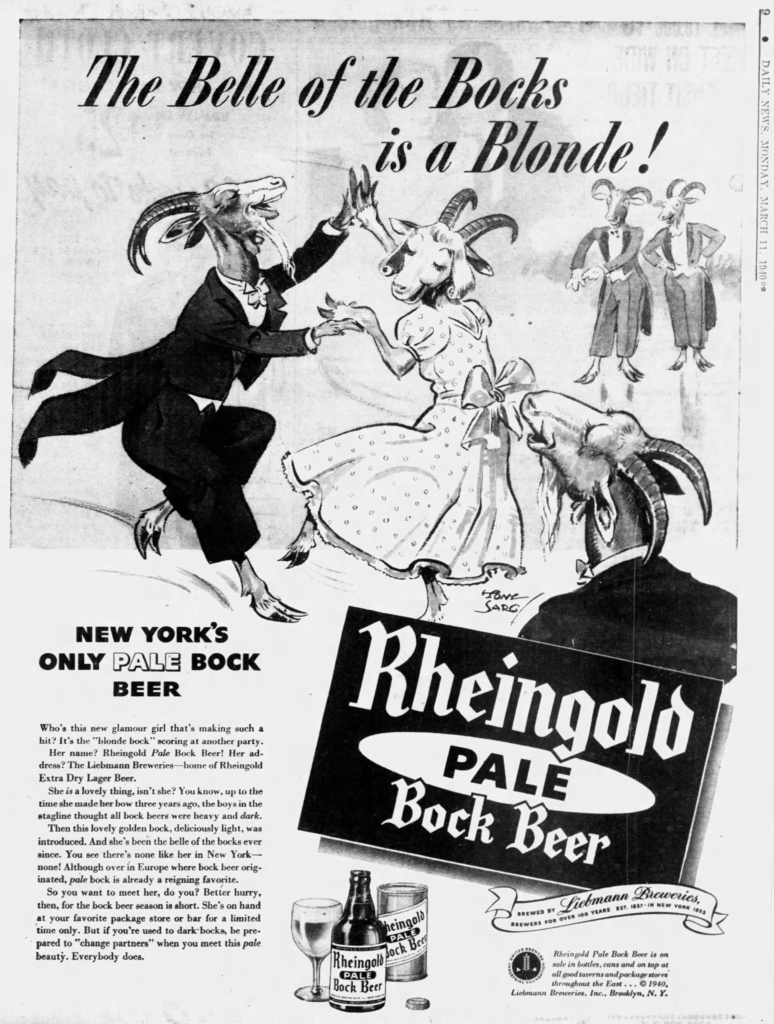
Beer In Ads #5157: The Belle Of The Bocks Is A Blonde!

March 11, 2026 By Jay Brooks Leave a Comment

Two years ago I decided to concentrate on Bock ads for awhile. Bock, of course, may have originated in Germany, in the town of Einbeck. Because many 19th century American breweries were founded by German immigrants, they offered a bock at certain times of the year, be it Spring, Easter, Lent, Christmas, or what have you. In a sense they were some of the first seasonal beers. “The style was later adopted in Bavaria by Munich brewers in the 17th century. Due to their Bavarian accent, citizens of Munich pronounced ‘Einbeck’ as ‘ein Bock’ (a billy goat), and thus the beer became known as ‘Bock.’ A goat often appears on bottle labels.” And presumably because they were special releases, many breweries went all out promoting them with beautiful artwork on posters and other advertising. With Spring approaching, there are so many great examples that I’m going to post two a day for a few months.

Wednesday’s first ad is for Rheingold Pale Bock Beer, which was published on March 11, 1940. This ad was for the Liebmann Breweries, of New York, New York, a.k.a. Rheingold Brewery, which was originally founded in 1854 by Samuel Liebmann. This ad ran in The Daily News, also of New York, New York.

Filed Under: Art & Beer, Beers, Breweries, Just For Fun Tagged With: Advertising, Bock, History, New York, Rheingold

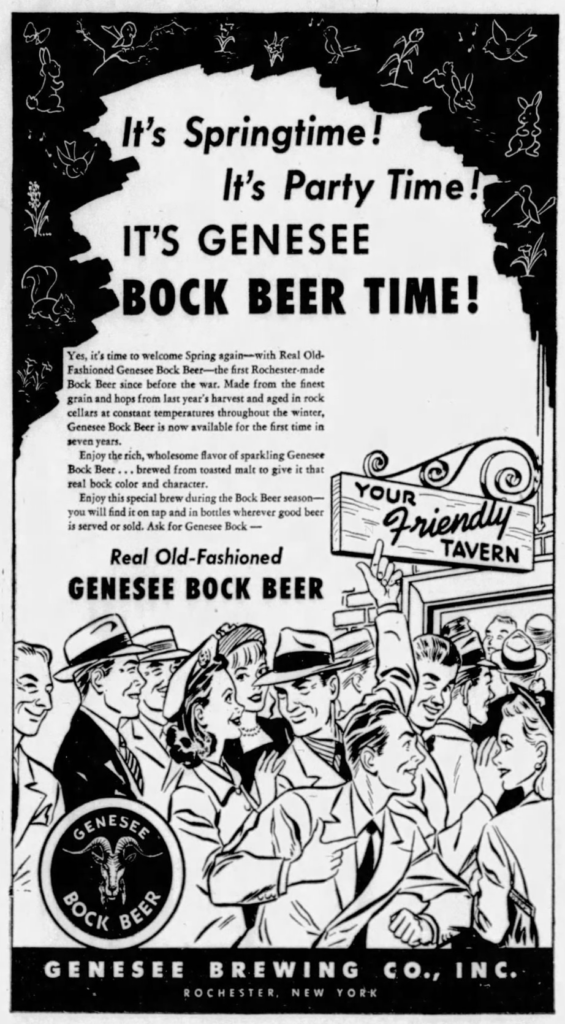
Beer In Ads #5156: It’s Springtime! It’s Party Time! It’s Genesee Bock Beer Time

March 10, 2026 By Jay Brooks Leave a Comment

Two years ago I decided to concentrate on Bock ads for awhile. Bock, of course, may have originated in Germany, in the town of Einbeck. Because many 19th century American breweries were founded by German immigrants, they offered a bock at certain times of the year, be it Spring, Easter, Lent, Christmas, or what have you. In a sense they were some of the first seasonal beers. “The style was later adopted in Bavaria by Munich brewers in the 17th century. Due to their Bavarian accent, citizens of Munich pronounced ‘Einbeck’ as ‘ein Bock’ (a billy goat), and thus the beer became known as ‘Bock.’ A goat often appears on bottle labels.” And presumably because they were special releases, many breweries went all out promoting them with beautiful artwork on posters and other advertising. With Spring approaching, there are so many great examples that I’m going to post two a day for a few months.

Tuesday’s second ad is for Genesee Bock Beer, which was published on March 10, 1949. This ad was for Genesee Brewing Co. of Rochester, New York, which was originally founded in 1878. This ad ran in The Syracuse Herald Journal, of Syracuse, New York.

Filed Under: Art & Beer, Beers, Breweries, Just For Fun Tagged With: Advertising, Bock, History, New York

Beer In Ads #5155: … A Real Bock Beer!

March 10, 2026 By Jay Brooks Leave a Comment

Two years ago I decided to concentrate on Bock ads for awhile. Bock, of course, may have originated in Germany, in the town of Einbeck. Because many 19th century American breweries were founded by German immigrants, they offered a bock at certain times of the year, be it Spring, Easter, Lent, Christmas, or what have you. In a sense they were some of the first seasonal beers. “The style was later adopted in Bavaria by Munich brewers in the 17th century. Due to their Bavarian accent, citizens of Munich pronounced ‘Einbeck’ as ‘ein Bock’ (a billy goat), and thus the beer became known as ‘Bock.’ A goat often appears on bottle labels.” And presumably because they were special releases, many breweries went all out promoting them with beautiful artwork on posters and other advertising. With Spring approaching, there are so many great examples that I’m going to post two a day for a few months.

Tuesday’s first ad is for P.O.C. Bock Beer, which was published on March 10, 1954. This ad was for the Pilsener Brewing Co., of Cleveland, Ohio, which was originally founded in 1893 as the Medlin Pilsener Brewing Co. This ad ran in The Plain Dealer, also of Cleveland, Ohio.

Filed Under: Art & Beer, Beers, Breweries, Just For Fun Tagged With: Advertising, Bock, History, Ohio

« Previous Page
Next Page »

Find Something

Northern California Breweries

Please consider purchasing my latest book, California Breweries North, available from Amazon, or ask for it at your local bookstore.

Recent Comments

  • Bob Paolino on Beer Birthday: Grant Johnston
  • Gambrinus on Historic Beer Birthday: A.J. Houghton
  • Ernie Dewing on Historic Beer Birthday: Charles William Bergner 
  • Steve 'Pudgy' De Rose on Historic Beer Birthday: Jacob Schmidt
  • Jay Brooks on Beer Birthday: Bill Owens

Recent Posts

  • Beer In Ads #5179: Back Again! Pittsburgh Brewing Co’s Bock Beer March 22, 2026
  • Historic Beer Birthday: Joseph A. Straub March 22, 2026
  • Beer Birthday: Steve Wellington March 22, 2026
  • Beer In Ads #5178: Wow! The Public Is Really Getting A Boot Out Of Gold Bond Double Bock Beer March 22, 2026
  • Beer In Ads #5177: The Fable Of Bock Beer! March 21, 2026

BBB Archives

Feedback

Head Quarter
This site is hosted and maintained by H25Q.dev. Any questions or comments for the webmaster can be directed here.