Brookston Beer Bulletin

Jay R. Brooks on Beer

  • Home
  • About
  • Editorial
  • Birthdays
  • Art & Beer

Socialize

  • Dribbble
  • Email
  • Facebook
  • Flickr
  • GitHub
  • Instagram
  • LinkedIn
  • Pinterest
  • RSS
  • Twitter
  • YouTube

Powered by Genesis

World Beer Market: Opportunities & Forecasts 2014 – 2020

September 30, 2015 By Jay Brooks

world-map-3
Allied Market Research, an international research company with seven offices around the world, has started selling their latest report, the World Beer Market – Opportunities and Forecasts, 2014 – 2020. If you want to buy the report it will set you back anywhere from $4,515 to $10,680, for a global user. While here at the Bulletin we’re not sufficiently well-heeled to buy our own copy, there is some information revealed to entice potential buyers on the report’s website.

For example, this chart gives several data points from the report.

Global Beer Market

And here’s the “Report Overview:”

Beer is a yeast – fermented alcoholic drink prepared from malt, and flavored by adding hops. Popular in Neolithic Europe, its production dates backs to as far as 2050 BC. By, 7th century AD the alcoholic drink was being produced and marketed by several monasteries in Europe. This drink is majorly brewed from ingredients such as yeast, water, hops and malted barley, although many fermentable carbohydrate sources or natural additives may be included. Likewise, fermentable carbohydrates like wheat, rice and maize are added to produce different styles as well as flavors. Beer style categorizes this alcoholic beverage by factors including flavor, production technique, ingredients, color, and origin etc., of which ale and lager are the two commercially popular types. Ales use top fermenting yeast at a room temperature, on the contrary lagers are made with bottom – fermenting yeast below 10 Celsius. The global beer market is expected to generate about $688.4 billion in sales by 2020. Besides this, the aforementioned industry is likely to register a CAGR of 6 percent during the forecast period 2015 to 2020. A significant increase in the consumption volume is believed to fuel the market growth in developing regions.

Worldwide, sales is following an upward trend. Many brands are now experiencing tremendous success due to a sudden rise in the disposable income and changing lifestyle. Exploiting a niche segment, matured markets are also witnessing a dramatic shift in the high calorie beer market and have developed a taste for low –calorie brew. Likewise, continuous popularity of craft brew has paved a path for a new generation of producers. It is phenomenon, that right from their debut to their annual sales the strong and light brews occupy majority of the market share in the beer industry. Alternatives to glass such as PET, makers are using durable yet ductile, affordable and sustainable packaging solutions like cans or draught. Consumption statistics also disclose a rapid growth in the number of female drinkers.

Beer Market Analysis by Type

World’s largest brands have uncorked and positioned their wide portfolio of strong and light brew in the domestic and international market, which now occupies a major chunk of the total business. The market for strong brew is expected to garner about $464 billion in sales by 2020. Besides this, the strong industry is likely to register a CAGR of 6.5 percent during the period 2015 to 2020. Many developed countries have been biased to stronger brew, a liking that has become highly accentuated with the brand image associated with such drinks. In the West, taste and refinement are the prime factors for drinkers. Thus many prefer strong brews due to their high alcoholic content. In close completion are the light brews that have low calorie count and other nutritional contents. Light brew have exploited the desire of the health conscious drinkers to stay healthy.

Beer Industry Market Analysis by Production

Breweries are categorized into macro-breweries and micro-breweries based on the production volume or size. Officially the war between them is on, with craft brew companies increasing their production capability. Macro breweries are offering quality and quantity across greater distances. At the same time microbreweries are benefitting too. Likewise, emergence of breweries in less saturated locales worldwide too is a welcome news. Recent changes in drinking preferences have considerably increased the demand for micro-breweries, which is anticipated to register a CAGR of 9.3 percent during the period of 2015 to 2020. Larger number of discerning consumers are shifting to locally produced drinks, enabling the ale industry to revive. So, with varieties of flavor as well as alcohol content, microbreweries are increasing today because distributors spotted a huge demand and took risk on imports of major microbrew brands.

Industry by Category

Better sales of even the more expensive premium, super premium and draught have shrugged off all doubts about the dip in the consumption volume. Consumers today are increasingly desirous to experiment with locally produced premium and international varieties. Many brewers now recognize that the premium brews industry would stay the most attractive new segment. Some brewers have just hyped their portfolio as premium in many countries because they are international. Producers are putting greater focus on how they should brand these premium labels. Premunization, is significant and an innovation, that aims at targeting the high–spending customers including highly trendy brews for tier -1 mavericks. The premium industry is anticipated to register a CAGR of 6.4 percent during the period of 2015 to 2020, when compared to the super premium and normal brew segment. Besides this, the super-premium brews are observing a rapid growth in the business and would grow three folds. Few major consumer behavior pattern have also given the super-premium sales a push. The grocery outlets today make up a major part of alcohol sales in terms of value. This presents a greater opportunity for the super – premium brews to grow via channel expansion. Moreover, the normal brews occupy a largest division of about 43 percent of the total industry.

Industry by Packaging

The packaging plays a vital role when it comes to influencing the customer buying pattern. Available in bottles, cans or draught these drinks are delivered with care and consideration. In line with the growing sales of brews like ales, new and flavored drinks in bottles are making waves. However with acceleration, canned brew are giving an intense competition to their bottled and draught peers. Likewise, cans are becoming more and more famous and idiosyncrasy in it contributes to the shift in the buying pattern or attitude. There is a rising demand for canned that can be easily stored as well as transported. Further, what makes canned the first choice is the fact that it protect the content from external heat. Alongside this, range of already –established draught brews are continuing to expand in the competitive business environment.

Industry by Geography

Over the 300 years that ale existed in North America, customer demands has constantly pushed the segment forward with rapid and steady growth. Next, introduction to the craft brewing technique created immense opportunity and a greater population responded to it with further support. Similarly, Europe also has an emerging market for hop lovers. Region’s relaxed brewing mandates have stabilized the consumption volume, which fell significantly in the past two years. Emerging economies are also becoming significantly important to the major international brands, as sales in some matured region still lags. Increased sales in Latin America and Asia has empowered producers to economize out complete sales growth. The Asia – Pacific market is expected to garner about $202.4 billion in sales by 2020. Besides this, the market is expected to register a CAGR of 7.3 percent during the period 2015 – 2020.

Beer Industry Competitive Analysis

To acquire a major chunk of the market, brew producers are seen expanding their distribution channels even for their less popular breeds. Merger and acquisition, rumors have hovered over the brew sector for years, with many domestic and international brewers considering tie – up at some point, inescapable. Likewise, multinational producers continue to make huge investments to grow their reach and trump up collaboration with domestic operators, to help consumers keen in exploring the local and international varieties buy them. To tap demand for expensive brews, a product segment where companies have more rivals brands decide to compete directly and launch new products.

And here’s a short “Analyst’s Review:”

The Global Beer Market would witness a steady growth in the coming years. Europe accounts for the highest revenue generating region in the global beer market followed by Asia-Pacific and North America. The growth in the North American and European region would be at a moderate pace in the future due to increasing health consciousness and legal regulations in the region. However, there has been a significant increase in the demand of beer in the developing countries of Asia-Pacific region. International brewing companies like SABMiller, Heineken have introduced especially brewed beer for the Asian market catering to the distinct taste buds of the consumers. The global beer market is primarily driven by the increasing disposable incomes and changing lifestyles. The growing adoption of craft beer and the rising number of restaurants and bars would further accelerate the growth of the beer market.

Conventionally, the male population has been the major consumer segment. However, with evolving cultural changes and modernization, there has been a significant rise in the count of females drinking beer. Women in the age group of 21 to 30 consume more beer than other age groups. Women generally prefer light beer with low alcohol content. Many vendors in the market are focusing on drinks especially made for women to increase their customer base and serve a wider audience. There has also been a rise in the adoption of craft beer as consumers want to explore different beer flavors. Craft beers include traditional brewing methods with exotic ingredients which add distinct flavor to the beer. Craft beer is widely adopted in the European and North American countries while Asian countries are still in the growing phase. Growing health consciousness, heavy taxation, and legal regulation limit the growth of the market. Stiff competition from substitutes including wine and other spirits also restrict its adoption.

You can buy the full report https://www.alliedmarketresearch.com/beer-markethere, and if you want to share it with me, I wouldn’t say no.

Filed Under: Beers, Breweries, Just For Fun, News Tagged With: Business, International, Press Release, Statistics

Patent No. 2428321A: Hop Picking Fingers

September 30, 2015 By Jay Brooks

patent-logo
Today in 1947, US Patent 2428321 A was issued, an invention of Freddie Morford and Wilfred E. Rivard, for their “Hop Picking Fingers.” There’s no Abstract, although in the description it includes this summary:

In hop-picking machines, as presently used, there are approximately twenty thousand fingers per machine and it is necessary after each day-of-operation to check each of the fingers, many of which invariably require straightening. During the straightening operation, some of the fingers break, due principally to crystallization, and must be replaced. The maintenance and replacement of the fingers is costly and in addition, each finger bent during operation, decreases the operating efficiency of the machine. After much experimentation, we have found that the device of the present invention corrects these shortcomings with the. result that the original operating efficiency of the fingers, and their appurtenances, is retained throughout the entire hop picking season.

It is therefore within the contemplation of this invention to provide hop picking fingers which are not subject to distortion when normally used, yet are inherently resilient to yield, under load, Within predetermined limits.

It is further within the objects of the invention to employ fingers which will be unaffected by crystallization; to reinforce each finger at its locus of stress; to provide a finger which may be flexed to any degree within maximum demands even under extraordinary working conditions; to provide a finger in which the yieldable reinforced portions are coaxial with the fingers to retard crystallization of the fingers and effect instant return of the fingers to their normal position upon release of load stress; and to provide fingers which may be used with standard hop-picking machines without appreciable increase in cost.

It is also an object of this invention, not only to provide a hop picking finger which includes a pair of springs arranged in a particular manner, but likewise to interengage the fingers preparatory to securing the latter to the finger bar for uniform distribution of stress.

Untitled

Filed Under: Beers, Just For Fun, Politics & Law, Related Pleasures Tagged With: Brewing Equipment, History, Hops, Law, Patent

Beer In Ads #1693: Famous Signals Of The Royal Canadian Navy

September 29, 2015 By Jay Brooks


Tuesday’s ad is for John Labatt Limited, from 1943. Apparently part of a wartime series, as this first one is marked “Famous Signals of the Royal Canadian Navy, No. 1.” Labatt directed a lot of its advertising during World War II toward extolling the virtues of the Canadian army and navy, and in this one they even promote “the Overseas League Tobacco Fund” to ensure soldiers won’t run out of cigarettes.

Labatt-1943-ship-warheads

Filed Under: Art & Beer, Beers Tagged With: Advertising, Canada, History

Patent No. 2906435A: Air Pressure Actuated Beer Dispenser And Coil Cleaner

September 29, 2015 By Jay Brooks

patent-logo
Today in 1959, US Patent 2906435 A was issued, an invention of Frank Nichols, for his “Air Pressure Actuated Beer Dispenser and Coil Cleaner.” There’s no Abstract, although in the description it includes this summary:

This invention relates to beer dispensing apparatus in which beer is on tap continuously, and in particular, beer dispensing apparatus where beer is supplied from kegs or other containers to cooling coils and taps by filtered air under pressure continuously and in which the coils are cleaned by a detergent suspended in water and wherein the moisture is removed by air under pressure.

The purpose of this invention is to provide beer dispensing apparatus in which all foreign tastes or flavors due to leakage of oil, gases, and the like into the system are eliminated.

Untitled
Untitled

Filed Under: Beers, Just For Fun, Politics & Law, Related Pleasures Tagged With: History, Kegs, Law, Patent

Patent No. 327099A: Bottle Stopper

September 29, 2015 By Jay Brooks

patent-logo
Today in 1885, US Patent 327099 A was issued, an invention of William Painter, for his “Bottle Stopper.” Painter patented a number of bottle-related items, but is undoubtedly best known for having invented the first crown bottle top. There’s no Abstract, although in the description it includes this summary:

My invention is particularly designed for use with bottles or similar vessels containing fluids under pressure from eft’ervescence or otherwise; but it is adapted as well for use where such pressure does not exist.

Stoppers have heretofore been made secure against internal pressure in one of two ways by using a tie-wire, also by special stopperriety; or by placing the stopper inside the bottle and so arranging it that the stopper is forced against a seat or packing by the pressure within. The first of these methods is objectionable because of the expense, and in some cases the inconvenience of its use and liability of accidental opening, The second is so for the same reasons, and for the outside of the bottle is an obstruction to ready and effectual cleansing both of the bottle and stopper. Stoppers secured by external fastenings are retained solely by the power of the device to overcome the internal pressure. Those within the bottle are retained because they present a solid mass too large to pass through the bottleneck. In neither case referred to does the lateral expansion of the stopper itself against the interior of the bottle mouth enter as an element of its action in resisting internal pressure, as it does with stoppers made according to my method.

My invention differs from all others in the respects named. It is made of thin material, and placed within the bottle. neck or mouthward, so that it presents the resistance of an inverted arch or dome having its haunches supported by contact with the walls of the bottle-mouth, which are preferably indented or grooved to afford a more secure hold. Pressure upon an arch is always transferred in part as lateral pressure against its abutment, while a similar pressure upon a solid body having the same convexity does not tend to I displace the abutment laterally, but to shear of the bottle neck and stopper off the edges of such solid body. This physical principle illustrates the actual difference between my cup-shaped disk-stoppers and all others with which I am acquainted.

Untitled

Filed Under: Beers, Just For Fun, Politics & Law, Related Pleasures Tagged With: Bottles, Crowns, History, Law, Packaging, Patent

Patent No. 4291821A: Keg Tapping System Unit And Valve Interlock

September 29, 2015 By Jay Brooks

patent-logo
Today in 1981, US Patent 4291821 A was issued, an invention of James E. Nezworski, assigned to The Perlick Company, Inc., for his “Keg Tapping System Unit and Valve Interlock.” Here’s the Abstract:

In a keg tapping system, a keg unit in each keg has coaxial gas and liquid valves, and a tavern unit, detachably connectable to the keg unit, has a lever actuated plunger that is depressed to open the valves in the keg unit and to open a gas valve in the tavern unit. The keg unit has a well in its top in which the tavern unit is rotatably received and diametrically opposite lugs projecting into that well to cooperate with a flange on the tavern unit body in providing a bayonet connection between the units. Affixed to the lever on the tavern unit is an abutment carrier having abutment portions cooperable with said lugs. If the bayonet connection is not fully engaged, one abutment portion engages an upper surface on one of the lugs to prevent the lever from being swung down to its valve-open position; with the lever down, an abutment portion engages a lug to prevent rotation of the tavern unit to a position at which the bayonet connection is disengaged.

Untitled
Untitled

Filed Under: Beers, Just For Fun, Politics & Law, Related Pleasures Tagged With: History, Kegs, Law, Patent

Beer In Ads #1692: The Way To A Man’s Heart!

September 28, 2015 By Jay Brooks


Monday’s ad is for Blatz, from 1939. A woman is delivering a tray of Blatz beer, and boy does he look happy. It’s another one of those magic beer bottles. Less than half the bottle has been emptied, but she’s filled the pilsner glasses. So either they’re six-ounce glasses or ginormous bottles. Maybe magic tricks are the way to a man’s heart.

Blatz-1939-moms-heart

Filed Under: Art & Beer, Beers Tagged With: Advertising, Blatz, History

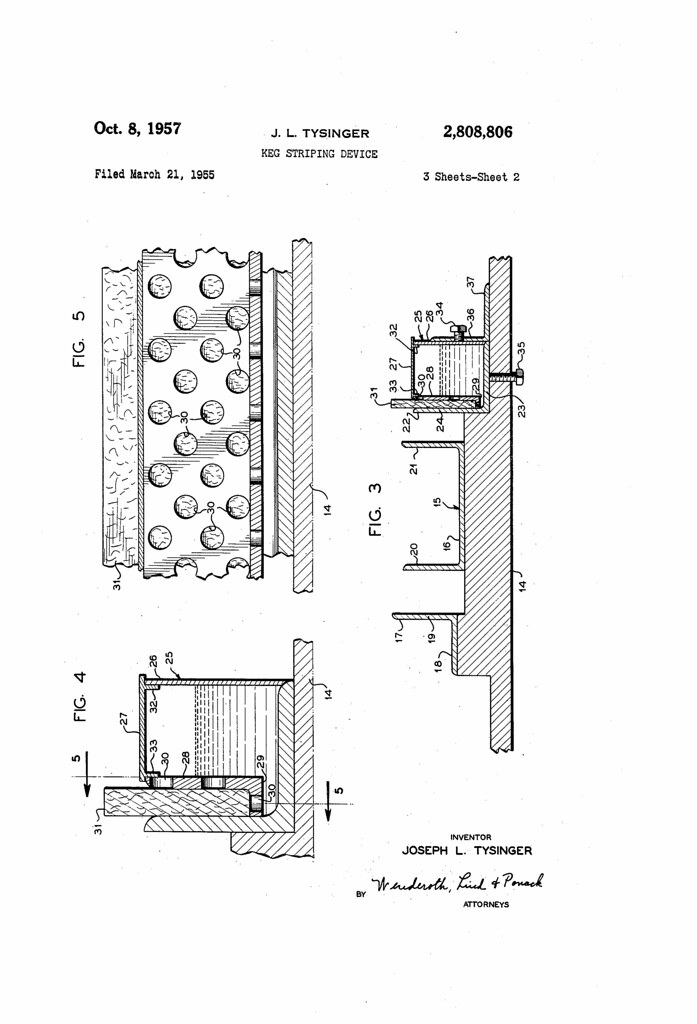
Patent No. 3608790A: Tapping Device For Beer Kegs

September 28, 2015 By Jay Brooks

patent-logo
Today in 1971, US Patent 3608790 A was issued, an invention of Mack S. Johnston, for his “Tapping Device For Beer Kegs and the Like.” There’s no Abstract, although in the description it includes this summary:

The present invention relates to a new improved tapping device for drawing fluids such as beer from containers such as beer kegs or barrels using a gas to drive the fluid from the container. Particularly, the present invention relates to a new improved tapping device usable with conventional beer kegs of the type having a 1% inch tapping opening and comprising a novel keg adapter for sealing and the keg opening, a unique coupler reliably attachable to the adapter at the dispensing establishment for dispensing beer, a new siphon tube configuration for the keg adapter whereby the keg may be substantially completely drained of beer notwithstanding its employment in high-pressure systems, and a novel beer shutoff valve for the coupler whereby flow of beer from the keg to the faucet can be shutoff at the keg.

Untitled
Untitled
Untitled
Untitled

Filed Under: Beers, Just For Fun, Politics & Law, Related Pleasures Tagged With: History, Kegs, Law, Patent

GABF Awards With Photographs 2015

September 28, 2015 By Jay Brooks

gabf-2014
On Saturday, September 26, the winners of the 34th Great American Beer Festival were announced. A record 6,647 beers were judged in 92 categories by 242 judges, of which I was again privileged to be one. I was on hand at the awards ceremony and thought I’d share the results again, this time along with some of the photographs I took during the awards.

Untitled
Inside the back of the theater, about an hour before the award ceremony began.

Untitled
Justin Crossley, from The Brewing Network, on stage getting ready to simulcast the awards.

Untitled
After the theater filled up.

Untitled
A partial panorama view of the theater.

[Read more…]

Filed Under: Beers, Breweries, Just For Fun, News Tagged With: Awards, Brewers Association, GABF, Photo Gallery, Photography

Patent No. 1155009A: Beer-Racking Apparatus

September 28, 2015 By Jay Brooks

patent-logo
Today in 1915, US Patent 1155009 A was issued, an invention of Simon Schlangen and Nicholas Schlangen, for their “Beer-Racking Apparatus.” There’s no Abstract, although in the description it includes this summary:

This invention relates to improvements in Beer-Racking Apparatus, of which the following is a specification.

Among the objects’aimed at by the invention are; to provide a construction whereby it shall be possible to secure an even and uniform filling of the packages regardless of the variations in the amounts of expansion and contraction which different packages exhibit under the application and release of the counter-pressure to which they are subjected in the filling operation, to provide a construction not requiring any adjustment of parts to adapt it to the filling of packages of different sizes; to provide a construction wherein the contents of the filled package shall be vented to the atmosphere through the counter-pressure return pipe during the withdrawal of the filling tube from the package, thereby insuring the complete filling of the package by back-flow oi liquid from the counter-pressure return pipe to fill the space created by the withdrawal oi the filling tube regardless of the amount of expansion and contraction of the package; to provide a construction which will more effectively prevent waste and loss of beer at the bung of the package when the 3 seal is broken; and generally, to provide a simplified and improved racking mechanism of the type referred to.

Untitled
Untitled
Untitled

Filed Under: Beers, Breweries, Just For Fun, Politics & Law, Related Pleasures Tagged With: Brewing Equipment, History, Law, Patent, Science of Brewing

« Previous Page
Next Page »

Find Something

Northern California Breweries

Please consider purchasing my latest book, California Breweries North, available from Amazon, or ask for it at your local bookstore.

Recent Comments

  • Bob Paolino on Beer Birthday: Grant Johnston
  • Gambrinus on Historic Beer Birthday: A.J. Houghton
  • Ernie Dewing on Historic Beer Birthday: Charles William Bergner 
  • Steve 'Pudgy' De Rose on Historic Beer Birthday: Jacob Schmidt
  • Jay Brooks on Beer Birthday: Bill Owens

Recent Posts

  • Beer In Ads #5333: Bock Beer Goat Love August 29, 2026
  • Historic Beer Birthday: Hathor, Egyptian Goddess of Drunkenness August 29, 2026
  • Historic Beer Birthday: Rudolph J. Schaefer III August 29, 2026
  • Beer Birthday: Jim Woods August 29, 2026
  • Historic Beer Birthday: Charles H. Wacker August 29, 2026

BBB Archives

Feedback

Head Quarter
This site is hosted and maintained by H25Q.dev. Any questions or comments for the webmaster can be directed here.