Brookston Beer Bulletin

Jay R. Brooks on Beer

  • Home
  • About
  • Editorial
  • Birthdays
  • Art & Beer

Socialize

  • Dribbble
  • Email
  • Facebook
  • Flickr
  • GitHub
  • Instagram
  • LinkedIn
  • Pinterest
  • RSS
  • Twitter
  • YouTube

Powered by Genesis

Dr. Bill Joins Stone

March 18, 2009 By Jay Brooks

According to the Stone Blog, as of Monday, Dr. Bill Sysak has joined Stone Brewing as the Beverage Coordinator of Stone Brewing World Bistro & Gardens.
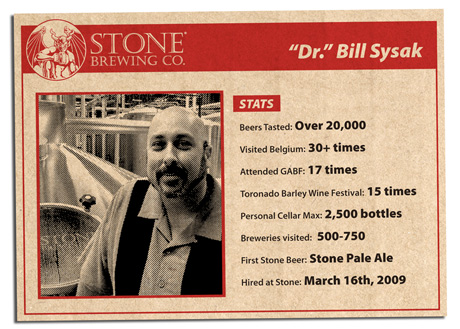
dr-bill

Believe it or not, this is Dr. Bill’s first job in the beer industry, though he’s been involved in the beer world for quite some time. I profiled Dr. Bill a few years ago for an article on Beer Geeks I did for Beer Advocate magazine. He’s justly famous for the legendary beer-tasting marathon parties he threw a few times each year. Congrats, Bill.


Filed Under: Breweries, News Tagged With: California, Southern California

My Beer Predictions for 2009

January 10, 2009 By Jay Brooks

crystal-ball
I keep seeing ads on television for Nostradamus and others’ predictions that the world will end in 2012, so I guess it’s time to get cracking on my own vague, hare-brained predictions. First of all, I do not believe the world will end on December 21, 2012 so you can stop planning your end of the world blow-out parties and put away that R.E.M. CD. It’s time once again to look into the crystal malt ball and try to divine the future. Let’s see if anything that happened last year can be used to predict what might happen in the beer industry in 2009. Here are five things I think will happen this year. Let’s see how I do a year from now. What are your predictions?

 
Collaboration Beers: 2009 will be the year of the collaboration beer, a trend that’s been building for the past few years. But this year I think you’ll see a steep rise in the number of breweries pairing up with one another to do a special beer together.

 
Food & Beer Goes Mainstream: Last year I predicted 2008 would be the year of the beer dinner, and I think that was largely correct. I was invited to more beer dinners in the first quarter of last year than the entire year before that, and not because my popularity as a dinner guest grew. More restaurants discovered just how well beer and food work with one another and, perhaps more importantly, some culinary schools finally started including beer in their curricula (it’s a sad fact that most only teach students about cooking with wine and pairing it, a decidedly narrow-minded, elitist philosophy). With so many successful experimenters last year, it seems almost inevitable that we’ll see beer pairings on menus, special dinners and an increased use of beer as an ingredient from not only more fine stand-alone restaurants, but also some chains, too.

 
Merger Shakeouts: Many people have been putting their heads in the sand, saying that the recent mergers will have no effect whatsoever for consumers or small brewers. This year they will finally be proven wrong. For some time now, distributor consolidations have been on the rise and have been making it tough for some smaller breweries to gain access to market or to have their brands adequately represented in the marketplace. With the Coors/Miller merger and the InBev acquisition of Anheuser-Busch, this will be the year what that means will come dramatically into focus as the distributor adjustments, mergers, closings, etc. settle out. I believe this will continue to make things difficult for small brewers trying to bring their beer to market or increase their distribution to new areas, but time will tell. It may, of course, create opportunities for self-distribution or new boutique distributors to be created with small portfolios of craft beers.

 
Beer Prices Will Continue To Rise: Access to most hop varieties and all malts seem secure, though prices will continue to remain high, causing additional price adjustments throughout the year. It will be two more years before acreage newly planted last year will be at full yield. Between that and rising energy costs and price going up for virtually everything, it’s inevitable that the price of beer will go up again. I think the major companies will try their best to keep prices down as best they can, but it’s going to be difficult for them to continue with rzor-thin margins, especially with the rising costs plus at least one having to pay of the largest cash-buyout in history.

 
New Drys’ Attacks Will Be More Aggressive: As we saw in 2008, Neo-Prohibitionists will use almost any tactic to further their agenda. They really ramped up their attacks on drinking society and showed just how far they were willing to go to remove alcohol from society. I think we’ll see that played out more and more and no doubt we’ll see many states tax structures targeted as the economy tanks, with alcohol used as a convenient scapegoat to pick up the tab for years of fiscal irresponsibility not of their making. Beer will again, as usual, take the major brunt as the New Drys perceive it the greater threat because of its popularity. As the backlash of their failed policies continue with new common sense suggestions of returning the drinking age to 18 to be in line with the rest of the civilized world will expose them to more and more criticism, and hopefully more and more politicians will be emboldened to ignore their bullying tactics, but sadly that may still a few years in the future.


Filed Under: Beers, Breweries, Editorial, Just For Fun, News Tagged With: Predictions

Sacramento Closes Oasis, But Still Brewing

January 5, 2009 By Jay Brooks

sac-brew
I learned today that the Oasis location of Sacramento Brewing on Madison Avenue in Citrus Heights has closed its doors for good. The original location at Town and Country Village is alive and well and will continue as usual. Recent rumors that Sacramento Brewing was in danger of closing are simply not true. After the remaining beer in the tanks at Oasis is finished, all production — including bottling — will take place at Town & Country.

I’m told business at the Oasis location was always hand to mouth, even from the very beginning, but with the economic times we currently face dipped down below profitable levels. At Town and Country, on the other hand, business remains good and the new owner is optimistic and confident that will continue.

Head brewer Peter Hoey tells me that he will concentrate on having at least a dozen Sacramento beers on tap at any given time and will begin introducing guest taps, possibly as many as 24 in an effort to make the brewpub a Sacramento destination for not only his beers, but better beers of all stripes.

sacbrew-oasis
Some some good news, some bad. I’m certainly pleased to learn that the brewery is not closing. I think Peter is a talented, under-appreciated brewer so it will interesting to see what he comes up with this year in the way of specialty beers, which he promises won’t be dull.

Filed Under: Breweries, News Tagged With: California, Northern California, Sacramento

Toasting the New Year 2009

January 1, 2009 By Jay Brooks

newyears
Here at the Brookston Beer Bulletin we’re pausing today to wish you and yours a very Happy New Year. 2008 was yet another interesting year and was rarely dull with plenty of drama. Nobody knows with any real certainty what 2009 will be like for the beer industry, but I’ll be here for my fifth straight year of ranting about it, er .. analyzing it, online. I hope you’ll join me on another year’s worth of adventure in the beer world.
 

nyd09-1
Taken a few minutes ago in front of the Christmas tree; Alice, Porter and a tasty beer. What better way to start the new year. Sometime tonight raise a glass of a tasty libation as we toast you a Happy New Year with one of my favorites:

Observe, when Mother Earth is dry,
She drinks the droppings of the sky,
And then the dewey cordial gives
To every thirsty plant that lives.

The vapors which at evening sweep
Are beverage to the swelling deep,
And when the rosy sun appears,
He drinks the misty ocean’s tears.

The moon, too, quaffs her paly stream
Of lustre from the solar beam;
Then hence with all your sober thinking!
Since Nature’s holy law is drinking,
Mine’s the law of Nature here,
And pledge the Universe in beer.

            — Tom Moore, The Universal Toast

 
nyd09-2

This is one my favorite out-takes. I have plenty more of the kids mugging for the camera and making some pretty funny faces. And here’s one final toast.
 

Too much work, and no vacation,
Deserves at least a small libation.
So hail! my friends, and raise your glasses;
Work’s the curse of the drinking classes.

            — Oscar Wilde

Welcome to 2009.

Here are more of my favorite toasts. Let me know if I’m missing one of your favorites.

Filed Under: Just For Fun, News Tagged With: Holidays, Personal, Poetry

Here We Go Again: Beer & Taxes

November 9, 2008 By Jay Brooks

tax
Those nattering nabobs of negativity, the Marin Institute, are gleefully spreading the word that the Governator, Arnold Schwarzenegger, is proposing to raise the tax on beer in order to get California out of the mess that he and the rest of the gang of idiots — collectively known as politicians — got themselves into, dragging us down with them while constantly trying to figure out how to make us pay for their mistakes. So no, I don’t feel too strongly about this issue.

Naturally, they’re characterizing it as a “modest” proposal and continue to justify it with faulty arguments and no understanding of history. But you’ve got to love how they feel about those of us in the beer business. “Despite the whining by industry about a tax increase, the time has come for Big Alcohol to pay its fair share of the cost burden of problem drinking in California. They’ve dodged the bullet for too long.” So I think it’s fair of me to point out that I’ve been quite correct in saying that they’ve been shooting at us, gunning for us, trying to bring us down. They chose the perfect way to phrase that, some old-fashioned honesty for a change. The neo-prohibitionists have been attacking our industry, and we’ve been dodging their bullets. But responding to those premeditated attacks, and trying to defend ourselves, that they consider “whining.” Really? For Schwarzenegger it may be about the money, but for these chuckleheads it’s moral indignation.

tax-man

So here’s the lie. The neo-prohibitionists talk about how little taxes are paid on beer, as if breweries are getting away with something. Or that it’s the responsibility of alcohol companies to pay for how a minority of drinkers abuse it and exercise incredibly poor judgment. They don’t seem nearly as quick to make gun makers responsible for a crime committed using one of their guns. They’re not suggesting fast food companies be held accountable for their role in creating an obese, unhealthy populace and placing a huge burden on medical facilities. They want beer companies to pay for medical expenses supposedly caused by a minority of their customers abusing alcohol. Please explain to me how that’s different from the health risks posed by fast food, soda, red meat, and all manner of overindulgences? And what industry does the most harm and places the biggest costs on our society? That would be the automotive industry, along with the the related oil interests.

But let’s assume, just for talking about it, that beer should pay those taxes. Le’s get back to that notion that the industry is getting away with something, underpaying our “fair share,” as it were. The state excise taxes that they’re talking about bumping up a nickel, and saying that they haven’t been raised since 1992 is, of course, nowhere near the whole story.

In addition to those taxes, breweries pay many other taxes on the beer you enjoy. It’s not just that one tax. In fact, about 44% of the cost of your beer goes to taxes of one kind or another. That’s nearly half! Here’s a list of many of the taxes that go into that 44%.

Taxes Paid On Beer

  • Federal Excise Tax on Beer
  • State Excise Tax on Beer
  • State Sales Tax on Beer
  • State Sales Tax on Federal Excise Tax
  • State Sales Tax on State Excise Tax
  • County Sales Tax on Beer
  • County Sales Tax on Federal Excise Tax
  • County Sales Tax on State Excise Tax
  • Federal Income Tax
  • Federal Payroll Tax
  • Workmen’s Compensation Taxes
  • Unemployment Insurance Taxes
  • State Property Tax
  • Local Property Tax
  • Federal State and County Gas Taxes
  • Tire Excise Tax
  • Truck Highway Use Taxes
  • Heavy Truck Excise Taxes
  • Telephone Excise Tax
  • Business License Fees
  • State Insurance Premiums Tax

But wait. Don’t other businesses pay all of those taxes, too? Why yes they do, all except the excises taxes, state and federal, and the taxes on the excise taxes. Those are unique to alcohol (and also tobacco) and are, I think, at the heart of what’s wrong with the neo-prohibitionists argument. But I’ll go into that later. For now, what do those additional unique taxes add to what other businesses have to pay in order to do business. “According to a 2005 study by Global Insight and the Parthenon Group, more than 40% of every beer sold in the United States is consumed by taxes. In fact, the total tax burden adds up to nearly 70% more than the average amount of tax paid in the U.S. on all other purchases. That represents well above $10 billion in extra taxes paid on beer.” So much for the beer industry not paying its fair share.

But where did that excise tax come from? Why do brewers pay it now, when no other industry, save tobacco, has to? Well the history of excise taxes stretches back to the Civil War, or War Between the States for my southern readers. During Lincoln’s first term, the North had to raise money to finance the Civil War and they turned to the beer industry, among others, to help finance the war effort. I just wrote about this, shortly before the election, so I’ll just quote myself and pick up the story here.

In Brewing Battles, by Amy Mittleman, she details how in July of 1861, the US Congress (or a least what was left of it in the north) levied the first income tax on the remaining states in order to raise money to fight the war with the southern states. By the end of the year, Congress realized it wasn’t enough and they needed a way to raise more funds for the war. In a special session in December 1861, Congress reviewed a request by the Secretary of the Treasury, Salmon P. Chase, to raise the percentage of income tax slightly and levy excise taxes on a number of goods, including beer, distilled spirits, cotton, tobacco, carriages (the automobiles of the day), yachts, pool tables and even playing cards, to name a few. The amendments passed, and Lincoln signed them into law July 1, 1862. They took effect September 1. Several weeks later, the first trade organization of brewers, the United States Brewers Association (USBA), was founded in New York.

Excise taxes are a “type of tax charged on goods produced within the country (as opposed to customs duties, charged on goods from outside the country).” The excise taxes were intended to be “temporary” but it was the beginning of temperance sentiments in the nation, and many people objected to alcohol on moral grounds. In the decade following the war, most were rescinded, but the taxes on alcohol and tobacco were the only two to remain in force, and in fact are still in effect today.

The only reason these excise taxes remained after the Civil War was primarily on moral grounds, coming from prohibitionist organizations. And I think that’s still relevant in 2008 because today’s neo-prohibitionists are also trying to use a moral sledgehammer to raise taxes on alcohol in an effort to put beer companies out of business and/or bring about another national prohibition. In state legislatures in many states, neo-prohibitionist groups are trying a variety of tactics to further their agenda. Usually it’s couched in propaganda that pretends they’re concerned for the children, or people’s health or some other hollow claim that hides their true aims.

I still find the argument strange that there should be higher taxes on products some people find morally objectionable. I find soda morally objectionable because it’s so unhealthy that it’s contributing to a nation of obese kids (and adults) — not to mention that beer in moderation is much healthier for you. But I wouldn’t argue pop should have an excise tax. The very concept of a so-called “sin” tax seems antithetical to the separation of church and state. Sin is a religious concept, and should play no role whatsoever in our government. Making people pay a higher price for goods that other people don’t like seems not only a little cruel, but also contrary to freedom of religion, because those are the morals people are using to deny people getting (or making prohibitively expensive) certain goods that not everyone agrees are sins. By using one set of morals as the basis for a particular law (in this case an excise tax) it ignores other sets of morals that differ from the prevailing one. That’s how a theocracy works, and we’re not one yet, despite recent efforts to make religion a central issue in government.

beer-excise-taxes

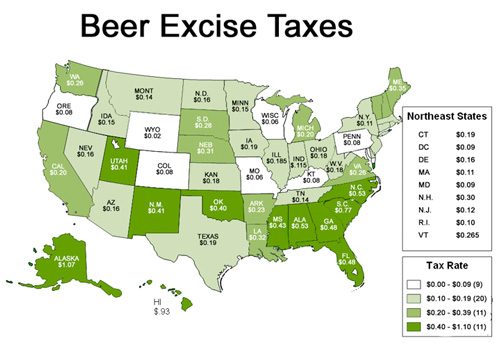
That’s the federal excise tax, and there’s an interesting part of that story, too, which we’ll get to. After Prohibition ended in 1933, most states imposed a new state excise tax as a part of allowing alcohol back into society legally. Today, each state’s excise tax is very different, with Alaska being the highest and Wyoming the lowest. California’s in the middle, tied at 21st (see this chart of State Beer Excise Tax Rates). And it’s that particular tax that California wants to raise a nickel now. So let’s return to the neo-prohibitionist argument that the California excise tax hasn’t been raised since 1991. What they don’t mention is that around the very same time, the tax burden for breweries jumped up considerably, when Congress doubled the federal excise tax in 1991, jumping from $9 per barrel to $18!

Here’s what happened, from Roll Back the Beer Tax:

In 1990, Congress raised taxes on luxury items like expensive cars, fur coats, jewelry, yachts, and private airplanes and doubled the federal excise tax on beer. This was the largest single increase in the tax on beer in American history and resulted in some 60,000 people losing their jobs in brewing, distributing, retailing and related industries.

Today, all of the other luxury taxes have been repealed, but the beer tax remains in place. The tax burden on beer is far higher than the average consumer good in the American economy. Astonishingly, over 40% of the cost of every beer sold is comprised of taxes. This means working Americans continue to reach into their pockets to pay the beer tax … at the rate of $5.2 billion a year.

And here’s why excise taxes are such a bad deal for the economy:

A tax is considered regressive if it falls more heavily on lower- and middle-income families than on the wealthy. And this is certainly true with beer taxes. This has long been recognized, but perhaps underappreciated. Analyses based on recent data from the Consumer Expenditure Survey clearly show that beer taxes are very regressive, as a percentage of income, costing lower- and middle-income households many times more than those with more comfortable incomes. A recent Beer Institute analysis found that beer taxes are actually 6.5 times higher as a percent of income for lower-income households (those earning less than $20,000 per year) compared to higher-income households (earning $70,000+ per year). As a result, the tax on beer is one of the most regressive of all taxes in the federal and states’ tax codes.

Viewed another way, 50% of all beer, is purchased by families with incomes of $50,000 or less, though these households account for less than one-fourth of all income earned in the U.S.

Sadly, the fact that beer taxes are very regressive has been known for quite some time, yet they continue to persist. A strong case can be made for rolling back or reducing beer taxes, based on the simple fact that research has exposed – notably, by Citizens for Tax Justice (CTJ) and the Institute on Taxation and Economic Policy (ITEP) – that the overall tax systems in many cases are already disturbingly regressive with many becoming decidedly more regressive in the past decade or more. According to the report, “sales and excise taxes are the most regressive element in most state and local tax systems.”

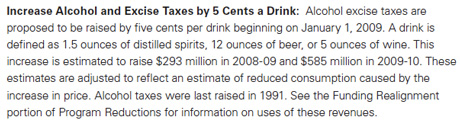
But let’s get back to California’s proposal. Here’s the language from the budget proposal (it’s an image because the pdf is locked for copying the text. If you have trouble reading this, download the original pdf for the Budget Proposal):

calexhike08-1

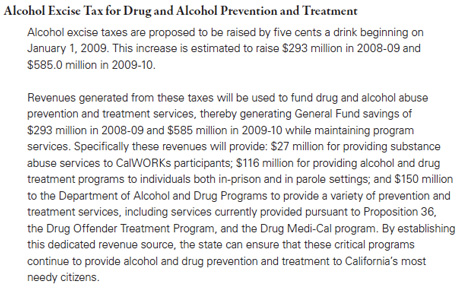
So let’s go the Funding Realignment, as they suggest. This is undoubtedly what the Marin Institute is crowing about when they say revenues from the new tax will be “providing critical support to programs that deal specifically with alcohol-related problems.”

calexhike08-2

But take a closer look at that language. What is says is that “[r]evenues generated from these taxes will be used to fund drug and alcohol abuse prevention and treatment services.” [my emphasis.] Hmm, why is the brewing industry also funding drug abusers? The argument being advanced to justify all of this is that beer industry is supposed to fund the problems neo-prohibitionists insist they created. Well, I’m pretty sure you can’t pin that on the monkey on your back, that “H” problem or your crack addiction on beer. Even using their own logic, such as it is, that seems incredibly unfair.

This isn’t the first time, even recently, that beer has been tapped to fix budget problems not of their making. For the morally indignant, it apparently fits some weird moral compass to punish an industry they don’t agree with in order to to fix the shortcomings of our politicians. Earlier this year, state congressman Jim Beall proposed raising beer taxes 1400% for “health reasons” and in June the Sacramento Bee weighed in with their own nonsensical proposal, though that time the bogeyman was specifically alcopops. Here’s what I said then, modified slightly:

The idea that beer drinkers should have to pay for our state’s fiscal irresponsibility is so ridiculous that I’m amazed the argument can be made with a straight face. But that’s what many have proposed, in effect, the Sacramento Bee weighed in with their own absurd idea, that goes like this: “Psst! Hey, legislators — looking for some fast cash to ease the budget crisis? Think booze.” The faulty logic, downright incorrect statements and tortured reasoning are in virtually every sentence. It’s as if up really were down in the Bee’s worldview.

The Marin Institute, an alcohol industry watch group [who originally floated this idea], estimates that raising taxes on all alcoholic beverages just 25 cents per drink would raise $3 billion. That’s money the state desperately needs from an industry that has not paid its fair share for a long, long time.

As a colleague of mine put it, “saying the Marin Institute is “an alcohol industry watch group” is like saying the Taliban is a cultural and morality watch group.” The Marin Institute is nothing so grand. They are quite simply a neo-prohibitionist group who wants to return to a time when all alcohol is illegal and they will use any means necessary to achieve that goal. But that aside, saying that taxes should be raised because “the state desperately needs” it is not a valid reason. It may be a result, but what kind of world would we have if every time we needed money, our government looked around for somebody they didn’t like and decided to target them for higher taxes. That’s not a world I’d want to live in. That’s certainly not the high-minded ideals we should be aspiring to.

Where the taxes on any good or product made should be a policy decision based on a variety of factors, none of which should include manufactured hysteria, the agenda of a misinformed and misguided minority, or an opinion based on a lack of truthiness by an apparently biased newspaper.

So no matter how you look at this, it just makes no sense, has no internal logic, and just feel like as an industry we’re being attacked once again. Apart from raising the tax on oil found in California and the sales tax on certain goods that weren’t subject to it in the past — like appliance and furniture repair, automotive repair, amusement parks, sporting events and veterinarians — beer has been singled out for special assessment again. That so many feel that it’s fair to do so, I find remarkable, especially since proponents do not see how they’re using morality to solve political problems. But perhaps they do know full well what they’re doing but just don’t care about fairness. What’s important is their agenda, and the real consequences to those who disagree with them are inconsequential. I sometimes feel like they don’t consider their opponents — you and me — as fully human. Or perhaps they see us as children who need their moral guidance, though meted out with a bludgeon — tough love indeed.

From a purely pragmatic position, placing a burden on a not insignificant part of the state’s economy seems misguided at best. Of California’s $1.6 trillion economy, the beer industry represents $24,646,539,216 or just over 1.5%. In difficult economic times, why would you try to harm such a large percentage of it? For those of us who can look past the moral arguments, it feels a little like shooting oneself in the foot.

The Marin Institute doesn’t see that, of course, and wants to shoot everybody in the foot. They claim “[a]t least 38 other states also face serious budget deficits, totaling more than $60 billion dollars, according to the Center on Budget and Policy Priorities. ‘A nickel a drink — It’s the change we need to fix budgets around the nation,’ said Bruce Lee Livingston, executive director of Marin Institute, the California-based alcohol industry watchdog. ‘The largest states, such as New York and Florida can avoid cutting essential programs through long-overdue alcohol tax increases,’ Livingston added. California’s proposal accomplishes exactly that.” Don’t you believe it. The California budget deficit is $11.2 billion. The Governor’s proposal estimates raising only $293 million from the beer industry. That comes nowhere close to “fixing” our budget, and simply unfairly harms an industry already struggling to recover from record increases of crucial ingredients, like hops and malt.

There’s no doubt we need to fix the budget deficit gripping California, and in the many other states where it’s an issue. And let’s not forget the record federal deficit that eight years of Republican neocon rule have run up, the same folks in favor of us returning us to a national prohibition. As of this morning, it was $10,636,486,383,932.04. According to the U.S. National Debt Clock, the “estimated population of the United States is 305,064,289 so each citizen’s share of this debt is $34,866.38. The National Debt has continued to increase an average of $3.99 billion per day since September 28, 2007!” Our economy is obviously in serious jeopardy. But this is a problem that affects us all equally, and any solutions should likewise be distributed evenly among the citizenry. Any other result is simply patently unfair.

Filed Under: News Tagged With: Uncategorized

Dinosaur Beer

September 2, 2008 By Jay Brooks

t-rex
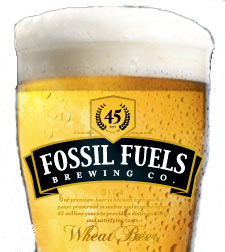
No, I don’t been those lumbering giants making flavorless beer-like industrial beverages which we all hope might one day become extinct, I’m talking about a beer made with roughly 45-million-year old yeast found in a bug entombed in amber, and extracted just like the plot of Michael Crichton’s Jurassic Park. This time around, the story involves Fossil Fuels Brewing Co., whose owners include Dr. Raul J. Cano, the Emeritus Professor at Cal. Poly in San Luis Obispo who originally made the discovery. According to the story in today’s Washington Post, the breakthrough came last month.

“I was going through my collection, going, ‘Gee whiz — this is pretty nifty. Maybe we could use it to make beer,’ ” says Cano, 63, now the director of the Environmental Biotechnology Institute at California Polytechnic State University in San Luis Obispo.

Last month? Hold on just a second. First of all the article mentions the following:

In April, at the World Beer Cup in San Diego, “we had one judge give us the highest marks, one just below and one who didn’t like it,” says Chip Lambert, 63, the company’s other second microbiologist. “We learned that the issue was that in these competitions, you brew to match the traditional concept of the style, which these yeast just don’t do.”

Ignoring for the moment that the World Beer Cup isn’t judged like that (there are no “highest marks” or anything similar), the Washington Post published this article yesterday, September 1. That would mean the World Beer Cup took place five months ago, not to mention that to enter that competition you have to register and submit your beer well in advance of the actual judging. I’m not trying to quibble with the story, a least that wasn’t my original intent, but this just doesn’t add up. Last month? Setting all that aside for the moment, I wrote about this two years ago, when Stumptown Brewing, in Guernville, California, made a beer called Tyrannosaurus-Rat, also using Dr. Cano’s ancient yeast.

This is part of what I wrote in Fall of 2006 in the Celebrator Beer News, reviewing a beer and barbecue festival held along the Guernville River at Stumptown:

But as good as the barbecue was, I was there for the beer. I was particularly keen to try what Stumptown was billing as a beer made with the world’s oldest yeast. Their “Tyrannosaurus-Rat” — or T-Rat for short — was essentially their popular “Rat Bastard,” but brewed using yeast that was 30 million years-old, give or take a few million years! How it got to be in Stumptown’s beer is nearly as interesting as the beer itself. It was discovered in the Dominican Republic trapped inside of a bee that was also trapped inside of a piece of amber, a terrific preservative. And the bee had been there for somewhere between 25 and 40 million years. Dr. Raul J. Cano, Emeritus Professor at Cal. Poly in San Luis Obispo, made the discovery in 1995 and managed to extract living bacterium, including a few strains of yeast, directly from the bee’s stomach. The ancient microorganisms were patented and also inspired the movie “Jurassic Park II.” It fell into Stumptown’s lap during a ski trip where the Hackett’s met a friend of Dr. Cano, and the rest, as they say, is literally ancient history.

I tried the T-Rat alongside of its modern counterpart, Rat Bastard, as they were the same in all respects except for the yeast. The Rat Bastard is a well-made pale ale, with good aromas and a crisp, clean palate. It has a generous hop bite that finishes bitter, then drops off sharply in the end. The T-Rat was much smoother, with softer, fruity flavor characteristics and just a touch of lemony sweetness that wasn’t tart. The finish is quite clean, with just a quiet hop presence lingering. While they’re both good beers, I think the T-Rat has a more complex, developed taste profile but its smoothness makes it great. The fact that it was made with such an old yeast is fascinating and given how good the beer is, no mere novelty.

There are also other anomalies. In my story, which relied primarily on Stumptown’s information, the yeast was found in a bee from the Dominican Republic. The Washington Post account, however, lists the Lebanese weevil as the yeast carrier. On top of that Dr. George Poinar, who was also involved in finding and extracting the DNA from amber, says on his biography web page that its age was 125 million-years old.

And here is the original press release for Stumptown’s version of the beer, from June 27, 2006:

For the first time, 25-40 million year old yeast has been used to brew a commercial batch of beer (“Tyrannosaurus Rat”) to be made available to the public on July 8th at Stumptown Brewery (15045 River Rd. Guerneville, Ca.). Dr. Raul Cano, Lewis “Chip” Lambert, and Peter Hackett will be celebrating this historic event and available for questions from 11:00A.M. on Saturday July 8th.

The public tasting of the T-Rat is the culmination of coincidences that involved a 20-40 million-year old bee trapped in amber and discovered in the Dominican Republic, a pair of renowned scientists, a ski weekend and an award winning microbrewery.

Amber is nature’s perfect preservative. It desiccates its specimens and protects them from damaging radiation of all types. Man has successfully used it to preserve their dead for thousands of years; Nature has preserved many of its inhabitants, including the recently identified spider web, in their elegant tombs for tens of millions of years.

Dr. Raul J. Cano, Emeritus Professor at California Polytechnic State University, San Luis Obispo, reported in Science (Volume 268, May 19, 1995) that he extracted a living bacterium from the gut of a stingless bee entombed in amber 25 – 40 million years ago. Independently, Lewis (Chip) Lambert, Fremont, CA, at the time Director of Pre-Clinical Research at a Bay Area biotech company, confirmed his work in a very skeptical scientific environment that has, for the most part, accepted its validity. In addition, Raul’s work became the underlying premise for the movie Jurassic Park.

The patented ancient microorganisms (USPO#5,593,883) became the focus of a new company based on the potential use of these microbial isolates for industrial and medical applications, and the hunt began. From the ancient-amber library came a few yeast strains and with them, the question, could they be used to make beer? The answer was a resounding yes as very good beer was brewed for the Jurassic Park II cast party and Raul’s daughter’s wedding reception.

After this initial success, Fossil Fuels Brewing Company was born with the motto “We bring good things back to life.” Using ancient yeasts that had all been thoroughly tested and selected for their beer-making properties, Fossil Fuels Brewing Co. planned to produce high quality distinctive beers with yeasts that had been isolated from amber.

The partners then proposed trials of these ancient yeasts to numerous microbreweries. Much to their surprise, in an industry that thrives on innovation, found a lack of enthusiasm among commercial breweries.

Fast forward a few years to the snowy slopes of Alpine Meadows where Carla Hackett was taking a ski lesson from Raul’s now friend and business partner, Chip. Carla had all the attributes of a great skier that her husband, an Aussie who owns the Stumptown Brewery in Guerneville, lacks. On the second, never the first, ride up the chair lift, an important relationship was established when the question was raised, “would you like to make some beer with some patented, 35-million year-old yeast?” The affirmative response started a brewing relationship between Stumptown Brewery and Environmental Diagnostics, Inc.

This random path led the ancient yeast to Stumptown Brewery on May 6th where Peter, Owner/Brewer, put the yeast to work. On June 21st came the news that “T-Rat” had finished fermenting and was conditioning. Perhaps most importantly, that it’s “very good, very unique. The yeast character is unusual, exotic, and very pronounced”.

fossil-fuels

On page two of the Post piece they finally do mention Stumptown’s involvement. The new versions, which include a wheat beer and a pale ale, are made at Kelley Bros. Brewing, which is in Manteca, California. I really enjoyed the pale ale version that Stumptown brewed and will eagerly try these two new versions. But I’m still a bit bewildered by the discrepancies that seem to accompany this story. But I guess history itself is a lot like that, so maybe it’s fitting after all. I wonder what “Cheers” is in dinosaur-speak? “Here’s tar in your eye?”

Filed Under: Beers, Just For Fun, News Tagged With: History

Craft Beer Up 11% In 1st Half Of 2008

July 29, 2008 By Jay Brooks

The midyear numbers are out, and things couldn’t look better, which is especially wonderful under the circumstances. The Brewers Association released sales through the first half of 2008 and growth of craft beer by dollars is up a very healthy 11%.

According to their press release, “The Brewers Association attributes this growth to a grassroots movement toward fuller flavored, small batch beers made by independent craft brewers.” I’m all for that, but since it’s dollars one must at least speculate that higher prices for craft are driving that number, at least to a certain extent. Since others (admittedly with an agenda of showing craft in not the best light) have suggested that craft sales are slowing, it’s tempting to worry about the absence of where volume of sales is for the first half of the year. But as the Nielsen Company, points out, “beer sales are affected the least by the economic downturn, with wine sales showing the most impact. Additionally, craft beer is gaining customers from across all segments of beverage alcohol.” So perhaps I’ve no reason to worry after all.

More from the BA’s press release:

“Newer brands by the larger brewers, like Belgian style wheat beers, have huge distribution advantages over beers by independent craft brewers,” said Paul Gatza, Director of the Brewers Association. “These brands can grow when the large brewers decide they want them to grow with the ability to impact what brands get shelf space and tap handles. At the same time, beer from craft brewers is being requested by the customer, which encourages distributors and retailers to make the beer available.” According to the Brewers Association, 1,420 of the 1,463 U.S. breweries are independent craft brewers.

The Brewers Association reports that in the first half of 2008 volume of beer sold by craft brewers grew by 6.5% totaling an estimated 4 million barrels of beer compared to 3.768 million barrels sold in the first half of 2007. Harry Schuhmacher of Beer Business Daily stated, “Crafts have really taken pricing this year given high input costs, and yet it is still driving volume gains faster than the beer category.”

But if the numbers all bear this out, then it’s very good news indeed. With rising prices across the board for all manner of food and beverages, there has been much speculation about whether consumers would continue to be willing to spend more for craft beer or would retreat back to the cheaper stuff from the big beer companies. The initial anecdotal evidence I’d been hearing suggested to me that sales by most breweries had not suffered significantly from higher prices at retail and at the tap. More than a few people I’ve talked to in the last several months have said demand is still rising unabated. The BA’s stats do appear to bear that out, so hopefully what initially seemed like a brick wall staring us down in the near future might in reality be another hurdle, but one which can be jumped over with a good business plan and, most importantly, a good-tasting, full-flavored beer.

Filed Under: Breweries, News Tagged With: Press Release, Statistics

Brewers Day Profile: Brian Hunt

July 18, 2008 By Jay Brooks

moonlight
Shortly after I launched the website for International Brewers Day, I got an appropriately curmudgeonly comment disdaining the idea from my friend Brian Hunt, who owns Moonlight Brewing. Here’s what he had to say.

Let’s all just make good beer and drink it. The Brewer’s Association will log acres of forests for special posters and mailings. I can see Hallmark jumping on this one big time, and before long you’ll have to wade through all the K-Mart “holiday” ads looking for that right something for the brewers in your life. I vote no on this.

While hardly shy, I think having worked in the moonlight for so many years has made Brian shy away from the limelight. That alone made him the perfect choice for my first IBD profile. He is, to my mind, one of the truly unsung heroes of brewing, quietly making some of the nation’s best beers.

And happily I’m not the only one. In an article entitled Czech Mate, published in Forbes, the author reveals that of all the beers rated on Beer Advocate, Moonlight’s Reality Czech is the only golden lager on their list of the “Top Beers on Planet Earth.” Unfazed, Hunt explains.

“We have almost no concept in this country that we can have a beer that is light but also flavorful and vibrant,” explains Brian Hunt, Moonlight Brewing’s owner (and sole employee). “Making a great lager like that requires more time, more skill and more expense than making an ale.”

moonlight-ibd2

Brian Hunt was, of course, born in a log cabin near Sacramento, and walked ten miles to school, uphill — both ways — through blizzards in winter and punishing heat in summer. Alright, everything in that last sentence, except Sacramento, I made up. But Brian’s past just cries out to be remade as mythic fable.

ibd-vertical-red-grunge

Brian started college at U.C. San Diego as a biochemistry major, but soon realized that most of his fellow students were pre-med, a path he decidedly was not interested in pursuing. So he transferred to U.C. Davis to study fermentation sciences with an eye toward becoming a winemaker. But fate stepped in when he was randomly assigned Michael Lewis as his advisor. Needing income, he found himself working in Lewis’ laboratory and found it was easy to be persuaded to concentrate on beer instead of wine. He found his fellow brewing students much closer to his own temperament, more down to earth and fun. “Beer just seemed more enjoyable.” Hunt remarked.

After graduating with a degree in Fermentation Sciences in 1980, Hunt relocated to the heart of early brewing — Milwaukee, Wisconsin — to take a job at the Schlitz Brewery. He loved the history of the place. Everywhere you looked it was there. Hunt spent about eighteen months working for Schlitz. There were no computers in the place. Every step they took was done manually, so you learned the reason why you did certain things, and you could extrapolate those to subsequent steps, too. As a result, he learned a lot in that year and a half, crediting that experience with setting the tone for the rest of his career.

He moved back to California in 1981, brewing at the now long gone Berkeley Brewing Co., making ales and lagers on a 40-bbl system. After that venture went belly-up, he consulted on several brewing projects throughout the Bay Area, before ending up at Acme Brewing in Santa Rosa, California in 1985. He was there two years, but the brewery never had much of a chance owing to financial issues that the owners had not anticipated. The majestic 100-bbl brewhouse finally made its first batch of beer on March 2, 1987, but it was too late. Hunt says of his time there that it was a great MBA project and he learned most of what he needed (whether he wanted to or not) about the business side of the brewing industry.

When the Santa Rosa brewery finally shuttered its doors, Brian spent some time working for the other team at Grgich Hills Winery before a brief stint formulating two beers (whose recipes have since changed) and helping layout the brewery itself at the early Anderson Valley Brewing Co. in Boonville.

In 1988, Brian finally opened his own place in Napa with a descendant of the Hamms brewing family. He had a 1/3-share of Willett’s Brewing Co. (now Downtown Joe’s) from sweat equity and $1,100 of his own money. But by 1992, a get-rich-quick lawsuit brought by one of the brewpub’s employees forced Willett’s into bankruptcy. Brian Hunt saw the writing on the wall, and when someone phoned him to offer 100 Hoff-Stevens kegs, he bought them for himself and began … well, moonlighting.

moonlight-ibd3

The original Moonlight brewery was built in a barn behind the house he was renting. He built the entire system himself using equipment cobbled together from a variety of sources. Brian bought old kettles from a winery that couldn’t boil water, and so had to be adapted. Quite a number of items from Sierra-Nevada’s yard sale (when they opened their own larger brewery in Chico) found their way into Moonlight’s brewery barn, including fermenters and a keg washer. The whole enterprise was financed with credit cards and a $20,000 personal loan. The initial brewhouse included a 7-bbl system.

The original name was going to be Old Barn Brewery, but it never sounded quite right. New Moon Brewing was also an early contender of the hundreds of names that were brainstormed. But once the name Moonlight was floated, there was no turning back. It just worked on so many levels and it seemed to mean different thing to different people, a quality Hunt relished.

For the first two-and-a-half years, beginning in 1992, Brian literally slept 5-1/2 nights out of every seven. He was working two jobs, one at the newly opened Downtown Joe’s (where the bankrupt Willett’s brewpub had been) and at his own place in the barn. This continued until he could afford to concentrate just on Moonlight Brewing. But just a few years into the new venture, another monkey wrench was thrown Hunt’s way. His landlord decided he wanted the house Hunt and his family lived in for his own son and told Brian they had to go. Luckily, they let him keep the brewery in the barn until it could be moved. In 1999, Hunt and his family moved to their present location. It would take another four years until all he permits were in place and the new brewery was built. The new system was 21-bbl and was the original Hart Brewing system, which Brian bought from the Thomas Kemper brewery on Bainbridge Island in Washington. The present set-up has pieces from at least fifty different breweries, either ones that went out of business or upgraded.

stained-hops

Neither the original brewery now the new one has a computer of any kind in it, and that’s by design. It’s because of one of Hunt’s favorite quotes, this one by Albert Einstein. “Imagination is more important than knowledge.” Hunt sees one of the most important aspects of brewing as creativity and thinks of himself more as a tinkerer or toymaker of sorts. And, as he puts it, “you can’t see what’s happening if you’re just pushing buttons.” He believes that many young brewers don’t understand how to make “delicious” because of what he terms “a failure of imagination.” This is because, he says, “many are not taught how to think for themselves.

moonlight-ibd1

The first three beers Moonlight brewed are all still being made: Lunatic Lager, Death & Taxes, and Twist of Fate. Lunatic Lager’s original name, though, was Moonlight Pale Lager, so named because Hunt thought it would translate better to consumers already aware of the newly popular pale ales. The fourth beer Hunt made was Bombay by Boat IPA, also in 1992, and it was one of the first IPAs made in America. At that time, nobody really made one and certainly those few who did, did not call it an IPA.

moonlight-ibd4

Hunt believes that being small also allows him a flexibility that bigger breweries can only dream about. He can follow market trends and turn on a dime. Because he not only brews the beer, but also delivers it (he’s a one man operation, most of the time) he’s not removed from his customer but mingles and converses with them almost every day of the week.

His original plan was to hope that he could make a living in Sonoma selling whatever he brewed. Though his net is spread slightly wider than he originally thought, it’s not by much, and he’s remained true to initial vision. “I don’t find success by selling a lot, I find it by selling to people who respect it or appreciate it.” So long as that’s the case, we won’t be seeing Moonlight beer in grocery stores nationwide or even bottle locally. Brian’s just not looking for that kind of success. He’s content doing what he wants in his own way, an iconoclast to the end. As you’d expect, Hunt also doesn’t think much of competitions either. “Fame is empty.” He says. “Good beer should not be.” So while that may be a loss for the people who can’t find Moonlight beer in their neighborhood, it does make the Bay Area just that much more of special place for beer and provides yet another reason for beer fans around the world to make the pilgrimage to taste California beer.

moonlight-ibd5

Or put another way — as his pint glasses used to read — “good beer is as good beer does.”

Filed Under: Breweries, Just For Fun, News, Related Pleasures Tagged With: California, Interview, Northern California

Bud Woos Modelo

June 12, 2008 By Jay Brooks

The Wall Street Journal is today reporting that Anheuser-Busch has entered into talks with Grupo Modelo about some sort of merger or acquisition in an effort to keep InBev’s takeover bid from becoming a reality. This is at least one of the strategies that had been floated in recent weeks and months for strengthening A-B. If you’re unfamiliar with Grupo Modelo, they are the largest brewer in Mexico, with nearly a two-thirds share of the Mexican market, and I’m sure you know at least one of their dozen brands: Corona. A-B already has a 50% stake in the Mexican beer company, but it’s non-voting stock and thus they have no control over the business. Today’s AP story regarding the InBev deal mentioned that InBev’s weak performance last quarter makes getting enough equity to complete the takeover possibly problematic, meaning that an A-B that also included control of Corona would be more expensive, which might be enough to kill the deal. Strap in folks, this is getting interesting.


Filed Under: Breweries, News Tagged With: Anheuser-Busch, Business, Modelo

International Brewers Day

June 11, 2008 By Jay Brooks

Two Sessions ago I suggested that we set aside a day to honor the men and women who brew beer. I further suggested that July 18 be the day, because it is St. Arnold’s Feast Day, one of the most prominent patron saints of brewing. I’ve now set up a website (brewersday.org) and with the help of a graphics designer friend (thanks Ken), created some graphics, buttons and banners, to help promote the holiday. Take a look at the website and let me know what you think of it and, of course, about the holiday itself. Any constructive suggestions will be greatly appreciated.

With just over a month to go until the first International Brewers Day, I hope you’ll join me on July 18 in raising a toast to all the men and women who make the great beer we all love.


Filed Under: News Tagged With: Holidays

« Previous Page
Next Page »

Find Something

Northern California Breweries

Please consider purchasing my latest book, California Breweries North, available from Amazon, or ask for it at your local bookstore.

Recent Comments

  • Bob Paolino on Beer Birthday: Grant Johnston
  • Gambrinus on Historic Beer Birthday: A.J. Houghton
  • Ernie Dewing on Historic Beer Birthday: Charles William Bergner 
  • Steve 'Pudgy' De Rose on Historic Beer Birthday: Jacob Schmidt
  • Jay Brooks on Beer Birthday: Bill Owens

Recent Posts

  • Beer In Ads #5137: Bock Is Back… Look For It March 1st February 28, 2026
  • Historic Beer Birthday: John Holme Ballantine February 28, 2026
  • American Craft Beer Hall of Fame: 2nd Year Inductees February 28, 2026
  • Beer Birthday: Jeff Bell February 28, 2026
  • Beer In Ads #5136: American Bock Beer Is Being Served Today! February 28, 2026

BBB Archives

Feedback

Head Quarter
This site is hosted and maintained by H25Q.dev. Any questions or comments for the webmaster can be directed here.