

The Oregonian is reporting that the Craft Brewers Alliance (essentially Widmer, with RedHook and distribution of Goose Island and Kona) will purchase Kona Brewing for $13.9 million. Under the terms of the agreement, Kona will become a “wholly owned subsidiary” and Mattson Davis will remain at the helm, with brewing for the mainland continuing to be done at Widmer and RedHook breweries.
Tragedy At Connecticut Beer Distributor

Tragedy struck earlier this morning at Hartford Distributors in Manchester, Connecticut. Apparently, an employee about to be let go opened fire, killing at least three and wounding four more before turning the gun on himself. Later reports are saying that perhaps as many as nine have been killed. Local Eyewitness News 3 has the full story. Additional accounts are at MSNBC and CBS.
Craft Beer Numbers Up Again Mid-Year

Good news again this year for craft brewers. The Brewers Association has released the mid-year numbers and they’re positive again this year despite a rocky economy. Volume sales grew 9% over the same period last year and sales dollars are up 12% for the first six months of 2010 as compared to 2009. Last year those same stats were 5% and 9% respectively.
From the press release:
Craft breweries continue to grow despite many challenges, and currently provide an estimated 100,000 jobs and contribute significantly to the U.S. economy. Barrels sold by craft brewers for the first half of the year are an estimated 4.6 million, compared to 4.2 million barrels sold in the first half of 2009.
“While craft brewer sales volume climbed 9 percent in the first half of 2010, overall U.S. beer industry volume sales are down 2.7 percent so far,” noted Paul Gatza, director of the Brewers Association. “There is a movement by beer lovers to the innovative and flavorful beers created by America’s small and independent craft brewers. More people are starting to think of craft-brewed beer first when they buy in restaurants, bars and stores.”
The other great news is the number of new brewery openings, which continues to rise, too. 100 new breweries or brewpubs have opened over the last year. Picking up the press release again:
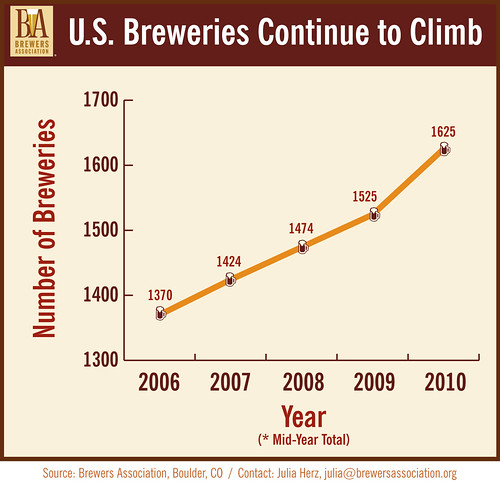
The U.S. now boasts 1,625 breweries—an increase of 100 additional breweries since July of 2009—and the highest number in 100 years. A century ago in 1910, consolidation and the run-up to Prohibition had reduced the number of breweries to 1,498.
“Entrepreneurs across the land are creating jobs by opening new microbreweries and brewpubs, and we are also seeing many homebrewing hobbyists going pro by starting what have been referred to as nanobreweries,” Gatza added. “Super tiny microbreweries or brew pubs, that make beer for a very localized network of taverns and stores, are starting to become a trend, primarily in the states that allow self-distribution as a means of getting beer to market.”
EU Rules ABI Cannot Trademark Budweiser
Reuters is reporting that the EU equivalent of Europe’s supreme court ruled today that Anheuser-Busch InBev (ABI) “may not register ‘Budweiser’ as a trademark in the bloc, ending a 14-year legal battle over the name with a Czech brewer.” The battle over the naming rights from the town in the Czech Republic has been raging for more than a hundred years and may now finally be over. ABI’s response, predictable from a multi-national company used to getting its own way, “said the ruling would have no effect on its business,” and continued to refer to the trademark as one they “continue to believe [is] rightfully [theirs].”
New Leader Emerges In Battle of Strongest Beer?

For the past couple of years, the battle for the world’s strongest beers has been between the Scottish BrewDog and the German brewery Schorschbräu, with the last volley mere days ago with BrewDog’s controversial 55% The End of History. Seemingly out of nowhere a new contender for the title emerged. The Dutch brewer Brouwerij Het ‘t Koelship announced today they’re releasing a new beer, Start the Future, no doubt a response to BrewDog’s name for their 55% beer. Start the Future is 60% a.b.v.
Here’s ‘t Koelship’s description, as auto-translated by Google:
It presents Reefer Biggest beer in the world now the Scots a 55% beer on the market was the question: what do we do now? He is START THE FUTURE 60% alc. In response to the Scottish reaction; Obilix 45% was a success, but this is even better!
START THE FUTURE is like a beer OBILX product, a heavy alcoholic drink with the ingredients Water, malt, hops and yeast. The beer is then processed into a product, a beer-based beer product. START THE FUTURE is like OBILIX is a product made of 100% beer beer. How? Ask the brewer. You drink our START THE FUTURE and Obilix from a small glass and not from a beer glass.
According to Reuters:
Nijboer’s Almere-based brewery, ‘t Koelschip (The Refrigerated Ship), sells the new beer, which is 120 proof and dubbed “Start the Future,” in a one-third litre bottle for 35 euros ($45) each.
Nijboer told ANP he developed the new brew to keep up with Scottish outfits that were also pushing the boundaries of beer’s alcohol content. His previous record-holder, a beer called Oblix that was 90 proof (45 per cent alcohol by volume), was eclipsed by a Scottish beer that reached 55 per cent.
“It has become a little competition,” Nijboer said. “You should see it as a joke.”
It’s probably not a coincidence that the brewery also operates a distillery, too.
Below is a bad photo of the bottle, from ‘t Koelship’s website.
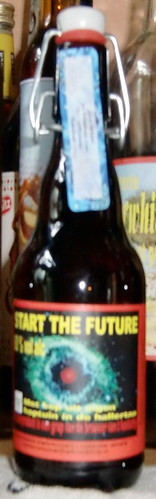
UPDATE: It looks like the Start the Future may have whisky added to it, making it doubtful most people will consider it a beer. (Thanks to Ken W. for the info.) The controversy is unfolding on Rate Beer — and probably elsewhere — where many people are questioning that this is truly a beer.
Even Schorsch from Schorschbräu weighed in:
What Mr. Nijboer is doing is not only trying to fool all others who do a fair contest (at the moment I got 43% Vol) and I will try more, but not for the price of leaving the way of Reinheitsgebot (German purity law). It’s a regional special German law and I do not expect that beer must be produced in that way worldwide…but what Koelschip does is pure customer deception. This is also illegal by national Dutch law.
North American Breweries Close To Deal To Buy Magic Hat & Pyramid


Beer News is reporting, via Harry Schuhmacher, that the Magic Hat/Pyramid Breweries is very close, possibly days away, from announcing that they’re being acquired by North American Breweries, the entity created to take over Labatt’s distribution in the wake of the Anheuser-Busch / InBev merger. NAB also owns the Genesee and Dundee beer brands. Check out the full story at BeerNews.org.
Action Alert: SF Alcohol Fee Vote Fast Tracked

Well we thought the vote was going to be delayed on the proposed ordinance in San Francisco to impose a fee on all alcohol sold in the city, but it turns out that’s no longer the case, which is a blow to fair play and common sense. Apparently the ordinance’s sponsor, supervisor John Avalos, recently realized that if Prop. 26 passes this November then a vote on the fee will be moot, because that proposition ends the practice of taxes masquerading as fees and all taxes, whether they pretend they’re fees or not, will be subject to a 2/3 margin instead of a simple majority. The proposition is sponsored by the group Stop Hidden Taxes.
To avoid that possibility, supervisor Avalos is instead fast tracking the ordinance and, according to the Small Business Commission, will present it “at the Budget and Finance committee meeting of the Board of Supervisors on August 4 — this is BEFORE the Small Business Commission will be able to make its recommendation (due to happen on August 9) and before he said he would be presenting the ordinance during the last Small Business Commission meeting. He is not sticking to his promises. He is changing the game.”
What Can You Do?
August 2:
If you own a small business in San Francisco, please consider attending the Small Business Commission meeting on Monday August 2 and most important at the Supervisor’s Budget and Finance Committee meeting at 1:00 pm on August 4 (though some earlier sources say the meeting is at 11:00 a.m., so check to be sure). There is expected to be a major rally at 11:00 in front of City Hall by proponents of the tax (firefighters union, healthcare union, etc.). At this hearing, the committee will take public comment.
August 10:
The ordinance will then go to the Board of Supervisors meeting on Tuesday, August 10th at 2:00 pm. If you’re a San Francisco consumer of alcoholic beverages, please consider attending this meeting and telling the board of supervisors that you drink responsibly and do not burden the city’s services and should therefore not be punished by having this tax imposed.
September 7:
On this day, the ordinance will go to the Board of Supervisors again for a second vote. There is no public comment or discussion — this is a formality vote.
September 8:
It then goes to the Mayor, who has 10 days to veto or sign. If he vetoes it, there will be a major effort by the Marin Institute to get the Supervisors to override the veto with a 2/3 vote.
The Two Most Important Things You Can Do
- Write or e-mail your supervisor and urge him or her to vote no against the Alcohol Mitigation Fee Ordinance. There is information to assist you in letter-writing or e-mailing at the California Alliance for Hospitality Jobs website.
- Attend the August 10th, 2:00 pm, Board of Supervisors meeting.
MADD Charity Rating Downgraded To “D”

The American Beverage Institute (ABI), a trade organization representing restaurants and specifically on-premise alcohol issues, is one of the few groups to confront MADD’s deceptive practices and neo-prohibitionist tendencies head on. Yesterday they released the following press release:
The American Institute of Philanthropy’s (AIP) Charity Rating Guide & Watchdog Report has downgraded Mothers Against Drunk Driving (MADD) to a “D” rating on a A-F scale in its August 2010 report.
“Under the leadership of CEO Chuck Hurley, MADD further diminished its focus on victim services and educating Americans about the dangers of drunk driving, instead pushing anti-drinking, anti-alcohol public policies,” said American Beverage Institute (ABI) Managing Director Sarah Longwell. “The public needs to realize that MADD isn’t the same group it was 20 years ago.”
MADD has consistently received low ratings from the Charity Rating Guide due to its poor fundraising and spending practices.
According to the AIP, it should cost most charities $35 or less to raise $100. In some years, MADD has spent nearly double that amount. The AIP also says most highly efficient charities are able to spend 75 percent or more of total expenses on charitable programs. In some years, MADD has spent as little as 57 percent on programs. In 2008, MADD spent almost $30 million on salaries and fundraising, leaving just 1/3 of its budget available for charitable work and victim services.
Another charitable giving guide, Charity Navigator, gives MADD an overall rating of 1 out of 4 stars. Charity Navigator reserves this embarrassing basement-level for a charity that “fails to meet industry standards.”
During Hurley’s tenure at MADD, the organization’s revenue declined while Hurley and other officers and directors saw their salaries increase — a whopping 56 percent. In contrast, MADD’s revenue declined nearly one-quarter over the same period. And MADD’s spending on community programs—what a charity should be about—dropped by 17 percent. In 2009, MADD had to lay off 50 employees nationwide—15 percent of its workforce—a move that cut much of the organization’s victim advocacy work.
These financial changes reveal a shift in MADD’s mission. In the words of its own founder Candy Lightner: MADD “has become far more neo-prohibitionist than I had ever wanted or envisioned … I didn’t start MADD to deal with alcohol. I started MADD to deal with the issue of drunk driving.”
Longwell continued: “MADD’s anti-alcohol agenda includes advocating for alcohol detectors in all cars, sobriety checkpoints and sky-high alcohol taxes. By spending on these new priorities, MADD has diverted money from programs created to help the victims of drunk driving and get dangerous drunk drivers off the roads.”
Hilarious, it’s great to see someone else holding their feet to the fire. You may recall back in August of last year, after the ABI had the temerity to criticize MADD, that MADD called the ABI “The Angry Arm of Alcohol.” At that time, I observed that we should be angry, and suggested someone make up “Angry Arm of Alcohol” T-shirts. So far, no one’s taken me up on it.
Some Beery Trends

Over the weekend, I got the latest newsletter from Michael Kuderka of the DBBB, the book of Domestic Brewers and their Bottled Brands, published by MC Bassett. One highlight was some interesting trends from recent IRI data.
If you’re not familiar with IRI data, it’s one of the two major data reporters, along with Nielsen, of sales trends along a variety of products. IRI is short for Information Resources, Inc., though the company is now known as the Symphony IRI Group. IRI data only covers certain kinds of retailers that sell beer, primarily grocery stores and convenience stores, and usually only chains at that. So it’s of limited use, but because the sales data is collected from consistent sources, it is fairly reliable and can show trends. I used to see it all the time, when I was a beer buyer, because most package brewers subscribe to one or the other service and usually bring carefully mined data to show their own positive trends. Anyway, here’s the interesting bits.
Fat Tire, from New Belgium, apparently “made more gains than any other brand when considering both year-over-year case sales and total dollars,” with case sales up 26% and total dollars just under $50 million. What that doesn’t take into account, of course, is that New Belgium opened several new states and a good portion of that bump may have been from being in new markets that weren’t in the data last year. But that does catapult them into the number 3 spot, making the top three best-selling craft beers as follows:
- Samuel Adams Boston Lager
- Sierra Nevada Pale Ale
- New Belgium Fat Tire
And here’s some additional trends and brands to watch, at least according to IRI:
- IPAs: Trending up 29%!
- Sierra Nevada seasonals: Up 23%
- Magic Hat #9: Up 22%
- Alaskan Brewing seasonals: Up 21%
- Amber Ale & Pale Ale also trending up
A Stiff Drink

It’s hard not to chuckle a bit when BrewDog manufactures another controversy to get free publicity. Their latest, and possibly greatest, stunt is their new world-record beater — at 55% a.b.v. — The End of History. As if a 110 proof beer wasn’t enough, each of the limited bottles (only 12 were made) cost £500 (approx. $770 U.S.). And they sold out in mere hours to consumers from the Canada, Denmark, England, Italy, Scotland and the U.S. Why, you may ask — besides of course supply and demand? The answer is no doubt designed to bait the press and especially animal lovers, because each of the twelve bottles is inside a small stuffed animal. That’s right, a taxidermist placed a bottle inside the body of 4 squirrels, 7 weasels and 1 hare, all collected as roadkill.
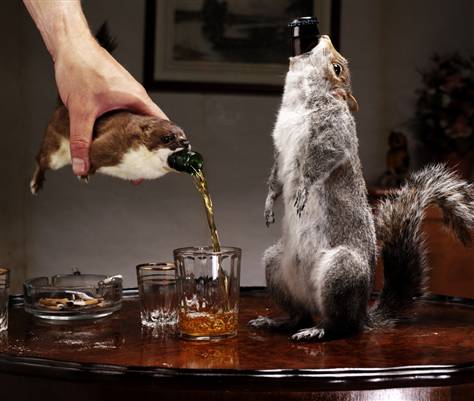
The BBC was the first to weigh in, calling it “perverse.” They got a twofer of outrage from both Advocates for Animals and Alcohol Focus Scotland. Libby Anderson, policy director for Advocates for Animals was quoted as saying “[i]t’s just bad thinking about animals, people should learn to respect them, rather than using them for some stupid marketing gimmick,” forgetting that animals are nearly ubiquitous in advertising, from cute and cuddly to perverse and scary. Remember the Foster’s Farm chickens driving around hoping to be eaten? She adds “[i]t’s pointless and it’s very negative to use dead animals when we should be celebrating live animals. I think the public would not waste £500 on something so gruesome and just ignore it.” Sorry Libby, I guess you don’t know the public as well as you thought, because it sold out in less than a day. Others have called it “shocking” and in “bad taste.”
Here’s how BrewDog describes the beer:
The End of History, at 55%, is the final installment of our efforts to redefine the limits of contemporary brewing.
This blond Belgian ale is infused with nettles from the Scottish Highlands and Fresh juniper berries. Only 12 bottles have been made and each comes with its own certificate and is presented in a stuffed stoat or grey squirrel. The striking packaging was created by a very talented taxidermist and all the animals used were road kill.
To me, the proof that it’s a put up lies in this fact. If you read much philosophy, perhaps the title of the beer, The End of History, sounds familiar? It should, because it’s taken from a 1992 book by Francis Fukuyama, “The End of History and the Last Man,” which itself was based on an earlier essay published in the international affairs journal The National Interest. Fukuyama’s original 1989 essay is online, and a percentage of the later book can be read online through Google Books. In referencing the title, BrewDog comments that “this is to beer what democracy is to history.”
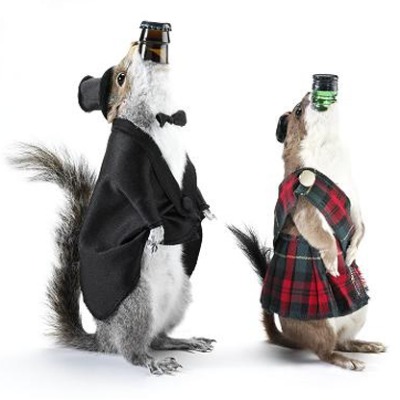
There’s also a pretty funny video about the End of History, you can find more about the beer at BrewDog’s website.