Brookston Beer Bulletin

Jay R. Brooks on Beer

  • Home
  • About
  • Editorial
  • Birthdays
  • Art & Beer

Socialize

  • Dribbble
  • Email
  • Facebook
  • Flickr
  • GitHub
  • Instagram
  • LinkedIn
  • Pinterest
  • RSS
  • Twitter
  • YouTube

Powered by Genesis

Drinkers Half As Likely To Get Lou Gehrig’s Disease

August 13, 2012 By Jay Brooks

lou-gehrig
Though contracting ALS (or Amyotrophic Lateral Sclerosis) is relatively rare, according to a new Dutch study, your risk is cut in half if you drink moderately, when compared to abstainers. Better known, at least in North America, as Lou Gehrig’s Disease — since the New York Yankees first baseman famously contracted it in 1938 — the ABMRF is reporting about the new study. According to their information, the Risk of ALS Seen to be Lower in Drinkers than Abstainers. Their full article is below:

A Dutch population-based case-control study of the rare but devastating neurological disease amyotrophic lateral sclerosis (ALS) suggests that the risk of such disease is increased among smokers, as has been shown previously. However, surprisingly, the risk of ALS was seen to be markedly lower among consumers of alcohol than among abstainers.

The study conducted between 2006 and 2009 included surveying 494 patients with incident ALS, a large sample for the rare disease, and 1,599 controls. Investigators compared results with those from cohorts including patients with prevalent ALS and referral patients.

Results highlight the importance of lifestyle factors in the risk for ALS. Current smoking is associated with an increased risk of ALS and a worse prognosis. However, alcohol consumption is associated with a reduced risk of ALS, as the risk among drinkers was about one half that of non-drinkers.

You can see the abstract for the study itself, Smoking, Alcohol Consumption, and the Risk of Amyotrophic Lateral Sclerosis: A Population-based Study, at PubMed.

Filed Under: Beers, Editorial, News, Related Pleasures Tagged With: Health & Beer, Science, Statistics, The Netherlands

How Neo-Prohibitionists Target Alcohol

August 11, 2012 By Jay Brooks

target-alcohol
Mark Twain is generally credited with popularizing the phrase: “There are three kinds of lies: lies, damned lies and statistics.” He attributed it to British statesman Benjamin Disraeli, though most historians now dispute that. So even when speaking about lying, there were lies. Today’s neo-prohibitionists would be proud, lying with statistics is something they’ve finely honed into its own kind of science. If you haven’t read How To Lie With Statistics or the more recent Trust Us, We’re Experts!, they both provide great insights into just how it’s been done over the years, and continues to be done with alarming frequency.

Thanks to Jason K. for alerting me to this one, which in the news is being portrayed with the intentionally misleading How Alcohol Ads Target Kids. The story concerns a study sponsored by CAMY (the Center on Alcohol Marketing and Youth) — itself a bit of an anti-alcohol organization who receives funding from the king of the neo’s, the Robert Wood Johnson Foundation — that examined alcohol advertising in eleven magazines over a five-year period. The study itself was recently published in The Journal of Adolescent Health with the much less misleading title Risky Messages in Alcohol Advertising, 2003–2007: Results From Content Analysis.

When CAMY released a press release about the study, they re-titled it Alcohol Advertising Standards Violations Most Common in Magazines with Youthful Audiences — also not exactly accurate — and by the time it got to the media (who love alarming headlines) it became How Alcohol Ads Target Kids, which was picked up by such high profile websites as Yahoo News, Live Science and Business News Daily.

All of the news stories rely on the CAMY press release and not the study itself, which seems at least a little strange. So here’s the Abstract:

Purpose
To assess the content of alcohol advertising in youth-oriented U.S. magazines, with specific attention to subject matter pertaining to risk and sexual connotations and to youth exposure to these ads.

Methods
This study consisted of a content analysis of a census of 1,261 unique alcohol advertisements (“creatives”) recurring 2,638 times (“occurrences”) in 11 U.S. magazines with disproportionately youthful readerships between 2003 and 2007. Advertisements were assessed for content relevant to injury, overconsumption, addiction, and violations of industry guidelines (termed “risk” codes), as well as for sexism and sexual activity.

Results
During the 5-year study period, more than one-quarter of occurrences contained content pertaining to risk, sexism, or sexual activity. Problematic content was concentrated in a minority of brands, mainly beer and spirits brands. Those brands with higher youth-to-adult viewership ratios were significantly more likely to have a higher percentage of occurrences with addiction content and violations of industry guidelines. Ads with violations of industry guidelines were more likely to be found in magazines with higher youth readerships.

Conclusions
The prevalence of problematic content in magazine alcohol advertisements is concentrated in advertising for beer and spirits brands, and violations of industry guidelines and addiction content appear to increase with the size of youth readerships, suggesting that individuals aged <21 years may be more likely to see such problematic content than adults.

There’s a lot gobbledygook and psychobabble jargon in that, but happily the news reports picked up the additional information in the press release to help out those of us who can’t afford to pay to see the full article. The so-called “study” is not exactly scientific, despite the academic journal publication and pedigree, but suffers greatly from how it’s defined and how the ads were characterized — how those “risk codes” were applied. As the study was sponsored by a particular organization with an agenda, it’s hardly a surprise that the conclusions would support that agenda. After all, they bought and paid for it.

One of the premises is that the 11 magazines they examined were ones with a “substantial youth readership,” which is important since they’re claiming that alcohol companies are targeting kids and/or violating advertising standards. I’d love to know which magazines they targeted, but that information has not been made readily available, even though you’d think that with such a dire problem they’d want to warn parents which magazines not to let their impressionable young children read. Should we wonder why that is? What it really comes down to is how they define “substantial youth readership?” For the study, that meant at least 15% of the readership was estimated to be underage, which is presumably what they mean by “youth.” I think most people would be hard pressed to consider 15% of anything “substantial.” So right from the get go, the study seems flawed; unless of course your goal is to manufacture a particular conclusion.

They further claim that these ads “frequently showed alcohol being consumed in an irresponsible manner.” First of all, how you define what “irresponsible” means is at best very subjective and certainly prone to be interpreted differently by different people. One of the examples of what they mean is “showing alcohol consumption near or on bodies of water.” Since when is that the hallmark of irresponsible behavior? Beer can’t be consumed responsibly, or safely, if there’s water nearby? Seriously, WTF?

Other examples they give include “encouraging overconsumption and providing messages supportive of alcohol addiction.” But those are both so vague as to be almost meaningless, and very open to interpretation. They further suggest that “sexual connotations or sexual objectification” were seen in “nearly one in five ad occurrences.” Again, pretty vague and subjective, but beyond that, so what? Isn’t “sex sells” the number one rule of advertising? Even if true, is alcohol advertising the only group using sex to sell their product? Or is that tactic literally everywhere. I remember being shown in an advertising class during college how the word “sex” could be found in the hair of the colonel in Kentucky Friend Chicken advertising. Sex is everywhere. Shock, surprise? Hardly. It’s the reason we’re all here. If you go looking for it, you’re going to find it. And frankly, under the circumstances, finding less than 20% of the alcohol ads with sexual content seems positively rock bottom, and something that they should see as a positive, wouldn’t you think?

But despite such vagueness, CAMY is undaunted, and finds exactly what they’re looking for. CAMY director and study co-author David Jernigan makes this claim. “The bottom line here is that youth are getting hit repeatedly by ads for spirits and beer in magazines geared towards their age demographic.” He goes on. “As at least 14 studies have found that the more young people are exposed to alcohol advertising and marketing, the more likely they are to drink, or if already drinking, to drink more, this report should serve as a wake-up call to parents and everyone else concerned about the health of young people.”

But another similar study by CAMY done in 2010 found that Less Alcohol Advertising Makes No Difference. In that study — covering nearly the same period of time — they found that youth exposure to alcohol advertising in magazines fell by 48 percent, alcohol advertising placed in publications with under 21 audiences greater than 30 percent fell to almost nothing by 2008, and youth exposure in magazines with youth age 12-to-20 audience composition above 15 percent declined by 48.4 percent. So apparently with that no longer a problem, they instead turned their attention to magazines with a youth readership of less than 15%. That must be the problem. There has to be a problem, after all. Without problems, there can be no fund raising. There can be no clarion call to arms against the heathen drinkers and alcohol companies.

This is the modern era of non-profits. There always has to be a problem. Now matter how much progress their organization makes against whatever problem they believe exists — and they will crow about that progress — the problem persists ad infinitum. It has to. But this particular problem has already been disproved. In 2003, a “‘Federal Trade Commission report to Congress indicate[d] that its comprehensive investigation’ found no evidence of targeting underage consumers.” See Alcohol Ads Target Youth? for the full story. The media may call this “How Alcohol Ads Target Kids,” but I can’t help but see it as just the opposite. When you look closer, it seems to me more like “How Neo-Prohibitionists Target Alcohol.”

Filed Under: Editorial, News, Politics & Law Tagged With: Anti-Alcohol, Prohibitionists, Science, Statistics

America’s Geographic Beer Belly

August 10, 2012 By Jay Brooks

maps-usa
Here’s another interesting set of data from the curiously named Floating Sheep, this one regarding The Beer Belly of America. Essentially, what they did was “a simple comparison between grocery stores and bars.” They anticipated that they’d find more grocery stores than bars, and that did prove to be true. But they were surprised to find what they termed the “‘beer belly of America’ peeking out through the ‘t-shirt of data.'”
us_bars_100122
In this chart, the size of the green symbols represents the number of mentions of bars in the Google Maps directory. To see it full size, click here. Chicago, Illnois had the highest number.

In the chart below, yellow dots are area where they found more mentions of grocery stores and the red dots indicate where they found more bars. And while there are red dots … well, dotting the whole nation, there does seem to be a definite concentration of red from Wisconsin/Illinois west to Idaho. That’s the area they refer to as The Beer Belly of America.
us_bars_groceries_100122
To see it full size, click here.

They also compiled a list of each state and the number of bars per 10,000 people. I don’t know what it means that the top seven states were all within the The Beer Belly of America.

  1. North Dakota 6.54
  2. Montana 6.34
  3. Wisconsin 5.88
  4. South Dakota 4.73
  5. Iowa 3.73
  6. Nebraska 3.68
  7. Wyoming 3.4

I’m also not convinced that this type of per capita statistics are that useful. Because of economies of scale, it seems that states with less people always do better in per capita comparisons. The same thing happened when looking at per capita brewery distribution by state, with perhaps the exception of Oregon.

The final chart is similar to the first, but shows the number of bars “normalized” based on the average number of mentions for all locations. That means that where you see color are the places where there were mentions of bars exceeding the average. In this view, it’s easier to see where there are more bars, or at least more Google Maps mentions of them.
us_bars_ind_100127
To see it full size, click here.

Filed Under: Beers, Editorial, Just For Fun, News, Politics & Law Tagged With: Bars, Beer Stores, Statistics

For Love Of IPA

August 2, 2012 By Jay Brooks

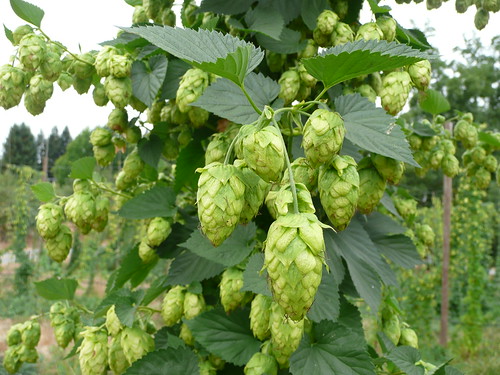
hops IPA-Day hops
One of my favorite authors is Henry David Thoreau, who in 1843 wrote A Walk to Wachusetts, which later became chapter 3 of Excursions. In it, he recounts a long walk taken with a friend, during which part of their journey included waking through hop fields. Here’s the passage:

This part of our route lay through the country of hops, which plant perhaps supplies the want of the vine in American scenery, and may remind the traveller of Italy, and the South of France, whether he traverses the country when the hop-fields, as then, present solid and regular masses of verdure, hanging in graceful festoons from pole to pole; the cool coverts where lurk the gales which refresh the wayfarer; or in September, when the women and children, and the neighbors from far and near, are gathered to pick the hops into long troughs; or later still, when the poles stand piled in vast pyramids in the yards, or lie in heaps by the roadside.

The culture of the hop, with the processes of picking, drying in the kiln, and packing for the market, as well as the uses to which it is applied, so analogous to the culture and uses of the grape, may afford a theme for future poets.

P1010777
It’s hard to disagree with that. Hops on the vine, especially at harvest time, are a beautiful sight. They’re just so green, especially in person. These were at the Moonlight hop field in 2007.

So today is the second IPA Day, fun new holiday celebrating beer that showcases hops. For several years, IPAs have been the fastest growing style in mainstream outlets, and have been doing very well everywhere else, too. Very few breweries don’t have an IPA or a similar hoppy beer these days, though as recently as a decade, or a decade and a half, ago that was not the case. Being on the west coast, and relatively close to the hops, it’s hard not to get caught up in hop fever. As much as I love malty beers, sour beers and most other styles, an aromatic hoppy IPA is pretty hard to beat. I find myself gravitating toward a hoppy choice, especially if I just want to enjoy the aromas and flavors of what I’m drinking.

P1050710
Harkening back to that earlier time, Moonlight Brewing in Santa Rosa has a 1/4-acre of hops that owner Brian Hunt uses for his fresh hop beer each year and invites friends and family to come up the brewery and help pick hops, just like in the old days when it was a community effort.

P1010791
Brian Hunt with some of his freshly cut down hops.

P1160115
My daughter Alice in 2009 in the Moonlight hop fields. I just love being in the hop fields at harvest time. It just smells so great and, as I said, it’s just so green.

Ashley Routson, who co-founded IPA Day (and works for Bison Brewing), had an interesting piece today at CraftBeer.com, The Ever-Emerging Sub-Categories of India Pale Ale, in which she identifies a multitude of shades and variations of IPAs.

  • American-style India Pale Ale
  • Belgian / Belgo IPA
  • Black IPA
  • Brettanomyces/ Wild /Traditional IPA
  • English-style India Pale Ale
  • Farmhouse IPA
  • Fresh Hop IPA
  • Imperial Black IPA
  • Imperial (Double) India Pale Ale
  • India Pale Lager (IPA-style, but fermented with lager yeast)
  • Red IPA
  • Rye IPA
  • Session IPA (IPA flavor at lower than average ABV)
  • Spiced/ Herbed IPA
  • White IPA

I’m sure some people will quibble with her list, but I love the broader idea that IPAs are not just one thing, but are different things to different people. The only real common thread is that they’re generally beers that emphasize the hop aromas and flavors possible in a beer. To some they’re unbalanced, while still others find that enamel-scraping, ginormous hop character what makes them so delightful. I can see both sides of the coin, and under the right circumstances like both subtle hop beers and the bigger hit-you-over-the-head variety, too. There’s a time and place for both. And they’re all worth celebrating. Happy IPA Day.

P1010555
Jumping in the dried hops, waiting to be baled, at Hop School in 2007. I’m so glad I had a chance to do it, but I was sticky the rest of the day. You really have to love hops to do this.

Filed Under: Beers, Editorial, Just For Fun, Related Pleasures Tagged With: Hops

Hokey Smokes! Cartoons Are Only For Kids?

August 2, 2012 By Jay Brooks

rocky
As a lifelong lover of all things drawn — comic strips, comic books, graphic novels, cartoons and animated films — there’s an argument that the neo-prohibitionist wingnuts make from time to to time that absolutely frys my bacon. And they’re at it again. The increasingly neo-prohibitionist group Alcohol Justice (AJ) is unhappy once more with Anheuser-Busch InBev (are they ever happy?), this time because they’re using — gasp! — cartoons to promote their association with the Ultimate Fighting Championship (UFC). In Bud Light and UFC Push Beer to Kids with Comics, AJ makes the same tired argument they always do whenever anybody uses an image that’s been drawn in an advertisement. Here’s how they put it this time:

So how does a company that says it’s committed to not advertising to kids choose to spend millions of its marketing dollars? Get this: comic strips, posted on Facebook, targeting fans of mixed-martial arts fighting, also known as Ultimate Fighting Championships. As the primary sponsor of the brutal and offensive UFC, A-B InBev gets the Bud Light logo delivered directly to the computer screens of millions of kids worldwide. Moreover, they use the quintessential child-friendly format of comic strips to do it. The only way they could top this direct advertising to youth is if they plastered Sponge Bob SquarePants’ picture on Bud Light cans.

Well get this, comic strips and other animated fare is NOT JUST FOR KIDS. They never, ever have been. Yes, there are cartoons aimed at kids, but many, many are either for all ages or are for more mature people. People able to separate content from delivery, something that AJ is apparently incapable of, understand this. The folks that come up with these arguments must be the least fun people to be around, if they avoid anything that’s been animated because they believe it must be for kids only. Think what they’re missing.

But just a short history should convince even the most jaded neo-prohibitionist that comics have long been for all ages, and many were aimed at adults since they were first created. The very first comic strip, The Yellow Kid, began in newspapers in the last decade of the 19th century. It tackled social and political topics, and was for the adults who read newspapers. The first animated film, Gertie the Dinosaur, created by Windsor McCay in 1914, was similarly not exclusively kiddie-fare. McKay used it in his vaudeville act, which was not for kids.

All those Looney Toons, Tom & Jerry’s, Popeye’s and other cartoons we grew up watching Saturday mornings and after school began as the cartoon shown before the main attraction started at movie theaters. And we’re not talking about kiddie files, but all films. They were aimed at either the adults there to see an adult film or were for all ages (Disney being exception and the prime example of a studio that did more family-friendly stuff). That’s why there are lots of old Warner Brothers cartoons (and others) that are never shown on television when they repackaged them for TV, because their subject matter is seen as inappropriate for today’s youth.

Comic books in the 1950s covered a wide range of subjects, not just superheroes, but another wingnut wrote “Seduction of the Innocent,” a deeply flawed book that equated violence with reading comic books, and comic books were reduced to only kid-friendly stories (at least until the 1980s).

Try to watch Rocky & Bullwinkle or Beany & Cecil and not see all the adult political references. You’d have to be utterly clueless to not see that cartoons have never been the exclusive realm of children. Many mature adults love cartoons now, and have since people first started drawing them.

That AJ and other anti-alcohol folks claim this is, for me, more proof of how they’re willing to bend the truth, and common sense, to push their agenda. I don’t even like the UFC, or any type of fighting sports like boxing, etc. (except for the NFL), but just because they use a comic strip promoting it does not ipso facto mean they’re targeting kids. You’d have to be a child yourself to make, or swallow, that line of reasoning.

Another interesting tactic that AJ uses again here is claiming they’re not the only one outraged, when they state that “Culinary Workers Union recently sent a forceful letter to A-B InBev expressing disgust at the company’s ‘socially irresponsible behavior.'” Except that when you look at this letter, it’s also signed by AJ’s executive director Bruce Lee Livingston, meaning it’s more likely AJ’s letter, or at a minimum a joint letter. But that fact is conveniently left out of their press release, most likely because it would weaken their already questionable argument. As I said, I’m no fan of the UFC, or similar spectacles, and I tend to believe the world would be a better place if people didn’t enjoy violence quite so much, but any meaningful public discussion has to start by being honest. And starting that discussion by claiming that if anybody uses a cartoon then they’re only targeting kids, is hardly honest. Now I need a beer, and the Simpsons is on.

Filed Under: Editorial, News, Politics & Law Tagged With: Anti-Alcohol, Cartoons, Comics, Prohibitionists

Travel Channel Picks The “Top 7 Beer Destinations”

July 29, 2012 By Jay Brooks

top-7
Okay, these things are pretty easy to pick apart because no one will ever agree on where the “best” or “top” destinations are for anything, beer or otherwise. I understand that top x lists are very popular. Hell, I enjoy making them myself. They can be fun. But take a look at what the Travel Channel, written by NYC-based travel writer Jimmy Im, has chosen as the Top 7 Beer Destinations.

  1. Asheville, North Carolina
  2. Los Angeles’ Popular Breweries
  3. Virginia’s Lagers and Ales
  4. Toronto’s Craft Breweries
  5. Finger Lakes, New York’s Beer Hub
  6. Atlanta’s New Brews
  7. Traverse City, Emerging Beer Town

So while I’m sure none of the places he’s listed are bad beer destinations, and certainly a few of them deserve to be on this list, I have a hard time accepting these as the very top destinations. The list strikes me as being from someone who’s not really connected to the beer community in any meaningful way. If they had only resisted calling them the top beer destinations and called them instead something like “seven beer destinations worth visiting” that might have worked, but they didn’t. Im specifically states that “these destinations that are fast becoming beer scene kings that offer some of the best suds in town.”

So while I have no problem with Asheville being here, ignoring Philly, Portland (both Oregon and Maine), San Francisco, San Diego, Seattle, Denver, Boston, Chicago and several others makes this list more infamous for what it’s left out than what was chosen. Certainly L.A. is an up and coming beer city, and has made great strides over the last few years, but I’m not sure I’d put it as the second-best beer destination, especially over so many others left out. And he singles out the Strand Brewing Co. and El Segundo Brewing Company as “two of the more popular breweries.” No disrespect to those two breweries — I haven’t been to either of them but I’m sure they’re fine places — but those are not the L.A breweries that are making a splash lately.

Third is the entire state of Virginia, and Im seems to have chosen the Old Dominion State because it’s “so obsessed with its beer culture, it is officially naming the month of August ‘Virginia Craft Brew Month'” and now has 40 breweries. Well July is Oregon Beer Month and February is California Beer Month. Oregon has over 160 breweries and California around 325. So while Virginia is a terrific state and undoubtedly has some fine breweries, if obsession, state beer months and the number of breweries is his criteria, then I’m just not sure Virginia is the right one to choose.

The remaning four, Toronto, the New York Finger Lakes, Atlanta and Traverse City, Michigan, again I’m sure are all fine beer places, but do they deserve to be among the “top 7?” By choosing Toronto, he’s also opened the door to other international beer destinations, of which there are numerous examples, many of which most people would choose over some of the destinations on the Travel Channel’s list. With the last one, Traverse City, Im seems even to have forgotten his own mandate, when he refers to the Michigan town as an “emerging beer town.” It may well be, but shouldn’t we wait until it’s emerged before putting it on the list of the top spots?

So while these things are, as I alluded to, very subjective and depend greatly on how you define the criteria used to rank them, these choices wouldn’t pass muster for even a casual beer lover. It could have been a fun list if they’d only resisted the temptation to declare them the “Top 7 Beer Destinations.” They’re just not.

Filed Under: Breweries, Editorial, Just For Fun, Top 10 Tagged With: Lists, Mainstream Coverage, Statistics

Anti-Alcohol Propaganda About Alcohol Being 3rd-Leading Preventable Cause Of Death

July 22, 2012 By Jay Brooks

alcohol-justice
I saw this tweet earlier today from my neighbors at the Marin Institute — now Alcohol Justice:

#Alcohol is the third-leading #preventable cause of death in the U.S. Fact sheets – #free to download… http://bit.ly/r8KoO5

First of all, somebody at Alcohol Justice (AJ) doesn’t quite understand the hashtag, using it on alcohol, preventable and free!

But Twitter etiquette aside, that statement is false, and they probably know that, making it a lie, to my way of thinking. But saying it that way makes it sound scarier, and AJ is all about propaganda these days as IMHO they’ve become more and more neo-prohibitionist since becoming the self-appointed sheriff, and changing their name.

That statement about alcohol being the “third-leading preventable cause of death in the U.S.” comes from the CDC. It’s from a 2001 study entitled “Alcohol-Attributable Deaths and Years of Potential Life Lost — United States, 2001,” and published in 2004. The very first words of the summary give you the spin, as it begins “Excessive alcohol consumption is the third leading preventable cause of death in the United States.” That’s right, it’s not alcohol, but excessive alcohol. Those of you drinking in moderation and responsibly — that is, the vast majority of adult drinkers — can breathe a sigh a relief. They weren’t talking about you. But they did materially change the “facts” to suit their needs and agenda. Put less charitably, they lied, at least in my opinion. Here’s the first few sentences:

Excessive alcohol consumption is the third leading preventable cause of death in the United States and is associated with multiple adverse health consequences, including liver cirrhosis, various cancers, unintentional injuries, and violence. To analyze alcohol-related health impacts, CDC estimated the number of alcohol-attributable deaths (AADs) and years of potential life lost (YPLLs) in the United States during 2001.

There’s a table at the bottom that reiterates that they’re taking about “the harmful effects of excessive alcohol use.” That table then lists all sorts of diseases, many of which may be related to alcohol, but many or most of which are only marginally associated. These sorts of reports have been discredited before, because they include a disease that excessive alcohol use may make worse, but which won’t cause the disease all on its own. Other factors are always involved. More generally, these are estimates that take a lot of liberties in their calculations. They are not hard numbers by any stretch.

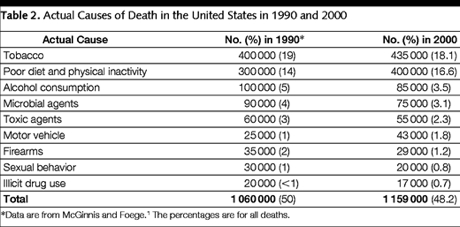
The second report that AJ attributes to this statement is another study, this one also from 2004 in JAMA, the Journal of the American Medical Association. In that article, Actual Causes of Death in the United States, 2000, they found that heart disease, tumors and strokes were the three leading causes of death for Americans. You can see from the numbers that those statistics were relatively precise.

leading-death-causes-2000-1

But now look at the next chart, where alcohol consumption is listed as the third highest among what they term “actual causes of death.” Those are obvious estimates, and based on how round the numbers are, probably more like guesses. They come from several studies conducted by interview, some by phone, in both the U.S. and Australia that were aggregated together. So at least a half-dozen studies using different methodologies, questions and sample sizes were lumped together to create their findings. And if you review the study’s limitations near the bottom at the “Comments” section you’ll see that there were many factors, such as genetics and cholesterol levels, that were simply not considered, further clouding the results.

leading-death-causes-2000-2

But something else is apparent, too. Even if we accept those guesses (and you shouldn’t) tobacco and overeating/not exercising account for nearly 10 times the deaths that are attributed to alcohol. Those first two account for 34.7%, over a third, while alcohol is 3.5%. And from 1990 to 2000, alcohol actually went down 1.5%, from 100,000 estimated deaths to 85,000.

And while any death is regrettable and a tragedy, especially to their loved ones, roughly 2,437,163 die every year in America. Every one of us will one day become a part of that statistic. The current CDC estimates are that the most likely reasons for our demise will be heart disease, cancer, chronic lower respiratory disease, stroke, accidents (unintentional injuries), Alzheimer’s disease, diabetes, influenza and pneumonia, nephritis (kidney trouble), nephrotic syndrome, and nephrosis (different kidney diseases) and suicide. Some of those diseases may be exacerbated by excessive alcohol consumption, but these, and many other diseases, will be held at bay by moderate alcohol drinking and will also most likely result in our living longer than both teetotalers or excessive drinkers.

Responsible alcohol consumption will also enhance our lives in ways that reduce stress and make our lives more enjoyable. Such positive associations and outcomes are never included in these types of studies, however. Any harm to individuals, often of their own making, is never balanced by the enhancement to our life experience that responsible drinking brings to a majority of Americans. When you go looking for harm, that’s all you will find. But when you set about to twist even these questionable studies to make them seem far worse than even they represent, that’s shameful propaganda and does little to actually address the real problems that some individuals do have with drinking.

Filed Under: Editorial, News, Politics & Law Tagged With: Anti-Alcohol, Prohibitionists, Statistics

No Defense For Light Beer

July 16, 2012 By Jay Brooks

miller-lite
Ever since I first read about this in Beer Business Daily, it’s been bothering me, but I’ve been unable to read the original editorial by David Ryder, who’s the Vice-President of Brewing for MillerCoors. It supposedly ran in the Chicago-Sun Times, but they apparently do not have that particular editorial online and their search engine only allows searching their archives for articles written in 2011 or before. But apparently on July 4, he wrote an op-ed piece, “In Defense of Light Beer,” though I imagine he would have preferred the spelling “lite beer.” Now, without having even read it, you have to be suspicious of it for no other reason then he owes much of his living to the continued sales and popularity of low-calorie light beer. As Upton Sinclair famously observed. “It is difficult to get a man to understand something, when his salary depends on his not understanding it.”

But here’s what I do know, as reported by Beer Business Daily:

“It’s absolutely true that U.S. beer drinkers have more choices than ever before, from spicy saisons to big imperial stouts to hoppy IPAs. It’s a wonderful development that brings energy and excitement to brewing.

“But it’s also true that, faced with all those choices, American beer drinkers still overwhelmingly choose American light lagers over all others.

“That fact often draws the scorn and condescension of beer ‘aficionados,’ not to mention the news media. Not too long ago, the financial newswire Bloomberg News derided light lagers as ‘barley water’ in a story on our sales trends.

“The lighter take on beer exemplified by American pilsners and lagers is an authentic and widely admired style. In fact, it is the very first style of beer listed in the Beer Judge Certification Program. I have worked as a brewer in some 20 countries on five continents. I can assure you that this is the most emulated and difficult-to-brew beer style in the world.”

David points out that in the old days before light beer, “beer was a food staple” but Adolph Coors and Adolphus Busch changed beer to be seen as “as a form of refreshment and pioneered new brands to meet changing consumer preferences.” He also points out that “light beers are incredibly difficult to brew. Heavy, sometimes cloudy, beers can mask brewing imperfections. But with light beers, the slightest irregularity is glaring to the taste buds. Consistently replicating these delicate flavors and aromas requires a remarkable level of brewing skill and precision.”

To the point he makes about the difficulty of making light beer, while I generally admire the science of brewing that the big breweries have developed and the difficulty of consistently brewing light beers, where flaws are nearly impossible to hide, that admiration does not extend to the products themselves. No matter how difficult they are to make, that still doesn’t excuse their existence, or make them a beer that I’d ever want to drink. To me, they are still an abomination, a science experiment gone awry. There’s no reason to sacrifice flavor to save a mere pittance of calories. Beer is not particularly fattening, especially if you drink it in moderation. The easiest way to reduce your caloric intake of beer is not to choose the latest scientifically engineered slightly lower-calorie beer, but to simply drink less bottles, cans or pints. Drink less, but drink better is always a good rule of thumb.

A little over a week after Ryder’s op-ed appeared, Chicago Sun-Times columnist Herb Gould also examined Ryder’s assertions. In his column Thirsting for some better pilsners, he claims to be a homebrewer, but one who will drink apparently any beer. He offers that he’s “not a beer snob,” but “simply like[s] beers that, well, taste better than what the Big Two offer.” Despite this apparent contradiction, he applauds Ryder for his “much-needed defense of American pilsners,” continuing. “As he said, it’s an American classic. When you’re watching a ballgame on a hot day, when you’re enjoying a big steak, or a nice piece of salmon, nothing’s better than a well-bittered but not too heavy lager.”

Except that light beers are not “well-bittered” and they’re not pilsners, American or otherwise. They may have been based upon pilsners once upon a time, but they have diverged so far from that purported origin that they bear little resemblance to pilsners from the Czech Republic, Germany or any other place on the planet. They have become, as even David Ryder notes, a separate category of beer all to themselves.

He claims surprise “that the little breweries don’t seem interested in making a nice pilsner — or a better version of Budweiser or Miller High Life” and later in his column challenges what he terms “earnest little micro-breweries” to “[g]ive us more and better All-American pilsners.” I’m not sure where he’s been going to find his beer, because there are literally hundreds of great pilsners made by craft brewers of all sizes. Right in my backyard, the Trumer Brauerei in Berkeley only makes one beer, a fantastic pilsner that’s exactly what Gould claims to want in a “quality pilsner — a beer that’s on the lighter side but has nothing to be ashamed of. A beer that’s got a little bite, has a nice layer of flavor but doesn’t shout out anything fancy.”

A beer fitting that description, frankly, is not all that difficult to find. Of the Top 50 Czech Pilsners on Beer Advocate, 36 of them are made in the U.S. and for the Top 50 German Pilsners, 34 are American-made. Good American pilsners are everywhere if you know where to look.

And quite frankly, the reason he may be having trouble finding one is that he admits he “will drink MillerCoors or Budweiser products, but only if more ambitious choices are not available, which is often the case.” But that’s never going to change if he just accepts what beers they have and fails to tell the bars he frequents that he would prefer “more ambitious choices.” If he keeps ordering whatever is available, there’s absolutely no incentive for the bar to stock “more ambitious choices.” He seems to wear not being a beer snob as a badge of honor, but he’s doing himself and craft beer no favors by settling for whatever beers a bar decides to carry. Asking, or even insisting, on the beers you want is not being a snob, but is simply the only way to effect change and get the beers you actually want. Can you imagine being hungry for a steak and going to a restaurant, only to find out the only kind they have is Salisbury steak, and just settling for that, especially when there are other steak restaurants right around the corner? Vote for what you want with your wallet. Buy what you actually want, don’t just settle for whatever’s put in front of you. Seriously, who lives that way?

But I think his way of thinking is pretty common, and is a big reason why light beer and other less-flavorful beers continue to be so popular. It’s simply that people who are not as fanatical as the average beer geek just don’t care enough to bother. There’s enough to worry about in people’s everyday lives, and we all decide what things we’ll make a priority and what we’ll just accept and not fuss too much about. And in that, the big breweries have the advantage.

Think about colas, for example. There are people who really care that they drink only Coke or Pepsi. They’re fanatical about it. My grandmother was a Pepsi person. She hated Coke. But there are countless people who just don’t care. You see it at restaurants all the time. “Can I have a Coke, please.” The waitress replies, “we only have Pepsi.” And how often have you heard this? “That’s fine. No problem. Whatever.” And so it is with beer. You’re out for lunch or dinner and want a beer. More often than not, most people will just accept whatever beer is offered. It’s the reason that distribution and availability are so crucial to success. Simply have your beer available at more places than your competitor and you’ll most likely do better. Because most people in such a situation will just capitulate and order from what’s available rather than make a fuss or ask for something else or, perish the thought, not patronize that bar or restaurant.

So simply having deep distribution and being available everywhere will sustain light beer for years to come, so long as people don’t speak up. Because until Gould and a majority of people do care enough to insist on what they put in their bodies, the big companies that can afford national advertising budgets and can make their products available everywhere, those light beer makers will continue to flourish, and little will change in the world of beer.

But let’s get back to Ryder, and some of his arguments in defense of light beer. Here’s just a few of the earlier statements Ryder makes that I disagree with.

  • The lighter take on beer exemplified by American pilsners and lagers is an authentic and widely admired style:

    Widely admired by whom, exactly? Sales do not automatically equal admiration. The reasons any product is popular is not that it’s the best one available. Often it’s the cheapest, most available or has the highest advertising budget. Wonder bread my be the best-selling bread in America, but does anyone actually think it’s the best bread money can buy? People drink light beer because they’re bombarded with marketing and advertising, have been tricked into thinking they’re not sacrificing flavor and/or don’t really think (or care) about their choices. And as for its “authenticity,” I don’t even know what he’s talking about, do you? They’re not “pilsners” by any stretch of the imagination and they may be among the groups of beers described as lagers, but they exist in their own world, as a separate category. That a new category was created so that similar beers could be tasted and judged with other similar beers, does not make them authentic, which is defined as “not false or copied; genuine; real.” Given that “light beers” are lighter, less flavorful beers copied from true pilsners and rendered into a false version of them, I’d argue they’re the very opposite of authentic.

  • In fact, it is the very first style of beer listed in the Beer Judge Certification Program:

    Why yes, yes they are. But that fact has absolutely nothing to do with authenticity or any positive attribute. The BJCP style guidelines are organized roughly by lagers, ales and hybrids, from lightest (and sometimes) weakest to darkest or stronger. Light lagers, being the lightest in color and weakest in terms of flavor are listed first. It is not because they are the most authentic or any other reason that anyone might consider because they are somehow more favored or the best. And, I suspect, Mr. Ryder must know that their position in the list is utterly meaningless such that trying to defend light beer using this argument is completely disingenuous and intentionally misleading.

  • It’s also true that, faced with all those choices, American beer drinkers still overwhelmingly choose American light lagers over all others:

    Yes, that may be true but it hardly proves that this is because light beer is somehow a superior product. As I argued above, marketing, advertising and manipulating consumers over decades is responsible for light beer’s popularity. It’s certainly not its taste or any actual health benefits over other beers.

The true reason that the big breweries have focused on low-calorie beers has more to do with business, and the bottom line, than health or any altruistic reasons. In fact, the earliest diet beers had a very difficult time finding a market. Men, by far the largest gender drinking beer when they were introduced, had to be convinced over a long period of time that they should drink light beer. And let’s not forget that low-calorie beers use less ingredients than their more flavorful counterparts, but yet are sold for the same prince point. You don’t even have to be very cynical to realize that they’re more profitable and to see why breweries might have put more effort into selling them.

Gablingers-Beer

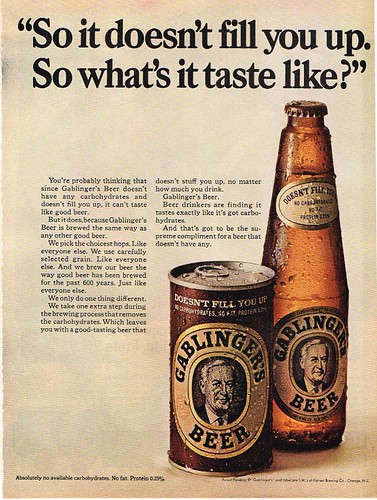
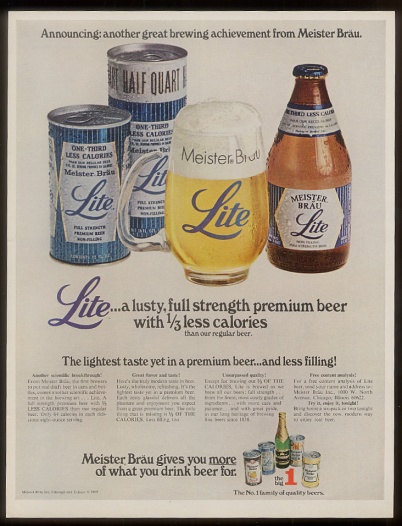
The first low-calorie beer was created by Joe Owades, who, it must be said, had some very strong opinions about beer. He once told me that all ale yeast was dead and inferior to lager yeast. Around 1967, he created Gablinger’s diet beer, the first light beer, while working for Rheingold. It flopped. Big time. Not everybody agrees on what happened next. Some accounts credit Owades with sharing his recipe for light beer with Meister Brau of Chicago while others claim that the Peter Hand Brewing Company (which marketed Meister Brau) came up with it independently on their own. However it happened, Meister Brau Lite proved somewhat more successful than Gablinger’s, primarily due to its superior marketing. Miller Brewing later acquired Meister Brau, and in 1975 debuted Miller Lite, complete with the distinctive, trademark-able spelling.

Meister-Brau-Lite-1969

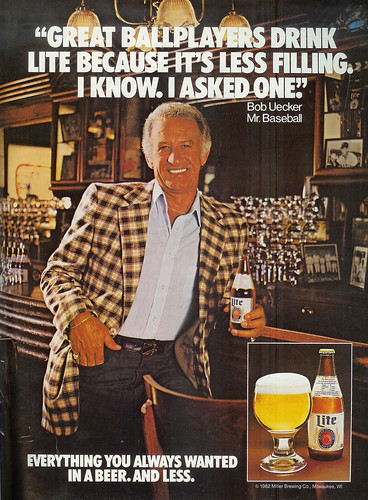
But it took marketing the new low-calorie beer in a new way so that it removed the “diet” stigma to make it work. They had to trick people into drinking it. Miller’s famously successful “tastes great, less filling” campaign was the primary reason for the category’s success. But it was hardly overnight. It took fifteen years — from 1975 to 1990 — for Miller Lite to reach 10% of the market. Over that time, the other big brewers (loathe to miss out on any market share) introduced their own versions, such as Coors Light and Bud Light, so that whole segment of low-calorie beer was nearly 30% of the beer market by 1990.

miller-lite-uecker-1982

Today, seven of the top ten big brands are light beers. Despite its recent dip in sales, it remains a $50 billion segment of the business and still hovers close to half of all beer sold in the United States. That fact, I find to be incredibly sad, frankly. What a great triumph of marketing over common sense and actual taste.

Earlier this year, Ryder gave a talk on beer in Milwaukee, entitled the Science of Beer, where he extolled the recent changes in people’s attitudes toward beer. “‘People are rediscovering beer,’ he said. ‘They’re gaining a brand new appreciation of what beer is and what beer could be.'” And to my way of thinking, what beer is and what beer can be is just so much more than low-calorie light beer. I find that there’s just no defense for light beer.

Filed Under: Beers, Breweries, Editorial, Politics & Law Tagged With: Light Beer, Miller Brewing, MillerCoors

Session #65: Drinking Alone

July 6, 2012 By Jay Brooks

alone
Our 65th Session is hosted by British blogger Nate Southwood who multi-blogs at his Booze, Beats & Bites. The topic he’s chosen is “So Lonely,” meaning going to the pub to have a beer alone. Here’s how he describes his Session topic:

Speaking of fun, going to the pub with a bunch of mates is great… you have a few beers and a laugh, generally a fun time and all.

I love going to the pub with mates but sometimes I go to a pub alone and I enjoy it.

Other people say I’m weird for this as there seems to be a stigma attached to being in the pub alone — alcoholism.

There are many reasons why I go to the pub alone.

  • Sometimes I just want to spend some quality time alone that isn’t at home.
  • Sometimes I’m walking home and fancy a pit-stop.
  • Sometimes my mates are all busy with their girlfriends/wives/children and I want a pint.
  • Sometimes I just fancy going to the pub and observing the bizarre people around me.
  • Sometimes I want to sit down and write blogs on my tableaux while having a pint.
  • Sometimes I just want to play angry birds while having a pint.
  • Sometimes I just want to prop myself at the bar and discuss beer with the bartender.
  • Sometimes I want to explore pubs that I’ve never been to before but my mates don’t want to.
  • Sometimes I’m just a miserable bastard and don’t want to socialise but want a nice pint.

The way I see it is that I love beer and pubs and I don’t see why I should only go to the pub when I’m with other people.

Am I weird for going to the pub alone?

How do you feel about going to the pub alone? Do you feel it’s necessary to be around friends to spend time in a pub?

session_logo_all_text_200

So to get in the right spirit, I’m putting on the Police’s song So Lonely and pouring myself a beer as I sit in the house all my myself, alone, as it were. It seems to me the only way to write about drinking alone is by actually doing just that. The profession of writing is itself a rather lonely one, hours upon hours spent in relative solitude tapping on keys and watching letters, words, sentences, paragraphs and, hopefully, fully formed thoughts and ideas spool out onto a computer screen in the vain hope that someone else will read them, like them (or at least be moved to think about them), and ultimately pay you for them.

Being a writer about beer is essentially a double whammy of loneliness, drinking and writing alone. As I wrote two sessions ago, “[m]y job often requires me to drink beer alone, which is far from my favorite thing to do. It’s perhaps the worst way to have a beer, even though it’s sometimes necessary. Alone, beer is stripped of all its intangibles, its raison d’etre. You can evaluate the constituent parts, its construction, even how they come together as a finished beer. In other words, on a technical basis. And that’s how you should begin, but there must be a discussion waiting at the end of that process.” So now I’m going to contradict myself and say that while that remains true some, or even most, of the time, there are indeed times when drinking alone isn’t as terrible as I made it out to be and that we can, and should, be allowed to enjoy a drink in silence and solitude.

For myself, I can’t tell you how many times I’ve ducked into a pub for a quick lunch and a beer, usually with a book in hand. It’s a satisfying way to eat a meal, drink a beer and feed your head, too. It usually reminds me of the great Bill Hicks’ bit about reading alone, “looks like we got ourselves a reader:”

But for reasons passing understanding, drinking alone is often equated with having a drinking problem or being an alcoholic. Even the “Diagnostic and Statistical Manual of Mental Disorders, Fourth Edition” does not mention solitary imbibing as a symptom of alcohol dependence. These are outlined at About.com’s Alcoholism page and you won’t find drinking alone among the symptoms. But when you click on their online quiz of 20 Questions known as the Alcohol Abuse Screening Quiz to discover if You Have an Alcohol Problem, question sixteen is “Do you drink alone?” But even most honest counseling centers, AA, what have you will admit that it’s not the act of drinking alone that signals, in and of itself, problem drinking, but the reasons for drinking alone, the underlying cause. Yet the notion of drinking alone automatically meaning an alcoholic persists. It’s downright pervasive in our society. Do a Google Image search for “drinking alone” or “at the bar alone” and look at what comes up. The great majority of images are depressing looking people, heads down, slumped over, with very few, if any, smiling people or positive associations shown.

Alone_in_the_bar_by_gabrio76
Alone in the Bar by Argentine artist Gabriel Hernan Ramirez

As is typical, the neo-prohibitionist, anti-alcohol version of reality gets more play and has wormed its way into the public consciousness through a concerted effort of their propaganda over many decades. It doesn’t really matter that there are numerous legitimate, healthy reasons one might have a drink alone that isn’t a sign of anything untoward or problematic, but that would make the narrative more difficult to carry. It’s far easier to keep it simple and not have to explain nuance or an understanding of how, and why, people drink.

For example, the Abuse & Addiction Help Information website — who, it must be remembered makes their living by having people pay them to seek treatment for addiction — lists their Ten Warning Signs Of Alcoholism. There is is at number 2:

2. Do you drink alone? Social drinking is one thing, but we believe that drinking alone is one of the sure fire ten warning signs of alcoholism or growing alcohol dependency. Drinking alone indicates a need for alcohol.

Hmm, “drinking alone indicates a need for alcohol.” Really? It does in all cases? Of course, not. It could just as easily be explained by being thirsty, for chrissakes. And notice that they don’t say it absolutely is a sign of alcohol dependencey, but instead say “we believe that drinking alone is one of the sure fire ten warning signs of alcoholism or growing alcohol dependency.” Well, sure, if it’s in your best interests to have as many people pay for your services, then it’s no surprise that you’d believe whatever creates the impression of more alcoholics because that means more customers, too.

Even the Medline Plus online medical encyclopedia, a “service of the U.S. National Library of Medicine and National Institutes of Health,” on their Alcoholism and alcohol abuse page, includes drinking alone under their list of symptoms, as does the celebrated Mayo Clinic.

But in every case, the context is not explored. It’s presented as black and white: if you drink alone, you’re a problem drinker or alcoholic. Even if tempered by “might be,” the impression that these authoritative sources give is that drinking alone is to be feared as the beginnings of a downward slide into degradation and life-crippling alcoholism. To know that’s true, just ask any ten random people. Most of them will tell you that they believe that to be the case. And that’s because certain people and groups have been saying so for so long, with virtually no dissenting opinions or contrary evidence or even common sense or reason being allowed into the debate. We say so, end of story, case closed. Like most of the propaganda coming from, or having been twisted and influenced by, anti-alcohol concerns, it’s both infuriating and grossly untrue. This is especially so because it makes people feel guilty and shameful for doing something as natural as drinking a beverage they like and want to have just because they’re alone. It’s why this could even be a topic, because it’s so taken for granted by so many people. If you’re alone and want a beer, goddammit, order a beer.

Happily, not everyone is so myopic and certain you’re life will fall into ruin with a solitary drink. Modern Drunkard published The Zen of Drinking Alone, which includes this bon mot:

Drinking alone, on the other hand, is a much more pure and forthright form of imbibing, and I say that because it focuses entirely on the simple act of putting alcohol into your bloodstream. It tosses aside all the half-hearted pretensions about merely using alcohol as a social tool. It gets down to what drinking is all about: getting loaded, and by doing that, getting down to the inner you. The inner joy, the inner madness, the subconscious you, the real you.

And a few years ago, Esquire magazine published suggestions on How to Drink Alone, which included some I agree with — ignore the television, look up often and read, don’t pretend to read — but also some I do not — don’t eat or that it’s never about being happy. Still, I love that they not only have no problem with drinking alone, but positively celebrate it. I think that’s how it should be. No one should tell another person or society as a whole that something that may be a problem for a minority of people should be avoided by everybody on the off chance that they can’t handle it. It would be like making red meat illegal because some people insist on eating too much of it and develop a heart condition. It sounds absurd when applied to almost everything else, but no ones questions it when it’s alcohol because neo-prohibitionists have dones such a good job of painting alcohol with the broad brush of danger. At the same time, they both ignore and insist that there is nothing positive about drinking alcohol, despite common sense and the obvious error of that position.

That people enjoy alcohol for a myriad of reasons and that most can continue to enjoy it as responsible adults should, it seems to me, be so obvious that it shouldn’t even have to be mentioned. But as long as there are people who fear it and believe it is the ruin of everything good in the world, I guess we have to keep reminding them that their position is not true for everyone; it’s not even true for most people. Most of us can have a drink alone for the best of reasons and not fall into a ruinous life. That we should wonder if that’s okay is perhaps the unkindest cut of all; proof positive that the anti-alcohol wingnuts are winning the war. They’ve obviously been allowed to frame the argument in their terms, because the question really should be why should we even have to ask if we can drink alone. If we can, we can. Now go away, I have a beer to finish and I want to be alone.

Filed Under: Beers, Editorial, Food & Beer, Just For Fun, Politics & Law, The Session Tagged With: Anti-Alcohol, Prohibitionists, Propaganda

Welcome To The World ABInBevMo

June 29, 2012 By Jay Brooks

abim
By now you’ve already seen the news that Anheuser-Busch InBev has taken another step closer to realizing their quest for world domination in the beer business. They’d already owned half of Mexican powerhouse brewer Grupo Modelo — makers of Corona, among other brands — but it was non-voting stock and they asserted very little control over them. In fact, Corona is often a competitor in the U.S., usually with non-Bud distributors. The irony, of course, is whether you bought Bud or Corona, eventually at least some of that money still made its way to ABI. The phrase “laughing all the way to the bank” springs to mind. Hard as it to believe, they already have a new website up even though the merger’s only been finalized in the last twenty-four hours. The name of the new site is Global Beer Leader. Does anybody else think that sounds ominously close to North Korea’s “dear leader?”

ABI is paying Grupo Model $20.1 billion to become ABIM, making it the second-biggest deal ever brokered in the beer world. The first was the $52 billion InBev paid to merge with Anheuser-Busch in 2008. The deal still needs government approval, and will likely be addressed and decided in the first quarter of next year.

According to the deal, Crown Imports — the current importer of Corona and other Grupo Modelo brands under the Constellation Brands umbrella — will continue to be the importer to the U.S. In fact, part of the deal includes the sale of the half of Crown Imports owned by Grupo Modelo to Constellation Brands, who had owned the other half, for $1.85 billion. That gives them 100% control over the distribution of the Modelo brands in America. ABIM head honcho Carlos Brito told Harry Schumacher this morning that they’re looking at this as a golden opportunity primarily to combine Bud and Corona outside the U.S. in the global beer market.

Adam Nason at Beer Pulse has a helpful chart showing that the merger gives ABIM control over 8 of the top 15 global beer brands, just over half.

Full details of the deal can be found at the new website Global Beer Leader.

abim
NOTE: This NOT their official new logo, I made this up as a parody.

Filed Under: Breweries, Editorial, News Tagged With: Anheuser-Busch InBev, Big Brewers, Business, Modelo

« Previous Page
Next Page »

Find Something

Northern California Breweries

Please consider purchasing my latest book, California Breweries North, available from Amazon, or ask for it at your local bookstore.

Recent Comments

  • Ernie Dewing on Historic Beer Birthday: Charles William Bergner 
  • Steve 'Pudgy' De Rose on Historic Beer Birthday: Jacob Schmidt
  • Jay Brooks on Beer Birthday: Bill Owens
  • Steve 'Pudgy' De Rose on Beer Birthday: Charles Finkel
  • Steve 'Pudgy' De Rose on Beer Birthday: Bill Owens

Recent Posts

  • Beer In Ads #5204: Oh Brother! Griesedieck Bros. Genuine Premium Bock Beer Is Here! February 15, 2026
  • Historic Beer Birthday: Emil Resch February 15, 2026
  • Historic Beer Birthday: Philip Zang February 15, 2026
  • Beer In Ads #5203: Robert Portner’s Bock Beer February 15, 2026
  • Historic Beer Birthday: August Schell February 15, 2026

BBB Archives

Feedback

Head Quarter
This site is hosted and maintained by H25Q.dev. Any questions or comments for the webmaster can be directed here.