

The BBC’s home editor, Mark Easton, had an interesting editorial a few days ago about The Myths Of 24-Hour Drinking in which he writes about the effects of the UK’s Licensing Act 2003, which among other changes to the laws concerning alcohol, opened up the possibility of some drinking establishments staying open 24 hours. Proponents hoped it would create jobs and more business and opponents were certain longer hours in the pub would create more drunks. Neither happened, of course, and it’s an interesting read, including all the usual heated comments.
Colorado To Make Session Beers Illegal In Bars & Restaurants

This should give anyone who loves session beers or groups trying to keep people from getting blotto a case of apoplexy. A new law in Colorado, actually a bill amended last spring, “now requires the state to enforce license restrictions to a T.”
The law requires to-the-letter enforcement of the state’s existing beer regulations. Bars, restaurants and liquor stores can sell only beer that is above 4 percent alcohol by volume. Grocery and convenience stores are allowed to sell only alcohol with less than 4 percent alcohol by volume.
So this is coming from the C-stores and groceries trying to protect their turf of low-alcohol beer. But the consequences are absurd, and will make it essentially illegal for any restaurant or bar to serve patrons beer that’s below 4% a.b.v. According to the Denver Post’s report, Stout Opposition to Looming Limits on Selling Lower-Alcohol Beer in Taverns, Restaurants, “[t]echnically, bars, restaurants and liquor stores in Colorado should never have sold the lower-alcohol beers in the first place, though no one ever paid much attention. Their licenses allow them to sell spirits, wine and beers that fall into the ‘malt liquor’ category.”
The original purpose of the law stems from the post-prohibition period when many laws enacted to regulate alcohol tried to limit access to it. Though Prohibition was a rousing failure, temperance groups merely shifted tactics and locally many of those early laws were an attempt to make it more difficult for alcohol to flow freely again as it had prior to 1920. Colorado’s answer was to enact laws that strictly specified which products could be sold where and that’s why modern Colorado has its peculiar alcohol landscape. But until now, the law restricting beers below 4% a.b.v. in bars and restaurants was not enforced. Increasingly, convenience and grocery stores saw that as a threat to their exclusive right to sell low-alcohol beer but were blocked time and time again from doing anything about it … until now, that is.
As is often the case, following the money does lead us to the answer. It’s about business, of course. I love this quote from Jason Hopfer, a C-store lobbyist. “Either stop selling the product we sell, or let’s stop having this false delineation on beer. Let’s let beer be beer.”
Yes, let’s let beer be beer, by all means. That is the obvious solution. To do that, we’d have to do away with Colorado’s ridiculous division that brands “beer” as anything under 4% a.b.v. and anything over it as “malt liquor.” That would be best for society as a whole, for the brewers and anyone who believes drinking lower alcohol beer while out in public is a safer idea. But as you might expect, the businesses that have benefited from these state-mandated monopolies for over 75 years are loathe to level the playing field. I think it’s simply an unknown. It doesn’t appear certain who would benefit or be hurt the most if all Colorado businesses could sell any strength beer. But it would change things considerably. And change is scary.
As the Denver Post story makes clear, nobody in the effected trade groups seem particularly concerned because they believe that when the next session of Colorado’s state legislature begins in early January, that the obvious absurdity of what this law would create will be addressed and fixed. Maybe, I’ve never followed Colorado’s state politics too closely so it’s hard to know how reasonable that belief is. But surely some of the politicians who supported this amendment with the language it currently uses had to know what the actual consequences would be. That’s perhaps the scariest thing of all, that they could accept the business argument in this case, ignoring the all too obvious negative repercussions. Save the Session Beers!
For The Love Of Beer

I’ve known about this for a little while now, but it seemed like Thanksgiving was a good time to try to help spread the word about this project. For the Love of Beer is a film project by Alison Grayson to highlight, well I’ll let her tell you.
For the Love of Beer is a documentary devoted to the stories and the passion of the women at the forefront of the Pacific NW beer community. It’s not for feminism or equality … it’s for The Love of Beer.
Frankly, that’s something I’m very thankful for: women in beer. Beer had traditionally been a man’s world because beer was all the same, not terribly complex or diverse and didn’t add as much as it could to a food experience. Not to mention the big brewer’s advertising beginning in the Sixties became more focused on marketing to young males, alienating many women in the process. Craft beer changed all that and women have been a big part of that movement, especially in recent years. The fact that a growing number of women are brewing beer and enjoying beer is having a profound impact on craft beer and the direction it’s heading.
Have you ever met a brewer or beer geek who’s significant other didn’t like beer? They always tell the tale with a sigh of resignation. Life seems better when your partner shares your obsessions. I know I’ve told this story too many times, but before I even asked my wife of 15-years out on a date, I took her to a brewery and ordered a sampler for her. At that time she didn’t drink good beer, but because of her positive reaction to the experience, I asked her out on the spot and we’ve been happily drinking together for over fifteen years. In fact, we spent our honeymoon touring breweries in Oregon and Washington, which is the geographic subject of Grayson’s film.
You can see more of her film work at her Vimeo page for Grayson Productions. But watch the trailer of the beer documentary in progress below. The film first caught my eye because my friend and colleague Lisa Morrison is featured in the trailer and, presumably the finished film as well. That’s reason enough to support it, but then there’s also Tonya Cornett, the terrific brewer from Bend Brewing.
For the Love of Beer Trailer from Grayson Productions on Vimeo.
Blue Laws In Decline

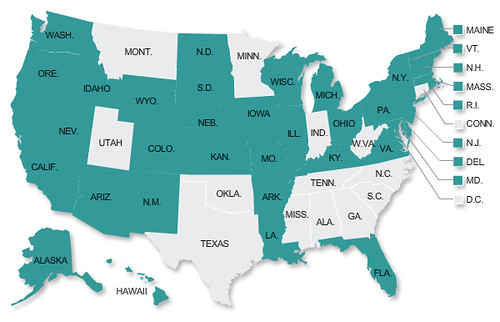
USA Today had an interesting report that more and more states are finally relaxing their antiquated blue laws and allowing alcohol to be — gasp — sold on Sundays. In the article, entitled Sunday Alcohol Sales Are on the Rise in U.S., it is revealed that “[s]ince 2002, 14 states have joined the list of states allowing Sunday sales of [alcohol], bringing the total to 36.” But that means there are still 14 more states, plus D.C., that prohibit Sunday sales of alcohol.
According to Dvaid J. Hanson, author the wonderful website, Alcohol: Problems and Solutions:
A blue law is one restricting activities or sales of goods on Sunday, to accommodate the Christian sabbath. The first blue law in the American colonies was enacted in Virginia in 1617. It required church attendance and authorized the militia to force colonists to attend church services.
As Wikipedia adds. “Most have been repealed, have been declared unconstitutional, or are simply unenforced, although prohibitions on the sale of alcoholic beverages, and occasionally almost all commerce, on Sundays are still enforced in many areas,” despite the fact that Sunday is the second busiest shopping day of the week.
As Lisa Hawkins, with the Distilled Spirits Council of the United States, put it, “[b]lue laws … simply don’t make sense in today’s economy. They inconvenience consumers and deprive states of much-needed tax revenue.” But economy aside, you’d think people would recognize that the origin of these laws to it to force religious practices on everyone, despite principles of religious freedom and not all citizens following the same faith. Apparently, you’d be wrong. One naysayer, Bruce Beckman (a council member in Downers Grove, Illinois who voted against modifying local blue laws), is quoted as saying he voted against changing his community’s blue laws because the “relatively small amount of tax revenue this might generate isn’t as important as using Sunday mornings for family, going to church … and not sitting in a bar somewhere.”
To me that’s an unbelievable rationale. I can hardly fathom someone holding such an opinion in 2010. Nobody’s stopping him from attending church or spending the day with his family, but that he believes he has the right to force everyone else in his community to do likewise is deeply offensive. It’s absolutely none of his business how I choose to spend my Sunday and that he thinks he should actively keep it illegal to do something he personally doesn’t care for is a tyranny, no matter how slight or small.
Happily, such outmoded points of view are visibly in decline, as evidenced by the increasing number of states doing away with these old-fashioned laws. Below you can see which states, in white, are still behind the times.
FDA To Rule Caffeine Unsafe In Alcohol

Harry Schuhmacher, of Beer Business Daily, just issued a news alert that he’s learned from the website of New York Senator Charles Schumer that the FDA “will rule ‘that caffeine is an unsafe food additive to alcoholic beverages, effectively making products such as Four Loko, Joose, and others like them, prohibited for sale in the United States.'”
According to the press release from Senator Schumer:
SCHUMER: FDA TO EFFECTIVELY BAN CAFFEINATED ALCOHOLIC DRINKS; FTC WILL NOTIFY MANUFACTURERS THAT THEY MAY BE ENGAGED IN ILLEGAL MARKETING OF UNSAFE BEVERAGES
After Months of Pressure by Schumer, FDA to Send Notice to Manufacturers of Caffeinated Alcoholic Beverages that Product is Not Considered Safe; Move Will Effectively Ban Products from the Market
FTC to Send Notices to Manufacturers That They Are Engaged in the Marketing of Unsafe Alcoholic Drinks
Schumer: Let This Serve as a Warning to Anyone Who Tries to Peddle Dangerous Beverages to Our Kids, Do it, And We Will Shut You Down
U.S Senator Charles E. Schumer announced today that the Food and Drug Administration (FDA) will rule that caffeine is an unsafe food additive to alcoholic beverages, effectively making products such as Four Loko, Joose, and others like them, prohibited for sale in the United States. Additionally, the Federal Trade Commission (FTC) plans to notify manufacturers that they are engaged in the potential illegal marketing of unsafe alcoholic drinks. These announcements come after months of intense pressure by Senator Schumer to have the drinks banned because of serious risks to consumer health and safety.
“Let these rulings serve as a warning to anyone who tried to peddle dangerous and toxic brews to our children. Do it and we will shut you down,” said Schumer. “This ruling should be the nail in the coffin of these dangerous and toxic drinks. Parents should be able to rest a little easier knowing that soon their children won’t have access to this deadly brew.”
After calls by Schumer to ban the drinks in New York, just this past week, the State Liquor Authority and the state’s largest beer distributors agreed to stop selling these dangerous drinks in New York. In addition to New York’s efforts, Oklahoma, Utah, Michigan, and Washington acted to ban the drinks as did a number of colleges, including Ramapo College, Worcester State University, the University of Rhode Island and the Wentworth Institute of Technology.
Popular drinks such as Four Loko and Joose contain as much as 2-3 coffee cups worth of caffeine and 2-3 cans of beer per container — a potent, dangerous mix that can be extremely hazardous for teens and adults alike. Last month, nine students passed out and were hospitalized after drinking Four Loko, leading states and universities across the country to issue ban, limit, or issue warnings about the drink.
Compounded with its health risks, beverages like Four Loko pose a unique danger because they target young people. The style of the beverages – with a vibrantly colored aluminum can colors and funky designs — appeal to younger consumers, increasing the likelihood that the beverages will be consumed by young adults and creating a problem for parents and business owners who might be misled by the branding. Four Loko is also stocked next to other energy drinks, creating further confusion.
Last week, Schumer was joined in his efforts to ban the drink by Jacqueline Celestino, grandmother of Nicole Lynn Celestino, an 18 year old from Long Island who passed away after drinking the caffeinated alcoholic beverage Four Loko. Nicole, went into cardiac arrest after drinking Four Loko this past August, she had taken a diet pill that day. Nicole’s family has become outspoken advocates for a ban on alcoholic caffeinated drinks like Four Loko.
The dangers of these drinks are well known. A recent study found that young and underage drinkers who combine alcohol with caffeine, which occurs with increasing frequency given the prevalence of beverages like Four Loko and Joose, are more likely to suffer injury, be the victim of sexual assault, drive while intoxicated, and require medical attention than drinkers who consume caffeine-free beverages. In 2008, Anheuser-Busch InBev NV and MillerCoors LLC reformulated caffeinated alcoholic beverages under pressure from several states and regulatory bodies, but smaller companies like the manufacturers of Four Loko and Joose managed to remain unnoticed.
According to the statement, the Federal Trade Commission (FTC) plans to notify manufacturers of caffeinated alcoholic beverages “that they are engaged in the potential illegal marketing of unsafe alcoholic drinks.”
There’s a lot of nonsense in that press release, and no one knows how whatever ruling the FDA makes will effect beer with coffee, tea or caffeine added for flavor.
First there’s this rant: “‘Let these rulings serve as a warning to anyone who tried to peddle dangerous and toxic brews to our children. Do it and we will shut you down,’ said Schumer. ‘This ruling should be the nail in the coffin of these dangerous and toxic drinks. Parents should be able to rest a little easier knowing that soon their children won’t have access to this deadly brew.’”
Did I miss a meeting. People under 21 can’t buy these products now. My kids, your kids, everybody’s kids have no access to these so-called “deadly brews.” If they do find a way to get them (which I have no doubt of) then that’s a failure of another kind. And doing away with them altogether effectively takes them away from law-abiding adults who want to purchase them. That just makes no sense to me. It’s as if they’re saying we can’t control the portion of the population that are under 21 so we’re going to punish everybody because we can’t do our job.
But that aside, there’s absolutely nothing preventing anybody from simply mixing a caffeinated drink with alcohol and making their own drink. That’s the whole reason companies started making pre-packaged RTD’s with alcohol and caffeine in the first place, because people were already doing that on their own. They didn’t create the demand, they responded to it and simply gave the people what they wanted.
This will do virtually nothing to stop people from drinking caffeine and alcohol together. It may make it more difficult and less convenient, but the cat is out of the bag. If anything, going back to people making these drinks themselves will make them less safe, not more, because there will be no standardized ratio for mixing the two.
Toward the end, Schumer claims “[t]he dangers of these drinks are well known.” Really, people have been drinking caffeine and alcohol together as long as the two have existed. Has it become more popular lately? Maybe, but people were doing it pretty regularly as long ago as when I was a young adult, thirty years ago. I’d love to see that study he cites, I’m willing to bet there are holes in it you could drive a truck through.
But the real danger is that undoubtedly craft beers that have beers with caffeine added for flavor, whether coffee or tea, will get dragged under in the government’s zeal to look like they’re doing something to protect people from themselves. Say goodbye to coffee stouts, a drink no underage kid would drink with a ten-foot straw.
Two New Studies Show Benefits For Beer Drinking Women

Two new studies were presented yesterday at the American Heart Association’s annual meeting in Chicago. According to the Wall Street Journal, “[b]oth studies, by researchers at Brigham and Women’s Hospital in Boston and Harvard University, used data from the landmark Nurses’ Health Study, which started in 1976 and involves more than 200,000 women.”
The results of the two studies, and additional ones presented at the meeting, included findings that suggest “women might not have to limit themselves to the [previous] one-drink-a-day guideline.” Also, “[w]omen who have an alcoholic drink or two a day in midlife turn out to be healthier overall in their old age. Another study presented at the conference showed that women who had a daily drink had a lower risk of stroke.”
From the Wall Street Journal:
The research into stroke risk looked at 73,450 women who were free of heart disease and cancer when they entered the study. They were followed from 1984 to 2006. Women who had up to one drink a day had a 20% reduction in stroke risk compared with non-drinkers. There was no impact on stroke risk among most women who drank larger amounts, such as two or three drinks daily. But women who were also on hormone-replacement therapy and who had two drinks a day had an increased stroke risk.
A third study released at the conference by researchers at the University of Rome in La Sapienza, Italy, showed that two to three drinks daily among male heart-bypass-surgery patients was associated with a 25% decline in the rate of subsequent cardiovascular problems like heart attacks and strokes compared to non-drinkers. But the risk of dying increased among people who had four or more drinks daily and had a particular heart problem affecting the left ventricle. The study involved more than 1,000 patients followed for about 3.5 years.
Women who had about two drinks daily also had fewer cardiovascular problems after bypass surgery but the benefit was smaller than seen in men. The researchers said many patients had wondered if they should stop drinking after bypass surgery so a study was designed to look at clinical outcomes among drinkers and non-drinkers.
While they caution that the jury’s still out on certain diseases that affect women, such as breast cancer, the overall effect of moderate drinking remains a positive force on total mortality. This new evidence, along with the mountain that precedes it, highlights yet more reasons why the Breast Cancer Action organization’s churlish denunciation of all alcohol companies in October was so obnoxious and wrong, which I wrote about at length in Biting the Hand That Feeds You.
One of the studies showed more evidence to confirm the prevailing theory that regular, moderate consumption of alcohol will keep you healthier, increasing the odds that you’ll live to a more advanced age than a person who abstains.
Qi Sun, a Harvard medical instructor, looked at nearly 14,000 women who had survived to age 70. Dr. Sun said he found that 1,499 of the women were free of major diseases like cancer and heart disease and had no physical impairments or memory problems. He looked at the amount of drinking these women had done at midlife, or about age 58 on average. Women who reported having one to two drinks most days of the week had a 28% increase in the chance of “successfully surviving” to at least age 70 compared with non-drinkers. Like other studies, Dr. Sun found women drinking most days of the week were more likely to be healthier than women who drank one or two days a week.
That’s advice my wife follows faithfully. Glad to know she’ll probably outlive me.
Who Is The Super Bowl For?

This season’s Super Bowl is still three months away and we’re only half way through the 2010/11 NFL football season. This next Super Bowl at North Texas Stadium, the new Dallas Cowboy’s place, will be played on February 6, 2011.

But already I’ve received three e-mails from the Marin Institute with their now annual screed about saving the Super Bowl from beer advertising, known as Free the Bowl. It’s of the “it’s for the kids” variety of complaint, a favorite of anti-alcohol groups. Trying to restrict alcohol advertising began almost immediately after the repeal of Prohibition. Since keeping alcohol illegal proved unreasonable and counter-productive for society, temperance groups instead turned to other ways to limit access to it, and advertising codes proved an effective target, one that continues through today.
I realize that the Super Bowl is the chosen target because it’s such a big event, being one of the most watched sports events all year in the U.S. But I can’t help but ask, exactly who is the Super Bowl for? Is it a children’s event? No. Is it a family event? Maybe, but it’s not exactly Thanksgiving or Christmas. I can’t help but think that it’s an adult event where, like most things that occur in our society, some parents exercise the judgment to allow their kids to watch, too, like a PG movie. But let’s look at exactly who the audience is.
Last year, according to Nielsen, an estimated 151.6 million people watched the championship football game. The Marin Institute claims 30 million of those people were underage. I don’t know where they got that figure — perhaps they made it up — but even assuming it’s correct that means the underage audience is around 20%. That also means that the vast majority of the Super Bowl’s audience is adults, just over 80%. And that’s why I believe the Super Bowl is an adult event. Adults who are allowed to drink alcohol. The fact that many adults also let their kids watch the game with them should not turn the Super Bowl into “kid’s programming.” After all, any parent who doesn’t want to subject their kids to beer advertising has a very simple option available to them: they can turn off the game. No one is forcing them to watch or is forcing them to allow their kids to watch.
One more word about the 30 million underage viewers figure. I can only assume that’s all underage viewers, kids aged 0-20. Of those, how many are even paying attention? Certainly not the babies, but when does the so-called critical age begin? My kids are 6 and 9 and definitely do respond to advertising, but only to things they’re interested in already. When a new toy is advertised, the ad has their rapt attention. When it’s something they don’t care about — such as beer — they pay it no mind whatsoever and turn their attention elsewhere.
Assuming the kids’ ages are evenly spaced, that would mean if we assume it’s the kids over 10 and under 21 that are the ones supposedly “at risk” from — gasp — seeing a television commercial, then only 15 million kids are the ones the Marin Institute are concerned about. That’s 10% or just 1 in 10. That would mean 90% of the audience is effectively adult.
But all that speculation aside, who actually watches the Super Bowl? Is it kids? No, actually, it’s not. According to Nielsen research data, the younger you are, the less likely you are to actually tune in to the Super Bowl.
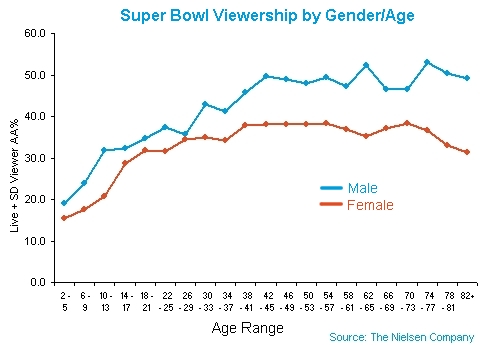
According to Nielsen, “[a] look at age/gender demographics showed that viewers of both genders exhibited a similar viewing arc: generally, the older the viewer, the more likely they tuned into the game.”
So kids are actually less likely to watch the Super Bowl than adults, making all this fear-mongering hoopla about kids and the Super Bowl even less truthful and more shameless propaganda. All three of the Marin Institute’s e-mails were to raise money from their supporters. Each included pleas that they needed money to fight the scourge of beer ads during the Super Bowl using such propaganda slogans as listed below, so let’s look at those.
“Football & Beer are not the same thing”
Did anybody say they were? What does that even mean? But that’s followed up with:
“Anheuser-Busch InBev wants kids to think so”
Really, they do? What on earth makes them think that? I should also mention that the graphics in the e-mail show pictures taken from the “Bud Bowl,” the stop-motion ads that Anheuser-Busch ran during the Super Bowl beginning in 1989 that showed two teams of beer bottles wearing football helmets and playing their own bowl game. So perhaps that’s the confusion. Unlike my own children, perhaps they’re unable to tell the difference between animation and reality. This is a tactic that just infuriates me. They seem to suggest that because it’s animated — or fun — that it’s meant to appeal to only children. You hear this same argument when beer labels have Santa Claus on them, as if cartoons and Santa Claus belong exclusively to the province of childhood. But since the last Bud Bowl took place in 1997 — thirteen years ago (14 by the time of the next Super Bowl) — it seems pretty far fetched to use an example that’s over a decade old and no longer even used to try to make their point.
“Football & Beer are a dangerous combination”
I would think playing football while drinking is a bad idea, but watching it? Oh, but wait for the punchline.
“Anheuser-Busch InBev wants kids to think it’s cool to drink when we know that Beer Kills Kids”
Oh, it’s because ABI is trying to make kids think it’s cool to drink beer. Nonsense. 80%, and more like 90%, of the Super Bowl audience is of legal drinking age. That’s the audience for the ads. If anybody, that’s who ABI wants to convince that drinking Bud is cool. Besides the fact that the underage kids can’t buy their products legally, why would any company spend the millions of dollars it costs to get an ad on during the Super Bowl to advertise to 10% of the audience watching? Simple answer; they wouldn’t.
And the phrase “Beer Kills Kids” is needlessly alarmist and at its core, untrue. It makes it sound like beer is a toxic poison. Do some children die because they drank too much alcohol? Of course, but more often it happens because of doing something stupid afterward while still intoxicated, like driving or being in a fraternity hazing. Beer didn’t do them in like they were drinking anti-freeze. It’s exactly the same as with adults, though we hope more adults are capable of behaving more maturely than our youth. But the reality is, for children and adults, that some people are mature enough to drink responsibly and some are not. Nothing magical happens when a person turns 21. I drank more responsibly at age 18 than my stepfather did at 51, my age now.
Worse still, the phrase makes it sound like they’re calling every person who makes or sells beer a murderer. I find that more than a little insulting.
“Americans Love Football…Why Push The Beer?”
This may be the single stupidest rhetorical question ever asked. Check the sales figures, Americans love beer, too. Countless adults like to watch sports and enjoy a beer at the same time. It’s relaxing, it’s enjoyable, it enhances the experience. I do it, don’t you? Don’t most people you know?
Hmm, let’s see. The Super Bowl is the most watched annual sports event in America and the audience is 80-90% adults, and even skews more male. Why would any company that makes a product aimed at almost that exact same demographic want to advertise during the game? Say it with me — “opportunity.” Any company that can afford it, should be advertising during the Super Bowl. To not do so would practically run counter to their corporate charter. And it’s that same opportunity to reach lots of people that the Marin Institute is cynically exploiting to raise money and stir up yet more unwarranted criticism of the beer industry.
The reality is I’m no great fan of the television advertising by the big beer companies, foreign and domestic, but not for the reasons that anti-alcohol groups don’t like it. The way in which beer has been advertised for decades has done a lot of damage over the years to people’s perception of what exactly beer is and can be. They’ve treated beer like an interchangeable commodity that has to be heavily advertised and marketed to sell, because at that level most beer is pretty similar and the differences all come down to how it’s marketed. That has also made it harder for the craft beer industry to be successful, because of how much re-edumacation has been necessary to essentially retrain people about beer’s diversity and sophistication. To this day, when many people say “I don’t like beer” invariably it’s because they view it as that one thing that big beer has convinced them is all that beer is.
But to suggest that those ads can’t run during the Super Bowl just because I’m going to let my children watch the game, too, is to me personally the height of absurdity. If nothing else, it’s a teachable moment for parents. Drinking responsibly with your children is perhaps the best way to show them that drinking alcohol is not to be feared, but can be done safely, enjoyably and in moderation. My wife and I teach that lesson every single day in our household, often while watching television with our kids. As a result, they see untold numbers of commercials for products aimed at adults, both watching sports and other programming. Some are for beer, most are not. But they all elicit a conversation about what they see, allowing us to shape how they respond to and think about the commercials they view. Isn’t that what parenting is all about: engaging your kids? Talking to them about how the world works, what’s in it and how they can deal with it is what we do every day? Why should Super Bowl Sunday be any different?
Zythophile Examines 40 Years Of CAMRA

With the 40th anniversary of the Campaign For Real Ale (CAMRA) just around the corner, one of my favorite beer historians, Martyn Cornell, takes a close look at some mistakes they’ve made along the way and some things they might have done better. He writes Maybe They Should Have Kept to ‘Revitalisation’. And Dropped the ‘Ale’at his wonderful blog Zythophile. Full disclosure, like Martyn, I’m also a CAMRA member.
New Evidence Supports Theory That Beer Sparked Civilization

The theory that it was beer that caused early man to make the transition from hunter/gatherers to farmers instead of bread, thus starting civilization itself, has been gathering steam since it was first proposed by anthropologists in the 1950s. The latest support comes from archaeologist Brian Hayden at Simon Fraser University in Canada, who will be submitting his recent research to the journal Current Archeology. His theories suggest that it wasn’t just the beer that was important, but its use in rituals like feasts that help bring people together.
From the article in Live Science:
The advent of agriculture began in the Neolithic Period of the Stone Age about 11,500 years ago. Once-nomadic groups of people had settled down and were coming into contact with each other more often, spurring the establishment of more complex social customs that set the foundation of more-intricate communities.
The Neolithic peoples living in the large area of Southwest Asia called the Levant developed from the Natufian culture, pioneers in the use of wild cereals, which would evolve into true farming and more settled behavior. The most obvious explanation for such cultivation is that it was done in order to eat.
Archaeological evidence suggests that until the Neolithic, cereals such as barley and rice constituted only a minor element of diets, most likely because they require so much labor to get anything edible from them — one typically has to gather, winnow, husk and grind them, all very time-consuming tasks.
Hayden told LiveScience he has seen that hard work for himself. “In traditional Mayan villages where I’ve worked, maize is used for tortillas and for chicha, the beer made there. Women spend five hours a day just grinding up the kernels.”
However, sites in Syria suggest that people nevertheless went to unusual lengths at times just to procure cereal grains — up to 40 to 60 miles (60 to 100 km). One might speculate, Hayden said, that the labor associated with grains could have made them attractive in feasts in which guests would be offered foods that were difficult or expensive to prepare, and beer could have been a key reason to procure the grains used to make them.
“It’s not that drinking and brewing by itself helped start cultivation, it’s this context of feasts that links beer and the emergence of complex societies,” Hayden said.
Feasts would have been more than simple get-togethers — such ceremonies have held vital social significance for millennia, from the Last Supper to the first Thanksgiving.
“Feasts are essential in traditional societies for creating debts, for creating factions, for creating bonds between people, for creating political power, for creating support networks, and all of this is essential for developing more complex kinds of societies,” Hayden explained. “Feasts are reciprocal — if I invite you to my feast, you have the obligation to invite me to yours. If I give you something like a pig or a pot of beer, you’re obligated to do the same for me or even more.”
“In traditional feasts throughout the world, there are three ingredients that are almost universally present,” he said. “One is meat. The second is some kind of cereal grain, at least in the Northern Hemisphere, in the form of breads or porridge or the like. The third is alcohol, and because you need surplus grain to put into it, as well as time and effort, it’s produced almost only in traditional societies for special occasions to impress guests, make them happy, and alter their attitudes favorably toward hosts.”
Food and beer together at the heart of the birth of civilization. Now that’s pairing idea I can get behind.
Full Fact Disputes UK Alcohol Statistics
In response to the highly unscientific study published in The Lancet last week suggesting alcohol is more dangerous than heroin, FullFact.org — “A [British] independent fact-checking organisation” — asked the question “Are alcohol-related problems on the rise?” Their conclusion? “Full Fact finds little support in the evidence.”