

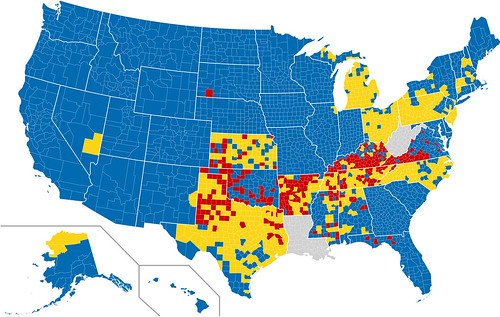
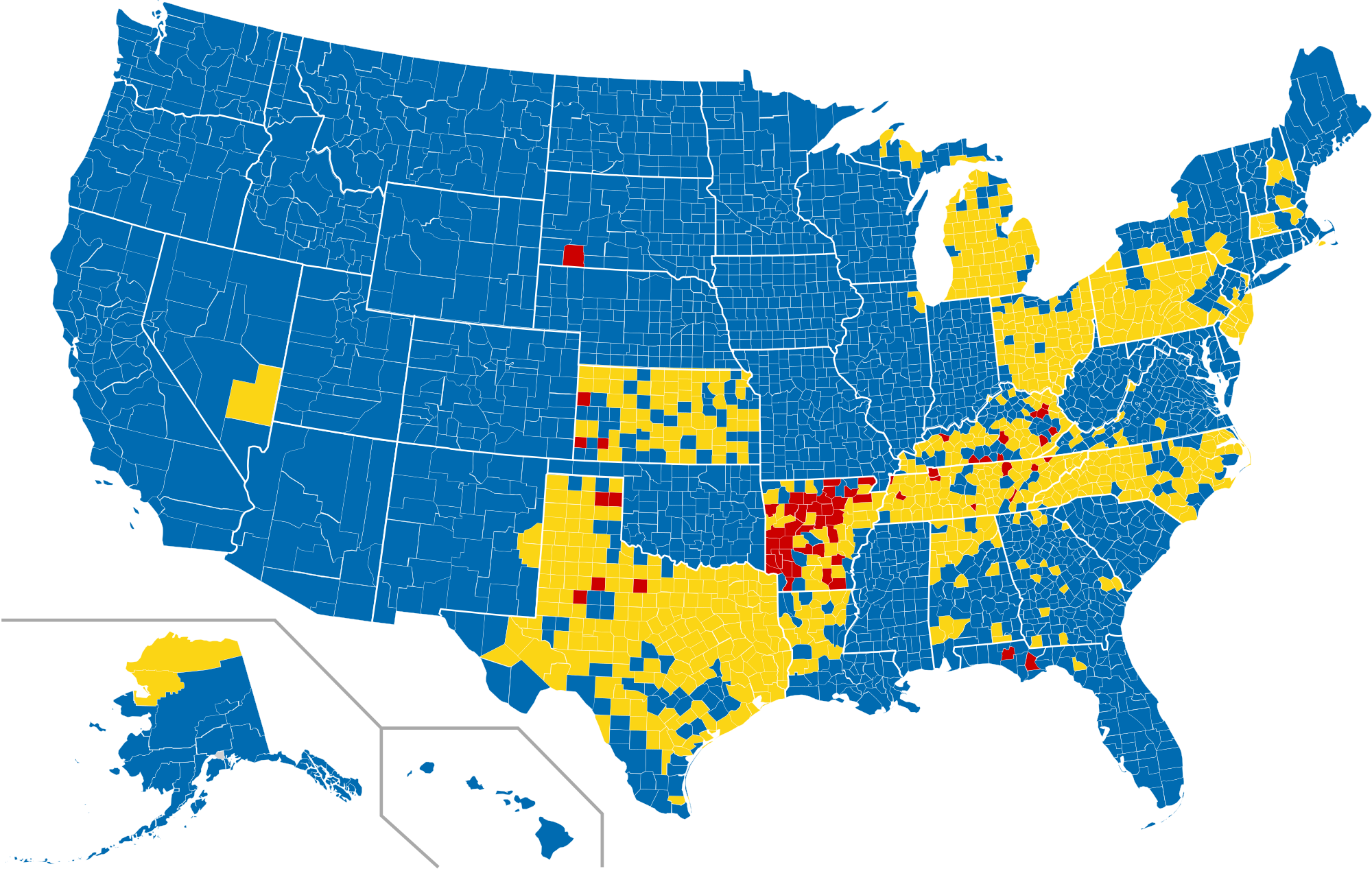
Today’s infographic is a map of every U.S. county, showing post-prohibition, which ones are wet (blue), which ones are dry (red) and which are mixed (yellow). Apparently gray is for ones where they didn’t have good information. Wikipedia has a list of dry counties by state, with a list of each state.
Beer Industry Trademark Concerns

Boston attorney Shannon Sadowski, founder of New Leaf Legal, wrote an engaging piece for the Boston Globe on trademark concerns that craft breweries will be facing as more and more brands emerge in the growing market. These disputes aren’t going to go away, and I’m always amazed by all of the naked ignorance of IP law on display anytime one these disputes rears its ugly head. Before the 24-hour news cycles and the internet, these controversies existed largely in back rooms out of the public eye, where — I believe — they belong. But until I finish building the time machine, “progress” marches on and these disputes are now part of the public brewing world landscape. Any-ha-who, her article, Trouble brewing: fierce competition for beer industry trademarks, is a good overview of the challenges breweries are facing, and even includes a link to Scott Metzger of Freetail Brewing’s wonderful response letter to a trademark dispute. Read it, and be prepared for the next trademark dispute, coming any day now to a brewery near you.
State Beer Excise Tax Rates

Today’s infographic is another map of the U.S. showing the State Beer Excise Tax Rates for each of the fifty states. Using data from 2011, it was created by the Tax Foundation.
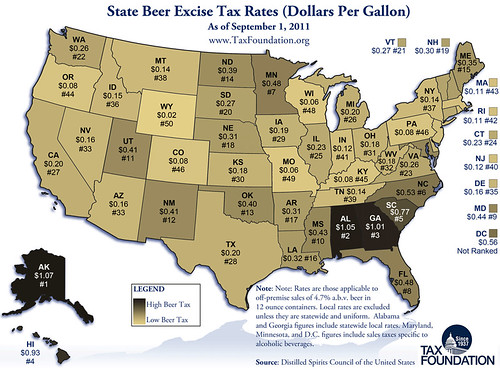
Click here to see the map full size.
Beer Taxes By Lester Jones Of The Beer Institute

A couple of months ago, the Tax Foundation interviewed Lester Jones, who’s the economist for the Beer Institute in Washington, DC. As I am a great fan of the dismal science, Lester’s become a good friend over the years and is a great asset to the beer industry. Tax Foundation host Richard Morrison describes the podcast interview. “Beer Institute Chief Economist Lester Jones explains the tangled web of federal, state, and local taxes that get applied to the beer we drink.”
If that doesn’t work, try listening to it directly on the web.
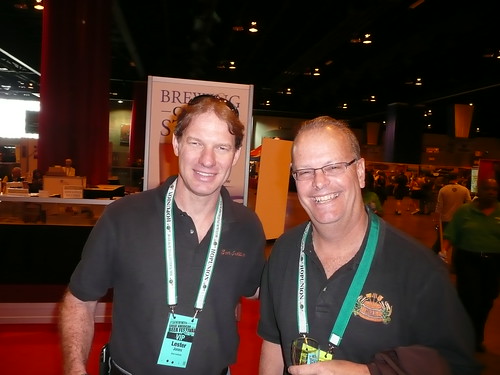
Lester Jones, at GABF a few years ago, with George Reisch of ABI.
Modelo Agrees To Reduce Its Tied House Monopoly In Mexico

I know governments have become increasingly beholden to business interests in my lifetime, but the idealist in me is unable to just be okay with that. It’s certainly true here in the U.S., where politicians are bought and sold, and the interests of ordinary folks rarely count for much in political decisions. And that’s unlikely to change while corporations are essentially immortals with all of the rights of people and none of the consequences or responsibilities, and whose profits have been declared free speech that can be used to influence our politics. Apparently Mexico’s government is similarly business-oriented. According to a story in today’s Wall Street Journal, “Mexico’s top brewer said Thursday it reached an agreement with the country’s anti-trust authority to limit its sales exclusivity contracts with corner stores, bars and restaurants, allowing more room for craft brewers and other players in a lucrative market split by Anheuser-Busch InBev’s Grupo Modelo unit and Heineken N.V.’s Cerveceria Cuauhtemoc Moctezuma.”
In a world where people mattered, a government would tell companies what the rules are and expect them to follow them. Negotiations would be, and frankly should be, unnecessary. But that’s not the way the world works anymore, if indeed it ever did.
More from the Journal piece:
Modelo said in a statement it would cap such agreements to no more than 25% of its points of sale, with the aim of reducing that number to 20% by 2018. The brewer said it would also allow craft brewers to sell their beers in bars and restaurants where Modelo has locked in exclusive pouring terms.
…
The Mexican beer market, the world’s fifth-biggest according to Euromonitor, is a virtual duopoly, with Modelo brands like Corona claiming around 58% of the 67 million hectoliters of brew sold in Mexico each year, while Cerveceria Cuauhtemoc brands like Tecate account for 41%.
Around half of the beer sold in Mexico each year is channeled through small convenience stores, many of which agree to sell only one of the two brewers’ brands in exchange for branded awnings, signs or refrigerators, as well as discounts on beer purchases, credit and even assistance with local permits.
The country is Heineken’s largest market, accounting for about 16% of sales, while it represents around 13% of AB InBev’s pro forma sales, according to Credit Suisse.
Nice that Modelo will “ALLOW craft brewers to sell their beers in bars and restaurants.” How magnanimous. While the Wall Street Journal, itself as pro-business as they come, ignored the reasons for Modelo’s change of heart, Beer Business Daily reveals why they’ve agreed to soften their monopoly. It’s because the Mexican Federal Competition Commission ruled, 4-1, “that future exclusive contracts that Cuauhtemoc and Grupo Modelo have with retailers be limited in nature.” If they don’t, they could be fined up to 8% of their total income. According to Harry, currently the two biggest Mexican brewery’s “exclusive contracts with retailers account for about 85% of total volume.”
More from Beer Biz Daily:
The CFC ruled that craft brewers (such as Cerveceria Minerva and Primus) that manufacture beer in Mexico (under 100m hectos a year) should have unfettered access to restaurants, bars, and cantinas, and that big brewers’ exclusive contracts with accounts should not exceed 25% of the total outlets they do business with, which is reduced to 20% over five years. Current contracts are allowed to continue in effect without change until they expire.
I find it odd that Heineken apparently responded with a press release saying “that it will abide by the new rules and ‘standardise and simplify some of our future contracts with customers.'” How nice that they let us know they’ve agreed to follow the law. That’s what drives me crazy about the large multinational corporations with economies bigger than many nations. But at least it’s some good news for Mexico’s smaller breweries and their burgeoning craft beer scene.
Homebrewing Finally Legal In All 50 States

As Mississippi’s ban on homebrewing was lifted today, for the first time since Prohibition made brewing illegal in 1919, homebrewing is finally allowed in all fifty states. My only comment is it’s about damn time. That a supposed clerical error — a typo — made home winemaking legal after prohibition ended while keeping homebrewing illegal is the biggest anti-alcohol bullshit move of all-time, especially when you consider it took a full seventy years to correct that “typo,” at least for all states. The American Homebrewers Association released a statement this morning, as did the Brewers Association:
Unifying the United States homebrew community has long been an aspiration of the American Homebrewers Association (AHA), and we are proud to announce this goal has been achieved with the help of countless dedicated homebrewers and AHA members like you. July 1, 2013 marks the day Mississippi lifts its homebrew restriction, unifying homebrewers in all fifty states for the first time since before prohibition.
Beer history in the United States region predates the very existence of the country as we know it. Native peoples of the Western Hemisphere produced a watery maize-beer, a pre-cursor to modern American adjunct beer, and as the earliest explorers settled down in the New World, America’s contemporary brewing culture was born.
“From our nation’s founders to our current President, this country has a long and storied tradition of homebrewing,” said AHA director Gary Glass.
Even after prohibition was eradicated with the implementation of the 21st Amendment in 1933, homebrewers would still be criminals in the eyes of the federal law for over four-and-a-half decades. President Jimmy Carter signed a bill that went into effect on February 1, 1979 federally legalizing homebrewing, but it remained up to each state to determine their individual alcohol policies, including home beer production. Over the course of the next forty-six years, states adopted legislation, permitting the making of beer at home.
It’s terrific news that finally homebrewing is permitted in every state. It’s been a long time coming.
Binge Drinking Infographic

Today’s infographic is another one filled with some questionable information, Binge Drinking. This one’s from the point of view Best Drug Rehabilitation, a company that makes money selling rehab to people with drinking or other problems, so they have a vested interest in making it sound like everybody is a binge drinker. Their definition of binge drinking, for example, is “consuming alcohol until the blood-alcohol concentration is 0.08% or more.” So just getting drunk is the same as binge drinking. Uh-huh, that makes sense.
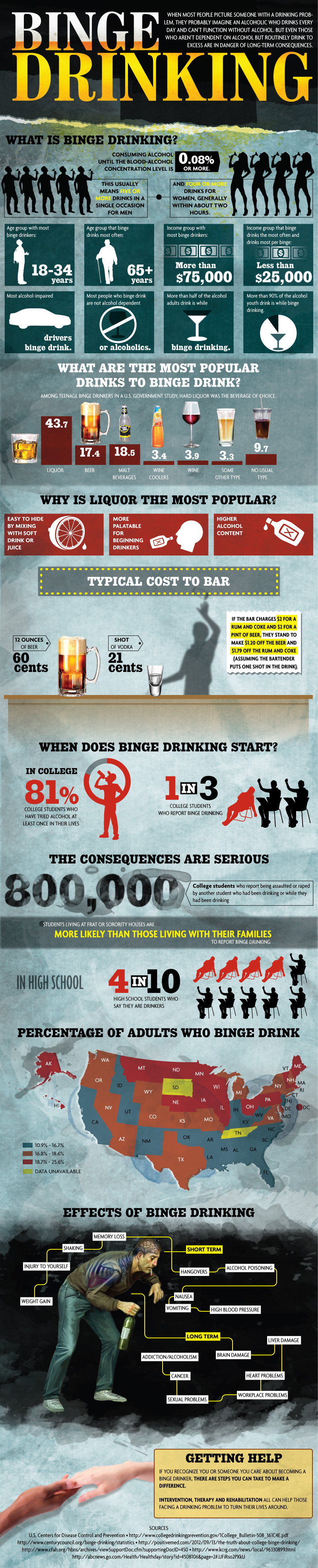
Click here to see the infographic full size.
Intelligent People Drink More Alcohol

I saw this yesterday in the Discovery Channel’s Curiosity.com. In answer to the question “do intelligent people drink more alcohol,” two separate answers reached the same surprising conclusion. When I say surprising, I mean it will come as a shock to the anti-alcohol wingnuts who continue to deny any positive attributes whatsoever to drinking alcohol. Because while the answer isn’t that new, or that unpredictable, especially if you’ve spent a lot of time around responsible drinkers — wets vs. drys — you probably already knew that the answer is simply yes.
Their first answer was from Ian O’Neill, Discovery News’ Space Producer, who wrote:
Surprisingly, a recent study using data from the National Child Development Study in the United Kingdom and the National Longitudinal Study of Adolescent Health in the United States indicates that intelligent people really do drink more alcohol.
By tracking the intelligence of children under the age of 16 and then revisiting them as adults, it turned out that kids who were considered “more bright” than others in their age group ended up drinking more alcohol later in life. Even after researchers canceled out marital status, parents’ education, earnings and childhood social class, smarter kids were drinking more alcohol as adults.
Why would intelligent people drink more alcohol? Some researchers suggest that as the production of alcohol is only a recent invention (within the last 10,000 years) and our ancestors had gotten their alcohol buzz from rotten fruit, the more intelligent humans would be more likely to drink modern alcoholic beverages. Although this is attractive evolutionary speculation, it’s more likely the real reasons are more complex.
The second answer was presented not by an individual, but as a group answer by Curiosity:
It’s a myth that alcohol kills individual brain cells, but drinking can cause long-term brain damage. That’s why researchers were surprised in 2010, when data from Britain and the United States revealed that more intelligent children, when grown and of legal age, tended to drink more alcohol than their less intelligent peers. The researchers were able to control for other factors that might affect a person’s propensity to drink, such as marital status and income, and the findings related to childhood intelligence held up. Researchers aren’t exactly sure why this link exists; one writer posited that drinking alcohol for pleasure is a relatively new thing, evolutionarily speaking. Intelligent people tend to try new things, so the writer argued that people who enjoy a glass of wine with dinner are actually performing a novel act when you take a long view of history.
One of the longitudinal study each answer is referring to was The National Longitudinal Study of Adolescent Health (Add Health) conducted here in the U.S., while the other was part of the UK’s massive National Child Development Study in the UK. I started writing about some of the conclusions drawn from the UK study several months ago, abandoning it when I got busy with other projects, but it’s still pretty interesting. Satoshi Kanazawa, an evolutionary psychologist who writes a blog for Psychology Today entitled the Scientific Fundamentalist, wrote More Intelligent People Are More Likely to Binge Drink and Get Drunk which covered much of the same ground. Although in it Kanazawa focuses on something I strongly disagree with. “Not only are more intelligent individuals more likely to consume more alcohol more frequently, they are more likely to engage in binge drinking and to get drunk.” That propensity to “binge drink,” I’d argue, has more to do with the narrowing definition of binge drinking than any actual increase in drinking. Binge drinking used to be a defined qualitatively but over the past few decades has become quantitative, meaning it’s become defined as a specific number of drinks in a set period of time, absent any context or mitigating factors (of which there could be many). And even that nonsensical number keeps shrinking and changing.
Kanazawa wonders aloud if that should be worrying. I have to say “no, Doc, it’s not.” Here’s why. Look at this chart below. It shows the correlation between intelligence and incidence of “binge drinking,” as defined using the modern absurdity of five drinks in a row.

But what this chart really says is that the most intelligent among us have just under five drinks one and a half times a year, roughly three times every two years. The horror! Or is it?
Even “controlling for age, sex, race, ethnicity, religion, marital status, parental status, education, earnings, political attitudes, religiosity, general satisfaction with life, taking medication for stress, experience of stress without taking medication, frequency of socialization with friends, number of sex partners in the last 12 months, childhood family income, mother’s education, and father’s education,” the smarter you are as a child, the more you’ll apparently drink as an adult. Isn’t it at least possible that the intelligent people are on to something? Maybe it’s not such a terrible thing after all.
Another psychologist who also writes for Psychology Today, Stanton Peele, wrote sort of a rebuttal to Kanazawa. In Are More Intelligent People More Likely to be Alcoholics?, he ponders.
So, we can ask, is getting drunk ‘once every other month or so good, bad, or neutral? Is it harmless — even beneficial? Is it a social convention? An exploration of the universe? Fun for people who are better off and can spare the time and who can protect themselves while having a night out drinking? Or is this behavior pathological, a precursor to alcoholism? Specifically, are more intelligent people more likely to be alcoholics?
To this, he posits three possibilities.
- Although smarter people (as measured in childhood) get drunk more, they are less likely than dull people to become alcoholics. Does that mean that they are inured against alcoholism? The dominant theory here would be that being smart is a protective life asset.
- They are just as likely to become alcoholics. Which would still be somewhat counterintuitive, since despite getting drunk far more often than dull people, they are no more likely to succumb to alcoholism.
- Smart people are more likely to be alcoholics. This could follow from several theories of behavior: smart people tempt fate by drinking more, and thus they are more likely to become alcoholics. Or, smart people are inherently more likely to be alcoholics — perhaps being smart makes them more acutely aware of the world’s problems, or creates other damaging emotional states.
Which, he notes, is odd, since it would seem to suggest “childhood intelligence is a risk factor for alcoholism.” Are parents putting their children at risk by sending them to good schools, making them do their homework or encouraging them to read? Peele declares this to be something of a “quandary — something most people generally value leads to a behavior of which we disapprove.” And Kanazawa concludes that since “more intelligent children are more likely to grow up to engage in binge drinking and getting drunk,” then “occasional drunkenness is incompatible with regular moderate drinking.”
The fallacy with both these lines of thought, I believe, is that occasional drunkenness may not be the demon the medical community has come to believe. In their zeal to quantify everything, they’ve removed the problems in problem drinking and reduced it to a simple formula that clearly doesn’t work. By their standards, I’m an undisputed binge drinker, and yet I’d warrant I’m drunk less than many people. I can state clearly and unequivocally that I’m not an alcoholic, having grown up with and around countless actual problem drinkers. And without trying to sound too egotistical, I’m not an idiot, at least. I did reasonably well in school. Maybe that’s why I drink more now? Since most of the people I know also drink a fair amount, does that means beer drinkers tend to be smarter than non-drinkers? My anecdotal evidence says yes. But then I’m very biased. Don’t we all want to believe we have smart friends? Maybe, but I’m just happy if they like good beer. Of course, that may possibly be one and the same thing.
Hammer Of Glory Stolen!

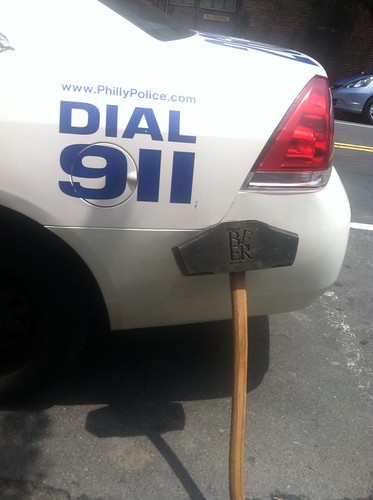
Well, this is horrid news. According to CBS in Philadelphia, Philly Beer Week’s “Hammer of Glory” has gone missing, presumed stolen. According to Philly Beer Week director Don Russell, “The Hammer was on display [at] the Fishtown Festival on Frankford Avenue when it went missing.” At some point, “somebody decided to pick it up and, you know, take off with it,” he added. He also said that they just want it back; “if you have it, just turn it in to a [Philly] Beer Week bar.” Hopefully, someone will do just that and return it. Read the full store here at CBS.

The Hammer at Standard Tap’s Bear Ninja Cowboy beerchambeau in 2010.

Me with the Hammer of Glory during a Hammer Time pub crawl Jennie Hatton (pictured above) took me on a few years ago.
UPDATE: Happy news. Philly Beer Week’s Facebook page is now reporting that the Hammer of Glory has been found. Here’s the story:
The Hammer of Glory is SAFE! It was turned in an hour ago to Frankford Hall. The person who dropped it off said he found it under 95. We really need to thank the Philadelphia Police, the Philadelphia Media and all you beer drinkers who helped us spread the word and get the HOG back.
Whew. Below, the HoG safe and sound.
Proving Adulthood

As I inch closer to senior citizenship — gallop really — few things cheese me off more than continually having to prove I’m old enough to buy a drink. It’s been 33 years since I became an adult (36 really, but they changed the definition from 18 to 21 while I was in between the two). Of course, what it means to be an adult is quite the loaded question. The standard responsibilities, obligations and rights include voting, the ability to enter into contracts, marry and several others, including of course, drinking alcohol. The fact that these standards vary from nation to nation, and culture to culture, should convince you that they’re a product of each individual community, and really ought to reflect the values of the populace. And once upon a time, they did, but in my lifetime those values have been hijacked by a minority of fanatics who are committed to forcing their own values on the rest of us.
While the common sense argument that fighting for one’s country should include at least the ability to vote lowered the voting age from 21 to 18, the reverse of that argument was used to raise the drinking age from 18 to 21. People 18 to 20 could be counted on to protect our freedoms — and die for their country — but neo-prohibitionists argued that they weren’t ready to enjoy a beer. A specious argument to be sure, but they managed to tie raising the drinking age to federal highway funds, and no state could afford to remain sensible.
But for anti-alcohol fanatics even that wasn’t enough, it was just a start. And neo-prohibitionists ever since have been working tirelessly to tighten the noose on all manner of restrictions on alcohol. I remember when I was in my early 20s, signs at cash registers warned that if you look 25 or older, be prepared to show your I.D. By the time I was in my 30s, the signs had changed, too, saying roughly the same thing but making 30 the threshold. As I’ve aged, the needle keeps moving. A few years ago, Tennessee passed a law that every person, no matter how old, has to prove they’re at least 21, even if they have one foot in the grave, no exceptions.
People invariably tell me I should be flattered to look so young, and chuckle as they say it, as if I should be amused. Well, I’m not. It has nothing to do with youth. It has to do with control, and having to keep proving I’m an adult is a ridiculous indignity that grows more insulting with each passing year. We live in an increasingly Kafkaesque world where as the older I look, the more I have to prove it. As late as my 40s, I was refused service because I left my wallet at home, despite there being little doubt I was more than twice the age of majority. It’s become the modern equivalent of having to “show us your papers” (say it with a thick German accent), a sad cliche become real. Adulthood has responsibilities and obligations, of course, but it should also have a few benefits, like not having to carry our “papers” with us wherever we go.
But now Somerset, the county in southwest England, has taken this absurdity one step farther. According to a story in the This is Somerset newspaper — a Grandfather, 77, falls foul of shop’s booze rules — an elderly gentlemen was refused his purchase of beer because he was shopping with his teenage grandson. Apparently, the overzealous cashier thought the 77-year old man was buying beer for the teenager, but even after he confirmed they were related, the sale was still refused. He sent his grandson outside, but the cashier still wouldn’t budge. Commenters to the story insist that she was right to refuse the sale because that’s what the law says. And that’s probably correct, but it’s the law that’s wrong. We have to stop trying to make a perfect society through such absurd legislation. When an elderly man can’t shop with his grandchild and buy something he’s legally entitled to purchase because he could potentially turn around and do something illegal with it, that’s going too far. That’s trying to fix a perceived problem by creating a different problem for many more people than were affected by the original problem. But this is the neo-prohibitionist strategy in a nutshell. They want to make it as difficult as possible for as many people as possible. It’s using a bazooka to kill a fly. It’s about punishing everyone who drinks, not about keeping alcohol away from minors.
And so neo-prohibitionists insist that 4/5th of the adult population, or more, has to suffer on the off chance a 16-year old might get his hands on a beer. That’s not what it should mean to be an adult in any society.