Brookston Beer Bulletin

Jay R. Brooks on Beer

  • Home
  • About
  • Editorial
  • Birthdays
  • Art & Beer

Socialize

  • Dribbble
  • Email
  • Facebook
  • Flickr
  • GitHub
  • Instagram
  • LinkedIn
  • Pinterest
  • RSS
  • Twitter
  • YouTube

Powered by Genesis

The Calorie Mix From The 1970s To Today

April 7, 2011 By Jay Brooks

cornucopia
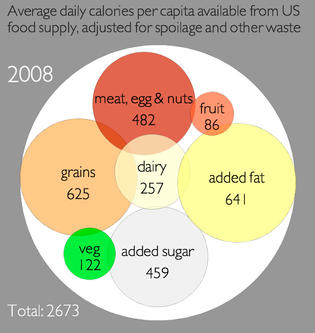
This is not a beer post, but we gotta eat, too. Tom Philpott, at Grist, details an interesting interactive chart created by Andrea Jezovit at Civil Eats.

Using USDA data for “average daily calories available per capita, adjusted for spoilage and waste,” it tracks our eating habits since 1970, separating our foodstuffs into basic categories: grains, dairy, vegetables, fruits, proteins (“meat, eggs, and nuts”), added sugars, and added fats.
calorie-mix-2008

Both Philpott’s The American diet in one chart, with lots of fats and sugars and Jezovit’s Where Do Americans Get Their Calories? are worth a read. Be sure to check out the interactive version of the chart which graphically shows how the mix of calories we eat has changed over the last 40 years.

Filed Under: Food & Beer, News, Politics & Law, Related Pleasures Tagged With: Food, Statistics

Summit Celebrates The Return Of Legal Beer

April 4, 2011 By Jay Brooks

summit
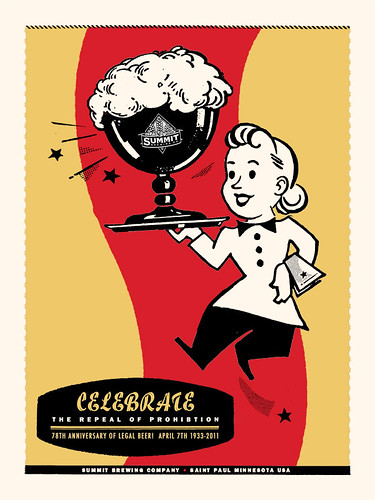
Summit Brewing, in St. Paul, Minnesota, commissioned a local artist, Miss Amy Jo, to create a poster celebrating the passage of the Cullen-Harrison on its effective date of April 7, 1933. Eight months before the repeal of Prohibition, the bill allowed the production of 3.2 beer in about twenty states, including Minnesota. I love the retro look of it. It will probably drive historian Bob Skilnik batty, but it’s a cool poster and it’s available for purchase at Summit’s online store.

Summit-2011RepealPoster

Filed Under: Art & Beer, Breweries, Events, Just For Fun, Politics & Law Tagged With: History, United States

Archie Comics Tapped To Teach Kids About Underage Drinking

March 22, 2011 By Jay Brooks

archie
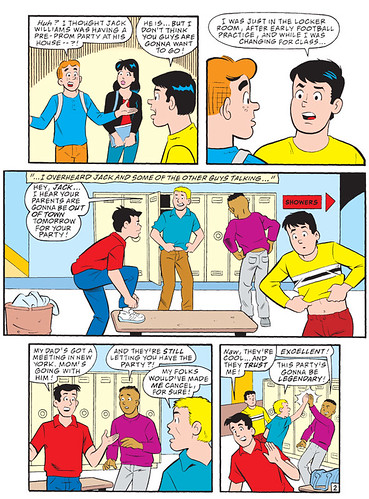
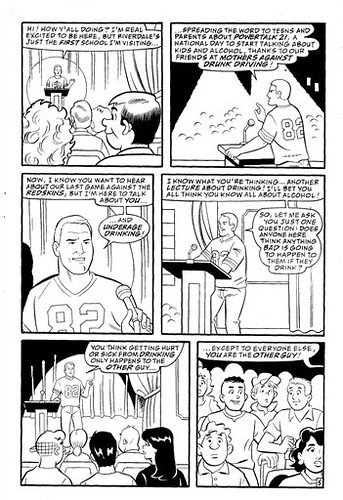
The neo-prohibitionist organization MADD today sent out a press release announcing that they’ve partnered with Archie Comics “to raise awareness about underage drinking.” The new issue of Double Digest #217 hits the comic book stores tomorrow, and features an 8-page story entitled The Madd Cowboy of Riverdale High. Below are a few sample pages.

Archie-217_8

Archie-217_9

The “Cowboy” part of the title is for Dallas Cowboy tight end Jason Witten, who appears as himself to speak to Archie and his classmates in an assembly. He’s specifically promoting MADD and their Power 21, which will take place April 21 and is touted as a “national event that seeks to have parents talking to their children about underage drinking.”
Archie-217_10
Believe it or not, I’m not entirely against this latest effort by MADD, although I don’t believe the goal should be to completely eliminate underage drinking — an impossibility, in my experience — but should instead focus on figuring out an effective way to allow parents to educate their kids about drinking alcohol as they grow from teens to young adults. In my opinion, that would go a long way toward encouraging responsible behavior and reducing drunk driving and binge drinking. Though to be honest, by the time that message might have been relevant to me as a child, I was done reading Archie Comics. I’m not sure what their main demographic is, but my guess would be pre-teens, around 8-11 or 12.

Filed Under: Beers, News, Politics & Law Tagged With: Comics, Prohibitionists

The Chemistry Of Beer

March 14, 2011 By Jay Brooks

ACS
I got an interesting press release this morning from the American Chemistry Society (ACS) touting the Chemistry of Beer, as they put it, “just in time for Saint Patrick’s Day. Today they “released a new video, The Chemistry of Beer, which focuses on the science involved in producing the world’s third most popular beverage (after water and tea).”

From the press release:

Shot in high-definition format, the video features Sam Adams Senior Brewing Manager Grant Wood, who holds a degree in Food Science & Technology from Texas A&M University. It explains the process of turning barley, hops, water and yeast into a lager or ale. Among the insights:

  1. Yeast is the most important ingredient because it determines if the brew is ale or lager.
  2. Water is crucial, too, and it must be free of organic substances and “off” flavors.
  3. Key flavor compounds are packed into those little flower clusters called hops, which add flavor and a pleasant bitterness to the beer.

Produced by the ACS Office of Public Affairs, the video includes plenty of “did-you-know” fodder for those St. Patrick’s Day conversations over a pint. Did you know, for instance, that the fermentation process in which yeast produce alcohol also produces almost 600 flavor compounds? The Chemistry of Beer ends with a message that all drinkers should take to heart, St. Patrick’s Day and every day: Drink responsibly!

The whole video was shot at Boston Beer’s pilot brewery in their Jamaica Plain location in Boston. Grant, who you probably know if you’ve visited the brewery or have been in the industry for any length of time, gives a polished tour and explanation of the brewing process. It’s probably nothing you haven’t seen before, but it’s relatively comprehensive and does a good job of explaining brewing in a nutshell, with an emphasis on the chemistry, of course.

Filed Under: Breweries, Just For Fun, News, Politics & Law Tagged With: Science of Brewing, Video

Craft Beer Bridging Senate Partisan Divide

March 10, 2011 By Jay Brooks

politics-balloons
I think I’ve mentioned before that my wife is a political news junkie. She just sent me this link from one of the most popular political websites, Politico, entitled Craft beer bridges partisan divide in Senate. It’s nice to see beer getting some mainstream attention.

The Politico article is all about the introduction Wednesday of BEER, “Brewer’s Employment and Excise Relief Act,” which would cut taxes for microbreweries and on the production of smaller quantities of beer barrels, among other things. It was introduced in the Senate by Republican Mike Crapo (Idaho) and Democratic Senator John Kerry (Massachusetts).

Although Senator Kerry misstates that the “craft beer revolution started right here in Massachusetts,” I think we can forgive him for that one, having obviously been talking with Jim Koch for many months about this bill.

Here’s Crapo’s Press Release about the introduction of the BEER Act:

Small Brewery Tax Bill Would Create Jobs, Open Markets

Wednesday, March 9, 2011

Washington, D.C. — Senators Mike Crapo (R-Idaho) and John Kerry (D-Massachusetts) today introduced legislation to reduce the beer excise tax for America’s small brewers. The Brewer’s Employment and Excise Relief (BEER) Act will help create jobs at more than 1,600 small breweries nationwide, which collectively employ nearly 100,000 people. Idaho and Massachusetts are home to dozens of small breweries.

“Like any private business, craft brewing is all about supply and demand,” said Crapo. “In touring Idaho last year, I met with many craft brewers who are seeking to expand their business because they are seeing increased demand for their product. In addition, this legislation will expand the ready markets for our barley, wheat and hops producers in Idaho. I remain optimistic this bill will pass this year to create new jobs and new markets.”

“The craft beer revolution started right here in Massachusetts and they’ve been going toe to toe with multi-national beer companies ever since,” said Kerry. “This bill will help ensure that these small businesses keep people on the payroll and create jobs even during tight economic times.”

Because of differences in economies of scale, small brewers have higher costs for production, raw materials, packaging and market entry than larger, well-established multi-national competitors. The BEER Act also helps states that produce barley, hops and other ingredients used by these small brewers. In addition to Senators Crapo and Kerry, the legislation is co-sponsored by a bipartisan coalition of 16 additional Senators.

Currently, a small brewer that produces less than two million barrels of beer per year is eligible to pay $7.00 per barrel on the first 60,000 barrels produced each year. This legislation will reduce this rate to $3.50 per barrel, giving our nation’s smallest brewers approximately $19.9 million per year to expand and generate jobs. This change helps approximately 1,525 breweries nationwide.

Currently, once production exceeds 60,000 barrels, a small brewer must pay the same $18 per barrel excise tax rate that the largest brewer pays while producing more than 100 million barrels. This legislation will lower the tax rate to $16 per barrel on beer production above 60,000 barrels, up to two million barrels, providing small brewers with an additional $27.1 million per year that can be used to support significant long-term investments and create jobs by growing their businesses on a regional or national scale.

The small brewer tax rate was established in 1976 and has never been updated. This legislation would update the ceiling defining small breweries by increasing it from two million barrels to six million barrels. Raising the ceiling to six million barrels more accurately reflects the intent of the original differentiation between large and small brewers in the U.S.

Filed Under: Breweries, News, Politics & Law Tagged With: D.C., Law, Press Release, Taxes

More Absurdity From The Lunatic Fringe

March 7, 2011 By Jay Brooks

nut
In another missive from the increasingly well-named Professor David Nutt, today in the UK Guardian he announed that There is no such thing as a safe level of alcohol consumption and then proceeded to claim that the reasons he believes that “the idea that drinking small amounts of alcohol will do you no harm is a myth” are fourfold:

  1. Alcohol is a toxin that kills cells.
  2. Although most people do not become addicted to alcohol on their first drink, a small proportion do.
  3. The supposed cardiovascular benefits of a low level of alcohol intake in some middle-aged men cannot be taken as proof that alcohol is beneficial.
  4. For all other diseases associated with alcohol there is no evidence of any benefit of low alcohol intake.

He elaborates slightly more on each of these, though not much more, and then follows up those grand sweeping pronouncements with the following:

“Hopefully these observations will help bring some honesty to the debate about alcohol.”

That’s one of those comically-spit-out-your-drink sort of statements, because what he just said was nowhere near honest. It would almost be funny except that mainstream media in Great Britain keep giving him a bully pulpit to proselytize from and people seem genuinely uncritical of what he has to say, which is even more baffling. Some of the comments to the Guardian article from supporters are downright scary, as they seem to believe he has science and evidence to support his wackadoodle claims. He doesn’t. Last year, when he proclaimed, to equal fanfare, that beer is more dangerous than heroin, his scientific evidence consisted of gathering together a group of like-minded individuals (that is people already predisposed against alcohol), many of whom were members of the made-up organization he started after the UK government sacked him — The Independent Scientific Committee on Drugs — and they sat together in a room one weekend and assigned arbitrary numbers for the amount of harm to society for various drugs based on their life experience, no actual data necessary. That’s what passes for science, and that they got the previously respected Lancet to publish it is downright bewildering.

Just a few thoughts about what’s wrong with every one of his four “proofs,” off the top of my head. At least I’m admitting I’m not researching these.

1. Sure, 100% rubbing alcohol will kill you. It’s 200 proof. Most chemical substances, compounds, etc. will kill you in sufficient doses. Most of the medicines we use to treat diseases will kill you if the dose is too high. That’s why they have warning labels and are doled out by doctors and pharmacists with specific instructions of how many, and when to start and stop taking them. For alcohol, we have the TTB and various state agencies to perform that role. Even things that are good for us become bad for us in higher doses — red meat, salt, vitamins, bacon (well, maybe not bacon). If we got rid of everything in the world with the potential to kill us, we’d be left with pretty much nothing.

2. Since Nutt claims we can’t predict who will become addicted to alcohol with the very first taste, then he suggests “any exposure to alcohol runs the risk of producing addiction in some users.” And that differs from everything else how? Assuming his anecdotal “evidence” that such immediate addiction is even possible — which seems unlikely at best — it’s hardly a basis for public policy. Not everybody reacted well to penicillin when it was introduced; should we have left all those people with diseases who could be cured by penicillin die just because less than 1% had an adverse reaction to it? This is just a post hoc fallacy of the worst kind.

3. Saying that the cardiovascular benefits are not proof ignores the many, many, many other studies that show positive health benefits for a myriad range of health concerns. The big enchilada, of course, is the numerous studies that show that total mortality is improved by the moderate consumption of alcohol; that is you’ll most likely live longer if you drink moderately than if you either don’t drink at all or drink too much. And a recent study seems to suggest that given a choice, drinking too much instead of abstaining will still lead to a better result. The FDA in its most recent dietary guidelines acknowledges this fact, yet Nutt completely ignores it and every other study that doesn’t fit his world view. Singling out one study to bash — his straw man — is about as dishonest a way to “bring some honesty to the debate” as I can imagine.

4. He concludes by just dismissing the vast body of medical and health studies that do in fact conclude there are health benefits to the moderate consumption of alcohol. He does this apparently by simply pretending they don’t exist, saying “there is no evidence of any benefit of low alcohol intake.” But just saying there are no benefits in the face of a mountain of contrary evidence is not, as his supporters seem to believe, scientific proof of any kind. It’s just the opposite, in fact.

I’m all for an honest debate about the positives and negatives surrounding alcohol, but if this is what passes for “honesty,” I think I’ll have to wait a little longer for that conversation.

Filed Under: Beers, Editorial, News, Politics & Law Tagged With: Prohibitionists, UK

Wisconsin Historian Compares Current State Politics To Prohibition

March 6, 2011 By Jay Brooks

wisconsin
Here’s an interesting op-ed piece by Wisconsin historian John Gurda entitled Smashing ‘Demon Government’ in which he examines the many parallels between the current political climate in his state and the temperance movement that led to Prohibition. Thanks to Wisconsin Bulletin reader Jason H. for sending me the link. Subtitled “Walker’s small-government zeal resembles that of the prohibitionists,” here’s a few choice excerpts below:

MJS prohibition

In its moral fervor, its contempt for compromise, its demographic base and even its strategies, today’s new right is the philosophical first cousin of prohibitionism.

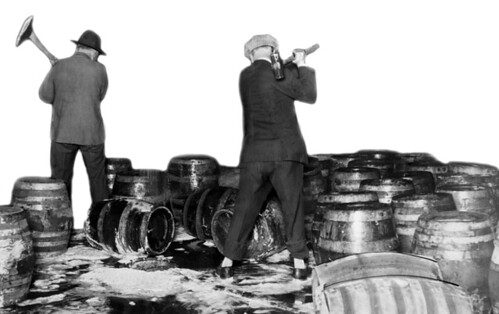
Consider a few of the parallels. The prohibitionists went after “Demon Rum,” while the tea party attacks Demon Government. The Anti-Saloon League preached that barrooms were destroying America’s moral fiber, while the new right declares that onerous taxation and excessive regulation are doing precisely the same thing. Carrie Nation smashed whiskey barrels, while today’s conservatives want to smash the welfare state. Addiction to spending, they might argue, is ultimately as destructive as addiction to alcohol.

Like the temperance movement of the last century, the tea party draws heavy support from Protestant evangelicals such as Walker himself, and their political playbook is a throwback as well. The prohibitionists were media-savvy opportunists, taking advantage of every opening to advance their cause.

When the United States entered World War I, they wasted no time demonizing beer as “Kaiser brew” and even accused Milwaukee’s producers of spreading “German propaganda.” When food shortages loomed during the conflict, the dry lobby convinced Congress to divert America’s grain supply from breweries and distilleries to less objectionable industries. The result was “wartime prohibition,” a supposedly temporary measure that went into effect in 1919 and soon gave way to the 18th Amendment. The national drought would last for 14 years.

It’s worth noting that America wasn’t alone in using the conflict of World War I to push anti-alcohol agendas. Like-minded measures in several countries led to similar alcohol prohibitions, many of which lasted far longer than ours, such as Australia, Canada, Finland, Hungry, Iceland, New Zealand, Norway and Russia. In each of those nations, temperance groups took advantage of wartime circumstances to push their plans on the rest of the populace in their respective places.

In much the same way that prohibitionists turned World War I to their advantage, the current crop of conservatives is making political hay from another temporary phenomenon: the global economic recession. The need for fiscal austerity has rarely been more obvious, but it’s being used as a pretext for advancing the new right’s legislative agenda.

We’re seeing that happen in most, if not every state, with anti-alcohol groups turning our nation’s economic adversity into an opportunity to raise taxes on beer, already the most heavily taxed consumer good (along with tobacco). The Marin Institute has even created propaganda showing the “worst” ten states, with “worst” meaning the states with the lowest taxes on beer, completely out of context and with no understanding whatsoever of why each individual’s states excise taxes are set where they are. Shortly after Governor Walker created Wisconsin’s deficit by giving tax cuts to the wealthy, Michele Simon of the Marin Institute tweeted that beer should make up the difference. “Dear Gov. Walker: Wisconsin has not raised its beer tax since 1969. At .06/gallon, among lowest in nation. Just one of many ideas.” If that’s not what Gurda was talking about, I don’t know what is. That’s using a grave political situation to further an unrelated agenda.

Walker began with a demand that public employees pay more for their pensions and health insurance – a necessary step to which they have agreed – and then proposed to strip them of their collective bargaining rights. That’s an epic non sequitur that makes sense only when you invoke tea party logic: If taxes are bad, then the people we pay with tax dollars must be brought to heel, even if it means freezing a new teacher at first-year wages until retirement.

But the new right’s agenda goes far beyond public employee unions. With solid majorities in the state Legislature, Walker first declared a budget emergency and then cut taxes by $140 million, which is equivalent to taking blood from a patient with severe anemia. In last week’s budget message, he pronounced the patient so sick that amputations are necessary. Walker’s juggernaut of tax cuts and service cuts, combined with his no-bid privatization plans, trends in one direction and one direction only: dismantling government one line item at a time, regardless of the consequences.

It is here, finally, that prohibitionism and tea party conservatism find common ground: Both are ideologies. They represent fixed, blinkered views of the world that focus on single issues and dismiss all other positions as either incomplete or simply wrong-headed. Get rid of alcohol, the prohibitionists promised, and the U.S. would become a nation of the righteous and a beacon of prosperity to the world. Just cut government to a minimum, the new right contends, and you will usher in a brave new era of freedom and opportunity.

And that’s how I see all of the neo-prohibitionist and anti-alcohol groups, as “ideologies.” All of the anti-alcohol groups that I’m aware of do everything in their power to punish alcohol companies because of their perceived sins and because they want to tell you and me how to live our lives. They do so without thinking through the consequences and overall use an “ends justify the means approach,” especially in the way they frame and distort their propaganda. Simply put, I believe that they think they know better than everybody else, there’s a certain smugness in their position; in its unwavering certainty, their righteousness that borders on religious fervor.

They’re convinced that there’s no free will, people are incapable of ignoring advertising, or knowing their limits when drinking. And while there are a few tragic figures who may fit that description, they’re the tiny minority that such groups are fixated on to make their case. The vast majority who drink alcohol do so responsibly and in moderation. Most people take personal responsibility for their actions, as they should. But personal responsibility rarely, if ever, figures into alcohol abuse if you listen only to anti-alcohol rhetoric and propaganda. It’s always the fault of the alcohol itself, and usually beer because it plays better to the people with money who fund such organizations (they drink wine after all). An op-ed piece in the UK Telegraph by Brendan O’Neil recently shed a light on the class issue in anti-alcohol efforts. If they’re not going after the children, then they’re preying on the weak-minded with the most effective advertising the world has ever wrought. Earlier this year, the hue and cry was because there were 3.5 minutes of beer commercial during the nearly four hours of the Super Bowl and — gasp — the little kiddies might see it.

But anti-alcohol rhetoric single-mindedly focuses on only the negative. I’ve never heard any of them say one word that was positive about any alcohol company. Even when Anheuser-Busch packaged cans of water and sent then to earthquake-ravaged Haiti, one anti-alcohol group criticized them for the deed, because they put their logo on the cans and sent out a press release (oh, the horror). Let no good deed go unpunished, indeed. That alone should convince us they’re idealogues.

I suspect they might say the same of me, but I understand and acknowledge that there are some people who should not drink. That such people can and do cause problems for themselves and often the people around them. I don’t write about it very much because I don’t have to; there’s plenty of lopsided anti-alcohol rhetoric already. I’m just trying to balance the conversation, though more often than not I feel like the lone voice in the wilderness.

But back to Wisconsin. My wife is a political news junkie, and she informs me that a careful reading of the facts reveals that Scott Walker’s entire political career has been in service to a single ideology: union busting. He apparently promised that was not his agenda throughout his campaign for governor, and the media swallowed that wholesale with few examining or reporting the discrepancy between what he said while campaigning and his entire career leading up to that point. In that, there’s yet another parallel between the new prohibitionists and the new political conservatives. Most mainstream news media also take the side of the well-funded anti-alcohol groups and parrot their propaganda without questioning it or providing any meaningful views from the other side of this debate.

As to Gurda’s comparisons, I think he’s right about anti-alcohol groups’ unwillingness to compromise and being self-righteous with “blinkered views of the world that focus on single issues and dismiss all other positions as either incomplete or simply wrong-headed.” That’s certainly been my experience. So as if there wasn’t enough reasons to support the protesters in Wisconsin, if this political test case is successful, not only will we see more unions busted in other states, but I suspect anti-alcohol groups are also closely watching this to see how they might use the same bullying tactics in furtherance of their own agenda. And that may be the scariest prospect of all. As usual, I’m with the Green Bay Packers on this one.

Filed Under: Beers, Editorial, News, Politics & Law Tagged With: History, Law, Prohibitionists, Wisconsin

When Common Sense Gives Way To Business Sense

March 3, 2011 By Jay Brooks

abita
First Anchor Brewing trademarked Steam Beer, but did so at a time when absolutely nobody else in the world made anything even remotely similar, so it was entirely understandable. As the years rolled on, and many brewers have been forced to call the same or similar type of beer a “California Common,” I can’t help but think it’s an idea whose time has passed. I know it’s too valuable, but personally I’d like to see them relinquish their hold over the name and allow the rest of the world to call it by its proper name.

Then Full Sailing Brewing came out with their genius stubbie bottles that they called Session Lager and Session Black. And that might have been the end of it, but as I understand it, they also trademarked “session beer” and related marks. No one objected, of course, because there’s nobody to object. “Session beer” was, and in my mind remains, a generic term so there really was no one to file an Amicus curiae or otherwise oppose the trademark. What I don’t understand is how an already established generic term can be appropriated for private business use. When a trade name becomes so common — remember Scotch tape? — that it becomes the generic word for it then it loses its status as a protected trademark, in effect a product of too much success. Other examples of generic words that used to be trade names include aspirin, escalator, heroin, kerosene, laundromat, linoleum, pilates, thermos, videotape and zipper, to name just a few. But session started out as a generic, loosely defined term. I love Full Sail, but hate the notion that they “own” the term “session beer.”

That brings us up to yesterday, when Abita Brewing of Louisiana sent a cease and desist letter to a local charity, claiming that they own the trademark on the term “pub crawl,” and have since 1999. According to the Baton Rogue Business Report:

An attorney representing the Abita Brewing Company has sent a cease-and-desist letter to a charity organizer, ordering him not to use the term “pub crawl” to refer to his events. Todd Owers III, an attorney with the New Orleans firm of Carver Darden, says Abita owns the Louisiana state trademark for “pub crawl” and that for Manu Kamat to use the term in referring to his events in downtown Baton Rouge is a clear infringement on the brewery’s rights. Kamat says he started organizing monthly bar tours across downtown Baton Rouge in December to benefit the New Orleans Council for Community and Justice. Participants pay a few dollars, which entitles them to drink specials at participating bars for the night. Kamat says he finds Abita’s actions “a little bully-ish.” David Blossman, president of Abita, says the brewery is trying to protect its rights. “We’re trying to work these things out amicably,” he says. Kamat says he got the letter from Owers on Feb. 18, the night of his most recent event. In the letter, Owers attached documents that show Abita filed an application to use the trade name “pub crawl” with the Secretary of State in July 1999 and renewed it for another 10 years in July 2009. Kamat says he’s seen the term “pub crawl” all across the U.S. and Europe and that Abita’s action is like trying to trademark the term “happy hour.” But Blossman says that Abita made the term “pub crawl” known across Louisiana and that the term is now synonymous with the brewery. Kamat says he’s a “huge fan” of Abita and is looking for ways to continue to have his events without further upsetting the popular local brewery. He’s dubbed the next event, set for March 25, a “bar golf.” But he won’t comply with one request from Abita—to transfer control of the domain name pubcrawlbr.com to the brewery.

Now I don’t live in Louisiana, but I still have to question the statement that “Abita made the term ‘pub crawl’ known across Louisiana and that the term is now synonymous with the brewery.” I’ve heard, and used, the term everywhere I’ve traveled, both here and abroad and I think you’d be hard pressed to convince me that it’s not a near universal term in the English-speaking world. I certainly have no such association between Abita and pub crawls. In 1999, when they apparently were granted a state trademark, again there would have been no one to oppose them or speak on behalf of such a generic term. My bet is nobody even realized they “owned” the term “pub crawl.” And while I know full well that trademark holders have an affirmative duty to vigorously defend their marks, I can’t see how this won’t be a dead loser in the goodwill department or for that matter what advantage there is to actually owning the trademark on a term most people already believe is generic in the first place.

UPDATE: In a swift and smart move, Abita president David Blossman today posted a note to their Facebook page reversing their position. Here’s an excerpt:

In the 1990s big corporate breweries began trying to mimic craft beers and take over the types of events smaller breweries like us had created. To protect the Pub Crawl for our fans we trademarked the name of the event in Louisiana only. Our intent was to prevent any confusion and to stop the big breweries from copying our success. Over the years, we’ve sent out letters asking others not to use the name Pub Crawl unless it is an Abita sponsored event.

We’ve heard from you today on this trademark issue and we agree. Your respect is far more important to us than two little words.

This morning we reached out to the New Orleans Council for Community and Justice and let them know we’ve changed our mind and our position on the trademark issue. We have offered and they have accepted our support of their next event, scheduled for March 25. Abita is proud of our history of charitable giving to our community through our fundraising brews and our commitment to non-profit organizations.

That’s a classy move, in my opinion. Few businesses can admit they’re wrong or at least admit an error in judgment. They appear to have listened to their customers and understood that their loyalty and respect was more important than being in the “right” legally.

Filed Under: Breweries, Editorial, News, Politics & Law Tagged With: Business, Law, Louisiana

Proud Of British Beer

March 1, 2011 By Jay Brooks

uk
In quasi-answer to I Am A Craft Brewer, Britain’s Society of Independent Brewers (SIBA) has released a video of their own: Proud of British Beer. It’s very well produced, and I like that they included not just brewers, but also farmers, publicans and salespeople to show the entire chain from farm to glass. It was also great seeing so many familiar faces.

Of course, the original video was made for a trade conference, whereas SIBA’s effort seems aimed directly at consumers, and especially those that might be on the fence about whether or not to support Britain’s beer industry. I love the end, because it goes after the wisdom of more and more taxes on beer, a situation similar to what’s happening in America, too. The answer, of course — here as there — is that neo-prohibitionst and anti-alcohol groups are using the weakened economy to further their agenda of attacking and punishing alcohol for its perceived sins. It’s great to see the brewing industry fighting back, something that I feel desperately needs to happen in the U.S., too. But over here, the media tends to pay a disproportionate amount of attention to well-funded anti-alcohol propaganda while ignoring any contrary opinions. If our national discourse on alcohol is anything, it’s certainly not fair or balanced.

One reason Proud of British Beer is so good is that the script was written by Pete Brown, and you can read his thoughts about Proud of British Beer on his blog. Pete’s a kindred spirit when it comes to the neo-prohibitionists and he makes an important case for beer in the UK. Well done, Pete!

From SIBA’s Vimeo page:

“Proud of British Beer” is a short film produced by the Society of Independent Brewers. It features brewers, both large and small, hop and barley growers, maltsters and industry suppliers. Our concerns are that the continued above inflation increases in beer duty are destroying this indigenous British industry. Pubs, which are an integral part of the fabric of British society are also being forced to close at the rate of 29 per week. This cannot be allowed to continue.

We are proud of British beer. Are you?

Filed Under: Beers, Breweries, Editorial, Just For Fun, Politics & Law Tagged With: UK, Video

A Case For Beer: A Major Minor Dilemma

February 27, 2011 By Jay Brooks

kwik-e-mart
Here’s another odd duck, a promotional film created in the early 1970s by the National Association of Convenience Stores. It was apparently made by students at Kansas State in association with several sponsors, who also provided grant money for it, including the NACS, the Southland Corporation (7-11) and Falstaff Brewing. It also had the cooperation of four state alcohol agencies, from Arizona, Missouri, Nebraska and Ohio, along with the United States Brewers Foundation.

Entitled A Case For Beer (A Major Minor Dilemma), it’s aimed at Convenience Store owners with tips on how to not sell to underage customers, while still being polite so as not to lose their non-alcohol business and not alienate them so that when they become adults they’ll still spend their money at the C-store. It’s a great time capsule — check out the cars, the fashion and the look of the stores themselves.

Some highlights:

  • Factoid: 2 out of 3 families use beer as a beverage.
  • The two things you have for determining a customer’s age: A Valid ID and “good judgment.”
  • Advice after a woman comes in the store in a bathing suit: “don’t allow yourself to be distracted (checked everything but her age).”
  • More feminine advice: “Beware of women, some have cheating hearts.”
  • Great final quote: “Americans love their leisure time, and convenience stores, with their quick shopping supply of beverages and related foods, contribute to the nation’s enjoyment of leisure time.”
  • Look quick at the end: and you’ll see a woman spreading relish on her hot dog with a beer can pop tab.

Filed Under: Beers, Just For Fun, Politics & Law Tagged With: Convenience Stores, History, Retail, Video

« Previous Page
Next Page »

Find Something

Northern California Breweries

Please consider purchasing my latest book, California Breweries North, available from Amazon, or ask for it at your local bookstore.

Recent Comments

  • Bob Paolino on Beer Birthday: Grant Johnston
  • Gambrinus on Historic Beer Birthday: A.J. Houghton
  • Ernie Dewing on Historic Beer Birthday: Charles William Bergner 
  • Steve 'Pudgy' De Rose on Historic Beer Birthday: Jacob Schmidt
  • Jay Brooks on Beer Birthday: Bill Owens

Recent Posts

  • Beer In Ads #5222: O’Keefe’s Bock Beer April 15, 2026
  • Historic Beer Birthday: George Schmitt April 14, 2026
  • Beer In Ads #5221: Bowler Brothers’ Bock April 14, 2026
  • Historic Beer Birthday: George W. Bashford April 14, 2026
  • Beer In Ads #5220: Hello People! I Am The Centlivre Bock Beer Goat April 13, 2026

BBB Archives

Feedback

Head Quarter
This site is hosted and maintained by H25Q.dev. Any questions or comments for the webmaster can be directed here.