Brookston Beer Bulletin

Jay R. Brooks on Beer

  • Home
  • About
  • Editorial
  • Birthdays
  • Art & Beer

Socialize

  • Dribbble
  • Email
  • Facebook
  • Flickr
  • GitHub
  • Instagram
  • LinkedIn
  • Pinterest
  • RSS
  • Twitter
  • YouTube

Powered by Genesis

Patent No. 5009082A: System For Cooling Beer For Remote Dispensing

April 23, 2016 By Jay Brooks

patent-logo
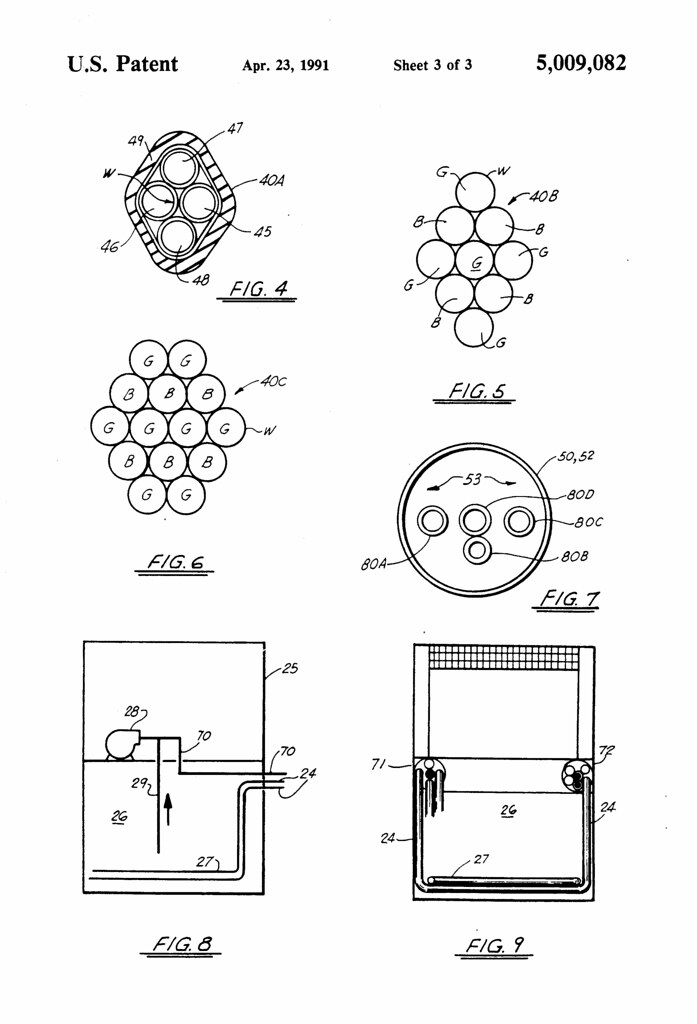
Today in 1993, US Patent 5009082 A was issued, an invention of Martin J. Abraham III, for his “System For Cooling Beer For Remote Dispensing.” Although it’s not strictly speaking, a beer patent, it is somewhat related, and it was too interesting not to include. Here’s the Abstract:

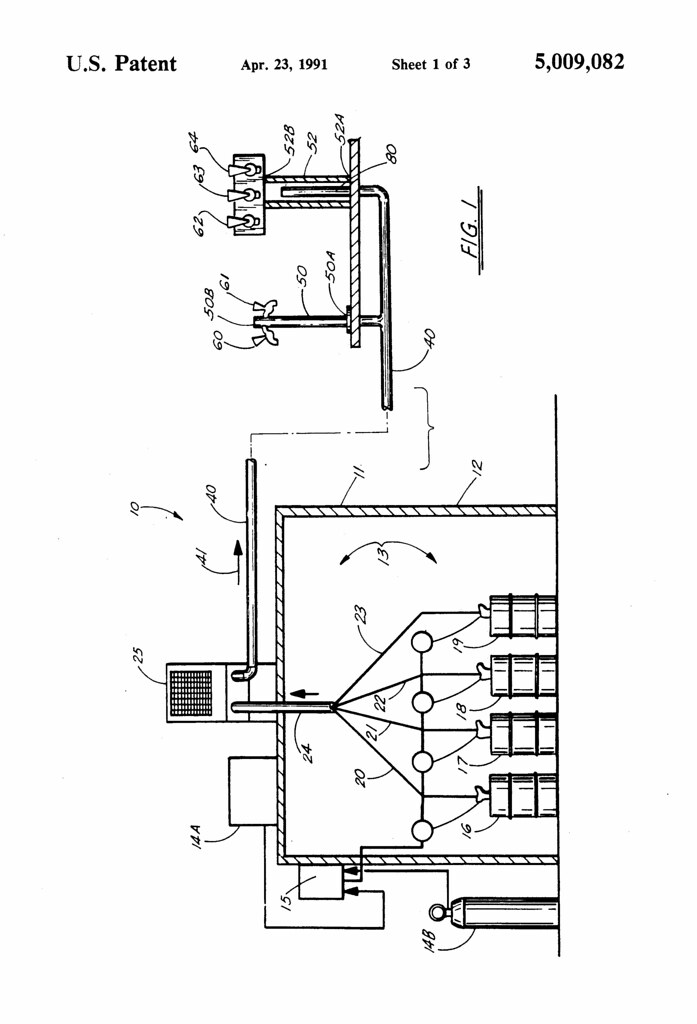
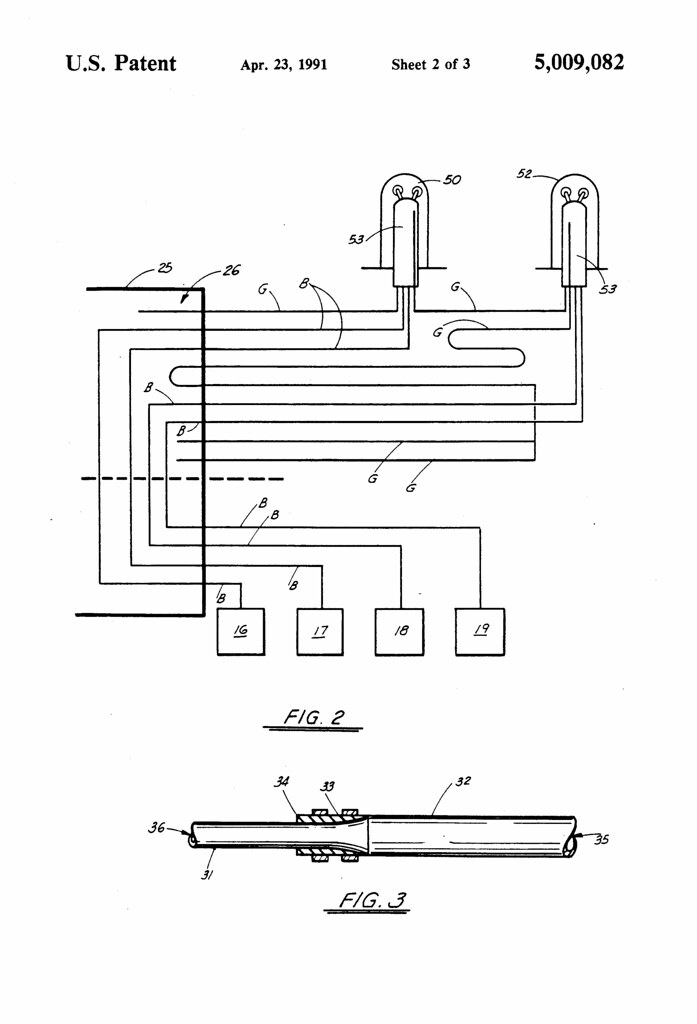
A system for cooling beer to be dispensed from a container housed in a preliminary air cooled environment that is cooled with a primary heat exchanger includes a first flowline for dispensing beer from the container and an auxiliary heat exchanger having a glycol reservoir for receiving the first flowline, the first flowline traversing the reservoir in heat exchange relation therewith. The second flowline includes at least a pair of side-by-side internal bores having a first bore in fluid communication with the first flowline downstream of the glycol reservoir and a second bore carrying glycol from the reservoir in close proximity and in heat exchange relation with beer in the first bore, the second flowline being extended in length so that beer and glycol can travel to remote positions away from the container. A spigot is provided for dispensing the beer at the remote position after transmitted thereto via the second flowline. The first flowline includes one or more fittings forming connections between the container and the reservoir that produce substantially laminar flow between the container and the reservoir.
US5009082-1
US5009082-2
US5009082-3

Filed Under: Beers, Just For Fun, Politics & Law, Related Pleasures Tagged With: History, Kegs, Law, Patent

Patent No. 698184A: Method Of Refining, Aging, Mellowing, And Purifying Alcoholic Liquors

April 22, 2016 By Jay Brooks

patent-logo
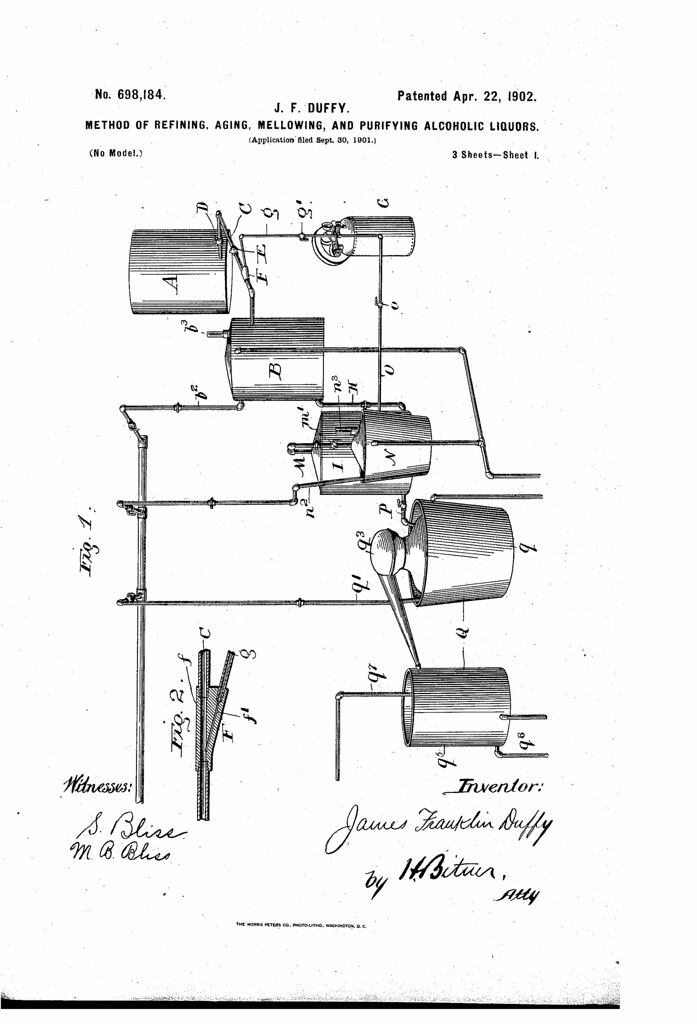
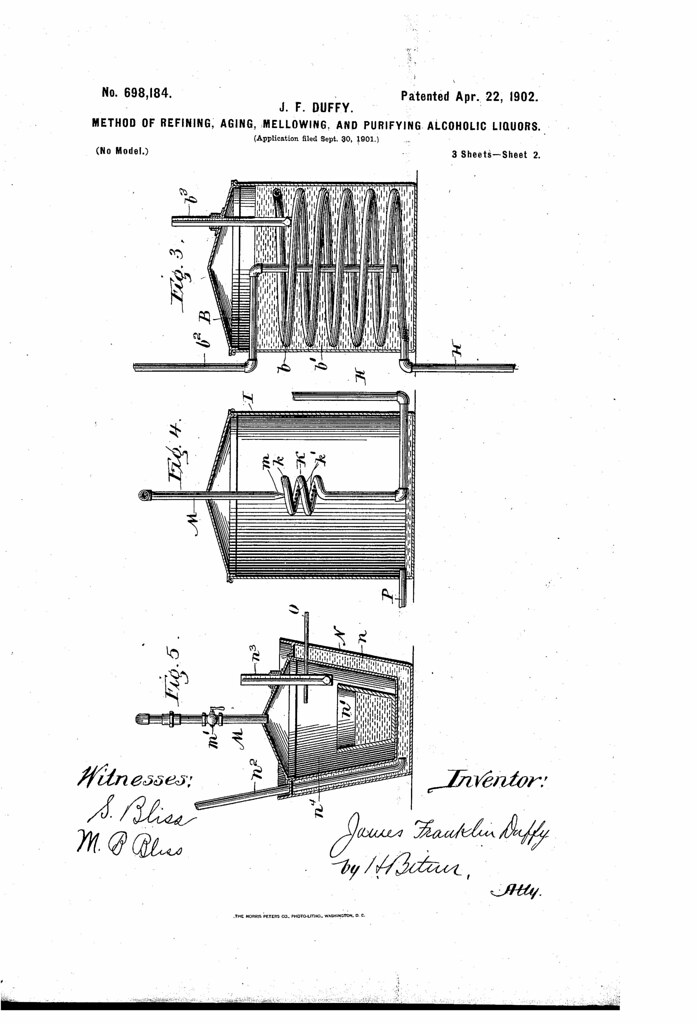
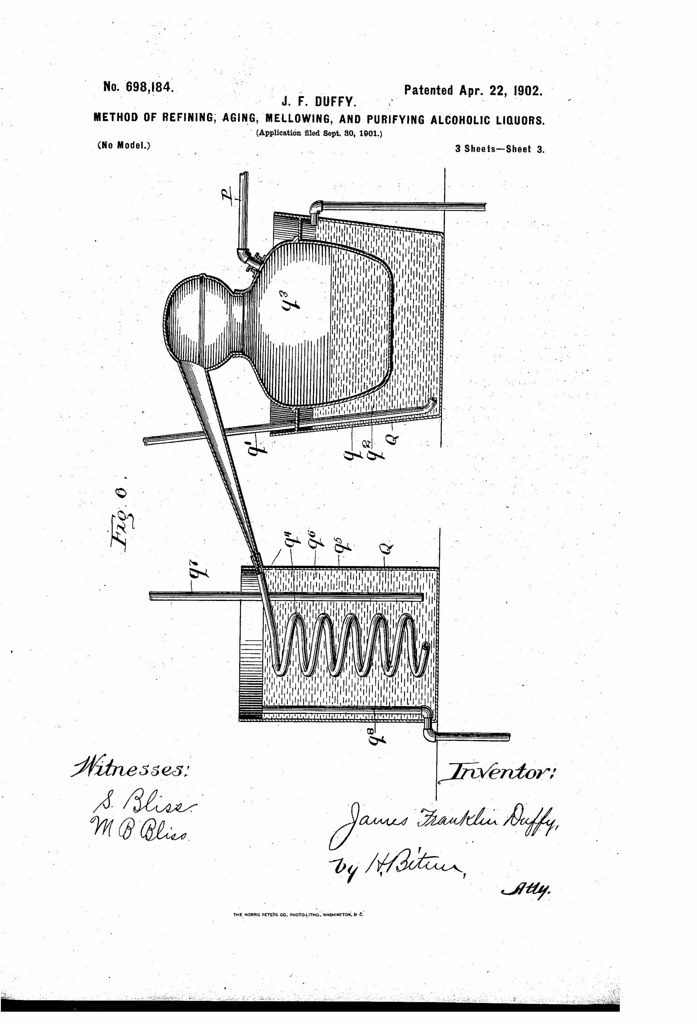
Today in 1902, US Patent 698184 A was issued, an invention of James Franklin Duffy, for his “Method of Refining, Aging, Mellowing, and Purifying Alcoholic Liquors.” Although it’s not strictly speaking, a beer patent, it is somewhat related, and it was too interesting not to include. There’s no Abstract, although in the description it includes this summary:

My invention relates to a certain improved method or process for the treatment of liquors in the same particulars as is usually accomplished through a considerable period by the ordinary aging process.

Under the term liquor as used herein I include all alcoholic or spirituous fluids, either distilled or fermented; and it is the purpose of the invention to purify said liquors,to eliminate all injurious qualities therefrom, and to supply the ripe, pure, and mellow qualities which time alone has done heretofore.

The invention consists in the treatment of the liquor by means of the various steps of the process, all of which will appear from the description and be clearly pointed out in the claims.

US698184-0
US698184-1
US698184-2

Filed Under: Just For Fun, Politics & Law, Related Pleasures Tagged With: Brewing Equipment, History, Law, Patent, Science of Brewing, Spirits

Patent No. 3129730A: Tapping System For Liquid Container

April 21, 2016 By Jay Brooks

patent-logo
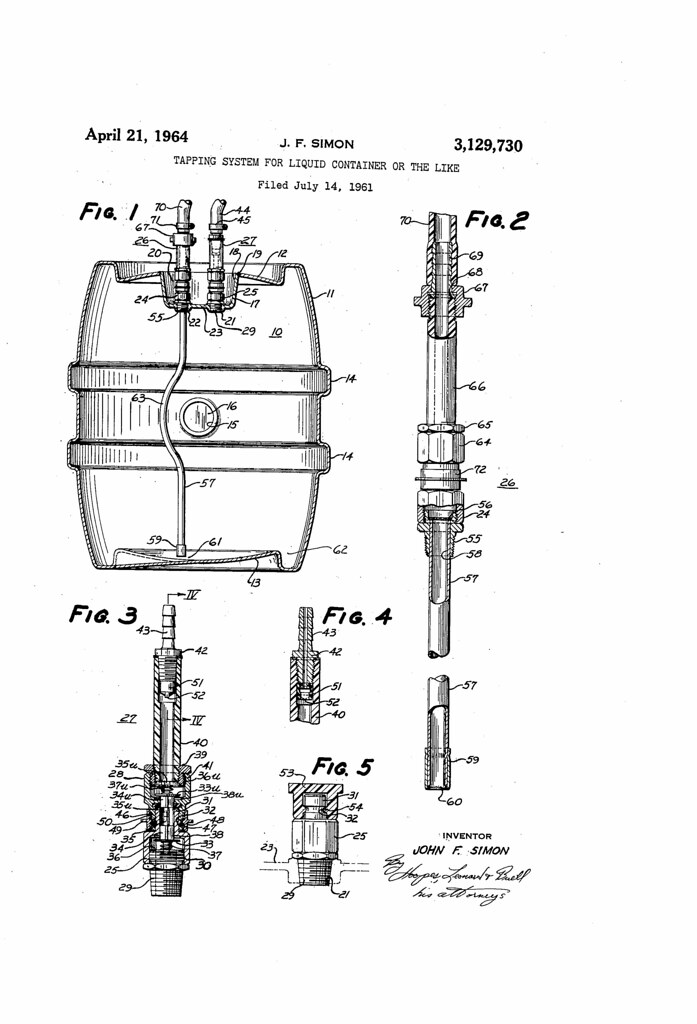
Today in 1964, US Patent 3129730 A was issued, an invention of John F. Simon, for his “Tapping System For Liquid Container or the Like.” There’s no Abstract, although in the description it includes this summary:

This invention relates to a tapping system for liquid containers or the like such as, for example, casks having a gas-charged beverage or other liquid therein. In particular, this invention relates to a quick coupling and uncoupling tapping system for new beer kegs or the like or for the conversion of conventional beer kegs or the like to provide prompt placement of liquid containers in service, the removal thereof from service when substantially empty and the maintenance of prompt and sound delivery of the liquid during service in optimal condition.

US3129730-0

Filed Under: Beers, Just For Fun, Politics & Law, Related Pleasures Tagged With: History, Kegs, Law, Patent

Patent No. 2280336A: Protector For Beer Can Openers

April 21, 2016 By Jay Brooks

patent-logo
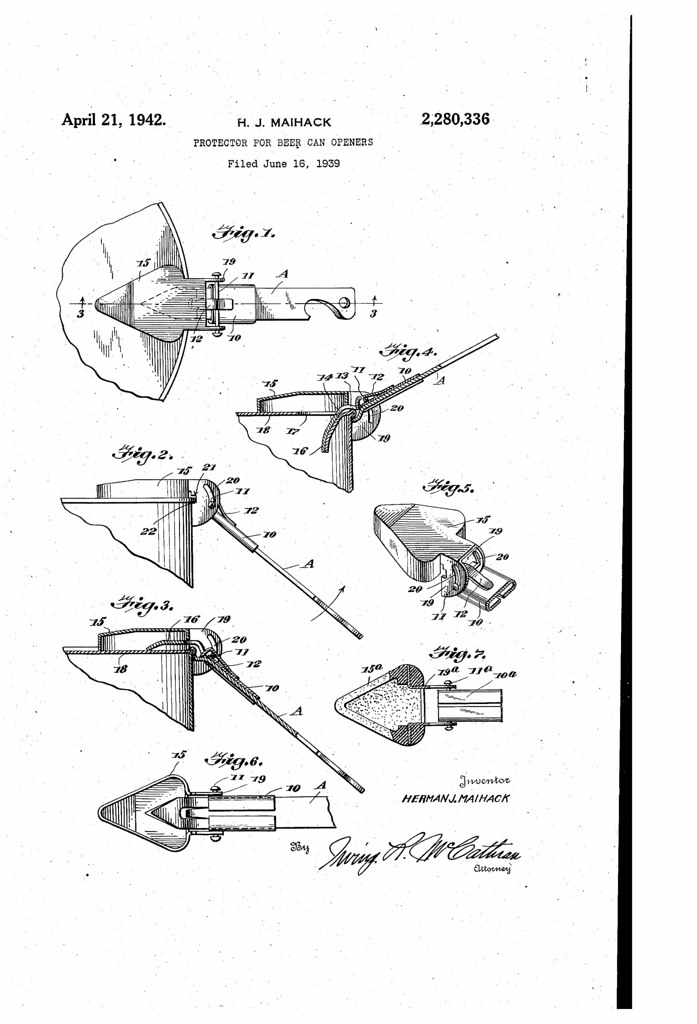
Today in 1942, US Patent 2280336 A was issued, an invention of Herman J. Maihack, for his “Protector For Beer Can Openers.” There’s no Abstract, although in the description it includes this summary:

This invention relates to protectors for beer can openers, and the like, andy has for one of its objects the production of a. simple and efficient means in the nature of a hood or cap which is adapted to be carried by a piercing can opener so as to overhang the pierced opening within the top of a can and prevent the spray of beer or other liquid outwardly through the opening which is being cut in the top of the can.

A further object of this invention is the production of a simple and efficient means for attaching the protector to the well-known type of piercing opener.

US2280336-0

Filed Under: Beers, Just For Fun, Politics & Law, Related Pleasures Tagged With: Cans, History, Law, Patent

Indian Gov’t Issues Arrest Warrant For Mendocino Brewing Owner Vijay Mallya

April 20, 2016 By Jay Brooks

mendocino
Those of you who’ve been in the beer world for a few decades will no doubt remember the tumultuous period around 1997 when Vijay Mallya, and his UB Group, which also owns the Indian beer Kingfisher, started buying up breweries. They picked up Nor’Wester Brewing first, along with a few others, and UB Group consolidated their U.S. holdings under the name “United Craft Brewers, Inc.,” or simply “United Craft.” The first five included Nor’Wester Brewing Company of Portland, OR; Aviator Ales of Woodinville, WA; Mile High Brewing of Denver, CO; Bayhawk Ales of Irvine, CA; and North Country Brewing of Saratoga Springs, NY. United Craft later added Mendocino Brewing Co. of Hopland, CA and Humboldt Brewing of Arcata, CA, and then Carmel Brewing of Carmel, CA. United Craft lists a Sausalito address, which is coincidentally where owner Vijay Mallya also built a multi-million dollar home. But essentially only Mendocino Brewing remains of the breweries as a viable brand, although Humboldt was sold off.

I remember when UB initially bought Mendocino Brewing and Mallya began visiting their distributors. He would attend distributor meetings with an actual entourage, including bodyguards, which was not exactly endearing to anybody. Within a short time the Mendocino brand, which had been very successful locally, began to fall precipitously. It’s never really recovered, though they do quite a bit of contract brewing out of their Ukiah facility. Mallya has a fairly ruthless reputation for his business practices, and I’ve spoken to at least two people who’ve done business with him in other industries who’ve had nothing flattering to say about the way he conducts himself, so the news being reported by the Drinks Business came as no surprise, except perhaps as to why it took so long. Undoubtedly, there, as here, the rules for billionaires are different than it is for you and me.

According to Drinks Business report, “Indian authorities have issued an arrest warrant against Vijay Mallya, the former head of United Spirits, just days after freezing his passport.”

The warrant was issued on the “third strike and out” practice of the Indian Enforcement Directorate (ED) when the colourful former tycoon failed to appear at the third time of asking at a Mumbai court to answer allegations of misuse of funds loaned to his Kingfisher Airlines by a state-owned bank, IDBI.

This is one of 17 Indian banks seeking to recover some $13 billion from Mallya. Last month they rejected his proposed scheme to repay $600 million.

It is alleged that Mallya used part of the $134m loan from IDBI to buy properties overseas. The airline, which was never profitable, collapsed into bankruptcy in 2012 with debts approaching £1bn.

Mallya has consistently denied impropriety and his private holding company, UB Group, said that the full loan, including up to $65m alleged to have been diverted to Mallya’s personal use, had been “used for legitimate business purposes only”.

The statement said that the arrest warrant was “erroneous and unjustified”.

Mallya, who is thought to be in Britain, has been ordered by India’s supreme court to disclose all his assets to the authorities.

P1050563
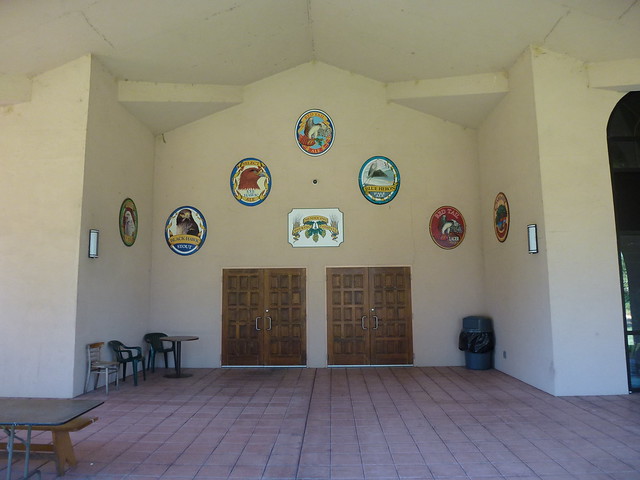
Inside the newer Mendocino brewery in Ukiah.

Filed Under: Breweries, News, Politics & Law Tagged With: Business, India

Patent No. 581206A: Apparatus For Aerating Liquids

April 20, 2016 By Jay Brooks

patent-logo
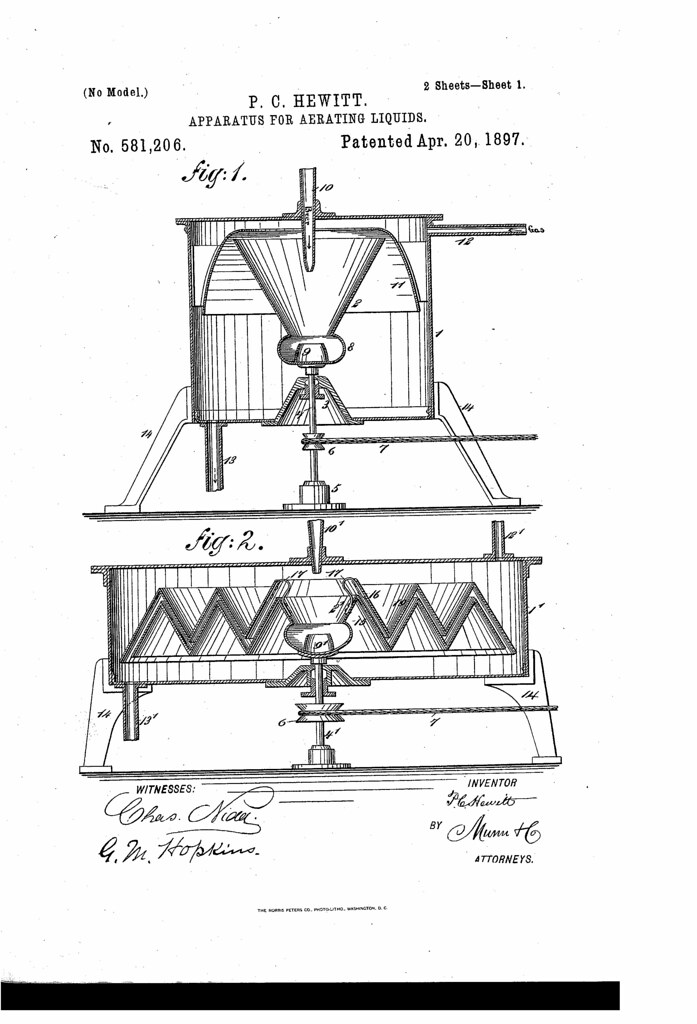
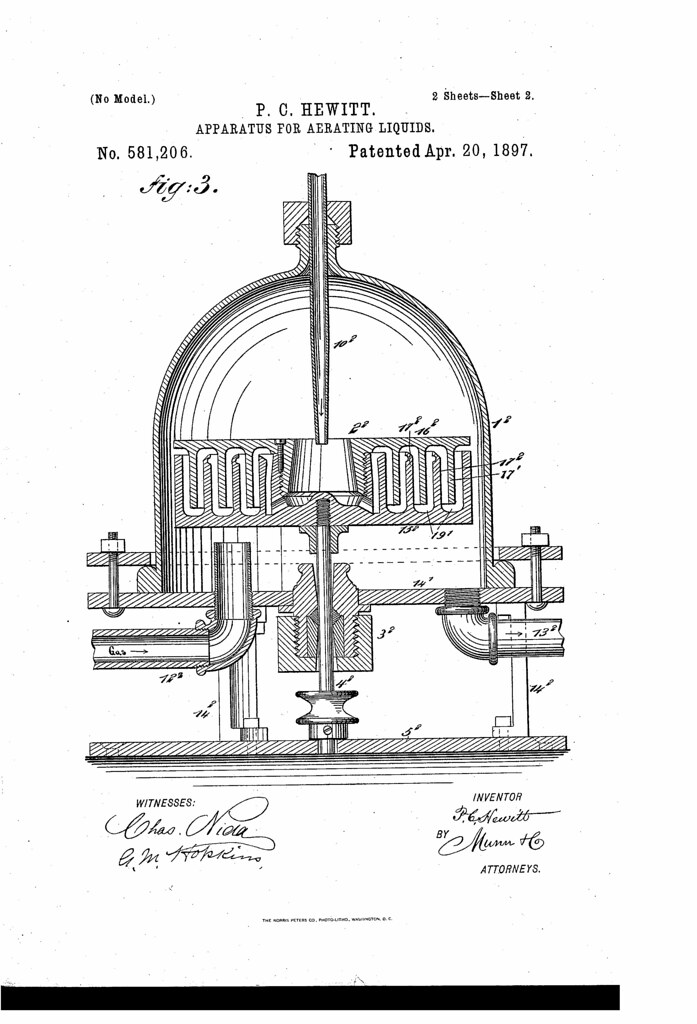
Today in 1897, US Patent 581206 A was issued, an invention of Peter Cooper Hewitt, for his “Apparatus for Aerating Liquids.” There’s no Abstract, although in the description it includes this summary:

My invention is applicable to aerating waters, beer, and other liquids.

In the manufacture of beer by some methods the carbonic acid in the beer is extracted and it becomes necessary to replace the gas thus taken out.

The object of my invention is to thoroughly aerate the beer while it is in the form of a highly-attenuated film.

My invention consists in a centrifugal machine of peculiar construction adapted to reduce the liquid to the form of an extremely thin film, the centrifugal machine being operated in a closed vessel suitable for the required pressure.

US581206-0
US581206-1

Filed Under: Beers, Breweries, Just For Fun, Politics & Law, Related Pleasures Tagged With: Advertising, Brewing Equipment, History, Science of Brewing

Czech Republic Wants You To Call Them “Czechia” To Sell More Beer

April 19, 2016 By Jay Brooks

czech_republic
This is interesting, if odd, news. The Czech Republic wants you to call them “Czechia,” believing that the shorter name is easier to remember and will ultimately sell more Czech — excuse me — Czechia beer. According to the CIA World Factbook, the official name of the country is simply the Czech Republic, in the local language, “Česka republika.” The “name derives from the Czechs, a West Slavic tribe who rose to prominence in the late 9th century A.D.”

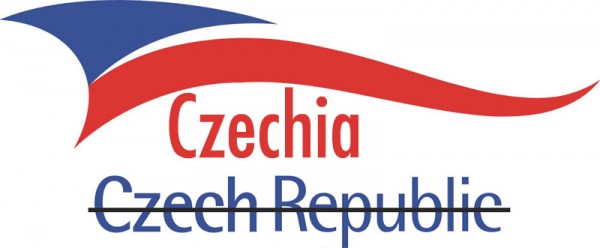
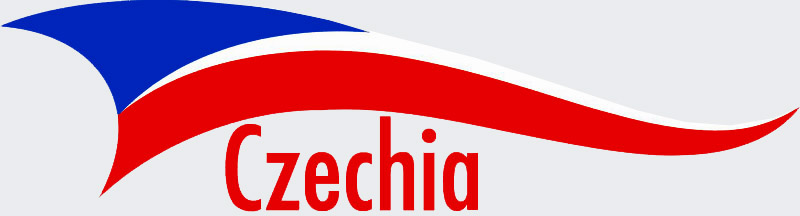
The nation’s website claims that “apparently it’s difficult for a country to make its way in the world if it has not got a shortened, easy to pronounce, name; something that fits in big letters on a shirt. And the Czech Republic has been dealing with that handicap ever since the split up of Czechoslovakia in 1993. Various unofficial options have been tried, Czech, the Czech lands, for example, but the safest option has often been to revert to the full, official name. After months of deliberations, they think they have a solution. Here’s what they decided.

Czechia-no

Now, the Czech Republic appears ready to end confusion and take the plunge with an official choice. Foreign Minister Lubomír Zaorálek, who is often confronted with confusion over the name, explained what is at stake.

“We are not talking here about the official political name, Czech Republic, Česká Republika, which is clearly established. But in Europe, every country or almost every country, has a shortened geographical title, for instance the Polish Republic is just Poland, and the same follows for others. In our case, unfortunately, it’s not quite so simple because we have not been able to share with the rest of the world the shortened name we use in Czech, Česko. But for us there exists just one possible option as a correct translation of that and that is something along the lines of Chequia or Czechia.”

Czechia in English, and various similar forms in other languages, is reckoned to be the most faithful translation of Česko. And it will be raised at a meeting on Thursday evening attended by the foreign minister, prime minister, heads of two chambers, and the president. If the idea is approved, then the shortened name will be registered with the United Nations, and should start to become common verbal and visual currency.

Minister Zaorálek says sporting bodies for one appear to be keen for a final agreement on a shortened name.

“Perhaps it will be something of a relief for them because it will be clear what must be written on the kits and there will be a general agreement about that. The problem is that we have not been able to agree on this as fast as we would have liked. I had the idea that it would be great if we could have got this done in time for the Olympic games but this whole process of approval by constitutional officials and the government has taken a certain amount of time and in the meantime they have had to start making the uniforms. So if it not this time it will be the next. And I have seen that sportsmen and women are willing to do this but they need some time to prepare.“

Some are asking whether Czechia might not cause confusion among the geographically challenged. In a far from isolated example, in 2013 the US broadcaster CNN confused the Russian province of Chechnya with the Czech Republic, suggesting that the Boston Marathon bombers came from the Central European country.

Czechia-yes

It’s worth noting that the local term for the country is “Česko,” so it’s not to far off from that, though it seems like it will take some time to get used to it.

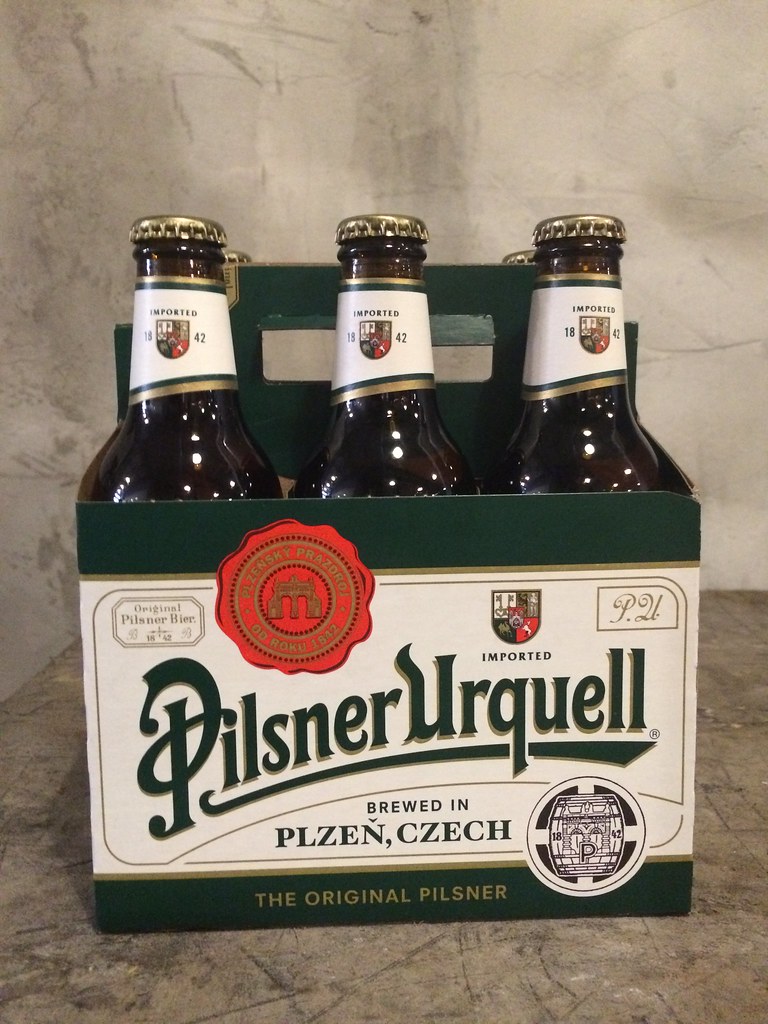
Business Insider asserts in their headline that The Czech Republic is changing its name to Czechia to make it easier to sell beer, adding “Because the name of the country is quite long, companies often brand their merchandise with the word “Czech” to show which country their product comes from. One company that does this is Pilsner Urquell beer, which has “Brewed in Plezen – Czech” written on the bottle. The problem with this is that the word “Czech” is an adjective so can’t really be used as a proper noun.”

pils-ur-6pk

So the official line doesn’t mention beer as one of the reasons for the country’s new nickname, but several news outlets have brought it up. For example, the New York Times mentions Pilsner Urquell, and their use of “Czech” on packaging already, rather than the official “Czech Republic.”

Variants that did not make the cut included “Czechlands,” “Bohemia” and, simply, “Czech.” (Pilsner Urquell, the storied beer maker, uses “Brewed in Czech” on its cans.)

But they’re hoping to make the change before the Olympics take place, hoping that the Czech Republic’s team can be referred to instead as the team from Czechia later this year in Brazil.

“It’s not good when a country does not have any clearly defined symbols, or cannot say clearly what its name is,” Foreign Minister Lubomir Zaoralek said on Tuesday, unveiling the proposal. “It would be good to set the record straight once and for all. We owe this to ourselves and to the world.”

On Thursday, Czech officials said they would have the name added to the United Nations database of geographical names, which records country names in the world body’s six official languages.

Fans of the change have set up a website, Go Czechia, to dispel myths about the name, its origins and other facts surrounding it.

Czechia

There’s also an interesting post from transculture, written by faculty of the School of Humanities within the Faculty of Arts, University of Wolverhampton, entitled From Czech Republic to Czechia, in which they reprint an excerpt from an article by linguist Tom Dickins, who wrote ‘The Czech-speaking lands, their peoples and contact communities: titles, names and ethnonyms’, published in The Slavonic and East European Review, 89 (3), 2011, pp. 401–54. Here’s what Dr. Dickens had to say:

“The degree of acceptance of short forms for the Czech Republic in foreign languages varies significantly. Some languages have largely embraced a new descriptor; for instance, French Tchéquie, German Tschechien and Spanish Chequía. Others have proven more resistant. Neither Czechia in English nor Cechia in Italian (which is perhaps too close to cieca [blind woman]) have become so well established, despite their endorsement in 1993 by the Ministry of Foreign Affairs of the Czech Republic, and their appearance in official geographical lists.105

There can be few precedents of a small state attempting to impose usage of this type on the speakers of major foreign languages, so it is difficult to predict the likely degree of acceptance of the promoted forms. For what it is worth, a poll conducted in 2006 found that ordinary Czechs overwhelmingly prefer the adjectival form Czech (used as an odd-sounding substantive in English) to Czechia, Czechlands and Czecho.106 Amongst native English speakers, Czecho, the misnomer Czechoslovakia (cf. continued references to ‘Yugoslavia’), the Czech-speaking lands and the Czechland(s), all appear to be more common than Czechia, for which there is only one citation in the Bank of English corpus.107 It is striking that even English-speaking Bohemicists are reluctant to adopt Czechia, and in some cases oppose it on the not altogether rational grounds of euphony.

To some extent, the Czechs recognize the anomaly of the situation, as exemplified in the variety of terms which they use to promote themselves abroad, including Czech/CZ made (which invites the unfortunate pun šmejd [junk]), Made in Czechia, Made in (the) Czech Republic, Made in Czech R./Rep./CR/CZ, Czech (Team) or Czech Republic (on sports kit), Czech beer or Brewed in Bohemia/the Czech Republic/in Plzeň, Czech (on the Prazdroj bottle) and Moravian wine.”

made-in-czechia

Filed Under: Beers, News, Politics & Law, Related Pleasures Tagged With: Announcements, Czech Republic

Patent No. 473248A: Valve For Beer-Coolers

April 19, 2016 By Jay Brooks

patent-logo
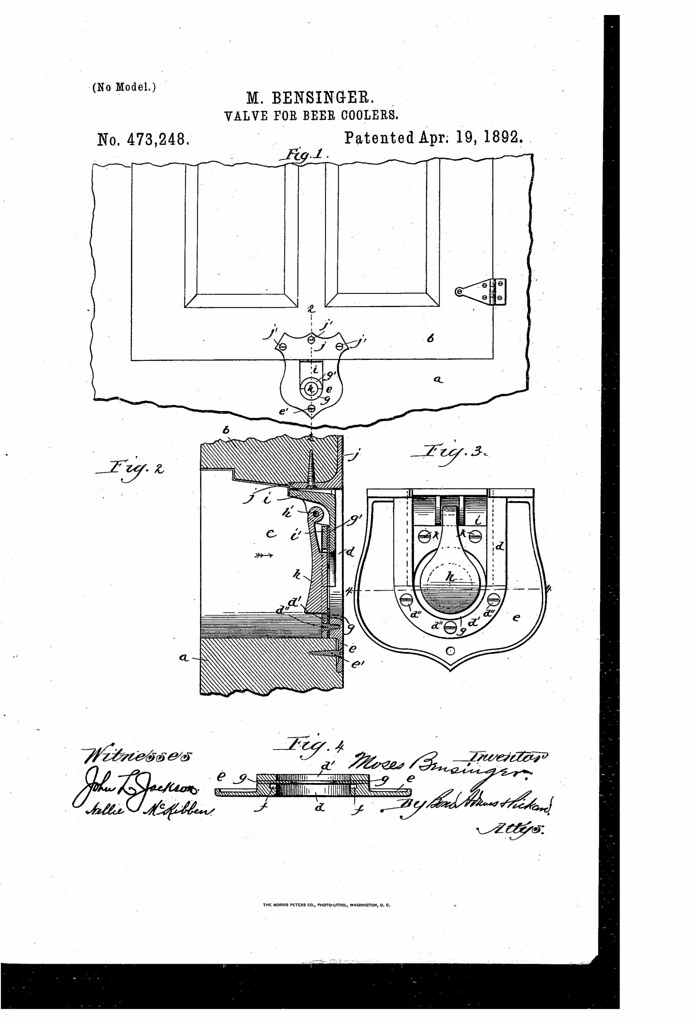
Today in 1892, US Patent 473248 A was issued, an invention of Moses Bensinger, for his “Valve For Beer-Coolers.” There’s no Abstract, although in the description it includes this summary:

My invention relates to valves for closing the opening provided in beer-coolers for the reception of the cock of a beer-keg after it has been introduced into the cooler. In beer coolers provided with an opening of the above description, when the keg has been removed from the cooler, the opening is uncovered and warm air may readily pass to the inside of the refrigerator, causing a great Waste of ice.

The object of my invention is to provide a valve for use upon refrigerators which will automatically operate to close the opening above referred to whenever the keg is removed. I accomplish this object as hereinafter specified and as illustrated in the drawings.

US473248-0

Filed Under: Beers, Just For Fun, Politics & Law, Related Pleasures Tagged With: History, Kegs, Law, Patent

Patent No. 20120093992A1: Apparatus And Method For Stripping Wort

April 19, 2016 By Jay Brooks

patent-logo
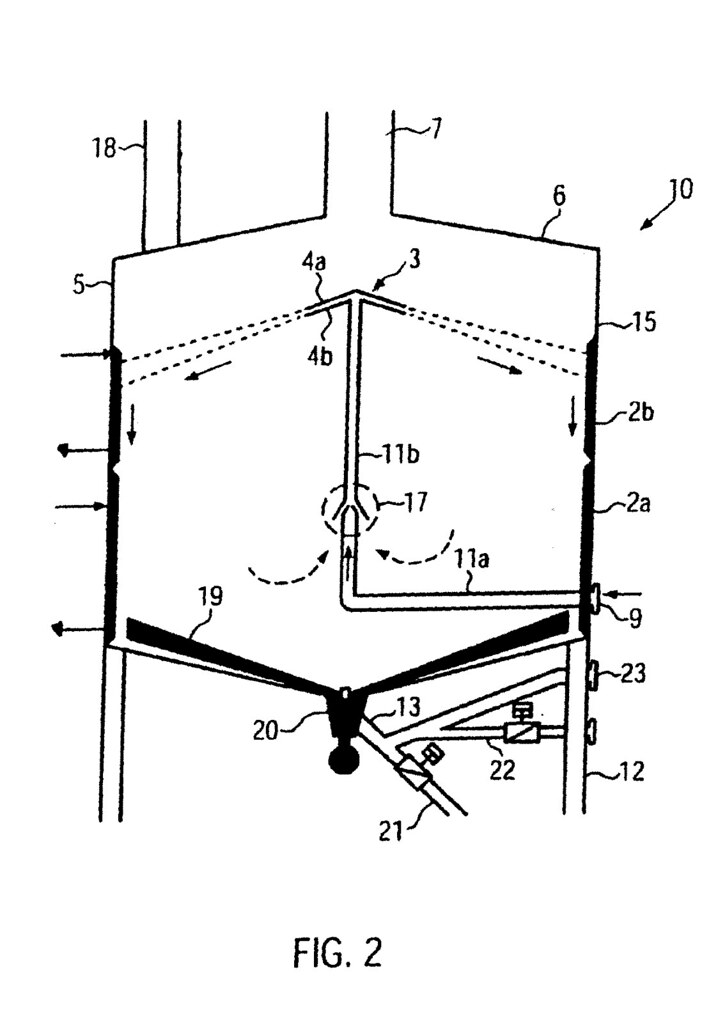
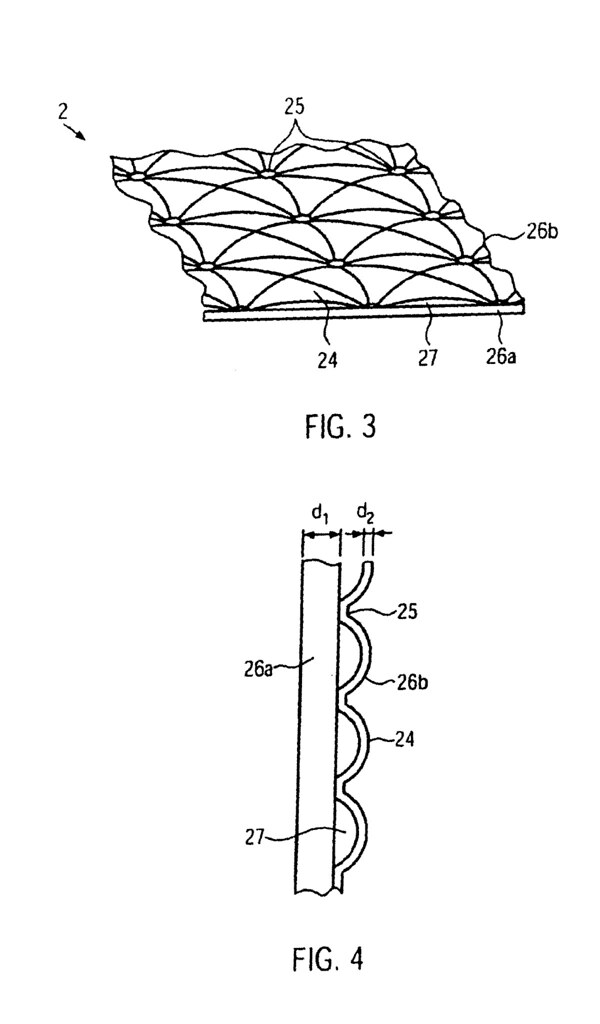
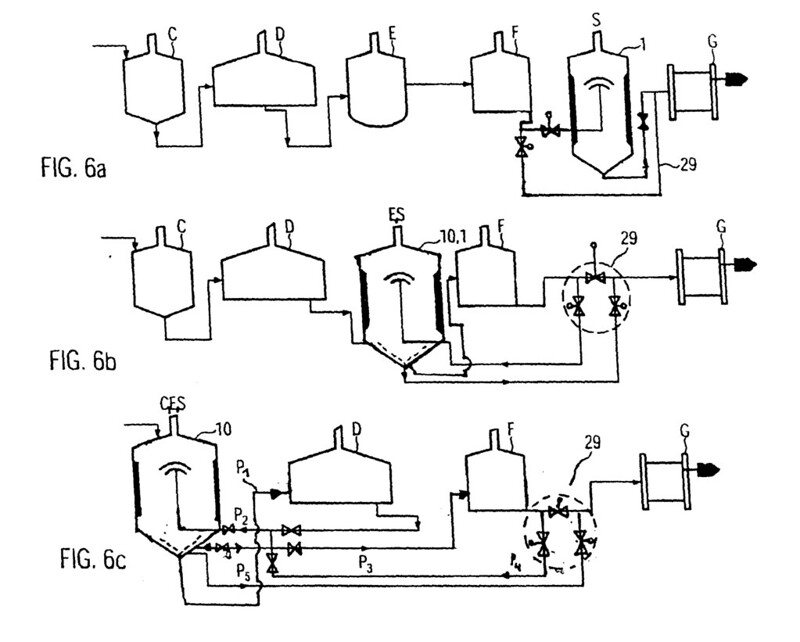
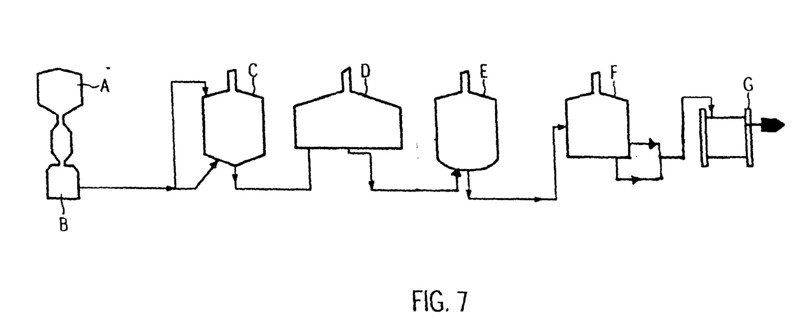
Today in 2012, US Patent 20120093992 A1 was issued, an invention of Peter Gattermeyer and Christian Dorr, assigned to Krones Ag, for their “Apparatus and Method For Stripping Wort.” Here’s the Abstract:

An apparatus and a method for stripping wort, with the apparatus including a receptacle that has a wort inlet and a wort outlet, and a heater on the side wall of the receptacle as well as a distributor device which applies the wort to the heating surface of the heater, such that the wort runs down the heating surface as a film.

US20120093992A1-20120419-D00001
US20120093992A1-20120419-D00002

US20120093992A1-20120419-D00003

US20120093992A1-20120419-D00005
US20120093992A1-20120419-D00006

Filed Under: Beers, Breweries, Just For Fun, Politics & Law, Related Pleasures Tagged With: History, Law, Patent, Science of Brewing, Wort

Patent No. 7028505B2: Cooling Device For Beer Pitcher

April 18, 2016 By Jay Brooks

patent-logo
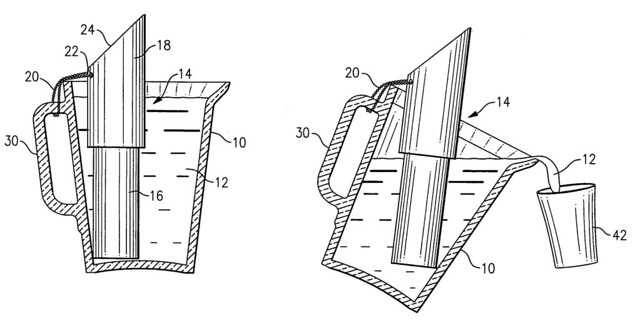
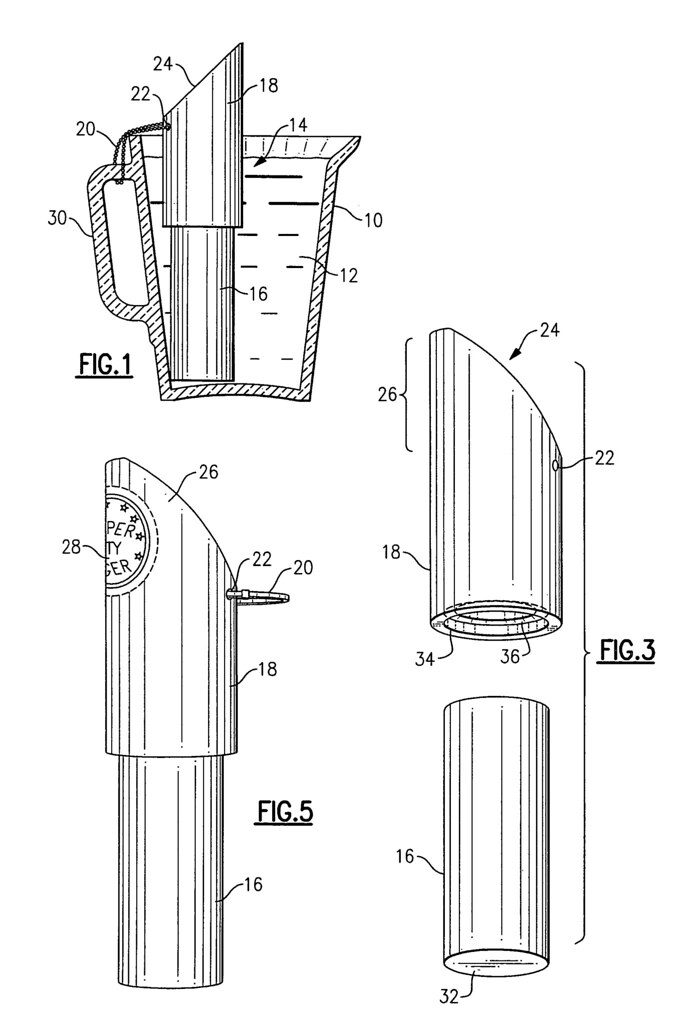
Today in 2006, US Patent 7028505 B2 was issued, an invention of Clement Albert Maus, for his “Cooling Device For Beer Pitcher.” Here’s the Abstract:

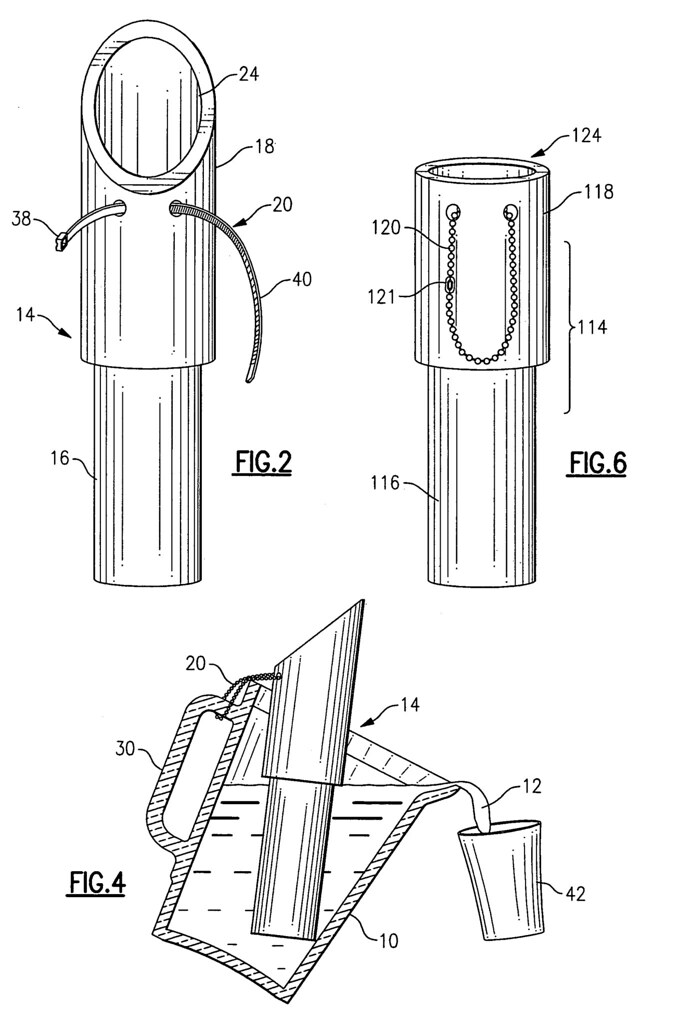
A beverage chiller device for a serving pitcher has a lower stainless steel cylinder and an upper food-grade plastic sleeve. The upper end of the device is open to receive ice. A flexible strap attached onto the upper sleeve has a free end that can pass through a handle of the serving pitcher, with the lower end of the device immersed in the beverage and situated at a base of said pitcher. The flexible strap forms a closed loop that secures the chiller device to the serving pitcher. The flexible strap also permits the chiller device to pivot when the pitcher is tipped for pouring, so that the device remains more or less erect, and so meltwater does not pour out of the chiller device when the customer is pouring a drink from the pitcher. The flexible strap allows the stainless steel cylinder to drop down to the base of the pitcher, so the cylinder remains immersed in the beverage at the bottom of the pitcher.

US07028505-20060418-D00000
US07028505-20060418-D00001
US07028505-20060418-D00002

Filed Under: Beers, Just For Fun, Politics & Law, Related Pleasures Tagged With: Glassware, History, Law, Patent

« Previous Page
Next Page »

Find Something

Northern California Breweries

Please consider purchasing my latest book, California Breweries North, available from Amazon, or ask for it at your local bookstore.

Recent Comments

  • Bob Paolino on Beer Birthday: Grant Johnston
  • Gambrinus on Historic Beer Birthday: A.J. Houghton
  • Ernie Dewing on Historic Beer Birthday: Charles William Bergner 
  • Steve 'Pudgy' De Rose on Historic Beer Birthday: Jacob Schmidt
  • Jay Brooks on Beer Birthday: Bill Owens

Recent Posts

  • Beer In Ads #5187: Ballantine’s Bock Is Here — With Horns! March 26, 2026
  • Historic Beer Birthday: Augustus Hoeveler March 26, 2026
  • Historic Beer Birthday: Bill Siebel March 26, 2026
  • Historic Beer Birthday: Conrad Windisch March 26, 2026
  • Beer Birthday: Rudi Ghequire March 26, 2026

BBB Archives

Feedback

Head Quarter
This site is hosted and maintained by H25Q.dev. Any questions or comments for the webmaster can be directed here.