Brookston Beer Bulletin

Jay R. Brooks on Beer

  • Home
  • About
  • Editorial
  • Birthdays
  • Art & Beer

Socialize

  • Dribbble
  • Email
  • Facebook
  • Flickr
  • GitHub
  • Instagram
  • LinkedIn
  • Pinterest
  • RSS
  • Twitter
  • YouTube

Powered by Genesis

Patent No. 8166893B2: Table System Beer Cooler

May 1, 2016 By Jay Brooks

patent-logo
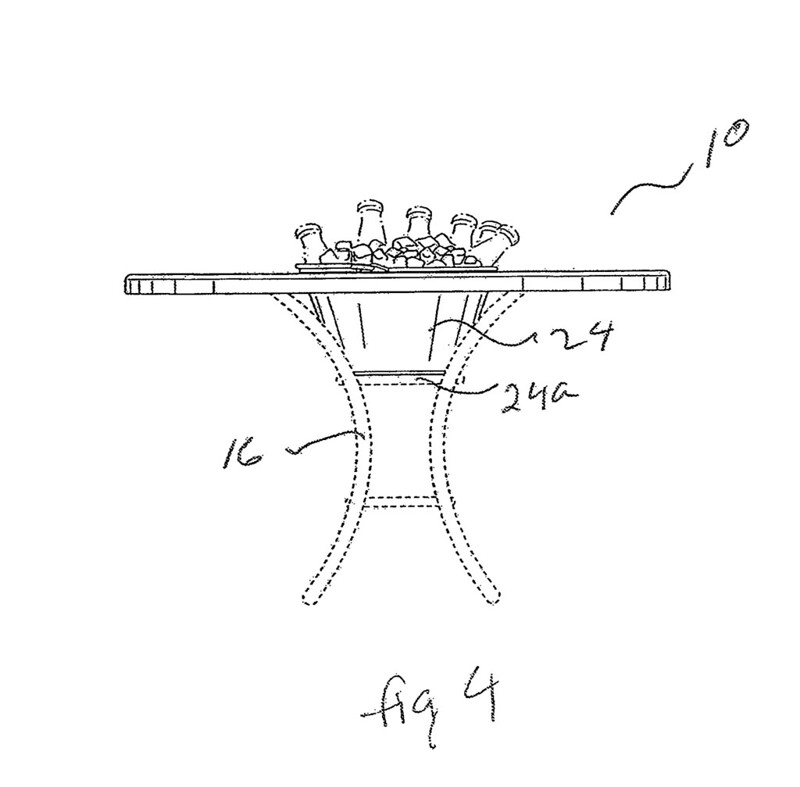
Today in 2012, US Patent 8166893 B2 was issued, an invention of Edgar Davis, for his “Table System.” Here’s the Abstract:

A table system that includes a table top having an upper surface and a surface covering which covers substantially the upper surface of the table top. The table top and the surface covering have concentric openings with substantially similar diameters.

This invention is directed to a table system and more particularly to a table system having a table top, an opening on the surface of the table top, and a removable bucket contained in the opening.

US08166893-20120501-D00000

US08166893-20120501-D00002

US08166893-20120501-D00003

Filed Under: Beers, Just For Fun, Politics & Law, Related Pleasures Tagged With: Bottles, History, Law, Patent

Patent No. 426965A: Beer-Filtering Apparatus

April 29, 2016 By Jay Brooks

patent-logo
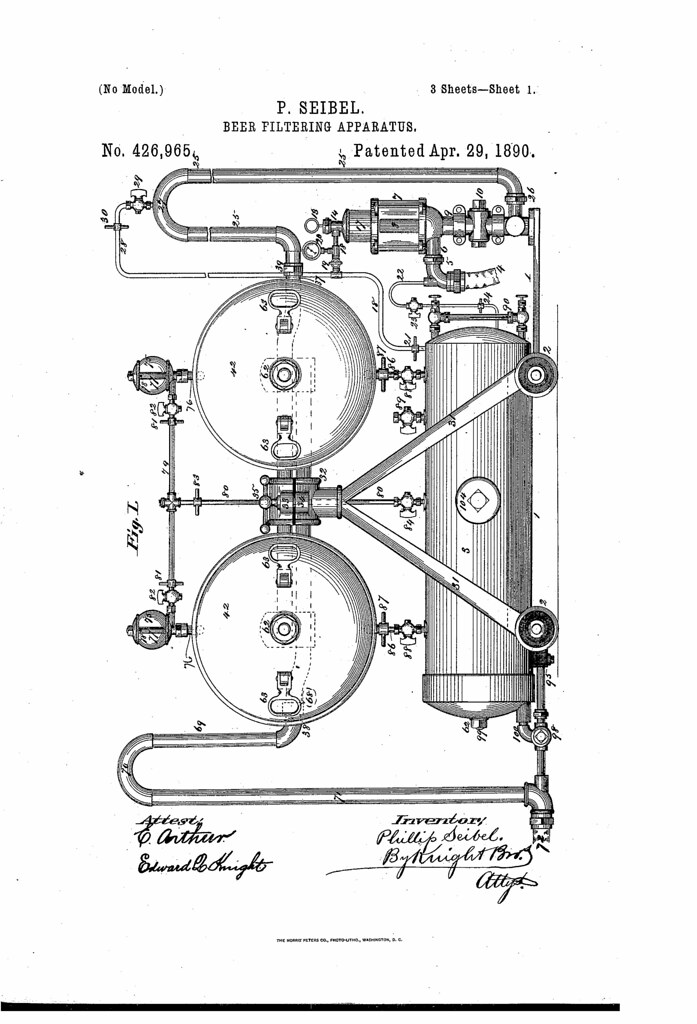
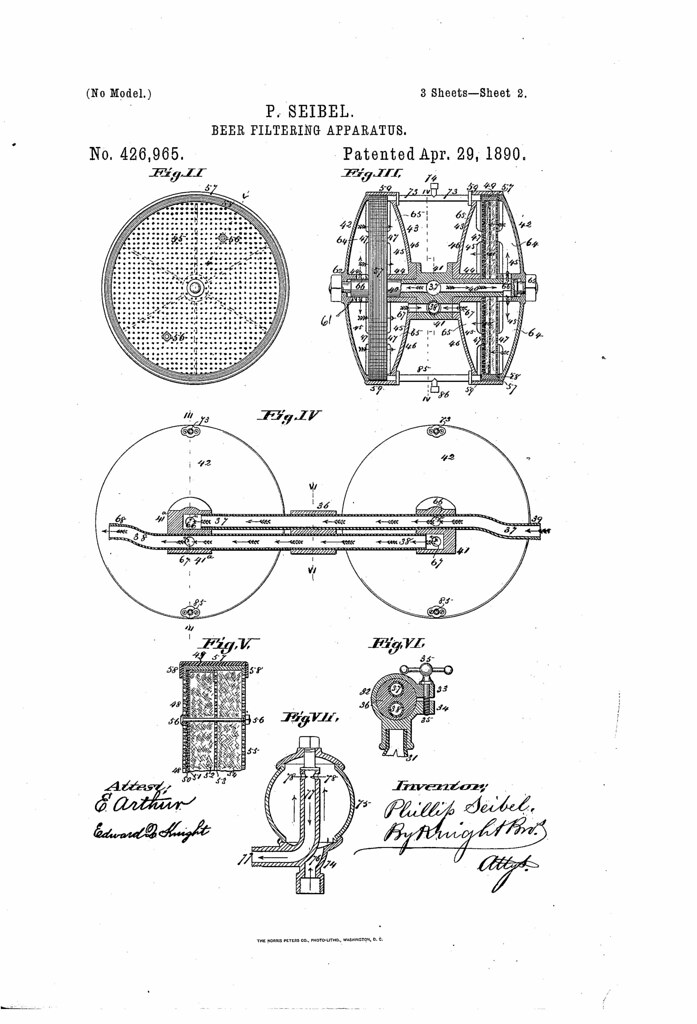
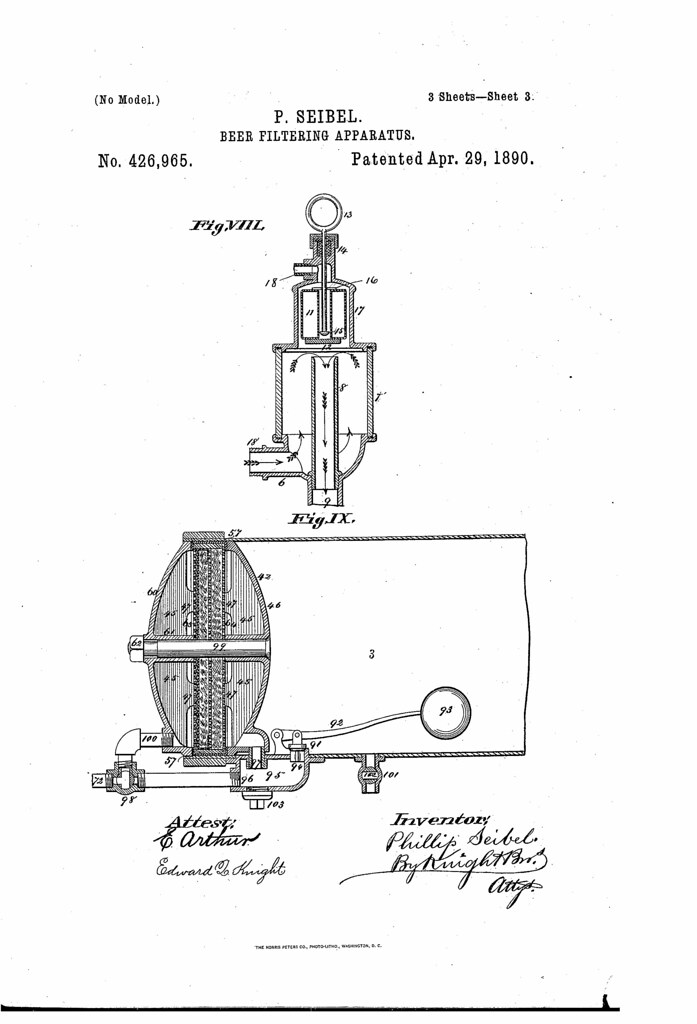
Today in 1890, US Patent 426965 A was issued, an invention of Phillip Seibel, for his “Beer-Filtering Apparatus.” There’s no Abstract, although in the description it includes this summary:

This filtering apparatus is intended especially for beer or other liquids liable to foam, and has means for the removal of the foam into a settling-chamber, from which the liquid is withdrawn as it subsides. The apparatus is composed of two or more similar filters connected with the same system of circulating pipes.

US426965-0
US426965-1
US426965-2

Filed Under: Beers, Breweries, Just For Fun, Politics & Law, Related Pleasures Tagged With: Brewing Equipment, History, Law, Patent, Science of Brewing

Patent No. 2883999A: Tapping Device

April 28, 2016 By Jay Brooks

patent-logo
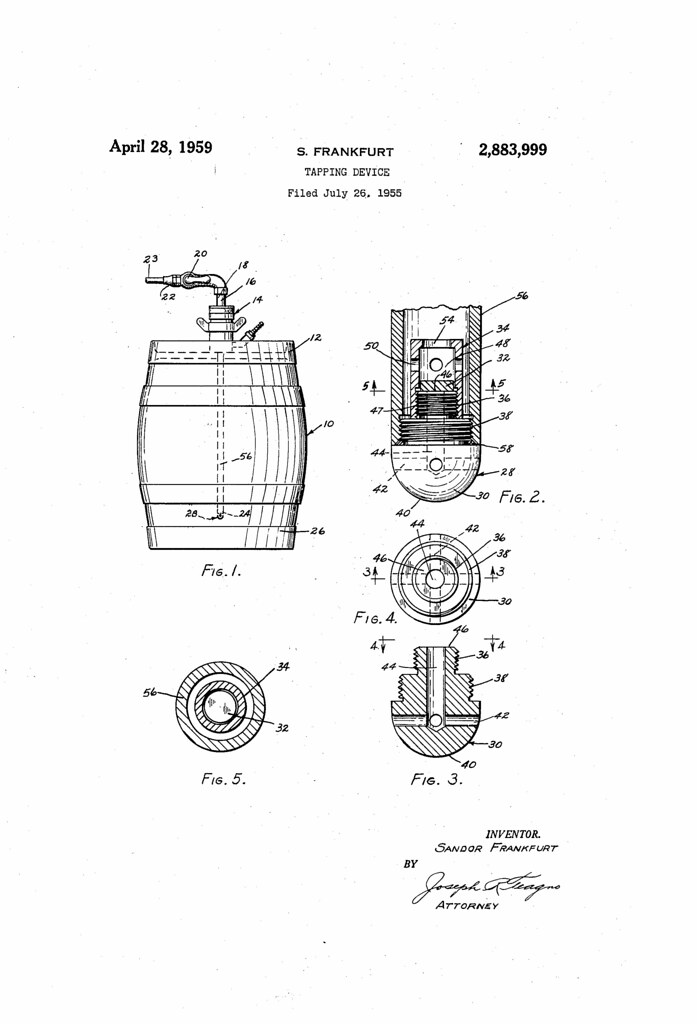
Today in 1959, US Patent 2883999 A was issued, an invention of Sandor Frankfurt, assigned to the Champion Safe Tap Company, for his “Tapping Device.” There’s no Abstract, although in the description it includes this summary:

This invention relates to the tapping of kegs of beer or like beverage and more particularly to a novel form of draft tube, tap rod or conduit means.

Broadly the invention comprehends the provision of a tap rod, or liquid conduit means, for use in the siphoning of beer or the like from containers, such as beer keg, having valve means incorporated therein for inhibiting the retrograde flow of beer from the rod or conduit to the keg, said valve means being movable axially to open or closed position by the flow of beer in the rod.

US2883999-0

Filed Under: Beers, Just For Fun, Politics & Law, Related Pleasures Tagged With: History, Kegs, Law, Patent

Patent No. 2281457A: Aeration Of Fermenting Wort In The Manufacture Of Yeast

April 28, 2016 By Jay Brooks

patent-logo
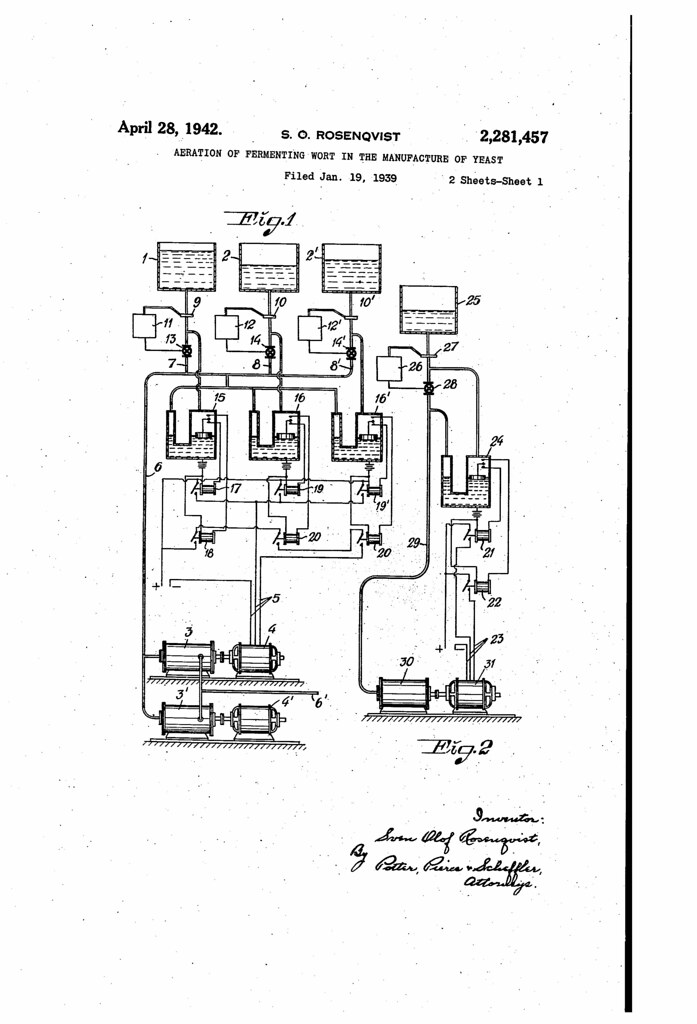
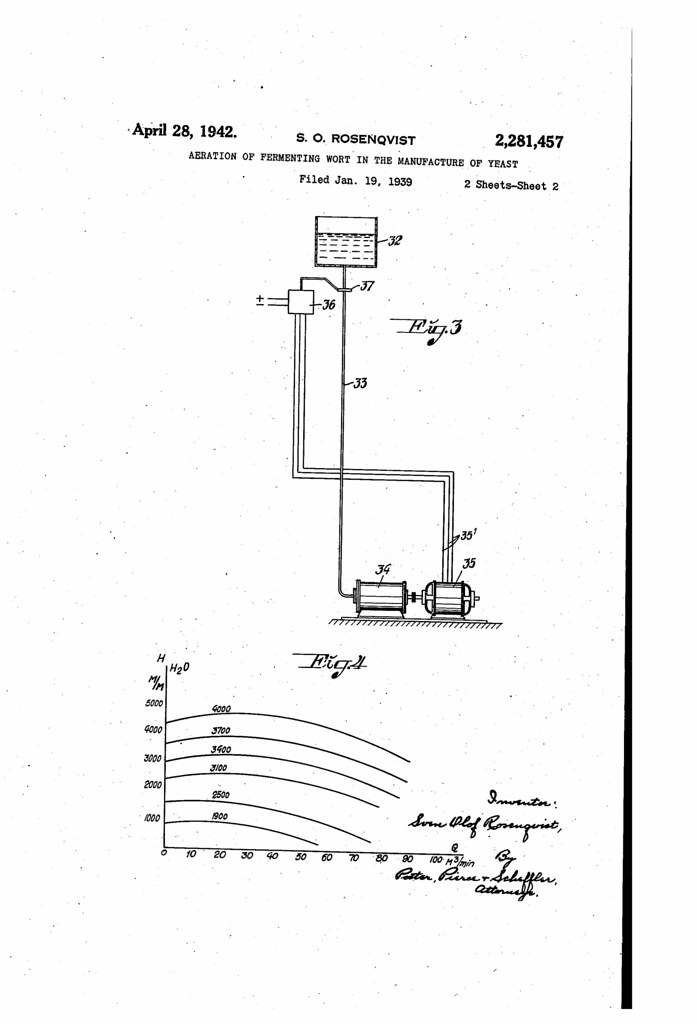
Today in 1942, US Patent 2281457 A was issued, an invention of Sven Olof Rosenqvist, for his “Aeration of Fermenting Wort in the Manufacture of Yeast.” There’s no Abstract, although in the description it includes this summary:

In the manufacture of pressed yeast it is known to blow air into the worts to increase the yeast yields; As a rule the fermentations are now performed with the use of the running-in method, the level of the wort in the vat being considerably lower at the commencement than at the termination of the fermentation. As a rule, it is desired during the start and at the termination of the process to supply less air to the wort than during the main portion of the fermentation. During the main portion of the fermentation it may also be of interest sometimes to be able to supply air quantities of different magnitudes.

Generally, one or more compressors of the same or of different types would operate on a ‘common pressure conduit branched off to the various vats’. By employing large compressor units, the air of which would be distributed to a plurality of vats, a rather low installation cost would be obtained for the compressor system. At the same time, however, the disadvantage would be incurred that the pressure on the air piping always would have to be maintained at a value corresponding to the highest back pressure prevailing in any vat.

Air taken out from the pipe system for a vat with a lower back pressure thus would have to be reduced by a valve from the higher to the lower pressure, which obviously would involve losses of energy.

With large compressor units, the losses in idle running would also be considerable at a low load.

Any control of the air quantity for the various fermentation vats could only take place manually with the arrangements described and with loss of energy. A control of the air quantity to a fermentation vat from the common conduit would entail disturbances in the air supply to the remaining vats and in order to limit such disturbances the pressure above atmospheric in the main conduit would have to be maintained at. an unnecessary high value. The arrangements as hitherto used consequently could not, owing to the fact that the control would be less accurate or too expensive, ensure the proper air supply to each of the fermentation processes proceeding in the various fermentation vats at an energy cost as low as possible. By reason of the fact that the supply of the quantities of air undertaken at the fermentations could not be properly adapted with respect to the process otherwise carried out in connection with these fermentations, the lowest cost for the aeration work, the best yield of the raw materials and the best quality of the finished product consequently could not be obtained.

The present invention refers to an arrangement for the supply of air to fermenting wort in the manufacture of pressed yeast, in the use ‘of which the above described disadvantages are avoided.

The arrangement according to the invention is principally distinguished by a compressor apparatus adapted to be controlled with respect to the delivery of air, the pressure conduit of which apparatus is connected to the plant of fermentation vats, and by an arrangement with a continuously driven member adapted to control the intensity of aeration in accordance with a previously determined aeration scheme, and which may actuate the air delivery of the compressor apparatus by influencing the compressor apparatus itself, its suction or pressure conduit or its driving machinery, or two or more of these arrangements, and which is so arranged as to adjust the compressor apparatus automatically and in accordance with an aeration scheme determined beforehand, to deliver air in a quantity and at a pressure required by the scheme at any moment. Preferably, a measuring device is provided to indicate the amount of air passing on its way to the fermentation vat, said measuring device being adapted to give impulses to the controlling doling device. According to an embodiment of the invention, the controlling doling device is adapted directly or indirectly to actuate a device, in ,order, in the case of double acting compressors, to convey a portion of the air to that part of the compressor which operates at a pressure below atmospheric. According to a further embodiment, a measuring device for the air in the inlet or outlet of the compressor “is arranged to transmit impulses for the control of the number of revolutions of the driving engine of the compressor.

Also. a measuring device for the air may be arranged to effect throttling in the inlet or outlet of the compressor so as to control the quantity of air in this way. If a compressor be used. a turbo-compressor adapted to be controlled with respect to the number of revolutions thereof is preferably made use of.

US2281457-0
US2281457-1

Filed Under: Beers, Breweries, Just For Fun, Politics & Law, Related Pleasures Tagged With: Brewing Equipment, History, Law, Patent, Science of Brewing, Yeast

Patent No. 726427A: Beer Filter

April 28, 2016 By Jay Brooks

patent-logo
Today in 1903, US Patent 726427 A was issued, an invention of William Haussermann, for his “Beer Filter.” There’s no Abstract, although in the description it includes this summary:

This invention relates to improvements in filters, and particularly beer-filters.

The object of the invention is to provide a beer-filter which is simple of construction, comparatively inexpensive of production, efficient in operation, and adapted to be readily and conveniently cleansed of the retained impurities.

US726427-0

Filed Under: Beers, Breweries, Just For Fun, Politics & Law, Related Pleasures Tagged With: Brewing Equipment, History, Law, Patent, Science of Brewing

Patent No. 1802638A: Pressed Metal Keg

April 28, 2016 By Jay Brooks

patent-logo
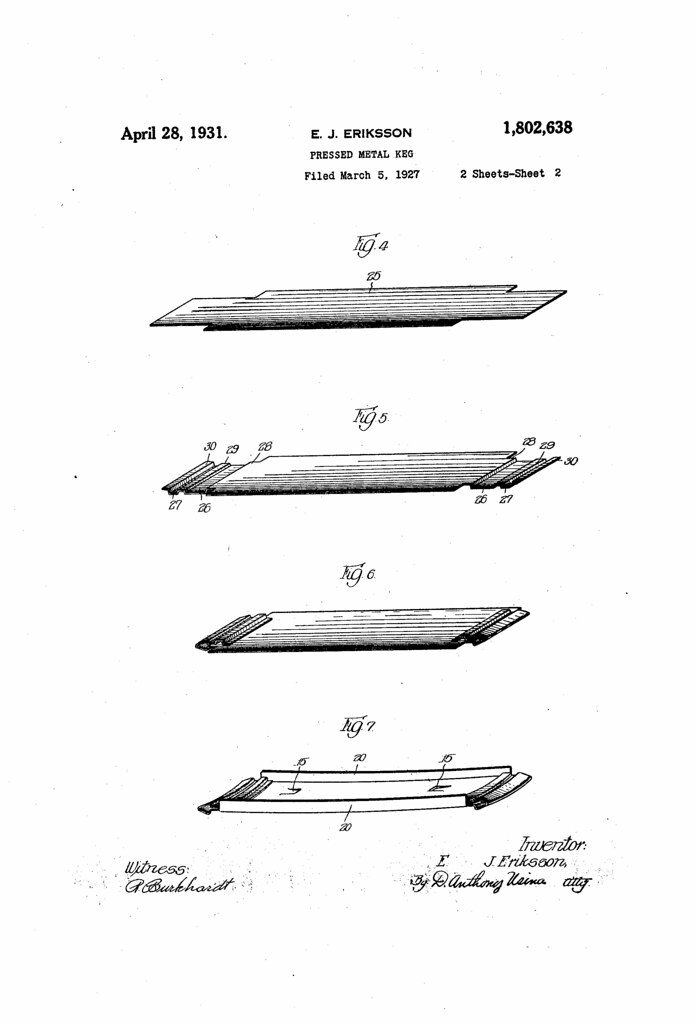
Today in 1931, US Patent 1802638 A was issued, an invention of Erik J. Eriksson, for his “Pressed Metal Keg.” There’s no Abstract, although in the description it includes this summary:

My invention relates to pressed metal kegs, and more particularly to the type of keg composed of a plurality of pressed metal staves assembled with metal end pieces and hoops in the manner of the customary wooden keg.

US1802638-0
US1802638-1

Filed Under: Beers, Just For Fun, Politics & Law, Related Pleasures Tagged With: History, Kegs, Law, Patent

Patent No. 2440276A: Brewing Method Using Albedo In Wort

April 27, 2016 By Jay Brooks

patent-logo
Today in 1948, US Patent 2440276 A was issued, an invention of Abraham Arnold Klein, for his “Brewing Method Using Albedo In Wort.” There’s no Abstract, although in the description it includes this summary:

According to the present invention albedo from fruit of the genus Citrus, particularly from grapefruit or citron, is used instead of, or in addition to, hops in the manufactured beer. I have found that the lupulin of hops has in many cases undesirable effects on the human organism. Furthermore hops deteriorate easily. Albedo from citrus fruit can be used instead of hops and the bitter flavour imparted by it to the wort is of a mild and agreeable character.

So this is essentially using grapefruit or other citrus almost 70 years before Ballast Point Grapefruit Sculpin. But not the whole fruit, or even the rind, the albedo is the white, fleshy inner later in between the thinner, top rind layer and the inside fruit. That spongy material is, according to this patent, used in place of or with hops in the brewing process. I wonder if anybody used this method to produce commercial beer?
Orange_cross_section_description
grapefruit

Filed Under: Beers, Breweries, Just For Fun, Politics & Law, Related Pleasures Tagged With: History, Hops, Law, Patent, Science of Brewing

Patent No. EP2583934A1: Reusable Beer Keg

April 24, 2016 By Jay Brooks

patent-logo
Today in 2013, US Patent EP 2583934 A1 was issued, an invention of Thomas W. Bates, Dan Morgan, and Leslie W. Ross, for their “Reusable Beer Keg.” Here’s the Abstract:

A reusable beer keg (1) is disclosed comprising a hollow beer keg body (2) with a dispenser tube assembly (10) having a dispenser valve (11), dispenser tube (12), and a disposable bladder (13). The dispenser valve (11) is releasably attached to a top portion of the keg body (2) and the dispenser tube (12) and bladder (13) extend into the interior of the keg body (2). When beer flows through the open dispenser valve (11) and into the bladder (13), the beer causes the bladder (13) to expand until it contacts the inside surface of the keg body (2). When the beer keg (1) has been emptied it can be returned to the brewery for reuse by cleaning the dispenser valve (11), dispenser tube (12) and disposing of the used bladder (13). The beer keg body (2) does not need to be cleaned, however, because the beer only comes in contact with the disposable bladder (13) and not the keg body (2). The beer keg parts can then be reassembled, using a new bladder in place of the used bladder.

2583934-imgaf001

Filed Under: Beers, Just For Fun, Politics & Law, Related Pleasures Tagged With: History, Kegs, Law, Patent

Patent No. 20030075208A1: The Beerbrella

April 24, 2016 By Jay Brooks

patent-logo
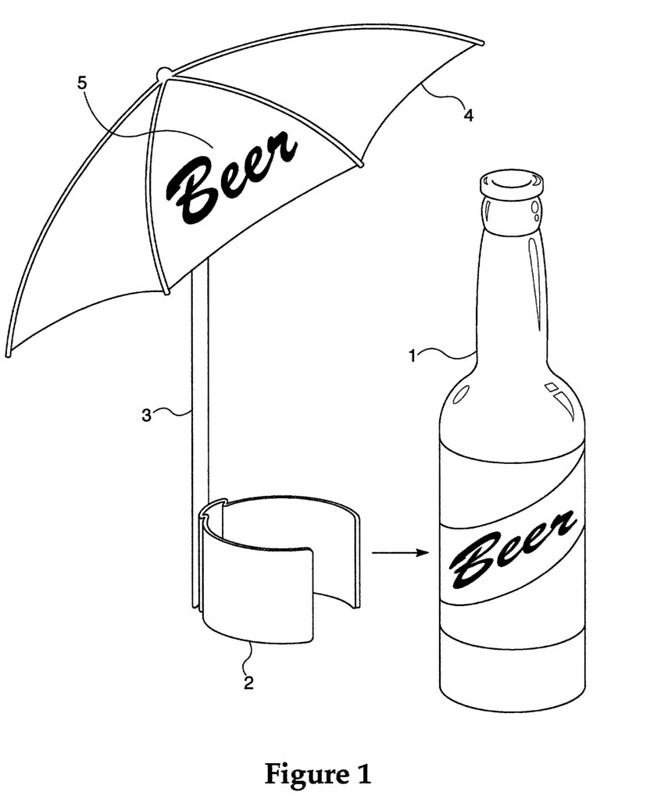
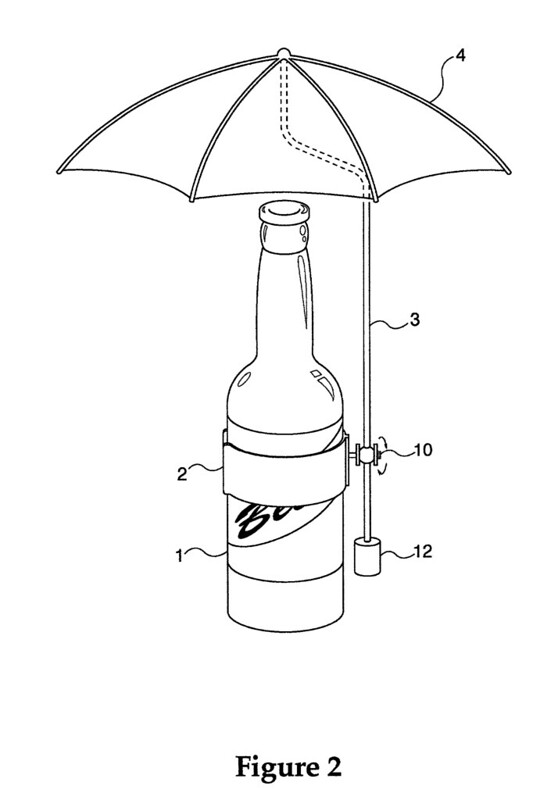
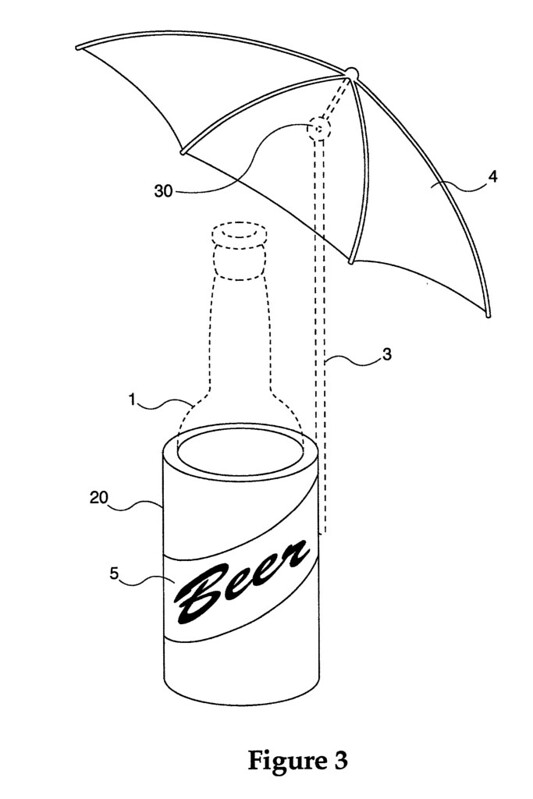
Today in 2003, US Patent 20030075208 A1 was issued, an invention of Mason McMullin, Robert Bell, and Mark See, for their “Beerbrella.” Here’s the Abstract:

The present invention provides a small umbrella (“Beerbrella”) which may be removably attached to a beverage container in order to shade the beverage container from the direct rays of the sun. The apparatus comprises a small umbrella approximately five to seven inches in diameter, although other appropriate sizes may be used within the spirit and scope of the present invention. Suitable advertising and/or logos may be applied to the umbrella surface for promotional purposes. The umbrella may be attached to the beverage container by any one of a number of means, including clip, strap, cup, foam insulator, or as a coaster or the like. The umbrella shaft may be provided with a pivot to allow the umbrella to be suitably angled to shield the sun or for aesthetic purposes. In one embodiment, a pivot joint and counterweight may be provided to allow the umbrella to pivot out of the way when the user drinks from the container.

US20030075208A1-20030424-D00001

US20030075208A1-20030424-D00002

US20030075208A1-20030424-D00003

US20030075208A1-20030424-D00004

Filed Under: Beers, Just For Fun, Politics & Law, Related Pleasures Tagged With: History, Law, Patent

500th Anniversary Of The Reinheitsgebot

April 23, 2016 By Jay Brooks

reinheitsgebot bavaria-coa
It’s hard to believe it’s been 500 years since Bavaria signed what’s considered the first food purity law, the Reinheitsgebot, also known as the Bavarian Beer Purity Law, and later the German Beer Purity Law. That’s because in 1516, when the law was decreed, Germany did not yet exist, and wouldn’t for nearly 300 years, with the formation of the German Confederation in 1815, longer if you go by the German Empire, founded in 1871. Modern Germany consists of sixteen federal states, called Bundesländers, of which Bavaria is one.
reinheits-500
And it was in Bavarian town of Ingolstadt on April 23, 1516, that William IV, Duke of Bavaria wrote and signed the law, along with his younger brother Louis X, Duke of Bavaria. That 1516 law was itself a variation of earlier laws, at least as early as 1447 and another in independent Munich in 1487. When Bavaria reunited, the new Reinheitsgebot applied to the entirety of the Bavarian duchy. It didn’t apply to all of Germany until 1906, and it wasn’t referred to as the Reinheitsgebot until 1918, when it was coined by a member of the Bavarian parliament. But while today most people think of it as all about food purity, that was in reality only a small part of it, and probably not even the most important.

reinheitsgebot

Here’s a translation of the Reinheitsgebot, from a 1993 issue of Zymurgy:

We hereby proclaim and decree, by Authority of our Province, that henceforth in the Duchy of Bavaria, in the country as well as in the cities and marketplaces, the following rules apply to the sale of beer:

From Michaelmas to Georgi [St. George’s Day], the price for one Mass [Bavarian Liter 1,069] or one Kopf [bowl-shaped container for fluids, not quite one Mass], is not to exceed one Pfennig Munich value, and

From Georgi to Michaelmas, the Mass shall not be sold for more than two Pfennig of the same value, the Kopf not more than three Heller [Heller usually one-half Pfennig].

If this not be adhered to, the punishment stated below shall be administered.

Should any person brew, or otherwise have, other beer than March beer, it is not to be sold any higher than one Pfennig per Mass.

Furthermore, we wish to emphasize that in future in all cities, markets and in the country, the only ingredients used for the brewing of beer must be Barley, Hops and Water. Whosoever knowingly disregards or transgresses upon this ordinance, shall be punished by the Court authorities’ confiscating such barrels of beer, without fail.

Should, however, an innkeeper in the country, city or markets buy two or three pails of beer (containing 60 Mass) and sell it again to the common peasantry, he alone shall be permitted to charge one Heller more for the Mass or the Kopf, than mentioned above. Furthermore, should there arise a scarcity and subsequent price increase of the barley (also considering that the times of harvest differ, due to location), WE, the Bavarian Duchy, shall have the right to order curtailments for the good of all concerned.

Notice that the first two decrees have to do with pricing and when beer can be sold. It isn’t until paragraph six, the second last one, that the issue of what ingredients will be allowed comes up. If it had been the most important part, is seems more likely they would have led with it. Even then, it wasn’t about purity, but again commerce. Barley was designated as the only grain so that others, notably wheat and rye, were set aside to be used for baking bread.

Also, a lot of hay has been made about it not mentioning yeast, with the idea that it was because yeast wasn’t discovered until Louis Pasteur in the 19th century. But early brewers did know something about yeast, even if they didn’t have the full scientific understanding that came later. Otherwise, they wouldn’t have been able to make consistent batches of beer. At the end of your brew, you’ll find a layer of billowing foam and other indeterminate matter at the bottom of the fermenter, which the Germans called “Zeug,” which means “stuff.” And early German brewers had a person, called a “hefener,” whose job it was to scoop out the Zeug, which was in effect the leftover yeast, and pitch it in the next batch of beer. So it’s hard to say they didn’t have some understanding of yeast.

Reinheitsgebot-Bier-stamp
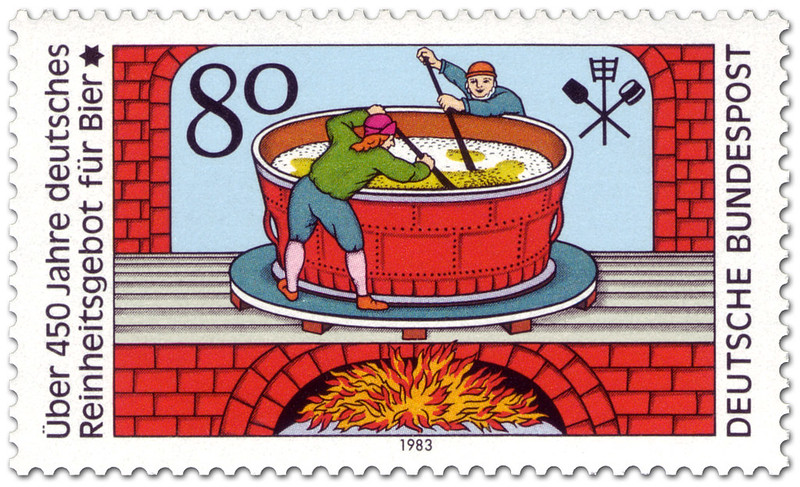
A German postage stamp celebrating the 450th anniversary of the Reinheitsgebot in 1983.

The Germans, of course, have set up a website for the 500th anniversary, and so does the Bayerischer Brauerbund, which is a a Bavarian brewers trade group along with the German Brewers Group. They also created a 50-second film marking the anniversary.

And the media is covering the Reinheitsgebot’s Quincentenary. A few examples include the BBC, Food and Wine, NPR, Spiegel, and Wired. But by far the most thorough examination of the Reinheitsgebot was by Jeff Alworth in All About Beer magazine, Attempting to Understand the Reinheitsgebot.

reinheitsgebot-replica

It’s great that it’s been 500 years, and that German brewers are justly proud of the Reinheitsgebot. It’s clearly helped create the unique German beer scene and their many native styles. But it’s also been used as a shameless marketing tool, been used as an exclusionary tactic, and has even had little-known exceptions to its rules for years, ones that most people are not even aware of, not to mention the use of other items in the brewing process that are also not mentioned by the law, but which because they’re not strictly “ingredients” more modern brewers have interpreted as not being prohibited.

Many people have voiced criticisms against it over the years. One that’s particularly thorough is The German Reinheitsgebot — Why it’s a Load of Old Bollocks. The German magazine Spiegel’s recent coverage is entitled Attacking Beer Purity: The Twilight of Germany’s Reinheitsgebot.

Back in 2001, Fred Eckhardt wrote an entertaining tale for All About Beer entitled The Spy who Saved the Reinheitsgebot, about how a brewer was able to prove Beck’s was using adjuncts and was not in adherence with the German law.

In another recent article in First We Feast, Sam Calagione, of the Dogfish Head Craft Brewery, is quoted with an opinion I suspect many American brewers hold. “I hate the concept of the Reinheitsgebot, but I am essentially happy it exists.”

Reinheitsgebot-Bier-stamp-2016
Deutsche Post’s 2016 commemorative stamp.

Filed Under: Beers, Events, Just For Fun, Politics & Law Tagged With: Bavaria, Germany, History, Law

« Previous Page
Next Page »

Find Something

Northern California Breweries

Please consider purchasing my latest book, California Breweries North, available from Amazon, or ask for it at your local bookstore.

Recent Comments

  • Bob Paolino on Beer Birthday: Grant Johnston
  • Gambrinus on Historic Beer Birthday: A.J. Houghton
  • Ernie Dewing on Historic Beer Birthday: Charles William Bergner 
  • Steve 'Pudgy' De Rose on Historic Beer Birthday: Jacob Schmidt
  • Jay Brooks on Beer Birthday: Bill Owens

Recent Posts

  • Beer In Ads #5228: To Clarify The “Bock Beer Date” Question April 23, 2026
  • Historic Beer Birthday: Anton Schwartz April 23, 2026
  • Beer Birthday: Christian Kazakoff April 23, 2026
  • Beer In Ads #5228: We Are Coming On The Run … April 22, 2026
  • Beer In Ads #5228: All Together For Newark April 21, 2026

BBB Archives

Feedback

Head Quarter
This site is hosted and maintained by H25Q.dev. Any questions or comments for the webmaster can be directed here.