Brookston Beer Bulletin

Jay R. Brooks on Beer

  • Home
  • About
  • Editorial
  • Birthdays
  • Art & Beer

Socialize

  • Dribbble
  • Email
  • Facebook
  • Flickr
  • GitHub
  • Instagram
  • LinkedIn
  • Pinterest
  • RSS
  • Twitter
  • YouTube

Powered by Genesis

Patent No. 3418135A: Light-Insensitive Malt Beverage

December 24, 2015 By Jay Brooks

patent-logo
Today in 1968, US Patent 3418135 A was issued, an invention of Peter D. Bayne, assigned to Schlitz Brewing Co., for his “Light-Insensitive Malt Beverage and Process of Producing the Same.” There’s no Abstract, although in the description it includes this summary:

This invention relates to a process of producing a malt beverage such as beer, and more particularly to a process of producing a malt beverage which is insensitive to light.

Malt beverages such as beer and ale are not stable to light. When subjected to light, the beer develops an odor and flavor characterized as skunky. To prevent the development of the sunstruck or skunky odor, beer is generally packaged in colored bottles which minimizes exposure to sunlight. Even though packaged in colored bottles or in cans or kegs, the beer can nevertheless develop the sunstruck odor by virtue of the short exposure to sunlight in drinking glasses.

It has been found that the presence of isohumulones are responsible for the development of the sunstruck odor in beer. The hops, which are boiled with the wort, contain resins and oils which are contained in the lupulin. The resins include the alpha and beta resins, with the alpha resins containing a bitter acid called humulone and the beta resins containing an acid called lupulone. The alpha acids provide the bitter flavor for the beer while the beta acids have low solubility in the Wort and do not appreciably enter into the brewing process.

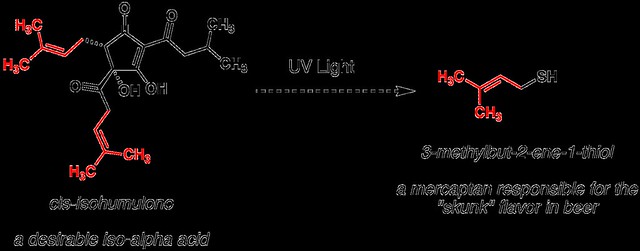
During the brewing-process, the humulone fraction is isomerized to the corresponding isohumulones. The sunstruck odor substance in beer has been identified as a mercaptan,3-Inethyl-2-butene-l-thiol, which is formed by the photolysis of the siX-membered side chain on the isohumulone molecule. The free radical formed by the intervention of sunlight splits Off carbon monoxide, forming the 3-methyl-2-butenyl radical. This product, in turn, reacts with hydrogen sulfide, which is formed from proteins or amino acids by photochemical action, to form 3- methyl-Z-butene-l-thiol. This mercaptan is considered to be the main component of the sunstruck odor in malt beverages.

To prevent the sunstruck odor, it has been proposed to convert a carbonyl group of the isohumulones into a secondary alcohol by reduction. In this reduced form, the molecule becomes insensitive to sunlight and there is no formation of odor on exposure to sunlight. This conversion has been carried out in the past by use of sodium borohydride as disclosed in Patent No. 3,079,262, but the use of sodium borohydride has not been completely successtul in that the reaction is difiicult to control. The contact time between the sodium borohydride and the isohumulone must be accurately controlled in order to effect a complete reduction of the isohumulones In addition, the sodium borohydride is a relatively costly material which adds to the overall cost of the beer.

The present invention is directed to a process for producing a light-insensitive malt beverage by reducing the isohumulones by use of an alkali metal dithionite. More specifically, the process consists of initially extracting ground hops with a solvent, such as hexane. The solvent is then evaporated, leaving a dark resinous oil which is isomerized in a dilute alkaline solution. After the isomerization, the material is neutralized to pH of 6.0 to 7.0 with a mineral acid and the lupulone, wax and chlorophyll are removed by further extractions with a solvent. The aqueous phase is then further acidified to a pH in the range of 1.0 to 2.0 and the isohumulones extracted with a solvent such as diethyl ether. The reduction is then accomplished by contacting the ether-isohumulone extract -with an aqueous solution of sodium dithionite.

After the reduction, the reduced isohumulone extract is separated from the dithionite solution and washed with brine. The ether is then removed by distillation to produce the reduced isohumulone concentrate.

The reduced isohumulone when added to a standard unhopped wort or beer produces a beer which does not develop the characteristic sunstruck odor when subjected to sunlight and at the same time allows precise control of the isohumulone bitterness levels which was hitherto impossible by traditional hopping methods.
isohumulone-degradation1

Filed Under: Beers, Just For Fun, Politics & Law, Related Pleasures Tagged With: History, Hops, Law, Patent, Science of Brewing

Patent No. 2225996A: Beer Foam Control Device

December 24, 2015 By Jay Brooks

patent-logo
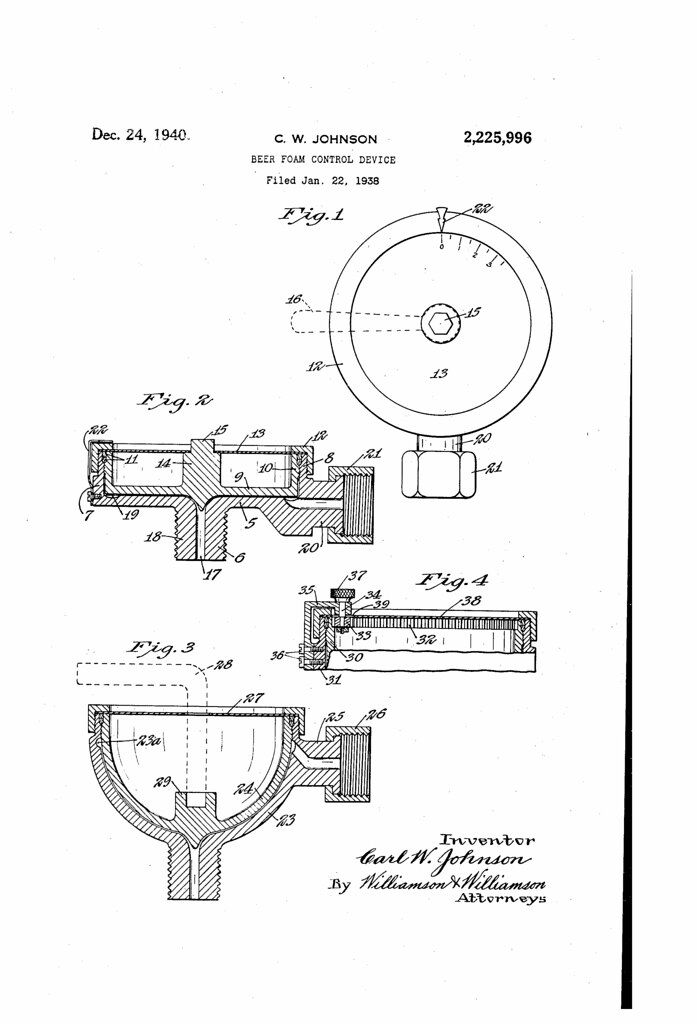
Today in 1940, US Patent 2225996 A was issued, an invention of Carl W. Johnson, for his “Beer Foam Control Device.” There’s no Abstract, although in the description it includes this summary:

This invention relates to devices for controlling the amount of foam on beverages which are maintained in storage containers under gaseous pressure, and is particularly adaptable for use in connection with the dispensing of malt beverages such as beer and ale.

One of the difficulties encountered in the dispensing of malt beverages has been the inability to control the foam or cap which forms on the beer when it is drawn into a glass or other container. It is desirable to maintain beer in a keg under relatively high pressures to prevent the beer from becoming flat, the pressure applied to the liquid serving to retain the natural gases formed in the beer during the fermentation thereof. Heretofore it has been found, however, that beer cannot be placed under very much pressure because it will cause foaming with the result that the person dispensing the beverage must scrape a considerable quantity of foam off the top of the beer in a glass, and that part which is removed is wasted.

It is, therefore, a general object of my invention to provide a device for controlling the amount of foam which is produced in dispensing beverages, such as beer, in. order that the beverage may be maintained under relatively high pressure to prevent it from becoming flat, and at the same time permit it to be dispensed with very little foam or cap thereon.

Another object of the invention is to provide a device which can be easily adjusted to meet different pressure conditions in order that a uniform amount of foam will be produced at all times.

A further object of the invention is to provide a device of this general type which is of extremely simple construction and which can be readily cleaned to maintain the original flavor of the beer.

US2225996-0

Filed Under: Beers, Breweries, Just For Fun, Politics & Law, Related Pleasures Tagged With: Brewing Equipment, History, Law, Patent, Science of Brewing

Patent No. 2225996A: Stationary Beer Container

December 24, 2015 By Jay Brooks

patent-logo
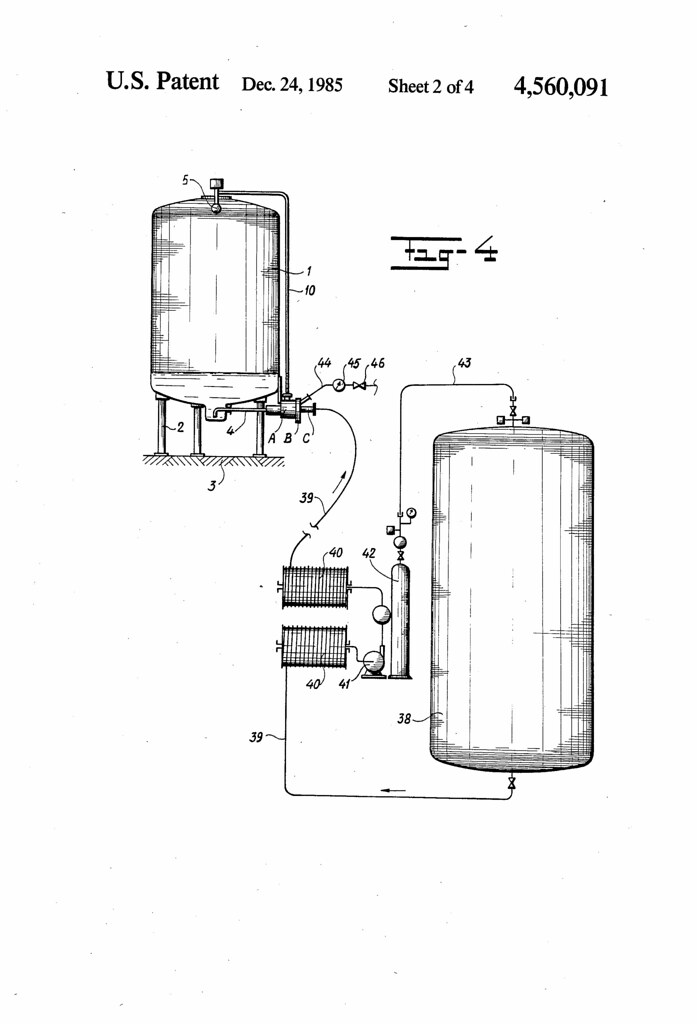
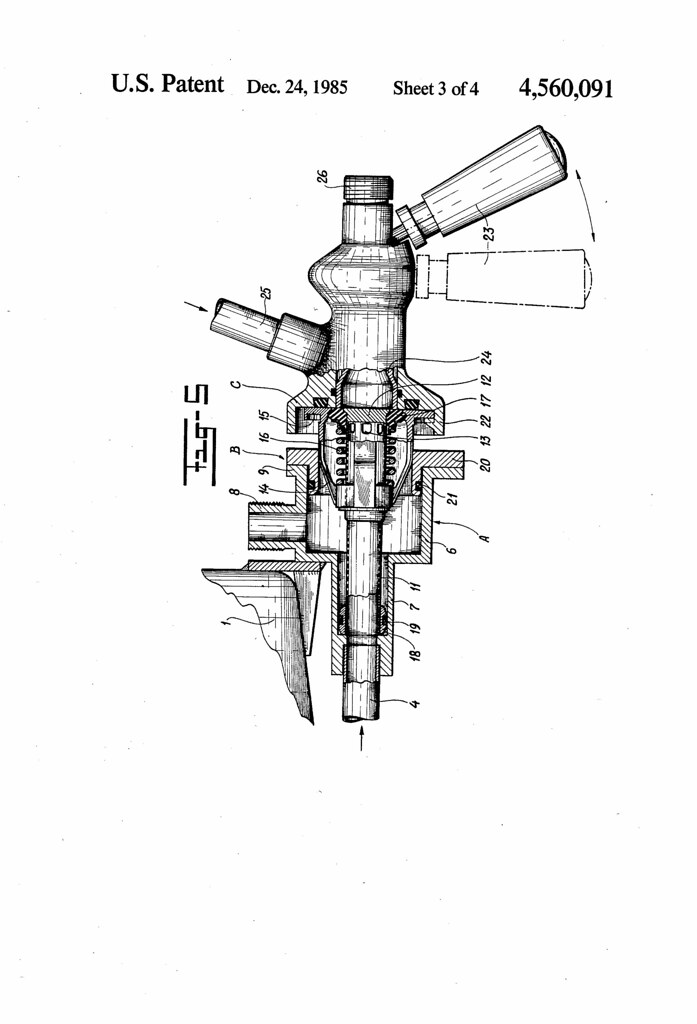
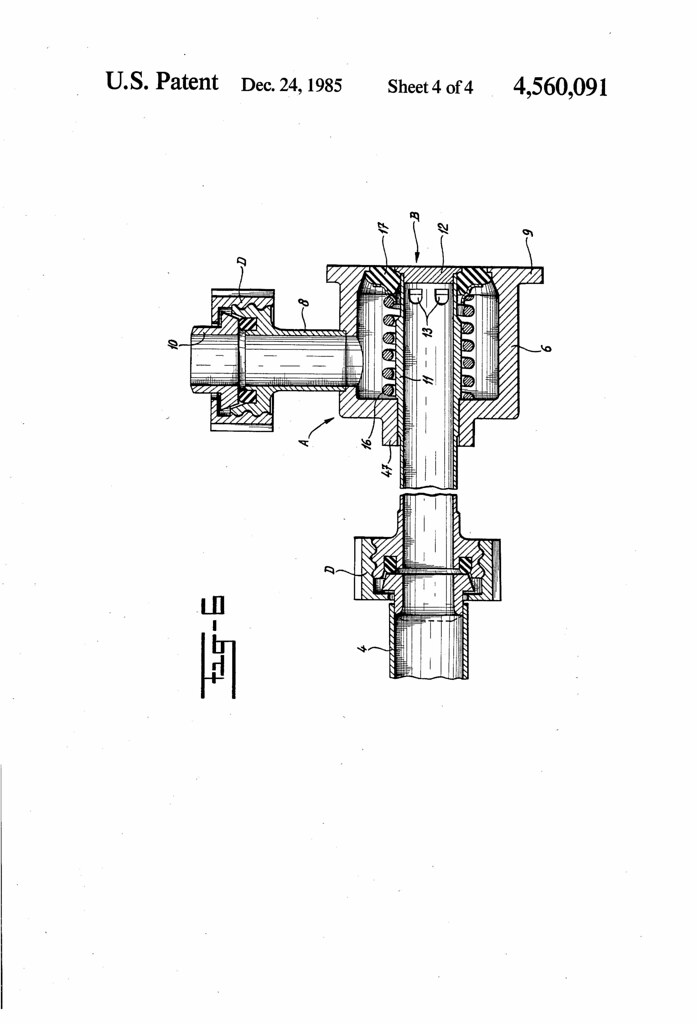
Today in 1985, US Patent 2225996 A was issued, an invention of Hubertus J. Souren, assigned to Grolsche Bierbrouwerij B.V., for his “Stationary Beer Container.” Here’s the Abstract:

A stationary beer container having upper and lower end connections coupled with a flow line coupling and valve assembly adapted to cooperate with a standard beer tap head used with barrels or kegs. The flow line coupling and housing assembly of the invention is connected with a line to the lower end of the beer container and a vertical line to the upper end of the container including a transparent section for determining the beer level in the container. The same type of tap head is used for tapping beer from the container, filing the container, and cleaning the container.

US4560091-1
US4560091-2
US4560091-3
US4560091-4

Filed Under: Beers, Breweries, Just For Fun, Politics & Law, Related Pleasures Tagged With: Brewing Equipment, History, Law, Patent, Science of Brewing

Patent No. 3927680A: Machine For Picking Hops

December 23, 2015 By Jay Brooks

patent-logo
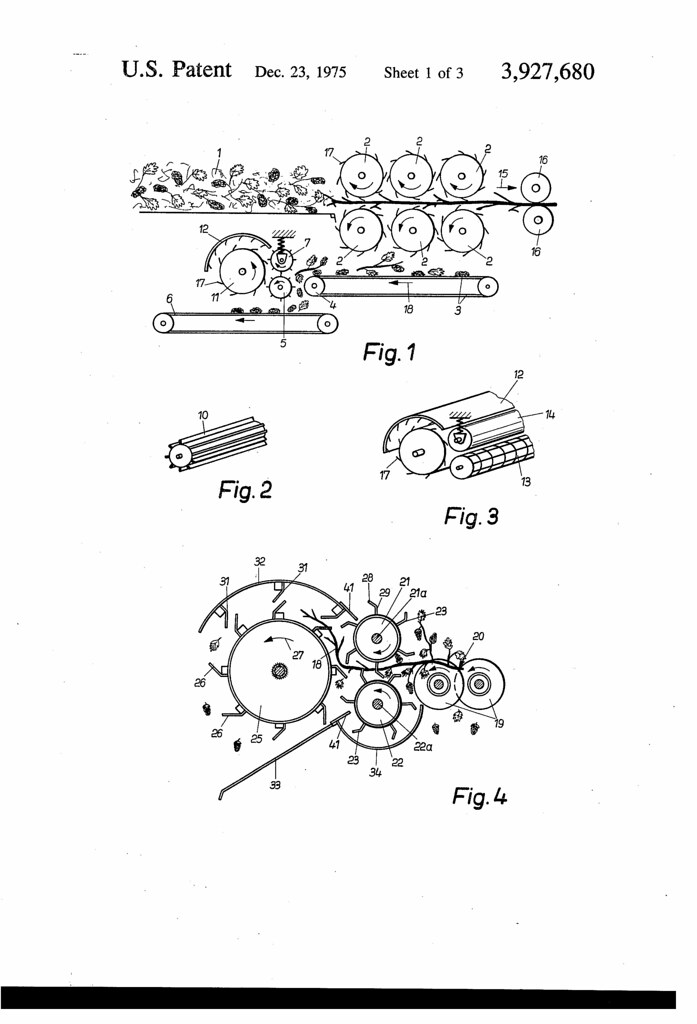
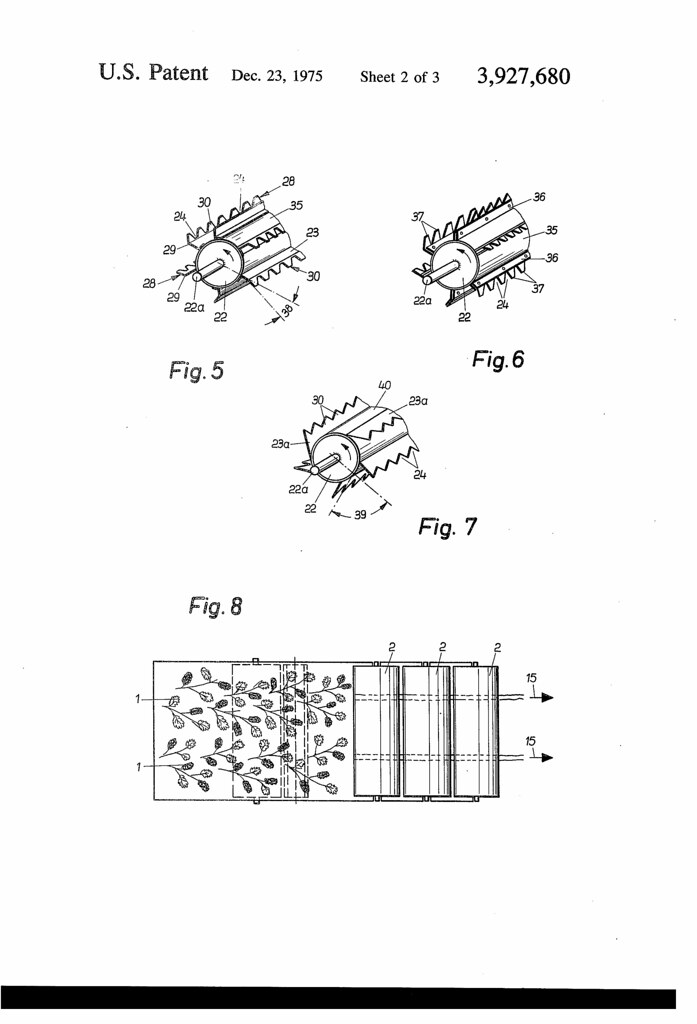
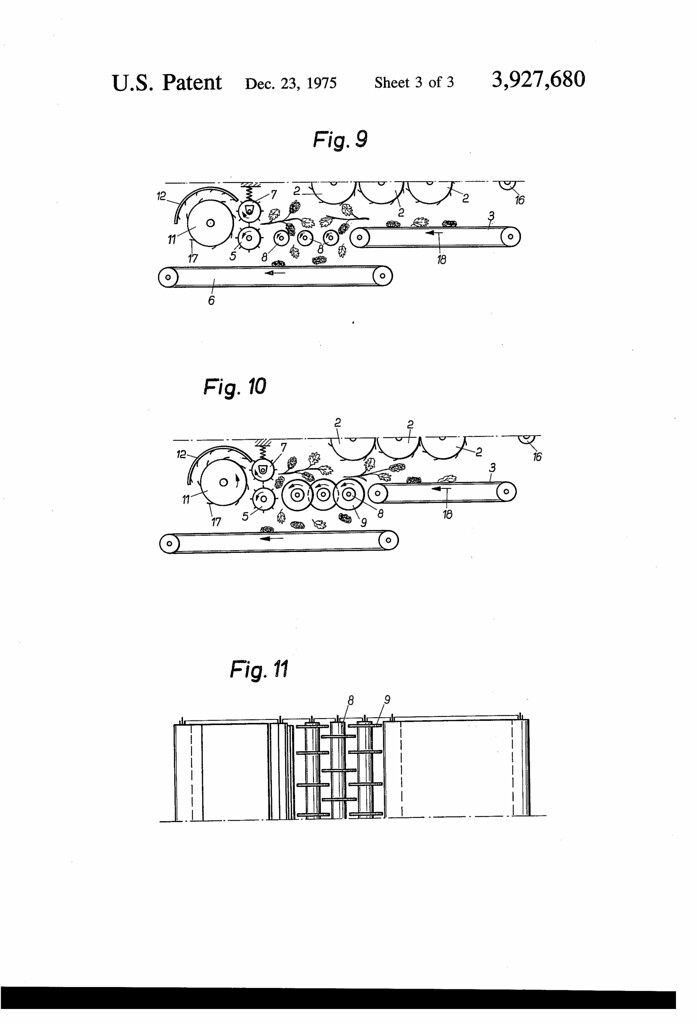
Today in 1975, US Patent 3927680 A was issued, an invention of Hermann Daum and Johann Stefan, for their “Machine For Picking Hops.” Here’s the Abstract:

This invention relates to a hop picking machine and more particularly to a hop picking machine which includes a device for performing a secondary picking operation.

US3927680-1
US3927680-2
US3927680-3

Filed Under: Beers, Just For Fun, Politics & Law, Related Pleasures Tagged With: Brewing Equipment, History, Hops, Law, Patent

Patent No. 2305641A: Method Of And Apparatus For Making Beer

December 22, 2015 By Jay Brooks

patent-logo
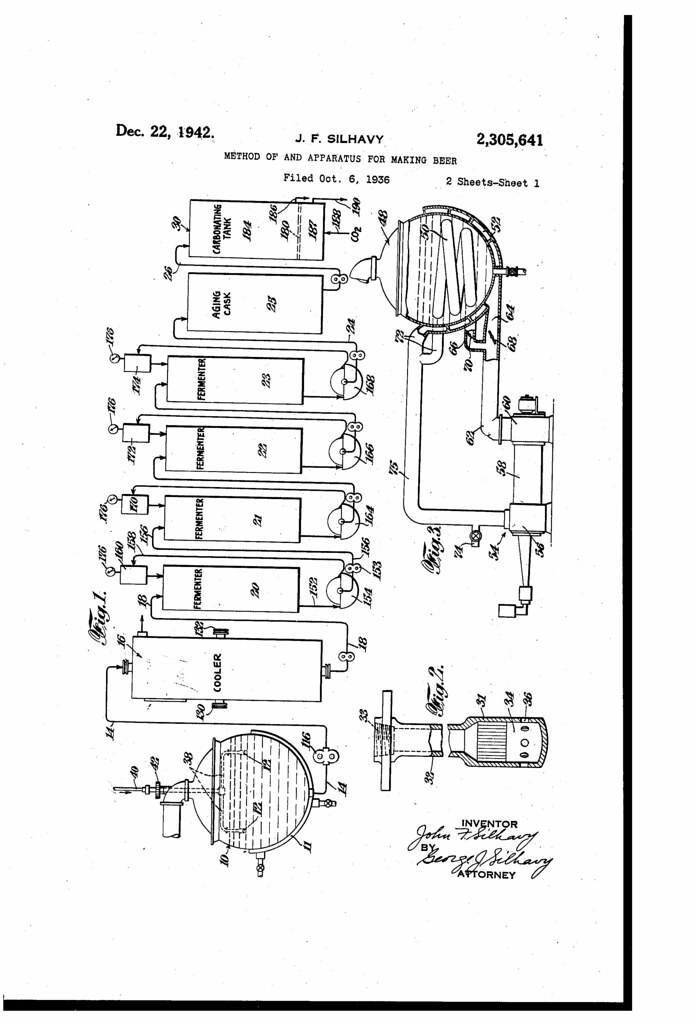
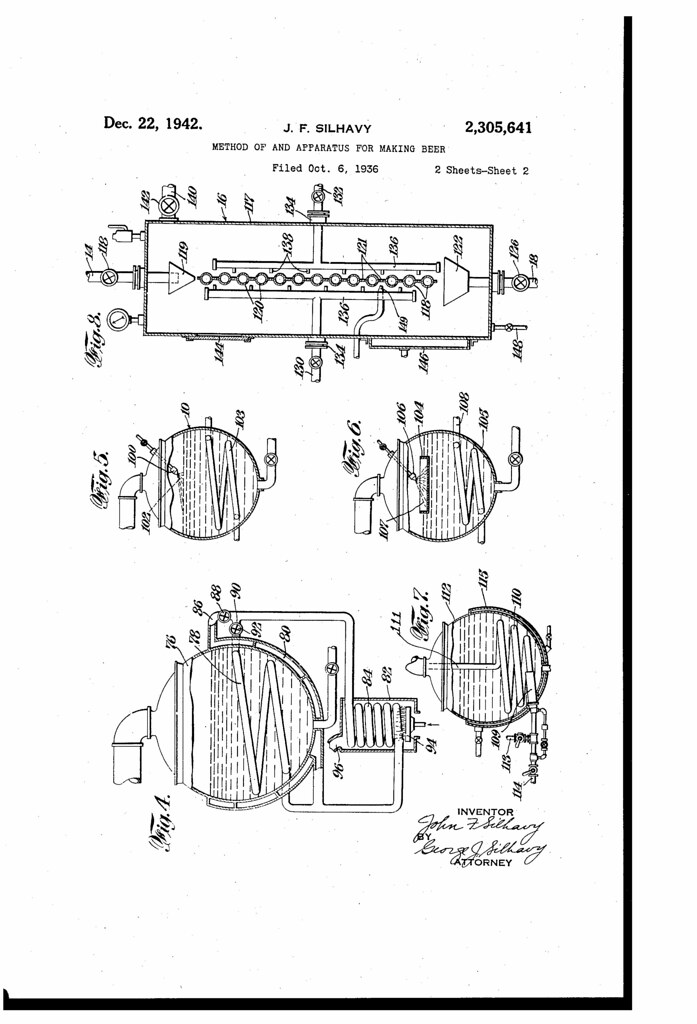
Today in 1942, US Patent 2305641 A was issued, an invention of John F. Silhavy, for his “Method of and Apparatus For Making Beer.” There’s no Abstract, although in the description it includes this summary:

I have invented new methods of and apparatus for heating `and boiling wort in the brew or hop kettle which will be described in connection with My invention is easily adaptable to and can be easily installed in existing kettles. When steam at 25 pounds gage pressure is used as a heating medium in the coil or jacket of a brew kettle, the temperature of the steam is about 265 F. According to my invention I employ heating means and mediums for the brew kettle which range in temperature from about 600 F to about 2000 F so that high’ heating temperatures far beyond those attainable by steam at ordinary pressures are obtained and by this new heating I obtain new and distinct advantages. In my heating systems I use high temperature heating mediums or means which are at a temperature greatly in excess of steam as now used and the wort is contacted with extremely hot surfaces or extremely hot gases. I have shown several ways in which these high and increased temperatures may be obtained but I- am not to be restricted thereto as any heating medium or means which produces high temperature is burned below the surface of the liquid mixture in the brew kettle. In Fig. 2 I have shown a simple form of a burner 3 which can be used but other submerged burners providing submerged combustion with high temperatures can be used. The burner has a tubular portion 32 with a threaded end 33, a combustion chamber 34 and outlet ports 35 for the combustion gases adjacent the combustion chamber. Gaseous fuels are preferably used and such fuels may be mixed with air in stoichiometric proportions in an industrial carburetor or the like and then forced under pressure through the tubular portion 32 and through the burner, being burned in the combustion chamber. By using excess gas a reducing flame is produced and by using excess air an oxidizing flame is obtained. Preferably purified gases such as hydrogen, C2H2 methane, or the like are used. The mixture of fuel and air is burned beneath the surface of the liquid mixture in the brew kettle. The burner may be positioned at any suitable height in the brew kettle but the burner should be placed sufficiently deep in the liquid being heated whereby the combustion gases will give up their heat to the liquid as they bubble through the liquid Wort, and so that the gases of combustion in escaping will not carry off valuable heat. The ideal position of the burner is to have the temperature of the outgoing combustion gases and the wort about the same.

US2305641-0
US2305641-1

Filed Under: Beers, Breweries, Just For Fun, Politics & Law, Related Pleasures Tagged With: Brewing Equipment, History, Law, Patent, Science of Brewing

Patent No. 1121930A: Metal Keg Or Cask

December 22, 2015 By Jay Brooks

patent-logo
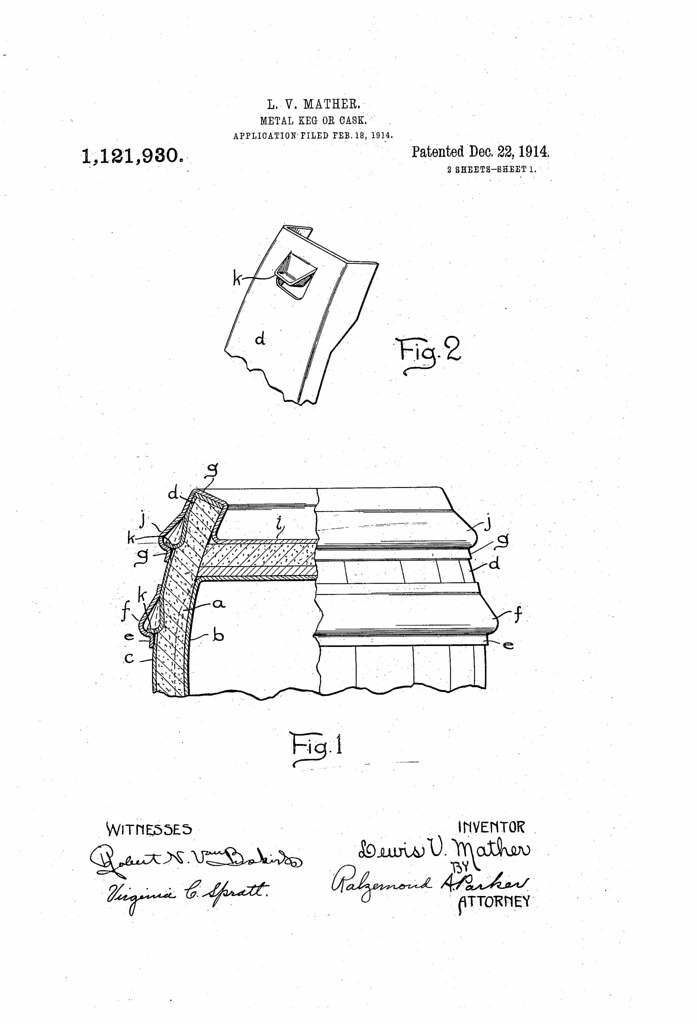
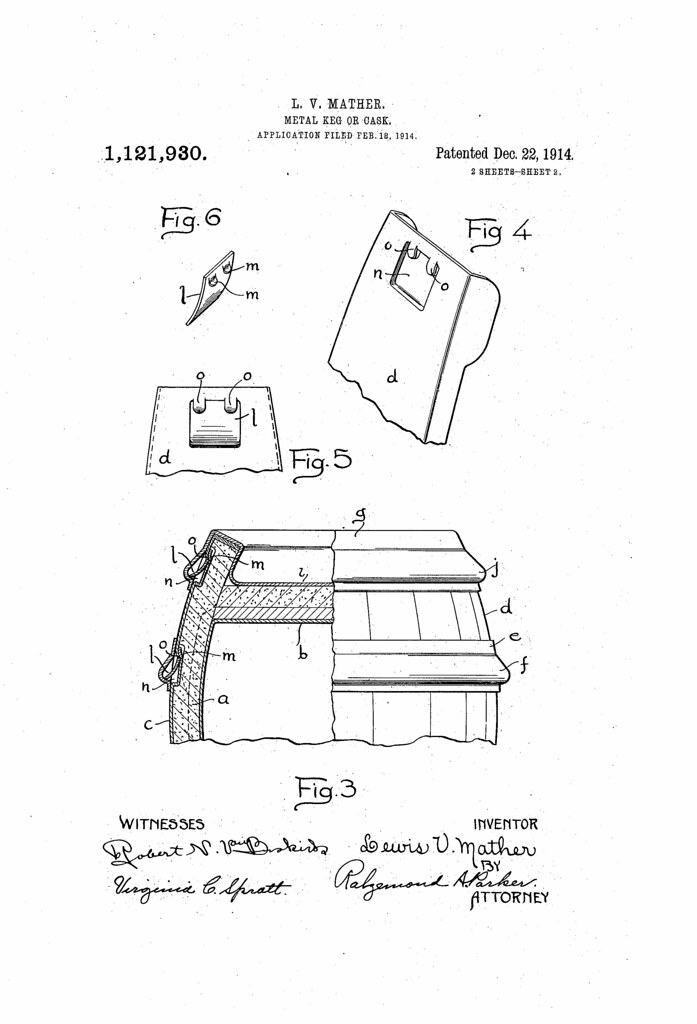
Today in 1914, US Patent 1121930 A was issued, an invention of Lewis V. Mather, assigned to Enameled Steel Package Corp., for his “Metal Keg or Cask.” There’s no Abstract, although in the description it includes this summary:

This invention relates to kegs or casks and has for its object a cask in which the hoops and the head rings are applied to the shell in an improved manner.

This invention consists essentially in the utilization of spring tongues on the shell or staves of the cask which spring out and lock with the hoops and the. head rings when the latter have been slipped into place.

US1121930-0
US1121930-1

Filed Under: Beers, Just For Fun, Politics & Law, Related Pleasures Tagged With: Cask, History, Kegs, Law, Patent

Patent No. 3998761A: Shampoo Compositions Containing Beer Solids

December 21, 2015 By Jay Brooks

patent-logo
Today in 1976, US Patent 3998761 A was issued, an invention of Herbert H. Gary, William Bess, and Frederick Hubner, assigned to the Bristol-Myers Company, for their “Shampoo Compositions Containing Beer Solids.” Here’s the Abstract, along with some additional claims:

Shampoo compositions containing beer solids.

What is claimed is:

1. A shampoo composition suitable for conditioning hair comprising at least one detergent and a waste liquid beer sludge concentrate distributed in an aqueous medium, the beer solids contained in said composition comprising from about 4% to 20% by weight based on the total weight of the shampoo composition and wherein said detergent comprises about 10 to 20% based on the total weight of the composition.

2. A shampoo composition according to claim 1 wherein the beer solids contained in said composition range from about 6% to 9% by weight based on the total weight of the shampoo composition.

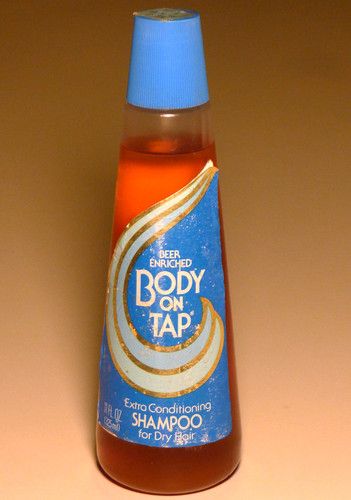
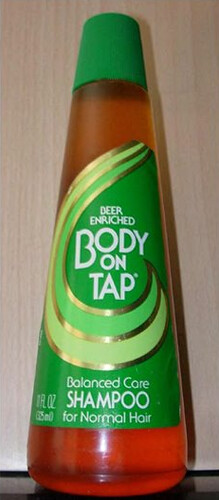
I’m not sure if this is the shampoo that resulted from this patent, but this was sold in the 1970s.

body-on-tap body-on-tap-2

Filed Under: Beers, Just For Fun, Politics & Law, Related Pleasures Tagged With: Health & Beer, History, Law, Patent

Patent No. 3628701A: Tapping Apparatus For Beverage Kegs

December 21, 2015 By Jay Brooks

patent-logo
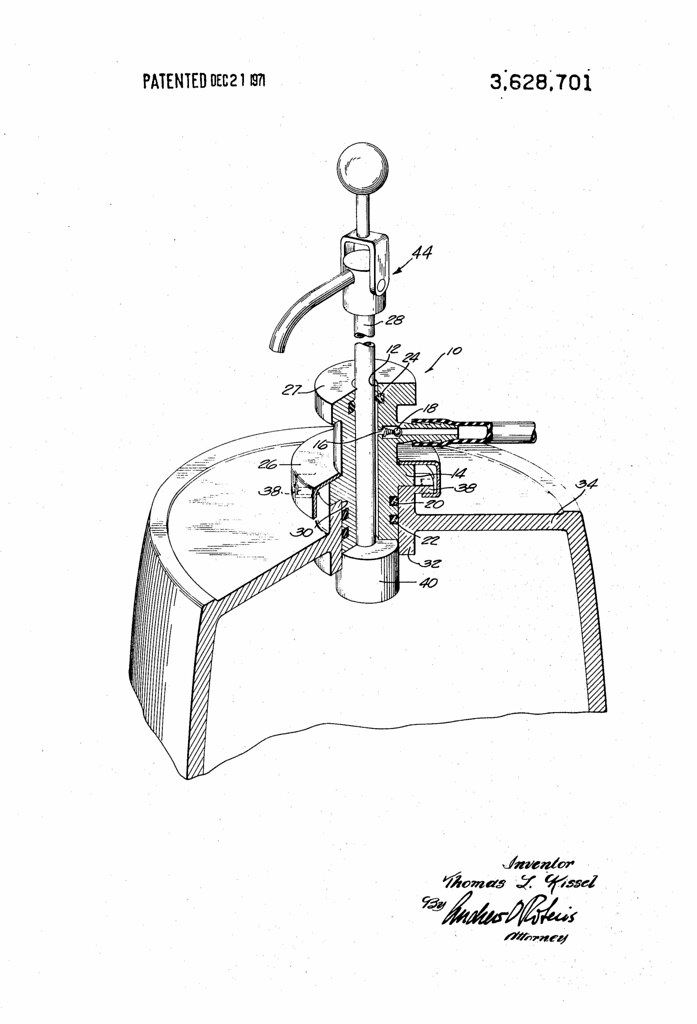
Today in 1971, US Patent 3628701 A was issued, an invention of Thomas L. Kissel, for his “Tapping Apparatus for Beverage Kegs.” There’s no Abstract, although in the description it includes this summary:

The principal object of the present invention is to provide tapping equipment which will not cause any escape of liquid during tapping of the keg.

Another and equally important object is to provide tapping equipment which will be less cumbersome, easier to operate and easier to fabricate than similar equipment used heretofore.

These objects are attained by providing a centrally apertured plug which is pushed into the taphole to partially push the stopper into the keg. The plug has two external O-ring seals which provide a seal between the taphole and the plug. An internal O-ring seal is located in the central aperture and provides a seal between the inside surface of the aperture and I the tap rod as it is inserted into the plug and is pushed downwardly against the stopper. The clearance between the tap rod and the aperture is fairly small, and as the stopper is removed the upward flow of the beverage and released gases is restricted to the narrow passage between the tap rod and aperture sidewall. For this reason, the O-ring seal is sufficient to prevent any beverage spray or leakage, which was encountered with prior commercial taps. The passage is, however, ample to permit a flow of gas under pressure from an entry port below the internal sealing means to the keg to, thus, permit the beverage to be maintained under sufficient pressure for operation of the tap.

US3628701-1

Filed Under: Beers, Just For Fun, Politics & Law, Related Pleasures Tagged With: History, Kegs, Law, Patent

Patent No. 2140816A: Beer Dispenser

December 20, 2015 By Jay Brooks

patent-logo
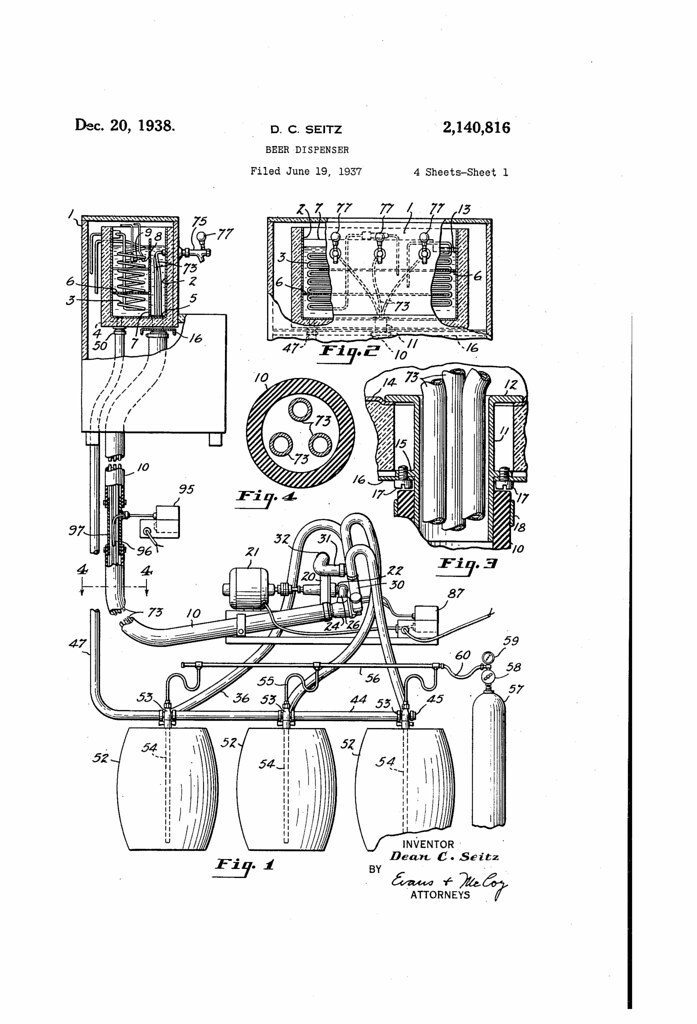
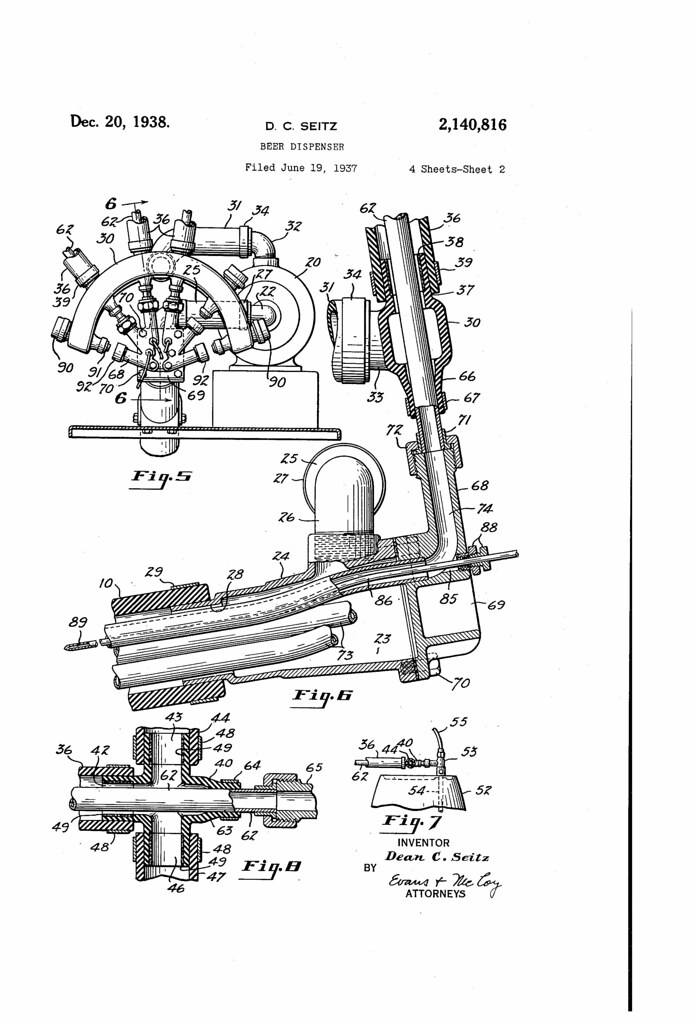
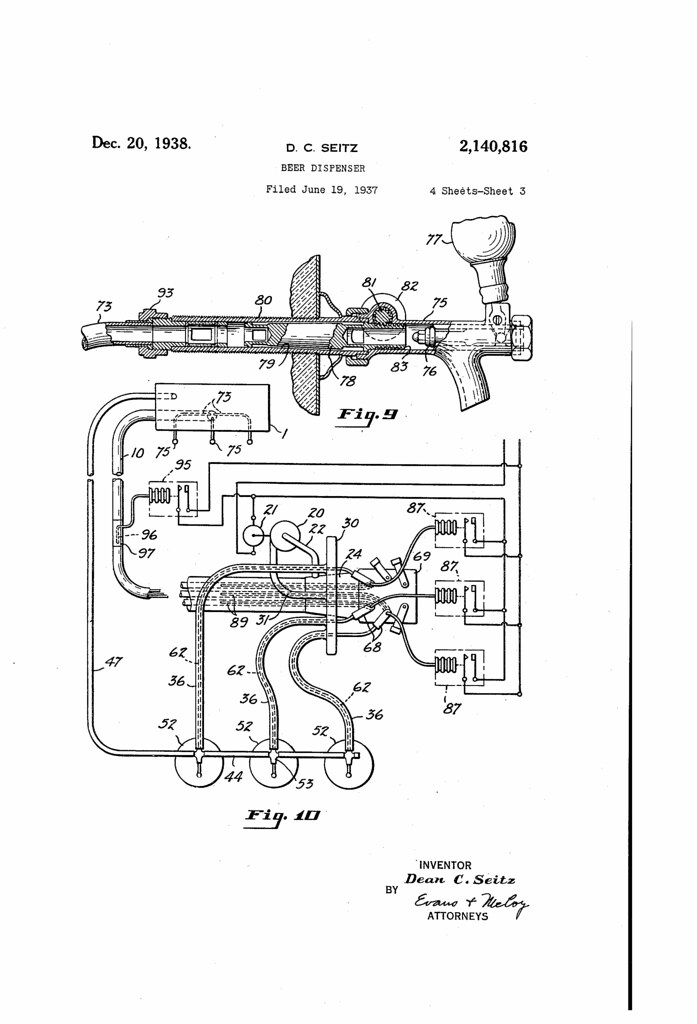
Today in 1938, US Patent 2140816 A was issued, an invention of Dean C. Seitz, for his “Beer Dispenser.” There’s no Abstract, although in the description it includes this summary:

This invention relates to beverage dispensing systems and more particularly to a method and means for dispensing a brewed beverage such as beer. ale and the like.

US2140816-0
US2140816-1
US2140816-2

Filed Under: Beers, Just For Fun, Politics & Law, Related Pleasures Tagged With: History, Kegs, Law, Patent

Patent No. 3293040A: Method For Chill-Proofing Beer With Water Soluble Alkyl Cellulose Ethers

December 20, 2015 By Jay Brooks

patent-logo
Today in 1966, US Patent 3293040 A was issued, an invention of Raymond L. McAdam and Richard G. Shaler Jr., for their “Method for Chill-Proofing Beer with Water Soluble Alkyl Cellulose Ethers.” There’s no Abstract, although in the description it includes this summary:

This invention relates to beer, the treatment thereof during processing, and a novel composition having utility in such treatment and elsewhere. More particularly it relates to a method and composition for the treatment of beer during processing for chill-proofing the beer.

The present invention is in part an improvement in the now conventional method of chill-proofing beer by the addition to the beer of a swelling gelling clay such as hectorite during processing of the beer. In the preferred embodiment the present invention contemplates the combination of a water soluble cellulose ether with the clay. This combination is employed as the clay itself was previously employed. Through the use of the new combination it has been discovered that the chill-proofing properties of the clay are maintained as before but the sludge produced by the clay in the beer is substantially reduced. Also, it appears that the beer is less turbid than when the clay alone is used.

Sludge reduction is desirable since beer is trapped by the sludge and is lost when the sludge is removed. By reducing the sludge level a greater recovery and yield of beer is possible.

Thus the present invention provides an improvement in the method of treating beer with a swelling gelling clay to chill-proof the .beer which comprises adding about .120% with respect to the clay of a water soluble cellulose ether to the beer during the treatment thereof with the clay. The new composition of the present invention may be defined as a swelling gelling clay and about .1- 20% by weight with respect to the clay of a water soluble cellulose ether.

3293040

Filed Under: Beers, Breweries, Just For Fun, Politics & Law, Related Pleasures Tagged With: Brewing Equipment, History, Law, Patent, Science of Brewing

« Previous Page
Next Page »

Find Something

Northern California Breweries

Please consider purchasing my latest book, California Breweries North, available from Amazon, or ask for it at your local bookstore.

Recent Comments

  • Bob Paolino on Beer Birthday: Grant Johnston
  • Gambrinus on Historic Beer Birthday: A.J. Houghton
  • Ernie Dewing on Historic Beer Birthday: Charles William Bergner 
  • Steve 'Pudgy' De Rose on Historic Beer Birthday: Jacob Schmidt
  • Jay Brooks on Beer Birthday: Bill Owens

Recent Posts

  • Beer In Ads #5189: —Here’s To Spring! March 27, 2026
  • Historic Beer Birthday: Ebenezer Beadleston  March 27, 2026
  • Beer In Ads #5188: Drink Bock Beer And You Will Soon Become Eligible To Membership In The “Don’t Worry” Club March 27, 2026
  • Historic Beer Birthday: William Dow March 27, 2026
  • Firestone Walker Brewing To Assume Stewardship Of Trumer Pils In U.S. March 27, 2026

BBB Archives

Feedback

Head Quarter
This site is hosted and maintained by H25Q.dev. Any questions or comments for the webmaster can be directed here.