Brookston Beer Bulletin

Jay R. Brooks on Beer

  • Home
  • About
  • Editorial
  • Birthdays
  • Art & Beer

Socialize

  • Dribbble
  • Email
  • Facebook
  • Flickr
  • GitHub
  • Instagram
  • LinkedIn
  • Pinterest
  • RSS
  • Twitter
  • YouTube

Powered by Genesis

Shattering Myths About Fast Food & “The Good Old Days”

October 8, 2010 By Jay Brooks

comfort-food-wh
Here’s a very interesting piece (shared by Maureen Ogle; thanks Maureen) by Rachel Laudan, and excerpted from the book The Gastronomica Reader. It’s all about the myths of how food used to be in the “good old days” and how many positive improvements to our health and well-being were a direct result of food production and processing becoming more modern and industrialized. The article was reprinted in the Utne Reader as In Praise of Fast Food. It’s pretty thought-provoking.

Laudan concludes with this:

Nostalgia is not what we need. What we need is an ethos that comes to terms with contemporary, industrialized food, not one that dismisses it; an ethos that opens choices for everyone, not one that closes them for many so that a few may enjoy their labor; and an ethos that does not prejudge, but decides case by case when natural is preferable to processed, fresh to preserved, old to new, slow to fast, artisanal to industrial. Such an ethos, and not a timorous Luddism, is what will impel us to create the matchless modern cuisines appropriate to our time.

Filed Under: Food & Beer, Politics & Law, Related Pleasures Tagged With: Food, History, Mythology

Beer Birthday: Craft Beer

October 8, 2010 By Jay Brooks

new-albion-banner
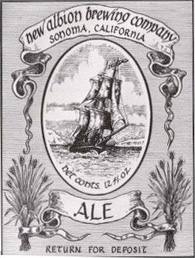
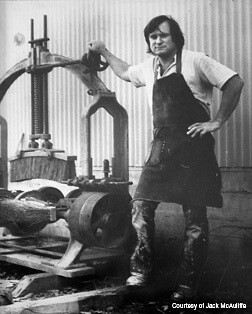
Today is the 34th anniversary of a momentous moment in the short history of craft beer. On October 8, 1976, the New Albion Brewery was incorporated in the State of California. Though the brewery opened in July the following year, it only lasted until 1982 or 83. It was ahead of its time, way ahead. But it was the first small brewery to be built from scratch, mostly by hand, using junkyard parts and old dairy equipment. To me, and many others, that makes it the first modern craft brewery and its legacy should be remembered, revered and celebrated. Its founder, Jack McAuliffe, essentially shied away from the brewing community after 1983, returning to his original profession as an engineer. As a result, few people — except us old-timers and historians — give McAuliffe his due. A lot of young brewers and fans don’t know his name, though that, happily, is changing.

Maureen Ogle managed to track down McAuliffe through his daughter for her book, Ambitious Brew, and in it she gives a great account of New Albion Brewery.

McAuliffe

Sierra Nevada recently lured McAuliffe to Chico to collaborate on a beer for their 30th anniversary. Jack & Ken’s Ale, a black barley wine, came out recently, and that seems to be the beginning of a resurgence or renaissance for Jack McAuliffe. He’s back in the public eye, and people are writing once more about his lasting impact on the craft beer industry. Here are a few places he’s been mentioned:

  • John Holl had a great piece he did for CraftBeer.com, New Albion Brewing.
  • Eric Braun in the San Antonio Express-News, McAuliffe’s new home, wrote Jack McAuliffe is Namesake of Commemorative Sierra Nevada Beer.
  • Greg Kitsock in the Washington Post writes The father of craft brewing comes out of retirement.

Then there’s The birthday of craft beer, written by me for my newspaper column. It was supposed to run this Wednesday but got bumped to next week, which happens occasionally. But it did go online this week, in time to raise a toast tonight

My idea is to designate today as the “birthday of craft beer,” a holiday to celebrate New Albion Brewery, Jack McAuliffe and the thousands of small breweries that followed to create the beer landscape we all enjoy today. Working with the California Small Brewers Association, we’re going to petition the state to recognize October 8, 2011 in some fashion as the 35th anniversary and the birthday of craft beer. If you’d like to help that effort, drop me a line and when we have a better idea what needs to happen, I’ll reach out to you. For now, today is the 34th anniversary, and the birthday of craft beer, so join me in raising a glass to Jack McAuliffe, New Albion Brewery and all the great beer that’s flowed since 1976. Happy birthday craft beer.

new-albion-ale

Here’s one of the original New Albion labels. The original sign from the New Albion Brewery now hangs on the wall at Russian River Brewing in Santa Rosa. Stop by and see it anytime you like. To see what New Albion looked like, check out breweriana collector Jess Kidden’s page on New Albion Brewing, where he’s reproduced two articles that appeared in Brewer’s Digest in 1979 and 80.

Filed Under: Birthdays, Breweries Tagged With: California, History, Northern California

Beer In Ads #211: Budweiser Through A Glass Lightly

October 7, 2010 By Jay Brooks

ad-billboard
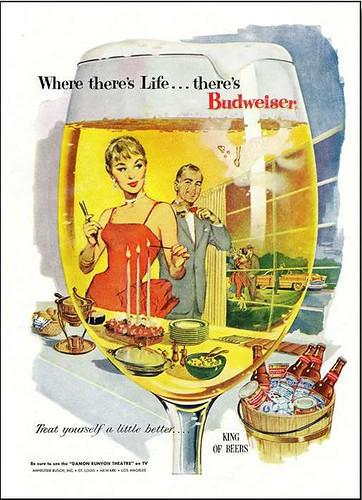
Thursday’s ad is for Budweiser, from 1956. It’s part of their “Where There’s Life … there’s Budweiser” campaign and features a great illustration of a dinner party scene through a glass of beer.

Bud-1956

Filed Under: Art & Beer, Beers Tagged With: Advertising, Budweiser, History

The Celebrator’s Conversation With Ken Grossman

October 7, 2010 By Jay Brooks

sierra-nevada
Tom Dalldorf did a great interview with Ken Grossman of Sierra Nevada Brewing for the most recent issue of the Celebrator Beer News. The new issue features part of the interview and also Grossman on the cover for Sierra Nevada’s 30th anniversary this year.

2010_ken_grossman

The entire interview is just under 30 minutes and was done last month in Chico. Enjoy.

A Conversation with Ken Grossman from Wing and Wing Productions on Vimeo.

Filed Under: Breweries, Just For Fun Tagged With: California, Interview, Northern California, Video

Beer In Ads #210: The Taste Buds

October 6, 2010 By Jay Brooks

ad-billboard
Wednesday’s ad is for Budweiser, from 1979. The “Taste Buds” ad campaign was one of the goofiest ones they ever did. It didn’t last very long, but it sticks out in my memory, for whatever that’s worth. This is a print ad for the campaign, but it was really the television ads where its complete goofiness came out. So below this I’ve included two of those.

Bud-1979-tastebuds

A 1979 Budweiser “Taste Buds” Ad:

And Another One with Pizza:

Filed Under: Art & Beer, Beers, Just For Fun Tagged With: Advertising, Budweiser, History, Humor, Video

Son of Binge Drinking Statistics Inconsistencies

October 6, 2010 By Jay Brooks

binge-modern
If you read my previous post about Inflating Binge Drinking Statistics, you’ve seen how data can be manipulated and essentially bent to any purpose. Today a second news item in U.S. News & World Report, 1 in 4 U.S. Teens and Young Adults Binge Drink, presents yet another portrait of reality using binge drinking data from the CDC.

This one focused more on underage drinking, declaring that 1 in 4 U.S. teens and young adults are binge drinkers. According to CDC director Dr. Thomas R. Frieden, “[n]inety percent of the alcohol consumed by high school students is consumed in the course of binge drinking.” Frieden goes on to say that “[a]mong drinkers, one-third of adults and two-thirds of high school kids binge drink, but doesn’t that contradict the 1 in 4 statistic and the 90% declaration? Which is it: 25%, 66% or 90%?

Beyond the fuzzy math, that high school students binge drink is a bit of a duh statistic, they don’t exactly have much choice under the circumstances. That’s because all underage drinking is done underground, none of it is out in the open. So any time they do get a chance to drink it’s without supervision. And that’s a direct result of the minimum age being 21 instead of 18 and also because not only is education not available, but is even considered criminal in some states. It was not unusual when I was a teenager for parties where alcohol was served to be chaperoned by parents with the full knowledge of other parents, too. Today, that would be cause in many places for arrests and jail time. But as a result of adult supervision, I never witnessed any problems at those parties and they were very safe. But thanks to zealotry and a no tolerance policy such safe environments are now impossible.

Another discrepancy is that in the U.S. News & World Report, the CDC claims that “more than 33 million adults have reported binge drinking in the past year.” That’s in contrast to the NPR story, in which the CDC claims that “half of all alcohol consumed by adults in the US is binge drinking.” Then on the CDC’s website there’s a map of the U.S. showing binge drinking averages by state, with the lowest state being Tennessee (with 6.8%) and the highest being Wisconsin (23.9%).

Filed Under: Beers, Editorial, News, Politics & Law Tagged With: Health & Beer, Prohibitionists, Science, Statistics

Inflating Binge Drinking Statistics

October 6, 2010 By Jay Brooks

binge-barney
The biggest problem with binge drinking statistics is that the definition keeps changing. Over the last few decades it’s gone from somewhat vague to an increasingly narrow definition. Each change in the definition increases the number of binge drinkers. It’s not that more people are binge drinking necessarily, but that more people fall under the definition as they lower it and lower it.

At the bottom of an NPR story, Binge Drinking: A Big Problem, Especially For The Prosperous, there’s a strange little video about binge drinking put together by the CDC. In it, they reveal some disturbing ways of looking at what it means to binge drink.

The most recent way our government defines binge drinking is “[f]our or more drinks within a few hours for a woman and five or more for a man.” That actually narrows yet again, as recently as the last few years it’s been “five or more drinks in a row,” which tends to imply more speed. Adding “within a few hours” means even drinking at a leisurely pace makes you a binge drinker. I wrote more about this shift last year in a post, Inventing Binge Drinking.

The CDC video further claims that “half of all alcohol consumed by adults in the US is binge drinking.” Wow, that’s pretty remarkable, especially if you consider that according to the DOJ only 54% of adults drink alcohol. We’re now a nation of binge drinkers. You’d think a society where 1 in 2 people drinking is on a bender would be more noticeable. But look out your door or window and unless there’s a car alarm going off, it’s more likely you’ll hear crickets and birds chirping, not the devastation implied by that alarming factoid.

They also claim “1.5 billion episodes of binge drinking” take place each year in the U.S. That’s 5 for every man, woman and child in the country, or 6.25 times for every adult. If we assume the DOJ’s statistic that 46% of adults don’t drink alcohol, then that’s 11.6 for every adult who does imbibe, or nearly once a month. That’s a lot of benders. Or is it? Is having five drinks less than once a month really an alarming societal problem? I go to a beer dinner probably at least once a month and most are at least five courses. That makes me a binge drinker, but I’m hardly a danger to society because of it. Clearly, for some individuals persistent binge drinking is a serious problem, but the people who fall into that category represent a very small minority of all drinkers.

Toward the end of the NPR article, they have this to add.

The problem, though bad, isn’t a lot worse than it used to be. In 1993, the CDC says, about 14 percent of adults had gone on drinking binges. But as Dr. Thomas Frieden, head of the CDC put it, “Because binge drinking is not recognized as a problem, it has not decreased in 15 years.”

That’s a pretty glaring inconsistency. On one hand, the CDC claims that “half of all alcohol consumed by adults in the US is binge drinking” but only “14 percent of adults had gone on drinking binges.” But my favorite howler is the statement that “binge drinking is not recognized as a problem.” What planet is he living on, because neo-prohibitionists and the health, university and government research communities, not to mention all the treatment and addiction businesses that stand to make more money if the problem keeps increasing, have been screaming about the perils of binge drinking as long as I’ve been an adult, and probably longer. And the hue and cry has only increased in recent decades. But this just serves to prove that binge drinkers aren’t born, they’re created … by statistics.

But wait, it gets worse. According to the CDC video, the NIAAA now defines binge drinking as “consumption that raises blood-alcohol content to .08%.” That’s right folks “binge drinking” and being “drunk” are now exactly the same! Then they go on to say that binge drinkers are “14 times more likely to drive drunk.” Duh, if you define binge drinking as getting drunk, then that’s a self-fulfilling statistic, isn’t it? But it’s pretty alarming that a government agency’s standard for binge drinking is simply drinking enough to raise your BAC to 0.08%.

Other interesting tidbits include that statistic that 70% of binge drinkers are 26 or older and that 80% of binge drinkers are not alcoholics. Of course they’re not alcoholics if all they have to do to binge drink is get drunk once. And if most are legal adults, why the insistence later in the video to maintain 21 as the minimum age of consumption?

Naturally, they propose all the same old chestnuts to “fix” the problems they just created by inflating the statistics. Nothing new is ever proposed. Of course, none of the proposals ever work, either, wherever they’ve been implemented. Here’s the CDC recommendations.

  1. Increase alcohol taxes
  2. Close places that sell alcohol, reducing their number
  3. Close the remaining outlets earlier
  4. Enforce the laws that prohibit underage drinking

But by continually widening the net and artificially adding to the number of people that are considered binge drinkers, it lessens the chances of actually helping the people who truly do need help. All they do is increasingly demonize alcohol manufacturers and criminalize law-abiding people. It’s as if all of the organizations that are anti-alcohol or who make their money from addiction, be it through treatment, medications or whatever, need to keep the issue a dangerous one and have to keep it just bad enough so the money keeps flowing. So it becomes a game of creating the perception of effectiveness while the problem remains perpetually, and conveniently, elusive.

Filed Under: Beers, Editorial, Politics & Law Tagged With: Health & Beer, Prohibitionists, Science, Statistics, Video

Biting the Hand That Feeds You

October 6, 2010 By Jay Brooks

ribbon-pink
This has has me seriously steaming mad. As you may know, October is Breast Cancer Awareness Month. The brewing community, particularly locally, has done much to help that cause and raise money for breast cancer research and treatment. Marin Brewing has been putting on the Breastfest for ten years now, and the annual beer festival was specifically created to benefit breast cancer awareness. As a side note, Marin County inexplicably has one of the highest rates of breast cancer in the country.

Natalie Cilurzo, co-owner of Russian River Brewing in Santa Rosa, goes all out every October with their All Hopped Up For the Cure campaign to raise money for the cause. For the last few years, they’ve decorated the brewpub in pink and auctioned a pink Vespa. It’s a cause that’s very personal to her and she spends a lot of time and energy on it every year.

rr-ribbon

That’s just the Bay Area. In Atlanta, there’s a Beer 4 Boobs beer festival. There are similar breast cancer charity events at breweries and in the form of beer festivals all over the country. Boulder, Colorado has one at Boulder Beer Co. and the Lost Abbey in San Diego sponsored an event along with White Labs. The Ladies of Craft Beer also held a “Beer for Boobs Brunch” at Denver’s Freshcraft restaurant. And that’s probably the tip of the proverbial iceberg.

My own mother died from breast cancer when I was only 22, nearly thirty years ago. I’ve lived virtually my entire adult life without the comfort and counsel of my mother so it’s pretty personal to me, as well. As a result, I’m quite proud that the brewing community is so supportive of a cause that’s near and dear to me and many of my friends.

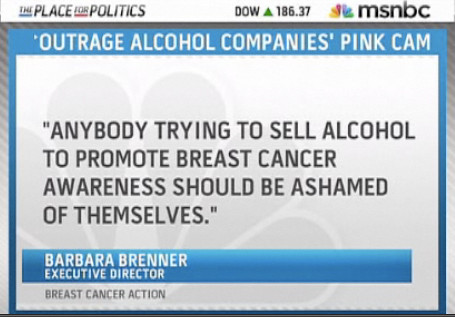
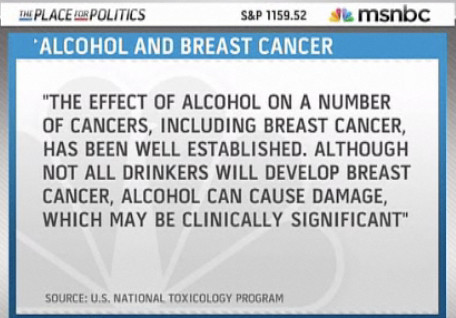
But apparently I shouldn’t be proud of that. In fact I should be ashamed of it. That’s what Angela Wall of Breast Cancer Action in San Francisco said on MSNBC yesterday. And it wasn’t just an offhand remark, it was the considered position of her organization. They even put up a prepared graphic with the same quote, but from Executive Director Barbara Brenner telling me a second time how ashamed I should be that the brewing community might try to help her cause.

breast-cancer-2

This reminds me a bit of when Anheuser-Busch put water in plain white beer cans with only their logo and where the water came from and then sent them to Haiti to help with earthquake relief. The Marin Institute had the temerity to chastise them in a press release for putting their logo on the cans and, wait for it, sending out a press release about it. I wrote all about that in Let No Good Deed Go Unpunished.

This is the same thing. But there’s a couple of ways to look at her problem with alcohol companies raising money for breast cancer. First — for purposes of discussion — let’s assume that alcohol does indeed cause breast cancer. The Marin Institute has this hokey idea of “charge for harm” where they believe that whatever “harm” is caused by people drinking alcohol should have to be paid for by the companies who make it. It’s a specious argument, but again — just to talk about it — let’s say that they’re right. Wouldn’t the industry actually paying money for their supposed harm be a good thing, exactly what their critics think they should be doing? That they’re raising money for breast cancer should be seen as a good thing, shouldn’t it? If they think the alcohol industry is causing the problem, then this should be exactly what the industry should do. But they don’t, do they? They think the industry shouldn’t be doing that, and they think they shouldn’t be trying to make a profit either.

Wall claims that “trying to sell alcohol to promote breast cancer awareness” is “shameful” because alcohol also carries a risk of breast cancer. But that makes no sense. Does she think for that reason alone, alcohol companies should simply just go out of business and stop making their products? Obviously, that would harm the economy and put thousands out of work. And of course, not everyone who drinks will get breast cancer. So presumably she’d prefer that the alcohol companies simply not raise money for her cause, but that seems counter-intuitive since it’s money that funds research into finding a cure for breast cancer. But since no one’s going to stop making alcohol just on her say so, I honestly don’t understand why she’d turn down money that might actually help find a cure if it didn’t come from the “right” source.

I would very much want there to be a cure for breast cancer found, if for no grander reason than I hope no one else has to go through losing their mother at a young age. I’m sure many people feel that way, and a number of them probably also work in the alcohol field. Some of them are my friends. But here Wall is telling me we should be ashamed of feeling that way because we work in the alcohol industry. I have to say, that pisses me off but good. I don’t think I’ve ever felt so conflicted about wanting to help a cause but feeling deeply offended and insulted by some of the people and organizations involved in it.

But perhaps the most telling part of the interview was when the MSNBC reporter remarked that one alcohol company had donated $500,000 to breast cancer awareness causes and then she asked a simple, direct question of Wall. “Do you think that money should be given back?” Wall hems and haws, but refuses to give a yes or no answer, indeed never really even addresses the question. Clearly, she’s not giving the money back. But the brewing industry, we’re the hypocrites?

On a post at their Think Before You Pink blog about this MSNBC appearance, they state that “[w]hile we do believe that the media focuses too heavily on lifestyle (diet and exercise, for example) in discussion of breast cancer risk, it’s irresponsible for companies to encourage people to ‘drink year round for breast cancer.'” So what Breast Cancer Action is saying is that they don’t like the media or how it covers breast cancer, but they’re still willing to use it when it suits them by appearing on it to further their agenda and get their message out. So I ask again, it’s the alcohol industry who’s being hypocritical by raising money for breast cancer?

One other quite strange argument made by Angela Wall for why alcohol companies should not be raising money for breast cancer was that it was no longer necessary. She said. “I don’t think anybody in this country is unaware of breast cancer in this month.” Oh, really? I guess we’re done with this issue, no more awareness or money is needed, the fight is over. Good job everybody, you can go home now. Of course, then why bother to keep designating October as Breast Cancer Awareness Month? If their work is done, why bother? You get the feeling she really hates us, if she’d go so far as to try and convince people that whatever money we raise isn’t even necessary. But I guess we should be getting used to that. Being in the alcohol industry is increasingly like being the fat kid at model camp. Everyone feels like they can make fun of us and attack us because, you know, we’re fat after all.

breast-cancer-1

The basis for Breast Cancer Action’s outrage is the results of one new study in the Journal of Clinical Oncology that “found drinking alcoholic beverages, including wine, beer and liquor, may increase risk of breast cancer recurrence, particularly among postmenopausal and overweight and/or obese women.” That’s as reported in a story in Food Consumer, which also cherry picks a few other studies which show similar risks. But that’s not exactly the whole story nor is this exactly as settled as they’d like you to believe, not by a long shot. While studies do indeed appear to show an increased risk of breast cancer in women, at least one done by Kaiser Permanente shows that it’s the amount that matters, the higher the intake the greater the risk, meaning moderate drinking has less risk.

Still others show just the opposite. For example, a 2008 study at the Universidade do Porto, Porto, Portugal showed that Compounds in Beer and Wine Slow Breast Cancer Cell Growth. Still another suggests that “xanthohumol found in hops [has] the potential to lower the risk of prostate cancer, [and] researchers believe it could also reduce breast cancer risk in a similar manner — by binding to the receptors on breast cancer cells and blocking the effects of estrogen which stimulates the growth of certain types of breast cancer.” That’s about the discovery that xanthohumol is a Cancer-fighting agent found in beer.

In a fact sheet about the relationship between Alcohol and the Risk of Breast Cancer at Cornell University, there’s this sage advice:

Researchers have reported that women who consume light to moderate amounts of alcohol have a decreased risk of developing and dying from cardiovascular disease. Since more women are affected by and may die from cardiovascular diseases than breast cancer, the recommendations regarding alcohol and breast cancer may seem to contradict the reports regarding cardiovascular disease. The 1996 Guidelines on Diet, Nutrition and Cancer Prevention from the American Cancer Society suggest that most adults can drink, but they should limit their intake. Given the complex relationship between alcohol consumption and different diseases, any recommendations should be based on information about all health risks and benefits.

Exactly. Of course women should make individual decisions based upon their family history and/or other personal factors, but making a pronouncement for everyone is wrong. The overall positive effects of moderate alcohol consumption have to be weighed against individual risk factors. For example, total mortality is effected positively by moderate alcohol consumption, that is numerous studies and meta-studies have shown that people who drink in moderation will most likely live longer than people who abstain completely or who regularly binge drink. And that’s taking into account both the negative and positive risks and rewards.

So the Breast Cancer Action’s outrage seems to avoid looking at the big picture and instead focuses all it’s enmity at one individual study. I’m not saying it shouldn’t be concerned by that study, but to not factor in any other and to use that to shout at organizations trying to help their cause is unbelievably obnoxious and off-putting.

Wall also claims that alcohol represents the “only proven link between food and breast cancer.” Hmm, let’s break that down. That’s a pretty declarative statement for something as complex as the relationship between cancer and alcohol and how the body processes it. That there are studies that seem to show an increased risk of breast cancer and others which show just the opposite suggests that a definite link has hardly been “proven.” But perhaps more annoying is her saying that it’s the only food that increases the risk of breast cancer. Dietary fat also appears to be linked. “International findings suggest that breast cancer rates are minimal in countries where the standard diet is low in fat (particularly animal fat). It is known that fat cells play a role in estrogen production, especially in postmenopausal women. Therefore, being overweight may contribute to risky estrogen exposure in such individuals.” According to WebMD:

The link between diet and breast cancer is debated. Obesity is a noteworthy risk factor, and drinking alcohol regularly — more than a couple of drinks a day — may promote the disease. Many studies have shown that women whose diets are high in fat are more likely to get the disease. Researchers suspect that if a woman lowers her daily calories from fat — to less than 20%-30% — her diet may help protect her from developing breast cancer.

So if being obese puts you at risk for breast cancer and eating food is what causes you to become obese, I’d say that food played a pretty direct role there. And let’s not forget that earlier this year, Breast Cancer Action similarly chastised one of their own, Susan G. Komen For the Cure, for partnering with KFC in “Buckets For the Cure.” Characterizing themselves as “the respected watchdog of the breast cancer movement,” one of their problems with the KFC partnership was that it exploited “breast cancer and [would] do the most harm in low income communities that are already disproportionately affected by health issues like obesity and diabetes, as well as breast cancer.” They went all out against them on their Think Before You Pink blog. Maybe not a direct reference to food, but they’re certainly linking food, obesity and breast cancer with KFC’s new pinkwashing campaign to “raise money for breast cancer” is half-cooked!

KFC-pink-bucket

Obviously, this story really pushed my buttons. Breast Cancer Action essentially is trying to invalidate the hard work of friends of mine who are sincerely trying to help find a cure for breast cancer and who have raised a lot of money in support of that cause. More than that, they’ve insulted those people for their sincere efforts. Quite frankly, I think they should be ashamed of themselves.

You can watch the entire story for yourself from MSNBC below.

Some Additional Thoughts: Since this post went online a few days ago, I was actually surprised to see that a lot of people shared my anger and frustration over this and similar experiences people have had. After reading the comments along with some experiences I’ve had with other charities, I’m really starting to believe that there’s now a “charitable industrial complex,” that these behemoth charities have become big business in their own right. And from what some of you have written, and from what I’ve seen, it appears that, like many big corporations, much of the profits go to the people who run them and only a little goes to shareholders, or in this case to the actual charitable cause itself. They seem to have become more about the money than the well-intentioned passion to do something about an issue that led to their formation. That’s a deeply disturbing trend.

Second, another thought occurred to me about how Breast Cancer Action was wrong to insult the alcohol community for their efforts. In the video from MSNBC, the piece opens by singling out Mike’s Hard Lemonade and Chambord for having programs designed to benefit breast cancer awareness. But what they didn’t ask was why? There are lots of worthy causes any company could choose to support. It’s possible it was just a calculated decision to ensnare more female drinkers, but there could be another, more personal, reason, too. All of the people in the brewing industry I know who do a lot for breast cancer, do so because breast cancer has touched their loves at some point. That’s why I’m passionate about the cause, and I suspect that that’s not an uncommon feeling. So it’s at least possible, I’d say even plausible, that Chambord decided to support breast cancer awareness because someone in the company or someone close to the company had breast cancer or knew someone who did. With so many available causes, people tend to pick the one that’s personal to them. My family tends to support Autism charities for the simple reason that our son Porter is autistic. I’d say that’s a pretty typical response. I’d be willing to say most charities are supported by the people who have been effected most by the diseases or issues at the heart of any particular charity.

According to the American Cancer Society, “[b]reast cancer is the most common cancer among women in the United States, other than skin cancer. It is the second leading cause of cancer death in women, after lung cancer. The chance of a woman having invasive breast cancer some time during her life is a little less 1 in 8. The chance of dying from breast cancer is about 1 in 35.” So that’s a lot of people and suggests that a large percentage of the population have been touched by breast cancer, either directly or indirectly. So I think it’s entirely likely that Chambord may have started their breast cancer awareness campaign precisely because someone in the company had an experience with breast cancer and wanted to do something about it. Perhaps it was to honor a loved one’s memory or perhaps to celebrate a survivor. We don’t know because Breast Cancer Action didn’t even bother to ask before lashing out at them for trying to do a good deed. As far as I can tell, they just assumed an evil intent but never asked the simple question “why.” My guess is they don’t actually care what the answer is, and asking it may have stopped their own quest for attention and publicity and donations.

Filed Under: Beers, Editorial, News, Politics & Law Tagged With: Charity, Prohibitionists, Video

Beer In Ads #209: Pilsner Urquell, Pilsner I

October 5, 2010 By Jay Brooks

ad-billboard
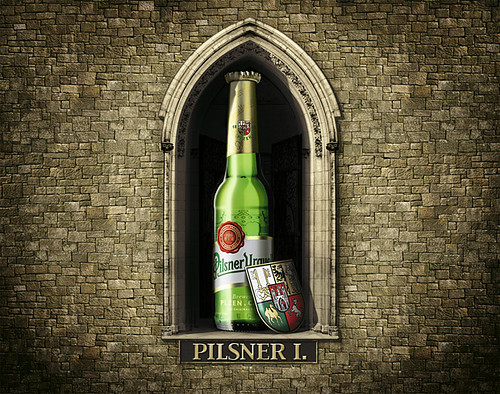
Tuesday’s ad is for Pilsner Urquel, because today is “Pilsner Day.” That’s because it was today in 1842 that the Citizen Brewery in Plzen, Bohemia — in what today is the Czech Republic — first brewed Pilsner Urquell, the world’s first pilsner. The ad is fairly recent, but plays on the beer’s heritage as a noble beer, Pilsner I, or Pilsner the First. And it’s just beautiful.

pils-ur-4

Filed Under: Art & Beer, Beers Tagged With: Advertising, Czech Republic, History

Mayor’s Veto Stands, No SF Alcohol Tax For Now

October 5, 2010 By Jay Brooks

san-francisco
After San Francisco Supervisor John Avalos asked for a week’s postponement, his attempt to override Mayor Gavin Newsom’s veto of the proposed ordinance imposing an alcohol tax in the city failed today. The Chronicle is reporting that, as many expected, Avalos was unable to find the vote he needed to override Newsom’s veto two weeks ago.

In the last two weeks Avalos has spent his time on more political gamesmanship, questioning the mayor’s right to veto, despite the question having been answered by the court in 1986. No word yet whether he’ll now take the vote to the people, something he claimed to be considering after the mayor’s veto. Only time will tell, but I doubt we’ve heard the last of this issue. This sure is one dead horse, but I’m sure he’ll find a way to keep beating it.

Filed Under: Breweries, Editorial, News, Politics & Law Tagged With: California, Prohibitionists, San Francisco, Taxes

« Previous Page
Next Page »

Find Something

Northern California Breweries

Please consider purchasing my latest book, California Breweries North, available from Amazon, or ask for it at your local bookstore.

Recent Comments

  • Bob Paolino on Beer Birthday: Grant Johnston
  • Gambrinus on Historic Beer Birthday: A.J. Houghton
  • Ernie Dewing on Historic Beer Birthday: Charles William Bergner 
  • Steve 'Pudgy' De Rose on Historic Beer Birthday: Jacob Schmidt
  • Jay Brooks on Beer Birthday: Bill Owens

Recent Posts

  • Beer In Ads #5222: O’Keefe’s Bock Beer April 15, 2026
  • Historic Beer Birthday: George Schmitt April 14, 2026
  • Beer In Ads #5221: Bowler Brothers’ Bock April 14, 2026
  • Historic Beer Birthday: George W. Bashford April 14, 2026
  • Beer In Ads #5220: Hello People! I Am The Centlivre Bock Beer Goat April 13, 2026

BBB Archives

Feedback

Head Quarter
This site is hosted and maintained by H25Q.dev. Any questions or comments for the webmaster can be directed here.