
Wednesday’s ad is an early ad for Ballantine, one of the first to use their iconic three-rings of “body,” “purity” and “flavor.” Unfortunately, it also features an ugly, frightening clown — but then I hate clowns.


Wednesday’s ad is an early ad for Ballantine, one of the first to use their iconic three-rings of “body,” “purity” and “flavor.” Unfortunately, it also features an ugly, frightening clown — but then I hate clowns.
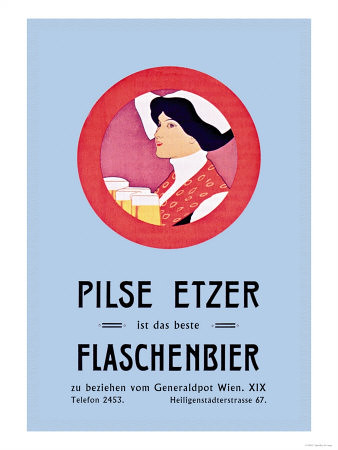
Tuesday’s ad is for a German brewery — I think — Pilse Etzer, so it says, is the best bottled beer. The woman in the red circle, however, looks like Dutch.
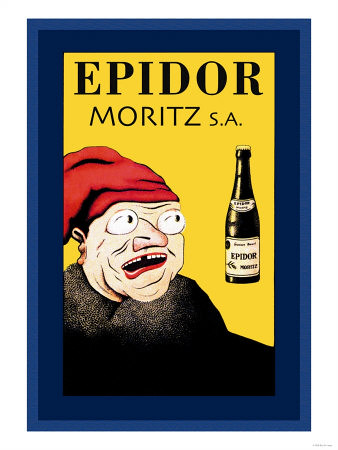
Monday’s ad is for a Spanish brewery, Moritz in Barcelona, which was founded in 1856 and closed in 1978. Remaining family members started up the brand again a few years ago, contracting the brewing. This ad is for Epidor, a strong lager they debuted July 23, 1923. Given the strange face of the man in the ad, I’m not exactly sure who their target audience was or why they thought that would help sell beer. Does it make you want to drink their beer?

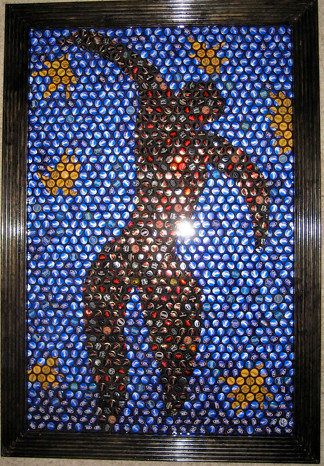
Today’s featured artwork is by an RN from Plano, Texas, who in in his spare time makes incredible works of art using crowns, or bottlecaps, as his medium. The one that I first saw was a bottle cap version of the famous work by Henri Matisse, Icarus. The framed bottlecap Icarus is 2.5 by 4 feet.
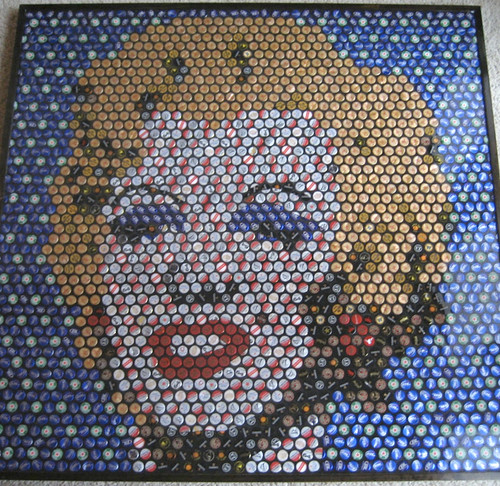
And here’s one of his Warhol-inspired portraits of Marilyn Monroe.
Here’s how he got into making bottlecap art, from his blog:
My work with bottle caps all started as a joke in college, but eventually became a hobby, and moreover a form of art that is quite interesting, stimulating, and rare. It is also keeping in theme with today’s mindset of reusing and recycling trash to make genuine treasures. I have many friends, relatives, coworkers, and favorite drinking/dining establishments who save bottle caps for me.
A friend of mine opened a bar in 2008, and I offered my first piece as decoration in the bare-walled establishment. After receiving copious and favorable feedback about my first piece, I decided to undertake bottle capping more seriously in 2009. I have completed several ‘spec’ pieces, in addition to selling my first piece in August 2009. In March 2010 I had a showing of all of my bottle cap artwork.
Here’s that first one he did, which was started n 2002 but not finished until 2006.
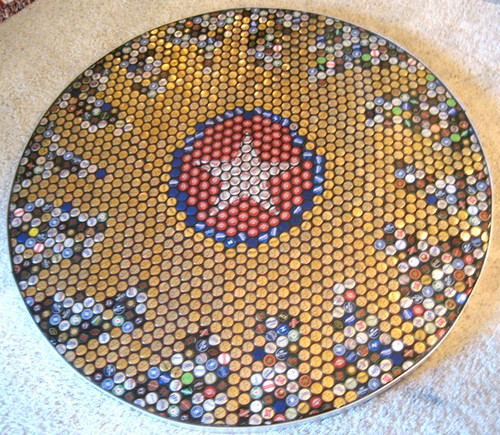
I think this is my favorite of his originals, a mostly blue field with the sun in the corner.

And finally, here’s another Matisse inspired piece, his recreations of Blue Nude, Souvenir of Biskra.

You can see the rest of Harris’ bottlecap works at his portfolio, many of which are for sale.

California freelance journalist Andrew Rosenblum has an interesting short history of malt liquor marketing on Accidental Blogger entitled What Was Malt Liquor?

Check out this unintentionally hilarious video made for the Anheuser-Busch sales force and distributors in 1973, created to showcase how they were going to “open up” the market for malt liquor with Budweiser Malt Liquor.

Ugh, here we go again. Three researchers at the University of Florida, led by epidemiologist Alexander C. Wagenaar, have just released a new study which they claim shows that raising alcohol taxes — in fact doubling them — will reduce consumption and cure society’s problems.
The study, Effects of Alcohol Tax and Price Policies on Morbidity and Mortality: A Systematic Review, is to be published in the November issue of the American Journal of Public Health, but was released online last week, as is common for academic journals.
As I don’t have the resources to buy a subscription to every related academic journal, I have to make do with the abstract and what other news outlets write about it. Here’s the abstract:
Objectives. We systematically reviewed the effects of alcohol taxes and prices on alcohol-related morbidity and mortality to assess their public health impact.
Methods. We searched 12 databases, along with articles’ reference lists, for studies providing estimates of the relationship between alcohol taxes and prices and measures of risky behavior or morbidity and mortality, then coded for effect sizes and numerous population and study characteristics. We combined independent estimates in random-effects models to obtain aggregate effect estimates.
Results. We identified 50 articles, containing 340 estimates. Meta-estimates were r=–0.347 for alcohol-related disease and injury outcomes, –0.022 for violence, –0.048 for suicide, –0.112 for traffic crash outcomes, –0.055 for sexually transmitted diseases, –0.022 for other drug use, and –0.014 for crime and other misbehavior measures. All except suicide were statistically significant.
Conclusions. Public policies affecting the price of alcoholic beverages have significant effects on alcohol-related disease and injury rates. Our results suggest that doubling the alcohol tax would reduce alcohol-related mortality by an average of 35%, traffic crash deaths by 11%, sexually transmitted disease by 6%, violence by 2%, and crime by 1.4%.
Those are some pretty specific promises and some pretty specific recommendations, something most academic papers assiduously avoid. To me that’s a red flag about the intentions of this study.
Science Daily covered the study in an article today (thanks to Richard S. for sending me the link) entitled Increasing Taxes on Alcoholic Beverages Reduces Disease, Injury, Crime and Death Rates, Study Finds. Obviously, I’m as predisposed to question such a study as the average anti-alcohol wingnut is to swallow it unquestioningly. And I confess something doesn’t smell right with it. My alky sense is tingling.
Having not seen the full article, I’m left wondering exactly what the “50 published research papers containing 340 estimates” means. What is being “estimated?” It reads like it’s the supposed harm that’s being estimated, because I can’t for the life of me understand how you could ever say there’s definitive causation for such a complex relationship as the price of something to “other misbehaviors,” or indeed any of the laundry list of issues the researchers believe are caused by people drinking alcohol. In my experience at looking at these studies, any event in which there was alcohol present is usually sufficient to consider the incident alcohol-related, but that’s nowhere near the same as having been caused by the alcohol. And so these statistics tend to be inflated and, consequently, misused.
But the key insight into the study came in the very last paragraph of Science Daily’s coverage of the study, where they reveal that the funding for the study came from the notorious Robert Wood Johnson Foundation (RWJF), the godfather of neo-prohibitionist groups. The RWJF funds many other neo-prohibitionist groups, and also sets the national agenda in the anti-alcohol community. That they funded this, and other similar studies, suggests that the answer preceded the study, that is it was designed to support their agenda, its conclusions a fait accompli.
To me this also explains professor Wagenaar’s statement. “Results are surprisingly consistent.” Of course, they would be if you’re looking for a correlation. The same team did a similar study in 2007, Raising Alcohol Taxes Reduces Deaths, Study Finds where they examined alcohol-related deaths in Alaska after beer taxes were raised in the state. That study was also funded by the RWJF. Predictably they found the correlation they were looking for, but this is playing with statistics for incredibly complex relationships. Their simple conclusions seem absurd. They ignore any underlying causes for alcohol abuse or suicide or anything else, for that matter. As almost every study like this I’ve ever seen, “alcohol-related” is a thinly veiled attempt to paint any alcohol use, however responsible or moderate, as dangerous and life-threatening. Beer is not a syringe of heroin, despite these same groups’ attempts to portray it that way.
Mark my words, we’re going to see this study used by groups all over the country in renewed efforts to raise beer taxes in state after state. But the only thing I remember happening when the federal excise tax on beer was doubled in 1990 was a loss of jobs and long term economic harm visited on the brewing industry. I don’t recall seeing any victory parties by the anti-alcohol groups once that doubling cured all the problems they previously ascribed to alcohol. They went right on complaining about all the supposed damage caused by the industry. That’s a real world example of what they want to do having none of the outcomes this new study claims would occur under the exact same conditions.

You’ve probably heard that in the age of e-mail, FedEx and UPS the U.S. Postal Service has been losing money. A lot, and for a long time now. According to the Washington Post, on Thursday, Senator Tom Carper (Democrat-DE) introduced legislation to save the post office, the Postal Operations Sustainment and Transformation (POST) Act of 2010. The bill includes a laundry list of changes designed to help stop the fiscal bleeding and turn things around. It would eliminate Saturday deliveries, for example, and as Postmaster General John E. Potter explains it, “it alleviates our retiree health benefit burden while bringing resolution to the pension overpayment dilemma we’ve faced.” I don’t know what that means, but it’s not important for my purposes.
The most important part of the POST Act is that it would also “revise current prohibitions against USPS shipping wine and beer.” Opening up the post office to shipping beer seems like a great idea to me, especially given the problems with UPS and FedEx in that regard. The Postmaster General is in favor of the bill, as many of the items contained in it are apparently ideas that have been suggested before. Curiously, William Burrus, president of the American Postal Workers Union, is against allowing beer and wine shipments, but I can’t really understand why. He just wonders aloud if “allowing the Postal Service to ship beer and wine and closing small post offices while the organization is losing billions really the answer?” To which I can only answer yes, why not? What can it hurt, and it would most certainly give the post office a competitive advantage. Why would he be against trying anything reasonable? The Postmaster General stated the bill seeks “to more closely align our costs and the needs of our customers.” Well speaking as one of their customers, I need to get beer so it would make my life simpler if beer could be legally and reliably shipped through the USPS. I’m certainly willing to give up Saturday deliveries in exchange for the potential to have my mailman bring beer the other five days of the work week.

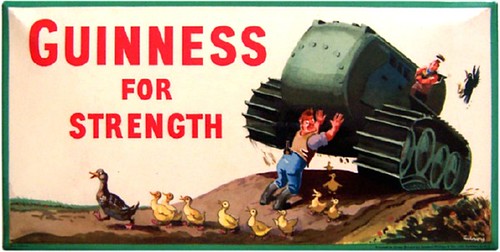
Our 36th Guinness poster by John Gilroy features a farmer lifting a heavy tractor (it actually looks a little like a tank) to let some baby ducks, and their momma duck, pass by. The tagline is “Guinness for strength” since it’s the bottle of Guinness in his back pocket that gave him the duck-protecting strength.

Last night, Friday September 24, the 8th annual Canadian Brewing Awards were presented at the Cool Brewery in Etobicoke, Ontario. At the CBA Gala and Medal Presentation, 93 medals were awarded in 31 style categories.
This year, there were 390 entries from 76 Canadian breweries, “making the 2010 edition the largest brewing competition ever held in Canada.”
Congratulations to all the winners.
North American Style Lager
Gold: Red Baron Premium Blonde Lager, Brick Brewing Co. (ON)
Silver: Laker Lager, Brick Brewing Co. (ON)
Bronze: Molson Dry, Molson Canada
North American Style Premium Lager
Gold: Molson M, Molson Canada
Silver: Premium Lager, Muskoka Cottage Brewery (ON)
Bronze Island Lager, Vancouver Island Brewing (BC)
European Style Lager (Pilsner)
Gold: King Pilsner, King Brewery (ON)
Silver: Pilsner, Mill Street Brewery (ON)
Bronze: Okanagan Spring 1516, Okanagan Spring Brewery (BC)
North American Style Amber Lager
Gold: Red Leaf Lager, Great Lakes Brewery (ON)
Silver: Barking Squirrel, Hop City Brewery (ON)
Bronze: Clancy’s Amber Ale, Moosehead Breweries Ltd.
North American Style Dark Lager
Gold: Dark 266 Lager, Cameron’s Brewing (ON)
Silver: Waterloo Dark, Brick Brewing Co. (ON)
Bronze: Hermann’s Dark Lager, Vancouver Island Brewery (BC)
Light (Calorie-Reduced) Lager
Gold: Brewhouse Light, Great Western Brewing Co. (SK)
Silver: Great Western Light, Great Western Brewing (SK)
Bronze: Moose Light, Moosehead Breweries Ltd.
Bock – Traditional German Style
Gold: Captivator Doppelbock, Tree Brewing Co. (BC)
Silver: Amsterdam Spring Bock, Amsterdam Brewing Co. (ON)
Bronze: Centurion, Le Saint-Bock (QC)
Kellerbier
Gold: Denison’s Dunkel, Denison’s Brewing Co. (ON)
Silver: Kellerbier, Les Trois Mousquetaires (QC)
Bronze: Bohemian Pilsner, R&B Brewing Co. (BC)
Porter
Gold: Coffee Porter, Mill Street Brewery (ON)
Silver: Two Fisted Stout, Amsterdam Brewing Co. (ON)
Bronze: Nutcracker Porter, Black Oak Brewing Co. (ON)
Strong Porter (Baltic)
Gold: Porter Baltique, Les Trois Mousquetaires (QC)
Silver: Brewmaster’s Black Lager, Okanagan Spring Brewing Co. (BC)
Bronze: Grand Baltic Porter, Garrison Brewing (NS)
Cream Ale
Gold: Sleeman Cream Ale, Sleeman Breweries
Silver: Cream Ale, Muskoka Cottage Brewery (ON)
Bronze: Cream Ale, Cameron’s Brewing Co. (ON)
Kolsch
Gold: Lug Tread Lagered Ale, Beau’s Brewing Co. (ON)
Silver: High County Kolsch, Mt. Begbie Brewing Co. (BC)
Bronze: Harvest Moon Organic Hemp Ale, Nelson Brewing Co. (BC)
North American Style Amber/Red Ale
Gold: Yukon Red Amber, Yukon Brewing Co. (YT)
Silver: Fire Chief’s Red Ale, Pump House Brewery (NB)
Bronze: Irish Red, Garrison Brewing Co. (NS)
North American Style Blonde/Golden Ale
Gold: Molson Export, Molson Canada
Silver: Red Cap, Brick Brewing Co. (ON)
Bronze: Natural Blonde, Amsterdam Brewing Co. (ON)
Brown Ale
Gold: County Ale, Wellington County Brewery (ON)
Silver: Naramata Nut Brown, The Cannery Brewing Co. (BC)
Bronze: Stonehammer Dark Ale, F&M Brewery (ON)
Scotch Ale
Gold: Squire Scotch Ale, The Cannery Brewing Co. (BC)
Silver: Wee Angry Scotch Ale, Russell Brewing (BC)
Bronze: Scotch Ale, Pump House Brewery (NB)
English Style Pale Ale (Bitter)
Gold: KLB Pale Ale, Amsterdam Brewing Co. (ON)
Silver: Red Devil Pale Ale, R&B Brewing Co. (BC)
Bronze: Wisharts ESB, Clocktower Brewpub (ON)
North American Style Pale Ale (Bitter)
Gold: Canuck Pale Ale, Great Lakes Brewery (ON)
Silver: Hopyard, Garrison Brewing Co. (NS)
Bronze: Duggan’s #9, Duggan’s Brewery (ON)
Wheat Beer – Belgian Style White/Wit
Gold: Dominus Vobiscum Blanche, Microbrasserie Charlevoix (QC)
Silver: White Bark, Driftwood Brewing Co. (BC)
Bronze: Paresseuse, Le Saint-Bock (QC)
Wheat Beer – German Style Hefeweizen
Gold: Hefeweizen, Tree Brewing Co. (BC)
Silver: Duggan’s #13 Weiss, Duggan’s Brewery (ON)
Bronze: Summer Wheat, Bushwakker Brewing Co. (SK)
Wheat Beer – North American Style
Gold: Sungod Wheat Ale, R&B Brewing Co. (BC)
Silver: Silver Wheat, Wellington County Brewery (ON)
Bronze: Dooryard Summer Ale, Picaroons Traditional Ales (NB)
Strong or Belgian Style Ale
Gold: La Fin Du Monde, Unibroue (QC)
Silver: Trois Pistoles, Unibroue (QC)
Bronze: Gros Mollet, Microbrasserie du Lac St-Jean
Barley Wine
Gold: Thor’s Hammer, Central City Brewery (BC)
Silver: St. Ambroise Vintage Ale, McAuslan Brewing (QC)
Bronze: Barley Wine, Mill Street Brewery (ON)
Stout
Gold: Dark Star Oatmeal Stout, R&B Brewing Co. (BC)
Silver: Malediction, Le Saint-Bock (QC)
Bronze: Timber Hog Stout, Picaroons Traditional Ales (NB)
Imperial Stout
Gold: Black IPA, Garrison Brewing Co. (NS)
Silver: Russian Imperial Stout, McAuslan Brewing (QC)
Bronze: Imperial Russian Stout, Wellington County Brewery (ON)
English Style India Pale Ale
Gold: Nasty Habit IPA, Mt. Begbie Brewing Co. (BC)
Silver: Brockton IPA, Granville Island Brewing (BC)
Bronze: India Pale Ale, Mill Street Brewery (ON)
American Style India Pale Ale
Gold: Red Racer IPA, Central City Brewery (BC)
Silver: Hop Rock Candy Mountain IPA, Hart & Thistle Brewpub (NS)
Bronze: My Bitter Wife, Great Lakes Brewery (ON)
Imperial India Pale Ale
Gold: Red Racer Imperial, Central City Brewery (BC)
Silver: Cuda, Benelux brasserie artisanale et café (QC)
Bronze: Ten Bitter Years, Black Oak Brewing Co. (ON)
French and Belgian Style Saison
Gold: Farmhand Ale, Driftwood Brewing Co. (BC)
Silver: Saison, Black Oak Brewing Co. (ON)
Bronze: Blonde de Chambly, Unibroue (QC)
Fruit & Vegetable
Gold: Coconut Porter, Swans Buckerfields (BC)
Silver: Quelque Chose, Unibroue (QC)
Bronze: Frambozen, Mill Street Brewery (ON)
Special Honey/Maple Lager or Ale
Gold: Enigma, Le Saint-Bock (QC)
Silver: Holiday Honey, Old Credit Brewing (ON)
Bronze: Mackroken Flower Grande Reserve, Bilboquet Microbrasserie (QC)
Two additional medals were bestowed during the CBAs Gala and Medal Presentation — Canadian Brewery of the Year and Canadian Beer Of The Year awards. Rob Engman, President of TAPS Media, was thrilled with the announcement that first time participants, Central City Brewery from Surrey, BC, won both of the prestigious awards. “I am extremely excited for Central City Brewery,” stated Engman. “This is the first year that the brewery has competed in the CBAs and they wowed the judges with their submissions.”
Beer of the Year: Thor’s Hammer Barley Wine, Central City Brewery (BC)
Brewery of the Year: Central City Brewery (BC)
