Friday’s ad is for another French brewery, Biere St. Nicolas De Port, which minus biere is a commune in the Lorraine region of northeast France. The ad is by Marcellin Auzolle, who’s done a number of French beer ads. It’s also oddly cocky.


Friday’s ad is for another French brewery, Biere St. Nicolas De Port, which minus biere is a commune in the Lorraine region of northeast France. The ad is by Marcellin Auzolle, who’s done a number of French beer ads. It’s also oddly cocky.

The National Highway Traffic Safety Administration (NHTSA) released the results of their latest National Survey of Drinking and Driving Attitudes and Behaviors, done in 2008.
That headline grabbing statistic, that one in five have driven after drinking (actually within two hours of drinking) is not about driving “drunk,” but simply after having had any amount of alcohol. That seems a little alarmist and misleading. If I have one beer with lunch and then drive, I’m included in that statistic even though at my size and appetite, it’s unlikely I’m anywhere near 0.08% BAC. It makes for a great headline, but that’s about it. It’s also the statistic featured on the home page for this survey. Here’s the abstract from the NHTSA.
One Out of Five Are Drinker-Drivers
Twenty percent of the public 16 and older had in the past year driven a motor vehicle within two hours of drinking alcohol. About two-thirds of these, or 13% of the total population 16 and older had done so in the past 30 days. The survey produced an estimate of 85.5 million past-month drinking-driving trips, up from 73.7 million trips in 2004 and reversing a declining trend in such trips since 1995. More than three-fourths (78%) of the trips were made by males.
Those who reported driving within two hours of drinking in the past year tended to be more frequent drinkers than did other drivers who drink but do not drive afterwards. More than one in four (28%) drinking drivers usually consumed alcoholic beverages 3 or more days a week, compared to 10% of drivers who drink but do not drink and drive. While few 16- to 20-year-olds reported drinking and driving, those that did averaged 5.7 drinks per sitting during the times they drink alcohol (inclusive of all drinking occasions, not just drinking and driving). For 21- to 24-year-old drinking drivers, their average alcohol intake was 4.2 drinks per sitting. The average number of drinks dropped sharply again for 25- to 34-year-old drinking drivers (3.0), then declined more slowly across ensuing age groups.
But when you look at this same statistic since 1993, when the first survey was taken, it’s been almost exactly the same, changing no more than a percentage point or two in nearly twenty years. The point is that all of the efforts to lower the standard of what it means to be drunk, the scare tactics and increased penalties have done little to change people’s behavior.
As for people driving after meeting our arbitrary definition of being drunk, that’s roughly 17.2 million people (in the last year) or about 8%. That’s more like one in twelve. And though I couldn’t find a companion chart for this stat since 1993, I’d be willing to guess it’s been similarly static.
I should say at this point — though I shouldn’t have to — that I don’t think people should get drunk and drive, so please don’t write and accuse me of that. I’m simply questioning the statistics and the effectiveness of current policy based upon them. As I’ve written before, I tend to think that all that lowering the standard of intoxication from 0.1% to 0.08% has accomplished is to criminalize more people while doing nothing to stop the true problem drinkers from driving.
To me, the real scandal is that not one organization that’s against drunk driving is actively lobbying for a mass transit system that actually works in the U.S. It seems to me that the most obvious way to curb drunk driving is provide an alternative. If history has taught us anything, it’s that we can’t effectively stop people from drinking alcohol. It was illegal for thirteen years, and that didn’t stop anyone. And if this recent study shows us anything, it’s that, right or wrong, people still drive after drinking despite years of increasingly criminalizing that behavior. In short, what we’re doing now isn’t working. Isn’t that obvious?
Many people who want to lower the BAC even further note that in Europe it’s often 0.05% or even lower. But what they fail to point out is that in every country in Europe I’ve ever visited, there are real, viable alternatives to get around using public transportation. But we’re a car country thanks to the actions of the oil and automobile companies in the last century, when they bought up and dismantled public transportation systems. Not to mention the greatest corporate giveaway in history is the public highway system. Imagine how expensive cars would be if the automobile companies had to build the roads, too, like railroads did. So if we want to use Europe as a model, then we have to build an effective public transportation system here, too. And that would have all kinds of positive benefits beyond reducing drunk driving. So let’s get on that.
You can read the whole survey, in three parts at the NHTSA website, where you can download the pdf’s.
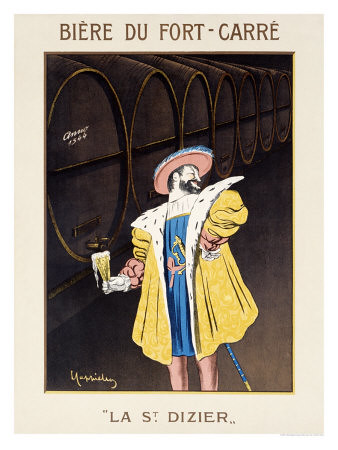
Thursday’s ad is for the French brewery, Brasserie du Fort Carré from Saint-Dizier, Haute-Marne. The ad is the third one we’ve featured by Leonetto Cappiello, the Italian illustrator considered to be the father of modern advertising.

Politicians are used to getting their way, and so are powerful non-profits, so they tend not to look at defeat as losing, but as an opportunity to try to win a different way. Certainly they’d never openly admit they’re wrong or have lost. If one strategy doesn’t work, they try another. The will of the people or common sense rarely matters, what matters is winning.
And so the new alcohol tax for the city of San Francisco, as proposed by supervisor John Avalos, was vetoed by mayor Gavin Newsom. But that’s hardly the end of it. I’m sure that Avalos and his backing organization, the Marin Institute, are still trying to strong-arm the three supervisors who voted against the new tax in the hopes of an override, but in the meantime, they’re also looking at others ways to realize their agenda. The determination of the minority who claim the moral high ground will not be stopped so easily. Their dream of punishing the majority of lawful, responsible drinkers for the excesses of the few will not go gently into that long goodnight. Likewise, their dream of punishing the big alcohol companies with a scheme that will barely register on their radar while at the same time causing real harm to the local economy, to local restaurant and bar owners and employees, and to hundreds of small family-owned breweries, wineries and distilleries will also not stop, but will instead just veer off in a different direction.
Just hours after Newsom’s swift veto of the alcohol tax, “supervisor John Avalos says the measure might be taken to voters to override Mayor Gavin Newsom’s veto.”
Unfortunately, every news outlet keeps repeating the lie that the tax would only add “a few cents per standard serving of beer, wine or hard liquor.” Don’t any of these news outlets fact check? As the business community has tried to explain — and any person with a functioning brain should understand — the initial tax (like all costs of doing business) will be marked up along the supply chain from wholesaler to retailer to consumer. Seriously, how hard is that to comprehend? This won’t be a “nickel a drink,” more like a buck a drink. Okay, maybe not that much for most, but if I have to keep hearing it’s only a nickel, I think I’m within my rights to engage in a little hyperbole, too. At least I’m up front about it. I feel like if I turn around, I’ll see Upton Sinclair shaking his head behind me. As he observed, “It is difficult to get a man to understand something when his job depends on not understanding it.” And so it goes.
And what also doesn’t get talked about — but should — is that alcohol is already the most taxed consumer product on planet America, with the possible exception of tobacco. But tobacco, you may recall, has no health benefits whereas the moderate consumption of alcohol has plenty, not least of which is that you’ll most likely live longer if you drink a little instead of abstain.
Every state and community is having trouble paying for the services its citizens feel entitled to, and that’s undoubtedly a real problem. I personally believe politics has led us down this path, but regardless I don’t believe politics can save us from it, either. Everybody wants the services, but curiously no one is willing to pay for them. No one wants their taxes to go up, even though that’s probably the fairest way to get us out of this mess. Instead, politicians keep trying to find a solution that doesn’t seem like a tax, in most cases just so they can continue to say they’re against more taxes, for no grander purpose than they want to keep their jobs. So when the Marin Institute whispered in the ear of John Avalos, “psst, have I got a ‘fee’ for you,” … he listened.
And in the end, that’s why I’m so vehemently opposed to this type of tax. It’s dishonest at its core. It argues from a false premise. I don’t really care how much the tax is, it’s patently unfair at any amount. It takes the all too familiar position that drinking alcohol is somehow a sin and therefore people should have to pay to enjoy it. Bullshit. I don’t believe that and neither should you. The concept of sin is a religious “belief” and last time I checked the Constitution guaranteed that I can believe otherwise and that in any event religion, where the idea of sin flourishes, should have nothing to do with the governing of alcohol policy or any other damn law.
What we have is decades of demonization working its way into a discussion it should have no part in. It’s utter nonsense to suggest that alcohol “made” people abuse it and further that the people who make it and sell it share that blame, too. When we start taxing ammunition and gun companies for the crimes people commit using their products then come talk to me about charge for harm. When we start taxing soda companies, high fructose corn syrup makers, fast food chains and red meat companies for the obesity epidemic and the burden it places on our healthcare system then come talk to me about charge for harm. When we start taxing the oil companies and car manufacturers for the loss of the ozone layer and other natural disasters from their dismantling of mass transit and people driving too much then come talk to me about charge for harm. Virtually every human activity does some harm to someone or something. Trying to calculate all of them and figure out who owes what is a fool’s errand. And that’s why we don’t, except when it comes to alcohol. Alcohol has been a convenient scapegoat for well over a century now, and there’s no end in sight for the ills of society it can be blamed for.
My biggest fear if this does go to a vote, is that the mis-information and propaganda out there has created a populace that believes one thing when another is closer to the truth. One of the most potent takeaways from the quasi-debate that KQED aired a few weeks ago, was how frighteningly uninformed many people are about this issue. So many have let emotions, inflated statistics and one-sided reporting inform them on this issue that I think a lot of people will happily pull that “yes” lever, blissfully ignorant of how unfair it is and how their emotions have been manipulated by propaganda and fear. And that’s a direct result, I think, of our local media just uncritically parroting propaganda in favor of the tax and all but ignoring any meaningful opposition.
But long term it’s also because we allow the debate to start from the premise that alcohol is bad in and of itself. It’s not. All the evidence you need to disprove that is your own behavior and those of almost everyone around you, easily able to responsibly drink moderate amounts of alcohol. You’re the majority. You’re the norm. You’re doing something good; good for you and for society. Drink up. Enjoy yourself. Don’t let fear and propaganda win the day.

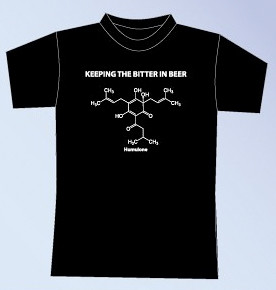
My friend, John Harris, the brewmaster for Full Sail Brewing in Mt. Hood and Portland, Oregon, has some cool t-shirts he’s created. I think you’ll want one or more of them for yourself. He brought a few of his latest ones along with him when we judged together at GABF. I bought one on the spot and thought I’d share them.
The shirt is perfect for hop lovers with the legend “Keeping the Bitter in Beer” with the chemical formula for humulone, C21H30O5, one of the main bittering compounds.
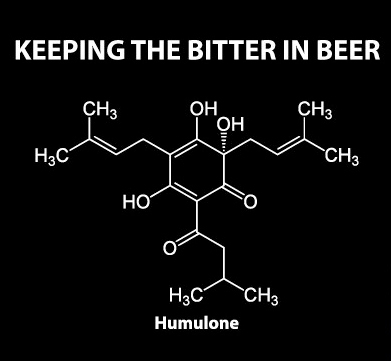
And here’s what it looks like as a shirt. You can get your very own for $20 (shipping included) and you can order one online at Bonds That Please
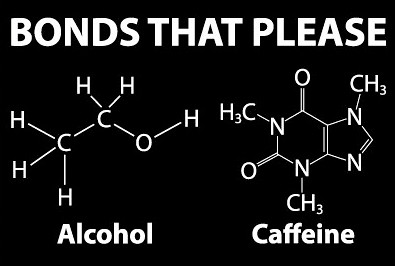
His other shirt is the chemical formulas for both alcohol and caffeine, the “Bonds That Please.” It’s also $20 (shipping included) and can be purchased online at Bonds That Please.

Saturday night at GABF, I was honored to be on a three-man panel talking about beer media, along with Daniel Bradford from All About Beer magazine, and Stan Hieronymus. We talked for about 40 minutes, although you can hear exactly how bad my voice was all week long, after losing it Wednesday night.
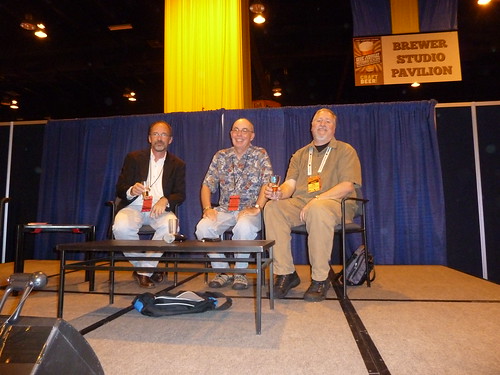
Daniel Bradford, Stan Hieronymus and me on stage at GABF. (Thanks to Julia Herz for taking the photo.)
We had about a half-full studio, more than I’d expected for a Saturday night session, and a high percentage of the audience was other media personalities. It was great fun, we could easily have talked all night.
If you can’t see the video embedded here, try viewing it on Justin.TV.
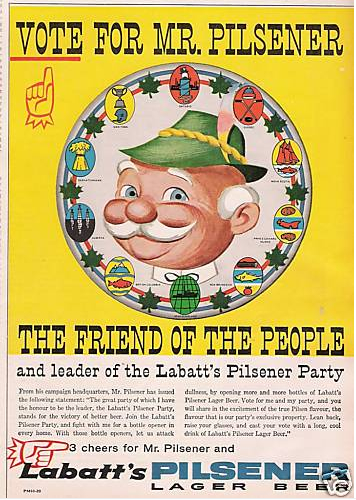
Wednesday’s ad is from 1960 for Labatt’s of Canada, which must have been election year there, too. I love Labatt’s little old German brewer persona. I’d vote for that guy. And what a great tagline: “Vote For Mr. Pilsener, The Friend of the People, and leader of the Labatt’s Pilsener Party.” Hilarious. “3 Cheers” indeed.

As I reported yesterday, San Francisco mayor Gavin Newsom kept his promise to veto the proposed ordinance that seeks to add an additional tax on alcohol sold in the city.
Here’s mayor Newsom’s veto letter that he sent to city supervisors:
This letter communicates my veto of the ordinance pending in File Number 100865, finally passed by the Board of Supervisors today, September 21, 2010. This ordinance proposes an Alcohol Mitigation Fee to be imposed on alcoholic beverage wholesalers and others who sell or distribute alcoholic beverages in San Francisco.
I cannot support this unnecessary and harmful new fee that will hurt our City’s economy and cost us jobs at a time when we most need them.
In this economy, I fundamentally believe that we need to be encouraging local businesses – large and small – to continue to work and operate in our neighborhoods, to continue to provide jobs and security to the residents of San Francisco, and to continue to support our City’s economy in its recovery. It is in these times of struggle that we need to stimulate our local economy – not pursue policies that will stifle growth and put our county at a competitive disadvantage with every other county in California.
In addition, while we have faced significant budget deficits for the last three years, we consistently have supported the provision of critical health care services to our residents most in need – at a much higher rate than surrounding counties. And, we will continue to do so. Therefore, I do not accept the premise that, but for this fee, we will be slashing our health care programs.
I also strongly believe that we are in questionable legal territory due to state preemption issues, and that passing this ordinance would risk millions of dollars in attorney’s fees that we can ill afford. I prefer to hold those battles for creative policy areas where we believe we are in strong legal standing.
I remain committed to working with the Board of Supervisors and City departments to continue to identify impactful programs to help chronic inebriates in San Francisco. However, I do not believe that an alcohol impact fee is the best approach in achieving that policy goal. Our best hope for continued strong financial standing of this City and support for public health services is to help our local economy grow and thrive.
The media reaction has been swift and voluminous. At least twenty media outlets throughout the state have weighed in since yesterday afternoon. Here’s what the San Francisco Chronicle, by John Coté, had to say:
Newsom contends the fee would hurt jobs and is illegal, treading on the state’s authority to regulate alcohol.
“You don’t help the city’s general fund by spending hundreds of thousands of dollars on a lawsuit we’re going to lose,” Newsom said.
Other opponents, such as the San Francisco , argue the fee is really a tax and thus needs voter approval. The city attorney issued a confidential opinion to supervisors that warned of potentially significant legal risks associated with the legislation on both fronts. Liquor industry representatives vowed to sue if the legislation were enacted.
And I love this gem. “Avalos said there was simply ‘no evidence’ that consumers would face inflated costs.” Puh-leeze. His insistence that there would be no mark-up on the tax from wholesaler to retailer to consumer is completely naive and disingenuous. Everyone in the business community is telling him the tax will be marked up, but that’s not “evidence.” Does he think they’re all lying just because they don’t like the tax? Has he never worked in any business capacity? That’s what businesses do, they mark up their costs and pass them along to consumers. Not doing so is how you go out of business.

USA Today is reporting that Anheuser-Busch InBev‘s plan to reverse slumping sales trends is to give away their beer. Not all of it, of course, but part of a new marketing barrage to begin next Monday includes stepping up sampling significantly, to record levels of free beer giveaways.
According to the article, Latest ad strategy to freshen Budweiser’s image: Free beer, by Bruce Horovitz, ABI is poised to “announce plans to push free beer and a hipper Bud image to younger beer drinkers over the next several weeks” in an effort to reach the under-30 crowd growing up under the influence of the more flavorful and more local craft beer segment.
The new marketing campaign will feature the tagline Grab Some Buds, a phrase ABI has applied to trademark, and starting Monday, Budweiser “will unleash its biggest-ever national free-sample effort in trendy bars and eateries.”
From the USA Today article:
The hype culminates on Sept. 29, when the brand hosts the “Budweiser National Happy Hour,” a bid by Bud to nudge folks to at least try a free brewski. The free samples for those 21 and up range from 6 ounces to 12 ounces, depending on state and local rules.
At issue: a brand that’s lost mojo. Bud unit sales were down 9% last year and are down the same this year, says Beverage Marketing Corp. Beer drinkers have lost loyalty to Bud for the past seven years, research firm Brand Keys reports. Bud’s ranking among national product brands slipped from 16th in 2003 to 220th in 2010.
Here’s their four-prong approach:
The article concludes doubtfully, with “Brand consultant Robert Passikoff [expressing] serious doubts about Budweiser’s effort. ‘They’re in trouble because they don’t know how to talk to consumers,’ he says. ‘They no longer know how to create an emotional bond.'”
Frankly, I think they’re in trouble because they’re not keeping up with what customers want. All their “fixes” for dwindling sales (though to be fair sales are still ginormous) involve the same old tried and true marketing tricks that have seen them through the last half-century. Sampling, new ads and more TV spending are hardly revolutionary, and neither is finally trying to figure out how to use Facebook.
ABI is losing the battle for customers perceiving them as a patriotically American company, however jingoistic and emotional that is. They’ve also taken hits for the way they’ve treated employees — laying off hundreds (is it thousands yet?) — and keeping the remaining ones fearful for the next round of layoffs and working many jobs and too many hours. They’ve also taken a hit for asking suppliers to wait as long as four months to be paid.
ABI could produce beer every bit as flavorful as the best craft beer, but they wouldn’t know how to sell it. It’s not their business model. ABI president Dave Peacock thinks sampling will work, of course. “‘When we get the trial, we find we have a positive result,’ Peacock says.” But I honestly can’t see how sampling will be a positive experience for young people that recognize there are more flavorful alternatives to mass-produced American-style light lagers.
I think the Hans Christian Anderson fairy tale, The Emperor’s New Clothes, provides a useful analogy. If we think of flavor as clothing, sampling young people on Budweiser will only serve to reinforce that indeed the Emperor has no clothes.

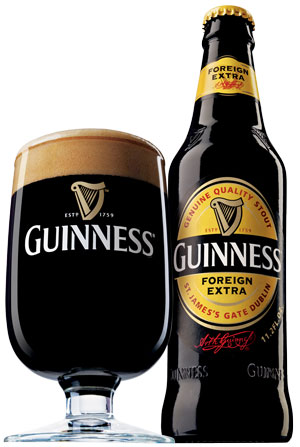
At long last, Diageo has announced that Guinness Foreign Extra Stout will be returning to the United States. Discontinued after Prohibition in 1920, it’s been 90 years since it was legally available here. Thanks to Beer Advocate for the tip.
From the press release:
Tuesday, September 28th is National Drink Beer Day! As if you didn’t already have reason to raise a pint, GUINNESS Irish Stout is proud to announce its U.S. launch of GUINNESS Foreign Extra Stout (FES) on October 1st. The fullest in flavor of the GUINNESS brand variants, GUINNESS FES is carbonated unlike the nitrogenated GUINNESS Draught with which most Americans are familiar. The specialty beer is 7.5% ABV and possesses strong, roasted aromas followed by a unique bittersweet taste. Foreign Extra Stout is already a favorite of many around the world, making up 45% of GUINNESS sales globally, and is sure to be a favorite of beer aficionados here in the U.S.
GUINNESS Foreign Extra Stout (FES) is brewed with the highest hop rate of all the GUINNESS variants. The generous hop additions express fully the beers distinctive character and flavor while also prolonging shelf life in warmer climates, as hops are the best natural preservative for beer. GUINNESS FES is uniquely different from GUINNESS Draught both in taste profile, color and ritual.
Brewed for more than two centuries, GUINNESS FES dates back to 1801. Known as West India Porter until the mid nineteenth century, FES was an export beer brewed with extra hops, giving the beer a more intense flavor and higher alcohol strength. The extra hops also acts as a natural preservative for beer, allowing it to survive long journeys overseas.
It’s nice to see a good decision by Diageo on behalf of the Guinness brand instead of gimmicks like Guinness Extra Cold or Guinness Red.