
Monday’s ad is for the Swiss brand Löwenbräu. “Trinkt Furcher Zöwenbräu” is essentially “drink Swiss Löwenbräu.” It was done by the Swiss artist Otto Baumberger. I love the look of the mug.
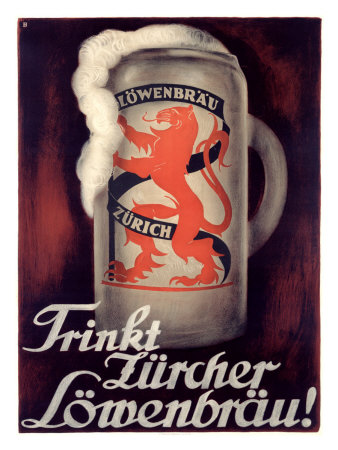

Monday’s ad is for the Swiss brand Löwenbräu. “Trinkt Furcher Zöwenbräu” is essentially “drink Swiss Löwenbräu.” It was done by the Swiss artist Otto Baumberger. I love the look of the mug.

Gizmodo has an interesting article on Friday speculating that Canned Beer Is The Future of Good Beer. Like most Gizmodo articles, it’s in-your-face opinionated (especially in the comments, where it turns decidedly loopy) but makes most of the points we all know about that are advantages for canned beer.
I don’t believe cans will ever replace bottles entirely, but cans should command a greater market share as the craft segment of the industry continues to grow. Cans will continue to be place-driven and occasion-driven, at least in large part. But we don’t always spend our time camping, swimming or on the golf course so the real trick in marketing cans is to convince everyone that they’re ideal for the home, too, which is in fact often the case. But I continue to believe that as we also try to raise the perception of beer as a sophisticated beverage worthy of white-table fine dining, that bottles will continue to be seen as the superior package at least from that perspective. In the same way we all know that screw-top wine can be every bit as good as wine sealed with a cork, the perception remains tilted toward corks as an indicator of quality. I should hasten to add that I love craft beer in cans and support the idea whenever I can, I just don’t think it will ever be an all one package world, nor do I think it ever should be. Both packages are good from different points of view, and so I think most likely both will also remain viable for years to come.

The Turbo Tax Blog last month had an interesting post looking at the question of How Much Money Does The Government Make From Alcohol? It’s an overview, of course, and doesn’t include some of the dirty details that make alcohol the most taxed consumer good out there (though tobacco is pretty high, too), but there certainly is some interesting information contained in the rather large infographic.


NPR’s Science Friday had a show last week devoted to The Science of Smell. If you’ve ever taken tasting beer seriously, you know how important smell is to the flavor of beer (and everything else). Host Ira Flatow discussed Olfaction with research scientists Stuart Firestein and Donald Wilson. The show’s only a little under 18 minutes but is pretty interesting.
For example, twenty years ago [the field of olfaction] made the most important discovery in the modern era of olfaction, which “was the identification and cloning of a large family of receptors in our noses that mediate the sense of smell that act like a lock. If you think of it, odor is a key, and when they fit together, the brain is clued in to the fact that this odor is out there somehow. And this identification of this large, large family of genes, a thousand of them in many animals, as many as 450 in us, mediates this smell.
This turns out to be “the largest gene family in the mammalian genome. The mammalian genome, typically, we think consists of about 25,000 genes. So in a mouse, it’s about 5 percent of the genes and even in us, it’s almost 2 percent. About one out of every 50 genes in your genome was devoted to your nose.”
And here’s a later revealing exchange, from the transcript:
Dr. FIRESTEIN: I think we use our nose a lot more than most people believe. The biggest problem with our sense of smell or the feeling that we don’t have a good sense of smell is actually our bipedalism, the fact that we walk on two legs. And we have our noses stuck up here five or six feet in the air, when all the good odors are about eight or 10 inches off the ground. Or for example, as the case with other animals, they’re more willing to put their nose where the odors are, shall we say, delicately.
FLATOW: And well, we’ve always heard that animals like let’s pick out dogs, bloodhounds and things like that, that dogs are able to smell so much more sensitively than us in all different kinds of smells. Is that true?
Dr. FIRESTEIN: Well, it’s a good question. I mean, I often say to people who ask me that question, if they have such a good sense of smell, why do they think they do that greeting thing that they do?
Dr. FIRESTEIN: You think you could do that from 10 feet away, you know?
FLATOW: Well, that’s true. They get right up there and sniff you.
Dr. FIRESTEIN: Boy, they sure do.
FLATOW: So why do they need to be so close if they smell…
Dr. FIRESTEIN: Yes, well so some of this is behavioral, and a part of it, the another way to show that, I think, for humans, is that we actually have very sophisticated palate, for example, for food, much more than many other animals and we know that most of flavor is really olfaction.
And here’s another interesting exchange about the specifics of our sense of smell, insert “beer” in the place of “coffee” and the process of judging beer critically works the same way.
FLATOW: Don Wilson, tell us what happens what is connected to our noses in the sensory? What goes on in the brain when we smell something?
Dr. WILSON: Well, it’s actually really exciting because – so these you mentioned the ABCs of olfaction. I think that’s a good analogy because these hundreds of different receptors that Stuart just mentioned essentially are recognizing different features of a molecule. You don’t have — for most of odors, you don’t have a receptor for that particular odor. You don’t have a coffee receptor or a vanilla or a strawberry receptor. You have receptors that are recognizing small pieces of the molecules that you’re inhaling, and the aroma of coffee, for example, is made up of hundreds of different molecules.
So what the brain then has to do is make sense of this pattern of input that’s coming in: I’ve got receptors A, B and C activated when I smell this odor, and I’ve got receptors B, C, D and E activated when I smell this other odor. And what we’ve found is that what the brain is really doing with the olfactory cortex and the early parts of the olfactory system are doing is letting those features into what we and others would consider something like an odor object, so that you perceive now a coffee aroma from all of these individual features that you’ve inhaled. And, in fact, once you’ve perceived that coffee aroma, you really can’t pick out that, you know, there’s a really good ethyl ester in my Starbucks today or something – you really have an object that you can’t break down into different components. So that’s what the brain is doing.
And we know that part of that building of the object, that synthetic processing of all these features, is heavily dependent on memory. So you learn to put these features together and experience this odor the first time. So it’s really a – in some ways, olfaction seems really simple. They suck a molecule up my nose and it binds to a receptor and so I must know what I’ve just inhaled. But, in fact, it’s a fairly complex process where it’s akin to object perception and other sensory systems.
FLATOW: Does the fact that it elicits such strong memories — you know, so you can a smell from 40 years ago or something. Is it because — are they close together, the centers for smell and memory in the brain?
Dr. WILSON: Well, in humans, it’s — in some ways, the olfactory cortex is really enveloped by — embraced by parts of the brain that are important for emotion and memory. There are direct reciprocal connections between the olfactory system and the amygdala and hippocampus, these parts that are important for emotion and memory. So – and we think that as you’re putting these features together to make this perceptual object, the brain and the cortex is also sort of listening to the context of which I’m smelling it, maybe the emotions that I’m having as I’m smelling it. And those can, in fact, we think can become an integral part of the percept itself. So it not only becomes difficult to say what the molecules were within that coffee aroma, but it also becomes difficult to isolate the emotional responses you’re having with that same odor.
After that they go on about memory and aromas, and then take calls from listeners. You can also hear the entire discussion below or at Science Friday’s website (or download it below or at NPR) and also see the full transcript.

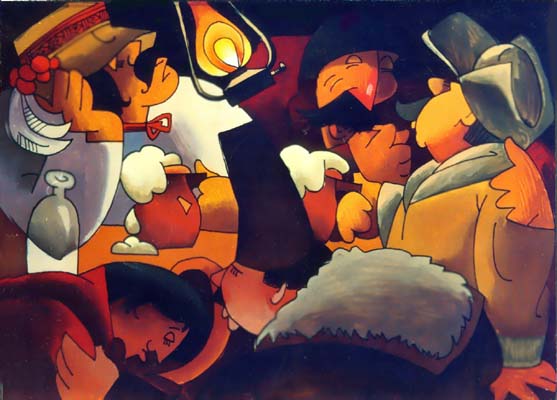
Today’s painting is done using a unique technique, reverse painting on glass. It’s an ancient process, and today’s artist, Andriy Khomyk, is from the Ukraine where at one time it enjoyed more popularity. According to his website. “No other medium allows for the creation of such deep and energetic color! Painting is done on the reverse side of the pane — the work is viewed through the layer of glass, which produces amazing effects!” You can also read more about painting on glass on Khomyk’s website. The title of the painting below is Drinking Beer.
A short biography is on his website:
Andriy Khomyk was born in Lviv, Ukraine, on May 28, 1962. He graduated from the Faculty of Design of Lviv College of Applied end Decorative Arts in 1981, and from the Faculty of Decorative Ceramics of the Lviv Academy of the Arts in 1986. He has worked in the fields of easel painting and book printing art, and since 1991 in the field of easel painting on glass. He has participated in international and national exhibitions, and has had personal exhibitions of paintings on glass in Lviv, 1993, USA, 1995, Kyiv, 1996, Lviv, 1996, Krakow, 1997, USA, 1997, Lviv, 1998, Lviv, 1999, and USA, 1999, 2001, 2002, 2003, 2004.
He’s also done one more beer-themed painting that’s in his Folk Arts section under crafts, entitled The Brewer.
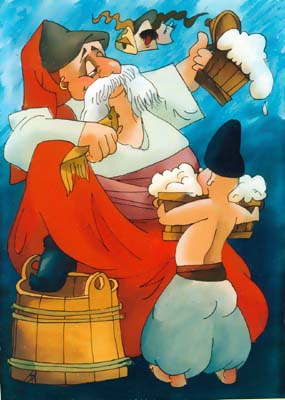
You can see many more of his painted glass artwork at the gallery on his website.

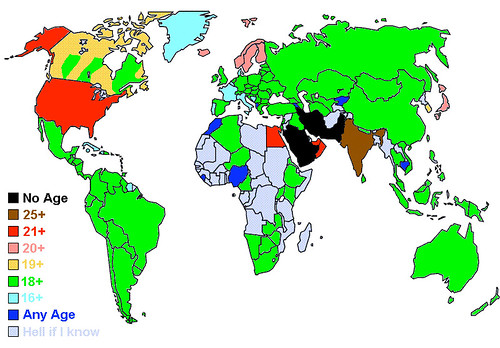
In a similar vein to yesterday’s hangover infographics, here are several more that show the minimum age that people can drink across the nations of the world. They show just how out of whack we are with the rest of the world, having one of the highest ages where people are permitted to drink: 21. The majority of the world is at 18 or below, with only a very few above eighteen (of those countries that permit their citizens to choose for themselves whether they want to consume alcohol).

For a larger view, click here.
One odd feature of this one is it shows India as a solid 21, whereas it’s actually 18-25 depending on the state. But it’s still pretty obvious that the world average, where drinking it allowed at all, is 18.
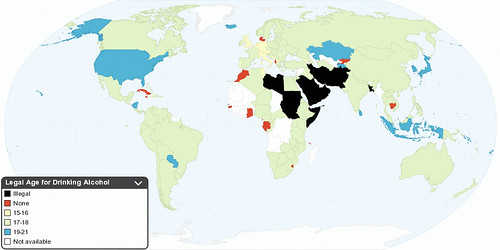
For a larger view, click here.
This one, too, shows a proliferation of 18 and under, where legal.
For a larger view, click here.
The last one, from Charts Bin, lumps together many of the ages of majority, which seems a little misleading. For example, it lumps 19-21 together making it seem like there’s many more that are on the high end whereas only five countries are as high as 21, including the puritanical U.S.
There are also a few decent lists of drinking ages, at the International Center for Alcohol Policies, Wikipedia and Alcohol Problems and Solutions.

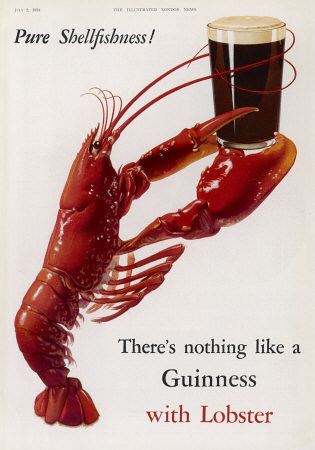
Our 33rd Guinness poster features a Guinness-drinking lobster and was at least promoting a nice beer pairing with the tagline “There’s nothing like a Guinness with Lobster.” But it’s the bad title pun that really make it.

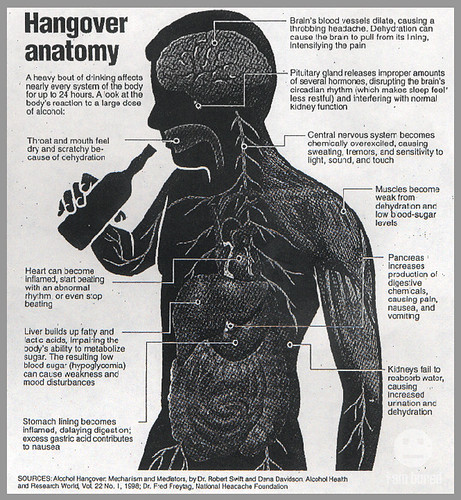
Here’s an interesting couple of infographics about how a hangover effects your body. The first is from Sloshspot (though I can’t find the original post) and the second is from an academic paper, Alcohol Hangover: Mechanism and Mediators, written in 1998.
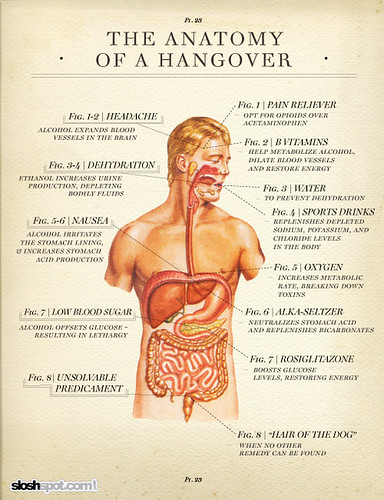
For a larger view, click here.
For a larger view, click here.
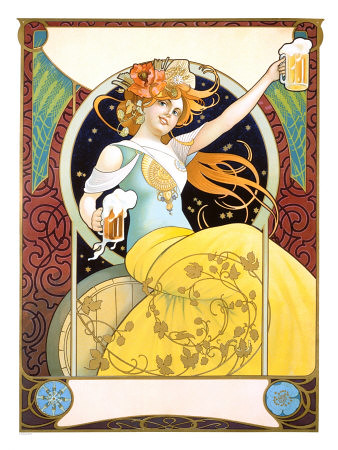
Friday’s ad is one of my favorite beer posters of all time, though I’ve never seen it with any text so I don’t know if it was ever actually used as an advertisement at all and, if so, for what brewery. I’ve never seen any information about the artist or even where it’s from precisely, though I suspect it’s French. Still, it’s beautiful.

This is the fourth year for the Brookston Fantasy Football Games. We’ve had a lot of fun over the last three, so if you love football and beer, consider joining us again this year. The NFL season begins on Thursday September 9, so you’ve got about a dozen days to sign up.
I’ve again set up two free Yahoo fantasy football games, one a simple pick ’em game and the other a survival pool. Up to 50 people can play each game (that’s Yahoo’s limit), so if you’re a regular Bulletin reader feel free to sign up for one or even both. It’s free to play, all you need is a Yahoo ID, which is also free. Below is a description of each game and the details on how to join each league and play.
Standings for both leagues will be listed at the bottom of the Bulletin’s right column.
In this Pick’em game, just pick the winner for every game each week, with no spread, and let’s see who gets the most correct throughout the season. I’ve added a new wrinkle this year. Since we’re all very busy, and you (or I) might screw up at least one week, you can now throw out your lowest week. All that’s at stake is bragging rights, but it’s fun.
Also, a new feature Yahoo added is the ability to keep picking all through the playoffs, so the game will continue through to the Super Bowl, which is pretty cool.
In order to join the group, just go to Pro Football Pick’em, click the “Sign Up” button (or “Create or Join Group” if you are a returning user). From there, follow the path to join an existing private group and when prompted, enter the following information…
Group ID#: 37001 (Brookston NFL Pick To Win)
Password: brookston
If picking all sixteen football game every week seems like too much, then Survival Football is for you. In Survival Football, you only have to pick one game each week. The only catch is you can’t pick the same team to win more than once all season. And you better be sure about each game you pick because if you’re wrong, you’re out for the season. Actually this year they added a new feature and I changed the game so to be kicked out you have to be wrong twice. In that way more people stand a better chance of lasting longer into the season. So get one wrong, and you’re still okay, get a second wrong, now you’re gone for the season. Last man standing wins.
Yahoo also added the new feature to this game, too, where we can keep picking all through the playoffs, assuming our luck holds. So the game could even continue through to the Super Bowl.
In order to join the group, just go to Survival Football, click the “Sign Up” button and choose to “Join an Existing Group”, then “Join a Private Group”. Then, when prompted, enter the following information…
Group ID#: 15291 (Soused Survival League)
Password: bulletin
With 50 players allowed in each game, there’s plenty of room, so don’t be shy. Sign up for one or both games. Beginning after the first weekend of the regular season I’ll post the standings on the home page (at the bottom of the right-hand column) and then each Monday after that through the season. Won’t you join us?