Brookston Beer Bulletin

Jay R. Brooks on Beer

  • Home
  • About
  • Editorial
  • Birthdays
  • Art & Beer

Socialize

  • Dribbble
  • Email
  • Facebook
  • Flickr
  • GitHub
  • Instagram
  • LinkedIn
  • Pinterest
  • RSS
  • Twitter
  • YouTube

Powered by Genesis

Asia Overtakes Europe In Beer Consumption

August 23, 2010 By Jay Brooks

asia
For a long while Europe has led the world in beer consumption by continent and also by nation since the EU has increased in economic prominence as a single entity. According to new data by Credit Suisse, China now leads the world in terms of beer consumption, growing at a pace of about 10% per year. The Economist has more details in All Pints East.

beer-consumption-map-2010

Filed Under: Beers, Breweries, News, Politics & Law Tagged With: Asia, Europe, Statistics

World Beer Awards 2010

August 23, 2010 By Jay Brooks

world-beer-awards-2010
I keep forgetting to write about this. Earlier this year I was asked to help judge for the World Beer Awards, which are put on by the former UK beer magazine Beers of the World, which is now published only online at Tasting Beers. They separated the beers into regions and Stan Hieronymus chaired the America’s region, along with me and Eric Warner.

We were each sent four large boxes filled with bubble-wrapped bottles or cans with a number assigned to each and the labels and even crowns obscured by labels and stickers. They were then separated into five broad categories: pale ale, dark ale, lager, stout & porter, and wheat beer. Then within each of those five, they were further subdivided by style. I don’t know how the rest of the judges did it, but I invited friends with judging experience and/or beer knowledge over to help taste them and bounce descriptors off one another and also had a volunteer steward to help keep the beers as blind as possible, but each beer’s numbered score came strictly from me.

The other two regions were Europe (chaired by Jeff Evans) and Asia (chaired by Bryan Harrell) with Roger Protz overseeing the entire process. In stage 2, the chairmen re-tasted all the regional winners and then a final round was held to determine the overall winners. It was great fun and the results are certainly interesting with a lot of beers with great reputations — and personal favorites — doing quite well. Because participation was not universal (that is, not every brewery submitted beers for judging) there are, of course, many beers not represented which may or may not have done as well or even better than the winners and I certainly hope more breweries will enter their beers next year. But within the group of what was submitted, it’s a pretty damn good list.

world-beer-awards-2010

Here are the big winners in each of the Five main categories:

  1. Pale Ale: Deschutes Red Chair NWPA
  2. Dark Ale: Unibroue 17
  3. Lager: Primator Premium
  4. Stout & Porter: Minoh Beer Imperial Stout
  5. Wheat Beer: Weihenstephaner Vitus

The rest of the winners within each style and also the regional winners can be found on the Tasting Beers website.

I didn’t know this going in, but they actually published a small book with all the winners, including a mash-up of all the tasting notes for the beers. It’s a nice small-size (3-3/4″ x 8-1/4″) paperback. In 162 full-color pages, there are features about the winning breweries and listings for all the winning beers, including at least a bottle shot for each. If you’re keen you can buy one online at Amazon UK or directly from the Tastings Beers website. Amazon US also has a listing for the book, but I believe it’s from a vendor selling copies from overseas.

worlds-best-beers-2010

Filed Under: Beers, Just For Fun, News, Reviews Tagged With: Awards, Beer Books

SABMiller May Buy Foster’s

August 22, 2010 By Jay Brooks

fosters-white
London’s Sunday Times is giving credence to the rumors and is reporting that SABMiller is seriously considering buying Carlton & United Breweries from the Foster’s Group, the makers of Foster’s, for $10.9 billion.

Earlier this year the Foster’s Group announced that next year that they would split their wine and beer divisions, and rumors began of potential buyers. Since SABMiller already owns the rights to Foster’s in the U.S. and India, speculation naturally centered on them, and now it looks likely they will make a bid for it. This would also give SABMiller Australia’s best-selling beer, Victoria Bitter, and a stronger presence throughout southeast Asia.

Filed Under: Beers, Breweries, News Tagged With: Australia, SABMiller, UK

Beer In Art #90: Louie Van Patten & Cara Thayer’s Collaborative Beer Paintings

August 22, 2010 By Jay Brooks

art-beer
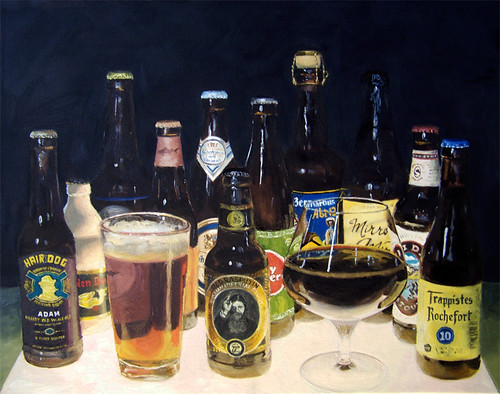
Today’s paintings are part of an exciting new project by a married couple working collaboratively on their Beer Paintings. Louie Van Patten is from Des Moines, Iowa but studied painting in Central Oregon. His wife, Cara Thayer, learned her craft at the Art Institute of Chicago, but she’s originally from Bend, Oregon, and that’s where the pair now make their home. Their regular art, showcased at The Gryllus has been exhibited in Bend and from Palo Alto to Vancouver. But being in Bend, home to Deschutes, “phenomenal beer is unavoidable and is bound to convert anyone who tries it,” as was the case with Thayer and Patten. So they decided to combine their love of good beer with their art, and the result is the newly launched Beer Paintings project. The very first painting was done for their local beer store, The Brew Shop.

Patten_Thayer-stilllife1

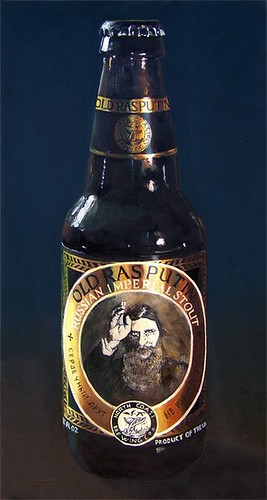
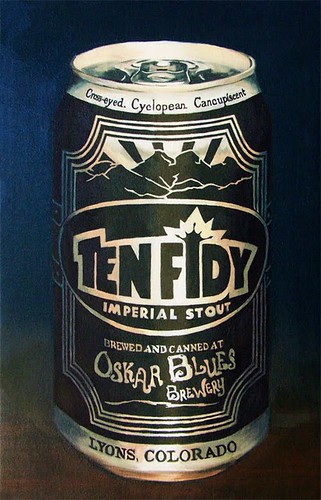
They’ve also been painting bottles, cans and crowns. Here’s a representative sample below.

Patten_Thayer-oldrasputin
North Coast’s Imperial Stout Old Rasputin.

Patten_Thayer-tenfidy
Oskar Blues’ imperial stout Ten Fidy.

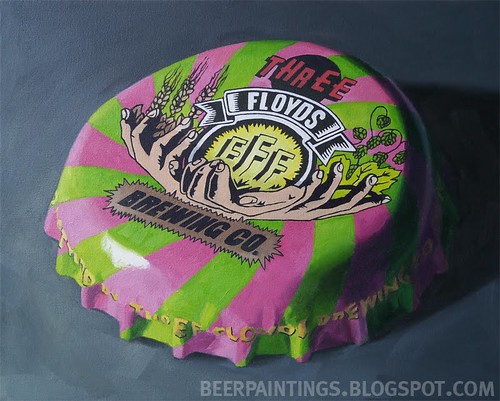
Patten_Thayer-3floyds
A crown from Three Floyds Brewing.

I asked Patten about the beer paintings.

These beer paintings have been somewhat of a side project, with our regular, very different body of work being the paintings at The Gryllus. Craft beer has always been a huge part of our painting ritual and one of our biggest interests outside of art. We did the first painting as a gift to The Brew Shop, but we found there was something really enjoyable about merging our hobby of collecting and drinking craft beers with our full-time painting practice. There is also something we like about the idea of an un-ironic contemporary still-life, especially in the case of painting something like Oskar Blues’ Ten Fidy, with canned beers typically being derided for their aesthetics. Ultimately, these paintings are about externalizing the beer drinking experience into something that can be enjoyed when you can’t imbibe. We like the idea of giving people who are passionate about good beer another way to show it, with the dignity it deserves.

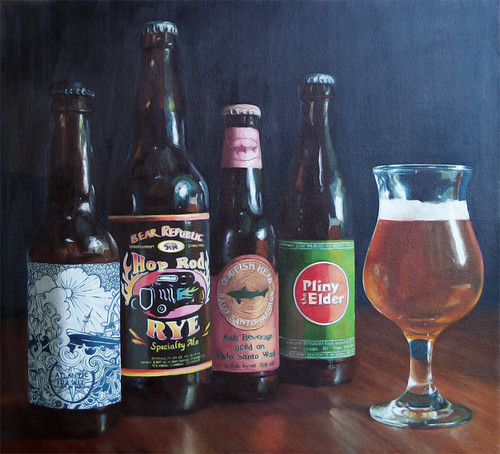
And here’s their most recent painting, featuring some more really great beers, including a few local ones to me.

Patten_Thayer-stilllife2

Filed Under: Art & Beer, Beers Tagged With: Oregon

Guinness Ad #32: The 1953 Coronation

August 21, 2010 By Jay Brooks

guinness-toucan
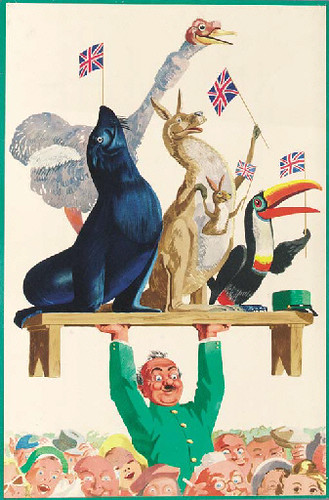
Our 32nd Guinness poster by John Gilroy was a one-off for a specific event, the 1953 coronation of Queen Elizabeth II.

Guinness-parade

The zookeeper is shown holding up a bench — presumably made possible from drinking a Guinness — with four of the animals used in various Guinness ads over the years, all waving British flags. There’s no text at all, but I assume everyone would have understood it at the time.

Filed Under: Art & Beer, Beers Tagged With: Advertising, Guinness, History, UK

Beer In Ads #177: Ludwig Hohlwein’s Spaten

August 20, 2010 By Jay Brooks

ad-billboard
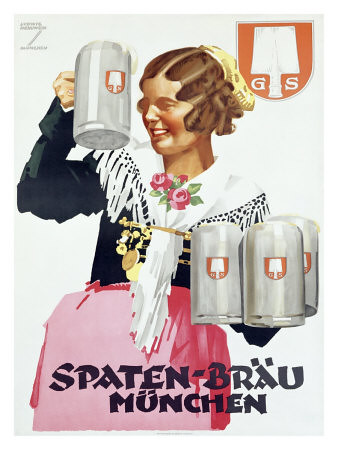
Friday’s ad is for the German brewery Spaten from either 1924 of 1933 (accounts differ). It’s by the famous German poster artist Ludwig Hohlwein. I love the stylized server and just the timeless quality of the art.

ludwig-hohlwein-spaten-brau

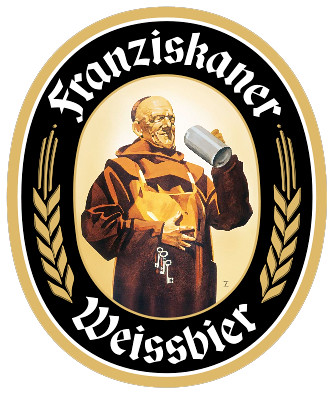
As far as beer is concerned, Hohlwein is probably best know for creating the artwork of the monk used in the label for Franziskaner Weissbier.

franziskaner-weissbier

Filed Under: Art & Beer, Beers Tagged With: Advertising, Germany, History

Less Alcohol Advertising Makes No Difference

August 20, 2010 By Jay Brooks

upside-down-world
The world is turned upside down. All of the neo-prohibitionist groups have been complaining for a very long time, since 1933 in fact, that alcohol advertising has to be severely restricted. The moment the 21st Amendment passed, ending Prohibition, the temperance groups didn’t admit defeat and start minding their own business but simply changed tactics. Instead of trying to make alcohol illegal for everyone, they tried to make it harder and more expensive for the companies to do business and harder for the consumers who wanted it to find it and/or afford it.

That’s a strategy they’ve continued to push over the past 75+ years, and in fact they’ve really stepped up those efforts lately. That’s why the anti-alcohol groups are constantly trying to get taxes on alcohol raised. It’s also why they’re trying to to get more and more restrictions on how and where alcohol can be advertised. One of their most persistent claims is supposedly how harmful alcohol ads are to young people. They’ve even got their own “studies” to prove it.

A recent one by the Center on Marketing Alcohol and Youth (CAMY) begins with the premise that “there is growing evidence that youth (defined as 12-20 years olds) exposure to alcohol advertising increases the likelihood and quantity of underage drinking.” Back in 2003, because of the whining of the anti-alcohol groups, the major alcohol companies pledged to reduce their advertising in publications that also included underage readers.

So CAMY last week released the results of a study they conducted to see the Youth Exposure to Alcohol Advertising in National Magazines, 2001-2008. The study found the following:

  • From 2001 to 2008, youth exposure to alcohol advertising in magazines fell by 48 percent. Adult (age 21 and above) exposure declined by 29 percent and young adult (ages 21 to 34) dropped by 31 percent.
  • Alcohol advertising placed in publications with under 21 audiences greater than 30 percent fell to almost nothing by 2008.
  • Youth exposure in magazines with youth age 12-to-20 audience composition above 15 percent declined by 48.4 percent.

Overall, in other words, they found that there’s far less ads in publications which young people might read. Which is what they wanted, right? So you’d think they’d be happy, wouldn’t you? But here’s the thing. They continue to proselytize that young people are drinking more and more, even right in the study itself, which gives the following background. “More young people in the U.S. drink alcohol every month than smoke cigarettes or use any illegal drug. In 2008, 10.1 million young people between the ages of 12 and 20 reported drinking in the past month, and 6.6 million reported binge drinking.”

So let’s see if I have this straight. The study shows, as Health Day reports, “alcohol makers have largely met the industry’s voluntary standard (adopted in 2003) of not placing ads in magazines with 30 percent or more youth readership.” And yet underage drinking continues to soar according to these same groups. Is it just me, or does that seem contradictory? If kids seeing ads for alcohol is the huge problem they claim it is, wouldn’t you expect that if there are fewer ads directed at children, that underage drinking would decrease. But that’s not apparently what’s happened. So maybe it’s time for the neo-prohibitionists to admit these ads weren’t the big problem they claimed and their self-serving studies were as bogus as a three-dollar bill.

I shouldn’t even have to explain how ridiculous it is that a magazine should lose advertising at a time when all print publications are having a hell of time making ends meet just because what they write about appeals to both adults and people under 21. Why, for example, should Rolling Stone — with a 12-20 year-old readership of around 25% — not advertise to the 75% of its readers who are legal adults just because both adults and young people enjoy music. And who came up with the 12-20 range? I can’t imagine how a twelve-year old reacts to an alcohol ad is remotely similar to a twenty-year old. That they consider all kids in that age range as the same seriously calls into question the entire exercise. Eighteen-to-twenty year olds (who incidentally should be allowed to legally drink) might be swayed by alcohol advertising if they’re alcoholically active, but a twelve-year old? It’s absurd.

The study did show that while wine and liquor dropped across the board, beer did rise slightly to fill the void. But while this is undoubtedly an unpopular idea, I much prefer my kids might see a beer ad over something laden with high fructose corn syrup, like soda, pop or soft drinks. Beer at least is all-natural and is not loaded with chemicals like soda. And last time I checked, it was still illegal for kids to actually buy beer. So no matter how the little darlings react to the horror of seeing an advertisement for beer, it really shouldn’t matter one wit. They still can’t buy it. Before the angry comments begin, I realize that underage kids can manage to get their hands on booze, but that sill doesn’t change the fact that it’s already illegal. It’s still not a valid argument why adults shouldn’t be allowed to see a beer ad in a publication that someone under 21 might also happen to see. And guess what, it’s not working anyway. Reducing the ads themselves has not resulted in kids under 21 drinking less, in fact just the opposite if we accept the anti-alcohol faction’s own propaganda. Their own studies seem to show that reducing those ads — as they insisted was necessary — is having almost no impact on underage drinking.

Filed Under: Editorial, News, Politics & Law Tagged With: Prohibitionists, Statistics

Beer In Ads #176: Biere Phenix

August 20, 2010 By Jay Brooks

ad-billboard
Thursday’s ad continues our week of ads from France, this one done in 1930. It’s for Biere Phenix, which was founded in 1886. The artist’s name is Leon Dupin. Either the sailor’s drinking in the fog, or he has a disembodied hand.

leon-dupin-biere-phenix

Filed Under: Art & Beer, Beers Tagged With: Advertising, France, History

Civilization’s First Decision: Orgies Or Beer?

August 19, 2010 By Jay Brooks

ninkasi-tablet
Gizmodo has an intriguing post up right now, combining ideas from two books about early man and the dawn of civilization, Sex at Dawn: The Prehistoric Origins of Modern Sexuality and Uncorking the Past: The Quest for Wine, Beer, and Other Alcoholic Beverages. In Orgies or Beer? You Only Get One, author Joel Johnson speculates that early man eschewed group sex with multiple partners to settle down and make beer, setting us on the path to modern civilization, monogamy and the happy hour. As long as you don’t take it too seriously, it’s a pretty funny idea. (In other words, you can safely ignore the many outraged commenters who seem to have confused Gizmodo with an academic journal, they’re an entirely different kind of funny.)

As Patrick McGovern makes the case in Uncorking the Past, a growing body of evidence is pointing to alcohol — and most likely beer, or a rudimentary form of it, at least — as the reason early nomadic man settled down, in order to grow the crops to insure a steady supply of it. In other words, beer, rather than bread, may have been responsible for civilization as we know it today, with all its good and bad developments and legacies. In the newer book, Sex at Dawn, authors Christopher Ryan and Cacilda Jethá argue that what we gave up for civilization, agriculture and beer was free love, group sex and orgies. Gizmodo summarizes the book’s claims in chart form.

agro-to-war

One thing that’s funny about the chart is that everything leads to war, and the most hate-filled comment that I ever received was from someone calling himself “The Savagist” who took that same view to ridiculous heights. He vehemently believed that beer and alcohol were directly responsible for every bad thing that ever happened in the history of mankind, ignoring anything good that civilization also brought. Given his epithet, one might have reasonably presumed he had or wanted to return to that savage “pre-civilized” time, but he was obviously still living in a building, with electricity, and typing on a computer connected to the internet, with no sense of irony. Apparently, when he looked in Pandora’s Box, there was no hope at all after beer released all the evil into the world. Me, I found hope … and hops.

But back to Sex at Dawn, and the key points, as laid down in the Gizmodo article:

  • Before humans settled down into civilization, we were small bands of hunter-gatherers who had no notion of sexual monogamy. Within our relatively small tribes, most humans had multiple partners, primarily from within the tribal group, although occasionally we’d have a dalliance with a stranger to keep the DNA pool zesty. Children had multiple social “fathers,” jealousy was nearly nonexistent, and relatively easy access to calories kept us fit, happy, and satisfied well into our 70s and 80s—provided we managed to get past the perils of high mortality rates expected from a wild environment and primitive medicine.
  • Upon the discovery of agriculture, nomadic wandering was no longer possible—someone has to stick around to water the crops—so the ideas of property and inheritance became sadly useful. Domesticated food could become scarce, unlike the effectively endless bounty of hunter-gathering (ignoring the occasional climate-torqued famine or run of bad luck), so hoarding became necessary to ensure calories even in lean times. It’s a lot of work to farm, so it became important to ensure that you weren’t wasting your precious grains on someone else’s offspring, especially if it meant you own kid was getting short shrift. Hence monogamy, marriage, and the unfortunate concept of partners as property, manifested in agrarian societies as a tendency to view women as chattel.
  • Our genes, still tuned toward sexual novelty, cause us to really hate being monogamous, but societal pressures—including centralized codified religion—force men and women into an arrangement that brings with it just as many problems as it solves. Men cheat, women wither in sexual shackles (or, you know, cheat), wars erupt over resources or sexual exclusivity, cats and dogs almost start sleeping together except they’re afraid the neighbors might find out—Old Testament, real wrath of God-type stuff.

But accidental alcohol was around for probably millions of years and the “drunken monkey hypothesis” proposed by biologist Robert Dudley “attempts to explain why our bodies have evolved such a happy capacity for metabolizing ethanol.” McGovern extends that idea in Uncorking the Past.

On average, both abstainers and bingers have shorter, harsher lives. The human liver is specially equipped to metabolize alcohol, with about 10 percent of its enzyme machinery, including alcohol dehydrogenase, devoted to generating energy from alcohol. Our organs of smell can pick up wafting alcoholic aromas, and our other senses detect the myriad compounds that permeate ripe fruit.

A couple of years ago, this came up in a different context, in a post I wrote entitled Beer and Civilization which discussed a book by Steven Johnson entitled The Ghost Map: The Story of London’s Most Terrifying Epidemic — and How It Changed Science, Cities, and the Modern World. In Johnson’s book, he discusses how at the dawn of civilization, survival often depended on how a person’s body reacted to and could tolerate the beer that was generally safer to drink than water. Over time, only people who were genetically predisposed with the ability to drink large quantities of beer survived, passing that trait down to their children so that perhaps today most of us have such an ancestor as evidenced simply by the fact that we’re here. As [George] Will (and Johnson) explains.

The gene pools of human settlements became progressively dominated by the survivors — by those genetically disposed to, well, drink beer. “Most of the world’s population today,” Johnson writes, “is made up of descendants of those early beer drinkers, and we have largely inherited their genetic tolerance for alcohol.”

But sitting here in my pajamas, typing on my laptop, beer in hand, surrounded by the trappings of modern society, I can’t help but think we made the right choice. I know the world has many, many challenges and problems but would any of us be happier crawling around the Savannah in a loincloth hunting (and gathering) for our next meal — and without a beer to pair with it? Beer may have been responsible for the single greatest butterfly effect in our civilization’s history because it’s nearly impossible to say what life might be like had we not taken the path we’re on. Did we give up orgies for our beer and civilization? Who knows, but I still think we chose wisely.

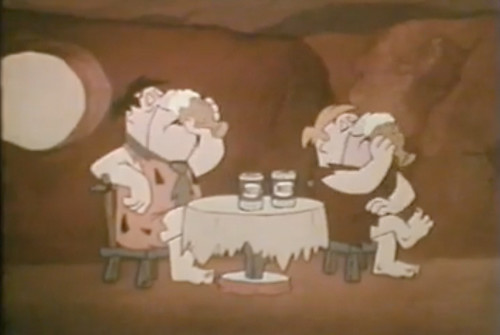
Another funny and very interesting excerpt from Sex at Dawn is The Flintstonization of Prehistory in which modern morals and values are super-imposed on to the past.

flint-busch-3

Filed Under: Beers, Editorial, Food & Beer, Just For Fun Tagged With: Archeology, Beer Books, History, Science

Beer In Ads #175: Biere De Vezelise

August 18, 2010 By Jay Brooks

ad-billboard
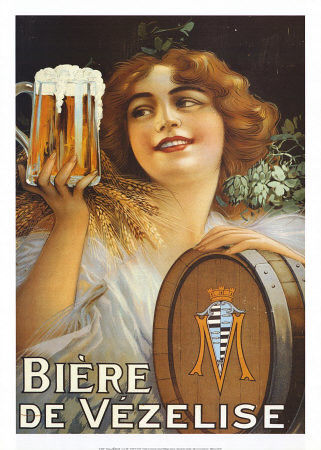
Wednesday’s ad is yet another one from France, done in 1920. It’s for Biere De Vezelise, a brewery that was located in northeastern France since 1863, when it was founded by Antoni Moreau. The brewery closed in 1971. The artist’s name is Guerzan.

guerzan-biere-de-vezekise

Filed Under: Art & Beer, Beers Tagged With: Advertising, France, History

« Previous Page
Next Page »

Find Something

Northern California Breweries

Please consider purchasing my latest book, California Breweries North, available from Amazon, or ask for it at your local bookstore.

Recent Comments

  • Bob Paolino on Beer Birthday: Grant Johnston
  • Gambrinus on Historic Beer Birthday: A.J. Houghton
  • Ernie Dewing on Historic Beer Birthday: Charles William Bergner 
  • Steve 'Pudgy' De Rose on Historic Beer Birthday: Jacob Schmidt
  • Jay Brooks on Beer Birthday: Bill Owens

Recent Posts

  • Beer In Ads #5218: The “Butter-In” Of The Season April 12, 2026
  • Beer In Ads #5217: The King Of All Beers April 11, 2026
  • Historic Beer Birthday: Gambrinus April 11, 2026
  • Beer In Ads #5216: The Finest Bock, As Usual April 11, 2026
  • Historic Beer Birthday: Anton Heeb April 11, 2026

BBB Archives

Feedback

Head Quarter
This site is hosted and maintained by H25Q.dev. Any questions or comments for the webmaster can be directed here.