Brookston Beer Bulletin

Jay R. Brooks on Beer

  • Home
  • About
  • Editorial
  • Birthdays
  • Art & Beer

Socialize

  • Dribbble
  • Email
  • Facebook
  • Flickr
  • GitHub
  • Instagram
  • LinkedIn
  • Pinterest
  • RSS
  • Twitter
  • YouTube

Powered by Genesis

Charting Beer With Infographics

November 30, 2009 By Jay Brooks

piechart
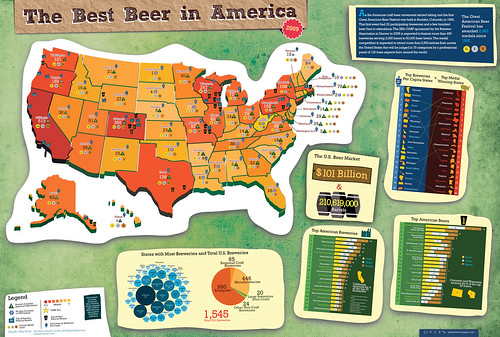
My friend and colleague Rick Lyke has the good fortune to have a son-in-law who’s a graphic designer and really, really good at creating graphs or infographics, which is essentially a chart that tell a story. For the second year in a row, Rick has persuaded his son-in-law, Mike Wirth, to create an awesome infographic of various GABF medal statistics for his Lyke2Drink blog. Since he introduced this back in August, about a month before this year’s GABF, hopefully he won’t mind my sharing it. I’ve parsed some of the most interesting mini-charts within the infographic and displayed them below.
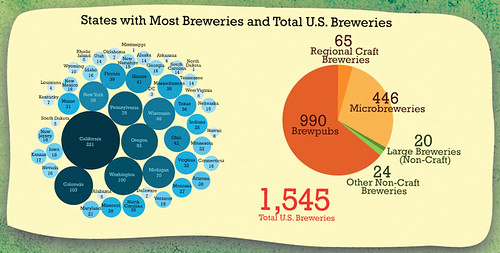
most-breweries-vs-total
These charts show the number of breweries by state and the total number by type or size of brewery.
breweries-vs-medals
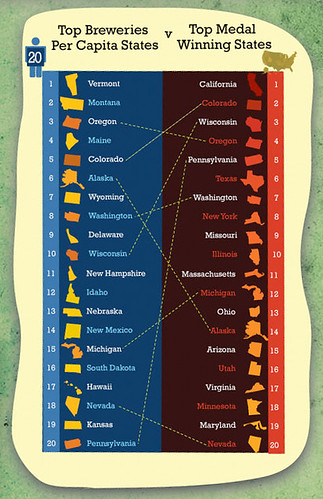
This is a chart of states with the most per capita breweries vs. the states that have won the most cumulative medals since they began awarding medals through 2008.
top-amer-breweries-09
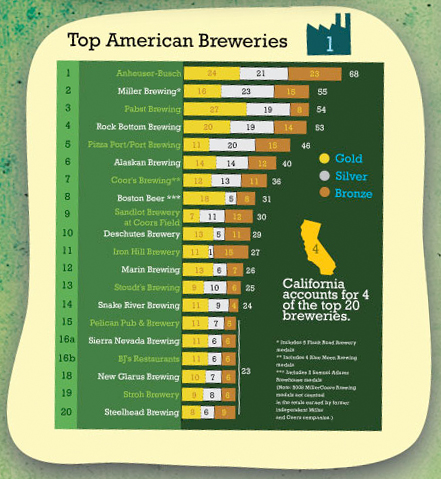
This is a chart of the breweries that have won the most cumulative medals since they began awarding medals through 2008.
top-amer-beers-09
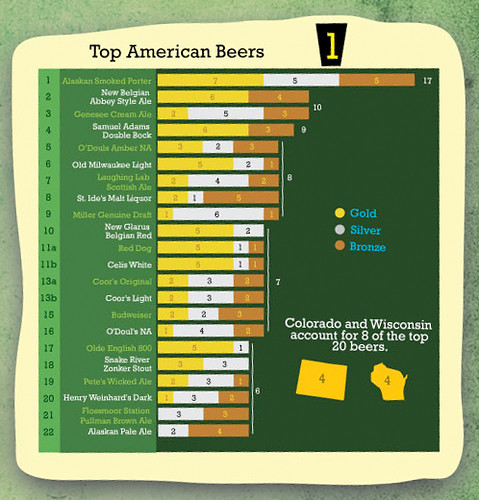
This is a chart of the individual beers that have won the most cumulative medals since they began awarding medals through 2008.
west-coast-gabf-medals
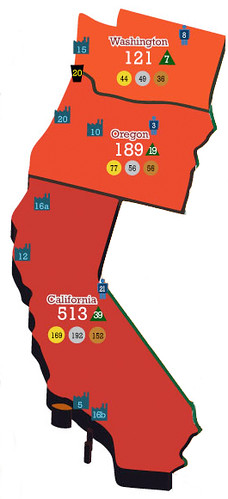
Lastly, here is a detail of the west coast and the medals won by breweries in California, Oregon and Washington.
best-beer-america-2009
This is the entire infographic, show smaller of course, but click here to see it full size or see it at Mike Wirth’s website or with Rick Lyke’s original analysis.

Filed Under: Beers, Breweries, Just For Fun Tagged With: Awards, GABF, Statistics

Inventing Binge Drinking

November 30, 2009 By Jay Brooks

drunk
I’ve long railed against the various governmental health department definitions of “binge drinking” as being out of touch with reality and self-serving to anti-alcohol groups. In the U.S., the CDC defines binge drinking as “five drinks in a row” and in the UK it’s too many “units of alcohol” in a given day (or number of hours). But that wasn’t always how it was defined.

In a recent issue of the Social History of Medicine, an Oxford Journal, social scientists Virginia Berridge, Rachel Herring and Betsy Thom published Binge Drinking: A Confused Concept and its Contemporary History.

Here’s the summary of the article:

Binge drinking is a matter of current social, political and media concern. It has a longterm, but also a recent, history. This paper discusses the contemporary history of the concept of binge drinking. In recent years there have been significant changes in how binge drinking is defined and conceptualised. Going on a ‘binge’ used to mean an extended period (days) of heavy drinking, while now it generally refers to a single drinking session leading to intoxication. We argue that the definitional change is related to the shifts in the focus of alcohol policy and alcohol science, in particular in the last two decades, and also in the role of the dominant interest groups.

To me, one of the key points of this article is how the definition has changed to create a panic of increasing binge drinkers when it’s far more likely rates are roughly the same, only the definition has changed so that it not only seems like the problem has grown worse, but so that anti-alcohol advocates have a convenient new method by which they can base ever more draconian policy demands.

Binge drinking as a concept has a distant history: but it also has a recent one. The term has come in recent years to describe two quite distinct phenomena. First, it is used to describe a pattern of drinking that occurs over an extended period (usually several days) set aside for the purpose. This is the ‘classic’ definition, linked to clinical definitions of the disease of alcoholism, as in Jellinek’s 1960 classification. Secondly, binge drinking has come to be used to describe a single drinking session leading to intoxication, often measured as the consumption of more than a specific number of drinks on one occasion, often by young people. There is no consensus on how many drinks constitutes this version of binge drinking—how much alcohol—and a variety of ‘cut-offs’ are used.

The second meaning has become prominent in recent years, is used extensively in research and informs UK policy. The ‘new’ definition has largely, but by no means entirely replaced the ‘classic’ definition, and both terms co-exist, if somewhat uneasily at times, in the alcohol field. Thus, it was evident from our research that there has been a shift in recent history in the meaning of the term. What was less clear was how the current confused definition of binge drinking has come to hold sway in public and policy discussions when it seems to be different from definitions which operated in the past. This is an issue which has implications for policy. But it is also a change which throws light on the relationship between science and policy. Our overall hypothesis, which is set out in this discussion paper, is that the definitional change must be related to the shifts in the focus of alcohol policy and alcohol science, in particular in the last two decades, and also to the role of the dominant interest groups in the alcohol field. It is not a change simply in the types of people drinking and the ways in which they drink, but rather an issue of perception which tells us something about the ways in which science and policy interact. [My emphasis.]

And the perception, as well as the target, has indeed changed. While binge drinkers used to be thought of as solitary older males, today the binge drinking “focus is on women and young people.” Although they’re careful in the wording of the article, I think it’s clear they’re saying that the shift in defining binging has been a bad idea, as it’s taken the focus away from the people who really need help and placed it on a more convenient target that allows neo-prohibitionist groups to sound the alarm about the problems of underage drinking — the children, always the children. People naturally want to protect kids from harm, and so it’s much easier to advance destructive alcohol policy under the rubric of underage drinking issues. I’d argue that this is even likely the reason for the shift in the definition, to advance the anti-alcohol agenda more effectively. Fear is always more effective than truth, sadly, in motivating people.

Among the journal article’s conclusions:

Policy makers should be aware of the context in which they operate. Concepts do not appear out of thin air, but have their own history. This study can in fact be seen as feeding in ‘evidence’ to policy on the rational model. On a more theoretical level, this change of definitions over time is also a case study of evidence and policy itself. It tells us how science interacts with policy making and the policy environment.

Exactly. In this case, the science was manipulated and created to further a specific anti-alcohol agenda over the last two decades. As a result, everyone I know is a binge drinker. That’s what happens when science no longer reflects reality but instead is used to remake it.

Filed Under: Beers, Editorial, Politics & Law Tagged With: Health & Beer, Prohibitionists

The American Beer Question

November 30, 2009 By Jay Brooks

usa
The American beer question, simply put — what is an “American Beer” — has been much debated in recent years, especially in the wake of InBev’s purchase of Anheuser-Busch last year. In The Daily Campus, a Connecticut student newspaper, author Tom Godwin wonders aloud in his essay The American Beer.

What exactly is an American beer? I’ve been asking myself that question a lot the last few days. Is it simply a beer that was first made in America, or is it a beer that is better when made here than anywhere else? What about an old style with a new American twist; does that make it American or simply an imitation?

It’s a question that hasn’t yet been answered with complete satisfaction, and he definitely adds some interesting thoughts to the debate. Most of all, I like that as a young man, he’s proud and supportive of American innovation. He opines that “American brewers are never satisfied with what they are doing, and that is the true ideal of beer in this country.” He gets it, unlike older writers who cling to tradition instead (but more about that in a post later today).

But it’s his conclusion that sticks with me.

American beer, just like its people, is an extreme melting pot of creativity, tradition, capitalism and an unnerving sense of complete disregard for reality. I don’t think I’d have it any other way.

Filed Under: Beers, Editorial Tagged With: United States

Beer In Art #54: Vangobot’s 99 Bottles Pop Art

November 29, 2009 By Jay Brooks

art-beer
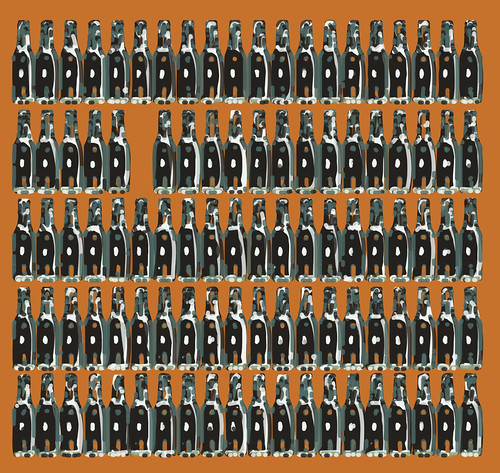
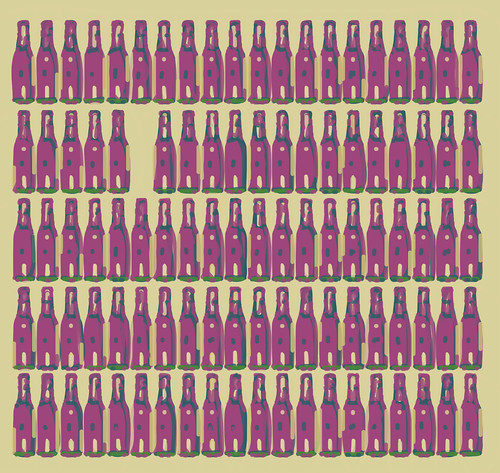
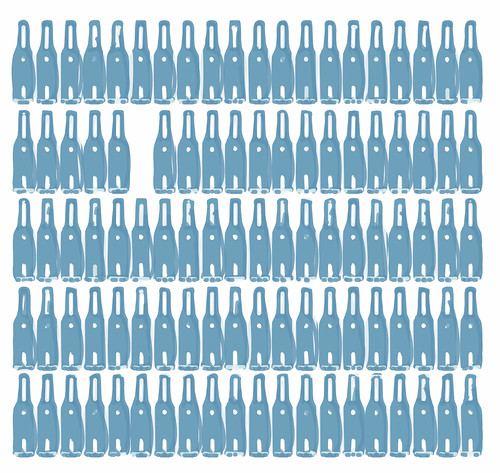
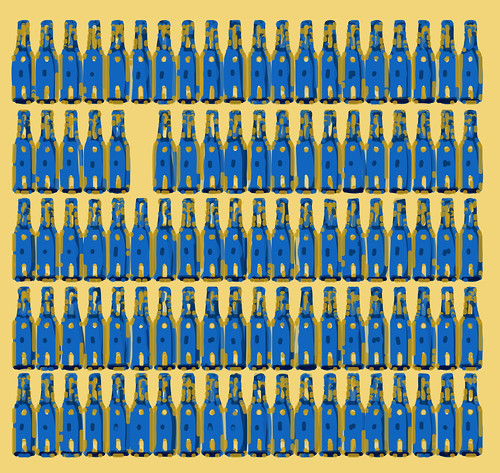
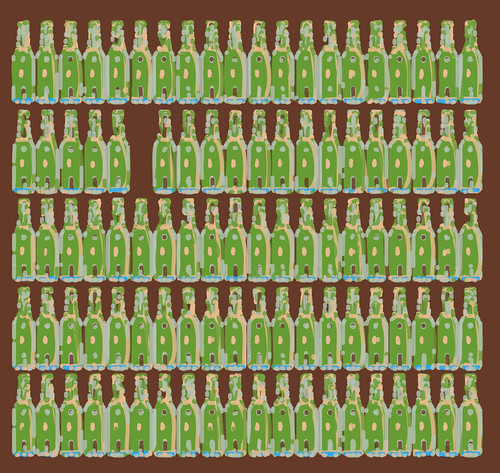
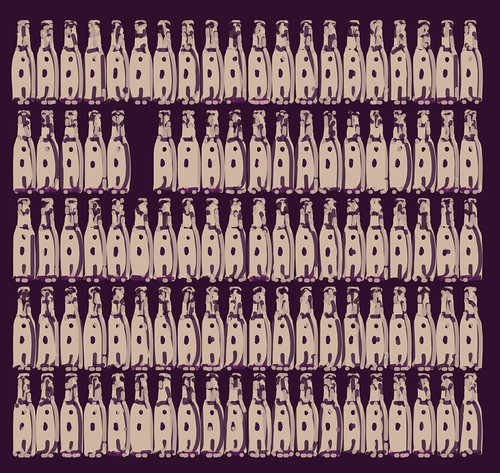
Today’s work of art may be one of the strangest pieces I’ve highlighted here, and may in fact stretch the definition of what actually constitutes “art.” The piece, or rather pieces, were designed by a human artist, but were painted by a robot, dubbed “Vangobot,” no doubt a reference to Vincent Van Gogh. The title of the work is a literal one, 99 Bottles of Beer on the Wall.

99_bottles-Reflect
99 Bottles of Beer on the Wall — Reflect.

The Vangobot is the brainchild of the Pop Art Machine and here’s their description:

Pop Art Machine is an experimental art suite that renders complex vectors portraying many different brush sizes, paint layers and brush handling techniques. The results can be printed but also physically painted with acrylics on canvas using a specialized CNC based robot named Vangobot.

There’s even a short video of Vangobot in action, painting.

99_bottles-Spring_Fashion
99 Bottles of Beer on the Wall — Spring Fashion.

There are fifteen different versions of 99 Bottles of Beer on the Wall, of which I’ve featured seven of them here. As far as I can tell, the names of each version have something to do with either their color scheme or an association made from that color.

99_bottles-Trident
99 Bottles of Beer on the Wall — Trident.

At the Pop Art Machine website there are over 20,000 paintings done by Vangobot.

99_bottles-Theology
99 Bottles of Beer on the Wall — Theology.

The website features Pop Art, a style that’s as much an attitude as a style. From Wikipedia:

Pop art is a visual art movement that emerged in the mid 1950s in Britain and in the late 1950s in the United States. Pop art challenged tradition by asserting that an artist’s use of the mass-produced visual commodities of popular culture is contiguous with the perspective of fine art. Pop removes the material from its context and isolates the object, or combines it with other objects, for contemplation. The concept of pop art refers not as much to the art itself as to the attitudes that led to it.

Pop art is an art movement of the twentieth century. Characterized by themes and techniques drawn from popular mass culture, such as advertising, comic books and mundane cultural objects, pop art is widely interpreted as a reaction to the then-dominant ideas of abstract expressionism, as well as an expansion upon them. Pop art, aimed to employ images of popular as opposed to elitist culture in art, emphasizing the banal or kitschy elements of any given culture, most often through the use of irony. It is also associated with the artists’ use of mechanical means of reproduction or rendering techniques.

Much of pop art is considered incongruent, as the conceptual practices that are often used make it difficult for some to readily comprehend. Pop art and minimalism are considered to be the last Modern Art movements and thus the precursors to postmodern art, or some of the earliest examples of Postmodern Art themselves.

Pop art often takes as its imagery that which is currently in use in advertising.[5] Product labeling and logos figure prominently in the imagery chosen by pop artists. Consider the Campbell’s Soup Cans labels, by Andy Warhol. Even the labeling on the shipping carton containing retail items has been used as subject matter in pop art. Consider Warhol’s Campbell’s Tomato Juice Box 1964, (pictured below), or his Brillo Soap Box sculptures.

99_bottles-Blue
99 Bottles of Beer on the Wall — Blue.

Some of the most well-known Pop Artists include Andy Warhol, Roy Lichtenstein, Jasper Johns and Keith Haring (who was born in Reading, PA but grew up in nearby Kutztown; I had his uncle as my art teacher in high school).

99_bottles-gone_walkabout
99 Bottles of Beer on the Wall — Gone Walkabout.

All fifteen versions of 99 Bottles of Beer on the Wall can be downloaded in the high resolution size of 3600 × 3406 so it can be printed fairly large, perhaps large enough to fill your wall.

99_bottles-Astoria
99 Bottles of Beer on the Wall — Astoria.

For about Pop Art, beyond Wikipedia, there’s also some good info at the Art Archive, Art Lex, World Wide Arts Resources and Pop Art Machine has a large collection of articles about Pop Art.

Filed Under: Art & Beer, Just For Fun

Beck’s Sale Called Off

November 28, 2009 By Jay Brooks

becks-white
Reuters is reporting that the impending sale of Beck’s by Anheuser-Busch InBev has been scuttled, by ABIB. According to the weekly German magazine WirtschaftsWoche, the 1.7 billion Euro ($2.54 billion) contract was ready to be sign by purchaser U.S. buyout firm Bain Capital when ABIB walked away from the deal. WirtschaftsWoche is speculating that the earlier “sale of 13 eastern European breweries for 2.2 billion euros in October eased Anheuser-Busch InBev’s debt burden enough for the brewing giant to call off the Beck’s deal.” That’s all that’s known so far, but I’m, sure we’ll learn more on Monday.

Filed Under: Breweries, News Tagged With: Anheuser-Busch InBev, Business, Germany

Toy Beer Trains

November 27, 2009 By Jay Brooks

train
Today, of course, is the busiest shopping day of the year. I’m staying home and drinking, as usual, but yesterday at my in-laws, my mother-in-law put up on the wall a giant poster where the grandkids could list all the toys they were hoping Santa might bring them this year. My son Porter filled out his entire section with requests for trains, particularly Lionel trains. He’s been obsessed with trains as long as I can remember. First it was Thomas the Tank Engine, then the I Love Toy Trains series, followed by Geo Trax. For a while now, though, he’s been fully engrossed in the expensive model trains, especially HO and G gauge, which seem to be his favorites. It what almost appears savant-like, he knows more about trains than anyone I know. To me, the old black steam trains all look alike but he sees them and cries “that’s the Big Boy” or the “GG-1” or some other unfamiliar name with complete certainty. I’d think he’s just making it up but recently at the barber shop, another man waiting his turn happened to run a local train museum and the two of them talked about trains like equals. The man confided in me later that my son had truly impressed him with his train knowledge, confirming what I’d always believed, that Porter really is as obsessed as I can be, just about different things. The apple really doesn’t fall very far from the tree.

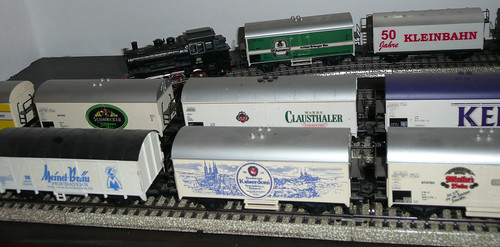
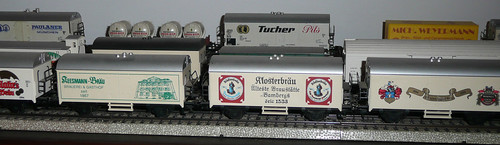
One thing that’s surprised me is that I see toy trains with breweries on them all the time. But what I’ve learned about model trains is that despite the word “toy” often being associated with them, there are far more adults collecting them than kids. For one thing they’re very, very expensive. So I suspect that’s why they can get away with so many beer-themed boxcars and the like. When we got home last night from or holiday feast, I decided to do a quick Google search for toy trains for breweries. Lots of lots of them, big surprise. There’s even a guy out there who collects toy beer trains, and he’s cataloged 780 of them with 658 photos. Check out The H.O. Beer Car Collectors Website and be amazed.

The most I’ve ever seen in one place is in Germany, at Weyermann Specialty Malt in Bamberg.
weyermanns-3
In Weyermann’s meeting room, the wall is completely filled with brewery signs and every available shelf, mantle and ledge has toy trains on them.

weyermanns-1
Mostly European brands, but there are a surprising number of American brewery trains, too.

Below is a slideshow of just a sampling of all the toy beer trains I found online. Most are from the The H.O. Beer Car Collectors, which is hands down the best resource I came across. The Flickr gallery is best viewed in full screen. To view it that way, after clicking on the arrow in the center to start the slideshow, click on the button on the bottom right with the four arrows pointing outward on it, to see the photos in glorious full screen.

Filed Under: Breweries, Just For Fun, Related Pleasures Tagged With: Christmas, Gift Ideas, Holidays

Beer In Ads #7: National Premium & Turkey

November 26, 2009 By Jay Brooks

ad-billboard
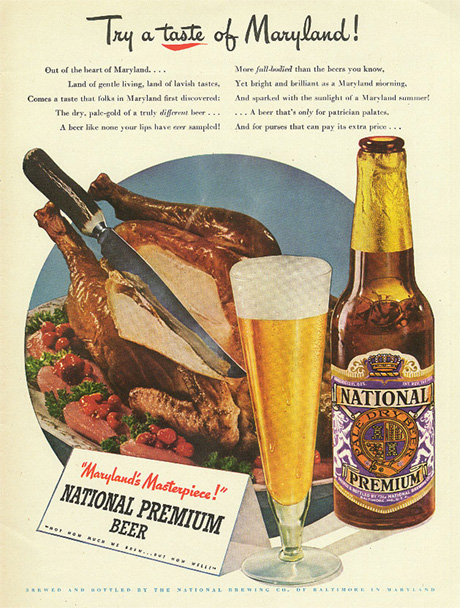
Today’s ad is more modern, because it’s Thanksgiving Day and I wanted to use one that was done for the holiday. This juicy turkey ad was for National Premium Beer, subtitled a “Pale Dry Beer,” and brewed by National Brewing of Baltimore, Maryland from 1936-1995. While accounts of the brewery’s origin vary from around 1850, 1855 or 1872 (and under several different names), after Prohibition ended, it returned as National Brewing with its most famous beer being National Bohemian, or “Natty Boh,” which today is owned by Pabst and brewed by Miller. This ad is for their premium beer, and is from the 1950s. Hoppy Thanksgiving.

national-turkey

Filed Under: Art & Beer, Beers, Breweries Tagged With: Advertising, History, Holidays, Maryland

Hoppy Thanksgiving a.k.a. Beer & Turkey Day

November 26, 2009 By Jay Brooks

turkey
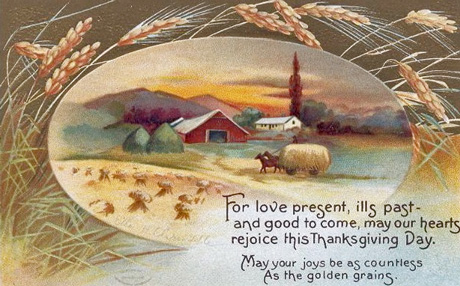
Hoppy Thanksgiving everybody. “May your joys be as countless as the golden grains.”

beer-and-turkey
For quite some time now — personally at least — Thanksgiving is really “Beer & Turkey Day.” I love turkey. I could eat it several times a week and not get tired of it. But unlike most people, I like it dry — no gravy. It stems from my Great Aunt Helen, who couldn’t make a turkey juicy to save her life, even though her heart was in the right place. And I never liked gravy all that much; weird, I know. As a kid, it just meant developing a taste for dry turkey. As an adult, it means finding the right beer to counteract the dryness I now love so much. Of course, making it wok with not just the turkey but also cranberry sauce, stuffing, potatoes and the rest of the feast is also a challenge.

For me, I’ve found that spicy beers work best for the Thanksgiving meal, the spicier the better for my purposes. Not everybody likes their beer spiced, I know, but my feeling is there are 364 other days when you can drink those.

My two favorites for Thanksgiving are Anchor’s Christmas Ale and Pike’s Auld Acquaintance.

Though Anchor’s “Our Special Ale” began in 1975 as essentially a brown ale, over the years since it became more holiday-oriented as spices were increasingly added. In my opinion, it’s best years were the later half of the 90’s decade when it was very spicy indeed. Though most people thought they were too spicy during that period of time, I reveled in the complex spiciness and found them to be the perfect complement to dry turkey and the other Thanksgiving fixings.

When Pike began making their Auld Acquaintance, they loaded it with spices and it quickly became my new favorite, especially when Anchor started backing off the spiciness of the Christmas Ale as the new millennium dawned. But early in the 2000s, it was discontinued in the bottle and I was unable to get it, returning instead to Anchor’s Christmas Ale, even though I wish it was spicier.

Happily, Pike under the new/old owners is bottling it Auld Acquaintance again, though it doesn’t appear to be exactly the same. It used to be around 6.5% abv, if memory serves, whereas the new bottle is a more modest 5%. It does contain orange peel, coriander, cinnamon and nutmeg. I also remember it being hoppy, while the 2008/9 version is only 32 IBUs.

turkey

So this year, happily I got to try both beers with dinner. I started with the Anchor, and it delivered almost everything I wanted, though I still pine for it to be even more spicy. But it certainly worked with my meal. The Auld Acquaintance, on the other hand, was slightly disappointing. It was thinner-bodied than I remember it and the spiciness was likewise more restrained. There was a lot there, but I wanted to be hit over the head, rather than be spoon fed. Still, I can’t complain. They both worked well and as I sit here writing this the rest of the family cleans up — and shoots me dirty looks — but I am completely satisfied. Ah, beer and turkey — a match made in heaven.

In past years, there were quite a few suggestions for beer and turkey pairings. Really, they’re almost all good suggestions. The important thing is family and friends. But the beer is the icing on the cake that makes the meal divine.

thanksgiving

Filed Under: Beers, Food & Beer, Just For Fun Tagged With: Holidays

A Clockwork Orange Approach To Alcoholism

November 25, 2009 By Jay Brooks

clockwork-orange
This is a strange one, and I’m not entirely sure what to make of it, though my natural skeptical tendencies run toward worry. As reported in the USA Today last week in an article entitled Kudzu Compound Could Help Alcoholics Quit Drinking, “[a]n ingredient derived from the [Kudzu] vine noted for gobbling up native Southeast landscapes could help treat alcoholism.

kudzu

Essentially the plant Kudzu, a vine that’s a native of Japan, later introduced in the U.S. and growing wild throughout the southeast, has been found to have a substance contained in it, daidzin, which researchers believe may help in the treatment of alcoholism. The article is based on a study published in the November issue of Alcoholism: Clinical and Experimental Research under the title Suppression of Heavy Drinking and Alcohol Seeking by a Selective ALDH-2 Inhibitor.

But here’s the odd bit, at least for me. The Daidzin found in Kudzu (and which the scientists now believe they can synthesize) makes “drinking alcohol an unpleasant experience.” Isn’t that how they treated the violent kids in Anthony Burgess’ novel A Clockwork Orange? In the novel (and film by Stanley Kubrick) the protagonist undergoes “a form of aversion therapy, in which Alex is given a drug that induces extreme nausea while being forced to watch graphically violent films for two weeks.”

Apparently using Kudzu in this manner is an ancient Chinese folk remedy, thousands of years old. To learn more about it, check out The Amazing Story of Kudzu. The addiction community seems interested. “The results seem promising, says Raye Litten, co-leader of the medications development team at the National Institute for Alcohol Abuse and Alcoholism. ”

But I can’t help thinking that’s still not the right way to treat addiction. I suppose if it’s reserved for the very extreme cases or is done voluntarily, but still I worry. Remember when fluoride was added to the drinking water? Sure, dentists are convinced it helps prevent cavities, but not everyone is so sure, and even today there are people who don’t believe it. (Doc, this would be a good place for you to chime in.) My mother — a nurse — and countless other parents complained and protested when they added it to the school water fountains in the mid-to-late 1960s. What’s to stop certain groups from trying to add this to the water to stop all people from drinking alcohol? Sure I sound paranoid, but it sure would make a good action/adventure flick, don’t you think?

Filed Under: Editorial, News, Politics & Law Tagged With: Alcoholism, Prohibitionists

Vermont Consolidation: Long Trail Buying Otter Creek/Wolaver’s

November 25, 2009 By Jay Brooks

long-trail
In case you missed it, yesterday my friend and colleague Andy Crouch dropped the bombshell that Long Trail Brewing of Bridgewater Corners, Vermont was in the early stages of purchasing Otter Creek / Wolaver’s Brewing, also located in Vermont. Not that I doubted him, but I was able to confirm the news through a well-placed anonymous source. Apparently it’s too soon for an official announcement and the story leaked (not by Andy, I should stress) so I was unable to get any additional details. I tried to reach owner Morgan Wolaver, but so far I haven’t heard back from him. I’ll update the story when I can. For now, you can read the full story at Andy’s Beer Scribe.

Filed Under: Breweries, News Tagged With: New England, Organic, Vermont

« Previous Page
Next Page »

Find Something

Northern California Breweries

Please consider purchasing my latest book, California Breweries North, available from Amazon, or ask for it at your local bookstore.

Recent Comments

  • Bob Paolino on Beer Birthday: Grant Johnston
  • Gambrinus on Historic Beer Birthday: A.J. Houghton
  • Ernie Dewing on Historic Beer Birthday: Charles William Bergner 
  • Steve 'Pudgy' De Rose on Historic Beer Birthday: Jacob Schmidt
  • Jay Brooks on Beer Birthday: Bill Owens

Recent Posts

  • Historic Beer Birthday: Anton Heeb April 11, 2026
  • Beer In Ads #5215: Another Load Of “Milwaukee’s Choicest” April 10, 2026
  • Beer Birthday: Alexandre Bazzo April 10, 2026
  • Beer In Ads #5214: Poth’s Bock Beer April 10, 2026
  • Historic Beer Birthday: Rudolf Brand April 10, 2026

BBB Archives

Feedback

Head Quarter
This site is hosted and maintained by H25Q.dev. Any questions or comments for the webmaster can be directed here.