Brookston Beer Bulletin

Jay R. Brooks on Beer

  • Home
  • About
  • Editorial
  • Birthdays
  • Art & Beer

Socialize

  • Dribbble
  • Email
  • Facebook
  • Flickr
  • GitHub
  • Instagram
  • LinkedIn
  • Pinterest
  • RSS
  • Twitter
  • YouTube

Powered by Genesis

Session #33: Don’t Think Of A Pink Elephant

November 6, 2009 By Jay Brooks

pink-elephant
I’ll Have a Beer, a.k.a. Andrew Couch, our host for the 33rd monthly Session, begins his explanation of this month’s topic — framing beer — with a compelling story:

My sister once told me a story she had heard about a sculpture exhibit: on the winter day it opened, the artist placed a coat rack next to the door. Predictably, the patrons hung their coats on it. Each day the artist moved the rack a bit closer to the rest of the exhibit, until the day came when the visitors chose not to use the “piece of art” for their coats. That day the artist placed a sign on the coat rack that stated simply, “Art begins here.”

Framing as a concept has been around a long time in academia as a part of such disciplines as linguistics, communications theory and similar social sciences. But it became more mainstream in 2004 with the publication of UC Berkeley professor George Lakoff’s book on the subject of framing in politics, Don’t Think of an Elephant.
pink-elephant
Delirium Tremens’ pink elephant is my allusion to Lakoff’s book, and the idea of framing with regard to beer. But everything we write and say is framed, to one degree or another, as our language is very contextual. What words we choose and how we phrase our communications with one another gives a great deal of information, in some cases as much as the words themselves. The Republican Party is quite skilled at framing their agenda, calling an act that restricts people’s civil liberties “The Patriot Act” or a tax that falls disproportionally on the very rich a “Death Tax.” By calling it essentially the opposite of what it really is — as in say the Clear Skies Initiative that does little to make our skies any clearer — it’s easier to gain support for it since few people bother to look more closely at the substance. Take another example in the news lately: socialized medicine. Opponents of health care reform bandy this term around safe in the knowledge that people have a negative reaction to it. But it is almost meaningless. The term was crated by a PR firm on behalf of the American Medical Association in the late 1940s when Harry Truman had the temerity to try to reform health care then. The Cold War was just heating up and the PR firm correctly figured that by calling it “socialized” people with associate it with communism. This despite the fact that in school we all learned that we’re a social democracy and that the police department, fire department, post office, medicare, social security, unemployment and all manner of programs that make our lives better and few people would want to do without are forms of socialism. No matter, the framing of it has everything to do with how people react to it.

Framing isn’t necessarily as sinister as that suggests, and in fact more often than not it does accurately reflect the intentions of the communicator, especially outside politics. It’s only when framing is misused to manipulate that it takes a more sinister turn. When it comes to beer, not so much. But almost everything about a beer can be described in those terms, from the packaging to the beer’s name, style designation and label.

Couch describes this phenomenon with regard to beer:

Imagine persuasively describing craft beer to someone who has until now entirely missed out, maybe in a sales situation. Perhaps it’s a brown ale and you can can describe the caramel and toast flavors, or it’s a pale ale and you have fruit or herbs from the hops. You might start having to defend yourself if it’s an IPA and those hops taste earthy, resiny, or particularly bitter. You’ll definitely meet some resistance if your favorite is an imperial anything, brimming with intensity and a sharp kick, or if you’d like to convince a person of the credibility of a sour beer or anything for which you must use the word ‘funky’. Each of these descriptions is inevitably an attempt to ‘frame’ the beer, putting the consumer in the proper state of mind to drink it.

For better or worse, in everyday situations beer comes with a label. This label very really ‘frames’ the beer inside. The fact that the beer comes commercially-produced signals the presence of investment (if not skill). A style name or tasting notes indicates the general characteristics to expect. If you know the brewery the beer is framed with your past experiences. Even the label art will affect your expectations for the beer.

framed

Then Couch goes on to the assignment at hand:

What role does this framing play in beer tasting, especially for ‘professional evaluators’? Relate an amusing or optimistic anecdote about introducing someone to strange beer. Comment on the role a label plays in framing a beer or share a label-approval related story. I have not done much blind tasting, and I would be intrigued to hear about this ‘frameless’ evaluation of beer.

And drink a beer. Ideally drink something that you don’t think you will like. Try to pick out what it is about that brew that other people enjoy (make sure to properly frame the beer!).

As for tasting blind, it’s virtually a necessity for competitive judging. Being human, we all bring our prejudices and bias to the tasting table, no matter how much we try to avoid it. I can’t tell you how many times I’ve been surprised to discover what a beer I tasted blind was, freed from expectations and even faulty memories. One of the things that’s stressed at GABF judging is that if you think you can identify a beer you’re sampling blind, keep it to yourself. Not only are you usually wrong, but you’ll unduly influence others at the table. Memory is a curious thing, and I’ve read a great deal about it in the context of courtroom testimony where it’s not nearly as reliable as one might expect. More recent scientific inquiry is revealing just how poorly our memories can be. So anything we can do to remove those and any other bias, goes a long way toward making beer judging better and more fair for the beers being judged.
session_logo_all_text_200

One of my favorite beers to get people thinking differently about beer and what beer is and can be is Unibroue’s Quelque Chose. When it was more widely available, I used to serve it each year at an annual Christmas party we’d throw before the kiddles came along. Quelque Chose is French for “something different” and that it is. If you’re not familiar with it, Quelque Chose is an 8% abv dark beer fermented with wild cherries and intended to be served hot, around 160° F. Essentially you mull the beer in a pot filled with water. It was originally created to service the ski regions northwest of Montreal and it’s absolutely divine on a cold night.

But what makes it is seeing people’s faces the first time they try a hot beer that also tastes good. It’s priceless because it’s so far removed from their normal experiences with beer. In a sense, they’re so far outside the frame that they’re forced to see beer in a whole new way and, hopefully, it will be difficult for them to go back to the old view. As a result, this beer is perfect for turning people on their head. It can’t fit into the frames of colder and colder beer that the big breweries have been crowing about and the experience should suggest that cold beer is not always better. Actually, I’d argue it’s rarely, if ever, better, but then I feel most American bars serve their beer too cold already, robbing people of all the flavor they should be enjoying.

I think the usual frames — beer styles, labels and reputations — are double edged swords that are equal parts good and bad, depending on specific circumstances. All we can really do is be aware of them and how they influence us.


Filed Under: Beers, Politics & Law, The Session Tagged With: Canada

Bottle Cap Game

November 6, 2009 By Jay Brooks

sierra-nevada-crown
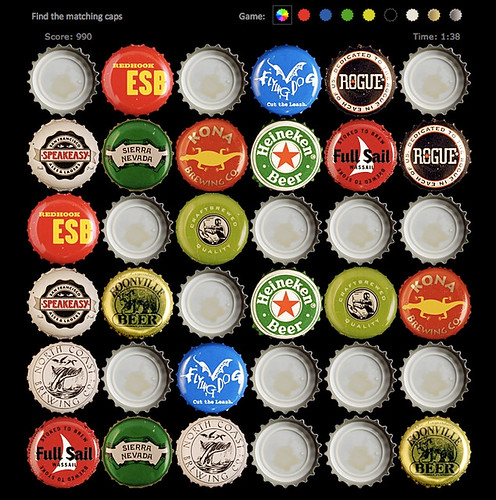
I stumbled on this very cool beer bottle cap game. It’s essentially one of those simple memory matching games but uses crowns and flash technology to create a fun little game.

beer-caps-game

You start out with 36 upside down crowns, after showing you them right-side up for a few seconds.

bottle-cap-backs

Then you have to find all the pairs as it times how long it takes. You also get 100 points for each match found but lose 5 points for each wrong guess. You can also make it a little harder by clicking on one of the eight single color crowns to the right of the multicolored one to play a game using crowns of just one color, which is slightly more difficult to play.

bottle-cap-game

Fun stuff. Finally a time suck that I can pretend is really work. Give it a whirl.

Filed Under: Beers, Just For Fun, Related Pleasures Tagged With: Crowns, Packaging

Beer In Ads #4: Thirst Is Only Through Good Beer

November 5, 2009 By Jay Brooks

ad-billboard
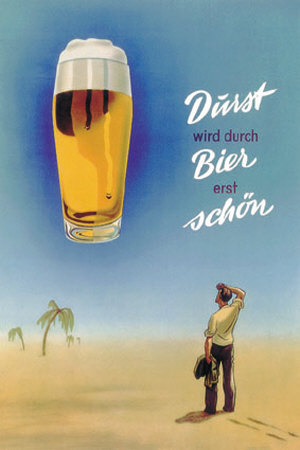
Today’s beer ad is from Germany. I saw an original of it framed at the Franconian Brewery Museum in Bamberg when I was there a couple of years ago. It was originally an advertisement for Gaffel Kolsch. The text reads “Durst wird durch Bier erst schon,” which Google translates as Thirst Is Only Through Good Beer. That’s the best-sounding one I came across, though I suspect it’s closer to something like “Thirst Is Only Quenched Through Good Beer.” Other translators came up with “thirst becomes through beer first already,” “thirst becomes by beer only already” and “thirst with beer is just been.” If you’re fluent in German, let me know what a better translation is. Still, I love the idea of being out in the desert and the mirage you see is a giant glass of beer. What better sight could there be under such circumstances?

durst-bier

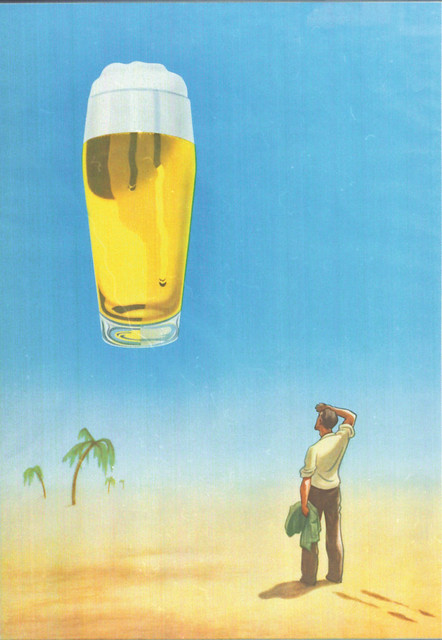
It was also sold as a poster without the text.

Gaffel_Koelsch_Bierglas_Mann-in-der-Wueste-high

Filed Under: Art & Beer, Beers, Just For Fun Tagged With: Advertising, Germany

Hey Mabel, Take Me Out To The Ball Game

November 4, 2009 By Jay Brooks

baseball
I confess that I’m not much of a baseball fan. When I was a kid I rooted for the Baltimore Orioles and Brooks Robinson was my favorite player. But since heading west, as a young man, I’ve paid little attention to Major League Baseball. I used to attend Giants’ games at Candlestick with friends, though primarily for the tailgating (and in fact occasionally never even went inside to see the game). But since I have so many friends back in Dutch Wonderland — a.k.a. Eastern Pennsylvania — that I’m now in touch with more regularly, thanks to social media, I find myself cheering for the Phillies. But that’s neither here nor there.

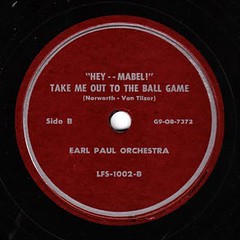
Yesterday, you may recall, I listed my top 10 favorite beer slogans, including Carling Black Label’s “Hey, Mabel” campaign. Last night, while visiting a music website I frequent, I chanced upon an interesting tidbit regarding both “Hey, Mabel” and baseball. Here’s what the website had to say about it in a post that included old records sung by both Dizzy Dean and Don Drysdale:

One connection between the days of old [baseball] and today is the persistence of beer advertising. When I was a young fella, too young to drink the stuff, baseball broadcasts in our local market and some others were sponsored by Carling Black Label Beer. Throughout the 50s and into the 60s, Carling used the slogan “Hey Mabel! Black Label” and an associated jingle to sell the goods. “Hey Mabel!” was sung to the “salt peanuts” figure — apt for a beer, I’d say.

This campaign was concocted by Carling’s ad agency, Lang Fisher & Stashower. Sometime in the early 50s, the agency prepared a 78 of the music, containing two instrumental versions of the Hey Mabel theme and the Carling Black Label jingle. One was a dance band version, which combined the Carling material with Take Me Out to the Ballgame, the other a Dixieland arrangement as played by a number of well-known LA musicians. There are no vocals on the record, so my guess is it was sent to the radio stations carrying the baseball games for use as filler before breaks, as was the practice on radio stations at the time.

Here’s the 78-rpm record (remember those?).

hey-mabel-78

And you can hear the medley below. It’s not exactly a cutting edge big band arrangement, even for the mid-1950s, but there are some interesting elements and I like the “Hey Mabel” bridges between the different treatments of Take Me Out To The Ball Game. Enjoy.

brookston-baseball

And Go Phillies!

Filed Under: Beers, Just For Fun Tagged With: Baseball, Music, Sports

Top Ten Tuesday: Top 10 Beer Slogans

November 3, 2009 By Jay Brooks

top-10
It’s been several months since I’ve done a Top 10 list, primarily because it’s been too hard to keep up with them weekly. So I think I’ll try once a month instead. I’ve been collecting old beer slogans for a project (more on that later) and so I thought I’d pick my ten favorite ones. I should stress — though it should be obvious — that my choices are about the efficacy of the slogans themselves, regardless of the way I might feel about the beer itself. So for my 19th Top 10 List, I present my favorite beer slogans. Let me know your faves. Here’s List #19:

Top 10 Beer Slogans

   It’s what your right arm’s for. John Courage Beer
   If you’ve got the time, we’ve got the beer. Miller
   When You’re Out of Schlitz, You’re Out Of Beer. Schlitz
   Guinness Is Good For You. Guinness
   Fresh. Smooth. Real. It’s all here. Bud Light
   The Happiest Taste In Beer Today. Gunther Beer
   Gunther is an old brand from Baltimore, Maryland that hasn’t been around for decades. But I love the idea that beer can taste “happy.” What exactly does “happy” taste like? Being a west coast guy, I assume they just meant hoppy.
   Hey Mabel, Black Label. Carling Black Label
   After a lackluster decade of poor sales, in 1951, Carling came up with the now-iconic Mabel the Waitress campaign, hiring New York actress Jean (sometimes spelled “Jeanne”) Goodspeed to play Mabel in TV commercials and print ads. Sales skyrocketed. In fact, they kept using her image long after she left the business in the mid-19500s to start a family and eventually even included an animated version in later ads. The Mabel campaign finally ended in the early 1970s. For me, I think what made the slogan was the whistle that precedes the slogan in television and, presumably, radio spots. Also, Mabel’s wink and a nod at the end of each ad is also priceless, even when they went to an animated version they wisely kept that element.

mabel2

Below are two Black Label ads, one an original live action one followed by a later animated commercial. (Note, the sound starts late in the first one. Also, check out the maniacal look of the third bartender. What’s up with that dude?)

   Here’s to good friends, tonight is kind of special. Lowenbrau
   This slogan is as much about the song as it is the words. It was sung by Arthur Prysock, an American jazz singer originally from South Carolina. Here are the lyrics and below them is a television commercial featuring the song from the mid-1980s, when the brand peaked.

Here’s to good friends,
Tonight is kind of special.
The beer we’ll pour
must say something more, somehow.
So tonight (tonight),
Tonight,
Let it be Löwenbräu (let it be Löwenbräu).
It’s been so long.
Hey, I’m glad to see ya.
Raise your glass.
Here’s to health and happiness.
So tonight (tonight),
Let it be all the best.

   The Friendly Beer For Modern People. Reading Beer
   I understand most people won’t know this one, because it’s a local favorite I grew up with in Reading, Pennsylvania. But beginning in the 1950s, they started trying to convince people Reading Premium Beer was not their Dad’s beer but was for modern people, a.k.a. young people, and that it was friendly. Like happy, I just love the association they’re trying to make to persuade people their beer is more friendly than other rival beers. To me, that’s just genius marketing. It’s not that other beers don’t taste as good, it’s just that ours is friendlier. Who wouldn’t want to drink a beer that’s friendly?
friendly-beer
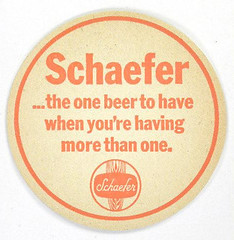
   The One Beer to Have When You’re Having More Than One. Schaefer
   What’s not to love about this slogan? Simple, to the point, and with one of the catchiest jingles ever. It would probably never fly today, because neo-prohibitionists would immediately accuse them of encouraging binge drinking since in their addled little minds more than one already is too many. The video below is not the original version of the jingle, but a jazzier, cooler one. Enjoy!

schaefer-coaster

It was, as always, really difficult to keep the list to ten, and a great many colorful beer slogans were left on the cutting room floor, mostly newer ones since I focused on older ones in the list above. Here’s a few more that might have made the list had I gone for more modern slogans:

Always a Good Decision. Samuel Adams; Drink in the World. Sapporo; Hooray Beer! Red Stripe; Life Is What You Pour Into It. Pyramid; Off-Cented Ales For Off-Centered People. Dogfish Head; You’re Not Worthy. Stone

And here’s a few older one I also like but didn’t have room for in the Top 10:

Always Smooth, Even When You’re Not. Keystone; The beer that made Milwaukee famous. Schlitz; Believe. Guinness; The Champagne of Bottled Beers. Miller High Life; For the man who really knows beer. Ortlieb; If I wanted water, I would have asked for water. Labatt Blue; It doesn’t get any better than this. Old Milwaukee; It’s what’s inside that truly counts. Dreher; When you say Budweiser, you’ve said it all. Budweiser; When you see the three-ring-sign, ask the man for Ballantine. Ballantine Ale

Let me know your favorites, and if you see any that you think should have made the list, please post a comment.

Also, if you have any ideas for future Top 10 lists you’d like to see, drop me a line.

Filed Under: Just For Fun, Top 10 Tagged With: Advertising, Jingles, Music, Video

Pumpkin Beer On The HuffPost

November 2, 2009 By Jay Brooks

halloween
My friend and colleague Gregory Daurer had a nice overview on Pumpkin Beers on the Huffington Post entitled It’s the Great Pumpkin Beer, Andy Brown!

Filed Under: Beers, Just For Fun Tagged With: Mainstream Coverage

Beer In Art #50: Pieter Bruegel’s Peasant Dance

November 1, 2009 By Jay Brooks

art-beer
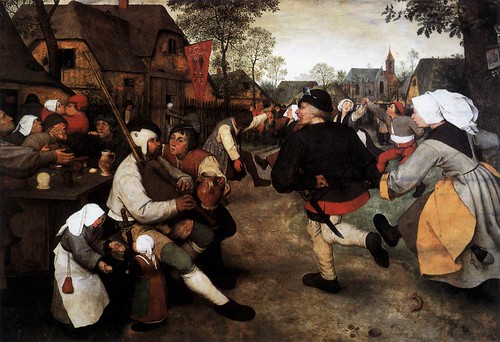
For today’s work of art we return to an old master, Pieter Bruegel (the Elder), considered by many to be the greatest Flemish sixteenth-century master. He was born in the Netherlands around 1525 and died in 1569. He was a Renaissance painter who began the Bruegel Dynasty that included six well-known artists. (It was originally spelled Brueghel, but in 1559 he stopped signing his paintings with the “h” in his last name). He was especially known for his landscape paintings that were populated by peasants, and in fact “is often credited as being the first Western painter to paint landscapes for their own sake, rather than as a backdrop for history painting.” Sadly, only 45 of his works survive to the present. In March, I featured his painting Harvesters, and today’s work by Brugel is entitled Peasant Dance, the original of which is at the Kunsthistorisches Museum in Vienna, Austria. It was painted in the last years of Bruegel’s life, most likely between 1566 and 1568.

Bruegel-peasant-dance

The Web Gallery of Art describes their interpretation on the meaning of Peasant Dance:

Like The Peasant Wedding, it is likely that Bruegel intended this painting to have a moral sense rather than simply being an affectionate portrayal of peasant life. Gluttony, lust and anger can all be identified in the picture. The man seated next to the bagpipe player wears a peacock feather in his hat, a symbol of vanity and pride. The occasion for the peasants’ revelry is a saint’s day, but the dancers turn their backs on the church and pay no attention whatsoever to the image of the Virgin which hangs on the tree. The prominence of the tavern makes it clear that they are preoccupied with material rather than spiritual matters.

But the Humanities Web describes in much less sinister terms. “The joviality of this picture is infectious. Bruegel’s eye objectively captures many scenes: cantankerous drunkards; a couple kissing; a feisty older man pulling a young peasant woman to join him in a dance; and children imitating their dancing elders.”

Encyclopedia.com also has a nice article on the artist, and indicate the importance that the Peasant Dance represented in Bruegel’s career:

The Peasant Dance (ca. 1566-1567) represents a new and important direction that Bruegel was to develop in the last years of his career. In this work the painter changed to a “large-figure” style in which highly animated peasants are organized to convey the rhythms and patterns of the dance. Also, by reducing forms to their elemental essences Bruegel achieved a clarity of design and coloration that has seldom been rivaled in Western painting.

If you want to learn more about the artist, Wikipedia, the Metropolitan Museum, Art Show Magazine, the Art Archive or the ArtCyclopedia are all good places to start. And to see more of his work, both Ricci-Art and Art Show Magazine have good collections, and Pieter-Bruegel-the-elder.org appears to have most of his known works.

Filed Under: Art & Beer Tagged With: Europe

Wacky Packages

October 31, 2009 By Jay Brooks

halloween
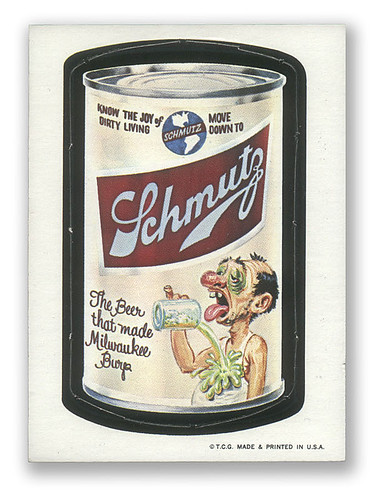
I kept looking at those four spoof beer labels that I posted earlier today for Hoppy Halloween because they reminded me of something, but I couldn’t quite put my finger on it. Then it hit me: Wacky Packages, those weird parody stickers that Topps debuted in 1967. Like most eight-year olds at the time, they were quite popular with me and my friends. What I didn’t realize is that they’ve continued to make them almost ever since. The Wacky Packages Website has a complete listing of all the Wacky Packages put out over the years and Topps even continues to maintain a new “official” Wacky Packages website. Not surprisingly, there have been several beer spoofs done, the first one being the very first year. It was a spoof of Schlitz, then one of the most popular beer brands.

wp-schlitz

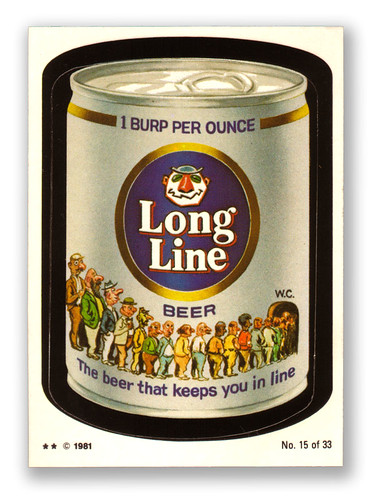
Later ones included most of the other popular national beer brands and a few originals, like Long Line Beer, from 1981. A search of the website revealed nine different beer brands, with some variations of Pabst and a few additional beer-related ones for other products.

wp-long-line

Below is a slideshow of all of the beer-themed Wacky Packages I found, including one of port wine just because I liked it and a few that are only beer-related.

Filed Under: Art & Beer, Beers, Just For Fun Tagged With: Halloween

White House Logs Reveal Neo-Prohibitionist Visits

October 31, 2009 By Jay Brooks

white-house
In response to several requests under the Freedom of Information Act, the White House late Friday released a partial list of visitors during roughly the first six-months of Obama’s administration. You can view the entire list at Whitehouse.gov. The Wall Street Journal and MSNBC are both reporting on the politics and law behind the requests, while most media outlets are just focusing on the celebrities. According to MSNBC, the White House rejected their request that all the names of visitors be released. “Like the Bush administration before it, Obama is arguing that any release is voluntary, not required by law, despite two federal court rulings to the contrary.” I don’t know the law on this point, so I won’t argue who’s right one way or the other. Not surprisingly, the administration is spinning it that they’re providing “transparency like you’ve never seen before.”

So why is this important at all to the world of beer? Given that one of the neo-prohibitionist movements most persistent claims is that the beer lobby has undue influence over politics in Washington, one name fairly jumped off the page of the Wall Street Journal report, a name which is confirmed by the official White House list. From January 20 to July 31, the president of the Robert Wood Johnson Foundation, Risa Lavizzo-Mourey, visited the White House seven times (that’s over once a month) and met personally with President Obama twice. The Journal disingenuously characterizes Lavizzo-Mourey as “a thinker in health policy,” when his organization’s true aims have been revealed as something very different. See, for example, the Center For Consumer Freedom’s report Behind the Neo-Prohibition Campaign, which details the true agenda of the RWJF. But perhaps more troubling, is their and other neo-prohibitionist’s persistent claims that the beer lobby has bought favorable treatment disproportionate to other industries. For a recent example, the Marin Institute’s facetious report entitled Big Beer Duopoly made this claim less than two weeks ago.

But let’s look at the facts, at least with regard to the White House. For all their lobbyist spending, not one beer industry representative visited the White House over a six-month period, while during the same time the most pernicious neo-prohibitionist group, the Robert Wood Johnson Foundation, had monthly visits to the White House, including two meetings with POTUS. Of course, it’s possible that beer lobbyists did visit the White House and their names are among those not released by the Obama administration. But since most of the list does include other business leaders and given the White House’s current anti-lobbyist policy, that seems less likely. And let’s not forget that President Obama appointed the former head of MADD, Charles Hurley, to lead the National Highway Traffic Safety Administration.

The obvious conclusion is that what this reveals is the propaganda behind the neo-prohibitionst claims regarding the beer lobby. As is typical, once again they’ve been shown to not be truthful. While claiming undue political influence on the part of the beer industry, the truth is that neo-prohibitionists have the ear of the President. Considering today is Halloween, that may be the scariest news of all.

Filed Under: Editorial, News, Politics & Law Tagged With: Prohibitionists

Hoppy Halloween!

October 31, 2009 By Jay Brooks

halloween
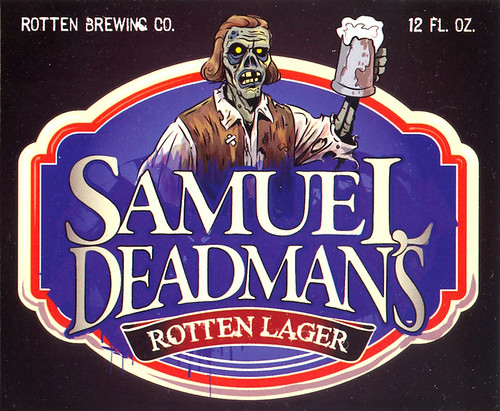
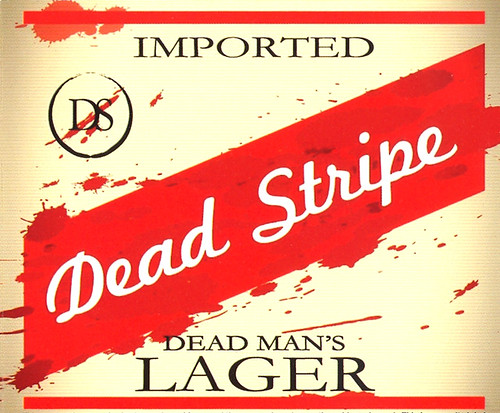
Hoppy Halloween everybody. Here are a few spoof beer labels someone gave me recently that seemed perfect for the holiday. Enjoy.

samuel-deadman

dead-stripe

st-zombie-girl

monster-brau

Filed Under: Beers, Just For Fun Tagged With: Halloween, Holidays, Packaging

« Previous Page
Next Page »

Find Something

Northern California Breweries

Please consider purchasing my latest book, California Breweries North, available from Amazon, or ask for it at your local bookstore.

Recent Comments

  • Bob Paolino on Beer Birthday: Grant Johnston
  • Gambrinus on Historic Beer Birthday: A.J. Houghton
  • Ernie Dewing on Historic Beer Birthday: Charles William Bergner 
  • Steve 'Pudgy' De Rose on Historic Beer Birthday: Jacob Schmidt
  • Jay Brooks on Beer Birthday: Bill Owens

Recent Posts

  • Beer In Ads #5215: Another Load Of “Milwaukee’s Choicest” April 10, 2026
  • Beer Birthday: Alexandre Bazzo April 10, 2026
  • Beer In Ads #5214: Poth’s Bock Beer April 10, 2026
  • Historic Beer Birthday: Rudolf Brand April 10, 2026
  • Beer In Ads #5213: Bock Beer Cascade Quality April 9, 2026

BBB Archives

Feedback

Head Quarter
This site is hosted and maintained by H25Q.dev. Any questions or comments for the webmaster can be directed here.