Brookston Beer Bulletin

Jay R. Brooks on Beer

  • Home
  • About
  • Editorial
  • Birthdays
  • Art & Beer

Socialize

  • Dribbble
  • Email
  • Facebook
  • Flickr
  • GitHub
  • Instagram
  • LinkedIn
  • Pinterest
  • RSS
  • Twitter
  • YouTube

Powered by Genesis

Beer Birthday: Tonya Cornett

March 4, 2026 By Jay Brooks


Today is Tonya Cornett’s 57th birthday. Tonya was the brewmaster of Bend Brewing in Oregon, for a number of years, but several years back moved to another Bend brewery — 10 Barrel Brewing — to become their R&D brewer. After being sold, her part of the brewery was unceremoniously shown the door, and she and her team regroup and opened their own place in Bend, UPP Liquids Pub, and Fermentations (of Immersion Brewing). And the best part, the new brewery just a few months after opening was named the Best Brewery of the Year (in the 251-500 barrel class). She was also featured prominently in the film, The Love of Beer, and more recently Beers of Joy. Tonya’s a great brewer and, of course, being born 1 day and ten years after me makes her a terrific human being, too. Join me in wishing Tonya a very happy birthday.


P1070571
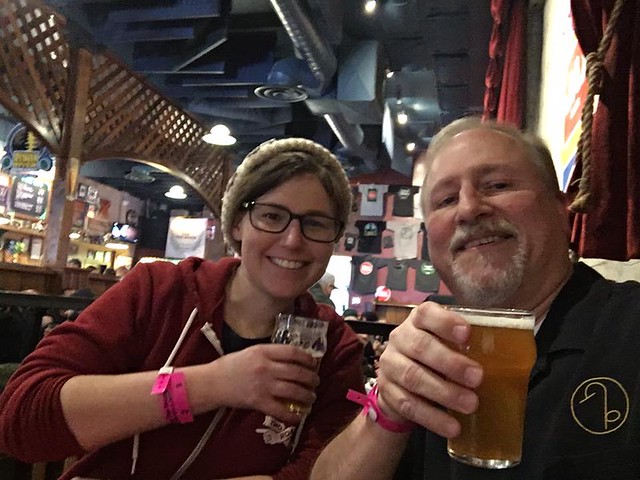
Tonya and me during a visit to Bend quite a few summers ago.
tonya-cornett-1
Tonya at GABF in 2008.
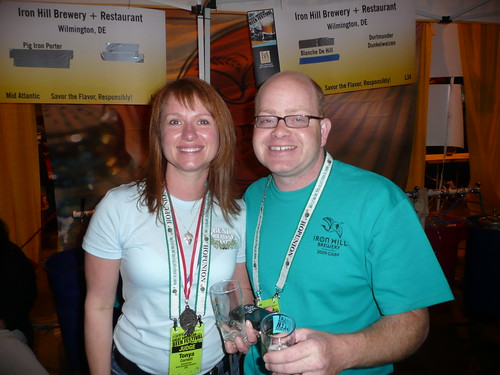
Tonya Cornett, from Bend Brewing, with Larry Horwitz from Iron Hill
Tonya with Larry Horwitz from Iron Hill at the 2009 GABF.
tonya-cornett-2
With Tomme Arthur of Port Brewing/The Lost Abbey at Falling Rock in Denver. (Special thanks to Sage from the Lost Abbey for photos 2 and 4.)
P1200477
Elva Ellen Kowald, Tonya and Teri Fahrendorf at the Craft Brewers Conference in Chicago.
P1010378
Tonya and Megan Flynn, former publisher of Beer West, then-Beer Northwest, at GABF in 2010.
tonya-and-me-in-bend
Meeting for a quick beer in Bend a few years back.

Filed Under: Birthdays, Just For Fun Tagged With: Oregon

Beer Birthday: Emily Sauter

March 4, 2026 By Jay Brooks

Today is the 43rd birthday of the extraordinary Emily Sauter, who used to work at Two Roads Brewing as their Social Media and Communications Manager, where on Two Roads’ website she reveals an intense love of soup but an equally powerful dislike of broccoli. I wonder how broccoli soup fits in with that? She now works part-time at the Fox Farm Brewery, but at night dons the cape and cowl to draw Pints and Panels, her blog of beer reviews, done in a comic strip style, putting to good use her education from Vermont’s Center for Cartoon Studies. And she’s written and a few books, Beer is For Everyone!: Of Drinking Age, Hooray for Craft Beer!, and Pairing Beer with Everything. Emily is one of my favorite people to hang out with at beer events, a kindred spirit. Join me in wishing Emily a very happy birthday.

DSCN1635
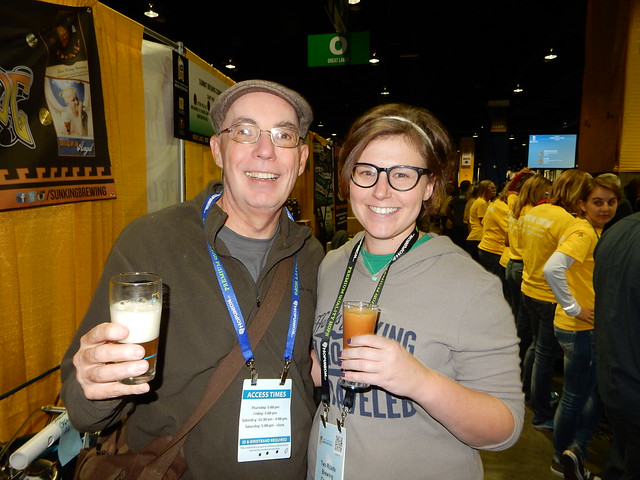
Stan Hieronymus and Emily at GABF a few years ago.
DSCN1222
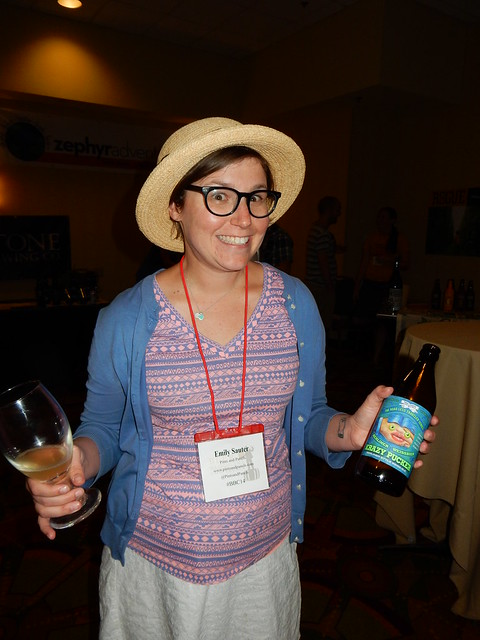
At the Beer Bloggers Conference in San Diego, opening a bottle of Crazy Pucker.
Sam-Emily-Me
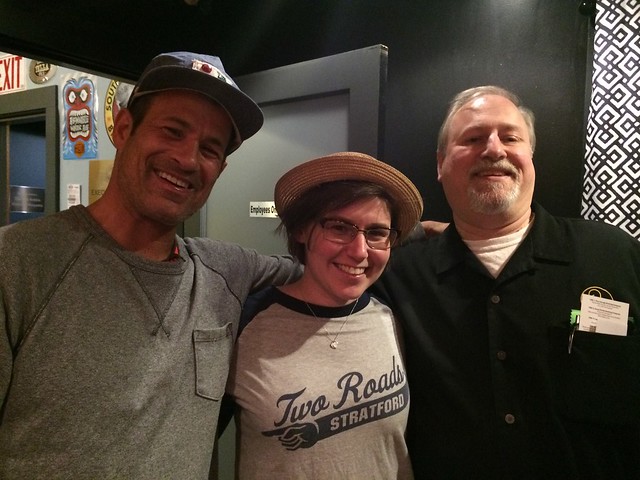
Sam Calagione, Emily and me at Belmont Station in Portland during CBC a few years ago.
emily-me-pliny
In 2018 at Russian River for the release of Pliny the Younger.
Em with her husband Matt in Connecticut when I visited them last summer.
Lucy Corne-Duthie (whose birthday is also today), Em, and me in Belgium last year.

Filed Under: Birthdays, Just For Fun Tagged With: Cartoons, Connecticut

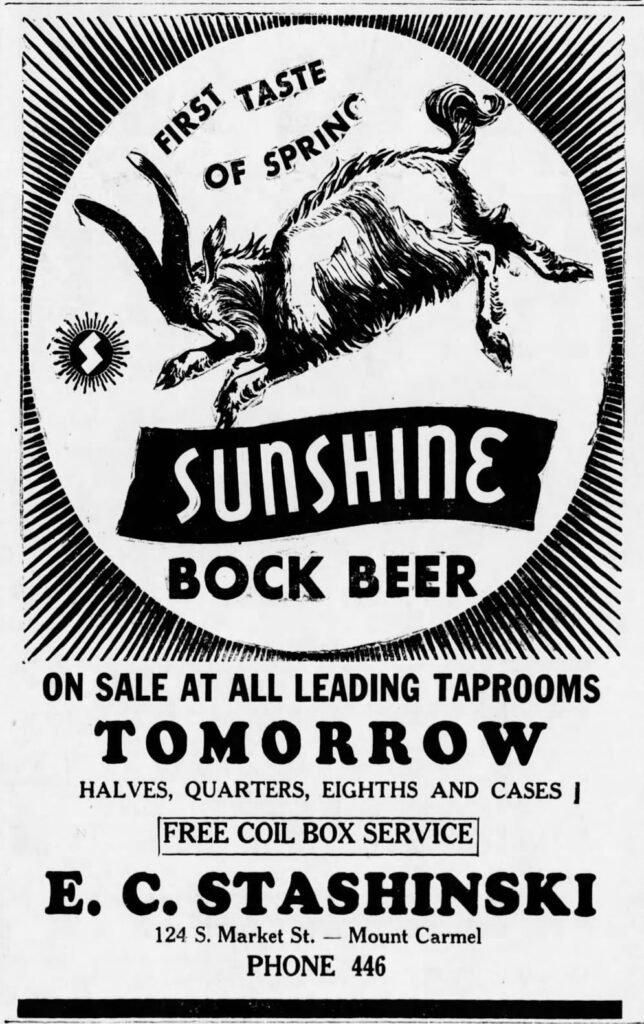
Beer In Ads #5142: First Taste Of Spring Sunshine Bock Beer

March 3, 2026 By Jay Brooks

Two years ago I decided to concentrate on Bock ads for awhile. Bock, of course, may have originated in Germany, in the town of Einbeck. Because many 19th century American breweries were founded by German immigrants, they offered a bock at certain times of the year, be it Spring, Easter, Lent, Christmas, or what have you. In a sense they were some of the first seasonal beers. “The style was later adopted in Bavaria by Munich brewers in the 17th century. Due to their Bavarian accent, citizens of Munich pronounced ‘Einbeck’ as ‘ein Bock’ (a billy goat), and thus the beer became known as ‘Bock.’ A goat often appears on bottle labels.” And presumably because they were special releases, many breweries went all out promoting them with beautiful artwork on posters and other advertising. With Spring approaching, there are so many great examples that I’m going to post two a day for a few months.

Tuesday’s second ad is for Sunshine Bock Beer, which was published on March 3, 1937. This ad was for the Sunshine Brewing Co. of Reading, Pennsylvania, near my hometown growing up, which was originally founded in 1859 by Peter Barbey. This ad ran in The Shamokin News Dispatch of Shamokin, Pennsylvania.

Filed Under: Art & Beer, Beers, Breweries, Just For Fun Tagged With: Advertising, Bock, History, Pennsylvania

Historic Beer Birthday: Geörg Ziegelmaier

March 3, 2026 By Jay Brooks

Today is the birthday of Geörg Ziegelmaier (March 3, 1852-December 27, 1908). He was born in Württemberg, Germany, but emigrated to the U.S. on July 2, 1854. He was originally trained as a baker and a miller, but became a brewer and founded the George Ziegelmaier Brewery in 1966, which was located in Boscobel, Wisconsin. He ran the brewery for nearly twenty years before selling it to William Bruer. It then went through a series of owners before becoming the Boscobel Brewing Co. in 1920, before closing for good in 1942.

Here’s his biography from Tavern Trove:

He became a farmer in New Hartford, Connecticut, then opened a milling business after the first harvest. In 1856 he established a farm in Crawford County, Wisconsin, but moved away after only one season. History next finds Ziegelmaier forty miles to the west, in McGregor, Iowa, a port city on the Mississippi River.  He stayed long enough there to get married, to Mary Koss, and have two children.

In 1857 he moved his family back to Wisconsin to the town of Boscobel, where he opened a brewery and bakery shop. The brewery burned soon after, and he returned once again to McGregor. He came back to Boscobel in 1866 where he purchased the old brewery property and rebuilt it.  He ran the brewhouse until 1884, when he sold it to William Bruer.

By 1890 Ziegelmaier had relocated to Milwaukee. The next decade saw him follow several of his children, now numbering an even dozen, to Washington state. Geörg died there on December 27th, 1908. He was 76 years old.

This is from another history of Boscobel beer that discusses the early history of the brewery.

This short biography is from “The History of Grant County, Wisconsin,” by Willshire Butterfield, and published in 1881.

Filed Under: Birthdays, Breweries, Just For Fun Tagged With: Germany, Wisconsin

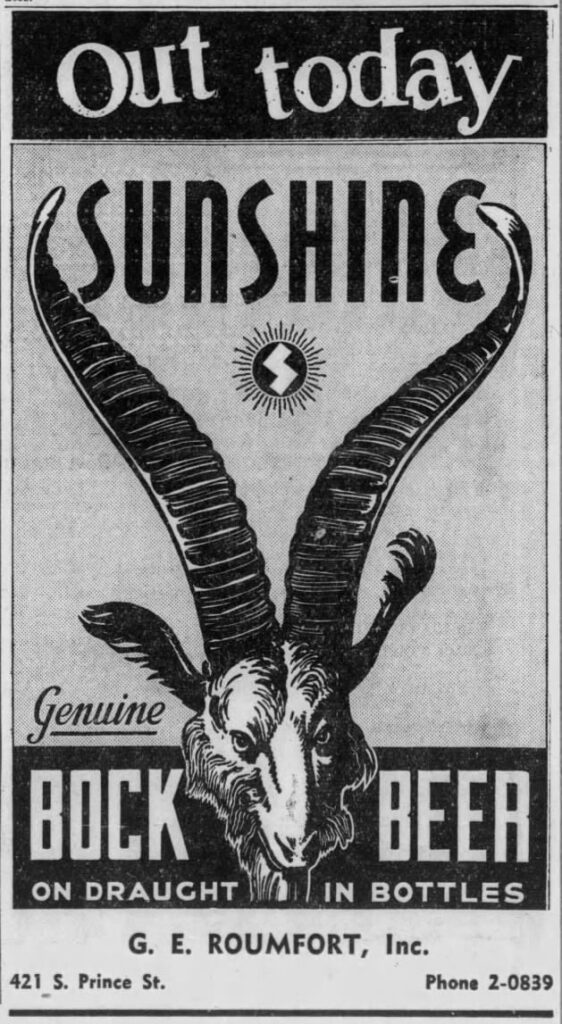
Beer In Ads #5141: Out Today Sunshine Genuine Bock Beer

March 3, 2026 By Jay Brooks

Two years ago I decided to concentrate on Bock ads for awhile. Bock, of course, may have originated in Germany, in the town of Einbeck. Because many 19th century American breweries were founded by German immigrants, they offered a bock at certain times of the year, be it Spring, Easter, Lent, Christmas, or what have you. In a sense they were some of the first seasonal beers. “The style was later adopted in Bavaria by Munich brewers in the 17th century. Due to their Bavarian accent, citizens of Munich pronounced ‘Einbeck’ as ‘ein Bock’ (a billy goat), and thus the beer became known as ‘Bock.’ A goat often appears on bottle labels.” And presumably because they were special releases, many breweries went all out promoting them with beautiful artwork on posters and other advertising. With Spring approaching, there are so many great examples that I’m going to post two a day for a few months.

Tuesday’s first ad is for Sunshine Genuine Bock Beer, which was published on March 3, 1939. This ad was for the Sunshine Brewing Co. of Reading, Pennsylvania, near my hometown growing up, which was originally founded in 1859 by Peter Barbey. This ad ran in The Intelligencer Journal of Lancaster, Pennsylvania.

Filed Under: Art & Beer, Beers, Breweries, Just For Fun Tagged With: Advertising, Bock, History, Pennsylvania

Beer Birthday: Jeff Cioletti

March 3, 2026 By Jay Brooks

Today is the 54th birthday of Jeff Cioletti, president of Drinkable Media and Editor-at-Large for Beverage World magazine. He’s been covering the business of beer for quite a long while. I run into Jeff at numerous industry events, and we’ve taken a press trip to Belgium. Join me in wishing Jeff a very happy birthday.

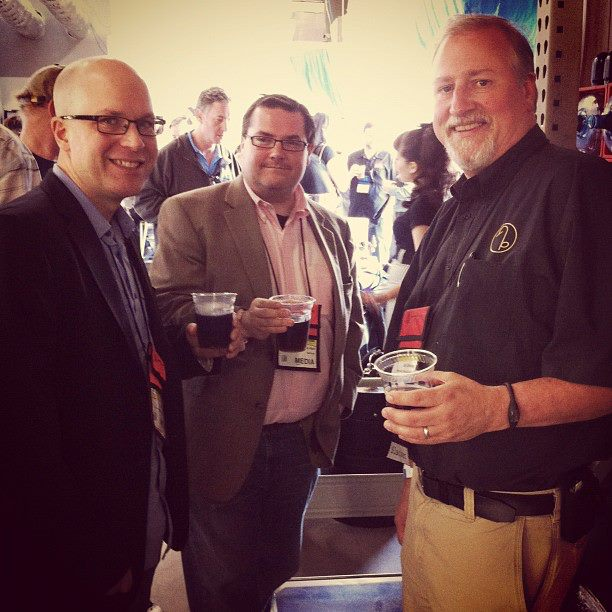
Three J’s at CBC in San Diego: Jeff, John Holl and me. (Photo by Win Bassett.)
DSCN0595
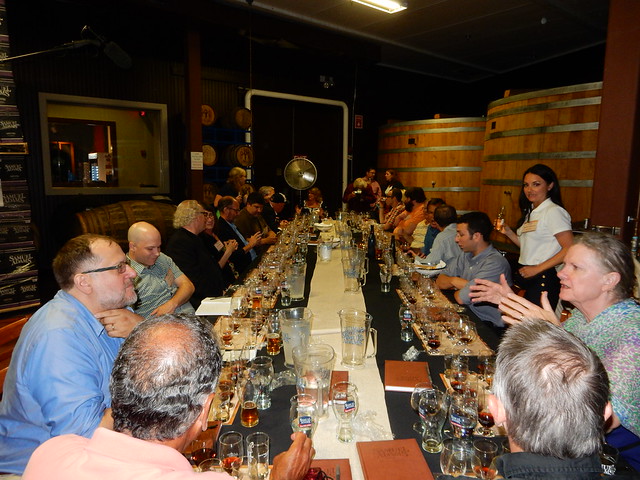
Jeff (on the left just above Lew Bryson) at our table inside the barrel room at Samuel Adams in Boston during an anniversary dinner there last year, when we opened every vintage of Utopias, plus Triple Bock and Millennium Ale.
DSC_8231
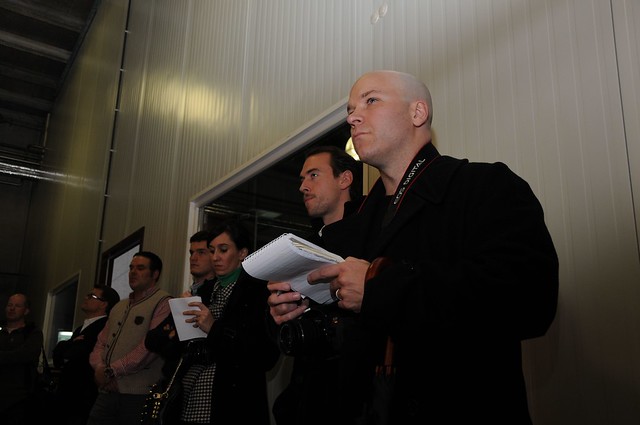
Ace reporter: “we just want the facts, ma’am, just the facts.”
DSC_8133
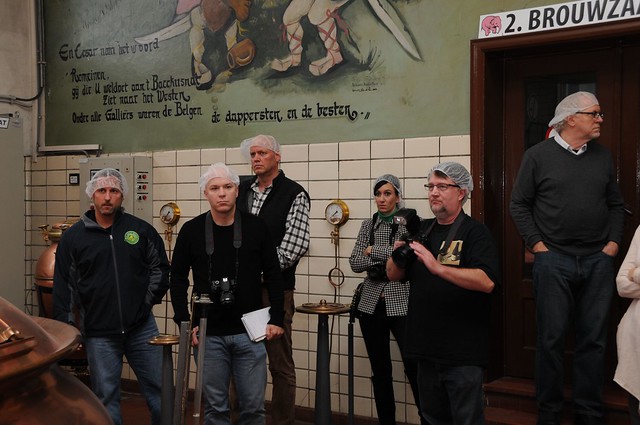
Jeff, in the center with a camera around his neck, during a visit to Brouwerij Huyghe during a press trip to Belgium in 2013.
DSC_8200
A night on bald mountain, or at least a table.

Filed Under: Birthdays, Just For Fun Tagged With: New Jersey, Virginia

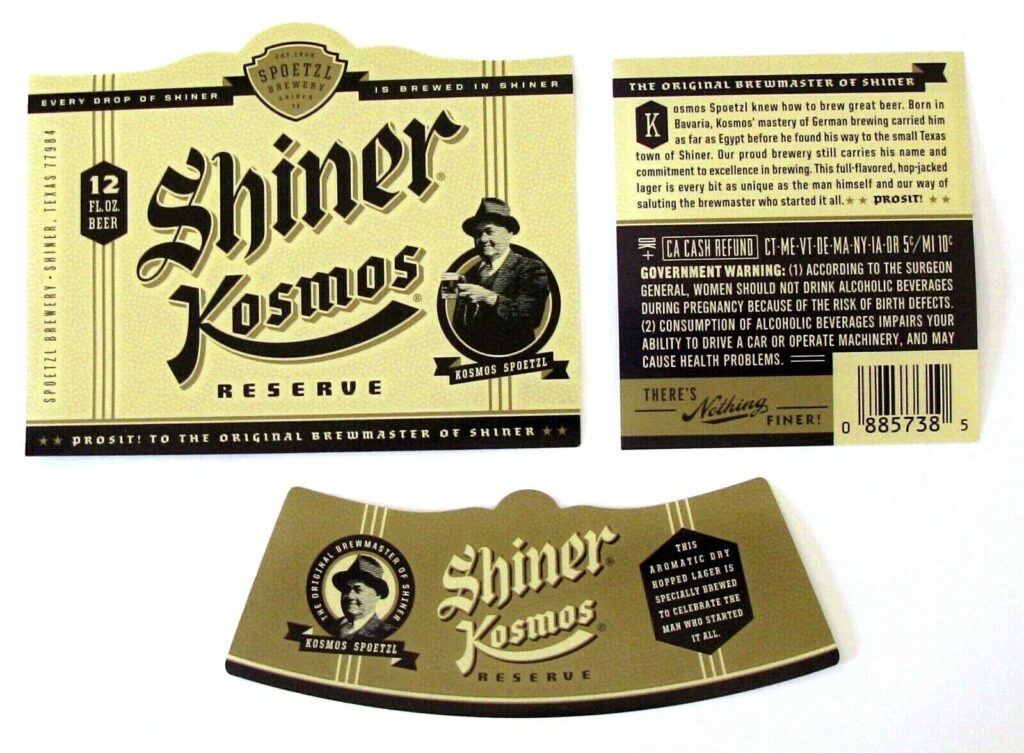
Historic Beer Birthday: Kosmos Spoetzl

March 3, 2026 By Jay Brooks

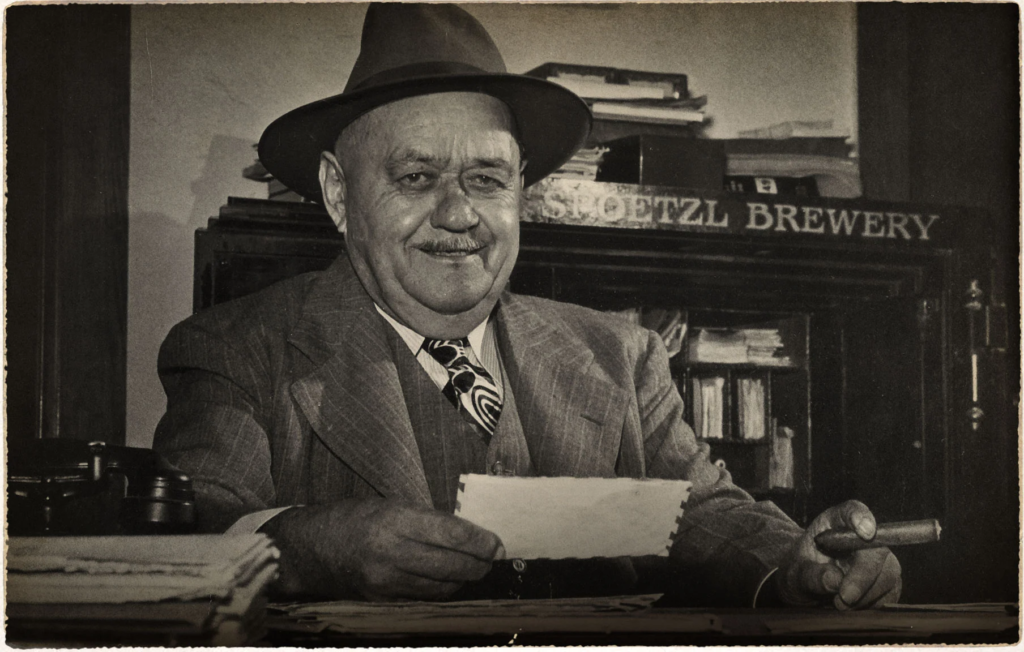
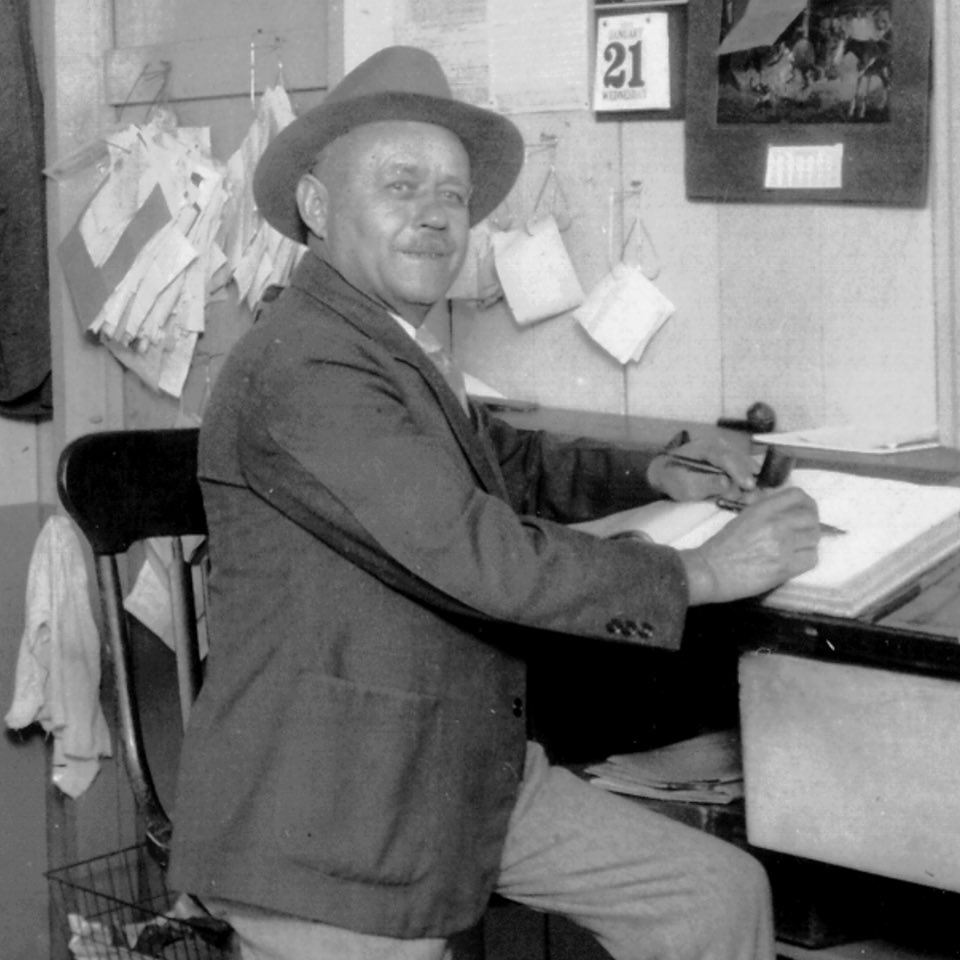
Today is the birthday of Kosmos Spoetzl (March 3, 1873-June 17, 1950). He was born in Bavaria, Germany and was trained a brewer. When the Texas-based Shiner Brewing Association was searching for a new brewmaster. Wikipedia takes up the story: “They found one in Bavarian-born Kosmos Spoetzl, a onetime soldier who had trained as a brewmaster in his native Germany. Part of the package that lured Spoetzl to Shiner was potential ownership of the brewery. In 1914, he co-leased it with Oswald Petzold with an option to buy in 1915, which he did, giving the brewery his own name, but continuing to call the product Shiner Beer. Spoetzl had attended brewmaster’s school and apprenticed for three years in Germany, worked for eight years at the Pyramids Brewery in Cairo, Egypt, and then worked in Canada. He had moved to San Antonio in search of a better climate for his health, bringing with him a family recipe for a Bavarian beer made from malted barley and hops.” He Served as the brewmaster until his death in 1950. 

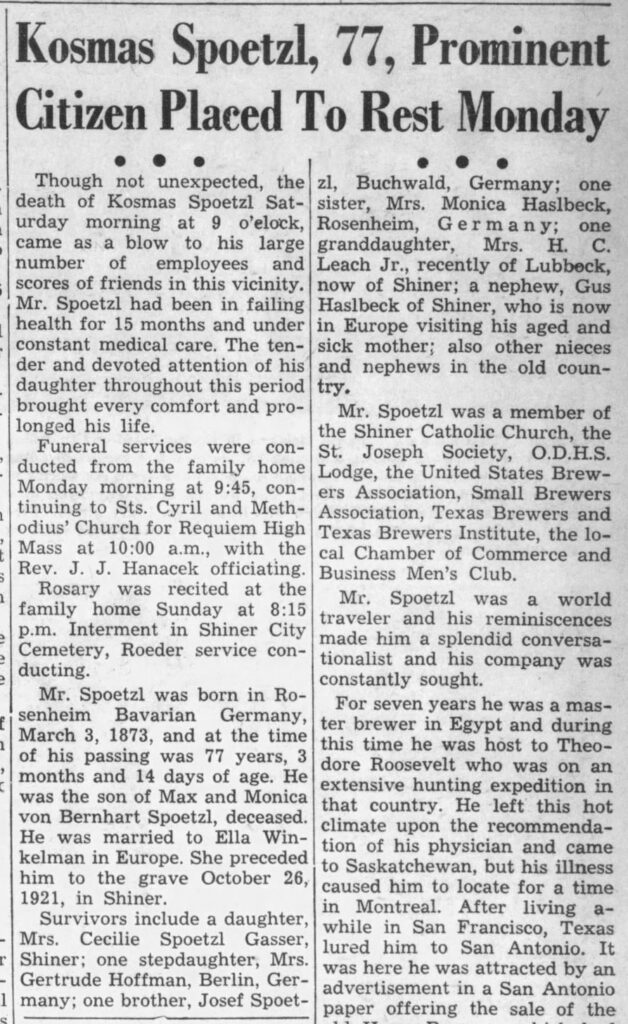
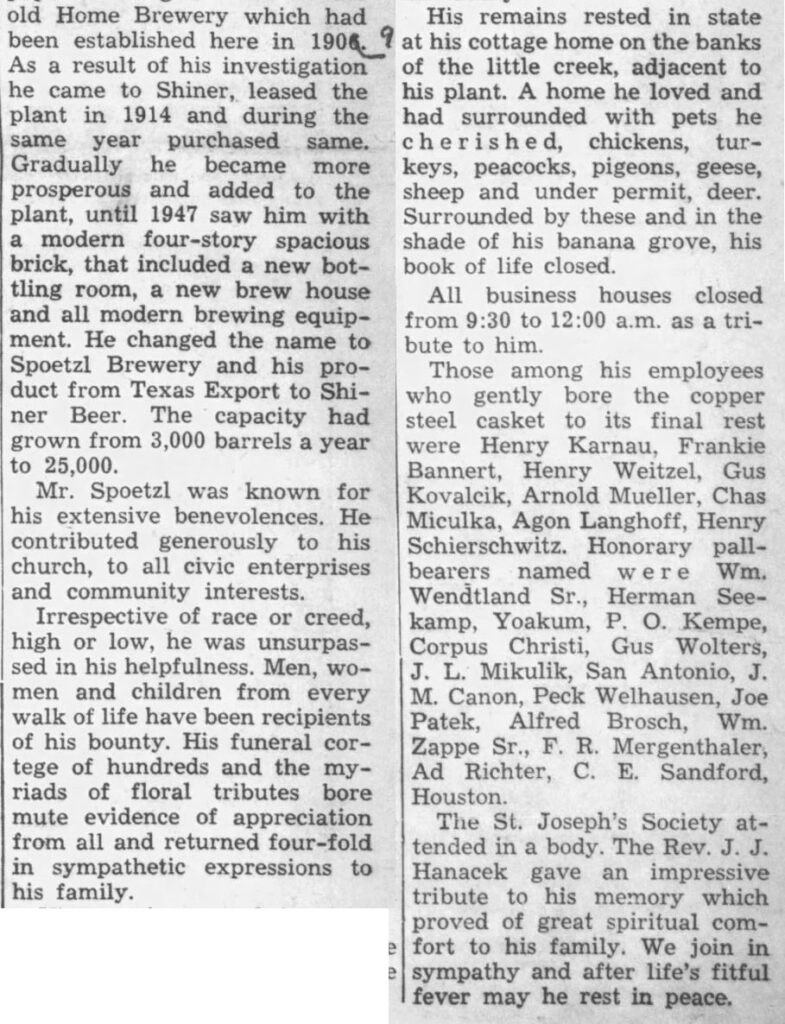
This is his obituary from the Shiner Gazette, June 22, 1950:

And this account is from the Texas State Historical Society, by Diana J. Kleiner from 1995:

The Spoetzl Brewery, also known as the Shiner Brewing Association, headquartered in Shiner, Texas, produces beer characterized by its carmelized quality. Private label brews produced by Spoetzl include Texas Tap, Gilley’s, and Rio Grande, while its original product, Texas Export, later became Shiner Texas Special Beer, or Shiner Beer. In 1986, before the rise of new microbreweries, the firm was the state’s last independently owned commercial brewing establishment. The original tin brewery was founded in the center of an Austrian, German, and Czech farming community near the railroad tracks on the banks of Boggy Creek. A group of Shiner businessmen interested in appealing to new Bohemian settlers established the original stock company, known as the Shiner Brewing Association in 1909, with Herman Weiss of Galveston as first brewmaster. The local product replaced beer formerly shipped in by rail from San Antonio and Houston. The first keg beer spoiled because of improper fermentation and refrigeration, however, and the founders offered the plant for lease in 1914.

Kosmos Spoetzl, a German immigrant brewmaster, learned of the Shiner operation and coleased the facility with Oswald Petzold with an option to buy in 1915. Spoetzl had attended brewmaster’s school and apprenticed for three years in Germany and worked for eight years at the Pyramid Brewery in Cairo, Egypt, before moving to San Antonio in search of a better climate for his health. He came, carrying the recipe for a Bavarian beer made by his family from pure malt and hops. Within a year Spoetzl bought the brewery, which he renamed the “Home Brewery,” and began to produce beer in wooden kegs and bottles. After 1916 the beer was packaged in glass returnable bottles; aluminum kegs were first used in 1947, nonreturnable bottles came in 1958, party kegs in 1964, and cans in 1970. When Prohibition was declared in 1918, Spoetzl produced near beer, ice, and, according to some sources, regular beer as well. During this period, he sustained the brewery by doing construction work in Florida with crews and trucks brought from Texas. After his wife’s death in 1921, Spoetzl considered returning to Bavaria but was convinced by his daughter to retain the business. “Miss Celie,” as Cecilie was called, served as business manager of the firm, and her daughter Rose joined the firm in 1964. August Haslbeck, who served as brewmaster, was the son of a noted Bavarian maltmaster and Spoetzl’s nephew. He later returned to Germany to complete an apprenticeship and receive a brewmaster’s degree. With repeal of Prohibition in 1933, the business resumed, with the introduction of “Texas Export,” a new product later known as “Texas Special” beer. Sales were made within a 100-mile radius. Over the next decade the company added a new bottling room and brew house, and in 1947 Spoetzl constructed the white brick Alamo-style plant still in use today. Across from the brewery, Spoetzl kept a menagerie of peacocks, deer, and other animals. Spoetzl is remembered for driving through the countryside, offering farmers cold beer, soda, or silver coins, and marketing his beer with the help of a hobo band, which continued to represent the company after his death. At his death in 1950 Spoetzl was succeeded by his daughter Cecilie, who became the only female brewery owner in the nation.

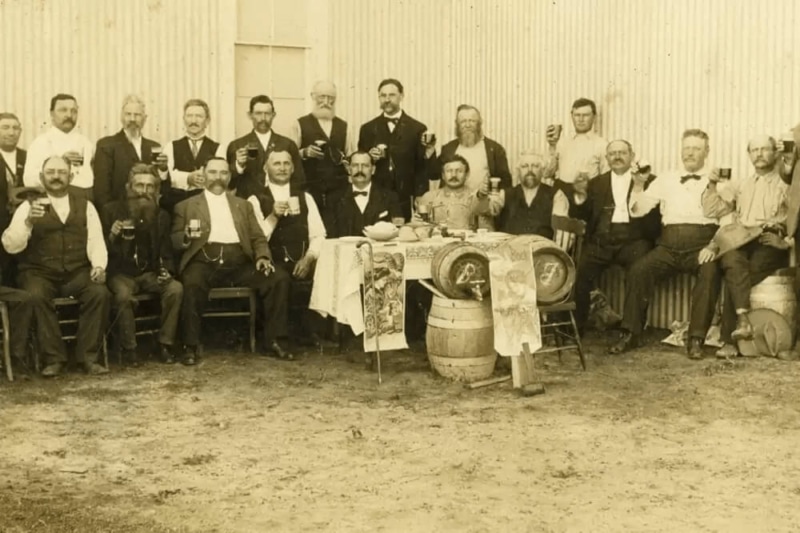
The brewery employees celebrating the end of prohibition.

And this is half of the story, “The Two Men who Rescued Shiner Beer” at Texas Standard:

In 1909, in the little town of Shiner, Texas, a group of German and Czech farmers decided they missed the beer of the old country. They pooled their money, built a ramshackle brewery, and called it the Shiner Brewing Association.

But they weren’t brewers. They were farmers. The beer was bad – so bad, locals joked it tasted more like medicine than malt. By 1914, the brewery was on its last legs, or last barrels. 

That’s when a Bavarian brewmaster named Kosmos Spoetzl appeared. He’d been trained in Germany, worked in Egypt, and landed in San Antonio. He leased the struggling brewery with an option to buy. And buy it he did, with his own savings and no small measure of faith.

Spoetzl brought with him an old-world recipe for a dark lager. He brewed it carefully, stubbornly. And soon, the townsfolk said Shiner beer finally tasted like beer.

Through Prohibition he kept the brewery alive making so-called “near beer”and ice, and even construction materials. By the time he died in 1950, Shiner beer had become the pride of a little Texas town.

But it never got much bigger than that. For decades, Shiner was still a tiny brewery in a town of two thousand souls, barely scraping by, undercapitalized for sure, but ably managed by Spoetzl’s daughter, Ms. Celie.

She held on. She kept it going against all odds. Hers was the only female-owned brewery in America.  She even lived in a house on the brewery site to devote all her time to it.  She kept it alive, but she couldn’t get it healthy. 

Locals were loyal to the brand. Still, Shiner’s market was mighty small. Even after Ms. Celie stepped down in 1966 and Shiner went through a succession of different owners; it never, during the ’70s and ’80s, managed to garner more than one percent of the Texas beer market.  

Filed Under: Beers

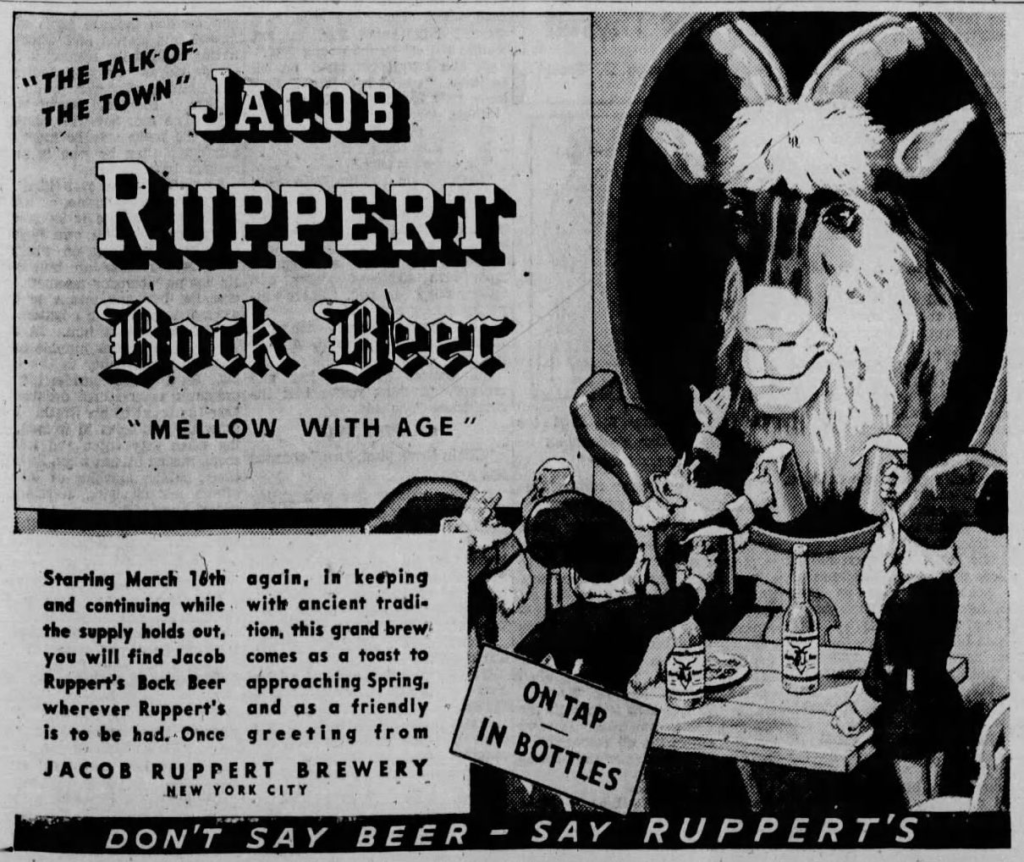
Beer In Ads #5140: The Talk Of The Town, Jacob Ruppert Bock Beer

March 2, 2026 By Jay Brooks

Two years ago I decided to concentrate on Bock ads for awhile. Bock, of course, may have originated in Germany, in the town of Einbeck. Because many 19th century American breweries were founded by German immigrants, they offered a bock at certain times of the year, be it Spring, Easter, Lent, Christmas, or what have you. In a sense they were some of the first seasonal beers. “The style was later adopted in Bavaria by Munich brewers in the 17th century. Due to their Bavarian accent, citizens of Munich pronounced ‘Einbeck’ as ‘ein Bock’ (a billy goat), and thus the beer became known as ‘Bock.’ A goat often appears on bottle labels.” And presumably because they were special releases, many breweries went all out promoting them with beautiful artwork on posters and other advertising. With Spring approaching, there are so many great examples that I’m going to post two a day for a few months.

Monday’s second ad is for Braumeister Bock Beer, which was published on March 2, 1936. This ad was for the Jacob Ruppert Brewery of New York, New York, which was originally founded in 1856 by Matthias Haffen as the Haffen Brewery until 1914 when Ruppert’s father bought it a year before he died, leaving it to Jacob, who changed the name. This ad ran in The Brooklyn Eagle, of Brooklyn, New York.

Filed Under: Art & Beer, Beers, Breweries, Just For Fun Tagged With: Advertising, Bock, History, New York

Historic Beer Birthday: Henry Gund

March 2, 2026 By Jay Brooks

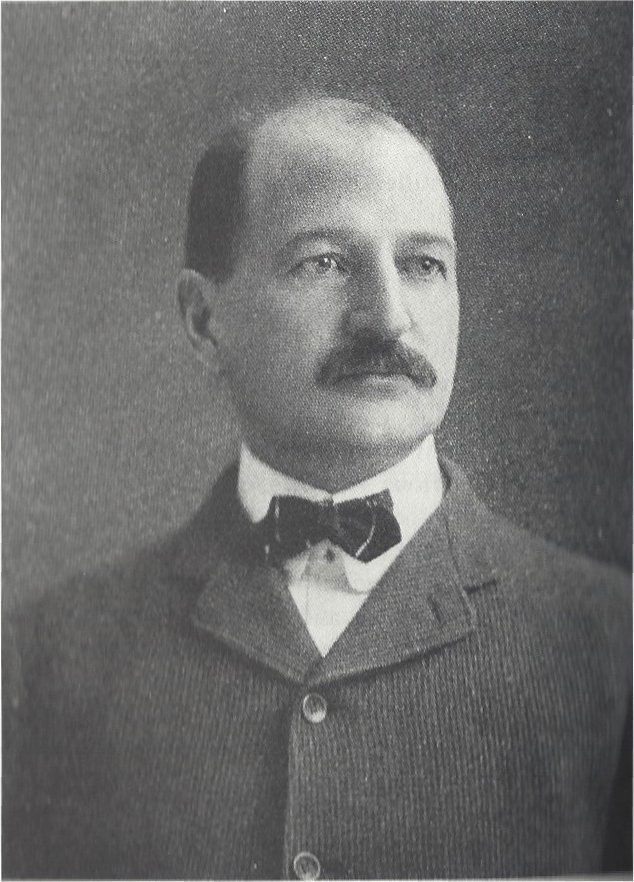
gund
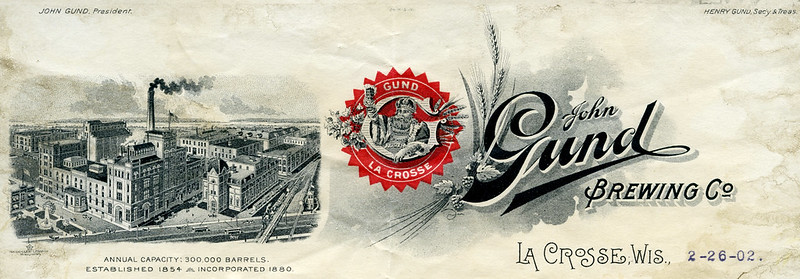
Today is the birthday of Henry Gund (March 2, 1859-July 2, 1945). He was the son of John Gund, who co-founded what would become the The G. Heileman Brewing Company with Gottlieb Heileman. They formed a partnership in November 1858 to operate the City Brewery in La Crosse, but “after nearly fifteen years in business together, Heileman and Gund dissolved their partnership in 1872.” After leaving City Brewing, Gund immediately “established a new brewery on the southern edge of La Crosse that he named the Empire Brewery, and which was incorporated in 1880 as the John Gund Brewing Company.” Gund employed all three of his sons in his new venture, and eventually Henry Gund became president of the brewery after his father’s death.

henry-gund

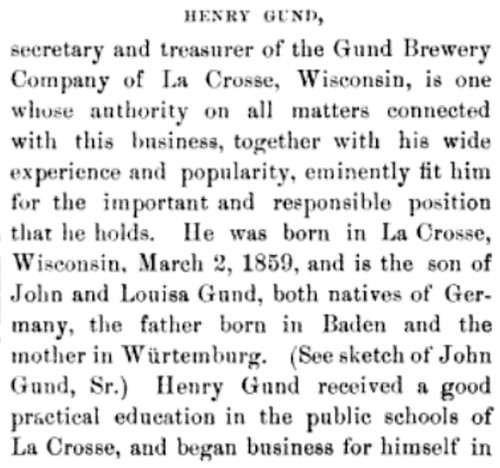
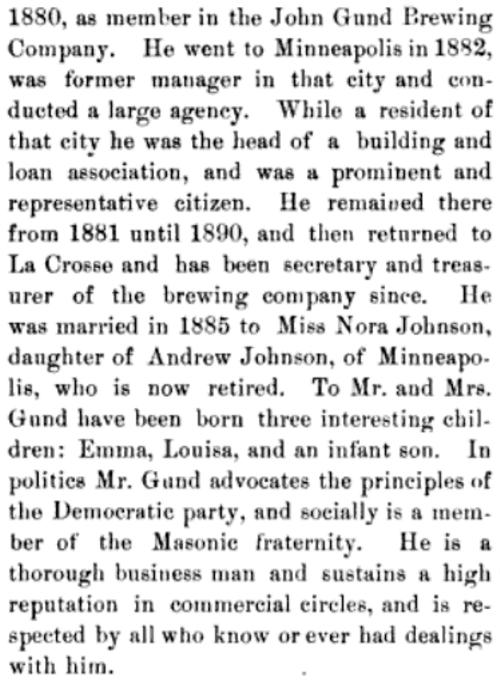
There’s not much biographical information on Henry, and I couldn’t find a photo of him, either. But there was a short write-up in the Biographical History of La Crosse, Trempealeau and Buffalo Counties, Wisconsin, published in 1892, when Henry was still alive, and so was his father. This biography starts with John Gund, and then has limited information about each son.

gundbrewery1892

henry-gund-bio-1
henry-gund-bio-2

gund-letterhead
Immigrant Entrepreneurship, under German-American Business Biographies, has a lengthy tale of both John Gund and Gottlieb Heileman

In May 1910, John Gund passed away a few months shy of his eightieth birthday. Fifty-one-year-old Henry Gund assumed control of the firm, which had expanded significantly to become the largest brewery in the Old Northwest outside Milwaukee. It employed 450 workers and owned numerous saloons throughout the region that carried Gund beer exclusively. Despite the firm’s success, the second decade of the twentieth century would be a trying time for Gund Brewing. The First World War fueled the prohibitionist movement in the United States and denunciations of German-American brewers became commonplace. In November 1918, shortly after the armistice ending the war had been signed, Congress passed the curiously misnamed Wartime Prohibition Act banning the production of intoxicating beverages starting in May 1919 and the sale of such beverages starting on July 1. Legal wrangling in the federal courts regarding the definition of “intoxicating beverages” occupied much of the spring of 1919. Many brewers including Gund held that beer with an alcohol content lower than 2.75 percent was non-intoxicating and resumed low-alcohol beer production. Later in the fall, Congress ratified the Volstead Act enacting national Prohibition and set January 16, 1920, as the start date.
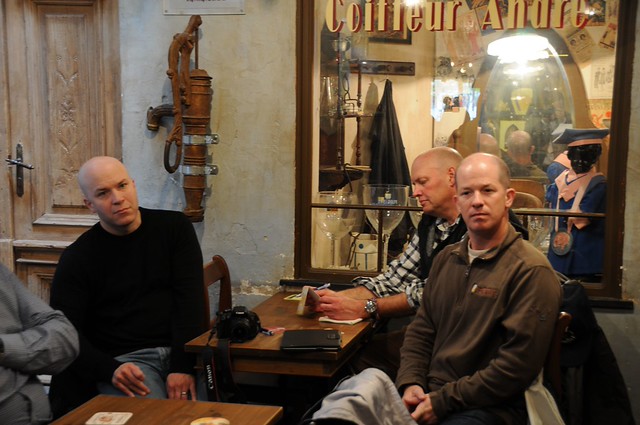
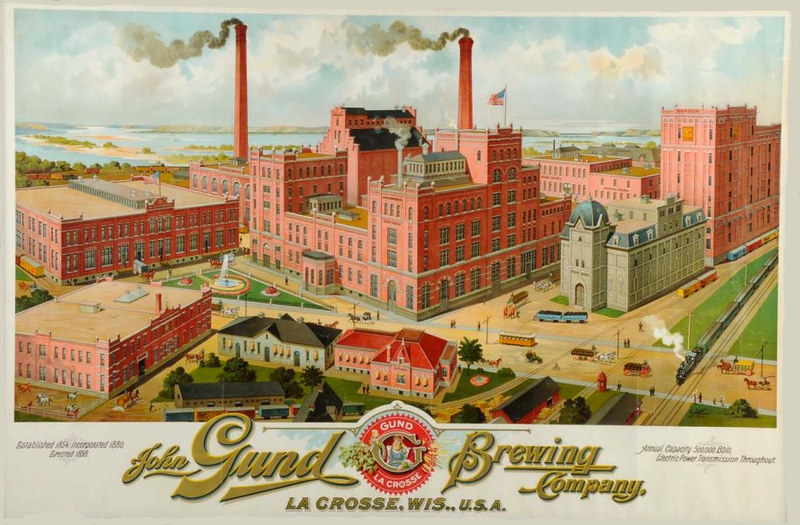
gund-brewery-1902
The Gund Brewery in 1902.

Despite the enactment of national Prohibition in early 1920, Gund and many other breweries continued producing 2.75 percent beer as various lawsuits made their way through the federal courts challenging the legality of the law and the meaning of various provisions. While the officers of the Gund Brewery awaited the outcome of the national legal battles, they faced a more immediate crisis. Local 81 of the International Brotherhood of Brewery Workers went on strike against local La Crosse breweries to ban open shops. Henry Gund refused to negotiate with the strikers and instead hired replacement workers to fill the vacant positions. The situation remained unresolved when the United States Supreme Court upheld the Volstead Act in the summer of 1920 and reinforced the complete ban on sales of alcoholic beverages. The ongoing labor unrest combined with the ban on beer production eventually led Henry Gund and the other corporate officers of the company to shutter the brewery. The corporation was dissolved in 1938 and the Peerless trademark was sold to the Michel brothers who resumed production of the brand. The Heileman Brewery later purchased Gund’s brew house.

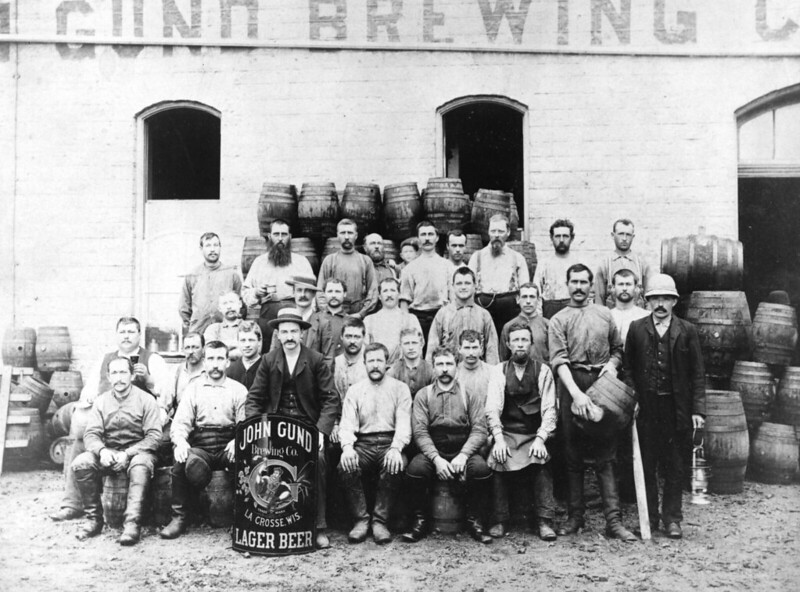
John-Gund-Brewing-Co-Workers

John Gund’s vision of his brewery evolving into a major shipping brewery did not come to pass, and La Crosse did not emerge as a major rival to Milwaukee, St. Louis, or Cincinnati. Nevertheless, Gund had a major economic impact on the community and he influenced the entrepreneurial path of his sons. All three pursued careers in brewing: George in Washington and Ohio, John Jr. in Illinois and Kentucky, and Henry in Wisconsin. They also diversified their business activities into other fields. George entered the financial and mining sectors and earned a fortune through banking and real estate. John Jr. operated a malting facility in Chicago, the Lexington Brewery in Lexington, Kentucky, eventually became head of the Swiss Oil Company and the president of the First National Bank of Lexington. Henry stayed in La Crosse and became a director and later president of the National Bank of La Crosse (later the First National Bank La Crosse) and the president of the Pioneer Real Estate Company, a holding company for the defunct Gund Brewery’s real estate.

gund-brewery

Filed Under: Birthdays, Breweries, Just For Fun Tagged With: History, Wisconsin

Historic Beer Birthday: William Bass

March 2, 2026 By Jay Brooks

Today is the birthday of William Bass (1717-March 2, 1787). Since the exact date of his birth is uncertain, in fact some sources give his birth year as 1721, the best date we have for him is when he died. For most of his life he worked as a general carrier, and moved to Burton-upon-Trent with his bride shortly after they married when he was 39, in 1756. His business increasingly involved carrying beer, and sensing an opportunity, he saved his money for many years. When he was sixty, in 1777, he founded the Bass Brewery

This is a short biography of Bass from the Local History of Burton upon Trent:

William’s father died when he was just fifteen. The eldest son, John, succeeded his father as plumber and glazier, leaving William to look after the running of the small-holding. Eventually, John and William established a carrier business and by 1754, they were operating a bi-directional service between Manchester and London but the following year, William gained complete control over the carrying business with his brother preferring to concentrate on the original established business so that he could remain in Hinckley.

In 1756, William married Mary Gibbons, the daughter of a London publican close who ran the ‘Red Lion’ close to the London depot. They chose to make their home in Burton upon Trent because it was mid-way en route from Manchester and London, was a growing industrial and commercial centre, and was positioned on the new, under construction Trunk canal.

From Burton, he carried felt hats, which had a strong manufacturing presence in Burton, together with spades, axes, screws and hardware predominantly for Thomas Thornewill’s works in New Street but also for other Burton manufacturers such as Richard Green. Increasingly, he was also shipping casks of beer from Burton’s steadily growing brewery trade for the likes of Charles Leeson, William Musgrave, Samuel Sketchley, Joseph Clay, Thomas Lovatt and Henry Evans.

Living in a modest house in Wetmore, William’s first of two sons, Michael Thomas was born in 1759. As a well established carrier proprietor, in 1765, William Bass was able to lease a large new house in High Street.

He entered brewing relatively late in life, aged 60, by selling his transportation business to the Pickford family and using the funds to purchase a Town House in High Street, with a brewery and malthouse on adjoining land, seeing brewing as providing a better future business for his two sons.

The Bass Brewery catered mainly for the domestic market, but in 1784 he started to export ale directly to the Baltic (Russia) via Hull. After his death, he was succeeded in the business by his sons William and Michael and in 1795 Michael took sole control.

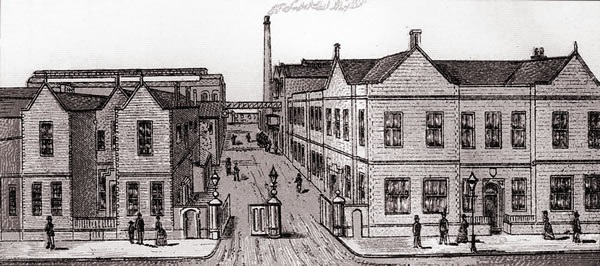
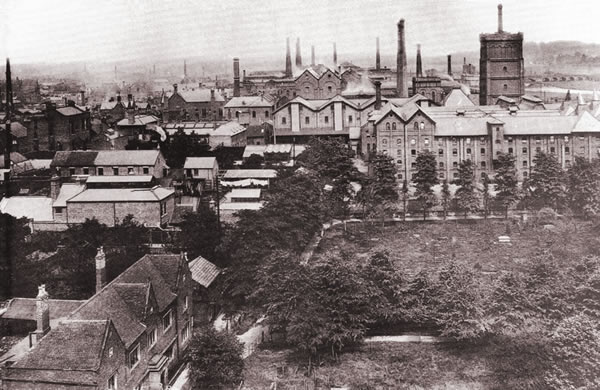
This etching, from 1882, is the earliest known image showing the completed new buildings together with the original one on the left.

Here is his entry from Wikipedia:

The exact origins of William Bass, the founder of the brewery are not clear, but a scholarly account of the history of the Bass brewery shows that in the 1720s he was living with his parents, John and Ann Bass, and his two brothers, John and Thomas, in Hinckley, Leicestershire.

His father, a plumber and glazier, died when William was 15, after which he carried on a carrier business with his older brother John in Hinckley, Leicestershire. In 1756 William married Mary Gibbons, daughter of a London publican who ran the Red Lion Inn close to the London depot. They chose Burton-upon-Trent as their home because it was midway between Manchester and London, was a growing industrial-commercial centre, and was ideally positioned on the new Trunk canal, continuing his business there as a carrier of beer, his chief client being Benjamin Printon, a local brewer.

By 1777, aged 60, he had saved some money, and, seeing the growing demand for Burton beer, he entered the brewing business. He bought a town house in the High Street, which contained a brewery and malthouse on adjoining land. Burton was already a thriving brewing town with several breweries exploiting the growing export beer trade via the Trent Navigation and Hull to the Baltic ports in Russia, mainly Saint Petersburg. He established the Bass Brewery and catered mainly for the domestic market, but in 1784 he started to export ale directly to Russia.

After his death, he was succeeded in the business by his sons William and Michael, and in 1795 Michael took sole control.

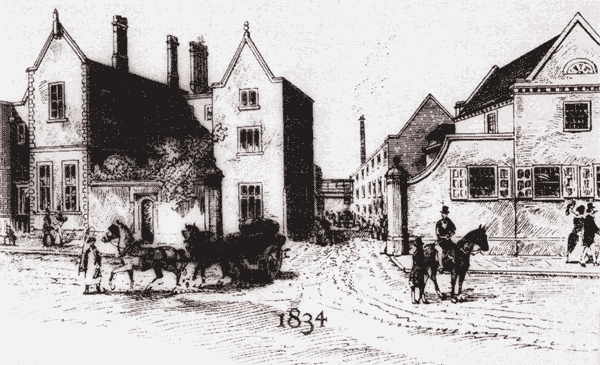
The Bass Town House, as would have looked in 1834.

And here’s part of the early history of the Bass Brewery he founded:

Prior to establishing a brewery, William Bass transported ale for brewer Benjamin Printon. Bass sold this carrier business to the Pickford family, using the funds to establish Bass & Co Brewery in 1777 as one of the first breweries in Burton-upon-Trent.

Early in the company’s history, Bass was exporting bottled beer around the world, serving the Baltic region through the port of Hull. Growing demand led his son Michael Thomas Bass (senior), to build a second brewery in Burton in 1799 in partnership with John Ratcliff. The water produced from local boreholes became popular with brewers, with 30 operating there by the mid-19th century. His son, Michael Thomas Bass, succeeded on his father’s death in 1827, renewed the Ratcliff partnership, brought in John Gretton, and created ‘Bass, Ratcliff and Gretton.’

And this is from a Burton-on-Trent history website:

William Bass, born in 1717, was the second son of three sons of William Bass who ran a moderately successful plumbing and glaziery business and small-holding in Hinkley.

William’s father died when he was just fifteen. The eldest son, John, succeeded his father as plumber and glazier, leaving William to look after the running of the small-holding. Eventually, John and William established a carrier business and by 1754, they were operating a bi-directional service between Manchester and London but the following year, William gained complete control over the carrying business with his brother preferring to concentrate on the original established business so that he could remain in Hinckley.

In 1756, William married Mary Gibbons, the daughter of a London publican close who ran the ‘Red Lion’ close to the London depot. They chose to make their home in Burton upon Trent because it was mid-way en route from Manchester and London, was a growing industrial and commercial centre, and was positioned on the new, under construction Trunk canal.

From Burton, he carried felt hats, which had a strong manufacturing presence in Burton, together with spades, axes, screws and hardware predominantly for Thomas Thornewill’s works in New Street but also for other Burton manufacturers such as Richard Green. Increasingly, he was also shipping casks of beer from Burton’s steadily growing brewery trade for the likes of Charles Leeson, William Musgrave, Samuel Sketchley, Joseph Clay, Thomas Lovatt and Henry Evans.

Living in a modest house in Wetmore, William’s first of two sons, Michael Thomas was born in 1759. As a well established carrier proprietor, in 1765, William Bass was able to lease a large new house in High Street.

He entered brewing relatively late in life, aged 60, by selling his transportation business to the Pickford family and using the funds to purchase a Town House in High Street, with a brewery and malthouse on adjoining land, seeing brewing as providing a better future business for his two sons.

The Bass Brewery catered mainly for the domestic market, but in 1784 he started to export ale directly to the Baltic (Russia) via Hull. After his death, he was succeeded in the business by his sons William and Michael and in 1795 Michael took sole control.

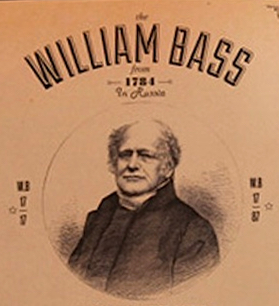
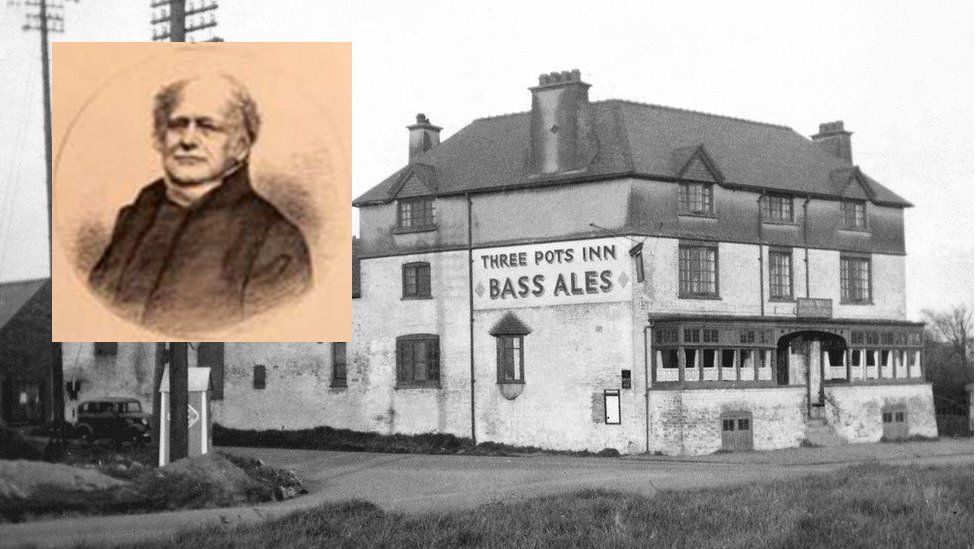
William Bass and one of the firm’s earliest pubs in Hinckley

Filed Under: Birthdays, Just For Fun Tagged With: England, Great Britain, History

« Previous Page
Next Page »

Find Something

Northern California Breweries

Please consider purchasing my latest book, California Breweries North, available from Amazon, or ask for it at your local bookstore.

Recent Comments

  • Bob Paolino on Beer Birthday: Grant Johnston
  • Gambrinus on Historic Beer Birthday: A.J. Houghton
  • Ernie Dewing on Historic Beer Birthday: Charles William Bergner 
  • Steve 'Pudgy' De Rose on Historic Beer Birthday: Jacob Schmidt
  • Jay Brooks on Beer Birthday: Bill Owens

Recent Posts

  • Beer In Ads #5203: Now’s The Time To Say … Blitz Weinhard Bock For Me! April 3, 2026
  • Beer Birthday: Dave Bonighton April 3, 2026
  • Historic Beer Birthday: Frederick Hinckel Jr. April 3, 2026
  • Beer In Ads #5202: The Bock Beer Time Is Near, And It Comes But Once A Year April 3, 2026
  • Historic Beer Birthday: Henry Pierre Heineken April 3, 2026

BBB Archives

Feedback

Head Quarter
This site is hosted and maintained by H25Q.dev. Any questions or comments for the webmaster can be directed here.