Brookston Beer Bulletin

Jay R. Brooks on Beer

  • Home
  • About
  • Editorial
  • Birthdays
  • Art & Beer

Socialize

  • Dribbble
  • Email
  • Facebook
  • Flickr
  • GitHub
  • Instagram
  • LinkedIn
  • Pinterest
  • RSS
  • Twitter
  • YouTube

Powered by Genesis

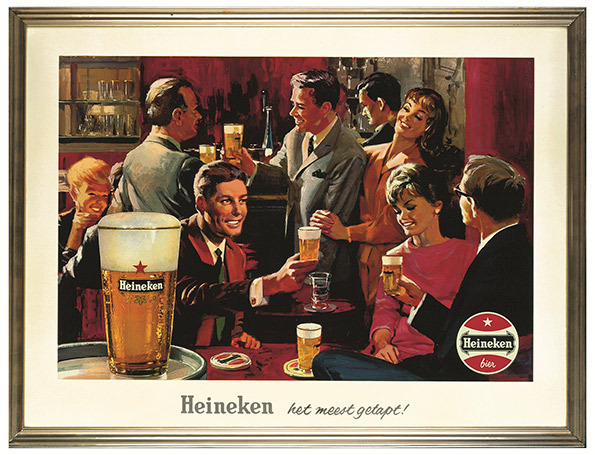
Beer In Ads #3338: Heineken’s Bier Wagon

May 2, 2020 By Jay Brooks

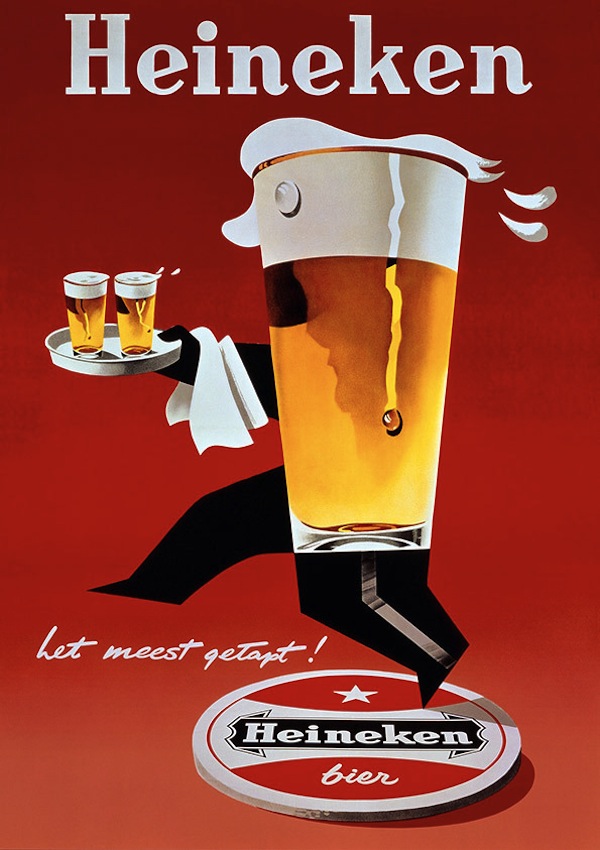
Saturday’s ad is for Heineken, from the 1940s. From the late 1800s until the 1980s, poster art really came into its own, and in Europe a lot of really cool posters, many of them for breweries, were produced. I’ve been posting vintage European posters all last year and will continue to do so in 2020. This one was created for Heineken, which was founded as De Hooiberg in 1592 in Amsterdam, in The Netherlands. The Heineken family bought the brewery and renamed it in 1864. The text at the bottom, “Let meest getapt!,” Google translates as “please most tapped,” which I suspect is something like “the most popular tapped beer.” I’m not sure who created this poster.

Filed Under: Art & Beer, Beers Tagged With: Advertising, Heineken, History, The Netherlands

Beer In Ads #3337: Heineken’s Bier Waiter

May 1, 2020 By Jay Brooks

Thursday’s ad is for Heineken, from the 1950s. From the late 1800s until the 1980s, poster art really came into its own, and in Europe a lot of really cool posters, many of them for breweries, were produced. I’ve been posting vintage European posters all last year and will continue to do so in 2020. This one was created for Heineken, which was founded as De Hooiberg in 1592 in Amsterdam, in The Netherlands. The Heineken family bought the brewery and renamed it in 1864. The text at the bottom, “Let meest getapt!,” Google translates as “please most tapped,” which I suspect is something like “the most popular tapped beer.” I’m not sure who created this poster, but it’s signed in the upper-righthand corner with “Dobe.”.

Filed Under: Art & Beer, Beers Tagged With: Advertising, Heineken, History, The Netherlands

Bavarian Beer Riots

May 1, 2020 By Jay Brooks

Beginning May 1, 1844, and lasting until May 5, the Beer Riots in Bavaria took place after King Ludwig I of Bavaria decreed a tax on beer. It was due to the rising cost of ingredients and raised the price of a beer by the equivalent of a penny.

Several thousand angry citizens stormed the breweries on the evening of May 1st. The authorities replied with repression, the decree of the Munich police director of May 4, 1844 states:

“The mines in the inns are not tolerated at all from 6 a.m. to 11 a.m. and in the afternoons only as long as no excesses are committed. In the event of excesses, the inns are cleared by the armed forces and the guests are exposed to the danger of being arrested. ”

The police director had not, however, counted on the local Army soldiers’ thirst for beer. These refused to act against the insurgents, and King Ludwig I had to reduce the beer price back to the old price. Order was only restored after the King decreed a 10% reduction in the price of beer. Ludwig I only remained King for 4 more years, when he abdicated following the Revolutions of 1848, and his son, Maximilian II, took his place.

Friedrich Engels, who is most famous for having developed Marxist theory along with Karl Marx, wrote a short article for The Northern Star newspaper a few weeks after the incident.

The Bavarian Beer is the most celebrated of all kinds of this drink brewed in Germany, and, of course, the Bavarians are much addicted to its consumption in rather large quantities. The government laid a new duty of about 100s. ad valorem on beer, and in consequence of this an outbreak occurred, which lasted for more than four days. The working men assembled in large masses, paraded through the streets, assailed the public houses, smashing the windows, breaking the furniture, and destroying everything in their reach, in order to take revenge for the enhanced price of their favourite drink. The military was called in, but a regiment of horse-guards, when commanded to mount on horseback, refused to do so. The police, being, as everywhere, obnoxious to the people, were severely beaten and ill-treated by the rioters, and every station formerly occupied by police-officers had to be occupied by soldiers, who, being upon good terms with the people, were considered less hostile and showed an evident reluctance to interfere. They only did interfere when the palace of the King was attacked, and then merely took up such a position as was sufficient to keep the rioters back. On the second evening (the 2nd of May) the King, in whose family a marriage had just been celebrated, and who for this reason had many illustrious visitors at his court, visited the theatre; but when, after the first act, a crowd assembled before the theatre and threatened to attack it, every one left the house to see what the matter was, and His Majesty, with his illustrious visitors, was obliged to follow them, or else he would have been left alone in his place. The French papers assert that the King on this occasion ordered the military stationed before the theatre to fire upon the people, and that the soldiers refused. The German papers do not mention this, as may be expected from their being published under censorship; but as the French papers are sometimes rather ill-informed about foreign matters, we cannot vouch for the truth of their assertion. From all this, however, it appears that the Poet King (Ludwig, King of Bavaria, is the author of three volumes of unreadable Poems, of a Traveller’s Guide to one of his public buildings &c. &c.) has been in a very awkward position during these outbreaks. In Munich, a town full of soldiers and police, the seat of a royal court, a riot lasts four days, notwithstanding all the array of the military, – and at last the rioters force their object. The King restored tranquillity by an ordinance, reducing the price of the quart of beer from ten kreutzers (3¼ denarius) to nine kreutzers (3d). If the people once know they can frighten the government out of their taxing system, they will soon learn that it will be as easy to frighten them as far as regards more serious matters.

Filed Under: Beers, Just For Fun, Politics & Law, Related Pleasures Tagged With: Bavaria, Germany, History, Politics

Beer In Ads #3336: Heineken Pint Serving Pints

April 30, 2020 By Jay Brooks

Thursday’s ad is for Heineken, from the 1950s. From the late 1800s until the 1980s, poster art really came into its own, and in Europe a lot of really cool posters, many of them for breweries, were produced. I’ve been posting vintage European posters all last year and will continue to do so in 2020. This one was created for Heineken, which was founded as De Hooiberg in 1592 in Amsterdam, in The Netherlands. The Heineken family bought the brewery and renamed it in 1864. The text at the bottom, “Let meest getapt!,” Google translates as “please most tapped,” which I suspect is something like “the most popular tapped beer.” I’m not sure who created this poster.

Filed Under: Art & Beer, Beers Tagged With: Advertising, Heineken, History, The Netherlands

Beer In Ads #3335: Heineken Pilsener Bier

April 29, 2020 By Jay Brooks

Wednesday’s ad is for Heineken Pilsener Bier, from the 1960s. From the late 1800s until the 1980s, poster art really came into its own, and in Europe a lot of really cool posters, many of them for breweries, were produced. I’ve been posting vintage European posters all last year and will continue to do so in 2020. This one was created for Heineken, which was founded as De Hooiberg in 1592 in Amsterdam, in The Netherlands. The Heineken family bought the brewery and renamed it in 1864. This poster was created by Dutch artist Frans Mettes.

Filed Under: Art & Beer, Beers Tagged With: Advertising, Heineken, History, The Netherlands

Beer In Ads #3334: Under The Heineken Table

April 28, 2020 By Jay Brooks

Tuesday’s ad is for Heineken Beer, from around the 1950s, maybe a little later. From the late 1800s until the 1980s, poster art really came into its own, and in Europe a lot of really cool posters, many of them for breweries, were produced. I’ve been posting vintage European posters all last year and will continue to do so in 2020. This one was created for Heineken, which was founded as De Hooiberg in 1592 in Amsterdam, in The Netherlands. The Heineken family bought the brewery and renamed it in 1864. I don’t know who created this poster, but it’s certainly a strange one.

Filed Under: Art & Beer, Beers Tagged With: Advertising, Heineken, History, The Netherlands

Beer Birthday: Abram Goldman-Armstrong

April 28, 2020 By Jay Brooks

naobf
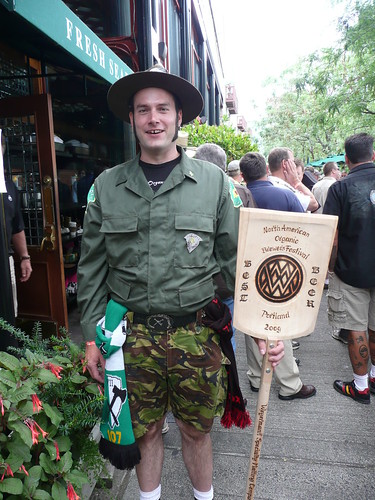
Today is the 42nd birthday of Abram Goldman-Armstrong, a Portland-based beer writer who is the managing editor of the Northwest Brewing News and also writes online at Brewsville. Abe also is the organizer of the North American Organic Brewers Festival and by day works in construction. When Abe was writing for the Celebrator Beer News several years back, during GABF we spent an evening drinking out and about the city eventually ending up at the Denver Diner, during which time I discovered I’d spent the entire evening calling him by the wrong name — d’oh. Anyway, these days I can get his name right. Join me in wishing Abe a very happy birthday.

Abe Goldman-Armstrong as Beer Patrol Man
As “Beer Patrol Man” at the 2009 OBF Parade.

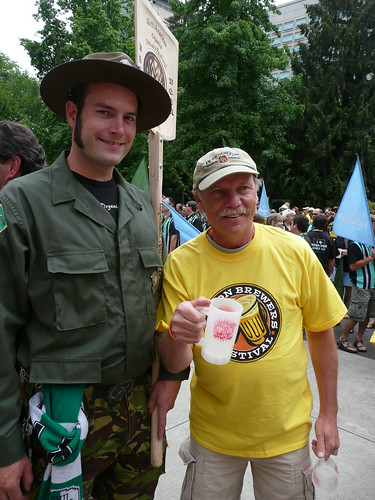
Abe & Ed Bennett
With Ed Bennett at the OBF Parade, also in 2009.

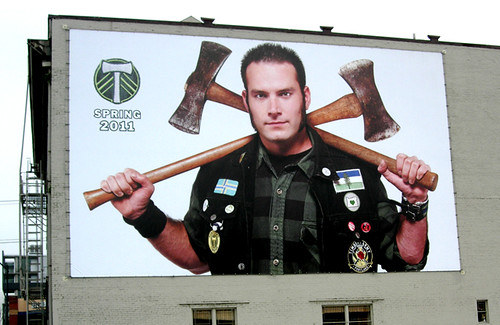
Abe-Timbers-Billboard
Abe’s also a big fan of the local soccer team, the Portland Timbers, and recently appeared on a billboard for the team as they joined the MLS several years ago.

Filed Under: Birthdays Tagged With: Oregon, Portland

Beer In Ads #3333: Heineken, Mostly Tapped

April 27, 2020 By Jay Brooks

Monday’s ad is for Heineken Beer, from around the 1950s, maybe a little later. From the late 1800s until the 1980s, poster art really came into its own, and in Europe a lot of really cool posters, many of them for breweries, were produced. I’ve been posting vintage European posters all last year and will continue to do so in 2020. This one was created for Heineken, which was founded as De Hooiberg in 1592 in Amsterdam, in The Netherlands. The Heineken family bought the brewery and renamed it in 1864. I don’t know who created this poster, but the text below Heineken’s Bier, “‘het meest getapt!,” which translates as “the most tapped!” Google went with “mostly tapped,” but happily a Dutch friend corrected that.

Filed Under: Art & Beer, Beers Tagged With: Advertising, Heineken, History, The Netherlands

Beer In Ads #3332: Heineken’s Bier Offers You The Best

April 26, 2020 By Jay Brooks

Sunday’s ad is for Heineken Beer, from around 1950. From the late 1800s until the 1980s, poster art really came into its own, and in Europe a lot of really cool posters, many of them for breweries, were produced. I’ve been posting vintage European posters all last year and will continue to do so in 2020. This one was created for Heineken, which was founded as De Hooiberg in 1592 in Amsterdam, in The Netherlands. The Heineken family bought the brewery and renamed it in 1864. I don’t know who created this poster, but the text below Heineken’s Bier, “‘Biedt U Het Beste,” translates as “Offer You the Best.”

Filed Under: Art & Beer, Beers Tagged With: Advertising, Heineken, History, The Netherlands

Beer In Ads #3331: Heineken Police Chase

April 25, 2020 By Jay Brooks

Saturday’s ad is for Heineken Beer, from around 1950. From the late 1800s until the 1980s, poster art really came into its own, and in Europe a lot of really cool posters, many of them for breweries, were produced. I’ve been posting vintage European posters all last year and will continue to do so in 2020. This one was created for Heineken, which was founded as De Hooiberg in 1592 in Amsterdam, in The Netherlands. The Heineken family bought the brewery and renamed it in 1864. I don’t know who created this poster, but the text below Heineken’s Bier, “‘Loo uit de Brouwerij,” although I’m not sure what that first letter is supposed to be. Is an “L” or does that flourish before it have some meaning? With an “L,” it translates as “Loo from the Brewery,” so I suspect it is something like “straight from the Brewery,” or something like that. Or maybe “A steal from the brewery.” Anybody know?

Filed Under: Art & Beer, Beers Tagged With: Advertising, Heineken, History, The Netherlands

« Previous Page
Next Page »

Find Something

Northern California Breweries

Please consider purchasing my latest book, California Breweries North, available from Amazon, or ask for it at your local bookstore.

Recent Comments

  • Bob Paolino on Beer Birthday: Grant Johnston
  • Gambrinus on Historic Beer Birthday: A.J. Houghton
  • Ernie Dewing on Historic Beer Birthday: Charles William Bergner 
  • Steve 'Pudgy' De Rose on Historic Beer Birthday: Jacob Schmidt
  • Jay Brooks on Beer Birthday: Bill Owens

Recent Posts

  • Historic Beer Birthday: John Courage Jr. June 26, 2026
  • Beer In Ads #5275: Gerst Bock Beer! The Famous Spring Tonic. June 25, 2026
  • Beer Birthday: Andy French June 25, 2026
  • Historic Beer Birthday: Peter Ganser June 24, 2026
  • Historic Beer Birthday: Steve Harrison June 24, 2026

BBB Archives

Feedback

Head Quarter
This site is hosted and maintained by H25Q.dev. Any questions or comments for the webmaster can be directed here.