Brookston Beer Bulletin

Jay R. Brooks on Beer

  • Home
  • About
  • Editorial
  • Birthdays
  • Art & Beer

Socialize

  • Dribbble
  • Email
  • Facebook
  • Flickr
  • GitHub
  • Instagram
  • LinkedIn
  • Pinterest
  • RSS
  • Twitter
  • YouTube

Powered by Genesis

Beer In Ads #2123: Recipe For Pleasure

December 12, 2016 By Jay Brooks


Monday’s holiday ad is for Miller High Life, from 1952. A table of holiday foods — including some pretty odd ones — but I especially love the Christmas tree of finger foods.

Miller-1952-xmas-recipe-for-pleasure

Filed Under: Art & Beer, Beers Tagged With: Advertising, Christmas, History, Holidays, Miller Brewing

Patent No. 1011147A: Beer Keg Valve

December 12, 2016 By Jay Brooks

patent-logo
Today in 1911, US Patent 1011147 A was issued, an invention of Samuel E Bennett, for his beer keg “Valve.” There’s no Abstract, although in the description it includes these claims:

This invention relates to valves and more particularly to an air valve of that character used in beer drawing apparatus, and the invention has for its primary object to provide a valve of this character consisting of an attaching body adapted for connection to the beer keg and to an air hose or pipe, and a valve carrying casing removably engaged in said body.

A further object of the invention is to provide improved means for mounting the valve member, whereby, in the event that foreign particles of matter should find their way between the valve member and its seat, said valve member and its case may be easily removed without liability of losing the valve member, and such foreign matter removed.

A further object of the invention is to provide an air valve of this character of extremely simple construction, and one which is highly efficient and durable in use.

US1011147-0

Filed Under: Beers, Just For Fun, Politics & Law, Related Pleasures Tagged With: History, Kegs, Law, Patent

Anchor Christmas Ale 2003

December 12, 2016 By Jay Brooks

xmas-christmas-ale
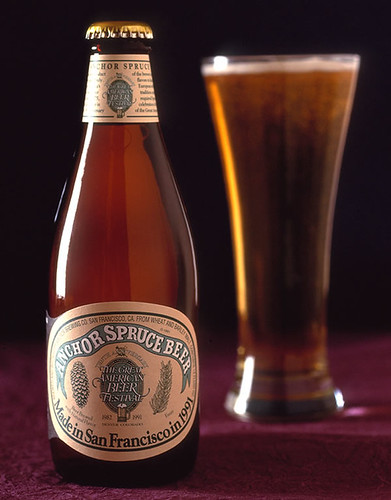
It’s day twenty-nine of my jack be nimble to Christmas featuring all 42 labels from Anchor’s Christmas Ale — a.k.a. Our Special Ale — all different beers (well, mostly different) and all different labels, each one designed by local artist Jim Stitt, up to and including this year’s label.

2003 was the twenty-ninth year that Anchor made their Christmas Ale, and from 1987 through the present day, each year Anchor’s Our Special Ale has included spices, a different combination of them every time. Generally the base beer has been a spiced brown ale, although it has been varied from time to time, as well. This twenty-ninth label was a “Sitka Spruce,” or “Picea sitchensis.”

Anchor-Xmas-2003

Filed Under: Art & Beer, Beers, Just For Fun Tagged With: Anchor Brewery, Beer Labels, Christmas, History, Holidays

Patent No. D209533S: Beer Can Holder

December 12, 2016 By Jay Brooks

patent-logo
Today in 1967, US Patent D209533 S was issued, an invention of Glen E. Cole and Wayne Miller, for their “Beer Can Holder.” The text of their patent application is, in its entirety:

The ornamental design for a beer can holder, as shown.

USD209533>

Filed Under: Beers, Just For Fun, Politics & Law, Related Pleasures Tagged With: Cans, History, Law, novelties, Packaging, Patent

The First Brewery In The Americas

December 12, 2016 By Jay Brooks

mexico
While I don’t have many specific details, the first Western-style brewery in the Americas began today when Don Alfonso de Herrera was granted permission to build a brewery on December 12, 1543. He built it near Mexico City the following year, opening in 1544.

Although the story began at least three years before, the specific details vary widely depending on which source you look at, I’ve done my best to piece it together as best I could.

Hernán Cortés was a Spanish Conquistador who led the expedition that led to much of South America and Southwestern North America being conquered by Spain. Cortes arrived in what today is Mexico in 1519. They found that the native population enjoyed traditional fermented drinks such as pulque, zendecho (pulque corn), izquiate, and pozol (or pozoles), chinguirito, tepaches, mesquite wines, chicha, the zambumbia and tesgüino. Initially, beer brewed with barley was produced in small quantities by Cortés’ soldiers, but it was very limited due to the lack of supplies.

On August 23, 1541, Don Alonso de Herrera, from Seville, Spain, submitted an application to the Spanish government hoping to receive royal authorization to build a commercial brewery in New Spain, which is what Mexico was called at that time. His application was debated in Madrid by the Council of the Indies, which Charles V, King of Spain and the Holy Roman Emperor, used to administrate his North American territories. The following year in the city of Nájara, on either June 6, 1542 or July 6, 1542 (sources vary), either Alonso de Herrera signed a contract with the Crown or Emperor Charles V (who apparently loved beer) signed a decree (or Royal Charter) giving him permission to establish his brewery in the New World (again, there is conflicting information about this).

Whichever is correct, the deal with the crown was this. Alonso de Herrera received a license to brew beer in New Spain (the “Indies” apparently was what was written on the agreement) exclusively for a period of twenty years. “He was liable to pay one third of his profits in tax, supervised by the Viceroy, Antonio de Mendoza. The price of beer was estimated at 6 reales (20.1 g or 0.7 oz of silver) per arroba” (a unit of measure equal to 25 pounds or 11.5 kg in Spain).

The Crown, in return, made him Corregidor (district governor) of an area of the valley of Mexico inside what is now Mexico City where the hacienda (estate) “de El Portal,” the site of the brewery, was situated. This allowed him, among other privileges, imports free of excise duty.

The agreement also stipulated that he was also permitted to manufacture other goods, such as “naveta oil, soap and blonde.” I think naveta oil is possibly shipping oil but I have no idea what they meant by “blonde.” But he had one more hurdle to get over, and that involved getting permission (probably a formality) from the Viceroy of New Spain, who at that time was Don Antonio de Mendoza. On December 12, 1543, Mendoza formally granted him permission, issuing him a permit to build his brewery, and he began at once. He also granted Herrera “land to grow hops and other necessary plants.”

Alonso de Herrera hired Flemish brewers, who brought “tackle, boilers, and other equipment necessary for brewing.” According to the terms of the deal, the Crown had also agreed that Alonso de Herrera would bear the costs on the workers he took with him. But he also received an exemption from the payment of any import tax on what was transported to and from Spain, and was also given two hundred slaves from Portugal, Cape Verde and Guinea, which would be used for the building of the brewery.

Apparently things didn’t go all that well for America’s first commercial brewery.

Herrera’s brewery struggled during its first years, as alcohol consumption was highly regulated by authorities, and the new brew had to compete with native beverages. It was also more expensive due to the lack of ingredients. However, the beverage caught on, as it was drunk by colonial authorities, leading others to want it as well. Herrera worked to expand his brewery and the land on which wheat and barley were raised. In the long run, Herrera’s brewery did not survive, and the production of European-style beverages such as beer and wine were heavily taxed and heavily regulated by Spain to protect home markets. The purpose of this was to make colonials import these products from Europe.

Herrera also sent lavish gifts to Emperor Charles V, and Viceroy Antonio de Mendoza was supplied with all the beer he could drink, which must have helped grease the wheels. Because wine was scarce, beer did become more popular, although the price did rise to more like 8 reales, mostly die to shortages of wheat and barley. Beer was sold primarily in the markets, plazas, and in a tavern Herrera built. “Beer production suffered ups and downs,” and he even had to stop production briefly when “some of his brewers decided to return to Flanders, and others chose to work in the mines of Mexico to make good money. However, from 1549 production increased: 1,158 pounds to be made between 28 January and 25 October 1549-an average of 128.6 pounds per month- and reached 4,192 arrobas between the last date and 8 May 1552, which places the monthly average in about 246.5 pounds, as noted by Emilio Luque Azcona.” The fate of the brewery is not known with any certainty, although it appears to not have survived Herrera’s death, although I’ve been unable to find when that was exactly. The last mention of it in the historical record appears to be in 1552.

While El Portal is thought to be where the brewery was built, its exact location is unknown, but it is thought to have been located in the south of Mexico City (where Metro Portales is today) or in Amecameca, Mexico State. Another source puts it “near the so-called Paso de Cortés.”

El-Greco-Portrait-of-Alonso-de-Herrera
Portrait of Alonso de Herrera, by El Greco.

Filed Under: Beers, Breweries, Just For Fun, Related Pleasures Tagged With: History, Mexico, Spain

Patent No. 121902A: Improvement In Preserving And Using Hops In Brewing

December 12, 2016 By Jay Brooks

patent-logo
Today in 1871, US Patent 121902 A was issued, an invention of Jacob Seeger and John Boyd, for their “Improvement in Preserving and Using Hops in Brewing.” There’s no Abstract, although in the description it includes these claims:

It is well known that the active principle of hops is soon dissipated and the flavor changed or lost upon exposure to atmospheric action, and that, therefore, fresh hops command in the market two or three fold the price of hops grown the year previous. They are also readily injured by dampness, and their shipment by water is, therefore, attended with risk.

We propose by grinding or otherwise pulverizing the hops, and by then packing the same in air-tight packages to secure the following advantages in an improved article of manufacture and trade: First, the bulk is reduced at least fifty per cent. in packing the hops after being pulverized. Second, the hops pulverized and packed in air-tight vessels or packages may be stored for an indefinite length of time without deterioration as to quality, weight, or flavor. Third, the expense and labor of transportation is greatly reduced. Fourth, hops pulverized and packed in air-tight packages may be transported by Water-carriage without risk or damage by dampness. For the purpose of retail trade the pulverized hops are packed in cans or packages holding a pound, more or less, while for the convenience of large consumers, breweries, &c., the packages may be boxes or barrels. In packing pulverized hops the contents of an ordinary bale may be reduced to the dimensions of a flour-barrel, and, therefore, the labor of handling and the expense of transportation will be proportionately reduced.

The large consumer is enabled by our method to store his years supply without danger of deterioration as to quality, flavor, or weight, and with a material saving as to quantity required and space occupied. The dealer is enabled by our method to handle his hops and to ship them to any market without risk from atmospheric causes or dampness, which now makes a material advance in the price in markets remote from the place of production; or he can hold his stock over and wait an advance in price. This latter fact will tend to equalize prices and relieve the market of a glut at one time or a dearth at another.

hop-flowers

Filed Under: Beers, Just For Fun, Politics & Law, Related Pleasures Tagged With: History, Hops, Law, Patent, Science of Brewing

Beer In Ads #2122: Christmas Cheer

December 11, 2016 By Jay Brooks


Sunday’s holiday ad is for Pabst Blue Ribbon, from 1912. Interesting illustration of Santa Claus peering through a beer glass and you can also see his ear through the bottle. And I love their tagline. “Nothing but the best will do at Holiday Season — especially if you expect to entertain.”

Pabst-1912-xmas-cheer

Filed Under: Art & Beer, Beers Tagged With: Advertising, Christmas, History, Holidays, Pabst

Anchor Christmas Ale 2002

December 11, 2016 By Jay Brooks

xmas-christmas-ale
It’s day twenty-eight of my eggnoged escape to Christmas featuring all 42 labels from Anchor’s Christmas Ale — a.k.a. Our Special Ale — all different beers (well, mostly different) and all different labels, each one designed by local artist Jim Stitt, up to and including this year’s label.

2002 was the twenty-eighth year that Anchor made their Christmas Ale, and from 1987 through the present day, each year Anchor’s Our Special Ale has included spices, a different combination of them every time. Generally the base beer has been a spiced brown ale, although it has been varied from time to time, as well. This twenty-eighth label was a “Fremont Cottonwood,” or “Populus fremontii.”

Anchor-Xmas-2002

Filed Under: Art & Beer, Beers, Just For Fun Tagged With: Anchor Brewery, Beer Labels, Christmas, History, Holidays

Patent No. 530827A: Beer Drawing And Saving Apparatus

December 11, 2016 By Jay Brooks

patent-logo
Today in 1894, US Patent 530827 A was issued, an invention of William R. Dales, for his “Beer Drawing and Saving Apparatus.” There’s no Abstract, although in the description it includes these claims:

The object of my invention is to produce an apparatus which enables beer to be readily drawn to fill a glass or other receptacle, and which has also an arrangement by which the froth may be sucked from the glass and delivered into a receptacle from which, after it settles, it may be withdrawn in the shape of merchantable beer. The apparatus thus provides for selling beer on draft in the usual way, while cans and such articles may be filled from the receptacle into which the froth has been delivered. To these ends my invention consists of certain features of construction and combinations of parts, which will be hereinafter described and claimed.

US530827-0

Filed Under: Beers Tagged With: Bars, History, Kegs, Law, Patent

Beer In Ads #2121: Foam Christmas Tree

December 10, 2016 By Jay Brooks


Saturday’s holiday ad is for Natakhtari, a brewery in the Republic of Georgia, from 2014. It was founded in 1991, but was bought by the Turkish brewery Efes in 2008. In this ad, a very simple one, a nearly empty glass on a red background, and the residual beer foam left behind is in the shape of a Christmas tree.

Natakhtari-2014

Filed Under: Art & Beer, Beers Tagged With: Advertising, Christmas, Georgia, History, Holidays

« Previous Page
Next Page »

Find Something

Northern California Breweries

Please consider purchasing my latest book, California Breweries North, available from Amazon, or ask for it at your local bookstore.

Recent Comments

  • Bob Paolino on Beer Birthday: Grant Johnston
  • Gambrinus on Historic Beer Birthday: A.J. Houghton
  • Ernie Dewing on Historic Beer Birthday: Charles William Bergner 
  • Steve 'Pudgy' De Rose on Historic Beer Birthday: Jacob Schmidt
  • Jay Brooks on Beer Birthday: Bill Owens

Recent Posts

  • Beer In Ads #5228: All Together For Newark April 21, 2026
  • Beer Birthday: Steve Parkes April 21, 2026
  • Beer In Ads #5227: It’s Here! Bock Beer By Bosch April 20, 2026
  • Beer Birthday: Drew Beechum April 20, 2026
  • Beer Birthday: Des De Moor April 20, 2026

BBB Archives

Feedback

Head Quarter
This site is hosted and maintained by H25Q.dev. Any questions or comments for the webmaster can be directed here.