Brookston Beer Bulletin

Jay R. Brooks on Beer

  • Home
  • About
  • Editorial
  • Birthdays
  • Art & Beer

Socialize

  • Dribbble
  • Email
  • Facebook
  • Flickr
  • GitHub
  • Instagram
  • LinkedIn
  • Pinterest
  • RSS
  • Twitter
  • YouTube

Powered by Genesis

Patent No. 3407121A: Fermenter Yeast Cropping And Washing Device

October 22, 2016 By Jay Brooks

patent-logo
Today in 1968, US Patent 3407121 A was issued, an invention of Gerald Einar Wilson and Louis A. Le Seelleur, assigned to John Labatt Breweries, for their “Fermenter Yeast Cropping and Washing Device.” There’s no Abstract, although in the description it includes these claims:

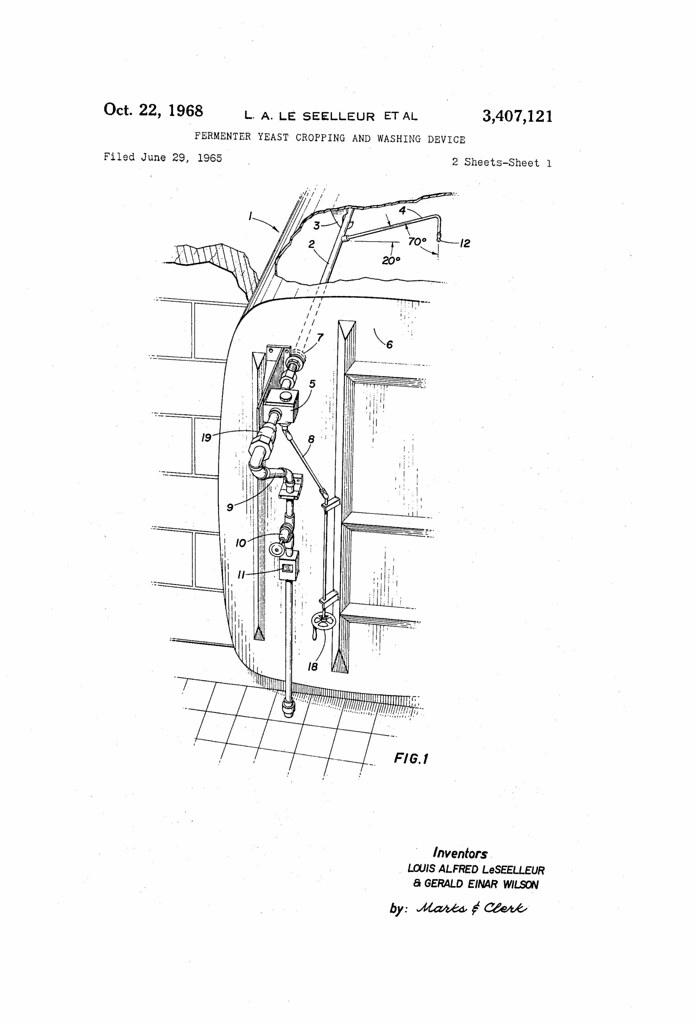
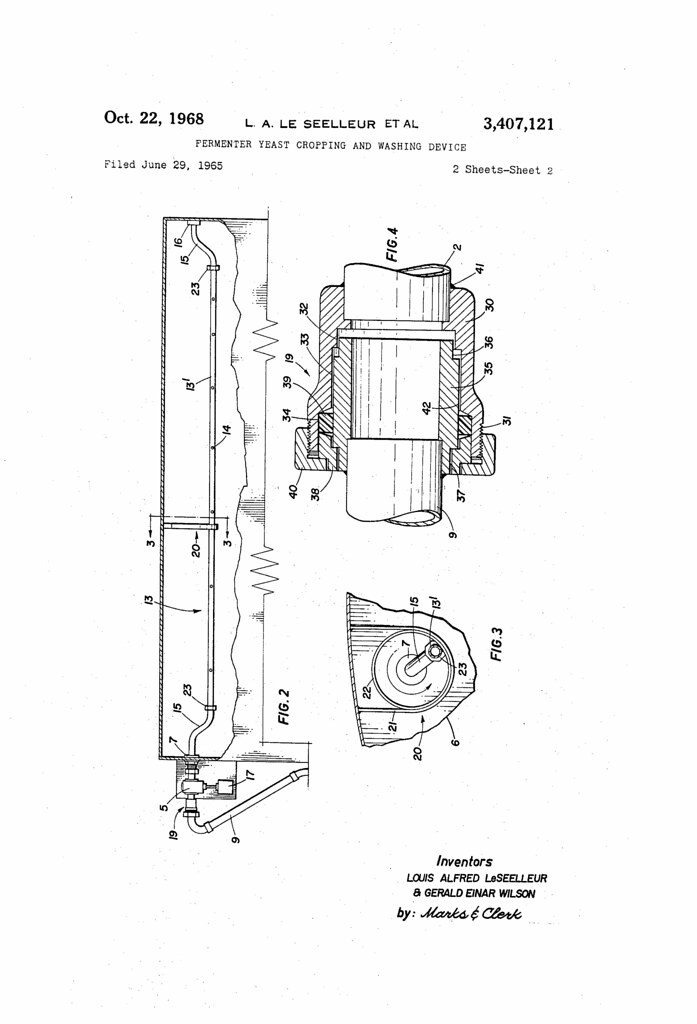
A fermenter vessel containing a yeast cropping and cleaning device consisting of a rotatable header pipe in the upper portion of the vessel with an end of the pipe extending outside the vessel and a series of orifices opening from the header into the vessel. The orifice outlets are offset a substantial distance radially from the axis of rotation of the header pipe either by providing an offset portion in the header pipe itself or by providing a series of branch pipes extending laterally from the header pipe with nozzles on the outer ends thereof. Conduit means connected to the external end of said header pipe by means of a connector and suction means associated with said conduit for cropping the yeast.

This invention relates to a yeast cropping and washing device for closed fermenting vessels used in the brewing industry.

The fermentation of wort is one of the most important steps in the brewing process. Brewers yeast, having the ability to assimilate simple nitrogenous compounds and reproduce and break down sugars to carbon dioxide and alcohol are introduced into the wort, whereupon through a controlled biological fermentation process, the wort is transformed into beer. The fermentation of wort is usually an operation carried out under relatively low pressure (1-3 p.s.i.g.) in large metal fermenting vessels capable of holding thousands of gallons of wort. The modern fermenting vessel is a closed vessel such as that described in applicants co-pending application entitled, Multipurpose Process Vessel for Heat Transfer Operations.

During the fermentation, top fermenting yeast forms on the surface of the liquid in the vessel and this is normally removed by skimming or is allowed to work over the rim of a tank into chutes or troughs. In the closed vessel it is, of course, necessary to use some form of yeast cropping device and according to the present invention a new device has been developed which can be used both for cropping yeast from the surface of the beer in the fermenter and for cleaning the fermenter after the beer has been removed.

The cropping and cleaning device according to this invention consists of a horizontally extending pipe which is rotatable within the fermenter and the rotatable pipe has a series of orifices which are adapted to draw off yeast from the fermenter or to spray cleaning solution into the fermenter. The pipe is arranged such that by rotating it the elevation of the orifices can be varied to permit the yeast to be drawn off to the desired level. One end of the rotatable pipe has a fluid connection to an external pipe through a connector which permits relative rotation between the two pipes while fluid is passing through. Suitable valve means are provided so that cleaning solution can be forced into the vessel or yeast can be drawn out of the vessel through the connector and rotatable pipe.
US3407121-0
US3407121-1

Filed Under: Beers, Breweries, Just For Fun, Politics & Law, Related Pleasures Tagged With: Brewing Equipment, History, Law, Patent, Science of Brewing, Yeast

Patent Nos. 548587A & 548588A: Machine For Blowing Glass

October 22, 2016 By Jay Brooks

patent-logo
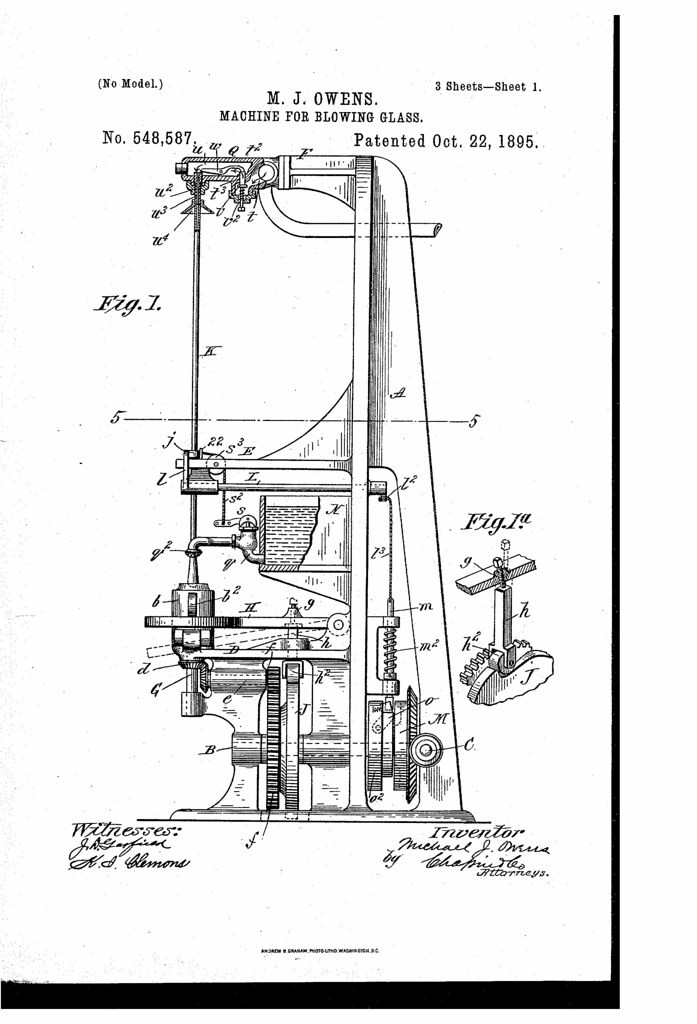
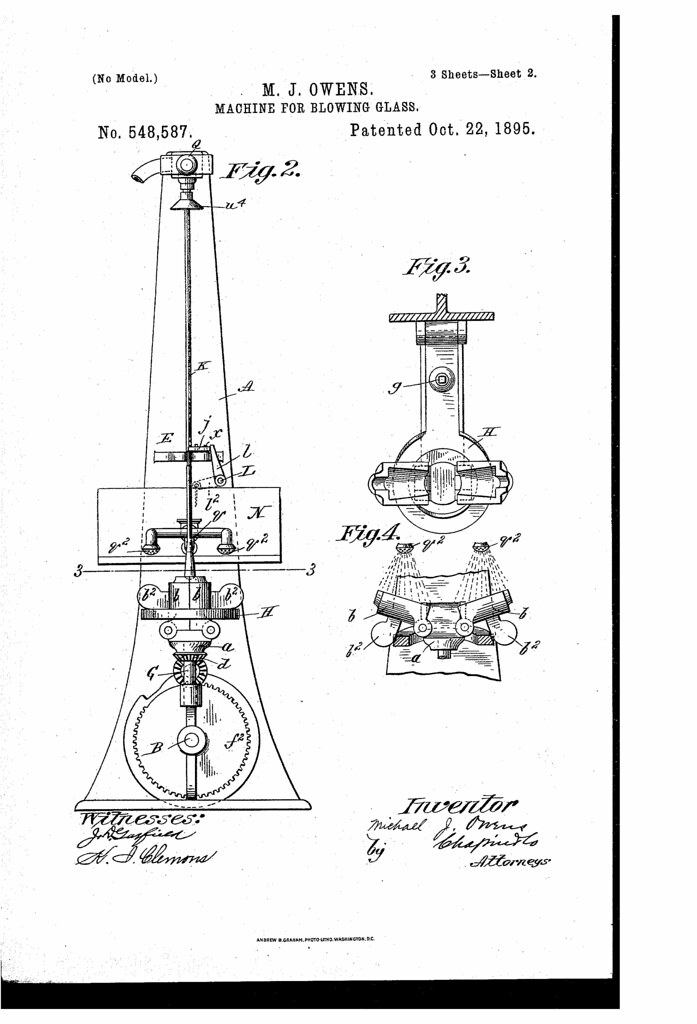
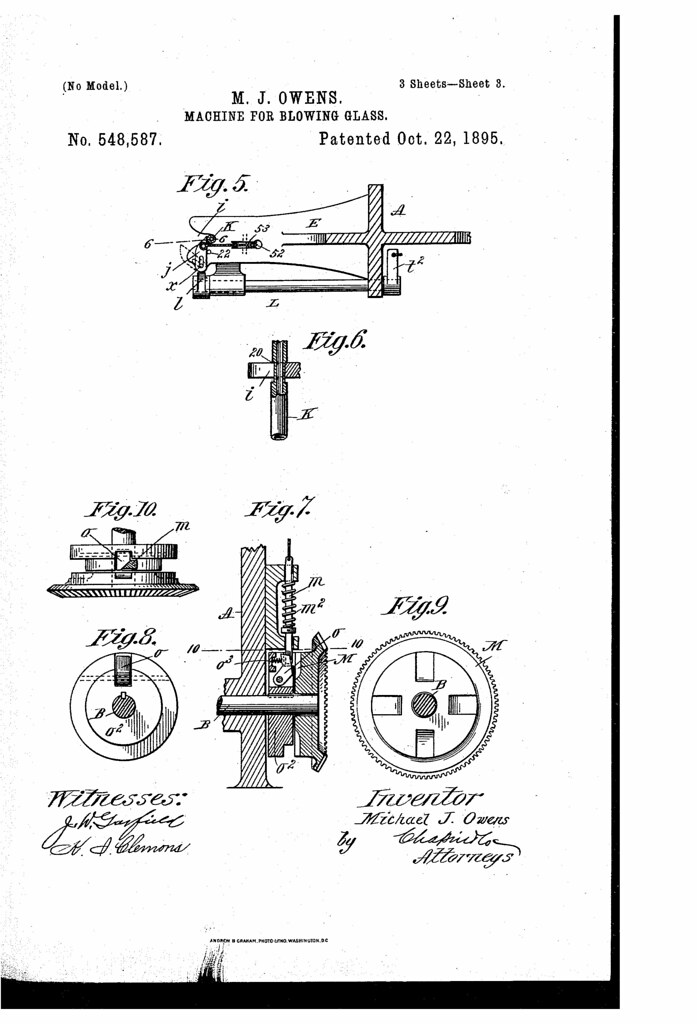
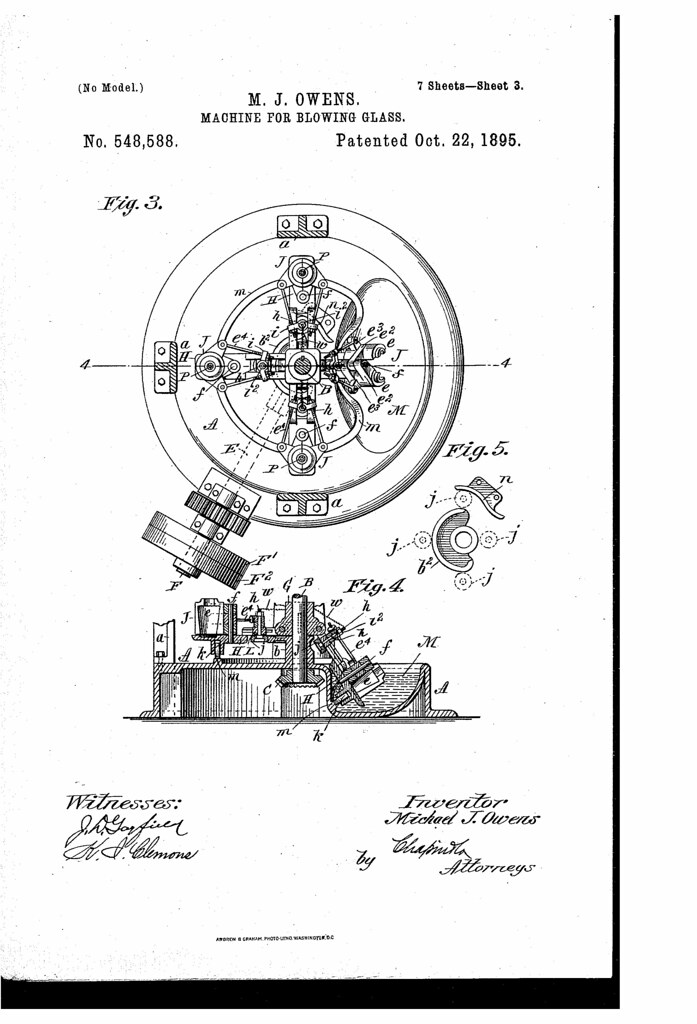
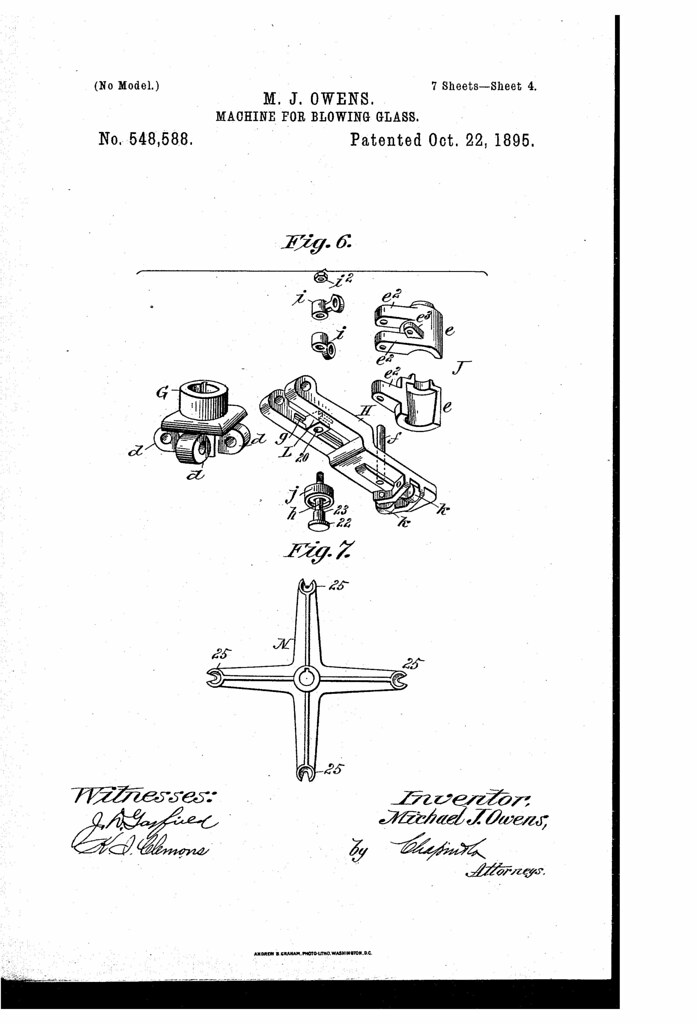
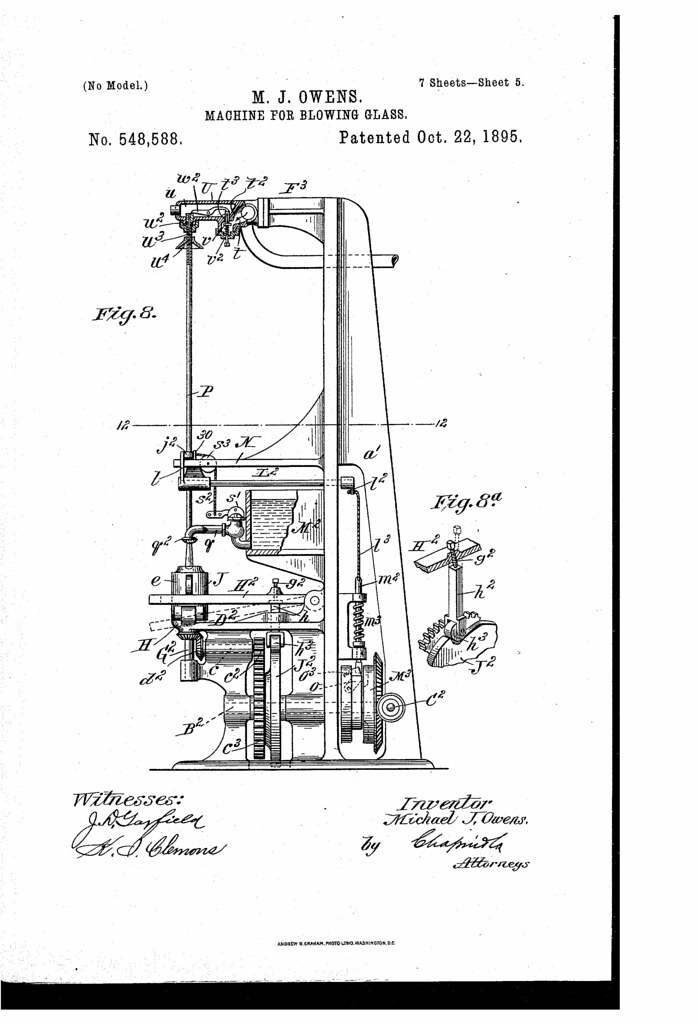
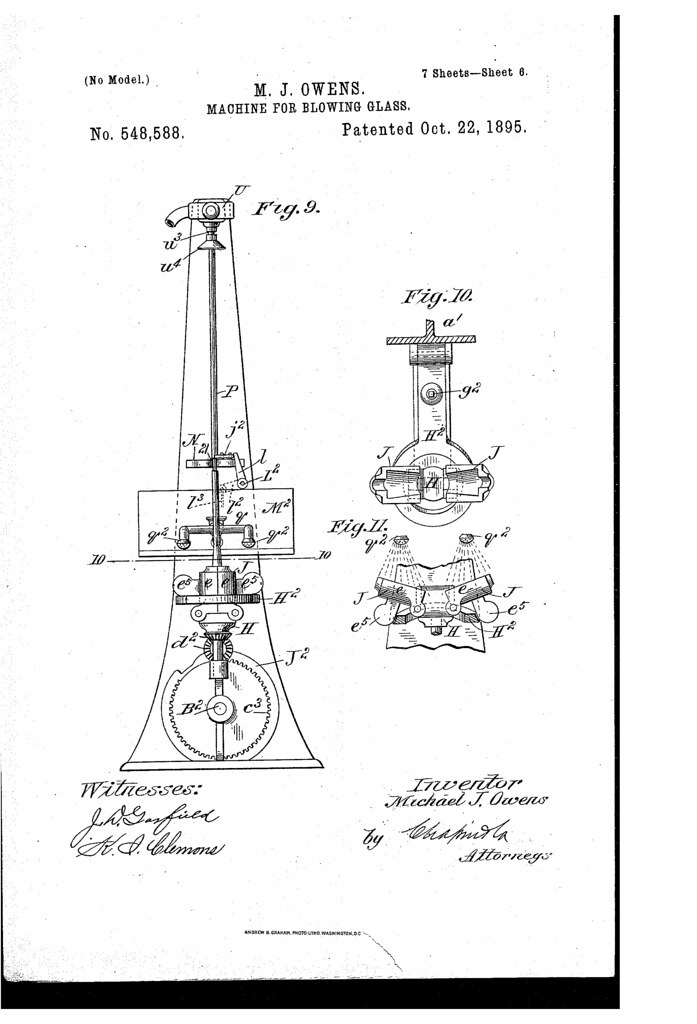
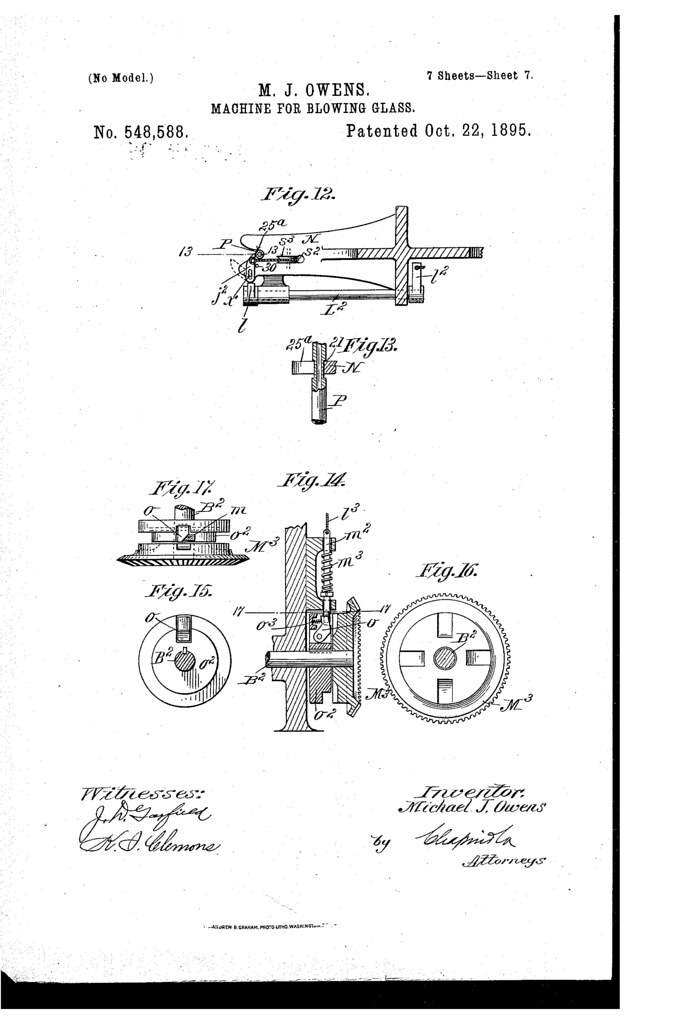
Today in 1895, both US Patent 548587 A and US Patent 548588 A were issued, and both are related inventions of Michael J. Owens, under the same name: “Machine For Blowing Glass.” There’s no Abstract, although in the description it includes these claims for the first one:

This invention relates to a partially-automatic machine for blowing glass into pastemolds, the object being to provide a machine which is susceptible of practical use for the rapid production of large quantities of glass vessels or objects of a given shape.

The machine of this invention embodies a means for supporting the blow-pipe with its one end in communication with the air-supplying device and its other in operative proximity to or within the mold; certain means for automatically admitting air through the blow-pipe; a sectional mold, which is adapted to be closed about or adjacent the gathering end of the blowpipe and to be also automatically opened, whereby the paste covered inner surface thereof may be subjected to a sprinkling action; means for automatically effecting the closing and afterward the opening of the mold-sections and for imparting to them while they are closed rotary motions, and means for automatically causing a sprinkling of the paste-lined mold-sections while opened. The automatic operations are instituted by and in consequence of the placing of the blow-pipe which has the gathering of glass thereon in the machine in its position of support and for the reception of air communication therethrough.

US548587-0
US548587-1
US548587-2

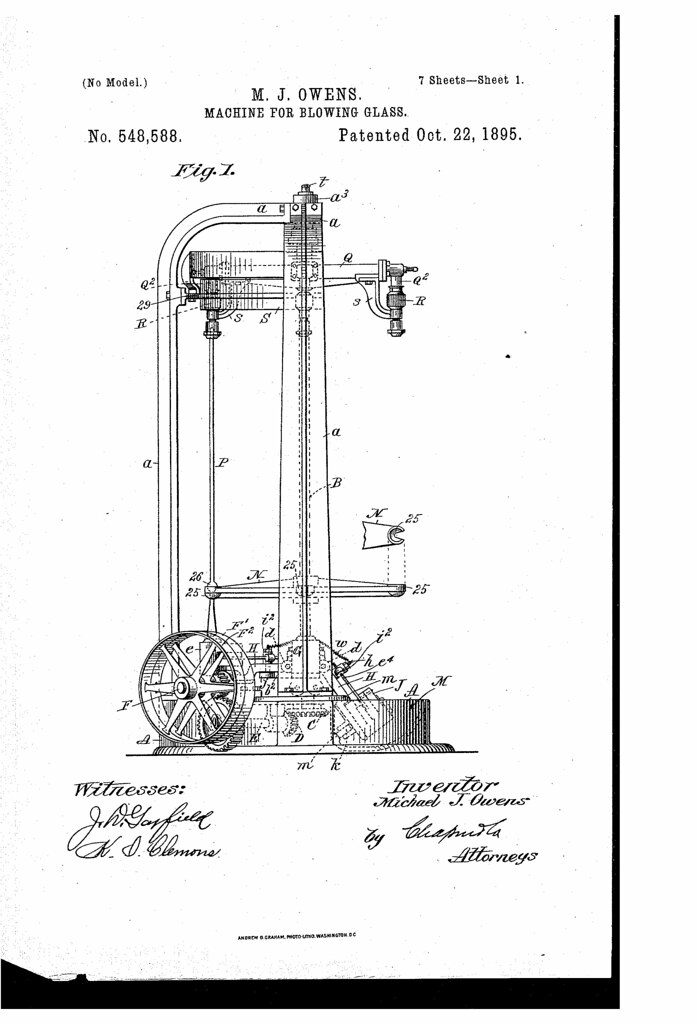
And here’s a description of the claims for the second patent:

This invention relates to improvements in machinery for blowing glass into sectional [O molds, and particularly to the organization in a machine of means for severally and respectively performing automatically and mechanically operations which heretofore have been done manually or through the operation of implements or devices which have been manipulated or in some manner actuated by or dependent upon hand, foot, or lung power.

US548588-0
US548588-1
US548588-2
US548588-3
US548588-4
US548588-5
US548588-6

With these two patents under his belt, Michael Owns co-founded, along with Edward Drummond Libbey, the Owens Bottle Machine Co., which today is Owens-Illinois. O-I supplies a lot of beer bottles to the brewing industry, of course.

Owens-Illinois_logo

Filed Under: Beers, Breweries, Just For Fun, Politics & Law, Related Pleasures Tagged With: Bottles, Glassware, History, Law, Patent

Patent No. 548618A: Steep Tank

October 22, 2016 By Jay Brooks

patent-logo
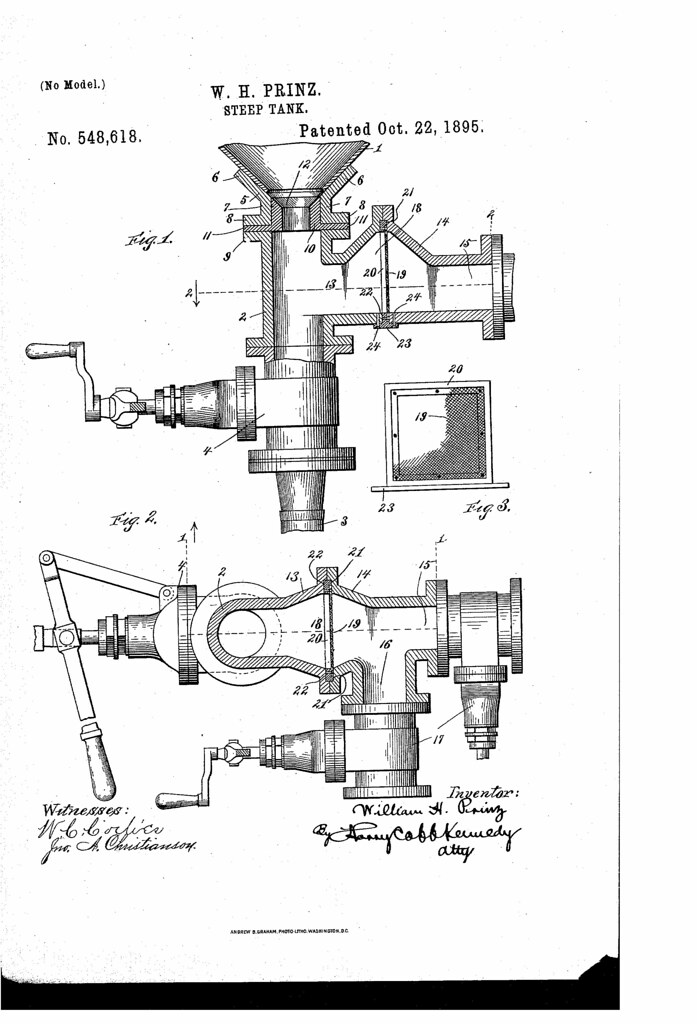
Today in 1895, US Patent 548618 A was issued, an invention of William H. Prinz, for his “Steep Tank.” There’s no Abstract, although in the description it includes these claims:

This invention relates to a novel construction in a steep-tank employed for steeping barley and like cereals, and more especially relating to a steep-tank for steeping barley to bring the same to a condition for germinating in the manufacture of malt.

The object of the invention is to provide a construction whereby the steeping can be can ried on and the steep-tank emptied under the most favorable circumstances, at the same time providing means whereby the steep-water can be admitted from the upper or lower end of the tank.

US548618-0

Filed Under: Beers, Breweries, Just For Fun, Politics & Law, Related Pleasures Tagged With: Brewing Equipment, History, Law, Patent, Science of Brewing

Patent No. 209163A: Improvement In Barrels Or Kegs

October 22, 2016 By Jay Brooks

patent-logo
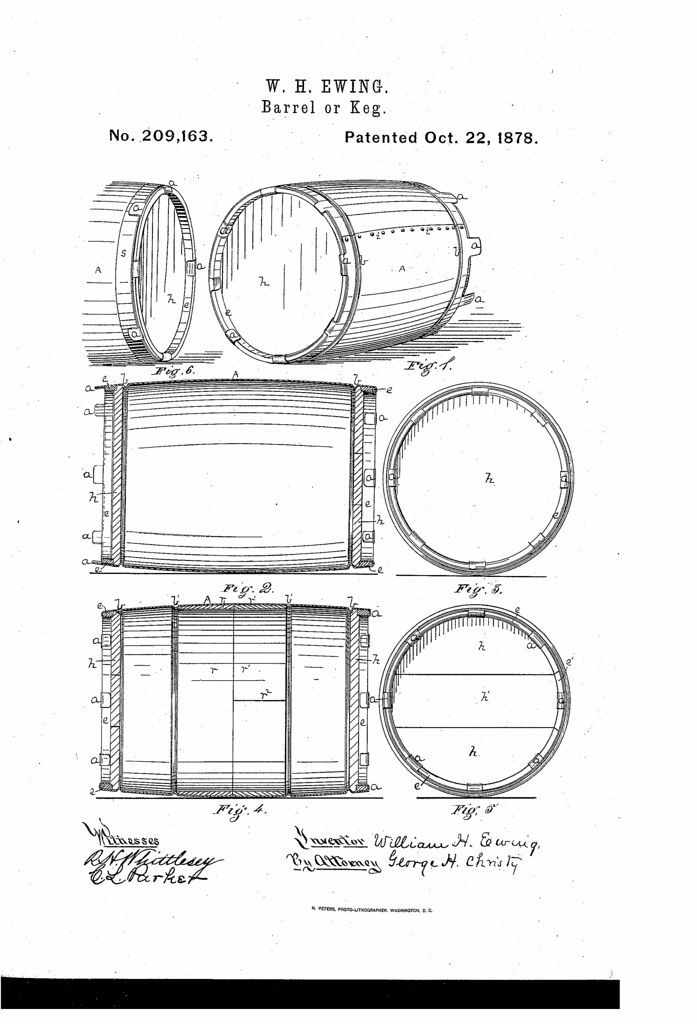
Today in 1878, US Patent 209163 A was issued, an invention of William H. Ewing, for his “Improvement in Barrels or Kegs.” There’s no Abstract, although in the description it includes these claims:

My invention relates to certain improvements in barrels and other like packages, the heads of the same being of wood, arranged and secured in a novel manner, while the sides, or that part usually made of wooden staves, are made of sheet metal, which is manipulated in the following way: A sheet or plate of metal of suitable thickness and size is passed through a train of rolls or under a hammer in such way as to draw out or lengthen the middle of the plate in one direction. The object of this is to secure the requisite bulge or swell to the barrel or keg, both for convenience in handling and to give additional strength. The sides of the plate which correspond to the ends of the barrel or keg: are stamped or out in any convenient way, so as to form a series of three or more clips, a, thereon. These clips are used for securing the heads, and also chine-hoops, as presently described.

US209163-0

Filed Under: Beers, Just For Fun, Politics & Law, Related Pleasures Tagged With: Barrels, History, Kegs, Law, Patent

Beer In Ads #2070: What Not To Do At A Picnic

October 21, 2016 By Jay Brooks


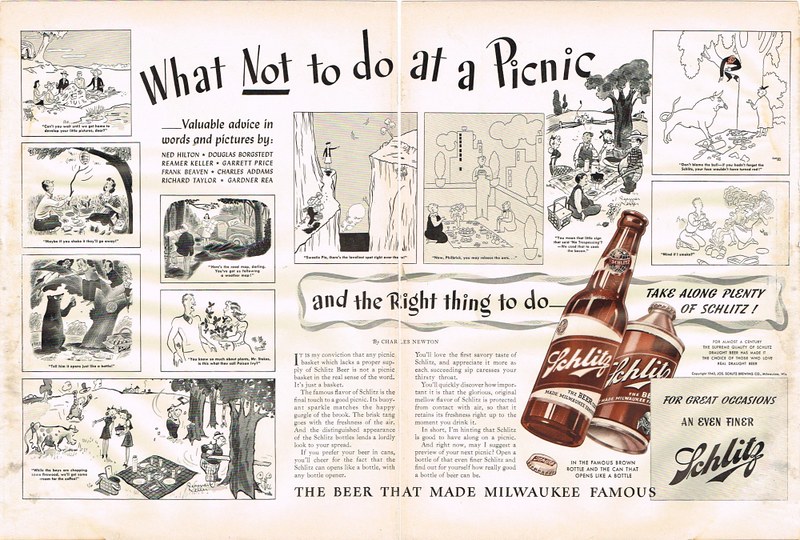
Friday’s ad is for Schlitz, from 1940. In this ad, entitled “What Not To Do At A Picnic,” there are several humorous cartoons illustrating bad ideas that will ruin a picnic. Given that there are eleven cartoons, it’s sort of like a second comics page. But, of course, there’s an addendum suggesting the “Right thing to do.” Their suggestion? “Take along plenty of Schlitz!”

Schlitz-1940-picnic

Filed Under: Art & Beer, Beers Tagged With: Advertising, History, Schlitz

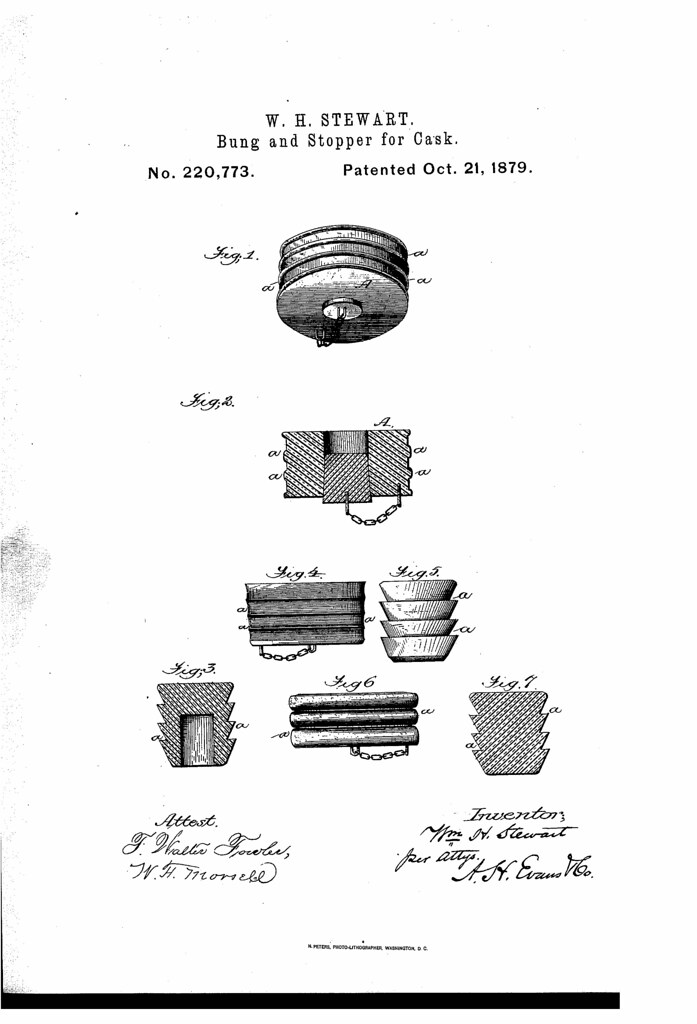
Patent No. 220773A: Improvement In Bungs And Stoppers For Casks

October 21, 2016 By Jay Brooks

patent-logo
Today in 1879, US Patent 220773 A was issued, an invention of William H. Stewart, for his “Improvement in Bungs and Stoppers for Casks.” There’s no Abstract, although in the description it includes these claims:

My invention relates to bungs and stoppers for faucet holes in lager-beer and ale casks and kegs; and it consists in the exterior form of the bung or stopper, whereby it is adapted to be more easily driven into the cask or withdrawn therefrom when desired.

Heretofore such stoppers made of wood or cork are objectionable, for the reason that the gases readily penetrate the pores of such materials and leave the beer or ale unfit for use in consequence of becoming flat or stale. The wood and cork will become saturated with the liquid, and after being once used will become sour and injuriously affect the beer.

In the use of the elastic bung or stopper I find that great difficulty exists in extracting it in the form in which it has heretofore been made from the aperture in the cask or vessel, on account of the adhesive properties of the rubber, and this especially is the case when using it for lager-beer or ale casks, where the aperture is wood or iron bound. If the bung or stopper is made very hard, or even hard enough to drive easily in the aperture, there is no certainty that the aperture will be perfectly sealed, as the harder the composition the less the elasticity,and the less the certainty of its filling any irregularities that may exist in the aperture. On the contrary, if the composition be made softer to gain more elasticity, then the difficulty of driving in the bung or stopper occurs, as the composition sticks and adheres to the sides of the aperture, and after as shown in Fig. 5, being once driven in is very difficult to extract.

The special object of my invention is to overcome these several difficulties by making a bung or stopper which can be readily driven in or extracted, and which will also perfectly seal the aperture in the cask.

US220773-0

Filed Under: Beers, Just For Fun, Politics & Law, Related Pleasures Tagged With: Barrels, Cask, History, Kegs, Law, Patent

Beer In Ads #2069: Any Minute Now …

October 20, 2016 By Jay Brooks


Thursday’s ad is for Schlitz, from 1940. In this ad, entitled “Any Minute Now … It may happen to you!,” although the subtitle (which appears above the larger title) may go to the heart of the ad, and it reads “What Are Your Chances …” of at least four things occurring. This ad has an actual author’s byline, Herbert M. Alexander, along with a short resume, and then a two-page article about chance, statistic, superstition and luck, before naturally finishing up with how Schlitz fits into this line of reasoning, as a perfect accompaniment to such great occasions.

Schlitz-1940-any-minute

Filed Under: Art & Beer, Beers Tagged With: Advertising, History, Schlitz

Ballantine’s Literary Ads: Ellery Queen

October 20, 2016 By Jay Brooks

ballantine
Between 1951 and 1953, P. Ballantine and Sons Brewing Company, or simply Ballentine Beer, created a series of ads with at least thirteen different writers. They asked each one “How would you put a glass of Ballantine Ale into words?” Each author wrote a page that included reference to their beer, and in most cases not subtly. One of them was Ellery Queen, who’s best known for writing a series of mystery stories.

Ellery Queen is not actually one person, but two: Frederic Dannay and Manfred Bennington Lee. They “were American cousins from Brooklyn, New York who wrote, edited, and anthologized detective fiction under the pseudonym of Ellery Queen. The writers’ main fictional character, whom they also named Ellery Queen, is a mystery writer and amateur detective who helps his father, Richard Queen, a New York City police inspector, solve baffling murders.” Today is the birthday of Frederic Dannay (October 20, 1905–September 3, 1982), and his co-writer, Manfred Bennington Lee, was born the same year (January 11, 1905–April 3, 1971).

ballantine-1952-Ellery-Queen

Their piece for Ballantine was done as if it was one of their cases, but it was less a mystery and more a simple contrast of two unrelated events that both took place the same year. It seems a bit forced, actually, and comes across like pure propaganda, even more so than the other ads in this series.

CASE OF THE CURIOUS COINCIDENCE

1840: Edgar A. Poe was preparing to give the world its first detective story, “The Murders in the Rue Morgue,” an all-time classic marked by three great qualities: Purity of conception, full-bodied plot, and a style and technique of matchless flavor.

1840: Peter Ballantine created his unique ale and sampled his first brew. Setting down his glass, he exclaimed, “Purity!” A second sip made him exclaim, “Body!” a third, “Flavor!”

Edgar Allen Poe’s Tale, Peter Ballantine’s Ale — American classics with the same three great qualities. Even the Ballantine Ale trade-mark carries out the coincidence of “threes.” For the triple overlapping rings made when Peter Ballantine set down his moist glass on the table top created his 3-ring trade-mark. To this day it sets the standard for Purity, Body and Flavor to connoisseurs of ale everywhere.

ballantine-1952-Ellery-Queen-text

Filed Under: Art & Beer, Beers, Just For Fun Tagged With: Advertising, Ballantine, History, Literature

Patent No. 7604147B2: Keg With An Inner Bag

October 20, 2016 By Jay Brooks

patent-logo
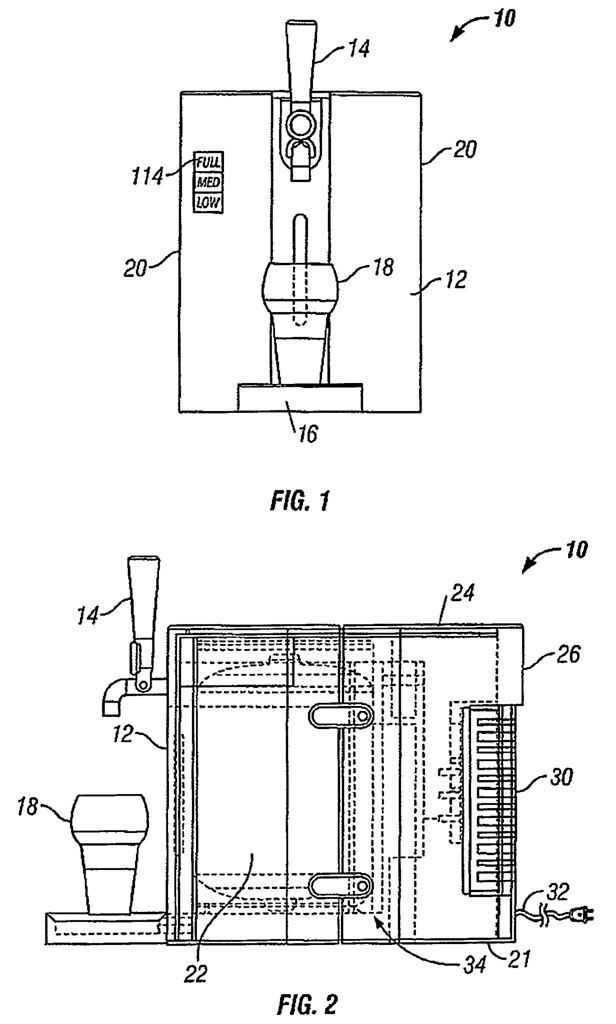
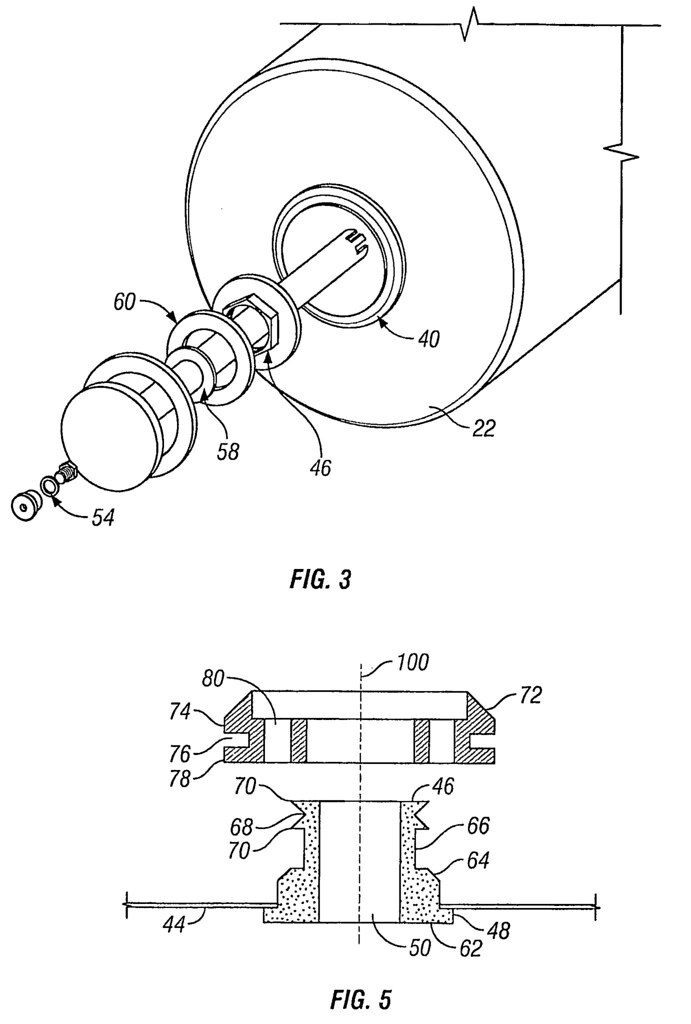
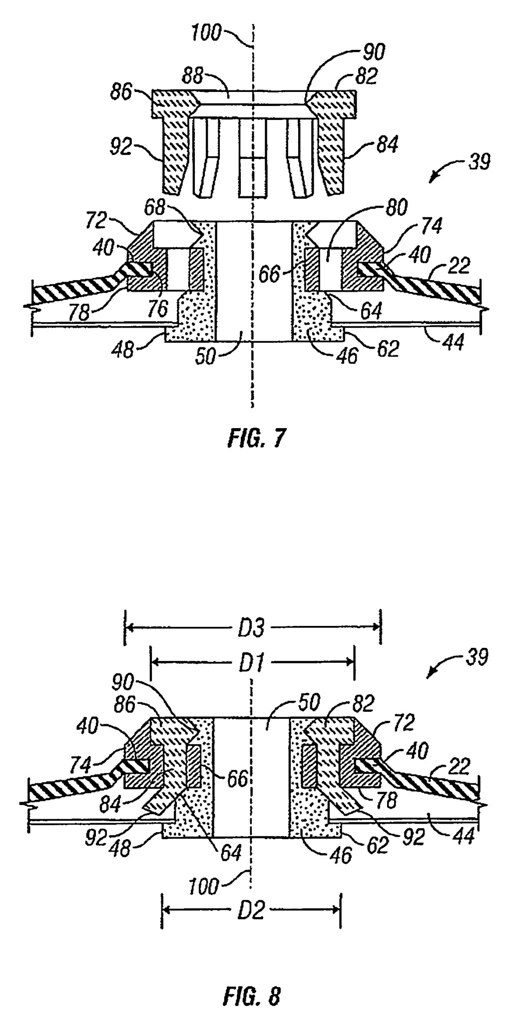
Today in 2009, US Patent 7604147 B2 was issued, an invention of Ian Anderson, assigned to Anheuser-Busch InBev S.A., for his “Keg with an Inner Bag.” Here’s the Abstract:

An interlocking collar (72) secures a bag neck (46) in a keg aperture (42) of an alcohol beverage keg container (22). The interlocking collar is mounted in press fit surrounding relation with a peripheral wall portion of the bag neck. The collar has an outer peripheral wall portion sized larger than that of a keg aperture. The collar (72) has a recessed groove (76) in the collar outer peripheral wall portion for receiving in press fitting and sealing relation a keg flange (40) that defines the keg aperture. The collar outer peripheral wall portion has a resilient edge portion (78) adjacent the recessed groove that deflects to permit the interlocking collar to pass through the keg aperture and receive the keg flange in the recessed groove. The interlocking collar has a plurality of locking passageways (80) placed around the interlocking collar and axially extending through the interlocking collar between the neck and recessed groove. A latch member (82) has a plurality of locking fingers (84) that extend axially through the locking passageways to prevent deflection of the resilient edge portion of the interlocking collar after the collar is placed in the keg aperture.

US07604147-20091020-D00001

US07604147-20091020-D00002
US07604147-20091020-D00003

US07604147-20091020-D00004

Filed Under: Beers, Just For Fun, Politics & Law, Related Pleasures Tagged With: History, Kegs, Law, Patent

Beer In Ads #2068: If Famous Crowns Could Talk

October 19, 2016 By Jay Brooks


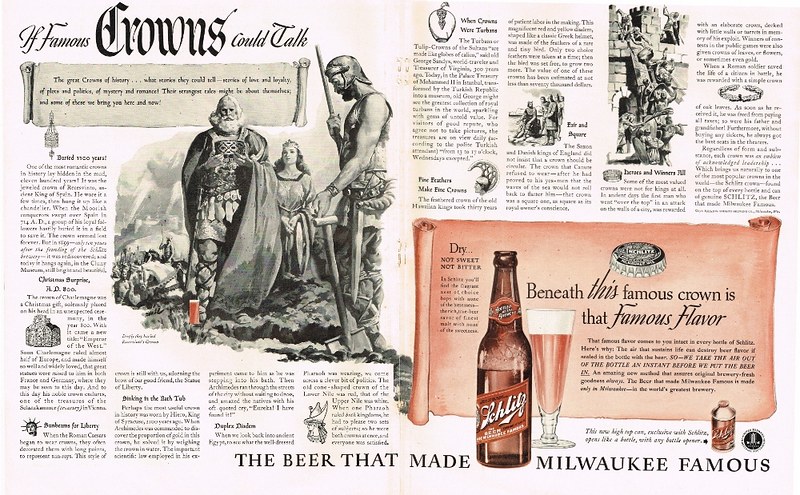
Wednesday’s ad is for Schlitz, from 1939. In this ad, entitled “If Famous Crowns Could Talk,” the history lesson is about the crowns worn by royalty around the world. The advertorial includes nine crown stories, before predictably finishing by talking about the bottle cap, or crown, from a bottle of Schlitz beer.

Schlitz-1939-crowns

Filed Under: Art & Beer, Beers Tagged With: Advertising, History, Schlitz

« Previous Page
Next Page »

Find Something

Northern California Breweries

Please consider purchasing my latest book, California Breweries North, available from Amazon, or ask for it at your local bookstore.

Recent Comments

  • Bob Paolino on Beer Birthday: Grant Johnston
  • Gambrinus on Historic Beer Birthday: A.J. Houghton
  • Ernie Dewing on Historic Beer Birthday: Charles William Bergner 
  • Steve 'Pudgy' De Rose on Historic Beer Birthday: Jacob Schmidt
  • Jay Brooks on Beer Birthday: Bill Owens

Recent Posts

  • Beer In Ads #5227: It’s Here! Bock Beer By Bosch April 20, 2026
  • Beer Birthday: Drew Beechum April 20, 2026
  • Beer Birthday: Des De Moor April 20, 2026
  • Beer Birthday: Brenden Dobel April 20, 2026
  • Historic Beer Birthday: Henry Becker April 19, 2026

BBB Archives

Feedback

Head Quarter
This site is hosted and maintained by H25Q.dev. Any questions or comments for the webmaster can be directed here.