Brookston Beer Bulletin

Jay R. Brooks on Beer

  • Home
  • About
  • Editorial
  • Birthdays
  • Art & Beer

Socialize

  • Dribbble
  • Email
  • Facebook
  • Flickr
  • GitHub
  • Instagram
  • LinkedIn
  • Pinterest
  • RSS
  • Twitter
  • YouTube

Powered by Genesis

Historic Beer Birthday: George F. Klotter Jr.

August 25, 2025 By Jay Brooks

bellevue-ohio
Today is the birthday of George F. Klotter Jr. (August 25, 1835-1900?) His father, along with partner Johann G. Sohn, established the Hamilton Brewery in Cincinnati, Ohio in 1846. Klotter Sr. left that brewery, while Sohn continued alone, and Klotter started another brewery, the George Klotter Brewery in 1866 The following year George Jr., and his brother Louis, joined the brewery, and it was renamed the George Klotter and Sons Brewery, which it remained until 1888.

Bellevue-postcard

It 1888, it was renamed the Bellevue Brewery until finally closing in 1919.

Filed Under: Birthdays Tagged With: History, Ohio

Historic Beer Birthday: John Taylor, The Bard of Beer

August 24, 2025 By Jay Brooks

poetry
Today is the birthday of John Taylor, who was nicknamed “The Bard of Beer,” although he apparently referred to himself as “The Water Poet.” (August 24, 1578-1653). He was born in Gloucester, and “after his waterman apprenticeship he served (1596) in Essex’s fleet, and was present at Flores in 1597 and at a siege of Cadiz.”

john-taylor-water-poet

Here’s part of his biography from his Wikipedia page:

He spent much of his life as a Thames waterman, a member of the guild of boatmen that ferried passengers across the River Thames in London, in the days when the London Bridge was the only passage between the banks. He became a member of the ruling oligarchy of the guild, serving as its clerk; it is mainly through his writings that history is familiar with the watermen’s disputes of 1641–42, in which an attempt was made to democratize the leadership of the Company. He details the uprisings in the pamphlets Iohn Taylors Manifestation … and To the Right Honorable Assembly … (Commons Petition), and in John Taylors Last Voyage and Adventure of 1641.

He was a prolific, if rough-hewn writer (a wit rather than a poet), with over one hundred and fifty publications in his lifetime. Many were gathered into the compilation All the Workes of John Taylor the Water Poet (London, 1630; facsimile reprint Scholar Press, Menston, Yorkshire, 1973); augmented by the Spenser Society’s edition of the Works of John Taylor … not included in the Folio edition of 1630 (5 volumes, 1870–78). Although his work was not sophisticated, he was a keen observer of people and styles in the seventeenth century, and his work is often studied by social historians. An example is his 1621 work Taylor’s Motto, which included a list of then-current card games and diversions.

He achieved notoriety by a series of eccentric journeys: for example, he travelled from London to Queenborough in a paper boat with two stockfish tied to canes for oars, described in “The Praise of Hemp-Seed”,[2] which was re-enacted in 2006. From his journey to Scotland in 1618, on which he took no money, Taylor published his Pennyless Pilgrimage. (Ben Jonson walked to Scotland in the same year.)

Taylor is one of the few credited early authors of a palindrome: in 1614, he wrote “Lewd did I live, & evil I did dwel.” He wrote a poem about Thomas Parr, a man who supposedly lived to the age of 152. He was also the author of a constructed language called Barmoodan.

Many of Taylor’s works were published by subscription; i.e., he would propose a book, ask for contributors, and write it when he had enough subscribers to undertake the printing costs. He had more than sixteen hundred subscribers to The Pennylesse Pilgrimage; or, the Moneylesse Perambulation of John Taylor, alias the Kings Magesties Water-Poet; How He TRAVAILED on Foot from London to Edenborough in Scotland, Not Carrying any Money To or Fro, Neither Begging, Borrowing, or Asking Meate, Drinke, or Lodging., published in 1618.

talyor-john
And this is his entry from the Encyclopedia Britannica:

John Taylor, (born Aug. 24, 1580, Gloucester, Gloucestershire, Eng.—died December 1653, London), minor English poet, pamphleteer, and journalist who called himself “the Water Poet.”

The son of a surgeon, Taylor was sent to a grammar school but became, as he said, “mired in Latin accidence” and was apprenticed to a Thames boatman. He served in the navy and saw action at Cádiz (1596) and Flores (1597). Returning to London, he worked as a waterman transporting passengers up and down the River Thames and also held a semiofficial post at the Tower of London for several years. Taylor won fame by making a series of whimsical journeys that he described in lively, rollicking verse and prose. For example, he journeyed from London to Queenborough, Kent, in a paper boat with two stockfish tied to canes for oars and nearly drowned in the attempt. He made other water journeys between London, York, and Salisbury, and The Pennyles Pilgrimage. . . (1618) describes a trip he made on foot from London to Edinburgh without money. In 1620 he journeyed to Prague, where he was received by the queen of Bohemia. His humorous accounts of his journeys won the patronage of Ben Jonson, among others. Taylor also amused the court and the public in his paper war with another eccentric traveler, Thomas Coryate. In 1630 he published 63 pieces in All the Works of John Taylor the Water Poet, although he continued to publish prolifically afterward.

When the English Civil Wars began Taylor moved to Oxford, where he wrote royalist pamphlets. After the city surrendered (1645), he returned to London and kept a public house, “The Crown” (later “The Poet’s Head”), until his death.

ex-ale-tation-cover
Here is one of his most beer-centric poems:

The Ex-Ale-Tation of Ale

ExAle-Tation-01
ExAle-Tation-02
ExAle-Tation-03
ExAle-Tation-04
ExAle-Tation-05
ExAle-Tation-06
ExAle-Tation-07
ExAle-Tation-08
ExAle-Tation-09
ExAle-Tation-10
ExAle-Tation-11
ExAle-Tation-12
ExAle-Tation-13
John_Taylor_poet

Filed Under: Birthdays, Just For Fun, Related Pleasures Tagged With: England, Great Britain, History, Literature, Poetry, Words

Beer Birthday: Dow Tunis

August 24, 2025 By Jay Brooks

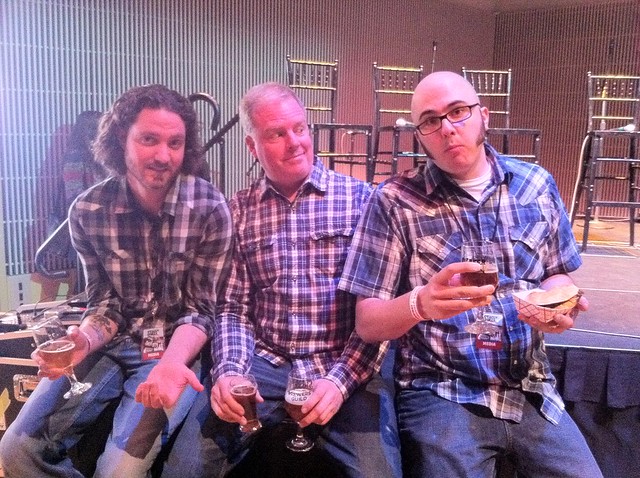
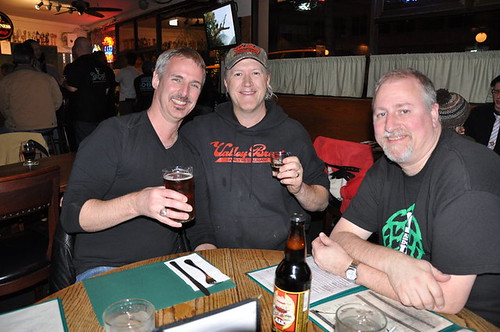
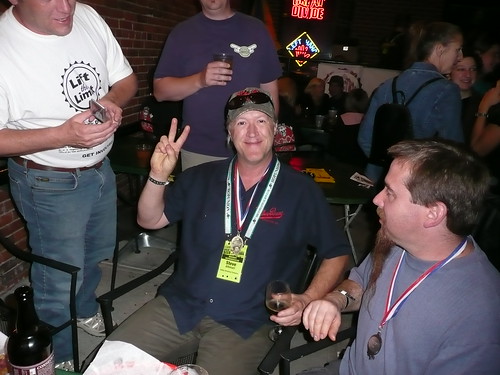
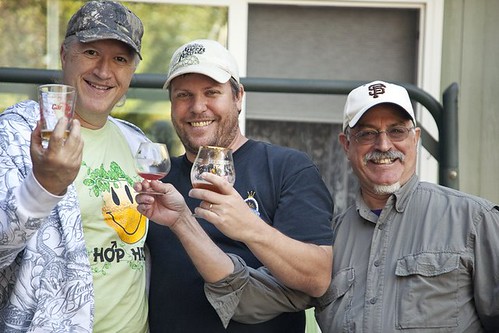
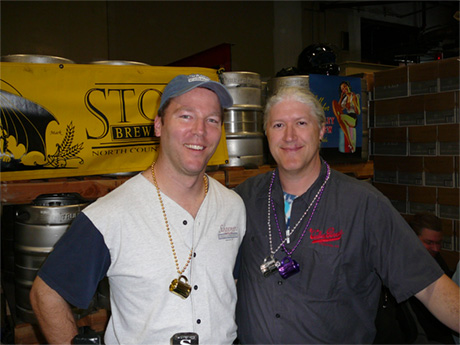
Today is the 63rd birthday of Dow Tunis. I can’t remember when I first met Dow, but it was a while ago. He’s been in the beer world almost as long as me. He’s currently the Bay Area Manager for New Glory Brewing of Sacramento, but he’s worn a lot of hats over the years.  For example, he used to be the Director of Bus Development for Fieldwork Brewing, National Sales Manager for Bear Republic, CEO of Half Moon Bay Brewing, Vice-President for Business Development at Drake’s Brewing, the GM of the Bear’s Lair Pub, and the GM of the legendary 20 Tank Brewery in San Francisco. So he’s seen it all, and has managed to keep his sense of humor. He’s a great guy to share a pint with. Join me wishing Dow a very happy birthday.

Dow with Homer at the Oak Barrel.
Sandwiched between Vic from The Bistro and John Martin, from Drake’s and Triple Rock.
Again with John Martin, but a few years earlier, just a few.

Filed Under: Birthdays, Just For Fun Tagged With: Bay Area, California, Northern California

Historic Beer Birthday: Louis Wiegand

August 24, 2025 By Jay Brooks

new_york
Today is the birthday of Louis Wiegand (August 24, 1840-March 2, 1912). He was born in Frankfort, Germany, he emigrated to America when he was 27, in 1867. He was initially in the meat business but in 1878, along with partners Carl Durr and William Wagner, he founded the Oswego German Brewing Co. in Oswego, New York. A few years later, in 1882, he bought out his partners, and renamed if the Wiegand Brewing Co. and then the Louis Wiegand Brewing Co. When his sons joined him in the business in 1896 it became known as Louis Wiegand & Son. It was closed by prohibition in 1916 and never reopened.

This is his obituary, from the Oswego Daily Times, for Monday, March 4, 1912:

The death of Louis Wiegand senior member of L Wiegand & son brewers, which occurred at his home, No 166 East Second street, Saturday evening at 4:45 o’clock, will be received with sorrow by citizens generally. Mr. Wiegand had been in failing health since last May and for several months had been confined to his home. Born in Wirthheina, near Frankfort, Germany, in 1840, Mr. Wiegand came to Oswego in 1867, He engaged successfully in the meat business in East Bridge street for several years. In 1882, Mr. Wiegand organized the Germania Brewing Company and shortly thereafter took over the business, which he has successfully conducted ever since. Deeply interested in the St. Peter’s Cemetery association and one of its organizers, Mr. Wiegand was zealous in promoting it. He had been president of the society for several years. When It was desired to acquire more property for the extension of the cemetery, the funds on hand were not sufficient. Mr. Wiegand purchased the property and sold it to the association without profit to himself. He was a constant visitor to the cemetery and gave much of his time to plans for beautifying it.

Mr. Wiegand’s first wife died several years ago. He is survived by his second wife, formerly Miss Catherine Stoke; one son, Louis X, and a sister, Mrs. Margaret Cook, all of Oswego. The funeral will be held tomorrow morning from his home and at St Peter’s church.

Unfortunately, apart from his obituary, there was almost nothing else I could find about him, his sons or his brewery, not even any photos or breweriana.

Filed Under: Birthdays, Breweries, Just For Fun Tagged With: Germany, History, New York

Beer In Ads #5061: Schaffhauser Giant Bock

August 23, 2025 By Jay Brooks

Last year I decided to concentrate on Bock ads. Bock, of course, may have originated in Germany, in the town of Einbeck. Because many 19th century American breweries were founded by German immigrants, they offered a bock at certain times of the year, be it Spring, Easter, Lent, Christmas, or what have you. In a sense they were some of the first seasonal beers. “The style was later adopted in Bavaria by Munich brewers in the 17th century. Due to their Bavarian accent, citizens of Munich pronounced ‘Einbeck’ as ‘ein Bock’ (a billy goat), and thus the beer became known as ‘Bock.’ A goat often appears on bottle labels.” And presumably because they were special releases, many breweries went all out promoting them with beautiful artwork on posters and other advertising.

Saturday’s poster is for Falken Schaffhauser’s Bock, and was published in 1934. This one was made for the Bierbrauerei Falken Schaffhausen, or Falcon Brewery, of Schaffhausen, Switzerland. The brewery was founded in 1799, and is still in business today, and is “considered the only independent brewery in the Schaffhausen region,” and is Switzerland’s 5th largest brewery. This one is for their Schaffhauser Bock and shows a giant goat (though honestly it looks more like a bighorn sheep) towering over a dozen men all drinking beer. It was created by Swiss artist Arnold Oechslin.

Filed Under: Art & Beer, Beers, Breweries, Just For Fun Tagged With: Advertising, Bock, History, Switzerland

Beer Birthday: Mario Celotto

August 23, 2025 By Jay Brooks

humboldt
Today is the 69th birthday of Mario Celotto, who founded Humboldt Brewing Co., along with his brother Vince, after his career as a professional football player with four teams, including the Oakland Raiders the season they won the super bowl in 1981. While I normally communicated with Vince, who was at the brewery day-to-day, I met Mario on a couple of occasions, including a memorable lunch in Oakland in the late 1990s. He always seemed like a great guy to me, and he did hire Steve Parkes, who created their wonderful Red Nectar Ale, one of best amber ales I’ve ever tasted. Anyway, join me in wishing Mario a very happy birthday.

This is the biography listed on the brewery’s website back in the 1990s:

Mario is the company’s founder and serves as its President. Prior to founding the company, he played professional football and was a member of the 1980 Oakland Raider Super Bowl championship team. Mario studied public relations at the University of Southern California, where he also played on the USC National Championship football sqad. After college he worked in mortgage banking and public relations. In 1987, Mario opened the Humboldt Brewing Company brew pub and restaurant.

Humboldt-Brewing-Co-RED-NECTAR-ALE-beer-label

This is the description of Red Nectar from Humboldt Brewing’s website in 1999:

Red Nectar is an American Ale with a deep reddish copper color and sweet malty notes from English crystal malt. The crystal malt comprises nearly 15% of the grist and gives our Red a toasted caramel flavor and a residual sweetness and malty aroma which melds with the strawberry esters of our own strain of ale yeast. We use two-row Harrington-Klages pale malt, a superior blend of ale malt, and in all our beers we add a small proportion of Pacific Northwest Malted white wheat. This aids in head retention and lacing in the glass. Red Nectar is brewed with Chinook hops for bittering, Willamette in the middle for a rounded hop flavor and Mt. Hood and Cascade in the finish for a delicate floral/spicy aroma and flavor.

Mario_Celotto
Mario, when he was a linebacker for USC.
Mario more recently at a Raiders charity bowling event in Las Vegas.

Filed Under: Birthdays, Just For Fun Tagged With: California, Football, Northern California

Historic Beer Birthday: George W.C. Oland

August 23, 2025 By Jay Brooks

Today is the birthday of George W.C. Oland (August 23, 1855-January 25, 1933). He was born in Hampshire, England but emigrated to Canada, settling in Halifax, Nova Scotia. He was the son of Susannah Oland, who founded Moosehead Breweries. After his mother died in 1885, he took over control of Moosehead, but “sold the brewery to an English syndicate and used the proceeds to acquire the Highland Spring Brewery of Halifax and another brewery in Saint John.

George W.C. Oland seated in the front, with his sons, Sidney, George Bauld, and Geoffrey behind him.

The Halifax brewery was destroyed in the explosion of 1917 and, as a consequence, George W. C. Oland transferred all his energies to the Saint John Brewery, which was run by his son George Bauld (see Halifax Explosion). His second son, Sidney, joined him in the business at the end of the First World War and with the aid of government compensation for victims of the Halifax explosion, the Olands rebuilt the old Highland Spring Brewery.”

The Oland Brewery after the Halifax explosion in 1917.

During Prohibition, when the sale of intoxicating beverages was illegal, the Olands supplemented the little money they made from soft drinks and 2 per cent beer, which was legal to produce, with profits from selling illegal “strong” beer in pubs and shops. In 1927, George Bauld admitted to selling illegal beer to various pubs and shops, which cost his business some $24,000 in fines over the course of Prohibition. This dodgy practice helped keep the business afloat. In 1928, Oland & Sons purchased the Alexander Keith’s Brewery when it came up for sale. Keith’s was the oldest brewery in the Maritimes and its acquisition gave Oland & Sons a monopoly on brewing in Nova Scotia.

The Moosehead Brewery in the 1930s or 40s.

Soon after the Oland family acquired the Keith’s brewery, Sidney Oland’s older brother, George Bauld Oland, acquired the James Ready Brewery in Saint John, which was renamed New Brunswick Breweries (and again renamed Moosehead Breweries Limited in 1947). In 1933, George Bauld introduced Moosehead Pale Ale to the public. Ever since they were boys, Sidney and George had been in competition with one another. While their father was alive, the intense rivalry was never allowed to descend into a family feud. But when George Sr. died in 1933, the brothers went their separate ways. By the end of the Second World War, there were two distinct branches of the Oland family: the Nova Scotia Olands, who owned and operated the Alexander Keith’s Brewery, and the New Brunswick Olands, who controlled Moosehead. Eventually, control of the Moosehead brewery in Saint John was given to George Bauld’s son, Philip, while Oland & Sons of Halifax was taken over by Sidney’s three sons Victor, Bruce, and Don.

Filed Under: Birthdays, Breweries, Just For Fun Tagged With: Canada, History, Nova Scotia

Beer In Ads #5060: Hospitality Demands Our Pale Bock Beer

August 22, 2025 By Jay Brooks

Last year I decided to concentrate on Bock ads. Bock, of course, may have originated in Germany, in the town of Einbeck. Because many 19th century American breweries were founded by German immigrants, they offered a bock at certain times of the year, be it Spring, Easter, Lent, Christmas, or what have you. In a sense they were some of the first seasonal beers. “The style was later adopted in Bavaria by Munich brewers in the 17th century. Due to their Bavarian accent, citizens of Munich pronounced ‘Einbeck’ as ‘ein Bock’ (a billy goat), and thus the beer became known as ‘Bock.’ A goat often appears on bottle labels.” And presumably because they were special releases, many breweries went all out promoting them with beautiful artwork on posters and other advertising.

Friday’s ad is for Thomas Brau Bock Beer, which was published on August 22, 1935. This one was for the Gebrüder Thomas Bierbrauerei of Munich, Germany, which was originally founded in the Middle Ages, but merged with Paulaner in 1928. To be fair, it’s really a small part of a full-page ad for a market chain called “George W. Loft Markets,” in upstate New York, with locations in New Rochelle, White Plains, and the Bronx. This ad ran in The Standard-Star, of New Rochelle, New York, and the exact same ad also ran in the Daily Reporter of White Plains.

Filed Under: Art & Beer, Beers, Breweries, Just For Fun Tagged With: Advertising, Bock, Germany, History, New York

Historic Beer Birthday: Carl Funke

August 22, 2025 By Jay Brooks

Today is the birthday of Carl Funke (August 22, 1855-April 15, 1912). While he’s best known as “a German industrialist, President of the Chamber of Commerce, City Councilor in Essen, Germany, and a Privy Councilor of Commerce, he was also involved running the Stern-Brauerei, in Essen. In 1890, he took over his father’s shares in the brewery, “and became chairman of the supervisory board of the Actien beer brewery in Essen an der Ruhr, which later became the Stern brewery. He held the office until his death in 1912.”

Here’s a biography of Funke from Wikipedia:

As the son of the industrialist Fritz Funke, Carl Funke attended the Humboldtschule secondary school in Essen with an upper secondary school leaving certificate. He then studied linguistics at the University of Geneva. This was followed by commercial training at the Kalk Chemical Factory in Cologne and at the AG for the Chemical Industry in Gelsenkirchen-Schalke.

Carl Funke married the wealthy Katharina geb. Waldthausen, which made a significant contribution to the assets of the Funke family. They had four children together, with the son Fritz Funke (1888–1975) successfully continuing the family legacy.

At the age of 22, Carl Funke took over the management of the Pörtingsiepen colliery in Fischlaken, a later district of Essen. Among other things, he decisively increased their sales through a railway connection. In 1884, at the age of 29, he took over his father’s stake in the mine and continuously expanded his property in the following years by acquiring additional shares. Carl Funke was a member of the supervisory boards of a total of twenty companies and unions, including Deutsche Bank. In 1906 he completed his coal – mines the Essen coal mines AG together, whose supervisory board chairman he became. This year the Heisinger Tiefbau colliery on the Ruhr was named the Carl Funke colliery.

By taking over his father’s shares in 1890, Funke also became chairman of the supervisory board of the Actien beer brewery in Essen an der Ruhr , which later became the Stern brewery. He held the office until his death in 1912.

Since 1882 Funke was a city councilor in the city council of Essen and a member of the Essen district council. As a member of the Essener Verkehrsverein, Funke played a key role in the construction of the Kaiserhof Hotel on Lindenallee around 1900, bringing representative space to Essen for congresses and conferences. The building was badly damaged in World War II and finally abandoned in 1973. Today the SEB Bank, also known as the Lindencenter, is located here. In 1910 Funke was elected as a member of the Prussian provincial parliament. From 1910 to 1912 he followed Max Rötger as President of the Chamber of Commerce.

In the Protestant Church, Funke was involved in the presbyteries of the parishes of Essen-Altstadt, Rellinghausen – Heisingen and Dorstfeld.

Funke received several awards through numerous foundations and donations to charitable purposes such as schools, a hospital, a lung sanatorium and the Karl-Funke-Stiftung parish hall as well as the Carl and Katharina-Funke Foundation for the Essen Realgymnasium. In 1899 he was appointed to the Commerce Council, nine years later to the Secret Commerce Council. He received the Order of the Red Eagle III. Class.

When Carl Funke died in 1912 after an otitis media, he was buried in the family crypt of the Funke and Schürenberg families in the cemetery at Kettwiger Tor. The funeral procession on the afternoon of April 19, 1912 was followed by several thousand people, including representatives of the Ruhr industry, employees of its trade unions and high city officials. After the cemetery was closed in 1955, the common crypt was moved to the Ostfriedhof Essen.

Filed Under: Birthdays, Breweries, Just For Fun Tagged With: Germany

Beer In Ads #5059: Schaffhauser Leaping Bock

August 21, 2025 By Jay Brooks

Last year I decided to concentrate on Bock ads. Bock, of course, may have originated in Germany, in the town of Einbeck. Because many 19th century American breweries were founded by German immigrants, they offered a bock at certain times of the year, be it Spring, Easter, Lent, Christmas, or what have you. In a sense they were some of the first seasonal beers. “The style was later adopted in Bavaria by Munich brewers in the 17th century. Due to their Bavarian accent, citizens of Munich pronounced ‘Einbeck’ as ‘ein Bock’ (a billy goat), and thus the beer became known as ‘Bock.’ A goat often appears on bottle labels.” And presumably because they were special releases, many breweries went all out promoting them with beautiful artwork on posters and other advertising.

Wednesday’s poster is for Falken Schaffhauser’s Bock, and was published in 1933. This one was made for the Bierbrauerei Falken Schaffhausen, or Falcon Brewery, of Schaffhausen, Switzerland. The brewery was founded in 1799, and is still in business today, and is “considered the only independent brewery in the Schaffhausen region,” and is Switzerland’s 5th largest brewery. This one is for their Schaffhauser Bock and shows a man leaping over a giant mug of beer. It was created by Swiss artist Arnold Oechslin.

Filed Under: Art & Beer, Breweries, Just For Fun Tagged With: Advertising, Bock, History, Switzerland

« Previous Page
Next Page »

Find Something

Northern California Breweries

Please consider purchasing my latest book, California Breweries North, available from Amazon, or ask for it at your local bookstore.

Recent Comments

  • Ernie Dewing on Historic Beer Birthday: Charles William Bergner 
  • Steve 'Pudgy' De Rose on Historic Beer Birthday: Jacob Schmidt
  • Jay Brooks on Beer Birthday: Bill Owens
  • Steve 'Pudgy' De Rose on Beer Birthday: Charles Finkel
  • Steve 'Pudgy' De Rose on Beer Birthday: Bill Owens

Recent Posts

  • Beer In Ads #5185: It’s Bock Time January 28, 2026
  • Beer Birthday: Shane McNamara January 28, 2026
  • Historic Beer Birthday: John Goetz January 28, 2026
  • Beer Birthday: Jean-Marie Rock January 28, 2026
  • Beer In Ads #5184: The “B”s Are Here, Bruton Bock Beer January 27, 2026

BBB Archives

Feedback

Head Quarter
This site is hosted and maintained by H25Q.dev. Any questions or comments for the webmaster can be directed here.