Brookston Beer Bulletin

Jay R. Brooks on Beer

  • Home
  • About
  • Editorial
  • Birthdays
  • Art & Beer

Socialize

  • Dribbble
  • Email
  • Facebook
  • Flickr
  • GitHub
  • Instagram
  • LinkedIn
  • Pinterest
  • RSS
  • Twitter
  • YouTube

Powered by Genesis

Patent No. 3625843A: Method For Treating Beer

December 7, 2015 By Jay Brooks

patent-logo
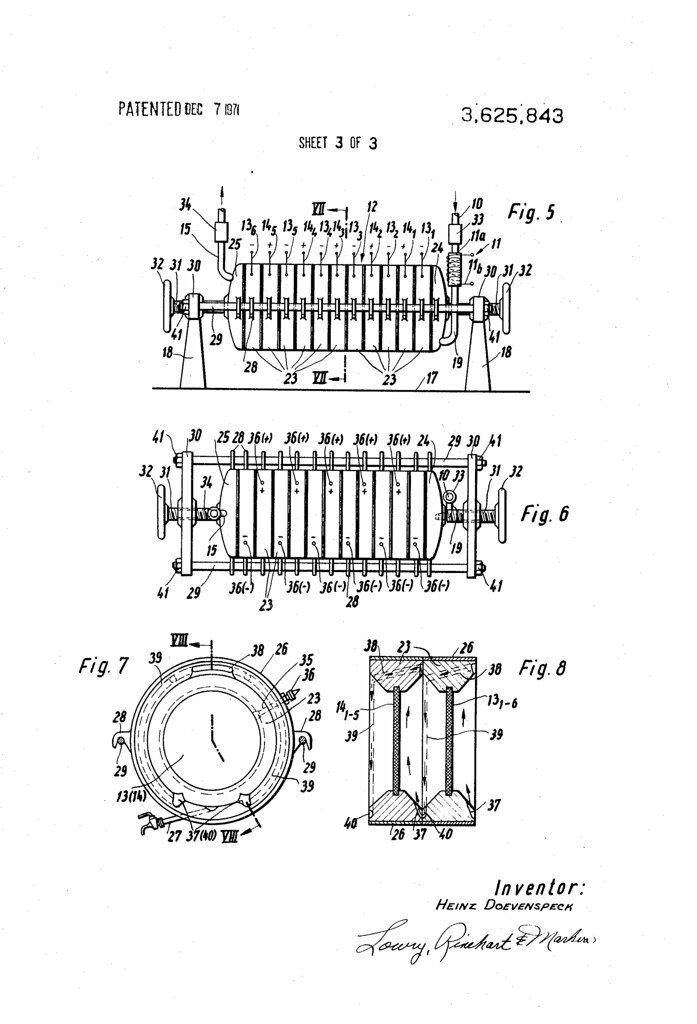
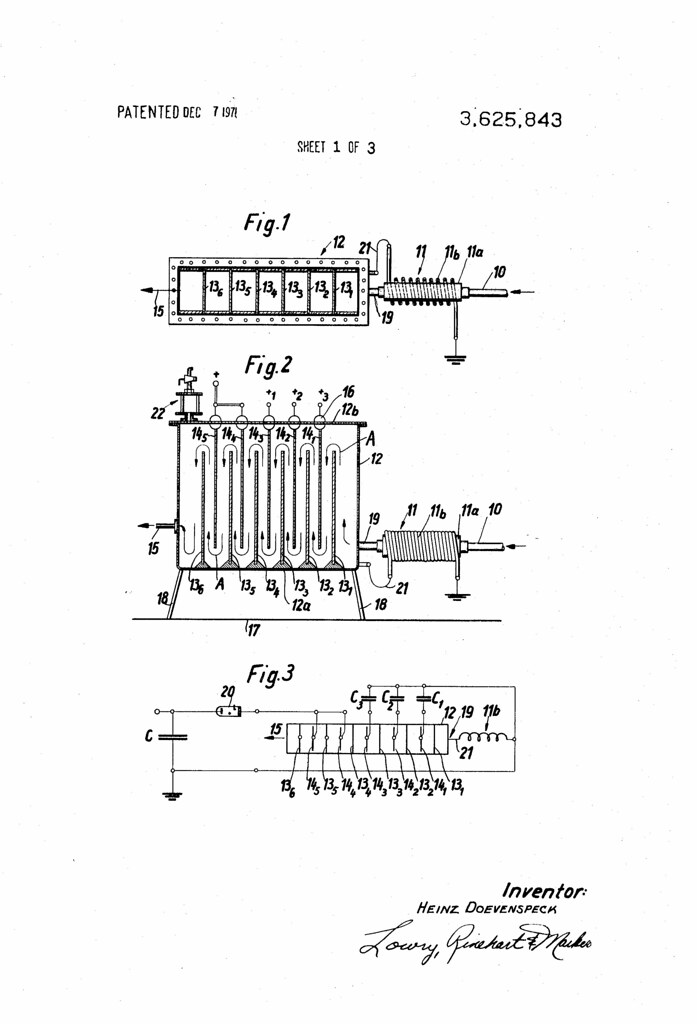
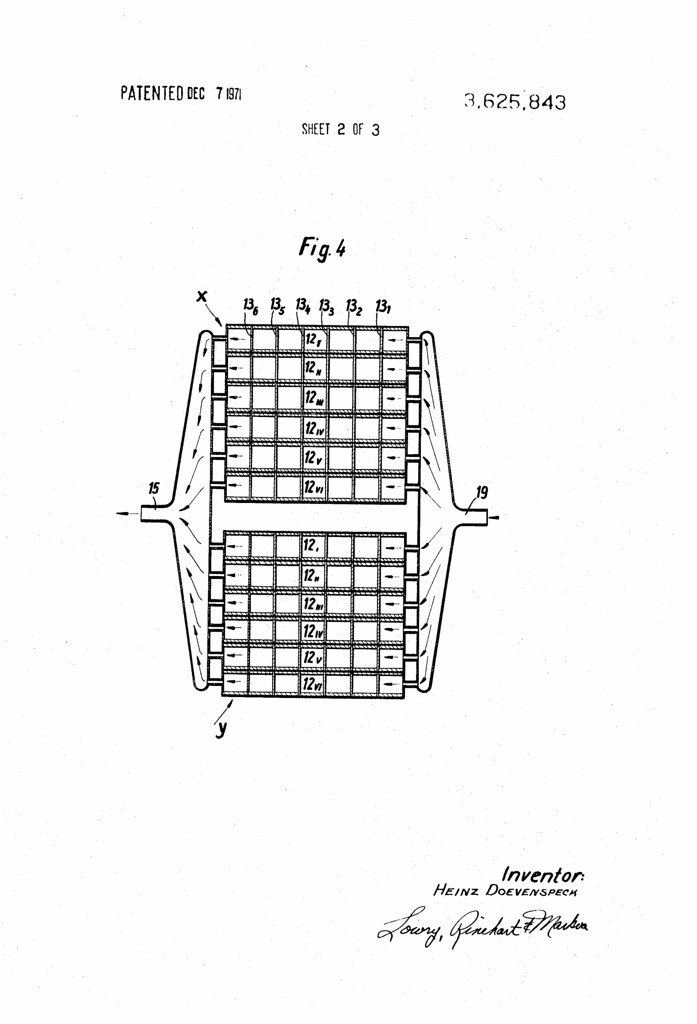
Today in 1971, US Patent 3625843 A was issued, another invention of Heinz Doevenspeck, for his “Method For Treating Beer.” There’s no Abstract, although in the description it includes this summary:

It is an object of the present invention to develop this prior art method and, in particular, to render it applicable with advantage to the treatment of liquids, preferably of beer. The method is intended to be developed in a manner as to enable the same to be carried out at temperatures of only about 25 C, thereby to prevent changes in flavor and color of the liquids to be treated and to obtain, at the same time, pasteurization and/or sterilization as well as stabilization of the liquids for the purpose of increasing the durability thereof.
Untitled
Untitled
Untitled

Filed Under: Beers, Breweries, Just For Fun, Politics & Law, Related Pleasures Tagged With: Brewing Equipment, History, Law, Patent, Science of Brewing

Patent No. 2336280A: Hop Cluster Stemmer

December 7, 2015 By Jay Brooks

patent-logo
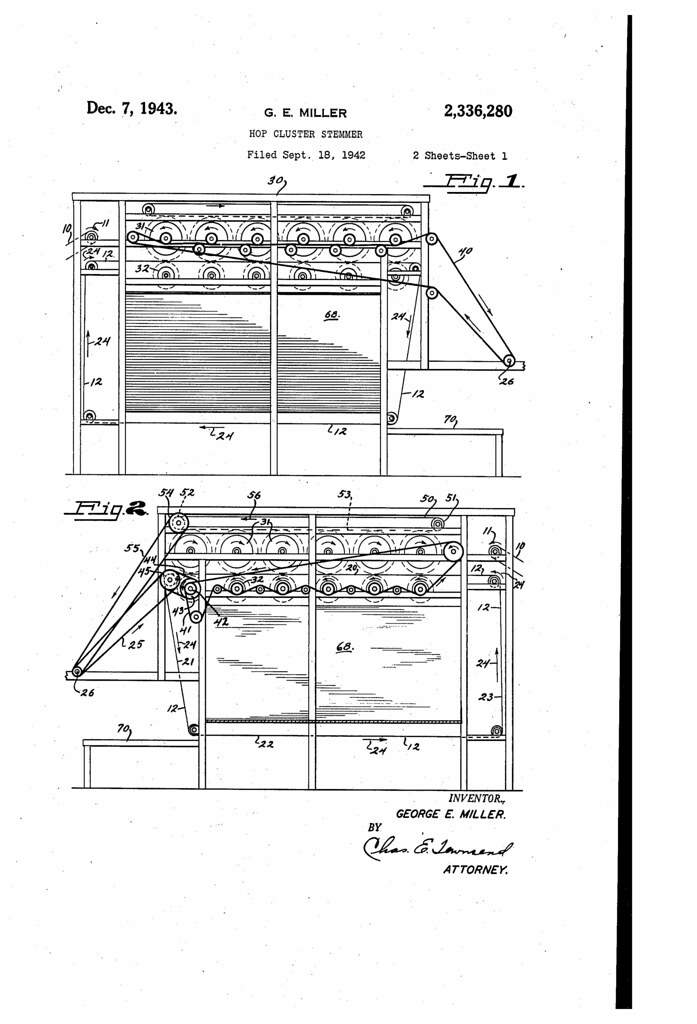
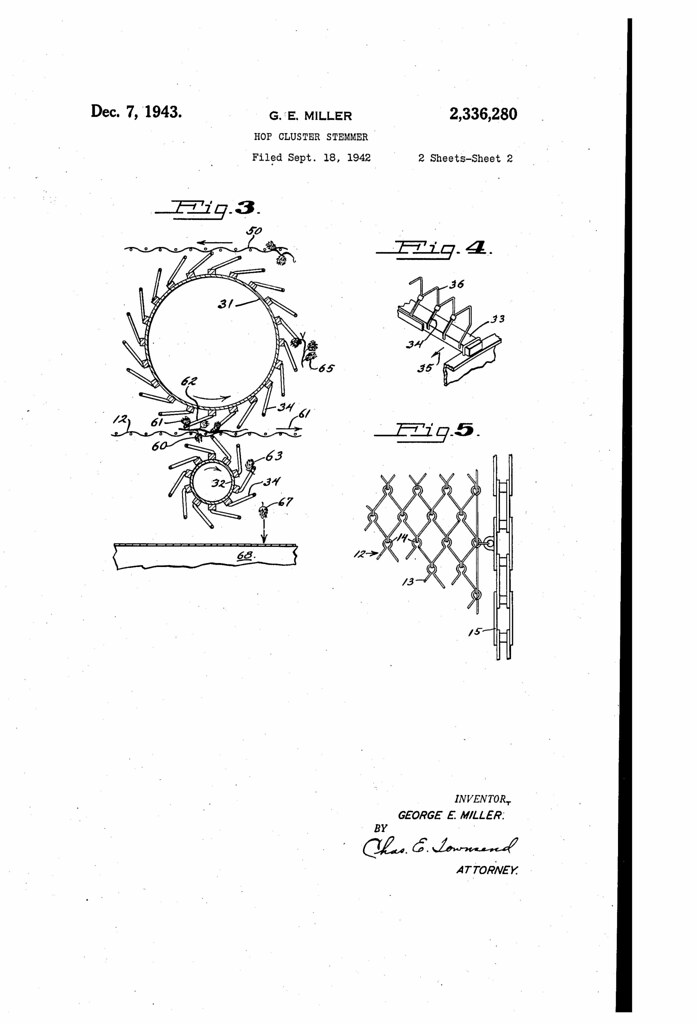
Today in 1943, US Patent 2336280 A was issued, another invention of George E. Miller, for his “Hop Cluster Stemmer.” There’s no Abstract, although in the description it includes this summary:

This invention relates to hop picking machines.

Hops grow on vines which are trained vertically on strings attached .to’ horizontal wires suspended about eighteen feet above the ground. At harvest time the vines are pulled down and hauled to a plant where they are run through a machine which picks the hops from the vines. The picked hops are then separated from the leaves, etc.

From the time the vine is pulled down in the hop field to the time it is fed into the picking machine, it receives considerable handling in the course of which clusters become detached from the vine. A cluster comprises an arm or branch of the vine bearing a cluster of hops. Heretofore the only satisfactory way to salvage the hops on these clusters was to pick them off by hand-an expensive, laborious task.

The object of this invention is to provide a machine for doing this work.

Untitled
Untitled

Filed Under: Beers, Just For Fun, Politics & Law, Related Pleasures Tagged With: Brewing Equipment, History, Hops, Law, Patent

Beer In Ads #1751: Bear’s Black Label Football

December 6, 2015 By Jay Brooks


Sunday’s ad is for Carling Black Label, from 1951. It looks like it was probably the back cover of a program for a football game, though it’s fairly low key, soft sell, just showing a bear playing football. The only hint that it’s a beer ad is the bear’s scarf, flapping in the wind as he rushes for a touchdown.

black-label-1951-football

Filed Under: Art & Beer, Beers Tagged With: Advertising, History

Patent No. 2139029A: Hop Picking Machine

December 6, 2015 By Jay Brooks

patent-logo
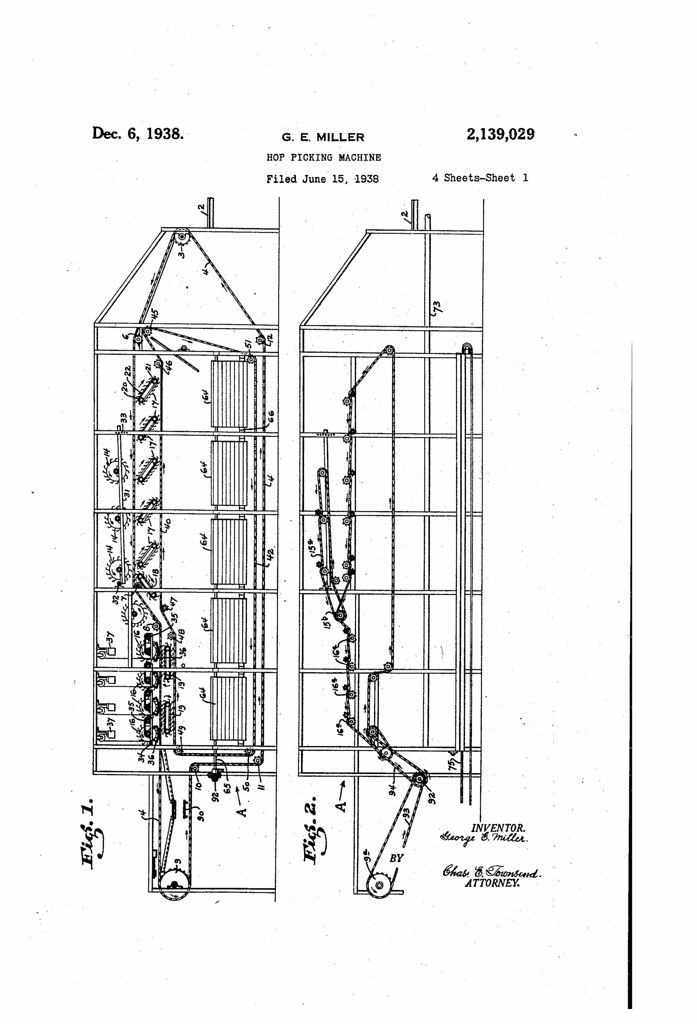
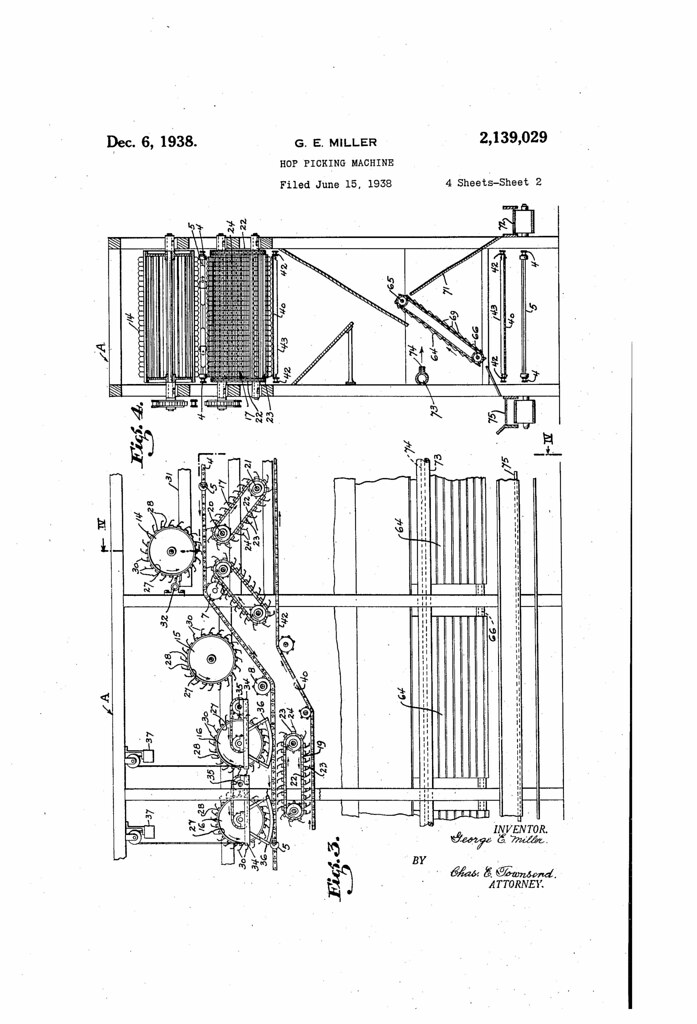
Today in 1938, US Patent 2139029 A was issued, an invention of George E. Miller, for his “Hop Picking Machine.” There’s no Abstract, although in the description it includes this summary:

This invention relates to a hop picking machine, and especially to improvements in the construction and operation thereof.

The object of the present invention is generally 5 to improve and simplify the construction and operation of hop picking machines; to provide a machine which will not only pick or remove the hops from the vines, but also from arms and clusters broken and pulled off the vines during the picking operation; to provide a machine which employs belts and cooperating drums mounted above them, said belts and cooperating drums .being provided with picking fingers which comb a the vines from opposite sides to remove the hops; to provide an endless flexible diamond-‘ meshed wire screen belt which is disposed below the picking belts, and cooperates therewith, to pick arms and break up clusters; to provide a machine which is divided into two picking zones, 80 one zone’in which the picking fingers are comparatively widely separated and where the major portion of the hops are removed, and a second zone in which the picking fingers are closely spaced to strip the vines of the remaining hops; to provide a picking machine which provides almost immediate liberation or removal of the hops from the picking zones, so as to prevent damage or breakage of the hops after they have been removed from the vines by the picking fingers; to provide a picking machine which tends to flatten out and spread the vines as they pass through and between the picking fingers. so as to insure a more thorough picking or removal of the hops; to provide means for separating the hops from leaves which are accidentally removed during the picking operation; and further, to provide means for automatically releasing and removing the vines from the machine when picked.

Untitled
Untitled

Filed Under: Beers, Just For Fun, Politics & Law, Related Pleasures Tagged With: History, Hops, Law, Patent

Patent No. 3290153A: Process And Apparatus For Concentrating Wort

December 6, 2015 By Jay Brooks

patent-logo
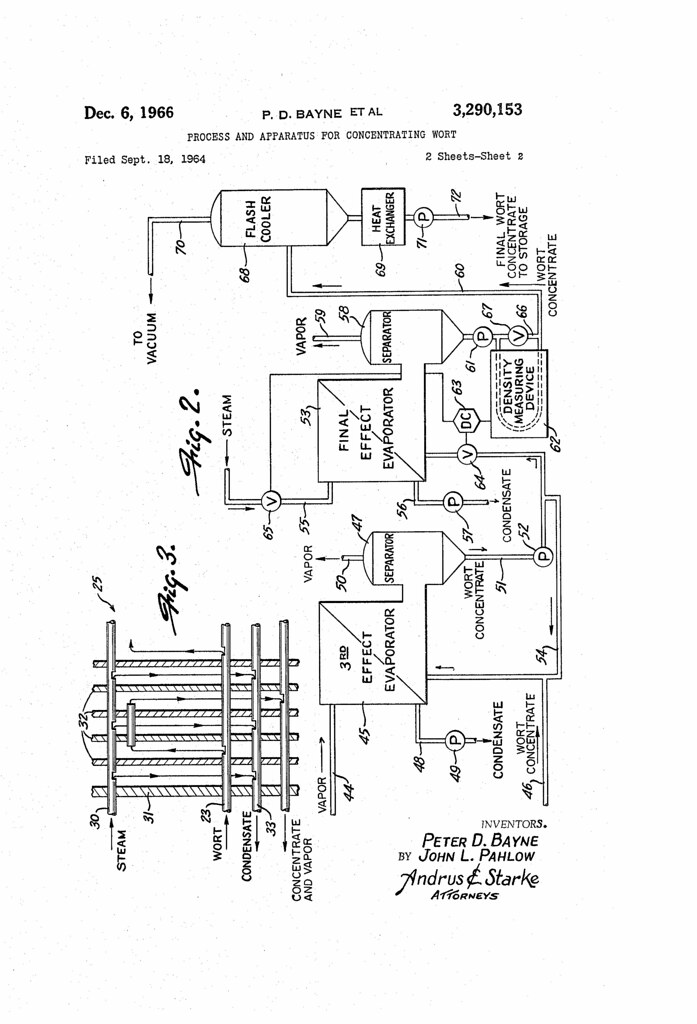
Today in 1966, US Patent 3290153 A was issued, an invention of Peter D. Bayne and John L. Pahlow, assigned to Schlitz Brewing Co., for his “Process and Apparatus for Concentrating Wort.” There’s no Abstract, although in the description it includes this summary:

The process of the invention, which includes the continuous film evaporation under high temperature and short holding time conditions, prevents degradation or color gain of the wort. On reconstitution, identical or organoleptic properties of the original wort are obtained.

The process of the invention utilizes a continuous flow of wort which is obtained by use of the pair of hot wort settling tanks in combination with the centrifuge so that a continuous supply of wort is available. Thus, it is not necessary to cease openation while waiting for a new batch of wort. l

A provision is also made in the process for automatically adding hop constituents to the Wort in the holding tank. A portion of the hop constituents will be lost during the concentrating process, and to compensate for this loss, a predetermined amount of hop constituents may be empirically added during the concentration process.

In addition, the process employs a density control mechanism which accurately regulate-s the final specific -gravity or concentration of the wort. The wort being discharged from the finishing evaporator passes through the density control mechanism which regulates the heating medium used in the` evaporator so that a uniform degree of Wort concentration is obtained.

Untitled
Untitled

Filed Under: Beers, Breweries, Just For Fun, Politics & Law, Related Pleasures Tagged With: Brewing Equipment, History, Law, Patent, Science of Brewing, Wort

Patent No. 2529882A: Hop Strainer

December 6, 2015 By Jay Brooks

patent-logo
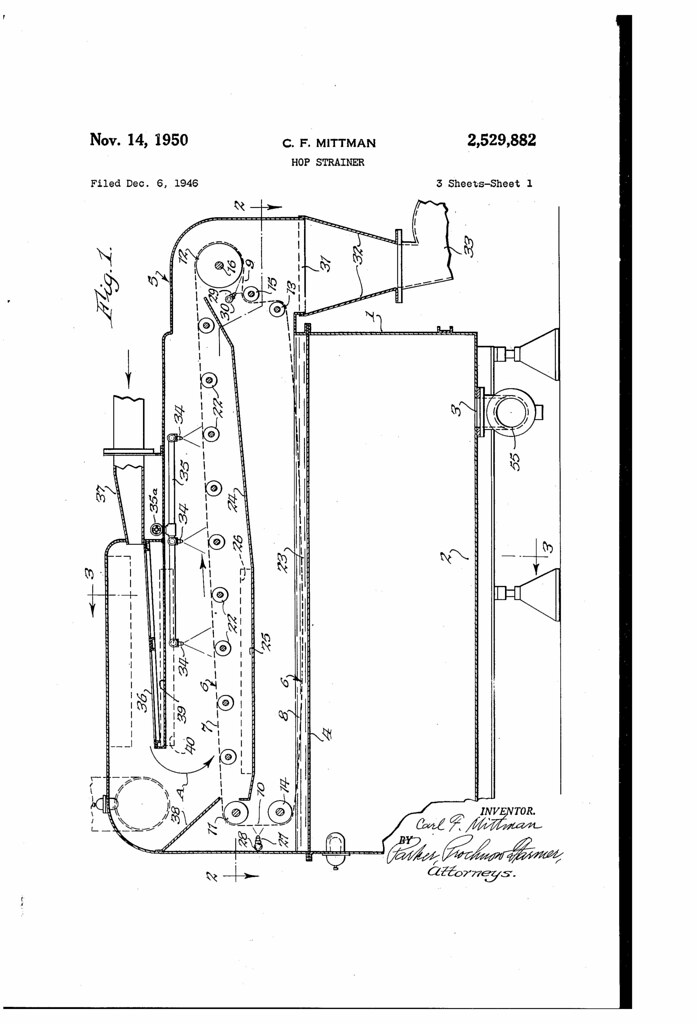
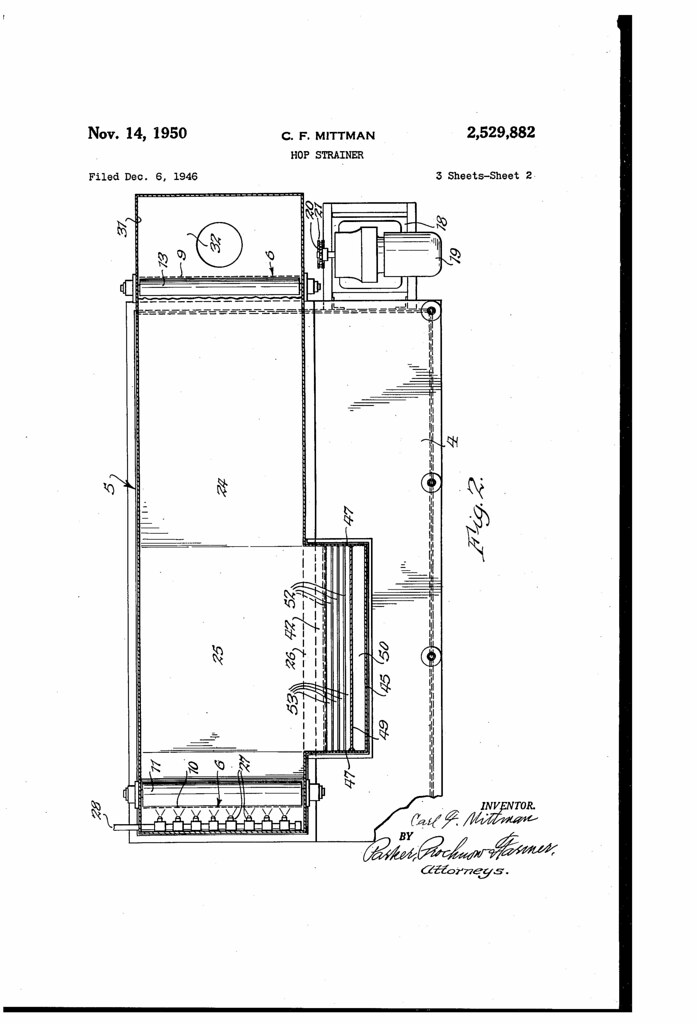
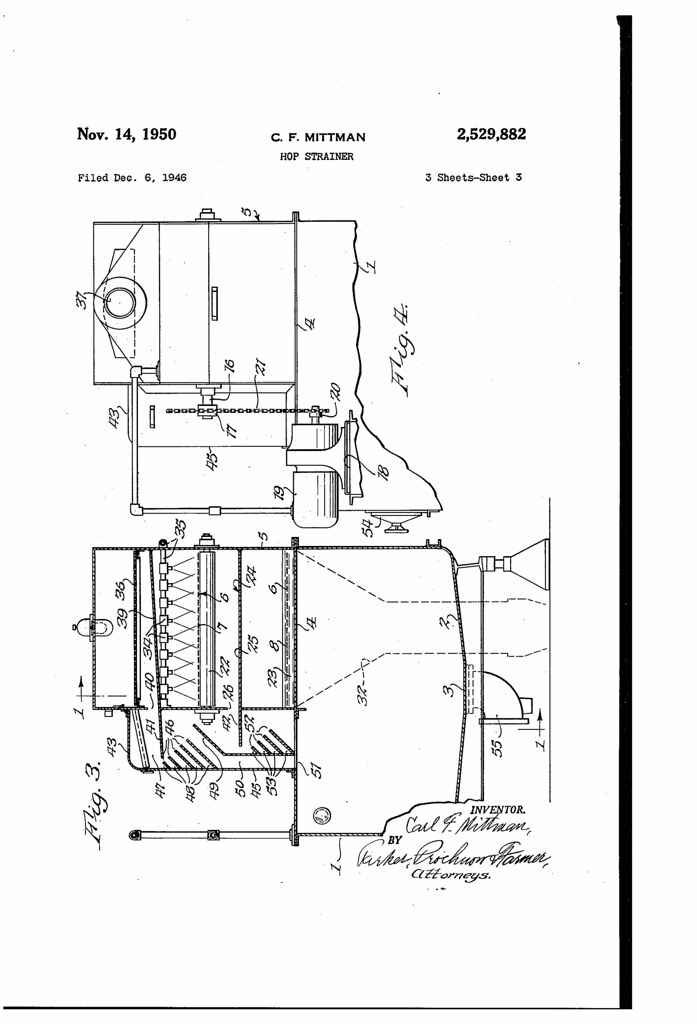
Today in 1950, US Patent 2529882 A was issued, an invention of Carl F. Mittman, for his “Hop Strainer.” There’s no Abstract, although in the description it includes this summary:

This invention relates to strainers, clarifiers and. filters, and more particularly to a combined hop strainer and trub clarifier or separator for use in the brewing industry.

An object of this invention is to provide an improved strainer, clarifier and separator with which the cooked hops and wort may be separated continuously, completely and rapidly; with which a major amount of the trub, that is, the fine solids of the cooked hops and wort mixture, will be effectively separated from the wort; with which no sugar coating on the separating surface can take place; with which the separating surfaces will be automatically cleaned; with which all parts of the apparatus Will be easily accessible for cleaning and collection of stale wort is prevented; which will have maximum capacity with minimum overall dimensions and low cost of operation; and which will be relatively simple, compact, efficient, practical and inexpensive.

Another object of the invention is to provide an improved simple, inexpensive and continuous method of separating cooked hops and wort; with which maximum recovery of the wort is .possible; and which will require only relatively simple apparatus.

Another object is to provide an improved method and apparatus for continuously separating cooked hops from wort; with which the separation Will occur upon a clean and sterile screen; with which the screen will be conditioned continuously and automatically during use.

Untitled
Untitled
Untitled

Filed Under: Beers, Just For Fun, Politics & Law, Related Pleasures Tagged With: Brewing Equipment, History, Hops, Law, Patent

Beer In Ads #1750: What A Time For Falstaff

December 5, 2015 By Jay Brooks


Saturday’s ad is for Falstaff, from 1967. It looks like they’re camping next to a river somewhere in the southwest, possibly along the Colorado by the Grand Canyon? I like their three-word description of the beer. “Crisp. Clean. Robust.”

Falstaff-magad57

Filed Under: Art & Beer, Beers Tagged With: Advertising, Falstaff, History

Patent No. 2181931A: Process For Extracting The Essential Principles Of Hops

December 5, 2015 By Jay Brooks

patent-logo
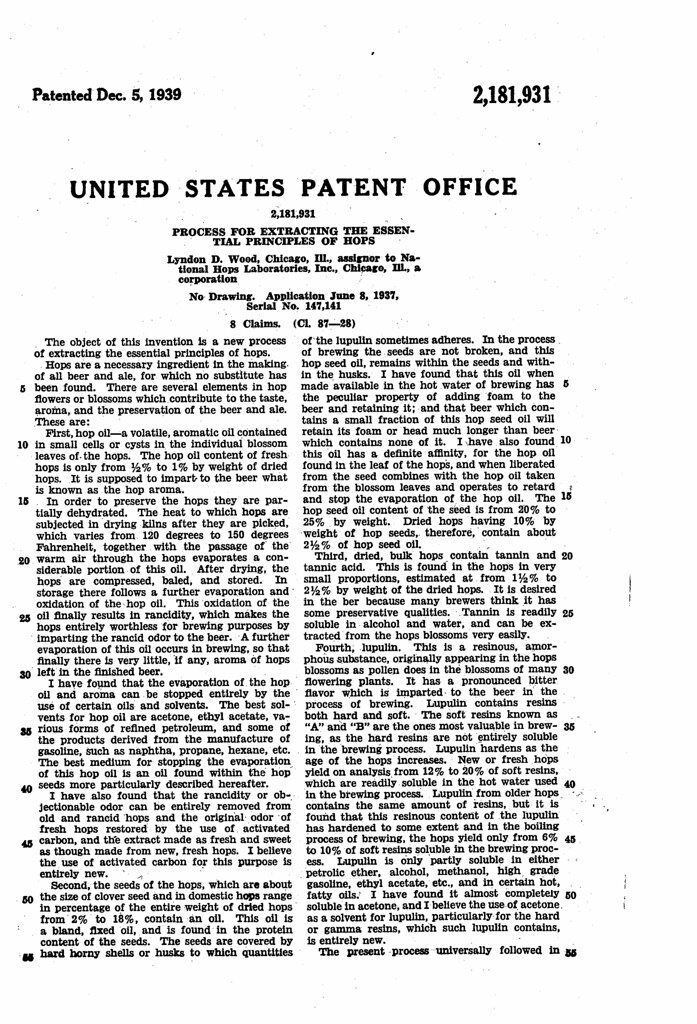
Today in 1939, US Patent 2181931 A was issued, an invention of Lyndon D. Wood, assigned to National Hops Lab, Inc., for his “Process for Extracting the Essential Principles of Hops.” There’s no Abstract, although in the description it includes this summary:

My process is essentially as follows:

My first procedure is to suitably prepare the hops by pulverizing them to’ a degree of fineness sufficient to crush all of the seeds which they contain and finely enough so that they will pass a 20 mesh screen or sieve. This may be done in any one of several types of mills which can be adapted for the work such as a ball mill, plate mill, roller mill, or a cutting mill, or a combination of cutting and hammer mill. The mill should be enclosed so that no air current are present in which the aroma of the hops can be dispersed. From the mill the prepared or pulverized hops should be conveyed to a closed tank or receptacle where the solvent is applied.

When old hops are used in which the lupulin has hardened and particularly those in which a rancid odor has occurred from the oxidation of hop oil, I employ activated carbon, which may be made from the vegetable, fibrous material of the hops residue after extraction has been made.

This activated carbon may be used in two ways. (a) By mixing it in finely powdered form with the pulverized hops while they are in a dry state.

When this method is employed ounce of activated carbon will be used to each pound of pulverized hops. The prepared hops should be stirred and shaken until the activated carbon has been thoroughly mixed with them, then be permitted to stand in a closed container for a period of time not less than two hours. The activated carbon experiments have shown restores the odor of fresh hops.

Untitled

Untitled

Filed Under: Beers, Just For Fun, Politics & Law, Related Pleasures Tagged With: History, Hops, Law, Patent

Beer In Ads #1749: Putting A Schooner In A Bottle Is Skilled Work

December 4, 2015 By Jay Brooks


Friday’s ad is for Oland’s Schooner Lager Beer, from 1967. The Oland Brewery is from Nova Scotia, Canada, though today it’s owned by Labatt Brewing, and ultimately ABI. The tagline, “putting a Schooner in a bottle is skilled work,” plays nicely on the beer’s name and follows through with the punchline at the bottom, “taking it out is pure pleasure.”

oland_schooner_beer_1967

Filed Under: Art & Beer, Beers Tagged With: Advertising, Canada, History

Patent No. 3776260A: Beer Kegs And Like Containers

December 4, 2015 By Jay Brooks

patent-logo
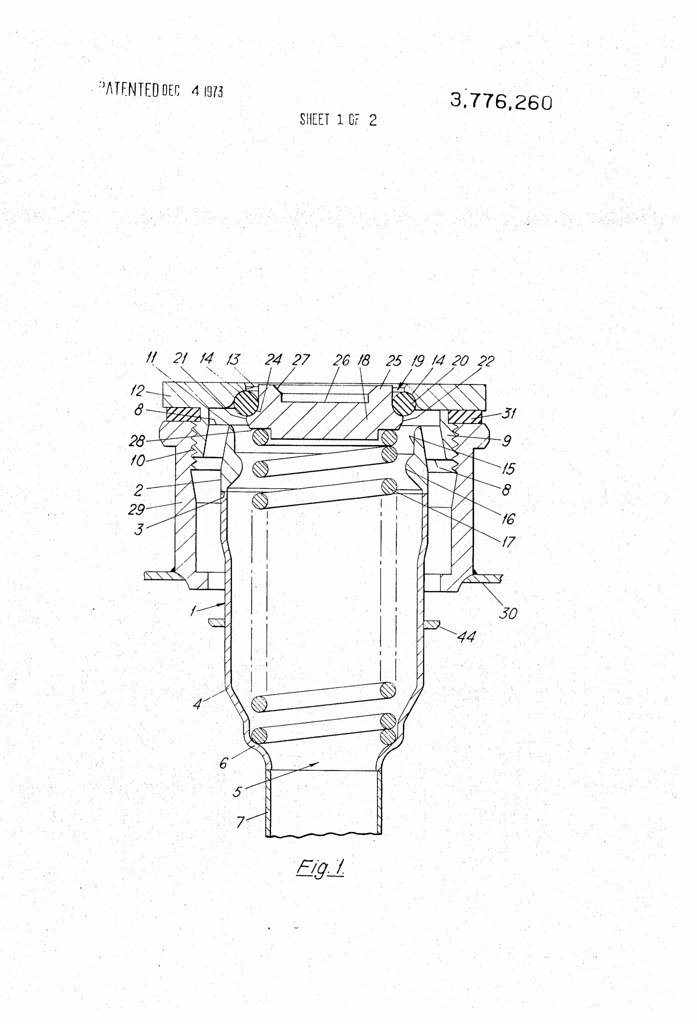
Today in 1973, US Patent 3776260 A was issued, an invention of Maurice Ruddick, for his “Beer Kegs and Like Containers.” Here’s the Abstract:

A spear and closure assembly which is arranged to be fitted as a single unit in the neck of a beer keg or like container comprises a tubular housing having one end open and the spear fixed to the housing and projecting from its other end, and a valve seat which is fixed to the housing so that it is located adjacent the open end of the housing and projects radially inwards with respect to the open end. The housing, the spear, and the valve seat are connected to form a unitary structure, such as by welding or by a combination of welding and being formed integrally. A spring located within the housing acts on a disc like closure member so that a resilient valve ring is pressed by the closure member against the valve seat, hence closing the opening bounded by the valve seat. Assembly of the spring, the closure member, and the valve ring within the structure is made easy by arranging that the size and shape of the spring and closure member allow these to be passed through the opening bounded by the valve seat, and by providing the valve ring with sufficient resilience to allow it to be deformed and squeezed through this opening. In use, application of a filling or dispensing fitting moves the valve ring and the closure member axially inwards against the action of the spring, the valve ring being displaced axially relative to the closure member and forming a seal against a second valve seat formed on the housing so that two separate passages are formed through the fitting and into the container, one through the housing and the spear and the other outside the housing via an aperture between the two valve seats.

Untitled
Untitled

Filed Under: Beers, Just For Fun, Politics & Law, Related Pleasures Tagged With: History, Kegs, Law, Patent

« Previous Page
Next Page »

Find Something

Northern California Breweries

Please consider purchasing my latest book, California Breweries North, available from Amazon, or ask for it at your local bookstore.

Recent Comments

  • Bob Paolino on Beer Birthday: Grant Johnston
  • Gambrinus on Historic Beer Birthday: A.J. Houghton
  • Ernie Dewing on Historic Beer Birthday: Charles William Bergner 
  • Steve 'Pudgy' De Rose on Historic Beer Birthday: Jacob Schmidt
  • Jay Brooks on Beer Birthday: Bill Owens

Recent Posts

  • Beer In Ads #5231: A Sign Of Spring April 26, 2026
  • Historic Beer Birthday: Henry Hoerl April 26, 2026
  • Historic Beer Birthday: John Toohey April 26, 2026
  • Beer In Ads #5230: The Original Old German Bock Beer, GOT IT? Get It! April 25, 2026
  • Historic Beer Birthday: Al Levy April 25, 2026

BBB Archives

Feedback

Head Quarter
This site is hosted and maintained by H25Q.dev. Any questions or comments for the webmaster can be directed here.