

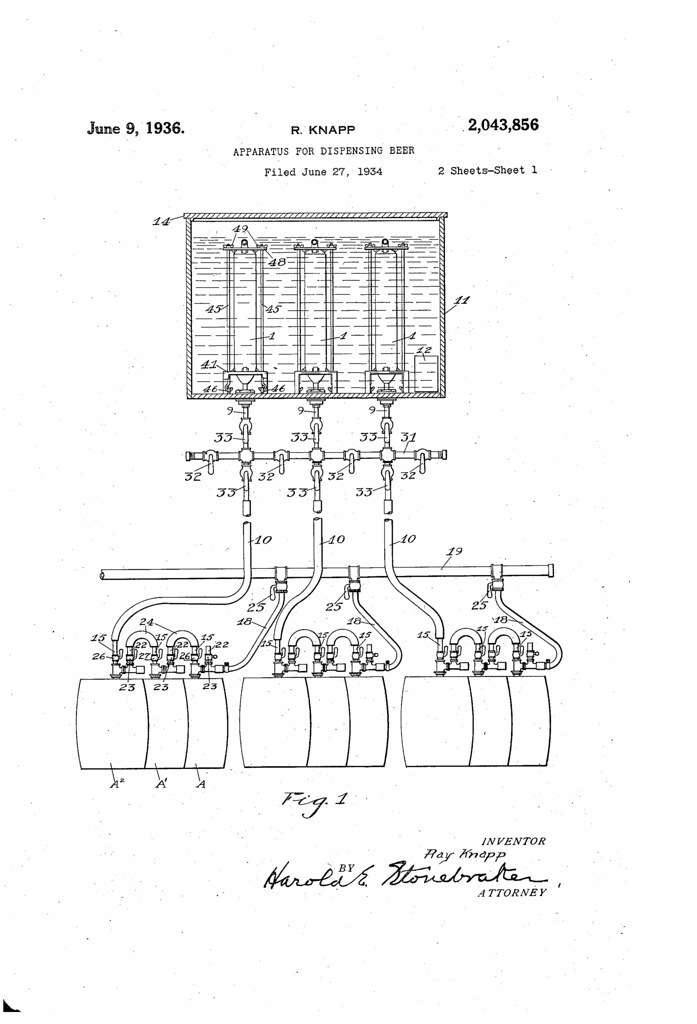
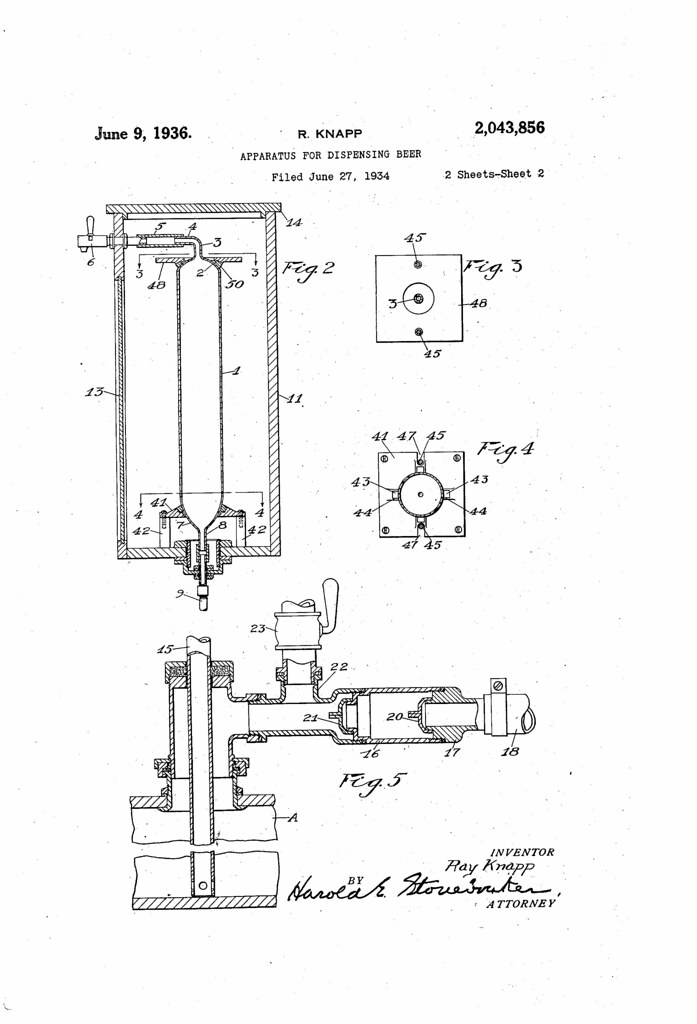
Today in 1936, US Patent 2043856 A was issued, an invention of Ray Knapp, for his “Apparatus For Dispensing Beer.” There’s no Abstract, although in the description it states that the “invention relates to a method and apparatus for dispensing beer, and has for its principal object to afford a structure that employs a cooling chamber made of glass or glass lined material, the beer being retained in the glass cooling chamber and conducted therefrom directly to the dispensing faucet.”
Patent No. 2641357A: Device For Cleaning Out The Bottoms Of Grain Elevators
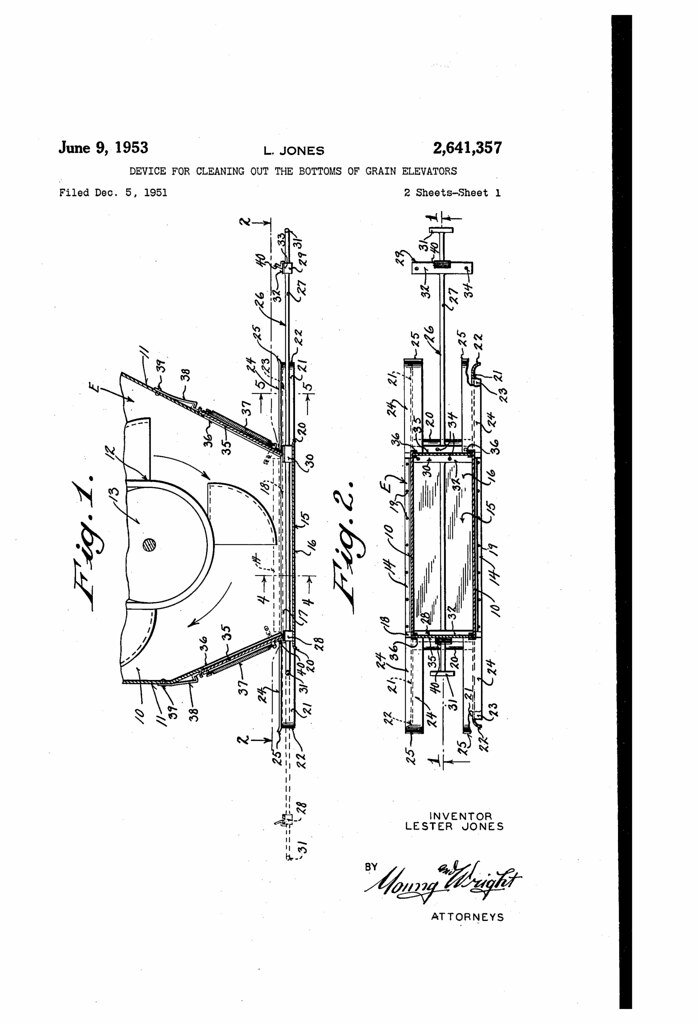
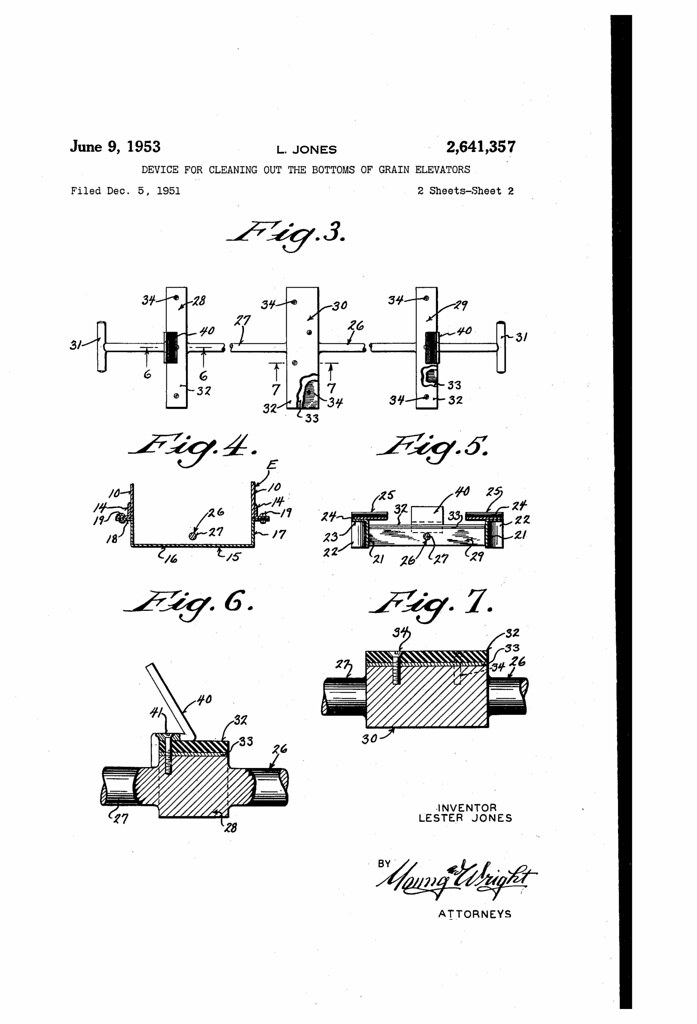
Today in 1953, US Patent 2641357 A was issued, an invention of Lester Jones (presumably not the economist with the NBWA), assigned to Pabst Brewing Co., for his “Device for Cleaning Out the Bottoms of Grain Elevators.” There’s no Abstract, although in the description it states that the “invention appertains to the handling of grain, and more particularly to a novel cleaning attachment for a grain elevator.”
In the handling of grain by bucket elevators, there is a clearance between the bottom wall or pan of the elevator housing and the elevator buckets. Consequently, a certain small portion of grain lies in an inactive state on this bottom wall or pan. If this grain is not periodically removed, there is danger that the same will spoil or become infected and contaminate the grain passing through the elevator. This condition is recognized, and provisions have been made to remove the inactive grain, but in all constructions with which I am familiar, it is necessary to shut down the elevator to effect the cleaning thereof. Consequently, there is a tendency to put off the cleaning of the elevator as long as possible.
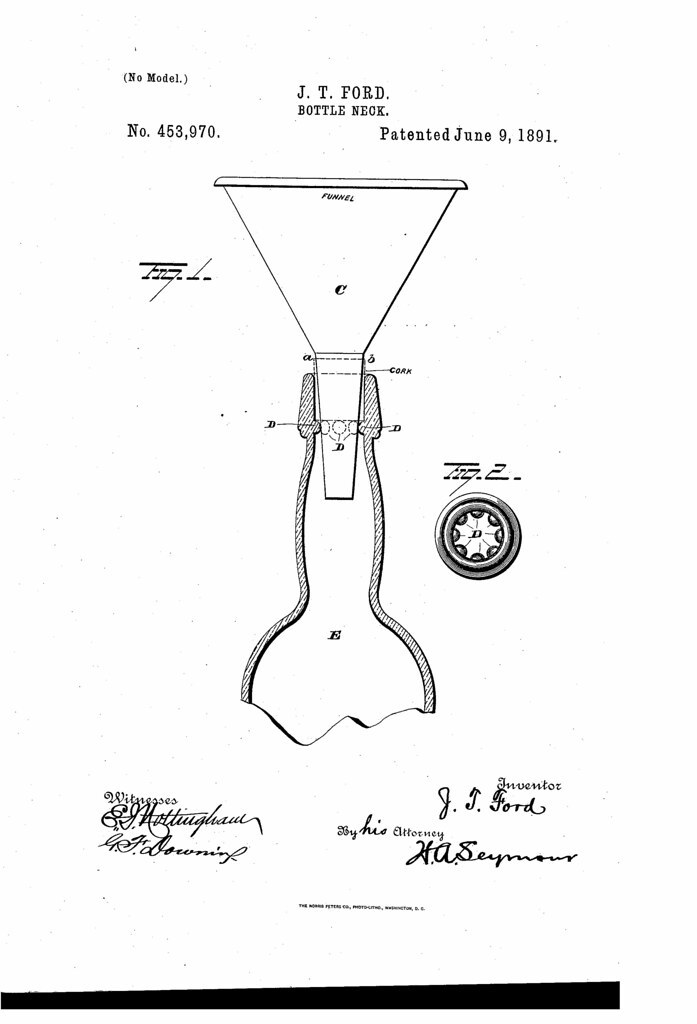
Patent No. 453970A: Bottle Neck
Today in 1891, US Patent 453970 A was issued, an invention of James Thomas Ford, for his “Bottle Neck.” There’s no Abstract, although in the description it states that the “invention consists in an improved form to be given to the necks of bottles, of glass or kind and closed with corks or other stoppers.”
The objects of the invention are, first, to facilitate the fitting of such bottles with ordinary funnels or faucets by permitting free exit to the air during the introduction of the liquid, thereby preventing the splutter and overflow of the funnel and quickening the operation of filling the bottles, more especially with liquids of considerable density, such as oils and sirups of all kinds; second, to prevent effectually the forcing inward of the cork. beyond a certain point during the extraction of it by means of a corkscrew or other implement, so frequent a source of annoyance with corks of inferior quality or slightly loose for the neck of the bottle.

And here’s the original illustration:
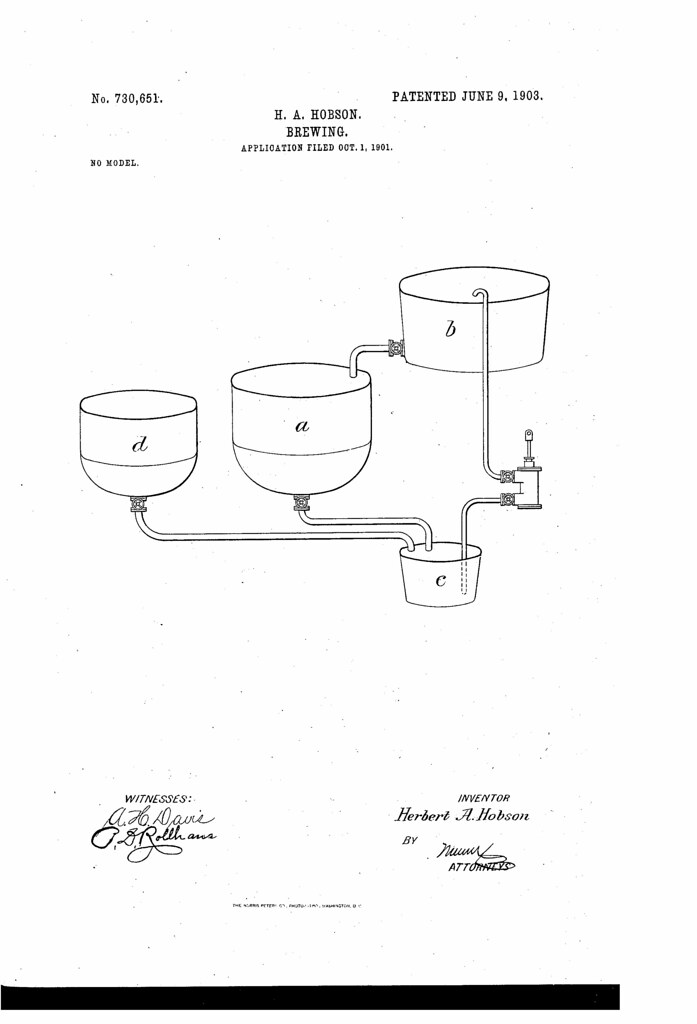
Patent No. 730651A: Brewing
Today in 1903, US Patent 730651 A was issued, an invention of Herbert Amos Hobson, assigned to the Concentrated Beer Company Ltd., for his “Brewing.” There’s no Abstract, although in the description it states that “this invention relates to a method of brewing in which a hopped wort is produced by first making an infusion or decoction of hops, then running off the infusion or decoction, and after fixing the tannic acid extracted from the hops mashing malt (or malt and grain) in the hop infusion or decoction as the mashing liquor.” Hobson was a British analytical chemist, and obviously he didn’t patent “brewing,” but an improvement on the process. I use the same titles that the grant of application uses, but sometimes they’re a little strange, case in point this one. Anyway, Hobson goes on to describe it great detail:
The invention consists,first, in a methodical process whereby the residual soluble matter contained in the spent malt and spent hops is extracted, the liquor containing such residual extractive matter being used instead of plain water for making the decoction of hops for a fresh brew, so that the residual malt and hop extract obtained from the spent malt and hops left from one brew will be utilized in the next succeeding brew, and so on.
The invention consists, secondly, in withdrawing from the hop extract (after it has been treated to fix the tannic acid, but before it is used for mashing) a portion of the hop liquor, separately heating the liquor thus withdrawn, and returning it to the bulk of the liquor after the mashing of the latter with malt, (or malt and grain,) so as to thereby raise the temperature of the mash without causing dilution thereof, as would be the case were naked steam blown in.
Beer In Ads #1580: Ballantine Beer Watches Your Belt-Line

Monday’s ad is for Ballantine Beer, from 1954. This must have been ad laying the groundwork for low-calorie diet beer, as light beer was known in those days. In fact, that’s why it flopped initially, because people didn’t like the idea of beer being called “diet,” though it seems to have worked fine for Coke. It’s funny how that brought red belt draws your attention to her waistline but then the dress below fans out so it maker figure look disproportionally hourglass, although I guess that was a thing once, wasn’t it. I also love the tagline captioning the photo. “Brewed to the American taste … to the American figure.” Hilarious.

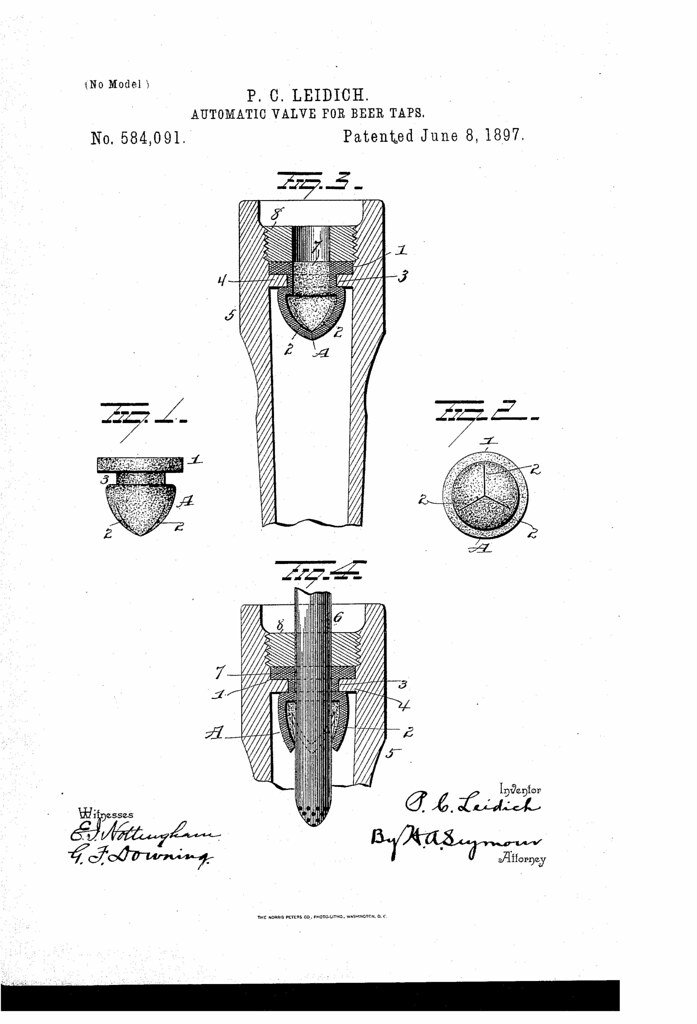
Patent No. 584091A: Automatic Valve For Beer-Taps
Today in 1897, US Patent 584091 A was issued, an invention of Peter C. Leidich, for his “Automatic Valve For Beer-Taps.” There’s no Abstract, although in the description it states that he’s ‘invented certain new and useful Improvements in Automatic Valves for Beer and other Liquid Taps.”
Patent No. 2083340A: Metal Barrel
Today in 1937, US Patent 2083340 A was issued, an invention of Herman Merker, assigned to the Pressed Steel Tank Company, for his “Metal Barrel.” There’s no Abstract, although in the description it’s explained as follows:
This invention relates to a metal barrel particularly designed and adapted for use as a beer barrel or as a container for similar beverages although also well adapted for other uses. One object of the invention is to provide a barrel with a strong and durable bung structure, one which will stand up under the severe usage to which such a structure is subjected and yet preclude fatigue or distortion of the metal adjacent the bung structure. Another object of the invention is to provide a barrel having a bung structure of the character mentioned and one which does not interfere with easy rolling and handling of the barrel.

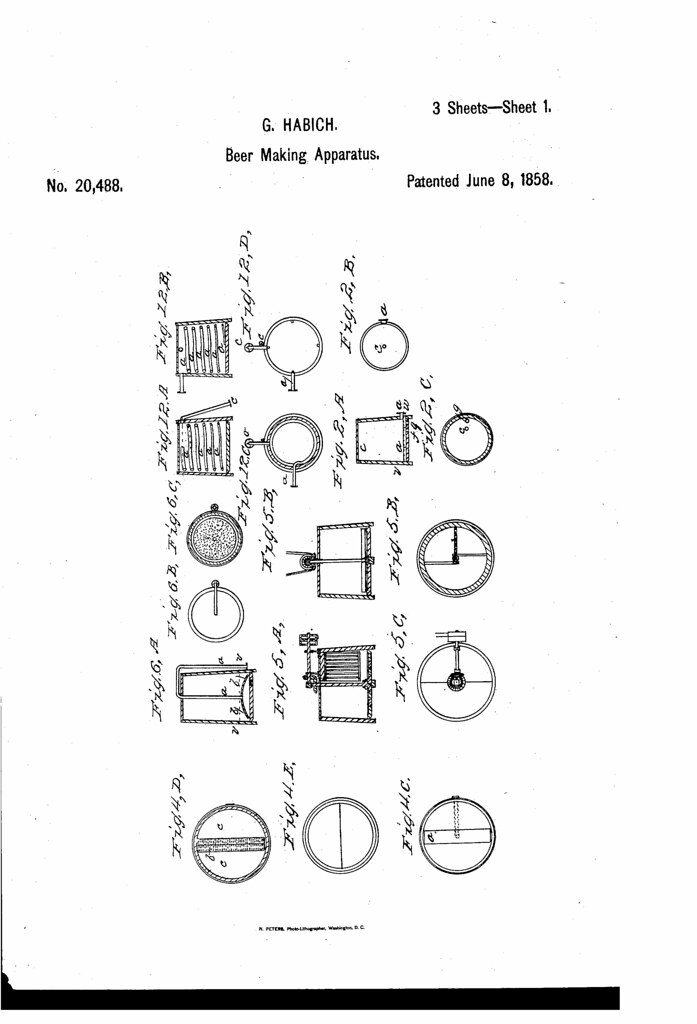
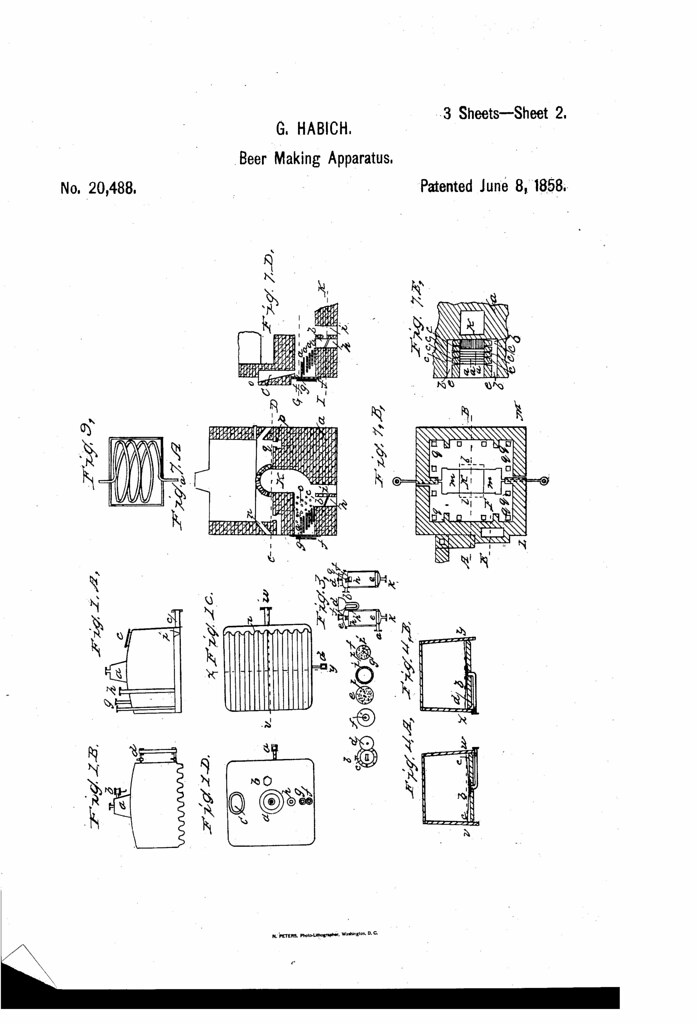
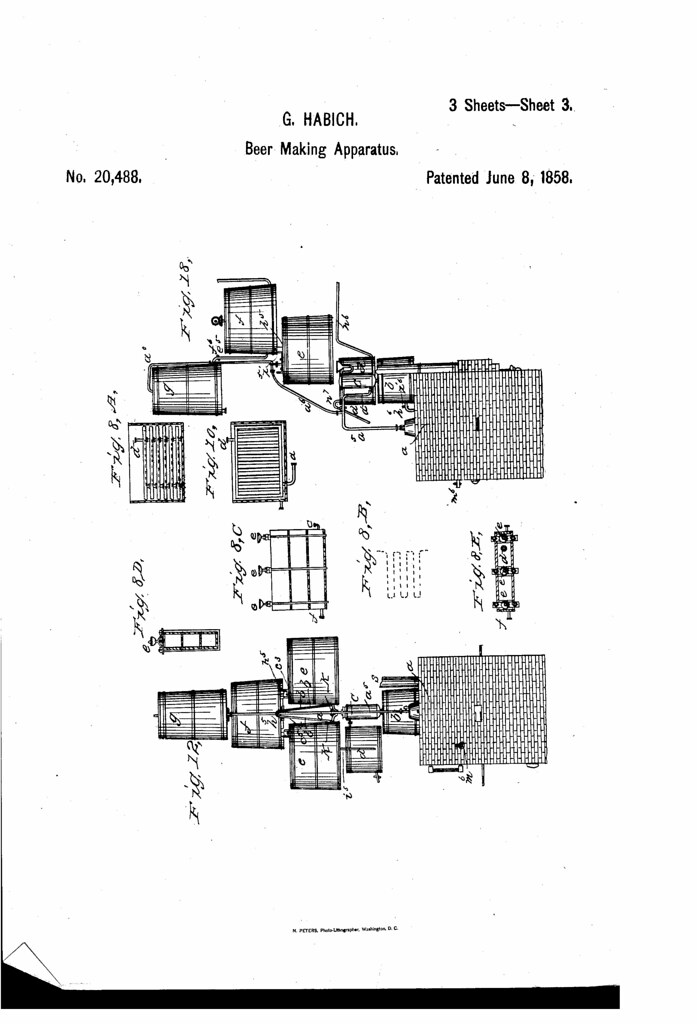
Patent No. 20488A: Apparatus For Manufacture Of Beer
Today in 1858, US Patent 20488 A was issued, an invention of George Habioh, for his “Apparatus For Manufacture Of Beer.” There’s no Abstract, though the description in the application states that he’s “invented an Improved Apparatus for Brewing or Manufacturing Beer.” What follows is a very lengthy explanation, but here’s the start of a fuller explanation.
For this boiling of the wort I use a closed copper or kettle; its steam I employ for new mashing and increase its pressure by a superincumbent column of water. This steam enters directly into the mash, and the increasing height of the water increases also the boiling point of the wort contained in the copper. This increased temperature manifests itself in stirring up again the wort, after it becomes clear, and finally the wort clears itself of all the coagulated albumen. The only thing to be observed is that the temperature should be sufficiently high, 2′. e. the steam pipe must be closed by a sufficient column of water.
Beer In Ads #1579: The Wife Most Likely To Be Kissed …
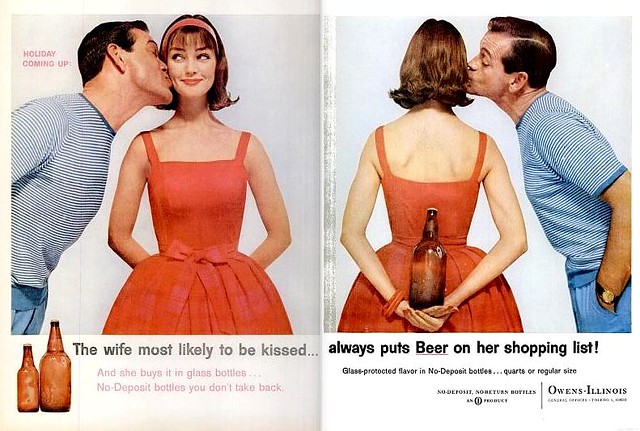
Sunday’s ad is for Owens-Illinois Glass, 1958. Owens-Illinois is still a going concern, making glass worldwide. It’s a big company. According to Wikipedia, “Approximately one of every two glass containers made worldwide is made by O-I, its affiliates, or its licensees.” In the late 1950s, they were trying to persuade people that “The wife most likely to be kissed … always puts Beer on her shopping list. Especially in “No-Deposit, No-Return Bottles.” Of course, this was also a time when it was “her shopping list” and not just “the shopping list.”
Patent No. 2472252A: Process For The Preservation Of Beer
Today in 1949, US Patent 2472252A was issued, an invention of Arthur Henry Hughes, assigned to Messrs. Arthur Guinness Son and Company Limited, for his “Process For The Preservation Of Beer.” There’s no Abstract, though the description in the application states that he’s invented “invention relates to the preservation of beer, which term as used herein includes both ale and stout,” apparently by adding “0.041% by volume of hen egg-whites.”

