Brookston Beer Bulletin

Jay R. Brooks on Beer

  • Home
  • About
  • Editorial
  • Birthdays
  • Art & Beer

Socialize

  • Dribbble
  • Email
  • Facebook
  • Flickr
  • GitHub
  • Instagram
  • LinkedIn
  • Pinterest
  • RSS
  • Twitter
  • YouTube

Powered by Genesis

Patent No. EP 0645342A1: Safety Dispensing Valve

March 29, 2015 By Jay Brooks

patent-logo
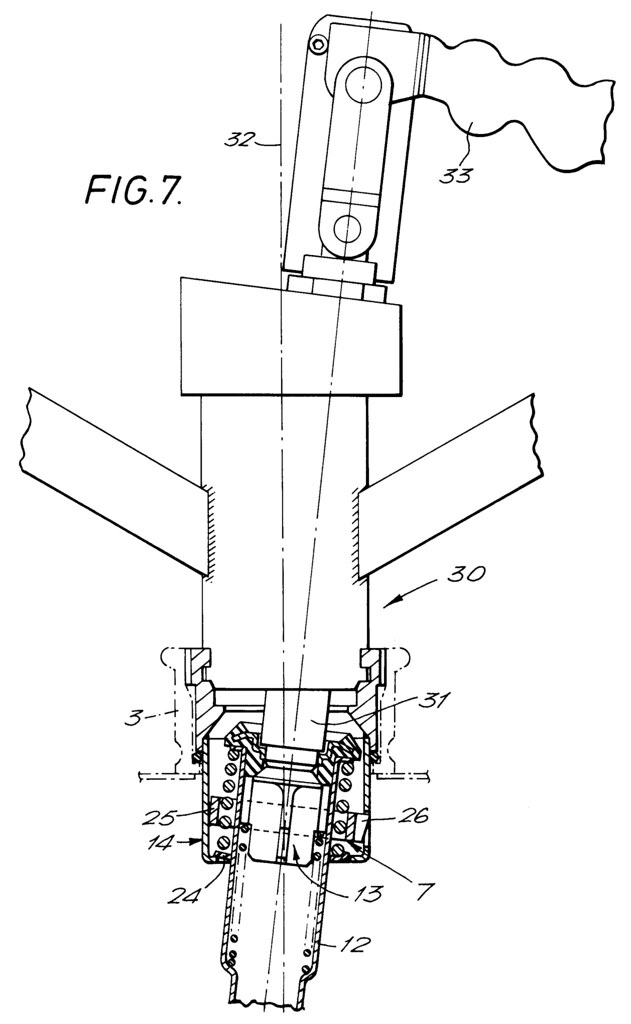
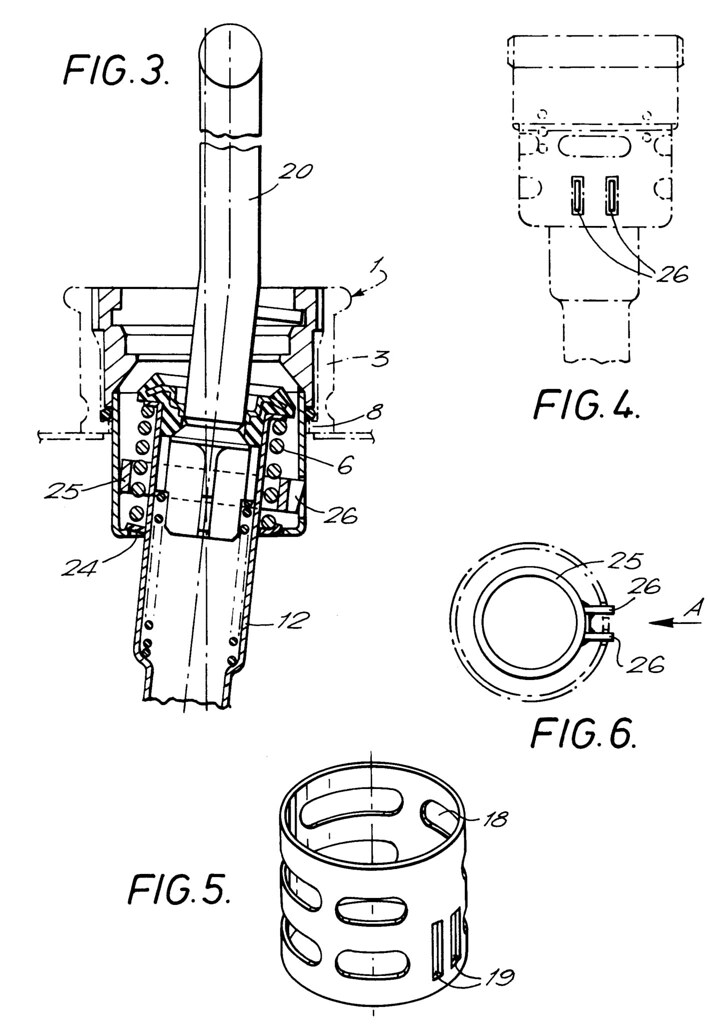
Today in 1995, US Patent EP 0645342 A1 was issued, an invention of Robert Bernard Harwood Cook, for his “Safety Dispensing Valve.” Here’s the Abstract:

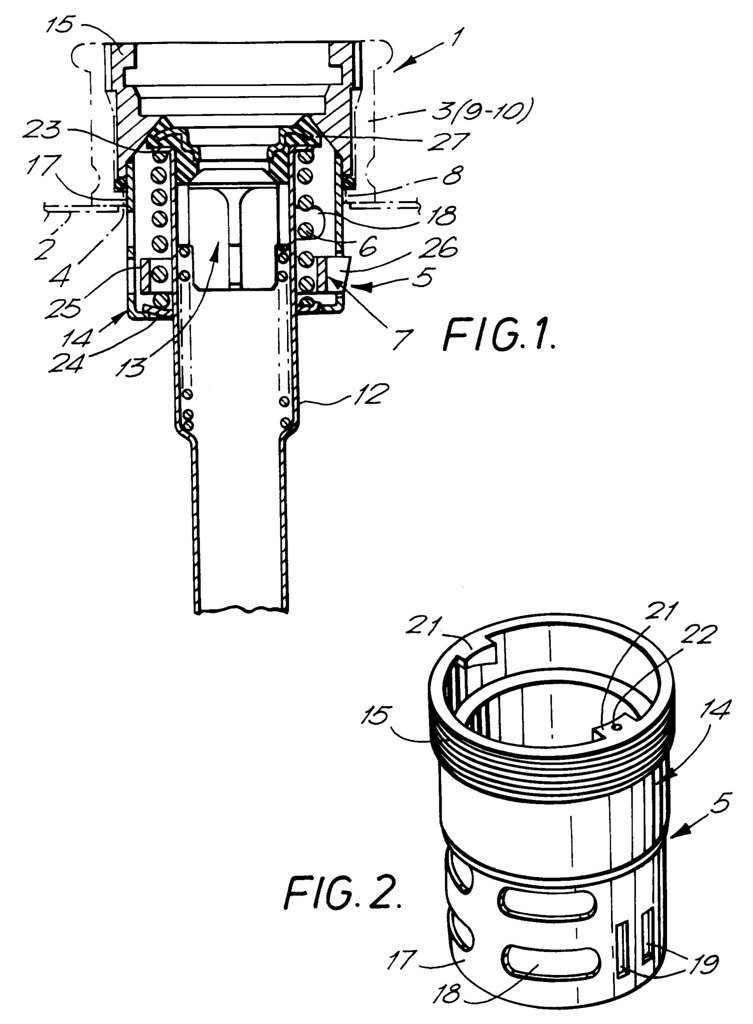
A spear valve assembly (5) has a valve body (14) for engagement with a keg neck (3) and a skirt (17) on the valve body (14) including openings (18) for the throughflow of beer during filling. A downtube assembly (12) is movable relative to the valve body (14) and the skirt (17) and includes a downtube (12) for projecting into beer in a keg. A locking member (7) is carried by the downtube assembly (12) and is arranged to project through at least one further opening (19) in the skirt. In use, the locking member (7) normally prevents the spear valve assembly (5) from being ejected from a beer keg by engagement behind the keg neck. However, for removal of the spear valve assembly (5) the downtube assembly (12) is tilted relative to the skirt (17) to retract the locking element (7).
EP0645342A1-imgf0001
EP0645342A1-imgf0002
EP0645342A1-imgf0003

Filed Under: Beers, Just For Fun, Politics & Law, Related Pleasures Tagged With: History, Kegs, Law, Patent

Patent No. 6871579B2: Device For Producing Beer And A Unit For After-Fermentation

March 29, 2015 By Jay Brooks

patent-logo
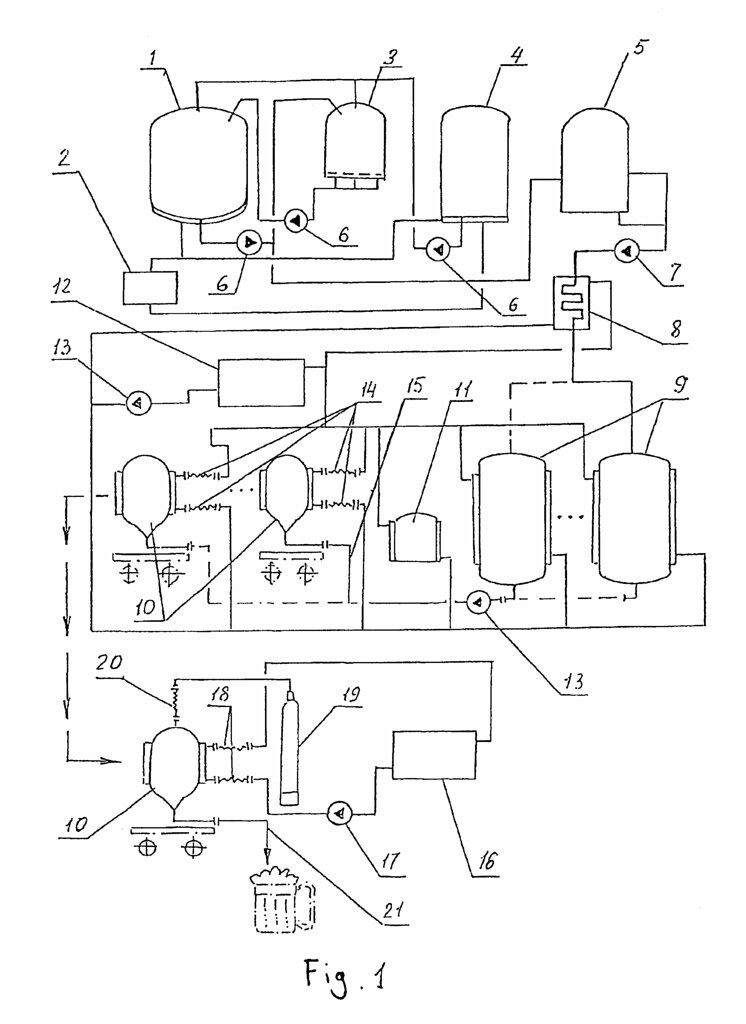
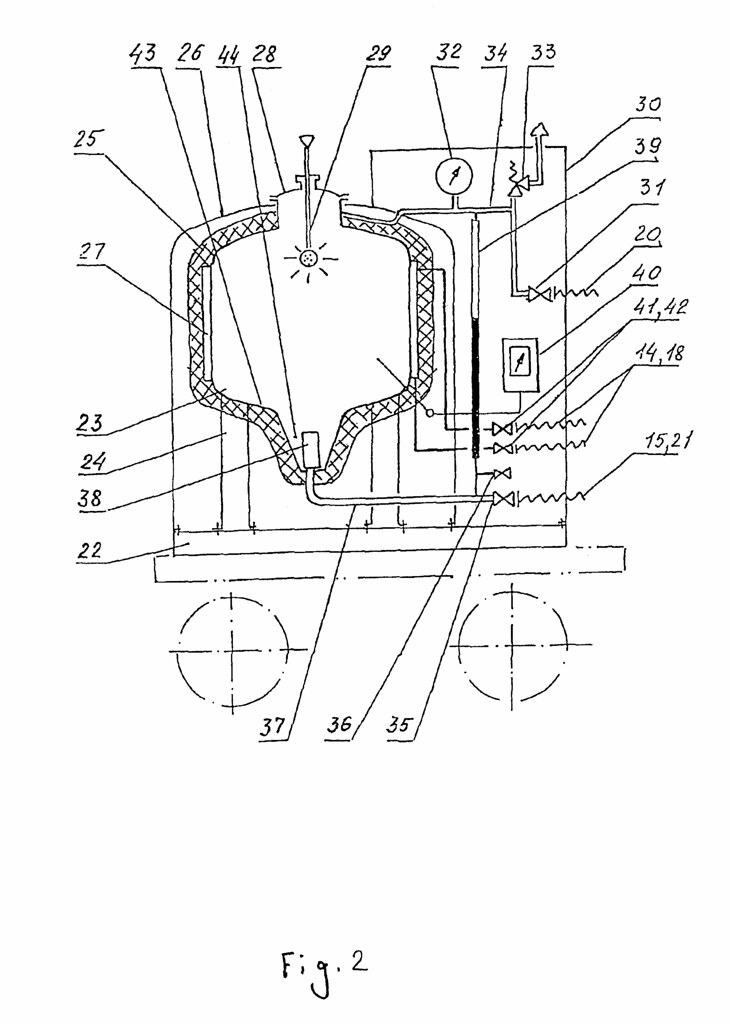
Today in 2005, US Patent 6871579 B2 was issued, an invention of Evgeny Konstantinovich Belkin, Andrei Arkadievich Peshkin, Vladimir Gennadievich Matveev, Leonid Mikhailovich Prikhozhan, and Yury Vasilievich Artamonov, for their “Device For Producing Beer and a Unit for After-Fermentation.” Here’s the Abstract:

The invention relates to the food industry. In order to reduce sales expenses and preserve the taste of beer, the inventive device is provided by i-number communication units, necessary for operational connection and disconnection of i-number units for after-fermentation, and each of i-number units for after-fermentation is embodied in such a way so that it is transportable, thermally insulated, hermetic, protected from deposited yeast mixing with non-filtrated beer while transportation and can be connected to a cooling system, arranged at a point of sale and/or dispense.

US06871579-20050329-D00001
US06871579-20050329-D00002

Filed Under: Beers, Breweries, Just For Fun, Politics & Law, Related Pleasures Tagged With: Brewing Equipment, Law, Patent, Science of Brewing

Beer In Ads #1508: Saturday Night

March 28, 2015 By Jay Brooks


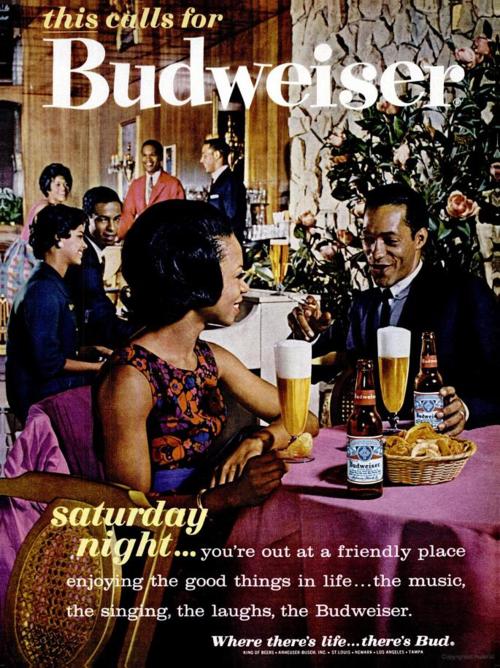
Saturday’s ad is another one for Budweiser, this one from, I think, the early 1960s. It’s another ad from their “Where there’s life” series, this one is called “Saturday Night.” A couple are out for dinner on, presumably, a Saturday night, or maybe just having drinks, as there’s only a basket of bread on the table. Those are some large looking glasses of beer.

budweiser-3

Filed Under: Art & Beer, Beers Tagged With: Advertising, Budweiser, History

Patent No. 1177529A: Beer-Faucet

March 28, 2015 By Jay Brooks

patent-logo
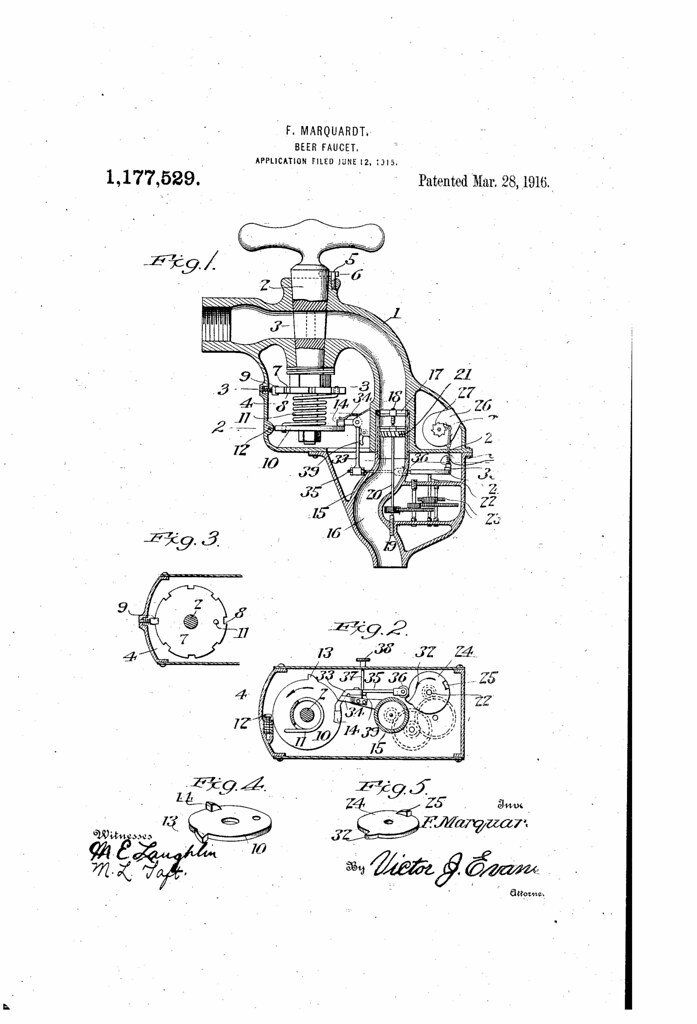
Today in 1916, US Patent 1177529 A was issued, an invention of Frederick Marquardt, for his “Beer-Faucet.” There’s no Abstract, but the description states that the “invention is to provide a faucet especially adapted to be used for dispensing beer, ale orthe like, and the faucet is provided with a meter which is operated by the passage of the liquid through the same to register the quantities of liquid drawn through the faucet.”
US1177529-0

Filed Under: Beers, Just For Fun, Politics & Law, Related Pleasures Tagged With: History, Kegs, Law, Patent

Reservoir Dogs Beers

March 28, 2015 By Jay Brooks

reservoir-dogs
The debut film of auteur filmmaker Quentin Tarantino was the violent heist film Reservoir Dogs. I remember being blown away by it when I saw it in the theatre when it was released in 1992, and especially the stylish opening credits scene with the principal characters walking down an alley in slow-motion to the nearly forgotten 1970s hit Little Green Bag by the George Baker Selection.

One of my favorite devices is that the six characters involved in the heist are each given code names so they won’t accidentally reveal their names during the diamond robbery and be able to give away each other’s identities should they be caught. Here’s the main cast, in order of their appearance in the slow-motion opening credits:

  1. Harvey Keitel as Lawrence Dimmick: Mr. White
  2. Michael Madsen as Vic Vega: Mr. Blonde
  3. Chris Penn as Eddie Cabot: Nice Guy Eddie
  4. Steve Buscemi: Mr. Pink
  5. Lawrence Tierney as Joe Cabot
  6. Edward Bunker: Mr. Blue
  7. Quentin Tarantino: Mr. Brown
  8. Tim Roth as Detective Freddie Newandyke: Mr. Orange

reservoir-dogs-white
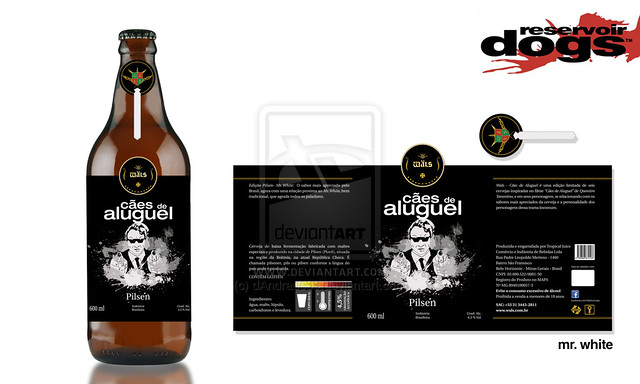
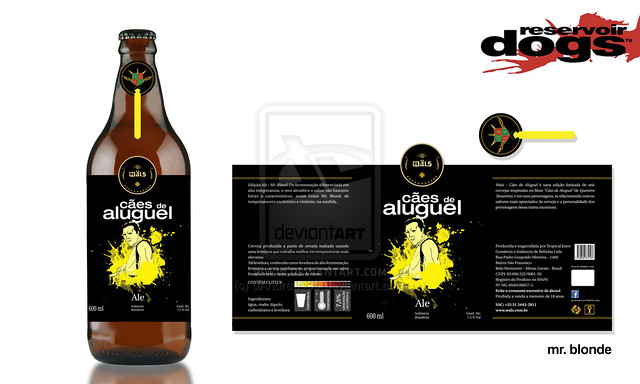
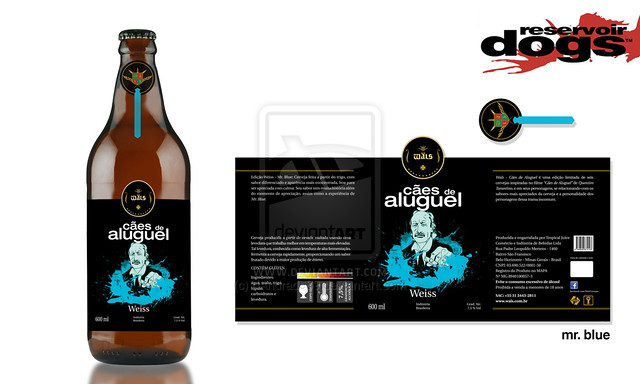
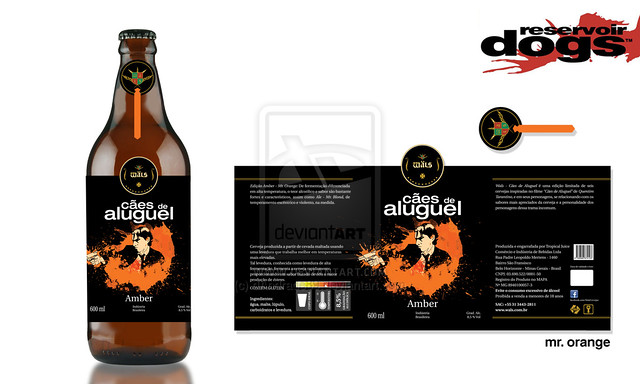
Earlier this month, Brazilian art student Peter de Andrade, for a school project created a series of beer labels based on the film, using “cães de aluguel,” which translates in Portuguese to, of course, Reservoir Dogs. The artist created the labels as if they were brewed by the Brazilian brewery Cervejaria Wäls, which each label and type of beer based on the film character’s code name color. As far as I know, Wäls was not involved and isn’t planning on making the Reservoir Dogs beers. Coincientally, there is a Reservoir Dogs Brewery in Slovenia.

Mr. White, a Pilsner
mr_white_beer___by_dandrade89-d8khyi4

Mr. Blonde, an Ale, presumably a Blonde Ale
mr_blonde_beer___by_dandrade89-d8khye2

Mr. Blue, a Weisss beer
mr_blue_beer___by_dandrade89-d8khyfr

Mr. Brown, a Stout
mr_brown_beer___by_dandrade89-d8khygh

Mr. Orange, an Amber Ale
mr_orange_beer___by_dandrade89-d8khyhg

It’s a pretty cool idea, and I’d love to see the actual beer made. There’s really only one question about all of this. Where the hell is Mr. Pink?

Filed Under: Art & Beer, Beers, Just For Fun Tagged With: Beer Labels, Brazil, Film

Patent No. 3311267A: Measuring Attachment For Beer Keg Or The Like

March 28, 2015 By Jay Brooks

patent-logo
Today in 1967, US Patent 3311267 A was issued, an invention of James E. Houston, Ryals E. Lee,and George M. Norman, for their “Measuring Attachment for Beer Keg or the Like.” There’s no Abstract, but the description states that the “invention relates to the dispensing of liquids including beer from closed opaque kegs or containers subjected to pressure to discharge the contents and with regard to which it is desirable to be able to determine the amount of liquid contained at any particular time between the initial dispensing and exhausting of the contents of such keg or container.” There’s not much more, but they explain its object:

It is an object of the invention to provide a simple, practical, readily usable, measuring attachment for a beer keg or the like, which can be quickly applied and removed, and by means of which an immediate reading of the contents can be made at any time.

US3311267-0

Filed Under: Beers, Just For Fun, Politics & Law, Related Pleasures Tagged With: History, Kegs, Law, Patent

Beer In Ads #1507: Next Time

March 27, 2015 By Jay Brooks


Friday’s ad is still another one for Budweiser, this one from 1959. It’s another ad from their “Where there’s life” series, this one is called “Next Time.” It’s hard to see what’s going on in this ad. A couple in a darkened room, their faces shiny from the dark red light. They’re dressed up, but he’s taken off his jacket and has his sleeves rolled up. On the counter, bar, table or whatever they’re leaning on, there’s a newspaper, a bag of potato chips and an ashtray, while the woman is pouring a can of beer into a pilsner glass. By the looks of it, if she doesn’t stop right this second, that glass is going to overflow, and with a pretty solid stream still coming out of the can, it may happen anyway.

budweiser-where-there-is-life-there-is-bud-next-time-1959

Filed Under: Art & Beer, Beers Tagged With: Advertising, Budweiser, History

Patent Nos. 2546250A & 2546251A: Process Of Concentrating Yeast Slurries & For Drying Yeast

March 27, 2015 By Jay Brooks

patent-logo
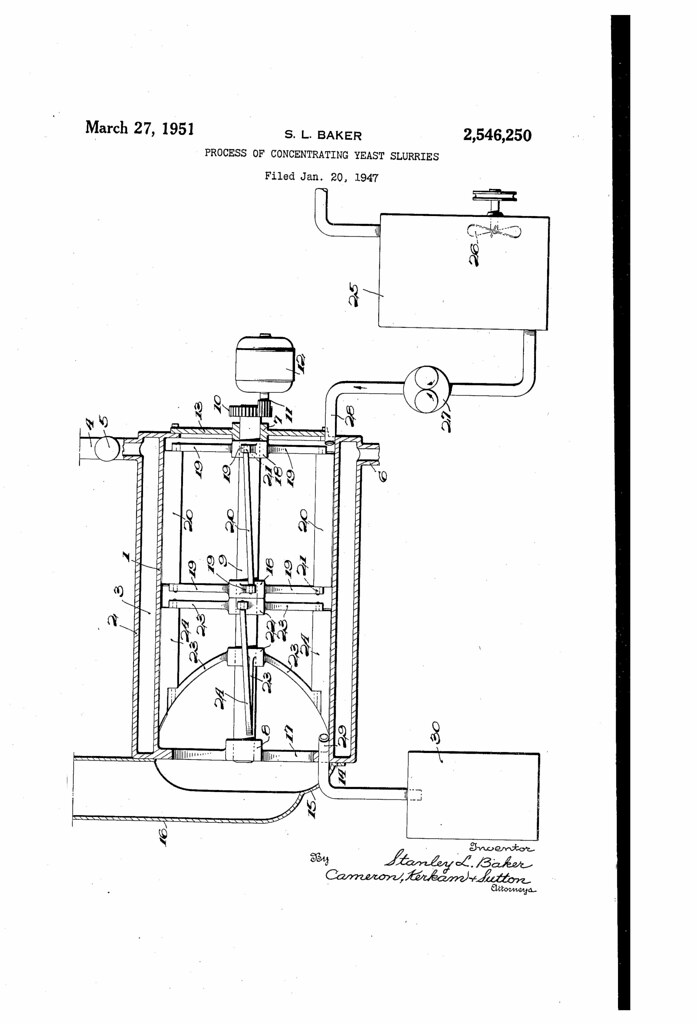
Today in 1951, US Patents 2546250 A and 2546251 A were issued, both inventions of Stanley L. Baker, for his “Process of Concentrating Yeast Slurries” and “Process for Drying Yeast.” There’s no Abstract for either, but the description for the first is an “invention relat[ing] to the concentration of dilute suspensions or slurries of yeast and especially of brewers yeast slurry which will be referred to hereinafter as an example although it will be understood that the invention is not restricted thereto.”
US2546250-0

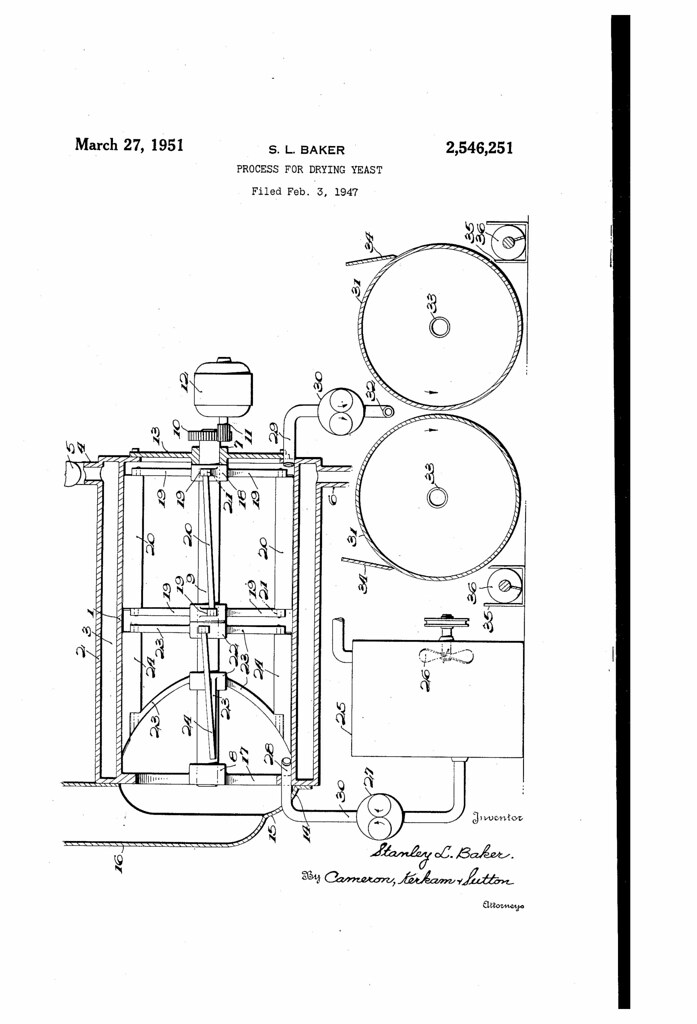
His second patent is described as an “invention relat[ing] to drying dilute suspensions or slurries of yeast and especially brewers yeast slurry which will be referred to hereinafter as an example, although it is to be understood that the invention is not restricted thereto.” You may have noticed that this description is exactly the same as the first. What’s clear is while these are two different patents, they are vey similar and are both about roughly the same yeast process. Even the drawings are only slightly different from one another.
US2546251-0

Filed Under: Beers, Breweries, Just For Fun, Politics & Law, Related Pleasures Tagged With: History, Law, Patent, Science of Brewing, Yeast

Oskar Blues Buys Perrin Brewing

March 27, 2015 By Jay Brooks

oskar-blues-blue Perrin
Oskar Blues, makers of Dale’s Pale Ale and other canned beers, has announced acquisition of the Perrin Brewing Co. of Comstock Park, Michigan (near Grand Rapids). MLive is reporting the deal, and that as part of it, Keith Klopcic, who formerly worked with nearby West Side Beer Distributing, becomes the new president at Perrin Brewing Co., replacing founder and former brewery head Randy Perrin. According to the article, “financial terms of the deal were not disclosed.” I love this quote: “Other than that, it’s the same company,” said Klopcic. “Nothing changes.” Not to second guess the deal, especially since I don’t personally know the parties involved (apart from Dale Katechis from Oskar Blues), but saying nothing changes when a brewery head and (I presume) a founder leaves a company when it’s sold doesn’t strike me as a particularly honest assessment.

Dan Perrin and Jarred Sper will continue running the brewery alongside production manager and head brewer John Stewart and his team. Sper, who will be vice president of sales and marketing at Oskar Blues-owned Perrin, said the brewery is very excited by the acquisition deal.

According to MLive, here’s what Dale had to say:

In a statement, Oskar Blues founder Dale Katechis called the deal “a radical thing.”

“We at Oskar Blues love the Michigan craft beer scene and what the guys at Perrin are doing,” Katechis said. “We feel that Perrin and Oskar Blues have the same mindset toward the craft industry and this partnership will allow us to share information and innovative ideas with one another.”

In December, the breweries teamed up on a lager called “Cornlaboration” that was sold only in Michigan, a state in which Oskar Blues began distributing in 2013.

Until Oskar Blues’ canned beer sales outstripped their original brewpub, they were considered one of the country’s largest brewpubs, so it’s interesting to see them reach a point where they’re acquiring additional brands and another brewery.

perrin-brewing

Filed Under: Breweries, News Tagged With: Announcements, Business, Colorado, Michigan

Studies Show Studies Don’t Show Much

March 27, 2015 By Jay Brooks

pill
If there’s one thing prohibitionists love to shout about, it’s a new study showing how terrible alcohol is, and how it supports what they’ve been proselytizing about all along. A growing trend has been anti-alcohol groups funding studies, having the “team” look for problems through phrasing the study’s goals and methodology with a particular outcome in mind, and then releasing the results as if it was impartial news. Sadly, with our media overworked and underpaid, many fall for it and report such a sham study’s results without ever critically examining it or even looking for a dissenting opinion to bring some fair and balanced perspective. Prohibitionists, knowing this, package their press releases into print-friendly versions so media outlets can simply cut and paste, passing it off as actual news. To be fair, it’s not just them. Almost everybody does it. It’s become a game, of sorts, one where most reasonable people’s wishes are ignored in favor of a more extreme agenda. Issues get polarized, and meaningful dialogue is becoming increasingly impossible with mud being slung in both directions, though I tend to think on the prohibitionist front that more mud comes our way, than vice versa.

But I’ve spent the last decade or so taking a fairly critical look at study after study, taking issue with almost all of them in one way or another. For every study that says one thing, you can find another that says the complete opposite, which you’d think wouldn’t, or shouldn’t, be possible. But a lot of it has to do with the way studies are conducted, how rigorous the science is, and whether or not they started with a specific agenda or not. I’ve certainly crowed about studies that show alcohol in a positive light, though I’ve never financed any. But despite all the tamper tantrums from the prohibitionists, they’re the ones spending all the money creating a false record of harm, not to mention taking advantage of any others they can, part of their post-prohibition strategy to bring down alcohol by less obvious means in a slower, more patient approach, chipping away at public policy and the law brick by brick, so to speak.

As a result of seeing so many of these so-called “studies,” I’ve noticed a lot of tricks that they use to make them seem like the findings actually mean something, but they rarely do, and usually even the study’s authors, who presumably want to keep their status as impartial scientists despite taking money for funding, almost always issue cautions and calls for further testing and for no one to make too much of what they found, words invariably ignored by the people using their findings to promote an agenda. It’s made me question the entire medical, and to some extent the scientific, community because it’s so obviously been corrupted by money — like every other aspect of our society, sad to say — with so many willing to take money to help a fanatical group promote its agenda. And it seems like the shear number of such studies has ballooned in recent years, too. Just how many scientific journals can there be, and how many are truly scientific, if any?

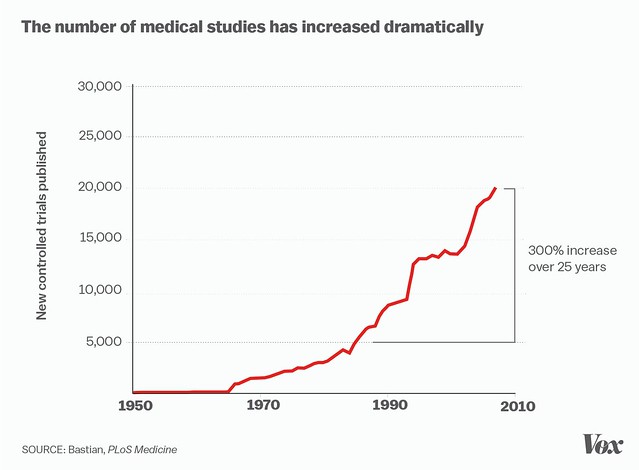
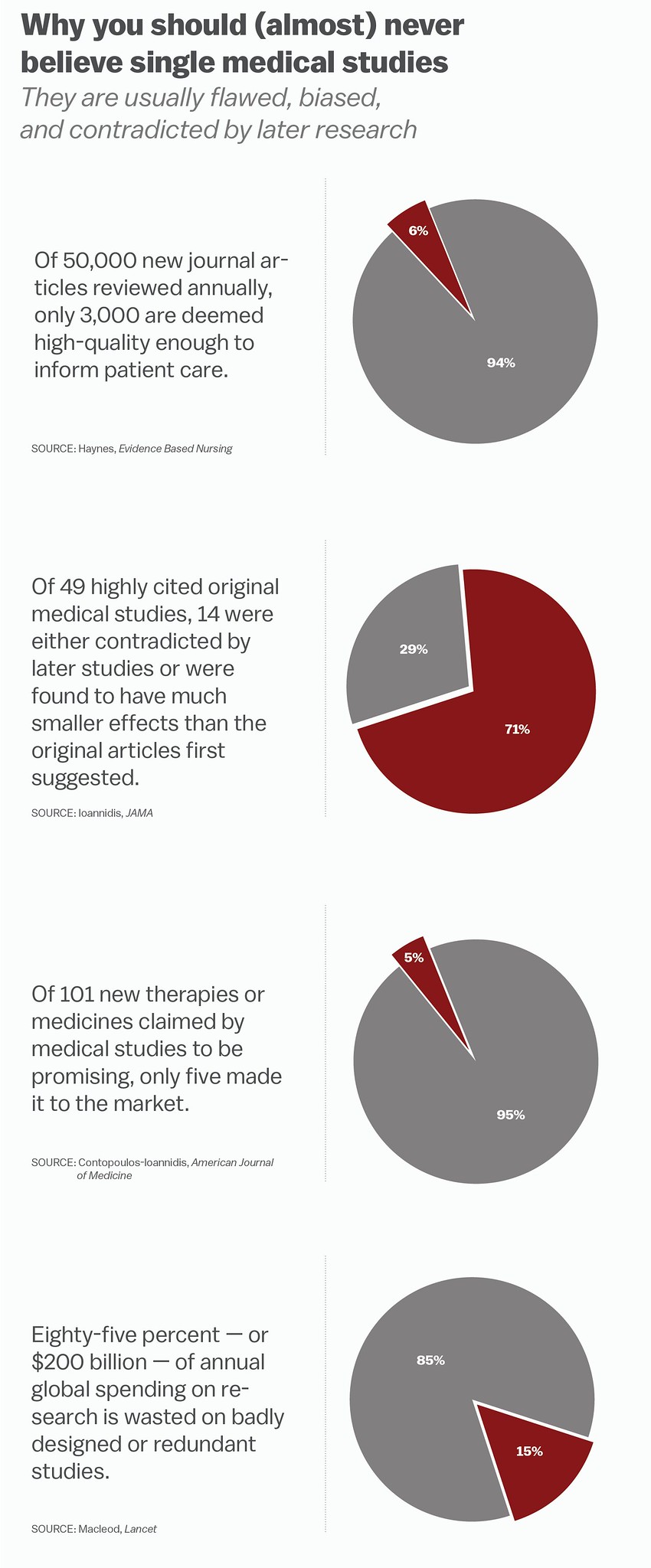
But an article on Vox a few days ago addressed this very issue, with This is why you shouldn’t believe that exciting new medical study. As the author wonders “whether there is any value in reporting very early research,” I’ve seen how it’s more often misused than anything else. As she writes. “Journals now publish their findings, and the public seizes on them, but this wasn’t always the case: journals were meant for peer-to-peer discussion, not mass consumption.” Because of this, the amount of studies being conducted has skyrocketed since their use is often now well beyond the original purpose of real study and furthering the science surrounding an issue. The actual number of so-called journal studies have seen an astounding 300% increase over the last quarter-century.

Medical_studies-2

But as she points out, early reporting on these studies rarely leads to any meaningful breakthroughs, even though those initial findings become fixed in the public mind as fact. A recent example that springs to mind is about glutens. A study in Australia initially seemed to suggest that eating gluten-free could be healthier for even people who didn’t suffer from Celiac disease, but further work by the same scientist found that his initial results were incorrect, and that there were no appreciable health benefits to a gluten-free diet for most people. Despite this clear repudiation of the initial findings, gluten-free as a healthier lifestyle remains an idea many people not only still believe, but even follow, despite having been refuted years ago. This is not an isolated occurrence.

In 2003, researchers writing in the American Journal of Medicine discovered something that should change how you think about medical news. They looked at 101 studies published in top scientific journals between 1979 and 1983 that claimed a new therapy or medical technology was very promising. Only five, they found out, made it to market within a decade. Only one (ACE inhibitors, a pharmaceutical drug) was still extensively used at the time of their publication.

One.

So that means 100 others proved to not pan out, their promise as originally reported proving to not stand up to further research or lead to any meaningful breakthrough. But the news cycle has already moved on, and the damage has been done, with the study reported and its inaccurate findings fixed into people’s minds. And this is just one of the reasons why immediately promoting the results of a study to the public is a bad idea. As the Vox article makes clear. “This cycle recurs again and again. An initial study promises a miracle. News stories hype the miracle. Researchers eventually disprove the miracle.”

“There’s a big, big, difference between how the media think about news and how scientists think about news,” Naomi Oreskes, a Harvard professor of the history of science, recently told [Vox’s Julia Bellus] in an interview. “For you, what makes it news is that it’s new — and that creates a bias in the media to look for brand new results. My view would be that brand new results would be the most likely to be wrong.”

In some cases, results are published too soon precisely to get attention for the study or the research in order to get more funding to carry on the research, or simply because of the pressure to “publish or perish” in academia or a career. Or, of course, it’s published specifically to promote an agenda or ideology.

Medical_studies-3

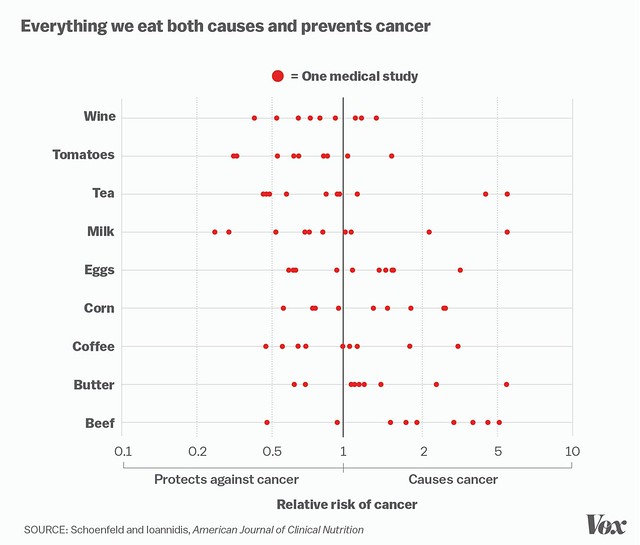
More often than not, single studies contradict one another — such as the research on foods that cause or prevent cancer. The truth can be found somewhere in the totality of the research, but we report on every study in isolation underneath flip-flopping headlines. (Red wine will add years to your life one week, and kill you quicker the next.)

This is seen in beer, a lot, too. But as the graph below makes clear, it happens everywhere, all the time, with the main culprit being the media in general, and the prohibitionists more specifically, reporting on single studies that show one thing rather then treating the issue as a whole or continuum of understanding. In particular, Alcohol Justice frequently takes one study that shows something in line with their agenda and treats it as if it’s the final answer and no further study is necessary; they’re right, case closed. Which, as you can see, is never the case.

Medical_studies-1

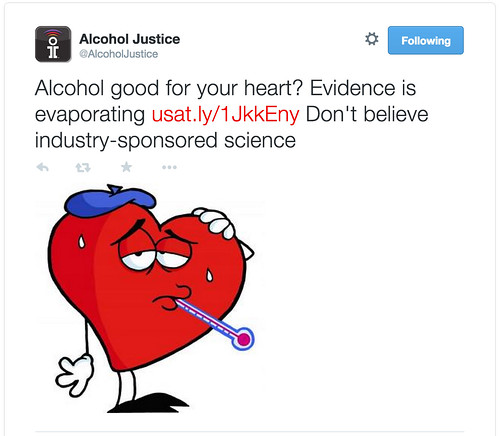
A good example of this is a recent tweet from Alcohol Justice, questioning that “Alcohol good for your heart? Evidence is evaporating http://usat.ly/1JkkEny Don’t believe industry-sponsored science.”

AJ-tweet-15-03-24

The link takes you to a USA Today story, entitled Alcohol good for your heart? Evidence is evaporating, which is where AJ got the witty language in the tweet. But the part about not believing “industry-sponsored science” is completely made up. The story never even addresses that as an issue. It’s pure propaganda. As you’ll see, the trail from the USA Today story leads not to “industry-sponsored science,” but to another anti-alcohol group.

The USA Today story itself is a hodgepodge of misinformation and innuendo, written in that most common style of the mainstream media that believes scaring people captures their attention and gets ratings, viewers or whatever metric they measure their success by. Early in the piece, the author sets out her premise.

But before you pour your next cocktail, beer or glass of wine, you should know this: the science suggesting a benefit has never been conclusive. And some experts believe the evidence is getting thinner all the time.

Almost no science is conclusive, or ever has been. That’s the point of continuously conducting research, to constantly learn more and to further our understanding of whatever’s being studied. But just as benefits may be inconclusive, the evils are similarly inconclusive. But she chose to frame the story in such a way as to emphasize the negative, despite the fact that the statement could be said almost any way and still be technically correct. And saying “some experts” reveals that not everyone agrees, even with so vague a premise. You can always find a person to disagree about anything, especially if they have some reason to do so.

To illustrate what I mean, take her reliance on an editorial written by “Mike Daube, professor of health policy at Curtin University in Australia.” He “writes that the once-touted benefits of moderate drinking ‘are now evaporating,'” providing the piece’s catch phrase and hook. But who is Mike Daube. Is he a doctor or scientist? Nope. Is he an impartial expert? Hardly, “Mike Daube, professor of health policy” is all that USA Today reports, and at the editorial she’s quoting from, the only author affiliation listed is “Curtin University, GPO Box U1987, WA 6845, Australia.”

But you don’t have to look too hard to find out that Mike is also co-chair of Australia’s National Alliance for Action on Alcohol, an organization who’s sole stated purpose is that is “has been formed with the goal of reducing alcohol-related harm.” So while he’s railing against “industry lobbying and promotion [being] rife and unchecked by governments, he’s pretending to be an impartial health professional, while also leading an organization who’s already convinced that alcohol has only a negative impact on society and is working to battle it, or get rid of it. That doesn’t seem particularly impartial to me. How utterly disingenuous and hypocritical. He’s using his background as a health policy professor to make it seem as if he has some expertise in medicine, but his area of study is public policy, with an emphasis on health, and you don’t need an advanced degree to understand those are two very different things.

And the editorial USA Today is relying on, Alcohol’s evaporating health benefits (they sure love a good turn of phrase, don’t they?), is published in The BMJ (formerly the British Medical Journal). So essentially a policy expert — who in 2012 was “awarded [the] ‘Oscar’ of public health campaigning — is editorializing about science and medicine in a medical journal. It’s an editorial — an opinion. No matter how authoritative, he should carry about as much weight on scientific matters as I do. We have exactly the same number of doctoral degrees in medicine.

Even so, while lambasting alcohol over a new British study which forms the basis for his “evidence is evaporating” quip, he has to admit that the study did show a positive correlation for “women aged 65 or more” but dismisses that as “at best modest and likely to be explained by selection bias.” Which may true, but then again maybe not. Perhaps more study is necessary before making such sweeping pronouncements as the “evidence is evaporating.” Which is entirely the point. He’s looking at one study in a vacuum and choosing the outcome he favors, because of his own bias. So that’s not, or should not, be newsworthy. “Hey guess what? What I believed all along is what I still believe, and here’s this one study that partially agrees with me, so I must be right after all. Can I be in your scientific journal?” Is this really what passes for peer-reviewed science? What a load of bollocks.

The USA Today article is actually very short, but is padded out with a list of “what U.S. experts say you need to know for now.” Unfortunately, that list is entirely about the negative aspects of alcohol consumption and completely ignores any positive contributions to a person’s health, and it’s not like they’re hard to find.

But one study said something different, so I guess all those others are wrong, right? Yet this is the approach prohibitionist groups take time and time again. And as the Vox article makes clear, this approach can result in creating false hopes and leading researchers, scientists and even public policy-makers down the wrong path. As journalist Julia Belluz admits, it’s hard for the press to not jump at new study results, because their novelty is catnip to the management structure of both old and new media. But as the media blinders are understandable and even forgivable, at least to some extent, that’s not the case for the anti-alcohol groups who take that news and use it unscrupulously to advance their agenda. They’re the ones doing actual harm, because they’re creating a false narrative that is dishonest and knowingly wrong. I think they’ve forgotten that advancing a particular point of view doesn’t mean destroying the other side by any means possible, especially since they so often claim to own the moral high ground. But if their “ends justify the means” strategy reveals anything, it’s that they don’t own a mirror. They only judge our morals, attacking us frequently and accusing us of caring only about business, money and hurting children.

The Vox article concludes with some sage advice from “Harvard’s Oreskes, Stanford’s John Ioannidis, and many other respected researchers,” who insist “we need to look past the newest science to where knowledge has accumulated. There, we’ll find insights that will help us have healthier lives and societies.” Could somebody please tell the prohibitionists?

Filed Under: Editorial, Just For Fun, News, Politics & Law, Related Pleasures Tagged With: Anti-Alcohol, Health & Beer, Prohibitionists, Science, Statistics

« Previous Page
Next Page »

Find Something

Northern California Breweries

Please consider purchasing my latest book, California Breweries North, available from Amazon, or ask for it at your local bookstore.

Recent Comments

  • Bob Paolino on Beer Birthday: Grant Johnston
  • Gambrinus on Historic Beer Birthday: A.J. Houghton
  • Ernie Dewing on Historic Beer Birthday: Charles William Bergner 
  • Steve 'Pudgy' De Rose on Historic Beer Birthday: Jacob Schmidt
  • Jay Brooks on Beer Birthday: Bill Owens

Recent Posts

  • Historic Beer Birthday: Carl W. Conrad April 1, 2026
  • Beer In Ads #5198: Heim’s Bock Beer! Ready To-Day April 1, 2026
  • Historic Beer Birthday: August Koch April 1, 2026
  • Historic Beer Birthday: Thomas Fowell Buxton April 1, 2026
  • Beer In Ads #5197: Bock Beer! On Tap After March 30 March 31, 2026

BBB Archives

Feedback

Head Quarter
This site is hosted and maintained by H25Q.dev. Any questions or comments for the webmaster can be directed here.