

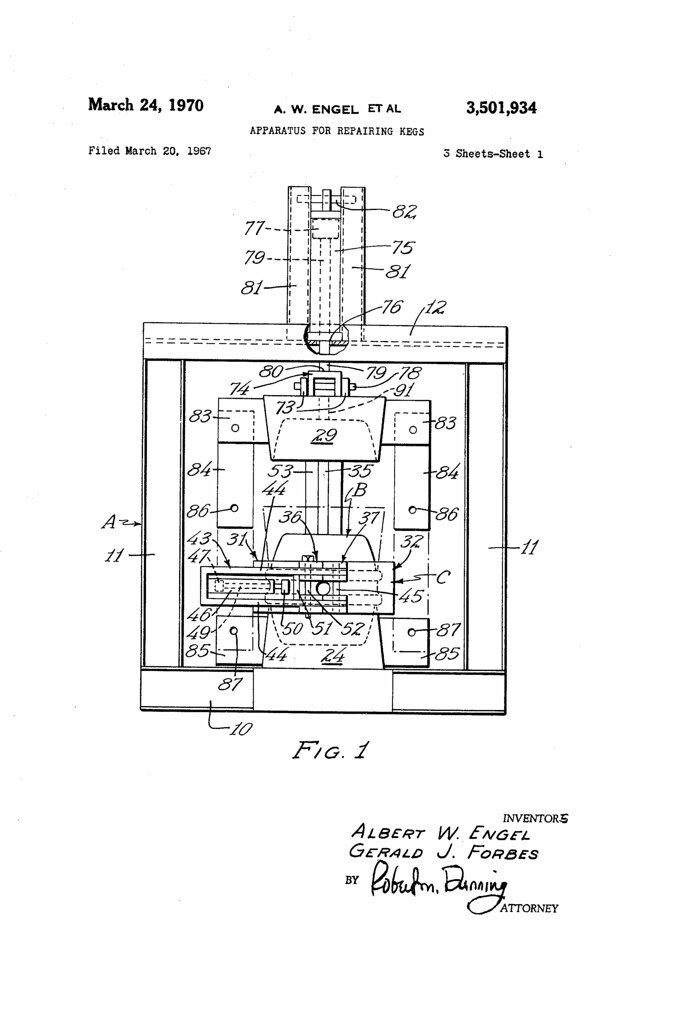
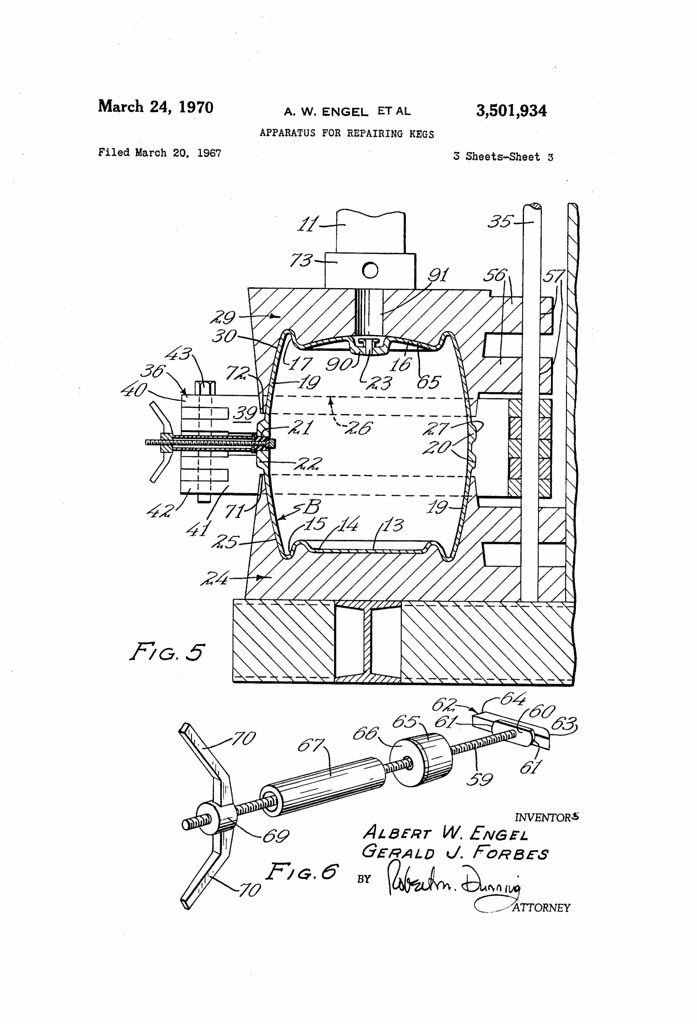
Today in 1970, US Patent 3501934 A was issued, an invention of Albert W. Engel and Gerald J. Forbes, for their “Apparatus For Repairing Kegs.” There’s no Abstract, but the description states that the invention relates to a “method and apparatus for repairing metal kegs, such as the aluminum kegs used for containing beer. The apparatus includes a die shaped to the outside form of the keg. The deformed externally projecting parts of the keg are pressed into an area defining original confines of the keg. In other words all external projections are forced inwardly by pressure. To return the keg to its original condition, the keg is filled with water, and an explosive is placed in the keg. The explosive is detonated to blow the keg back to its original form. The method comprises a hydraulic means of expanding kegs against a closed die to return the kegs to their original shape.”

Beer In Ads #1503: Teddy Roosevelt’s African Safari

Monday’s ad is for Schlitz, from 1935. Today in 1909, Theodore Roosevelt set sail for Africa for a year-long safari, shortly after leaving office as President. His party arrived in Mombasa, British East Africa (now part of Kenya) and added local guides so that their number were just over 250 people. The hunting party included “legendary hunter-tracker R. J. Cunninghame, scientists from the Smithsonian and, from time to time, Frederick Selous, the famous big game hunter and explorer.” During their time there, they collected 11,400 “specimans” for the Smithsonian Institution and for the American Museum of Natural History in New York. These ranged from local flora and fauna up to big game, including “17 lion, 3 leopard, 7 cheetah, 9 hyena, 11 elephant, 10 buffalo, 11 (now very rare) black rhino and 9 White rhino.” You can read more about his adventures in On Safari With Theodore Roosevelt and the Smithsonian–Roosevelt African Expedition.
But in the beer world, the thing that Teddy Roosevelt’s safari is most know for it this. “President Theodore Roosevelt took more than 500 gallons of beer with him on an African safari. Must have been thirsty work!” You see this all over the place, including in today’s ad, which features the tagline “Said T.R. ‘I Want It in Africa.'” And then the artwork, illustrated by Ralph Frederick, shows Roosevelt in Africa followed by men carrying cases of Schlitz beer. Unfortunately, it’s not true. Here’s one account:
Our 26th president loved his beer to the point of brining 500 gallons back from a safari in Africa. That isn’t actually true – it’s a myth. Reality is that Theodore Roosevelt did not drink beer, or much at all, except an occasional Mint Julep. However Teddy Roosevelt knew that beer was powerful, and while training the Rough Riders in Texas, he bought the men all the beer they could drink as a morale booster.
I’ve also read that it was Bass Ale that he took on the safari, but regardless of which beer, it doesn’t really matter which brand since it never happened in the first place. None of the historical accounts of the safari mention the beer which, given the large and heavy amount of beer, you’d expect to be part of the record of the trip. It’s not, as far as I can tell. But it’s a powerful, and persistent, story, and a good story beats the truth almost any day of the week.

Patent No. 3174650A: Bung Withdrawing Assembly
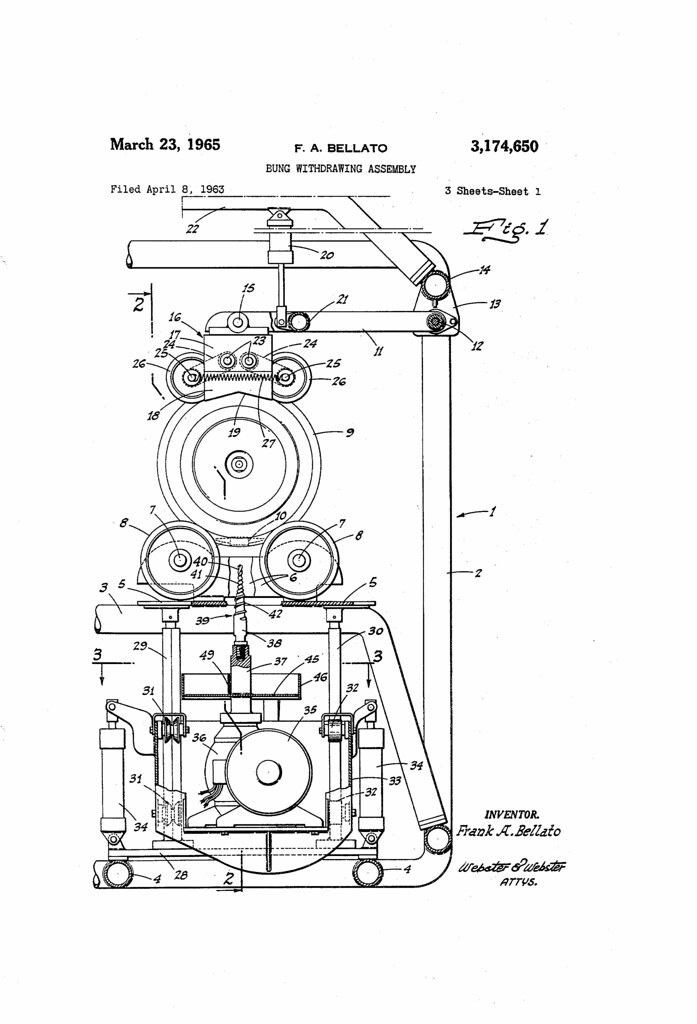
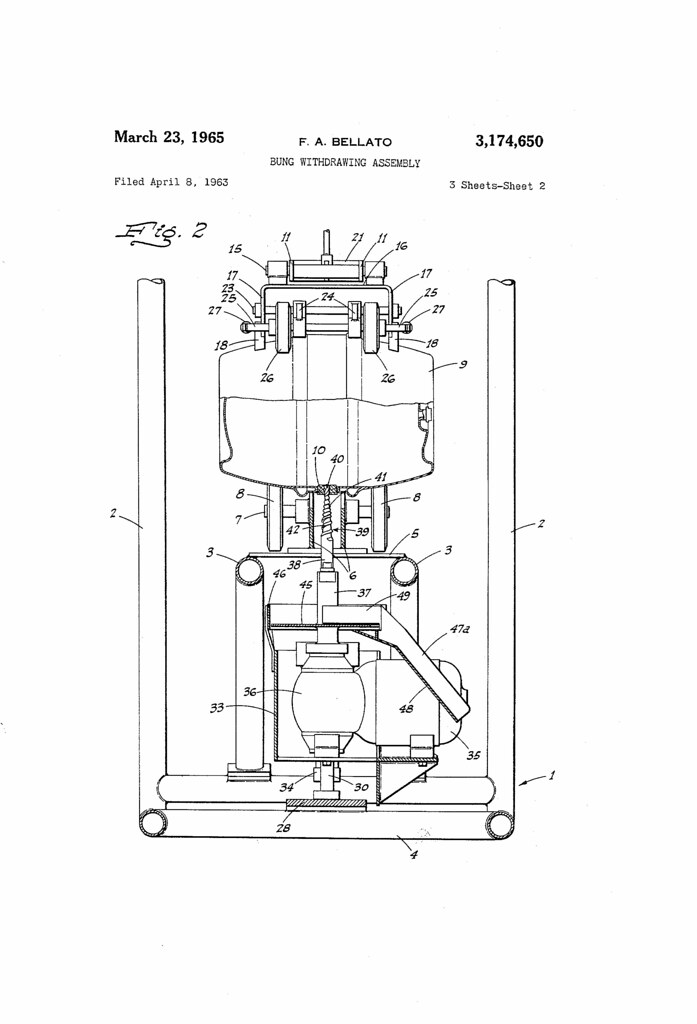
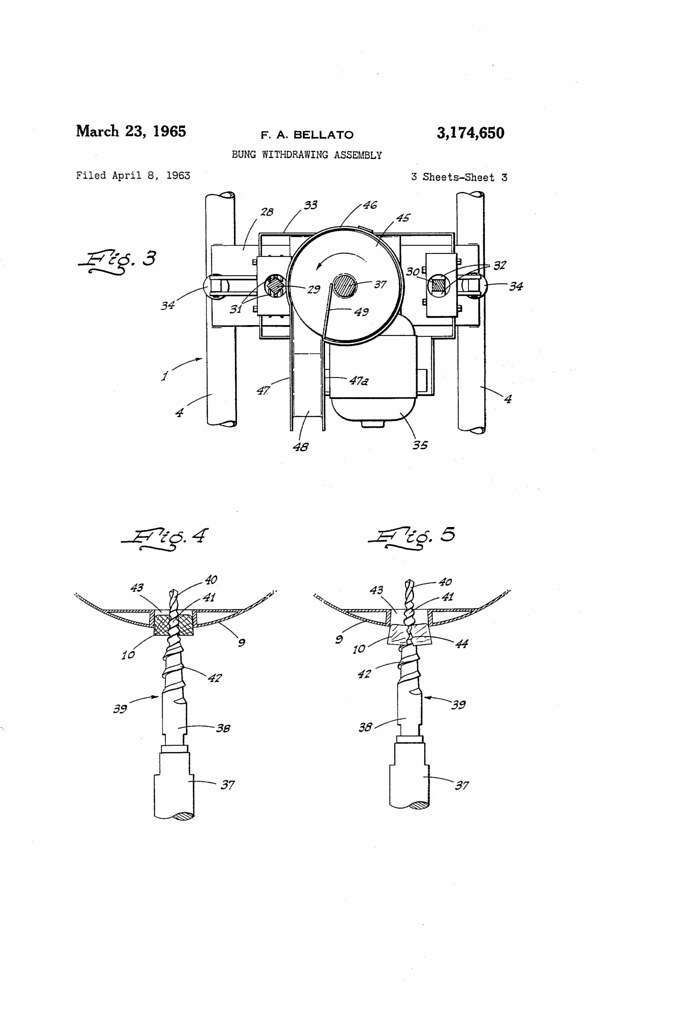
Today in 1965, US Patent 3174650 A was issued, an invention of Frank A. Bellato, for his “Bung Withdrawing Assembly.” There’s no Abstract, but the description states simply that the “invention relates to a device for removing the wooden bungs from beer kegs and similar containers after such kegs have been emptied of their contents.” Then the goals of their patent application are laid out:
A major object of the invention is to provide an auger, of special form for the purpose, having a pilot portion arranged so as to first penetrate the bung along a path axially of the bung without possible deviation from such path such as grain direction or irregularities in the wood of the bung might cause, and having a portion following the pilot portion arranged to then advance into the bung in a manner to cause the bung to be withdrawn from the bung hole and split into separate sections so that such sections will fall of themselves from the auger.
It is another and important object of the invention to provide a means for operatively mounting the auger, both for rotation and axial movement, in an upwardly facing position, and a means for supporting the keg above the auger in such a position that the bung, which as usual is in one side of the keg, will be disposed in a downwardly facing position directly in line with the auger.
The importance of having the bung disposed in an inverted position, with the auger disposed below the keg and bung, is that no chips or wood dust, as created by the action of the auger, can enter the keg but will drop down clear of the keg.
A further object of the invention is to provide a catch tray and carryotf chute in connection with and directly below the auger which will receive, and cause to be carried alway, all chips, withdrawn bung pieces, as well as any liquid residue dropping from the empty keg when the bung is withdrawn, and keep such waste matter from possibly fouling the auger supporting and operating mechanism.
The keg, when initially placed on the supporting means, may not always be disposed with the bung in the necessary downwardly facing position, and a still further object of the invention is to provide a keg support-ing means which enables the keg, after once being supported, to be easily rotated so as to dispose the bung in the proper position for engagement by the auger.
In connection with this latter feature, it is also an object of the invention to provide a clamping unit for engagement with the top of the keg, which will rst exert a yieldable hold-down action on the keg which still allows the keg to be rotated if necessary, and which will then clamp the keg against any movement. At the same time, the clamping means is mounted so that it can be readily moved clear of the keg so as to offer no interference with the placement of the keg on or removal of the same from the supporting means.
Beer In Ads #1502: Recipe For Corn
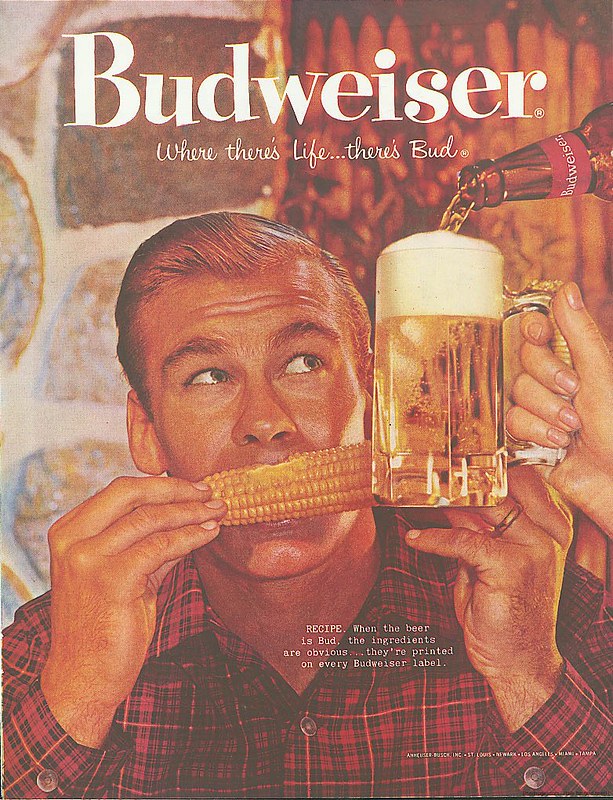
Sunday’s ad is for Budweiser, from 1960. It’s another ad from their “Where there’s life” series, this one a “Recipe.” By recipe, they’re talking about the ingredients of Bud, which they claim are “printed on every Budweiser label.” What’s funny about that is since at least the 1888 label, the list included rice as one of the ingredients, while the ad features a man chowing down on an ear of corn. Shouldn’t he be eating a bowl of rice?
Patent No. DE2145298A1: Instant Beer Powder
Today in 1973, US Patent DE 2145298 A1 was issued, an invention of Siegfried Beissner, for his “Instant Beer Powder — by vacuum-freeze drying.” Here’s the Abstract:
Beer is subjected to vacuum-freeze drying at -10 degrees to -20 degrees C, under a press. of about 0.5 atm. with agitation. Beer can be rapidly restored by treating the powder with water and a source of CO2 (pure CO2 or a mixt. of NAHCO3 and tartaric acid) and/or alcohol. The CO2-source and/or alcohol can be enclosed in capsules made from water-sol. gelatine and packed together with the beer powder.

Given that we’re seeing this type of product in the trade recently, and the anti-alcohol groups have been going apeshit, I would have thought this was a more recent invention. But a version of it was around at least as early as 1973, over forty years ago. I wonder why it took so long for it to make it to market?
Beer In Ads #1501: Fish Story
Saturday’s ad is for Budweiser, from 1961. It’s another ad from their “Where there’s life” series, this one a “Fish Story.” Or is it? They’re trying to say that since Bud puts its ingredients on the can, that they’re somehow more truthful than their competitors. I do love the cigarette in his beer hand. And lastly, I”m no fisherman, but that doesn’t like a fishing hat to me. It seems to fancy for fishing. Of course, I know as much about hats as I do fishing: almost nothing.

Patent No. 3310407A: Fermentation Processes For The Production Of Beer
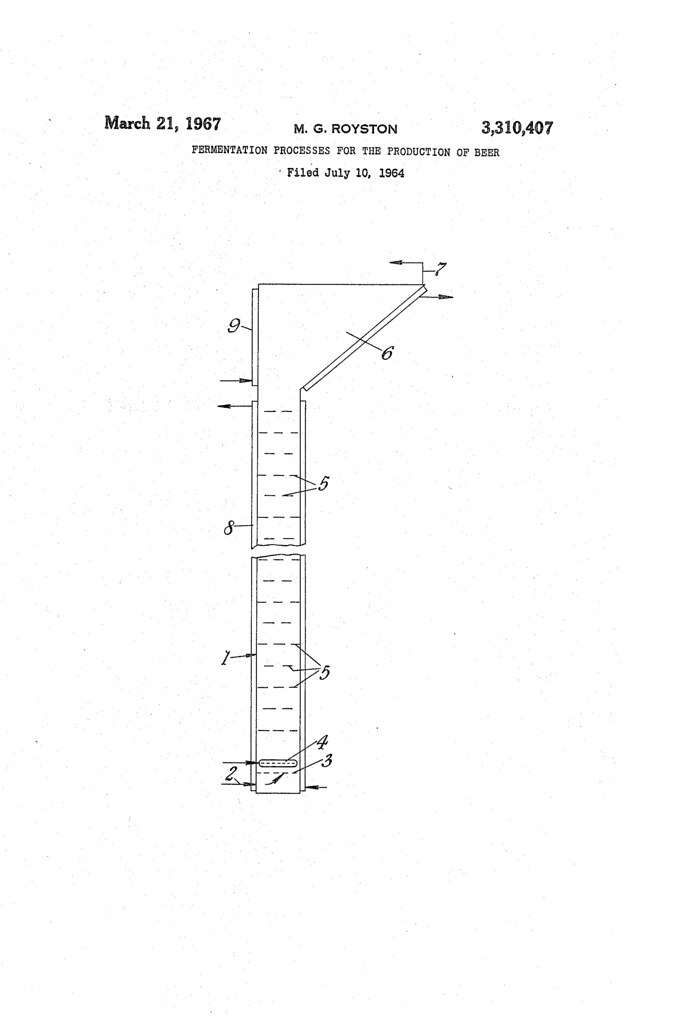
Today in 1967, US Patent 3310407 A was issued, an invention of Michael George Royston, for his “Fermentation Processes for the Production of Beer.” There’s no Abstract, and the application simply says that the “invention relates to the continuous production of beer.” It’s later summarized with this:
The invention concerns the stage at which hopped Wort including yeast, as is conventional, is allowed to ferment to produce beer as the final product. In this fermentation stage of production the rate of’conversion of the sugar in the wort is a function of the concentration of sugar and of the enzymic yeast cells in the wort.
Patent No. 3649993A: Apparatus For Opening The Flaps Of A Container And Removing Debris Therefrom
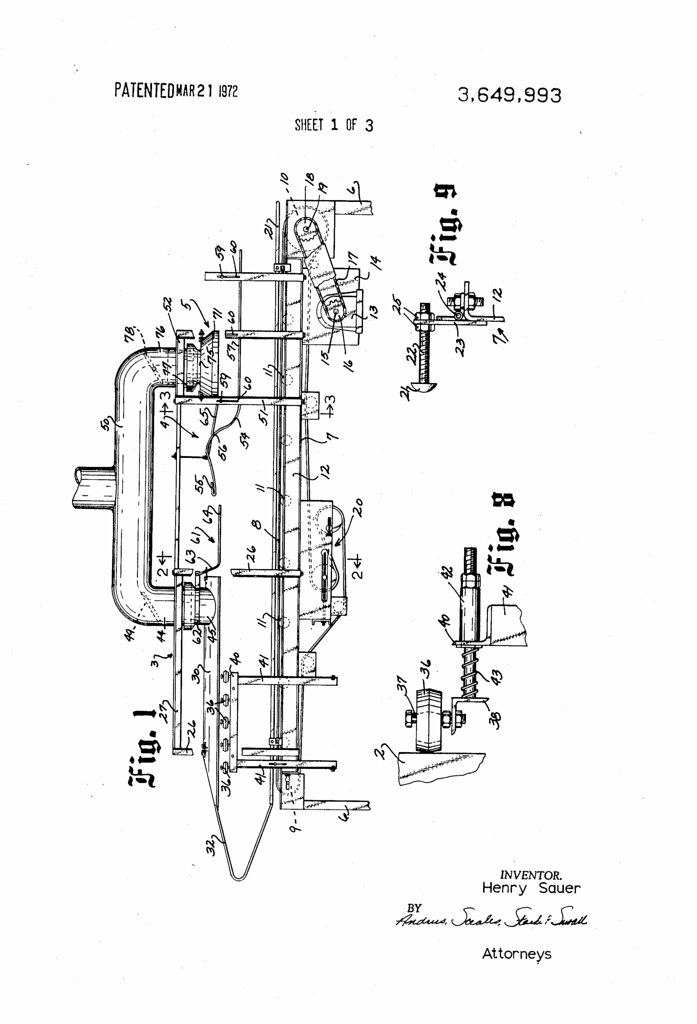
Today in 1972, just one year ago, US Patent 3649993 A was issued, an invention of Henry Sauer, assigned to Schlitz Brewing Co., for his “Apparatus For Opening The Flaps Of A Container And Removing Debris Therefrom.” Here’s the Abstract:
An apparatus for opening and spreading the top flaps of a carton containing packaged articles such as bottles, and for cleaning the carton after the flaps are opened. The carton containing the articles is moved along a conveyor and the sides of the carton are engaged by pressure members which deform the sides and pivot the flaps, if closed, to a partially open position. The carton then passes beneath a vacuum duct, which acts to raise the flaps. After the flaps have been raised, the carton moves into engagement with a spreader unit which spreads the flaps laterally outward. With the flaps in the spread position, the carton is then conveyed beneath a second vacuum duct which acts to draw lightweight debris from the carton.


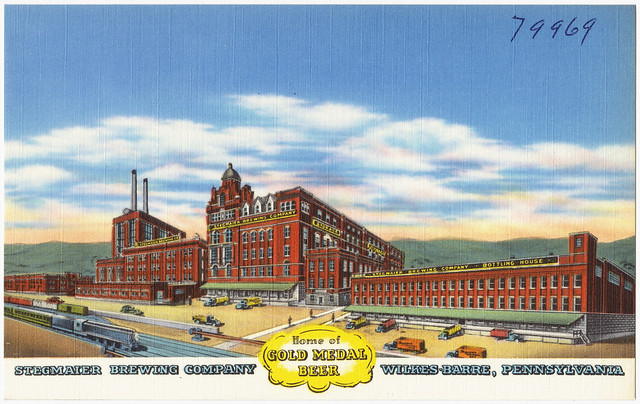
Beer In Ads #1500: Stegmaier Brewing Company, Home Of Gold Medal Beer
Friday’s ad is for the Stegmaier Brewing Company, the Home of Gold Medal Beer, from maybe the 1950s. It’s a postcard overview illustration of the brewery in Pennsylvania. I love these.
The Equinox: Day, Night & A Beer

Today, of course, is the Vernal Equinox, the first day of Spring for those of us on the northern side of the equator, and the beginning of Autumn for our southerly brethren. It’s also a day when we have roughly equal amounts of day and night.
People around the world have celebrated the equinox for millennia in an amazing array of ways. Back in the early days of Lagunitas Brewing, their celebration manifested itself, as you’d expect, in a beer they called Equinox. Launched originally in 1995, it quietly went away in the early 2000s, when they were working both day and night and it probably seemed like stopping to mark the middle of that made no sense. But this year, on the Equinox, they decided to bring back Lagunitas Equinox, though in a slightly altered package and recipe. It’s still a “pale oat ale,” but it’s a bit stronger now, at 8.4% abv (it was 6.4% before). It’s also again in 22 oz. bottles and kegs.
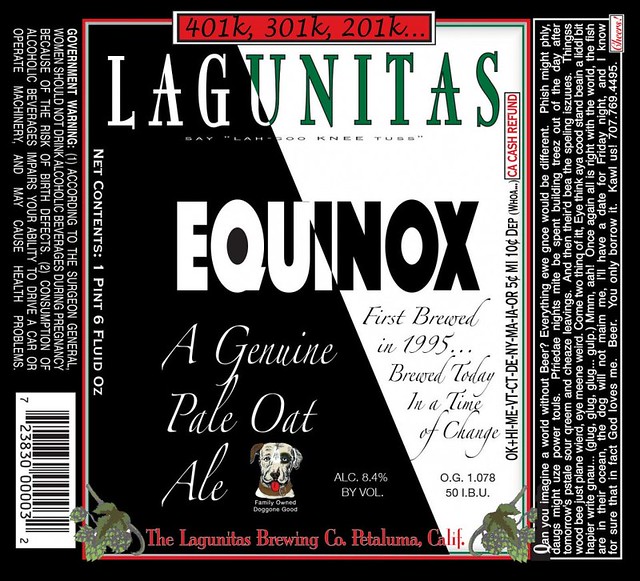
Lagunitas describes the beer as “a creamy, pale oat ale hopped up with a huge charge of Equinox and Simcoe hops for a piney, eucalyptusy, cedary, sprucey, foresty blast.” And Tony’s label notes make for some challenging reading.
Qan you imagine a world without Beer? Everything ewe gnoe would be different. Phish might phly, aaugs might uze power touls. Pfriedae nights mite be spent building treez out of the day after tomorrow’s pstale sour greem and cheaze leavings. And then theirft bea the speling iszuues. Thingss wood bee just plane wierd, eye meene weird. Come two thing of Itt, Eye think aya cool stand begin a kid bit hapier write gnaw… (glug, glug, glug… gulp.) Mmm, aaht Once again all Is right with the world, the fish are in their ocean, the dog will not maim me, I’ll have a date for Friday night, and I know for sure that in fact God loves me. Beer. You only borrow it. Kawl us!
They also created a pretty trippy one-minute video showing a split-screen journey of the beer during both day and night simultaneously.