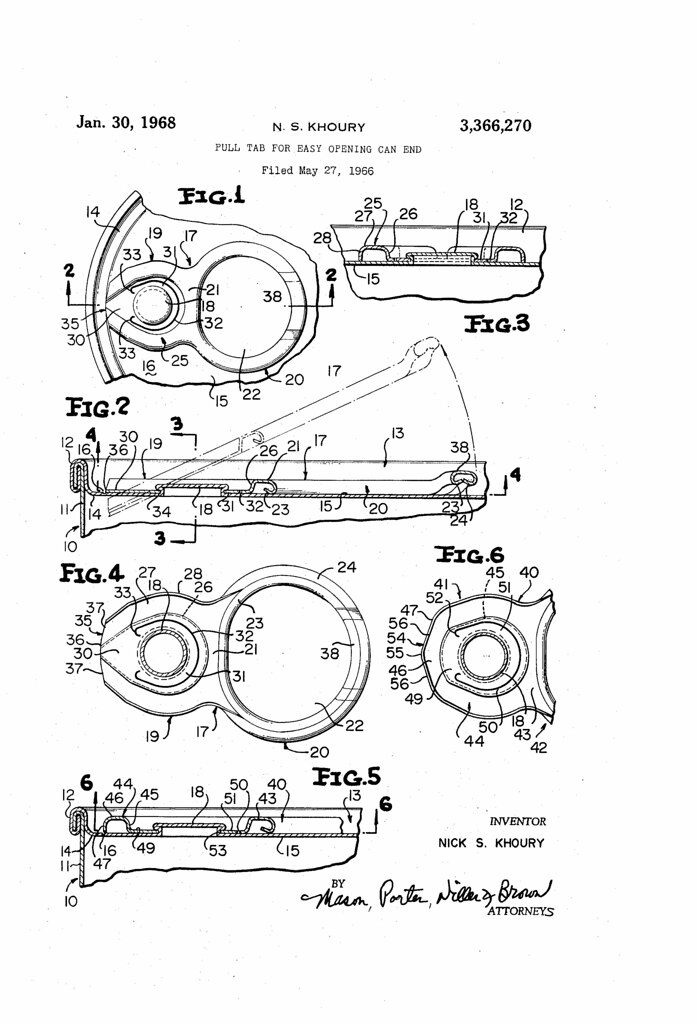
Today in 1968, US Patent 3366270 A was issued, an invention of Nick S. Khoury, assigned to Continental Can Co., for his “Pull Tab for Easy Opening Can End.” There’s no Abstract, but the description states that the “invention relates to a pull tab wherein in the initial rupture of the container panel, an inward pressure is exerted utilizing the pull tab with the pull tab functioning as a simple first-class lever.”
Super Bowl Advertising Through The Years

The Wall Street Journal, in their Life & Culture section, took a look at the commercials during the big game next week in Super Bowl Ads Turn Serious.
The 100 million-plus viewers expected Sunday will see a host of emotion-rich commercials that tug on the heartstrings or take on problems. Coca-Cola ’s spot will shed light on the rash of Internet bullying while the National Football League will air a public-service announcement aimed at ending domestic violence. Procter & Gamble will re-air an ad for its feminine-care brand Always that tries to fight gender stereotypes and remove the stigma associated with the phrase “like a girl.”
The article also talks about what’s at stake, with a chance to reach the largest audience for a TV event, which last year was viewed by 111.5 million, compared to number 2, which is the Academy Awards broadcast, which in 2014 had 43 million viewers. As a result, “[t]he Super Bowl also commands the highest ad rates. This year, 30 seconds of time costs roughly $4.5 million.”
The article then goes in to give a short synopsis of each major company’s plans. ABI is, of course, the only beer company advertising again this year, and here’s their plans:
Budweiser
Last year’s Super Bowl stars—the Clydesdale horses and an irresistible puppy—are looking to repeat. This year, the Clydesdales come to the rescue of the puppy. Stepping in at the last minute, they save him from a hungry wolf and bring him home safely. The twist: The spot adds extra emotion by using a reworked version of “I’m Gonna Be (500 Miles)” by the Proclaimers performed by Sleeping At Last. Is it enough to outdo last year’s spot that had “Let Her Go” by Passenger as its soundtrack?
Perhaps more interesting, the article also includes an interactive Super Bowl Ad-Spending Tracker, which breaks down the history of Super Bowl commercials by industry and even by company over the past fifteen years. For example, here’s the spending trends from the beverage industry, which included non-alcoholic as well as alcohol.
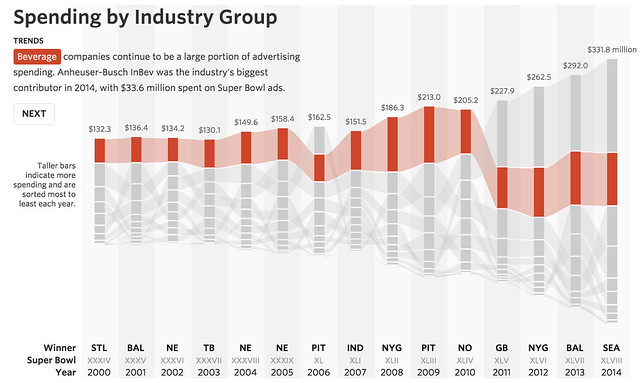
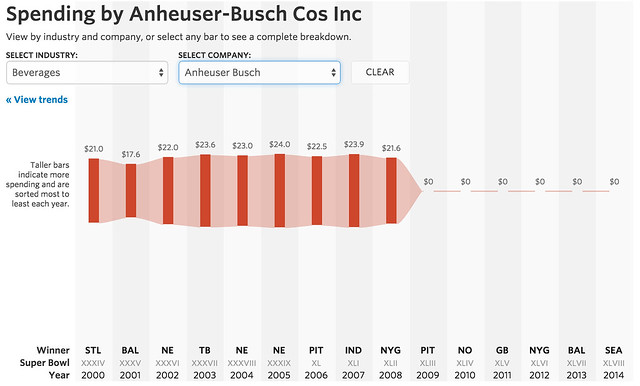
Then here’s Anheuser-Busch from 2000 through 2008, the year they were acquired by InBev and became Anheuser-Busch InBev.
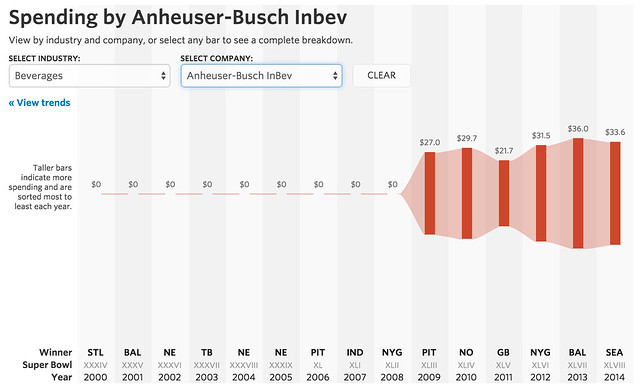
Then ABI spent at least as much, and usually more, in the subsequent years.
Then just for fun here’s the lone ad from the Beer Institute in 2006, which if I’m not mistaken was for Anheuser-Busch’s failed attempt at rallying the industry behind its “Here’s to Beer” educational website.
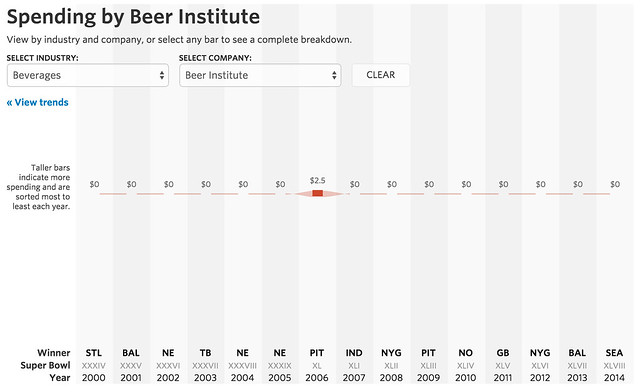
Here’s the Beer Institute ad that ran during the Super Bowl in 2006.
Patent No. 642460A: Apparatus For Producing Wort, Hop-Beer, Washing Filter-Pulp, &c.
Today in 1900, US Patent 642460 A was issued, an invention of Emil Kersten, for his “Apparatus for Producing Wort, Hop-Beer, Washing Filter-Pulp, &c.” There’s no Abstract, but the description states the “object of the invention is to provide a new and improved apparatus for use in breweries for washing and sterilizing the pulp used in filtering or for mashing and hopping purposes, to agitate and leach the pulverized or ground malt with water for producing wort, and to treat the wort with the hops in such a manner as to produce an unfermented liquor of a high quality and in such a state as to facilitate the fermenting process.”

Beer In Ads #1450: The Chief Of All

Thursday’s ad is for Budweiser, from 1910. This is an old ad, when clearly sensitivities were different. But check out the questionable ad copy, which few probably even thought twice about over 100 years ago. “Just as the American Indian chose his chieftain for deeds of valor in war, and wisdom in times of peace,
So has Budweiser, because of its Quality and Purity, been chosen by the American of today the Chief of all bottled beers.” It’s also interesting that a selling point was that was bottled only in St. Louis.

Cardboard Beer Bottles?

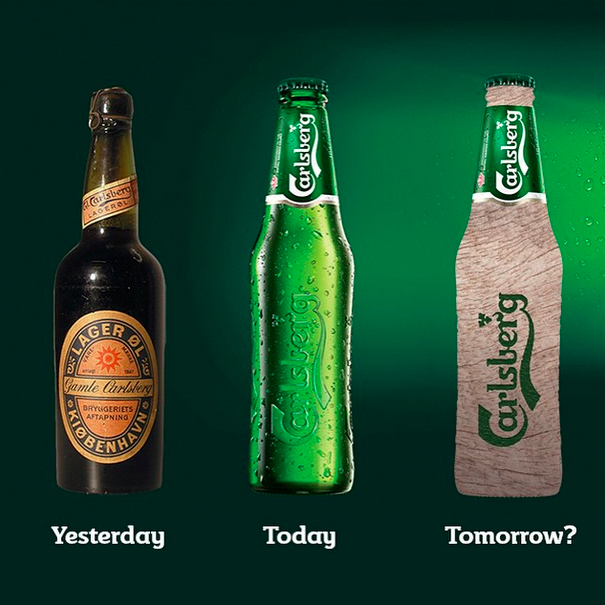
Well here’s a strange one. The Drinks Business is reporting that Carlsberg has created a new bottle made of “sustainably sourced wood-fiber” and “all materials used in the bottle, including the cap, will be developed using bio-based and biodegradable materials.” Known as the “Green Fiber Bottle,” it was announced at the World Economic Forum in Davos, Switzerland, “as part of a three-year project with packaging company ecoXpac, and in partnership with Innovation Fund Denmark and the Technical University of Denmark.”
From the Drinks Business article:
Andraea Dawson-Shepherd, senior vice president for corporate affairs, said: “At Carlsberg we are firm believers in the importance of a circular economy in ensuring sustainable future growth and development on our planet, and today’s announcement is excellent news. If the project comes to fruition, as we think it will, it will mark a sea-change in our options for packaging liquids, and will be another important step on our journey towards a circular, zero-waste economy.”
The article notes that “Carlsberg’s bottles are planned to be produced in one piece using an inner coating that will decompose naturally.” I can’t but help thinking this has about as much chance of catching on as the plastic bottle, something Carlsberg, along with several other larger beer companies, dabbled with over the last decade.
Patent No. 3788538A: Beer Carton
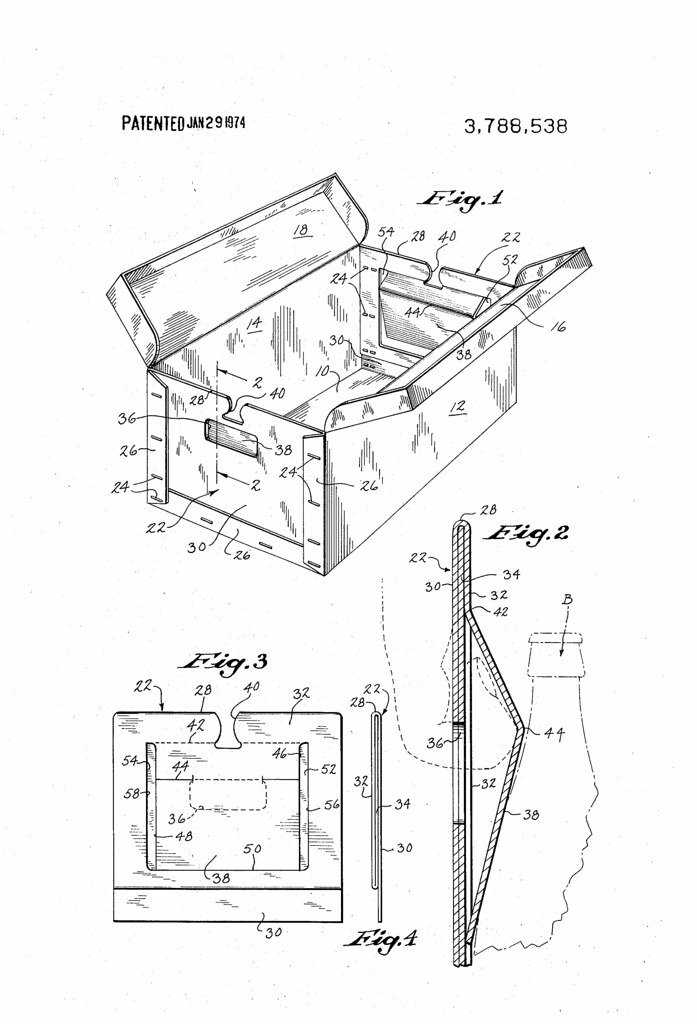
Today in 1974, US Patent 3788538 A was issued, an invention of William A. Kuenzi, assigned to Miller Brewing, for his “Beer Carton.” Here’s the Abstract:
The entry of light into the interior of a beer carton through the handholes thereof is prevented by flaps, one of which is hingedly attached to the inner surface of each end panel above the upper margin of the handhole. The flaps are preferably wider than the handholes, extend downwardly below the lower margin of the handholes, and have a free lower edge. The flaps are preferably deflectable inwardly along a fold line opposite the upper margin of the handholes to permit entry of fingers around the upper margin of the handhole and between the inner surface of the end panel and the adjacent surface of the flap. Each end wall panel is preferably made of triple-folded material with the flap being cut out of the inside face of the material and the handhole being cut through the other two thicknesses.
Beer In Ads #1449: The Full-Taste Beer
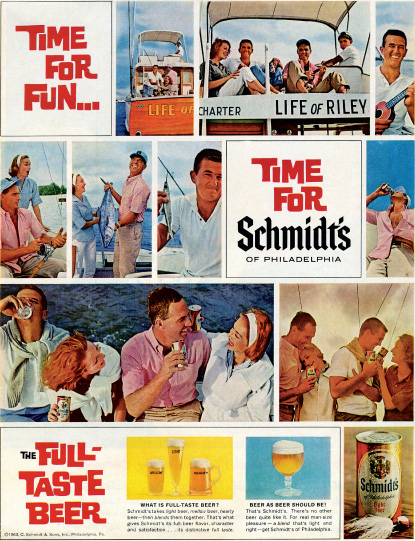
Wednesday’s ad is for Schmidt’s, from 1963. “Time for Fun … Time for Schmidt’s The Full-Taste Beer.” It certainly does look like they’re having a lot of fun, fishing aboard the “Life of Riley” charter boat. But what exactly is “full-taste beer?” As opposed to what? Half-taste beer?
Patent No. 692170A: Apparatus For Aerating Wort And Improving The Quality Of Yeast
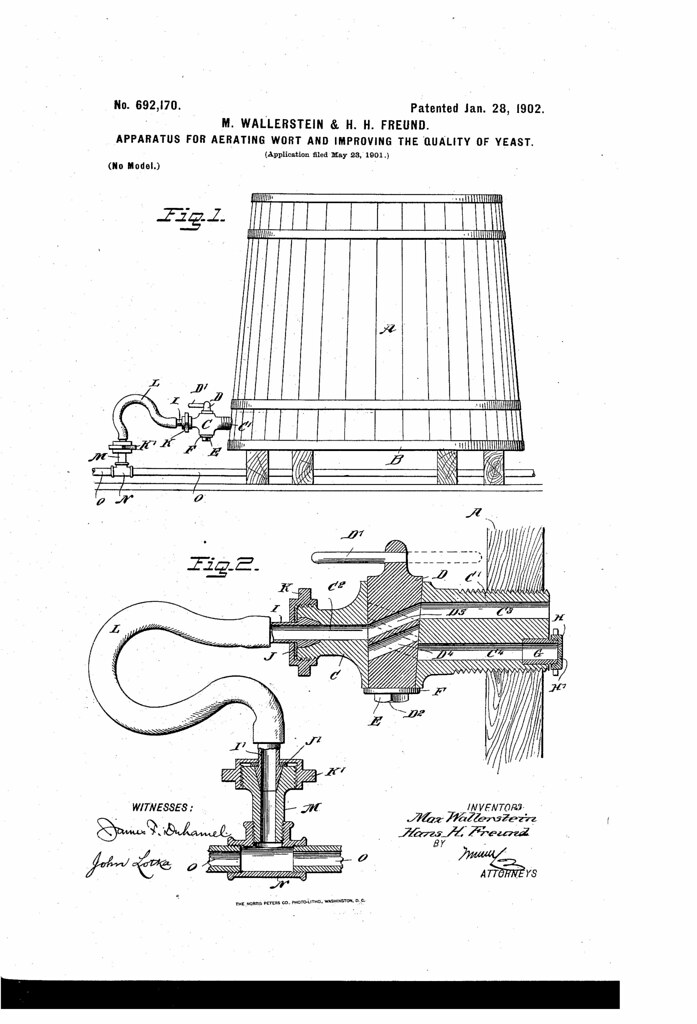
Today in 1902, US Patent 692170 A was issued, an invention of Max Wallerstein and Hans H. Freund, for their “Apparatus for Aerating Wort and Improving the Quality of Yeast.” There’s no Abstract, but this is from the description.
Our invention relates to apparatus for aerating Wort during fermentation and improving the quality of yeast, and has for its object to provide an apparatus of this class by the use of which wort is aerated with filtered air in any desired quantity during fermentation and yeast of healthy growth and great purity is obtained.
The Ultimate Beer Glass Guide
Okay, the title may be more hyperbole than actual fact, but it’s a decent starter of common beer glassware. Some of the information seems overly generalized, as well, but it provides a decent explanation of each beer glass type. It was created by a hangover cure marketed in Australia called Revivol to promote their product.

Click here to see the original infographic full size.
Patent No. 2229875A: The Art Of Wort Cooling
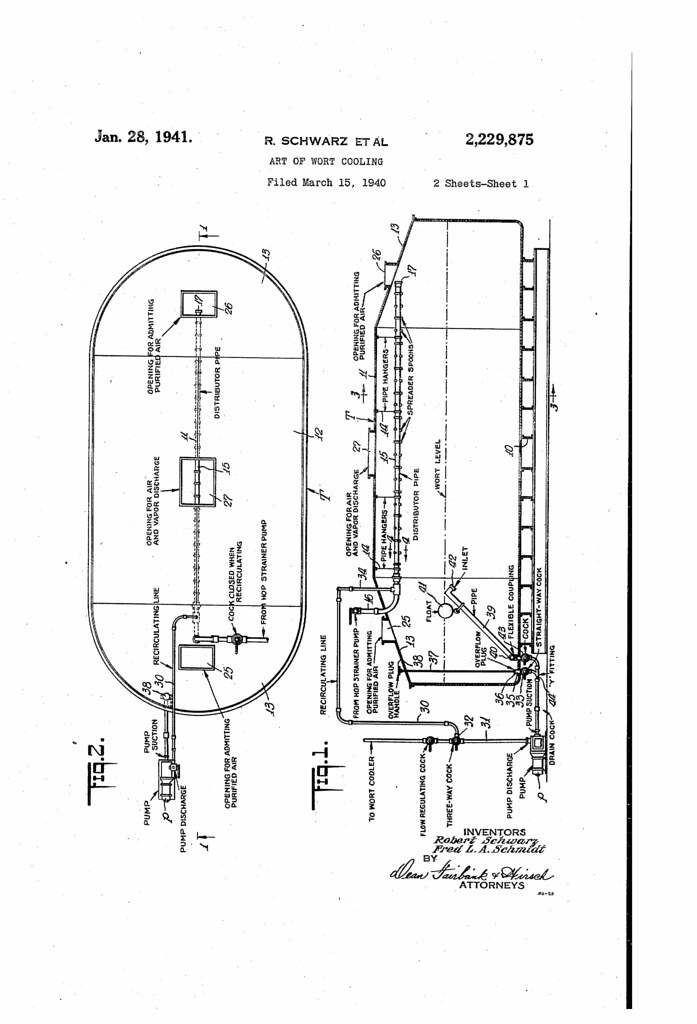
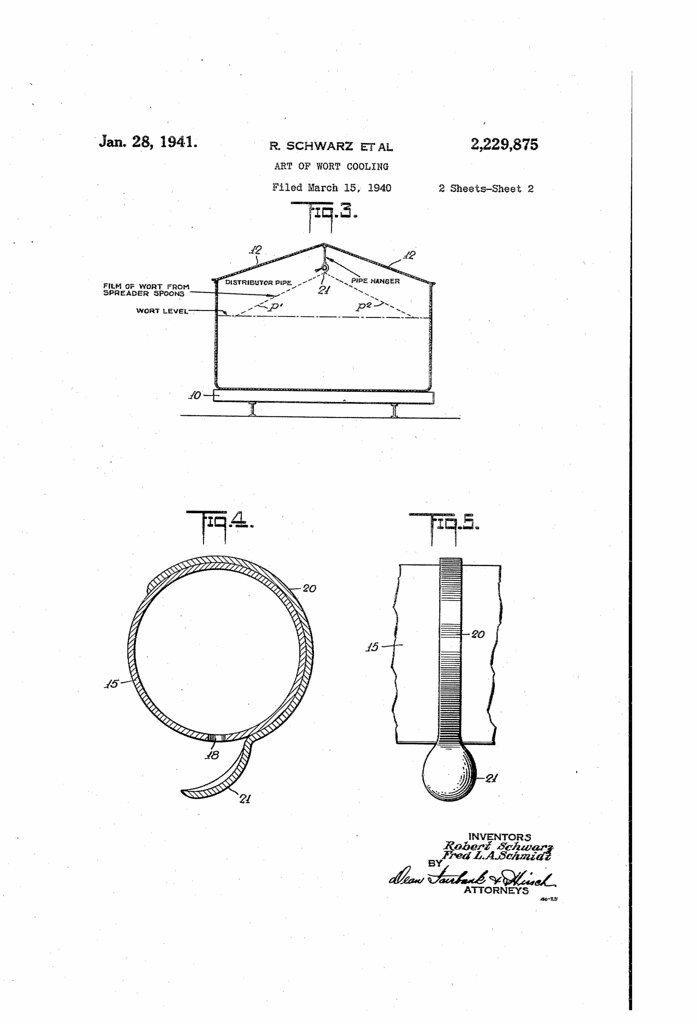
Today in 1941, US Patent 2229875 A was issued, an invention of Robert Schwarz and Fred L.A. Schmidt, for their “Art of Wort Cooling.” There’s no Abstract, but here’s the general idea.
Generally speaking, the invention involves cooling the wort by evaporation in a cycle which includes the passage of clean, filtered air or air 2o rendered germ-free by other methods, along or across the path of a flat expanded stream in which the wort is introduced into a closed chamber. Where the cooling after such operation is inadequate, the wort or some of it is pumped in go one or more repetitions of said cycle until the desired cooling has been effected.