Brookston Beer Bulletin

Jay R. Brooks on Beer

  • Home
  • About
  • Editorial
  • Birthdays
  • Art & Beer

Socialize

  • Dribbble
  • Email
  • Facebook
  • Flickr
  • GitHub
  • Instagram
  • LinkedIn
  • Pinterest
  • RSS
  • Twitter
  • YouTube

Powered by Genesis

Patent No. 20120000367A1: Brewery Facility For Producing And Bottling Beer

January 5, 2015 By Jay Brooks

patent-logo
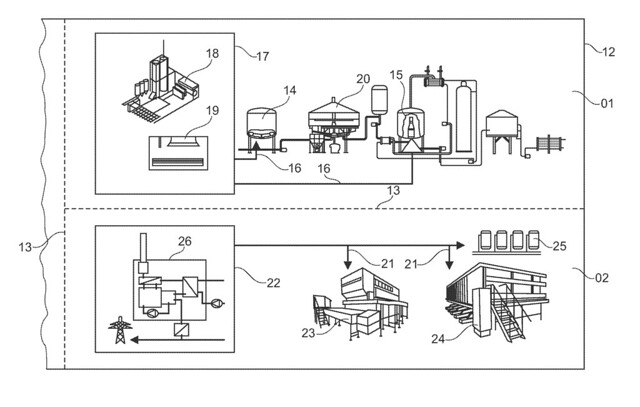
Today in 2012, just three years ago, US Patent 20120000367 A1 was issued, an invention of Rudolf Michel and Ludwig Scheller, for a “Brewery Facility for Producing and Bottling Beer.” Here’s the Abstract:

The invention relates to a brewery plant (12) for producing and bottling beer, comprising a brewhouse facility (01) in which wort is produced from raw materials while employing process energy, and further comprising a bottling facility (02) in which beer produced from the wort is filled into packaging containers, in particular bottles, while employing process energy, wherein in order to supply the brewhouse facility (01) with process energy a first energy supply network (16) is provided, into which process heat having a first temperature level is fed from at least one first energy generation facility (17) and is distributed by a heat transfer means to different energy consumers (14, 15) in the brewhouse facility (01), and wherein in order to supply the bottling facility (02) with process energy a second energy supply network (21) is provided, into which process heat having a second temperature level is fed from at least one second energy generation facility (22) and is distributed by a heat transfer means to different energy consumers (23, 24, 25) in the bottling facility (02), wherein the maximum temperature of the heat transfer means in the first energy supply network is above the maximum temperature of the heat transfer means in the second energy supply network.
US20120000367A1-20120105-D00000

If you love this sort of thing, there’s much more about the specifics at the patent application page.


Filed Under: Breweries, Just For Fun, Related Pleasures Tagged With: Patent, Science of Brewing

Beer In Ads #1425: For You Armchair Quarterbacks

January 4, 2015 By Jay Brooks


Sunday’s ad is for Pabst Blue Ribbon, from 1947. Featuring singer and comedian Eddie Cantor dressed up in a football uniform, watching the game on to modern eyes is a very tiny television screen. There’s also a small table holding a bottle and a glass of beer. The tagline, “For You Armchair Quarterbacks,” forever linked drinking beer while watching football on TV.

Pabst-1947-QB

Filed Under: Art & Beer, Beers Tagged With: Advertising, Football, History, Pabst, Sports

Patent No. 1166599A: Mash And Strainer Tank Machine

January 4, 2015 By Jay Brooks

patent-logo
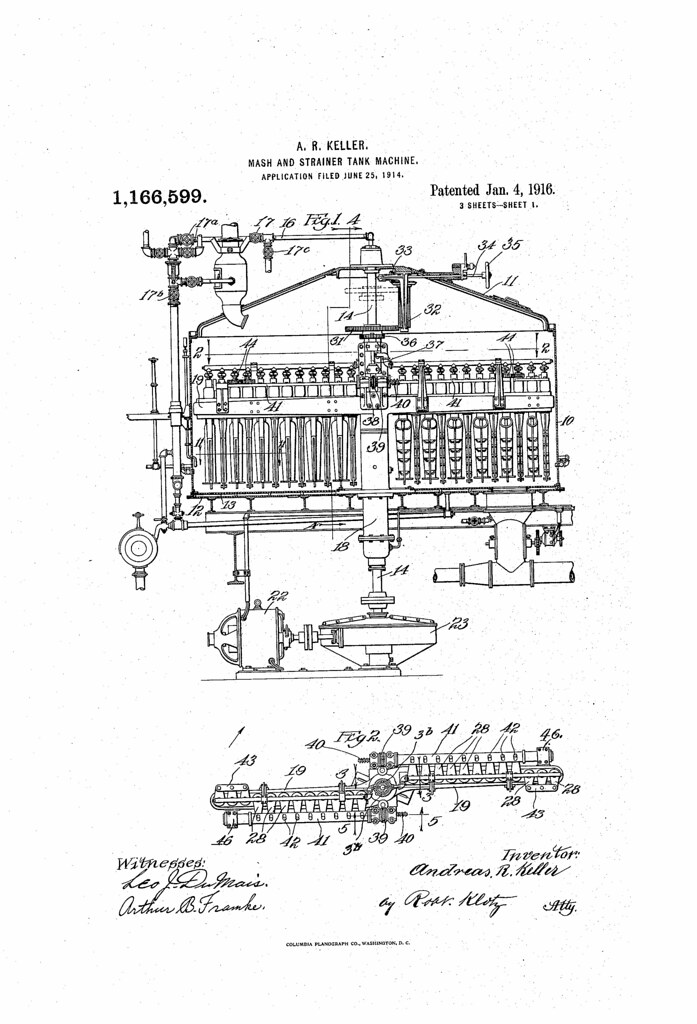
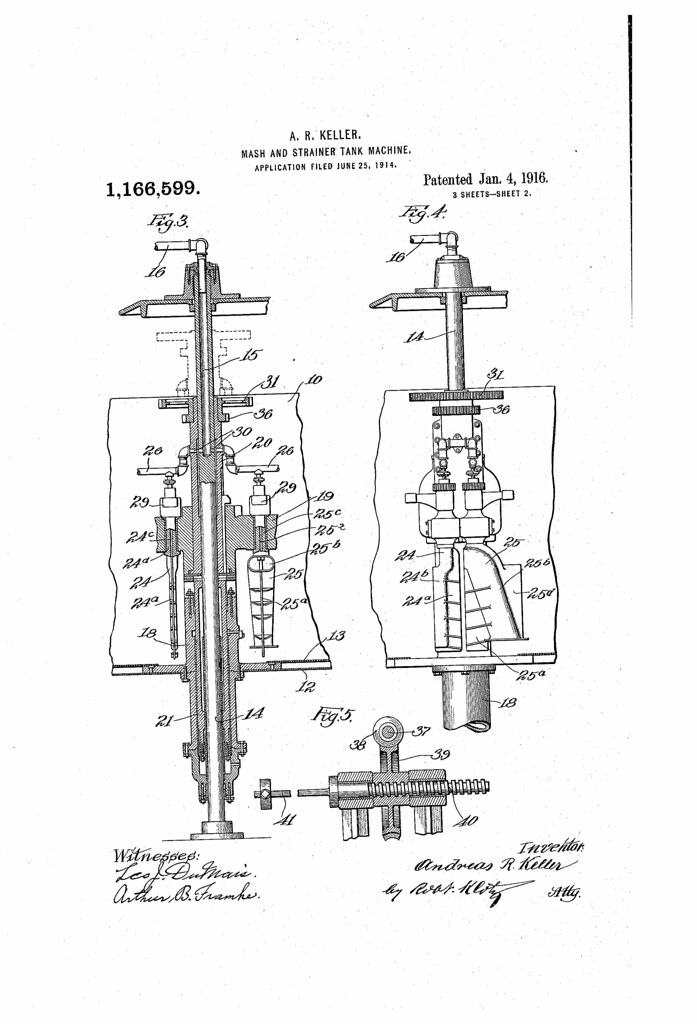
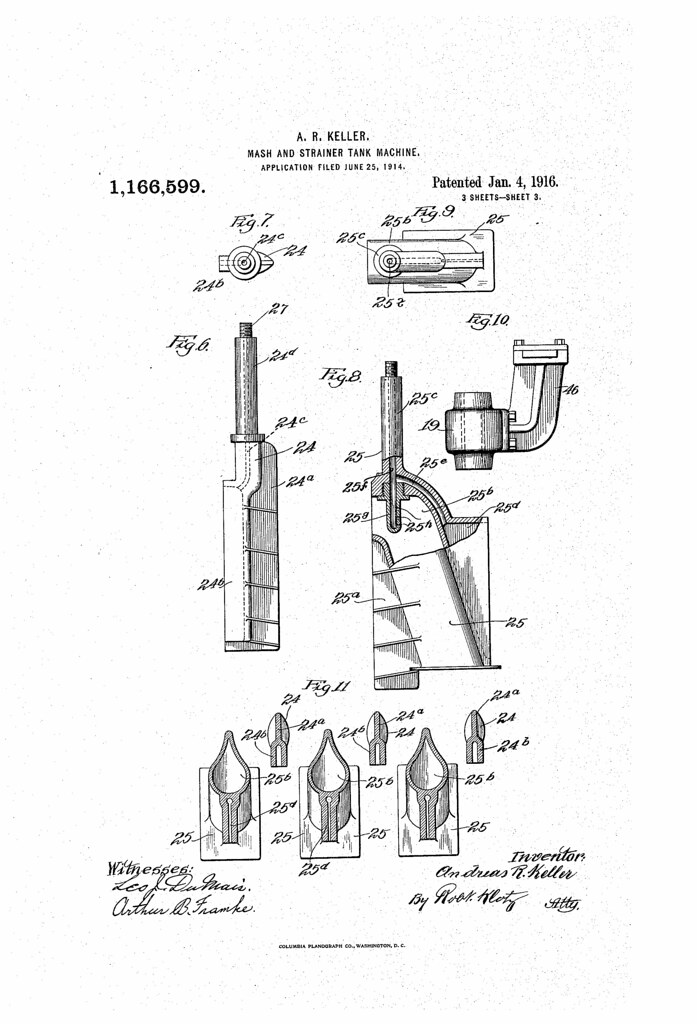
Today in 1916, US Patent 1166599 A was issued, an invention of Andreas R Keller, for a “Mash and Strainer Tank Machine.” There’s no Abstract, but in the description, the overview states the “invention relates to new and useful improvements in mash and .strainer tank machines, and is designed to increase the efficiency of such machines by improving the mixing, percolation, heating or cooking, straining, and drawing-off features, thereby overcoming the predominant and objectionable disadvantages of the machines now in use.”
US1166599-0
US1166599-1
US1166599-2

Filed Under: Breweries, Just For Fun, Politics & Law, Related Pleasures Tagged With: Brewing Equipment, Patent, Science of Brewing

Patent No. 5275015A: Container-Cooler

January 4, 2015 By Jay Brooks

patent-logo
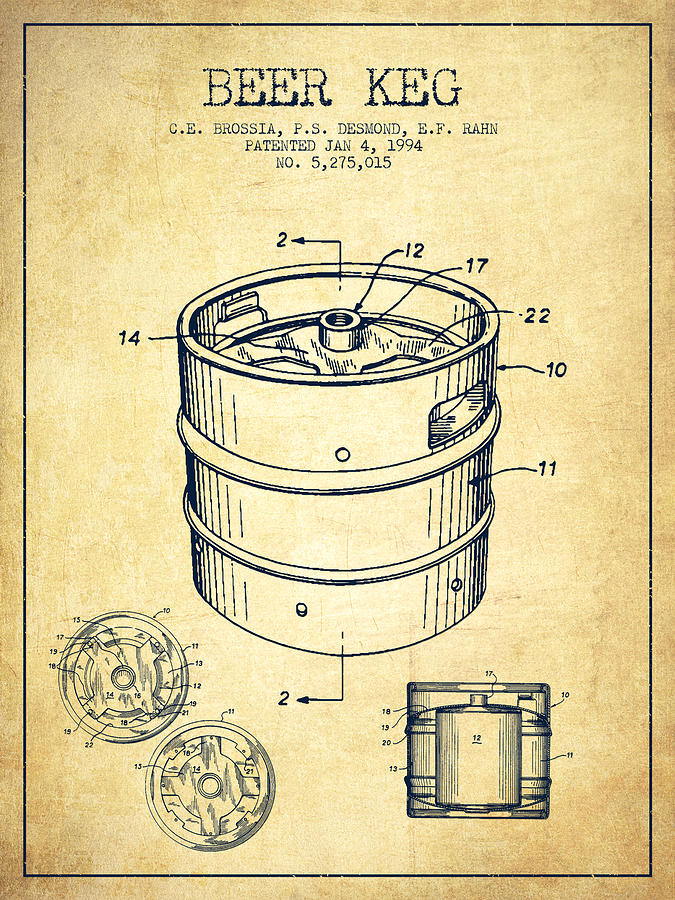
Today in 1994, US Patent 5275015 A was issued, assigned to Miller Brewing, for a “container-cooler for a beverage, such as beer, includes a conventional keg-shaped outer shell, an inner vessel for containing the beverage retained within the shell, and a space between the inner vessel and the outer shell for receiving a cooling medium, such as ice.”

beer-keg-patent-drawing-vintage-aged-pixel

Filed Under: Beers, Related Pleasures Tagged With: Patent

Beer In Ads #1424: Satisfaction Is What You Really Want In Beer!

January 3, 2015 By Jay Brooks


Saturday’s ad is for Schlitz, from 1954. One of several ads from Schlitz that same year all with a yellow background and red line drawing. In this one, the foreground features a high-class bartender in a white jacket handing you a glass of Schlitz. He’s also offering up this pearl of wisdom. “Satisfaction is what you really want in beer!” I’m not quite sure exactly what that means, but it sounds like good copy.

Schlitz-1954-bartender

Filed Under: Art & Beer, Beers Tagged With: Advertising, History, Schlitz

Beer Giants Still Giant

January 3, 2015 By Jay Brooks

wall-street-journal
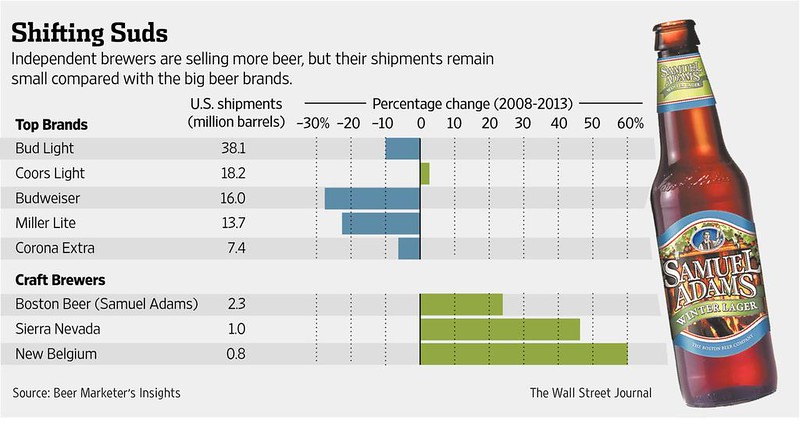
The Wall Street Journal had a piece on the beer business entitled Beer Giants Cultivate Their Crafty Side which I can’t read in its entirety because I don’t have a subscription, but it did include a chart showing the current state of affairs in the beer industry.

shifting-suds

Shifting Suds. “Independent brewers are selling more beer,” but given this comes from the Wall Street Journal (which is all about BIG business) they can’t help but add “but their shipments remain small compared with the big beer brands.”

What the Wall Street Journal forgets to mention is that Anheuser-Busch was founded in 1852 and didn’t hit 1 million annual barrels until 1901, when they were 49 years old. Sierra Nevada took only 35 years (or less) to reach 1 million, and Boston Beer needed even less time, reaching their first million barrels 1996, meaning it took Samuel Adams 12 years.

Filed Under: Breweries, News Tagged With: Big Brewers, Business, Mainstream Coverage, Statistics

Don’t Bet Dollars To Donuts Or Drinking

January 3, 2015 By Jay Brooks

doughnut
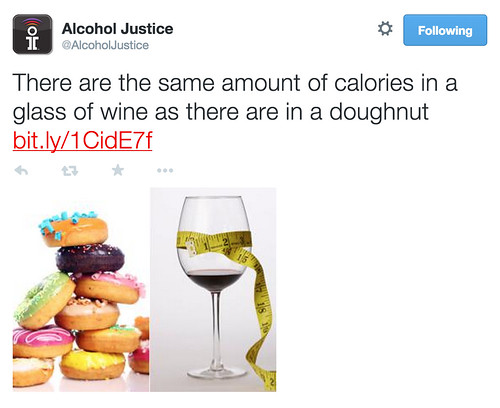
I think we can all agree that doughnuts are high in calories. I suspect few people would try to defend them as being a health food. Alcohol, on the other hand, is trickier. There are clear health benefits and, for some, health risks, too. But in order to paint alcohol as something worse than it is, prohibitionist groups feel no need to be truthful or avoid being misleading. To wit, today Alcohol Justice tweeted that “[t]here are the same amount of calories in a glass of wine as there are in a doughnut.”

AJ-tweet-15-01-03

To ad insult to injury, the image they used to hammer home their point depicts not one doughnut, as the text is singular, but a pile of them, in fact eleven doughnuts are visible, though some just partially. And look at that glass of wine. Does that look like the standard 5 ounces? It sure doesn’t to me. That looks like a short pour, all in effort to deceive and mislead, as if just a tiny amount of wine is equal to nearly a dozen doughnuts.

donut-wine

The truth, of course, is different. A standard glass of red wine — 5 ounces — is around 125 calories, while a doughnut is 195 calories. That’s from doing a simple Google search for calories in a glass of red wine and calories in a doughnut. Not surprisingly, calories in doughnuts vary widely, and according to a list on Calorie Lab can range from around 100 to nearly 400, and apparently Krispy Kreme doughnuts are even higher, ranging from 200 to 400.

Alcohol Justice included a link with their tweet to a story at Redbrick, a student publication from the University of Birmingham in England. That’s also where they snagged the photo of the glass of wine. Who knows where the pile of doughnuts came from.

The article AJ is using for their own purposes, Should Alcohol Show Calories?, has its own share of inconsistencies, not that they’d matter to Alcohol Justice. Redbrick states that a “large glass of wine is about 200 calories, which is the same as a doughnut” but then, of course, it links to a British drinks calculator showing that a standard glass of wine is 175 ml, or less than 6 ounces. So to make their analogy of a doughnut and a glass of wine being equivalent they have to pour a larger glass than is considered the standard amount. Naturally, AJ ignores that and even tries their best to make it appear that drinking a small glass of wine is like eating almost a dozen doughnuts, at least that’s the visual message they’re sending.

I had hoped we’d see more honesty from the prohibitionists in 2015, but I guess that was a foolish hope on my part. I think I need a doughnut, or maybe a Sierra Nevada Pale Ale, which at 175 calories is still less than my glazed doughnut.

Filed Under: Editorial, Politics & Law Tagged With: Food, Health & Beer, Prohibitionists, Statistics

Patent No. 3295988A: Preparation Of Reconstituted Beer

January 3, 2015 By Jay Brooks

patent-logo
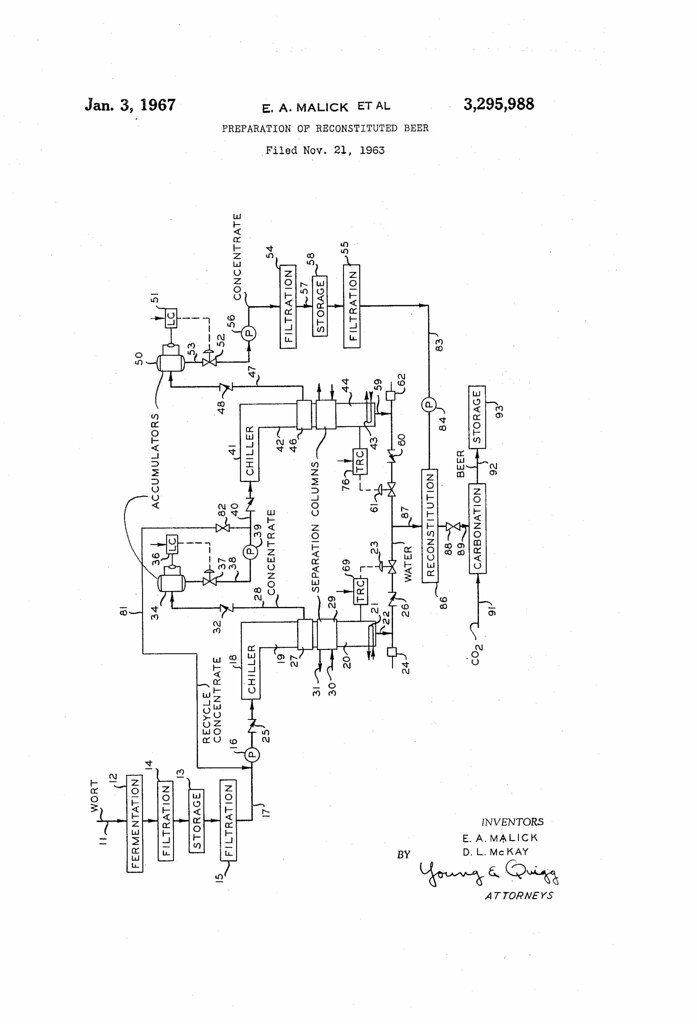
Today in 1967, US Patent 3295988 A was issued, assigned to Phillips Petroleum, for a “Preparation of Reconstituted Beer.” According to the application the invention “relates to a method of concentrating solutions by crystallization. In another aspect it relates to an improved method of using a crystal purification column for the removal of water from beer. In a further aspect it relates to an improved method of concentrating aqueous solutions, e.g., beer, and reconstituting the resulting concentrate.”

US3295988-0

Filed Under: Beers, Breweries, Just For Fun, Related Pleasures Tagged With: Patent, Science of Brewing

World’s Drunkest Countries

January 3, 2015 By Jay Brooks

world-map-3
An online article today on Business Insider examines the World Health Organization’s most recent Global status report on alcohol and health 2014. Entitled Here Are The Drunkest Countries In The World, it gives the highlights of the WHO report. Unfortunately, in my experience WHO tends to lean on the side of prohibitionists in their approach to alcohol, highlighting primarily the bad aspects while ignoring the positive. As a result, WHO tends to be all doom and gloom about alcohol in the world. It’s a somewhat odd position. At any rate, they use the map below, showing per capita alcohol consumption by country, as of 2010 (but it’s the same data in the 2014 report).

world-alcohol-map-2010-1
See the chart full size.

One thing to notice is that despite the hue and cry from U.S.-based anti-alcohol groups, American consumption has been flat or down since its 1980 high point, and worldwide we’re pretty much in the middle of the consumption scale, not the lowest or the highest, as they’d have us believe. Canada drinks more than we do. So does Australia and most of Europe, especially Eastern Europe and Russia.

But even with WHO’s very conservative view of drinking alcohol, American patterns of risky drinking is even lower than average, squarely in the second-lowest category. For example, Mexico may drink less than Americans per capita, but still manages to drink in a more risky manner, and Canada and us are the same, despite out-drinking Americans. Likewise, Western Europe, which drinks more than most, engages in the least risky behavior, at least as WHO defines it.

world-alcohol-map-2010-2
See the chart full size.

So if we accept the way WHO comes up with that statistic — stated as by considering “the usual quantity of alcohol consumed per occasion, proportion of drinking events when drinkers get drunk, proportion of drinkers who drink daily or nearly daily, festive drinking, drinking with meals, and drinking in public places — then overall there’s a lot less risky drinking in the world than the first chart would have us believe. While per capita consumption seems to follow the expected bell curve, risky behavior does not, with far less dark spots. The riskiest countries are concentrated in just a few nations, and looks even larger than it really is because one of the countries is geographically very big. The countries in the second-riskiest tier looks to be less than ten nations, suggesting that a majority of places to do not engage in a great deal of risky drinking, which is frankly what I’d expect. Either way, I’m not sure hardly any deserve the title “drunkest countries.”

Filed Under: Beers, Editorial, Politics & Law Tagged With: Health & Beer, International, Prohibitionists, Statistics

Patent No. 2967107A: Continuous Fermentation Process

January 3, 2015 By Jay Brooks

patent-logo
Today in 1961, US Patent 2967107 A was issued to Kenneth H. Geiger and John Compton, assigned to John Labott Ltd, for their “Continuous fermentation process.” According to the application the “invention relates to a novel continuous fermentation process for the production of potable beer.”

Figure 1 is a schematic illustrating a type of fermentation vessel which may be used in carrying out the process of the invention indicating typical fittings and controls.
US2967107-0

Continuous fermentation processes have already been utilized in connection with the production of industrial grade alcohols, and the desirability of continuous fermentation in the production of potable beer has long been recognized in the art. The principal obstacle to the adaptation of existing continuous fermentation methods to the production of potable beer has been the inability of such processes to provide adequate control of flavour. As is well recognized, the control of flavour is of paramount importance insofar as the production of potable beer is concerned.

The present invention provides a continuous fermentation process in which the control of flavour is readily achieved, and in which a number of additional advantages are to be found in addition to those important ones which might normally be expected to fiow from the conversion of what has previously been a batch operation into a continuous one.

Figure 2 is a schematic fiowsheet illustrating apparatus used for carrying out the process of the invention with one yeast propagation vessel and two alcohol producing vessels in the product formation stage.
US2967107-1

According to the present invention, potable beer is produced by the yeast fermentation of a fermentable carbohydrate which is carried out in stages. A first stage is provided in which aerobic conditions favourable to yeast growth are maintained, and a second stage is provided in which anaerobic conditions favourable to carbohydrate attenuation are maintained. Preferably according to the invention, the yeast concentration in the second stage of the process is maintained substantially constant at a concentration which is in excess of the maximum level normally obtainable or commonly used under batch fermentation conditions. This level of yeast concentration is maintained by separating at least a portion of the yeast from the efliuent of the second stage and recycling it through the second stage.

Operating in this manner, the first stage of the process serves primarily as a continuous yeast propagator under predetermined aerobic conditions while the second stage which may be, and preferably is, carried out in a series of separate series connected vessels serves primarily for ICC attenuation of the fermentable carbohydrates to alcohol under predetermined anaerobic conditions. For convenience hereinafter, we refer to the first stage of the process as the yeast propagation stage and the second stage as the product formation stage.

The inherent advantages of the continuous fermentation process described above are manifold, and of substantial practical importance. For instance, the growth rate of yeast and feed rate of fermentable substrate are equillbrated and controlled under steady state conditions in the first stage, so that the extent or rate of metabolism unconnected with yeast cell growth and/or reproduction is not critical. The maintenance of any predetermined high yeast concentration in the second stage is independent of flow rate, while, provided a relatively high concentration of yeast is present in the second stage, the rate of product formation will be for all practical purposes independent of yeast growth and, provided the substrate is satisfactory, almost entirely dependent on total quantity of yeast present and temperature.

Because the process of the invention makes for more efiicient substrate utilization, less is used for yeast production than in normal batch fermentations.

Furthermore, a very rapid fermentation is possible, with a holdup time appreciably less than in other conventional fermentation systems, batch or continuous, without concommitant adverse eifects on the quality of the product.

Figure 3 is a general schematic fiowsheet illustrating the process of the invention as it would be carried out using four separate vessels in the product formation stage.
US2967107-2

Filed Under: Beers, Breweries, Just For Fun, Related Pleasures Tagged With: Patent, Science of Brewing

« Previous Page
Next Page »

Find Something

Northern California Breweries

Please consider purchasing my latest book, California Breweries North, available from Amazon, or ask for it at your local bookstore.

Recent Comments

  • Bob Paolino on Beer Birthday: Grant Johnston
  • Gambrinus on Historic Beer Birthday: A.J. Houghton
  • Ernie Dewing on Historic Beer Birthday: Charles William Bergner 
  • Steve 'Pudgy' De Rose on Historic Beer Birthday: Jacob Schmidt
  • Jay Brooks on Beer Birthday: Bill Owens

Recent Posts

  • Beer Birthday: Don Tse June 3, 2026
  • Beer In Ads #5257: Dessower Schlossbrauerei Bockbier June 2, 2026
  • Historic Beer Birthday: Thomas Hardy June 2, 2026
  • Beer Birthday: Menno Olivier June 2, 2026
  • Beer Birthday: Tyler Smith June 2, 2026

BBB Archives

Feedback

Head Quarter
This site is hosted and maintained by H25Q.dev. Any questions or comments for the webmaster can be directed here.