Brookston Beer Bulletin

Jay R. Brooks on Beer

  • Home
  • About
  • Editorial
  • Birthdays
  • Art & Beer

Socialize

  • Dribbble
  • Email
  • Facebook
  • Flickr
  • GitHub
  • Instagram
  • LinkedIn
  • Pinterest
  • RSS
  • Twitter
  • YouTube

Powered by Genesis

Beer In Ads #1168: Max Gene Nohl For Blatz

April 21, 2014 By Jay Brooks


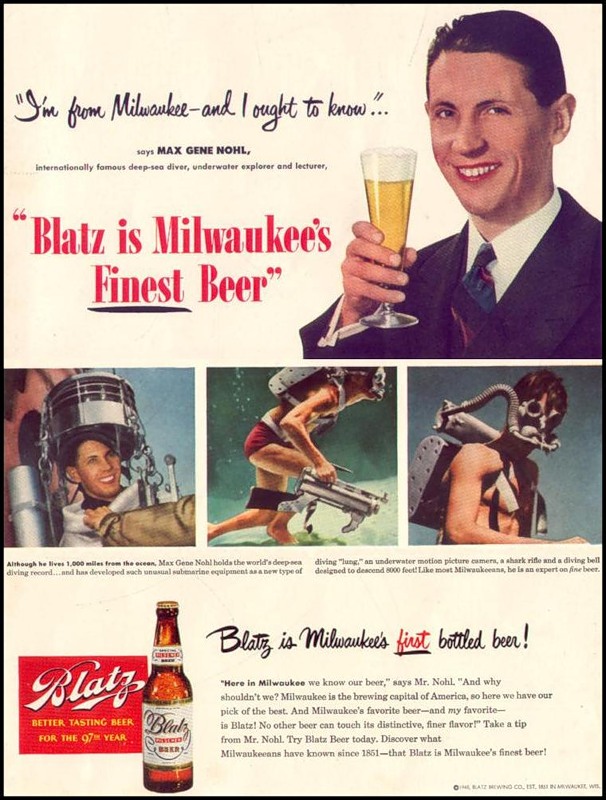
Monday’s ad is for Blatz Beer, from 1948. The ad is part of Blatz’s “I lived in Milwaukee, I ought to know” series from the later Forties and Fifties that featured prominent celebrities, sports figures and famous folks from Milwaukee claiming to know “Blatz is Milwaukee’s Finest Beer” because they lived there, or near there, at some point in their lives. This one features Max Gene Nohl, who was a famous deep sea diver from Milwaukee.

blatz-1948

Filed Under: Art & Beer, Beers Tagged With: Advertising, Blatz, History

The Prohibitionist Pot Calling The Brew Kettle Black

April 21, 2014 By Jay Brooks

pot-kettle
This is almost funny, an amazing press release from Alcohol Justice that is so lacking in self-awareness and irony that it’s hard not to laugh at just how truly absurd it is. Why any media outlet, anyone really, takes them seriously is a head-scratcher, especially with such a remarkable lack of perception displayed in this particular press release. This is perhaps the most remarkable case of the pot calling the kettle black that I have ever seen. According to the latest missive from the Sheriff of Anti-Alcohol, Alcohol Justice, the Century Council is in the “AJ Doghouse” — where I permanently live — and they accuse the group of a host of sins. Since the beginning of April, Alcohol Awareness Month, they’ve been tweeting their displeasure:

In the AJ Doghouse: Century Council Rebrand Rehashes Old Tricks http://bit.ly/1jayaKO Big Al’s smoke & mirrors.

I love that they’re now calling “Big Alcohol” by the shorter nickname “Big Al.” Do you think AJ knows that “Big Al” is the name of the mascot for the University of Alabama? Or that Big Al’s was one of the first strip clubs in San Francisco? There’s even a Big Al brewery in Washington.

big-al

But what’s really amazing about this particular press release is that practically everything that AJ is accusing the Century Council of doing is something that Alcohol Justice has themselves done at some point, and not throughout history, but recently. The “Old Tricks” that AJ claims they’re rehashing are all “tricks” they’ve also done, though when they did them it was perfectly acceptable behavior. Let’s break it down:

Just in time for Alcohol Awareness Month, the Century Council (educational front group arm of spirits producer trade group DISCUS) has announced a major rebrand effort, changing its name to sound more like an official NGO or policy institute: Foundation for Advancing Alcohol Responsibility (FAAR).

coming-april-2

This one is particularly funny. Do they think nobody will remember the Marin Institute? It’s only been three years since Alcohol Justice announced a major rebrand effort, changing its name to sound more official or more like a Wild West vigilante: Alcohol Justice (AJ). But when the Century Council does it, it’s for nefarious purposes, but when AJ did it, the new name supposedly “better reflects its national and global reach, and clarifies its mission.” Uh-huh. Sure. As Professor David J. Hanson wrote around the time of the name change, AJ “finally acknowledged that ‘we aren’t a research organization as institute implies.’ The fact that the Marin Institute wasn’t a research organization has long been noted by observers, although the activist group has often presented itself to the public and media as engaging in research.”

Whatever this industry-funded membership group calls itself, its real mission remains—to absolve its founders and funders from accountability for the staggering harm their products cause, and to raise as much profit and goodwill for their shareholders as possible.

No matter what “Big Al” does, it carries malicious intent. There is literally nothing that the alcohol industry can do that would satisfy AJ. They even found something to complain about when Anheuser-Busch gave water to hurricane victims in Haiti. You’d think that if alcohol was trying to combat the minority of people who abuse it, they’d welcome it, but when we do it, we’re apparently not serious about it. This one serious pisses me off, as if people in the alcohol industry don’t value human life as much as they do. It’s as if they think we’re fine with people dying. I honestly think sometimes, the way they describe us, that they don’t think that we’re human. It’s more than insulting. They claim that it’s just to “raise as much profit and goodwill for their shareholders as possible,” but much of what AJ does is solicit donations with their press releases and repetitive tweeting. In December, they kept asking for donations over and over again. Beyond that, a recent conference of prohibitionist groups revealed that their motives are to punish or profit from alcohol companies. One even said “they simply didn’t care about the public health impacts of taxes. They were in the game solely to get some of the tax revenue steered toward their organization.” Also at that event, AJ’s head sheriff Bruce Lee Livingston, “commented during the question and answer portion that activists are unable to get taxes high enough to actually produce positive public health benefits. Rather, he called for a ‘charge-for-harm’ approach, which is based on the assumption that anyone who drinks deserves to be punished.”

The new name does sound a little more grown up—like a bona fide, credible, research-based organization whose newly revamped mission is to help people drink a little less dangerously. The focus group and stakeholder feedback must have given them the green light — and hey, that’s one of the theme colors, too! (Unfortunately, our invitation to participate in the stakeholder group must have gotten shunted to the Spam folder…)

Snide comments aside, though I can’t help but point out it doesn’t make them sound particularly “more grown up,” here’s what’s insulting about them saying their “invitation to participate in the stakeholder group must have gotten shunted to the Spam folder.” A couple of years ago, at the National Conference of State Liquor Administrators, Alcohol Justice complained about the event in an obnoxious, insulting press release. But it was later revealed, when the NCSLA responded with a press release of their own, that “the now re-branded entity formerly known Marin Institute has repeatedly chosen not to become a member of the NCSLA despite the numerous invitations that have been extended to them and the years of courtesies from the NCSLA they have enjoyed in the form of expense-paid attendance at NCSLA conferences and participation on NCSLA panels. It is equally telling that this statement comes when further special treatment has been denied this re-branded entity while at the same time it was directly invited and encouraged to join the NCSLA, take a seat at the proverbial table, but on the same terms as those long met by other public health and public advocacy groups. It is disheartening when any entity with substantial financial resources, yet without the economic hardships endured for years by state beverage alcohol regulators, appears content to do nothing.” And given that AJ does nothing but insult alcohol companies, why would they even think it reasonable that they be given an “invitation to participate in the stakeholder group.” It’s absurd when you consider the way they treat the alcohol industry. Can they really believe that much in their own self-importance? Do they not realize how the world sees them? But let’s continue. What’s next?

But here is the reality. The corporations that fund these groups:

  • Pay academic researchers to discredit the evidence of alcohol-related harm from their products and marketing tactics, and promote spurious research to support the industry/producer agenda.

This one’s rich considering how much self-serving “research” AJ is involved in. AJ staff has appeared as the authors or co-authors of numerous so-called “studies” and then they promote them as if they’re independent research. They’re constantly exaggerating, mis-leading and making things up, but when they do it it’s to further their holy agenda, if the alcohol industry funds research it has to be spurious. It’s a double-standard at best, at worst, it’s the ultimate hypocrisy. As I’ve frequently wondered, who watches the watchdog? AJ claim their mission is to be an industry watchdog, to keep us honest, but their own track record for veracity is seriously lacking.

  • Hire public relations professionals to connect concern about just 2 of the many types of alcohol-related harm with activities that have no evidence of being effective at decreasing either harm or consumption (and support their marketing efforts and profits).

I confess I have no idea what they’re talking about here. The new Responsibility.org website alone has more than two issues they’re addressing. And certainly AJ has “public relations professionals” on their payroll. But beyond that, AJ has been grossly exaggerating the “many types of alcohol-related harm,” and even has made up many of them. A great example of this is when in 2010, they tried to force a new tax on the City of San Francisco. The city commissioned a Nexus Study (at great cost to taxpayers) to examine the supposed alcohol harms that AJ continues to insist are the fault of alcohol, not the people who drink alcohol, but the expensive study relied heavily on self-serving reports by AJ and throughout relies on all sorts of misleading and questionable data and reasoning.

  • Actively lobby against evidence-based policies that reduce harm, such as increased excise taxes, restrictions on alcohol advertising, state control over alcohol sales, and decreases in outlet density.

No doubt that lobbying does go on, by the alcohol industry, but not by this group, the Foundation for Advancing Alcohol Responsibility (FAAR). I know this is hard for AJ to understand, but corporations are allowed to lobby, just like every other business in America. I’m not a fan of lobbying in general, but until it’s prohibited for all businesses, Big Al isn’t doing anything wrong. AJ, and other prohibitionist groups, are also actively engaged in lobbying. But as you’ve probably figured out by now, whatever is done in the first person — “our lobbying” — is perfectly respectable but when it’s in the third person — “their lobbying” — then it’s evil and menacing. There’s another name for that way of thinking: hypocritical.

  • Use “Drink Responsibly” as a marketing tactic to build loyalty and sell alcohol while blaming youth, parents, schools, police, and anyone else but the product and their own practices for alcohol-related harm.

This is partly another example of letting no good deed go unpunished, where nothing that Big Al does is free of selfish agenda, unlike AJ and the other prohibitionists. What’s particularly annoying about this tactic is the implication that people who make or sell alcohol are against responsibility, and are for underage drinking, drunk driving and overconsumption. Why? Because all we care about is profit, apparently. But, despite AJ’s assumption, we’re people, too. We have families, and want to keep them just as safe as AJ’s do-gooder teetotalers. Do they really think we want our kids to become alcoholics or die driving drunk? Because that’s the impression one gets when you read prohibitionist literature, that we’re all monsters.

And their notion that it’s “the product” and our “own practices” that cause people harm is so offensive that I don’t even understand how they can really think that. They talk about us blaming everyone, but they don’t seem to accept the concept of responsibility or personal responsibility. That all people, whether they drink are not, should be responsible for their own actions. How can they honestly think that when I take a drink, I can no longer control my actions and that the alcohol takes over me and forces me to commit all manner of horrors? I, and most people I know within the beer industry, hate a bad drunk as much as they do. But we don’t think it was the alcohol that’s to blame so much as the person who acted stupidly. They’re responsible for their own bad behavior, as even a child should be able to figure out. But personal responsibility doesn’t get people donating money, having a bogeyman is far better for soliciting funds.

The Century Council’s announcement was released to coincide with Alcohol Awareness Month so that the industry voice can take over the public health discussions and events during the entire month. Industry leaders such as Diageo chief executive Ivan Menezes whine about his “right” to influence public health regulation while Diageo’s (and the other spirits producers’) influence protects profits and continues paving the path to harm.

It would strike any reasonable person that announcing renewed efforts at combating alcohol issues during Alcohol Awareness Month is precisely the right time to do so, when the entire month is set aside for the very purpose of raising awareness of people with alcohol problems. Their statement that the “industry voice can take over the public health discussions and events during the entire month” is completely false, and can be proven by the very simple fact of their own press release, and they have to know how disingenuous they’re being. But more telling is that this is the most typical tactic of the prohibitionists, sending out press releases that are regurgitated by media outlets as news with no dissenting or contrary opinions, thereby allowing AJ, and the others, to frame the discussion about alcohol policy. This is what happens perhaps 95% of the time, or more. I guess AJ doesn’t like it when we do it. Maybe they think they own the idea of trying to control the message.

Margaret Chan, the director-general of the World Health Organisation, put it bluntly: “As we learned from experience with the tobacco industry, a powerful corporation can sell the public just about anything…This is not a failure of individual will-power. This is a failure of political will to take on big business…When industry is involved in policy-making, rest assured that the most effective control measures will be downplayed or left out entirely.”

Puh-leeze. Prohibitionist groups are very well funded. They have no trouble taking on corporations, and have been worming their way into all levels of government since prohibition ended in 1933, when they switched tactics and have been incessantly been working to limit alcohol ever since. The way prohibition ended, and the laws subsequent to it, are in themselves a victory of a sort for the prohibitionist movement. And the David vs. Goliath myth is just that, a well-managed fiction. And as I mentioned in a recent post, I’ve been reading a lot of WHO literature lately, and the inescapable conclusion “is that their mission is more about stopping people from drinking because as an organization they’re convinced that alcohol is always bad and has no positive aspects or benefits. When you only look for negative consequences, that’s all you find.” You can really only compare alcohol and tobacco by willfully ignoring the many positive aspects of alcohol.

The Big Alcohol conglomerates and the billionaires that run them can focus group a new name and logo for their group, slap a hashtag in front of the word responsible, go live with a web address they bought in 2001, and splash their rebrand all over the web. As long as these spirits producers’ products dominate the top 10 brands consumed by underage youth (Captain Morgan, Smirnoff (Diageo); Absolut (Pernod Ricard) and Jack Daniels (Brown-Foreman), and continue to be disproportionately consumed by youth (Bacardi; Malibu rum (Pernod Ricard), we’ve got their hashtags right here: #hypocrite #alcoholharm #notresponsible #alcoholindustryisnotpublichealth

Hilarious. Replace Big Al with AJ in that first sentence, and it reads just the same. And the same can be said for those hashtags. What’s funny is they apparently can’t even see that they’re engaged in exactly everything that they’re accusing the alcohol industry of doing. It really is a case of the Prohibitionist Pot Calling The Brew Kettle Black.

meet-kettle

Filed Under: Editorial, Politics & Law Tagged With: Humor, Prohibitionists

What Kind Of Drinker Are You?

April 21, 2014 By Jay Brooks

look-magazine
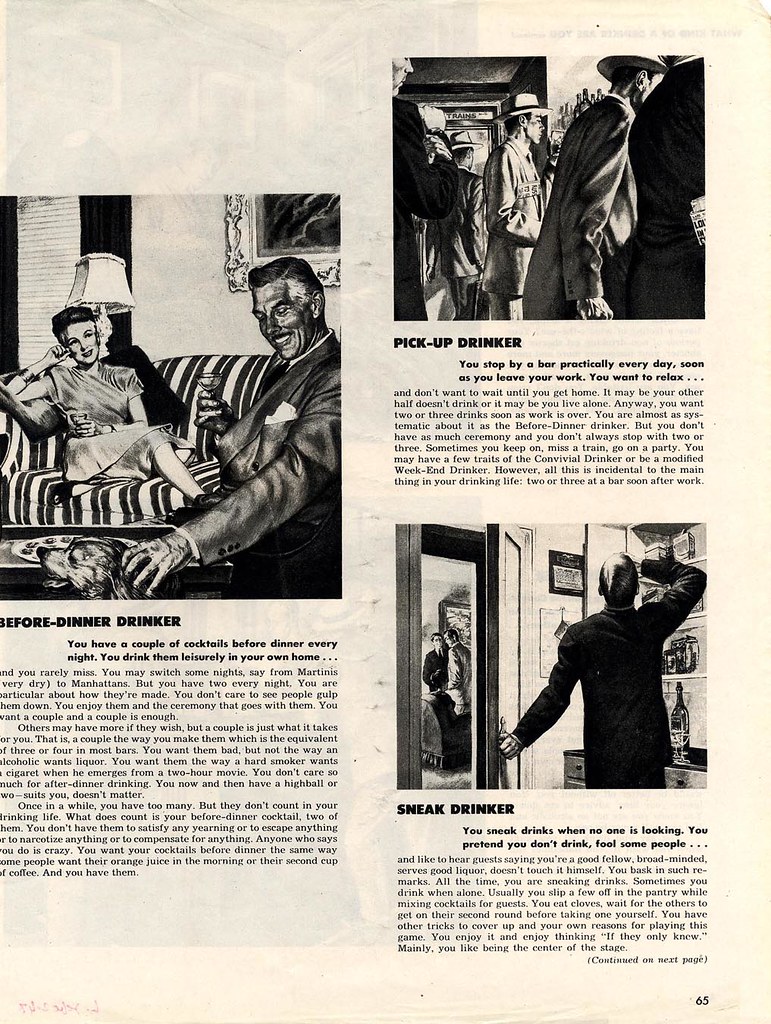
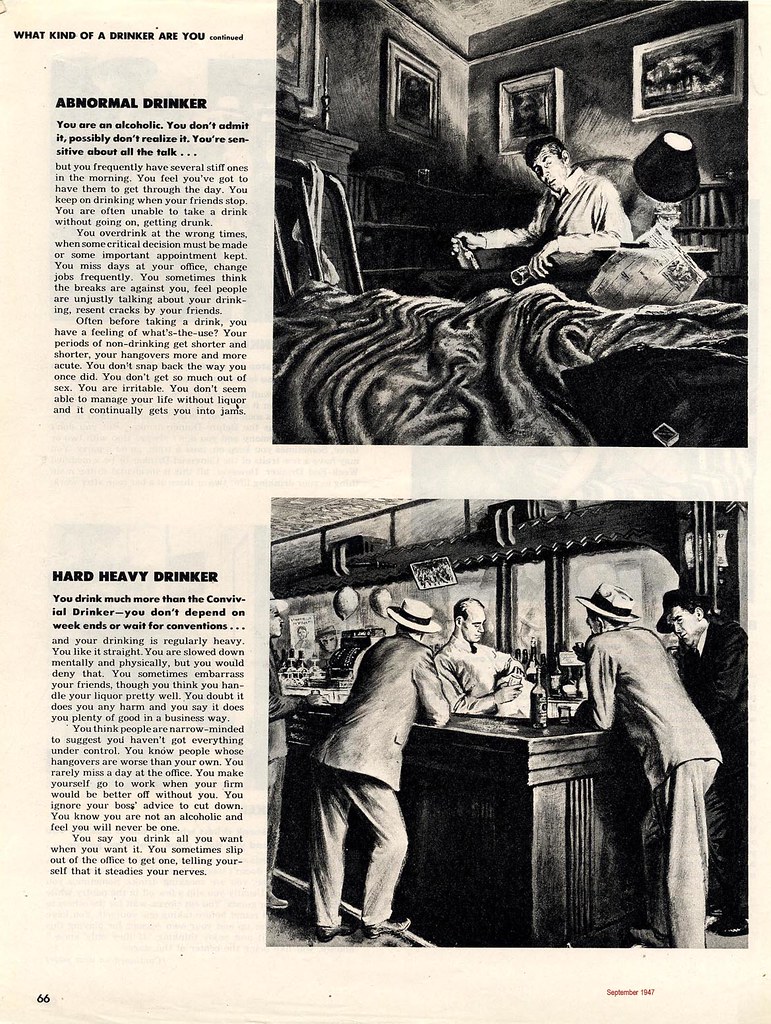
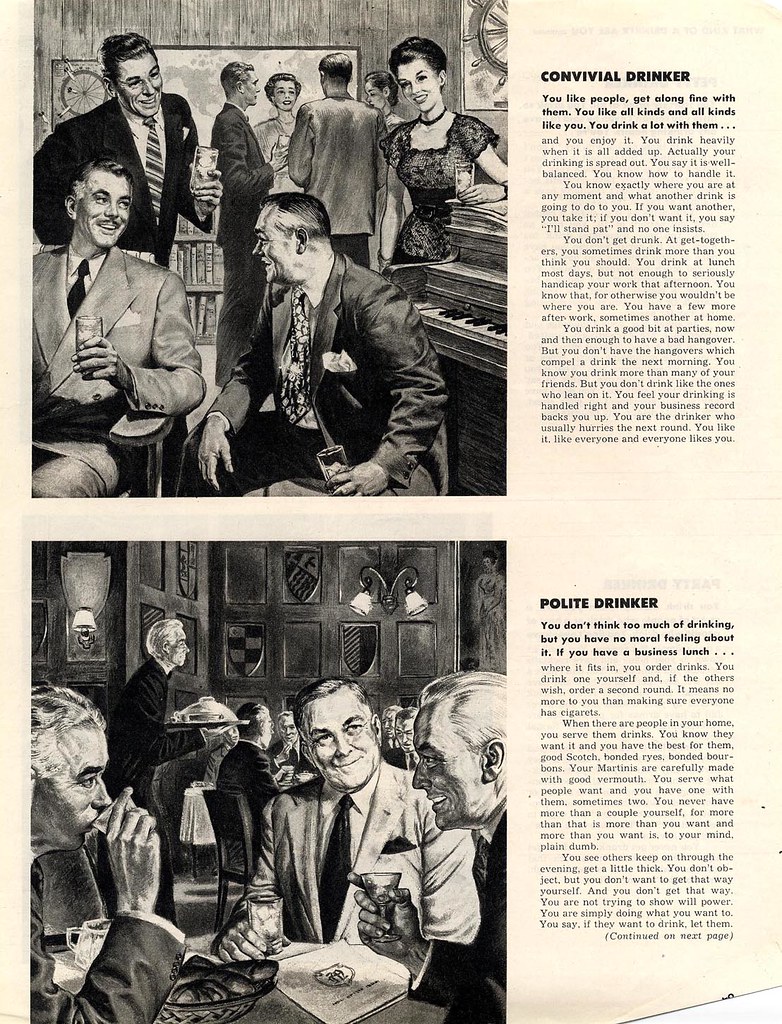
Here’s a fun little piece of history. In the September 2, 1947 issue of Look magazine, journeyman freelance author Don Wharton wrote an article examining the different types of drinkers one might encounter in mid-20th century America, as long as one kept to the mainstream America filled with white, affluent males. In his introduction to What Kind of Drinker Are You? he alludes to eleven different types, at least “according to doctors, psychiatrists, bartenders and drinkers of all types.” They admit that their types couldn’t cover everyone, but believe 95% of the population should be able to find themselves among the types. I thought the article I found online was complete, but it only shows ten. However in the text describing “Pick-Up Drinkers,” they refer to the “Week-End Drinker,” so that must be the missing eleventh type of drinker.

  1. Convention Drinker
  2. Before-Dinner Drinker
  3. Pick-Up Drinker
  4. Sneak Drinker
  5. Abnormal Drinker
  6. Hard Heavy Drinker
  7. Convivial Drinker
  8. Polite Drinker
  9. Petty Drinker
  10. Party Drinker
  11. Week-End Drinker

The descriptions of each type of drinker provide a fascinating insight into how people thought about drinking in the late 1940s, shortly after World War 2 ended.

What-Kind-Of-Drinker-01

What-Kind-Of-Drinker-02

What-Kind-Of-Drinker-03

What-Kind-Of-Drinker-04

What-Kind-Of-Drinker-05

Which type are you?

Filed Under: Beers, Just For Fun, Related Pleasures Tagged With: History

Beer In Ads #1167: La Verne Sunde For Blatz

April 20, 2014 By Jay Brooks


Sunday’s ad is for Blatz Beer, from 1949. The ad is part of Blatz’s “I lived in Milwaukee, I ought to know” series from the later Forties and Fifties that featured prominent celebrities, sports figures and famous folks from Milwaukee claiming to know “Blatz is Milwaukee’s Finest Beer” because they lived there, or near there, at some point in their lives. This one features dress designer La Verne Sunde, who was apparently well-known locally in her day as a fashion designed in Milwaukee.

blatz-fitting

Filed Under: Art & Beer, Beers Tagged With: Advertising, Blatz, History

Beer In Ads #1166: Pat Harder For Blatz

April 19, 2014 By Jay Brooks


Saturday’s ad is for Blatz Beer, from 1949. The ad is part of Blatz’s “I lived in Milwaukee, I ought to know” series from the later Forties and Fifties that featured prominent celebrities, sports figures and famous folks from Milwaukee claiming to know “Blatz is Milwaukee’s Finest Beer” because they lived there, or near there, at some point in their lives. This one features Pat Harder, who that year was a star Fullback for the Chicago Cardinals football team, which today plays in Arizona. He played in Chicago from 1946-1950, before being traded to the Detroit Lions, where he played his remaining years, retiring after the 1953 season. Harder was born and raised in Milwaukee.

Blatz-1949-pat-harder-lg

Filed Under: Art & Beer, Beers Tagged With: Advertising, Blatz, History

The Mythical Monolith Of Big Alcohol

April 19, 2014 By Jay Brooks

monolith-2001
Since the end of February, Alcohol Justice (AJ) has been tweeting the following:

Big Alcohol will never admit #3 http://bit.ly/1mFY39E Alcohol classified carcinogenic 25 years ago

It’s part of their new series of things that “Big Alcohol will never admit.” I think somebody forgot to tell AJ that there’s no actual organization “Big Alcohol,” no single entity that speaks with one voice on all matters alcoholic.

big-alcohol-monolith
The mythical monolith of “Big Alcohol” that doesn’t actually exist, but which Alcohol Justice believes should respond to their propaganda demands.

But let’s take a look at what we’re accused of this time. According to AJ, 25 years ago Alcohol was classified as a “carcinogenic.” That tidbit comes from their Alcohol and Cancer Risk “fact sheet” which states. “The International Agency for Research on Cancer (IARC) has classified beverage alcohol as a Group 1 (cancerous to humans) carcinogen since 1988.” That statement is footnoted by two studies. The first is the IARC Monographs on the Evaluation of Carcinogenic Risks to Humans VOLUME 96 Alcohol Consumption and Ethyl Carbamate and the second is Volume 100E A Review of Human Carcinogens: Personal Habits and Indoor Combustions (2012). And those two documents do indeed state that they “concluded that there was sufficient evidence of carcinogenicity for cancers of the oral cavity, pharynx, larynx, oesophagus and liver.” But is that the whole story? Hardly. Since that time, they’ve added colorectal and female breast cancer for a total of seven types of cancer, out of how many different types? Dozens? Hundreds? And for at least a few of those, moderate alcohol consumption reduces risk and for most of the rest is neutral, meaning there’s little or no effect. But AJ also claims that “Big Alcohol” has been somehow denying this for the past 26 years. How exactly has anyone been denying it?

But another questionable exaggeration is this, from AJ’s press release of February 26 of this year, where they attempt to take a position that the moderate consumption of alcohol is also unsafe.

While heavy drinking presents the greatest risk, daily alcohol consumption of as little as 1.5 drinks accounts for up to 35% of alcohol-attributable cancer deaths in the United States. Added [Director of Research Sarah] Mart, “The research is clear: There is no determined safe limit for alcohol consumption with regard to cancer risk.”

But that’s at least a little misleading. That claim comes from a 2013 study in the American Journal of Public Health entitled Alcohol-Attributable Cancer Deaths and Years of Potential Life Lost in the United States. Here’s the relevant bit from the results, in the abstract.

Alcohol consumption resulted in an estimated 18,200 to 21,300 cancer deaths, or 3.2% to 3.7% of all US cancer deaths. The majority of alcohol-attributable female cancer deaths were from breast cancer (56% to 66%), whereas upper airway and esophageal cancer deaths were more common among men (53% to 71%). Alcohol-attributable cancers resulted in 17.0 to 19.1 YPLL for each death. Daily consumption of up to 20 grams of alcohol (≤ 1.5 drinks) accounted for 26% to 35% of alcohol-attributable cancer deaths.

Although they exaggerated the findings by saying “Up to 35%” instead of “26% to 35%,” which is a typical propaganda tactic, what that one study really found is that 26% to 35% of 3.2% to 3.7% of all US cancer deaths may have come from moderate drinking. Put another way, 0.83% to 1.295% of all U.S. cancers may be attributable to people who drank moderately. From that, AJ concludes that “The research is clear: There is no determined safe limit for alcohol consumption with regard to cancer risk.” If you think that’s clear, keep making those donations, because it makes no logical sense. Less than 1% of all cancer deaths up to as many as 1.3% may be attributable to moderate alcohol consumption, and that constitutes clear causation, ignoring all other factors, such as genetics, environment, and lifestyle.

The study itself claims that there’s “no safe threshold for alcohol and cancer risk” despite it representing only around one percent of all cancers in the United States. Not to mention, when you dig deeper into the data, that particular study is only examining six types of cancer. They ignore all other cancers, while still making sweeping pronouncements about cancer, and ignoring any mitigating benefits of moderate alcohol consumption, including the rather hard-to-ignore total mortality.

Here’s what I don’t understand about calling alcohol a carcinogen. If indeed it increases the risk for certain types of cancers, but not others, it seems to me it would have to increase the risk to all persons (or even most) for all cancers to be considered to show “sufficient evidence in humans for the carcinogenicity of alcohol consumption.” My sense in reading through WHO literature over the years is that their mission is more about stopping people from drinking because as an organization they’re convinced that alcohol is always bad and has no positive aspects or benefits. When you only look for negative consequences, that’s all you find.

What AJ, WHO and many of these studies do is start with a premise and try to prove it, ending up cherry-picking the studies that support it and ignoring any that don’t. That creates a powerful propaganda tool but rarely stands up to any scrutiny. Luckily, as prohibitionist groups are well aware, few subject their propaganda masquerading as press releases to much, if any, scrutiny whatsoever. So their incentive to be more truthful is practically nil. So they can just make up whatever they want, like the mythical monolith of Big Alcohol, and then wonder why they won’t admit whatever prohibitionists says, no matter how twisted or distorted.

Filed Under: Beers, Politics & Law Tagged With: Health & Beer, Prohibitionists, Science, Statistics

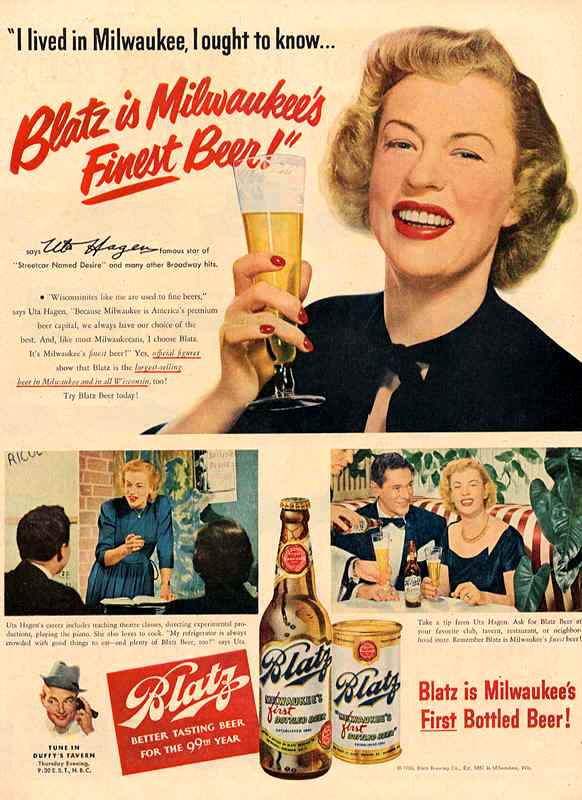
Beer In Ads #1165: Uta Hagen For Blatz

April 18, 2014 By Jay Brooks


Friday’s ad is for Blatz Beer, from 1951. The ad is part of Blatz’s “I lived in Milwaukee, I ought to know” series from the Fifties that featured prominent celebrities, sports figures and famous folks from Milwaukee claiming to know “Blatz is Milwaukee’s Finest Beer” because they lived there, or near there, at some point in their lives. This one features Uta Hagen, an actress born in Germany but raised in nearby Madison, Wisconsin.

Blatz-1951-Uta-Hagen

Filed Under: Art & Beer, Beers Tagged With: Advertising, Blatz, History

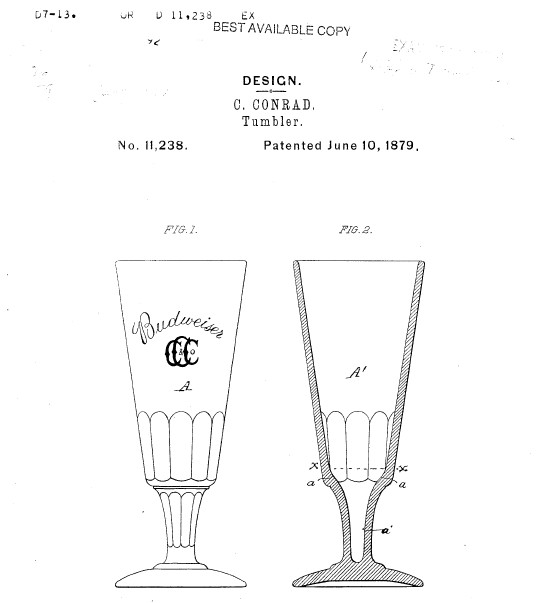
Budweiser Beer Tumbler 1879

April 18, 2014 By Jay Brooks

pint-glass
I came across this interesting patent design for a beer tumbler this morning for Budweiser that was patented on June 10, 1879 by C. Conrad. Liquor importer Carl Conrad is one of the more forgotten names from the history of Anheuser-Busch. He was at least partially responsible, along with his longtime friend Adolphus Busch, for the original recipe of Budweiser and in fact early bottles of Bud, prior to the 1920s were sold under the company name “C. Conrad and Co.” before A-B got the rights from Conrad. He apparently also designed this glass for the beer in 1879. I”m not sure if they were ever made, but they certainly look somewhat familiar. Anybody know?

bud-beer-tumblr-1879

Filed Under: Beers, Related Pleasures Tagged With: Glassware, History

The Hoplist

April 18, 2014 By Jay Brooks

hoplist
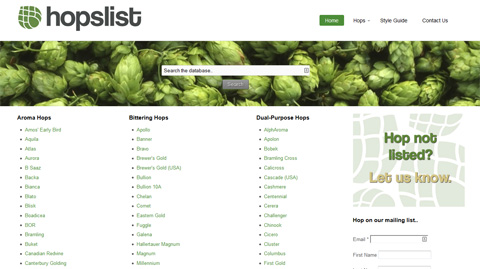
I got a press release yesterday from a Julian Healey about a project he’s just launched. His new website from Australia is The Hoplist, and includes information on at least 268 varieties of hops, which they claim is the “biggest list of hops … ever.” And that seems right, most of the hop guides are put out by the hop growers and sellers, and focus on just the varieties that they carry, whereas the Hoplist is at least attempting to be complete. For each hop, there’s a description of the hop and nearly two-dozen bits of information about it. I’ll be in Melbourne in just over a week, so perhaps I can share a beer with Julian. I think I’ll suggest something hoppy.

hoplist-screenshot

Filed Under: Beers, Just For Fun, Related Pleasures Tagged With: Hops, Science of Brewing

Next Session Focuses On Local History

April 18, 2014 By Jay Brooks

session-the
For our 87th Session, our host is Reuben Gray, from The Tale of the Ale. For his topic, he’s chosen a local theme, all about Local Brewery History. He’s asking you to “give your readers a history lesson about a local brewery,” and here’s the details:

In Session 87, I want you to give your readers a history lesson about a local brewery. That’s a physical brewery and not brewing company by the way. The brewery doesn’t need to still exist today, perhaps you had a local brewery that closed down before you were even born. Or you could pick one that has been producing beer on the same site for centuries.

Stipulations?
The only thing I ask is that the brewery existed for at least 20 years so don’t pick the local craft brewery that opened two or three years ago. This will exclude most small craft breweries but not all. The reason? There’s not much history in a brewery that has only existed for a few years.

Also, when I say local, I mean within about 8 hours’ drive from where you live. That should cover most bases for the average blogger and in many, allow you to pick one further away if you don’t want to talk about a closer one. For instance, I live in west Dublin and the closest brewery to me is The Porterhouse, but they only opened in the late 90’s. The most obvious brewery of course is Guinness, but enough people get told the history of Guinness by a very clever marketing team so I can’t bring myself the re-hash the same old tales about the 9000 year old lease and all that. So I will be picking something else on the day.

Some of you may already know a lot about the history of a local brewery and others might have to do a little research. If you do pick a dead brewery, see if there are any connections today! Perhaps the brewery is dead but the brand was bought by another brewery and lives on today.

The most important goal is to have fun with your research.

Wappen

So put on your historian’s hat and let’s tell some histories to make Maureen Ogle proud. On Friday, May 2, blow the cobwebs off of your local, possibly now defunct, brewery’s story and give us your best chronicle.

Also, as Reuben generously pointed out, we have a number of open slots for upcoming Sessions. If you’re a contributor, but haven’t yet been a host, please consider signing up for one. We need a host for June, along with August and beyond.

beer-is-as-old-as-history

Filed Under: Just For Fun, The Session Tagged With: Announcements, Blogging, local

« Previous Page
Next Page »

Find Something

Northern California Breweries

Please consider purchasing my latest book, California Breweries North, available from Amazon, or ask for it at your local bookstore.

Recent Comments

  • Bob Paolino on Beer Birthday: Grant Johnston
  • Gambrinus on Historic Beer Birthday: A.J. Houghton
  • Ernie Dewing on Historic Beer Birthday: Charles William Bergner 
  • Steve 'Pudgy' De Rose on Historic Beer Birthday: Jacob Schmidt
  • Jay Brooks on Beer Birthday: Bill Owens

Recent Posts

  • Beer In Ads #5222: O’Keefe’s Bock Beer April 15, 2026
  • Historic Beer Birthday: George Schmitt April 14, 2026
  • Beer In Ads #5221: Bowler Brothers’ Bock April 14, 2026
  • Historic Beer Birthday: George W. Bashford April 14, 2026
  • Beer In Ads #5220: Hello People! I Am The Centlivre Bock Beer Goat April 13, 2026

BBB Archives

Feedback

Head Quarter
This site is hosted and maintained by H25Q.dev. Any questions or comments for the webmaster can be directed here.