

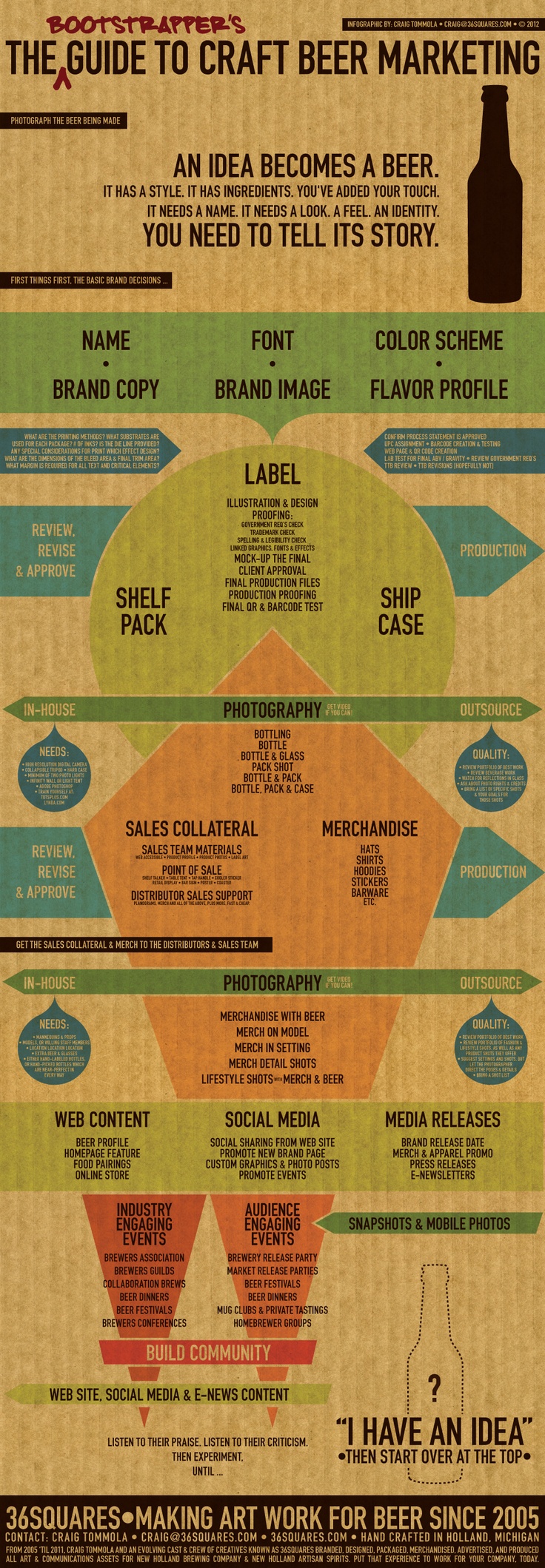
Today’s infographic is the ^ Bootstrapper’s Guide to Craft Beer Marketing, created by Craig Tommola of 36 Squares, although I found it on Pinterest where a Marta S M claimed its authorship. Whoever made it, it’s an interesting look at brand marketing.
Beer In Ads #1052: Good Things Go With Beer

Thursday’s holiday ad is for Schaefer, from 1946. It’s a colorful ad with a bright red background covering half the page with the foreground containing beer, nuts and a pipe.

The Man With The Golden Liver

Today’s infographic is an odd one, entitled The Man With the Golden Liver. It’s a serious (as far as I can tell) review of the fourteen James Bond books written by Ian Fleming, examining how much alcohol the fictional character James Bond drank. The result of their work (reading novels, mostly) was published in BMJ, the British Medical Journal, under the title Were James Bond’s drinks shaken because of alcohol induced tremor? Here’s what they found:
Results After exclusion of days when Bond was unable to drink, his weekly alcohol consumption was 92 units a week, over four times the recommended amount. His maximum daily consumption was 49.8 units. He had only 12.5 alcohol free days out of 87.5 days on which he was able to drink.
Conclusions James Bond’s level of alcohol intake puts him at high risk of multiple alcohol related diseases and an early death. The level of functioning as displayed in the books is inconsistent with the physical, mental, and indeed sexual functioning expected from someone drinking this much alcohol. We advise an immediate referral for further assessment and treatment, a reduction in alcohol consumption to safe levels, and suspect that the famous catchphrase “shaken, not stirred” could be because of alcohol induced tremor affecting his hands.
So they undertook the examination of the drinking habits of a fictional character and concluded he was a high risk drinker, worrying what consequences might befall him. I’d laugh my head off if the goal didn’t appear to be to warn others not to follow his example and drink too much. Has their been a problem with copycats pretending to be British superspies and binge drinking in the process? And that’s been since 1953, when the first book was published. So it’s been sixty years. You think we’d have seen this epidemic by now. If anything, based on the fact that no one reads books anymore, this has to be a waning problem, if indeed it as ever one to begin with.
To be fair, a number of years ago I did something similar, looking through the Fleming novels for instances when 007 drank beer, which I detailed in a post called James Bond’s Beer. But my goal was entertainment, not science, and I had no aspirations to warm people about unhealthy behavior in a character who wasn’t real. The “scientists” who undertook this “study” even have the cojones to say that “the author Ian Fleming died aged 56 of heart disease after a life notable for alcohol and tobacco excess,” suggesting a connection between the author and his fictional creation. Fleming himself always said that he’d based 007 on a Serbian field agent, Dušan Popov, although there are plenty of other contenders.
Another ridiculous caution is their finding that based on their analysis of Bond’s consumption he would have frequently drove a car with a BAC of 0.08 or above, which they note is above the legal limit in the UK. Except that the last Bond work that Fleming wrote was published in 1966. That’s one full year before the UK passed the Road Safety Act, imposing a BAC percentage. So if we’re continuing this absurd line of reasoning, it doesn’t even work by their own standards. At any rate, it’s an interesting infographic, I could just do without the proselytizing.
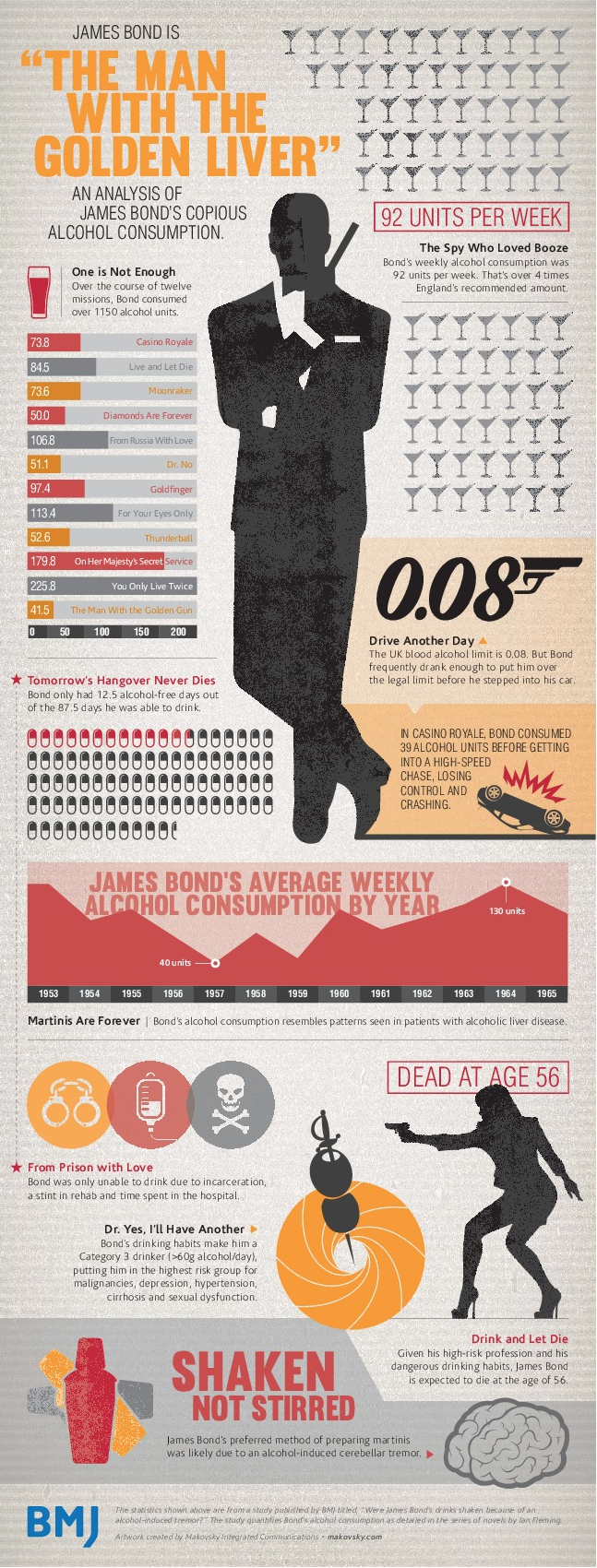
Click here to see the infographic full size.
The Sobering Power Of Amethyst

Maybe you already knew this, but I did not. The purple gemstone Amethyst gets its name from the ancient Greek word “amethustos” (ἀμέθυστος), which means essentially “not intoxicated” or “sober.” Apparently, the Greeks believed that wearing amethyst or drinking from a cup made for it would keep you from getting drunk.
The first mention of this property was by Asclepiades of Samos, a Greek poet born around 320 BCE. He mention amethyst’s sobering qualities in “XXX. Kleopatra’s Ring,” part of “The Windflowers of Asklepiades and the Poems of Poseidippos,” translated by Edward Storer in 1920.
Drunkenness am I — a gem worked by a subtle hand. I am graven in amethyst, and the subject and the stone are ill-assorted.
But I am the precious property of Kleopatra, and on the finger of a Queen even “drunkenness” should be sober.
Even Plato the Younger “mentions amethyst in connection with drinking” in one of his epigrams, to wit. “The stone is an amethyst; but I, the tipler Dionysus, say, ‘Let it either persuade me to be sober, or let it learn to get drunk.'” Later, Pliny the Elder discusses this superstition in his Natural History, knowing even then it didn’t work. “The falsehoods of the magicians would persuade us that these stones are preventive of inebriety, and that it is from this that they have derived their name.”
There is also a Greek myth that explains amethyst, though it was not written until much, much later, by the French poet Remy Belleau (1528–1577). It comes from a collection of his poetry entitled “Les Amours et Nouveaux Eschanges des Pierres Precieuses: Vertus & Proprietez d’icelles, ” which translates as “The loves and new transformations of the precious stones: their virtues and properties.” According to the account in Wikipedia.
Bacchus, the god of intoxication, of wine, and grapes was pursuing a maiden named Amethyste, who refused his affections. Amethyste prayed to the gods to remain chaste, a prayer which the chaste goddess Diana answered, transforming her into a white stone. Humbled by Amethyste’s desire to remain chaste, Bacchus poured wine over the stone as an offering, dyeing the crystals purple
Variations of the story include that Dionysus had been insulted by a mortal and swore to slay the next mortal who crossed his path, creating fierce tigers to carry out his wrath. The mortal turned out to be a beautiful young woman, Amethystos, who was on her way to pay tribute to Artemis. Her life was spared by Artemis, who transformed the maiden into a statue of pure crystalline quartz to protect her from the brutal claws. Dionysus wept tears of wine in remorse for his action at the sight of the beautiful statue. The god’s tears then stained the quartz purple.
And here’s another account of the myth, from Crystal Vaults.
The wine god Bacchus, angry over an insult and determined to avenge himself decreed the first person he should meet would be devoured by his tigers. The unfortunate mortal happened to be a beautiful maiden named Amethyst on her way to worship at the shrine of Diana. As the ferocious beasts sprang, she sought the protection of the goddess and was saved by being turned into a clear, white crystal. Bacchus, regretting his cruelty, poured the juice of his grapes over the stone as an offering, giving the gem its lovely purple hue.
Crystal Vaults continues:
Throughout history the special virtue of Amethyst has been that of preventing drunkenness and overindulgence. Ancient Greeks and Romans routinely studded their goblets with Amethyst believing wine drunk from an Amethyst cup was powerless to intoxicate, and a stone worn on the body, especially at the navel, had a sobering effect, not only for inebriation but in over-zealousness in passion. Catholic bishops also wore Amethyst in a ring to protect from mystical intoxication. Kissing the ring kept others from similar mystical intoxication and kept them grounded in spiritual thought.
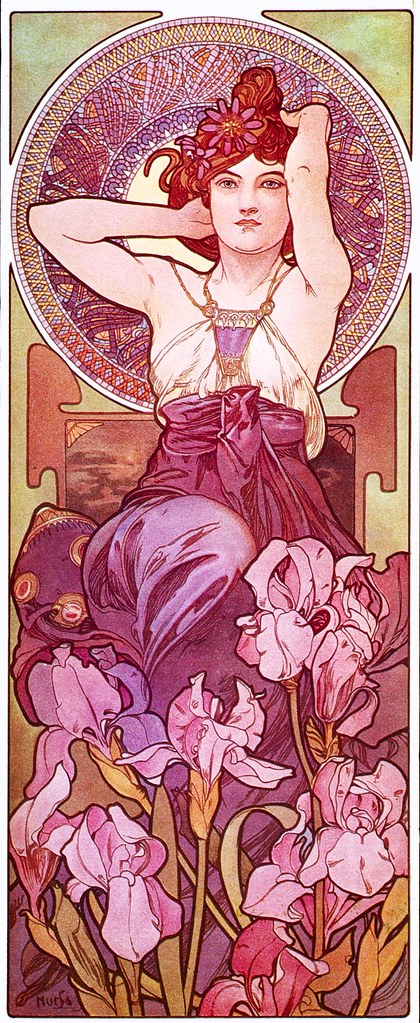
L’Amethyste by Alphonse Mucha, from the Precious Stones series, 1900
Another History and Lore of Amethyst tells it this way.
According to Greek mythology, Amethyst was a young virgin who became the object of wrath of the Greek God Dionysus after he became intoxicated with red wine. When Amethyst cried out to Goddess Diana for help, she immediately turned the girl into a white, shimmering stone (quartz). When Dionysus realized what had happened and felt remorse for his actions, his tears dripped into his goblet of red wine. The goblet overturned, and the red wine spilled all over the white rock, saturating it until it became the purple quartz that is now known as Amethyst.
The name amethyst derives from the ancient Greek word amethustos, meaning sober. It was said that an amethyst could prevent the bearer from becoming excessively drunk and also instills a sober and serious mind. It was believed that if a person drank from a cup or goblet made entirely of amethyst, he or she would not get drunk at all. In Greek mythology, amethyst was rock crystal dyed purple by the tears of Dionysus, the god of wine and revelry. Ancient Egyptians used the stone as the representative of the zodiac sign of the goat. The goat was considered the enemy of vines and vineyards, and therefore the antidote of wine.
I should have realized this before, but the Amethyst Initiative — an effort by 136 chancellors and presidents of universities and colleges across the United States to lower the drinking age which drive illegal drinking underground, making it more dangerous and risky than if it were legal — was named for its mythology, making it “a meaningful symbol for this initiative, which aims to encourage moderation and responsibility as an alternative to the drunkenness and reckless decisions about alcohol that mark the experience of many young Americans.”
So that’s interesting bit of historical trivia. I may have to wear some amethyst just in case. It can’t hurt, can it? Also, I can’t help but ask if anybody else remembers this Amethyst, from the 1980s?
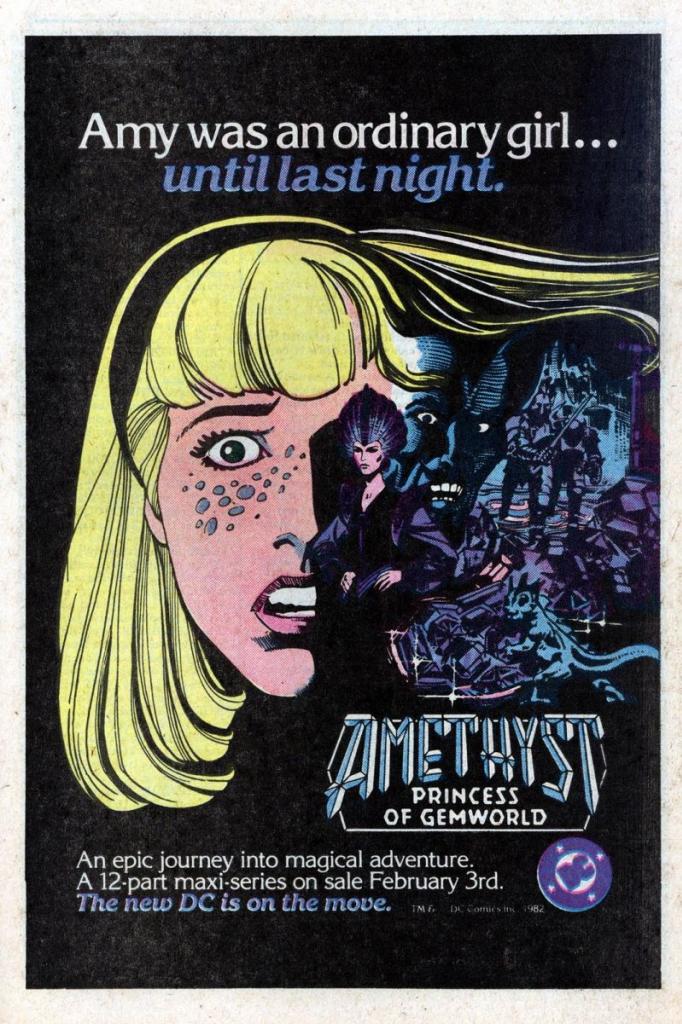
That one was about Amethyst: Princess of Gemworld, a 13-year old girl so I don’t think getting drunk came up very often throughout its short run (though she was recently brought back by DC last year).
Beer In Ads #1051: The Beer That Brings Cheer Throughout All The Year
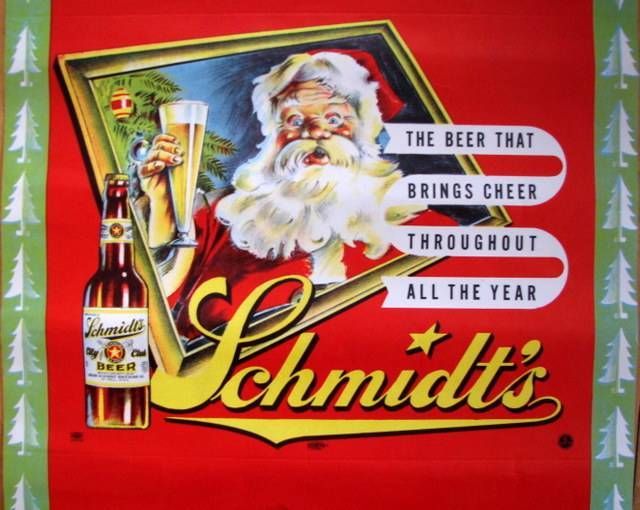
Wednesday’s Christmas ad is for Schmidt’s, from the 1940s. Schmidt’s created a great slogan for the holidays. “The Beer That Brings Cheer Throughout All the Year.” Hard to argue with that. Hoppy Christmas.
The History Of Christmas Infographic

Today’s bonus infographic shows the History of Christmas from 2055 BCE through the 21st century, brought to us by Hayes Garden World of Northwest England.

Types Of Beer

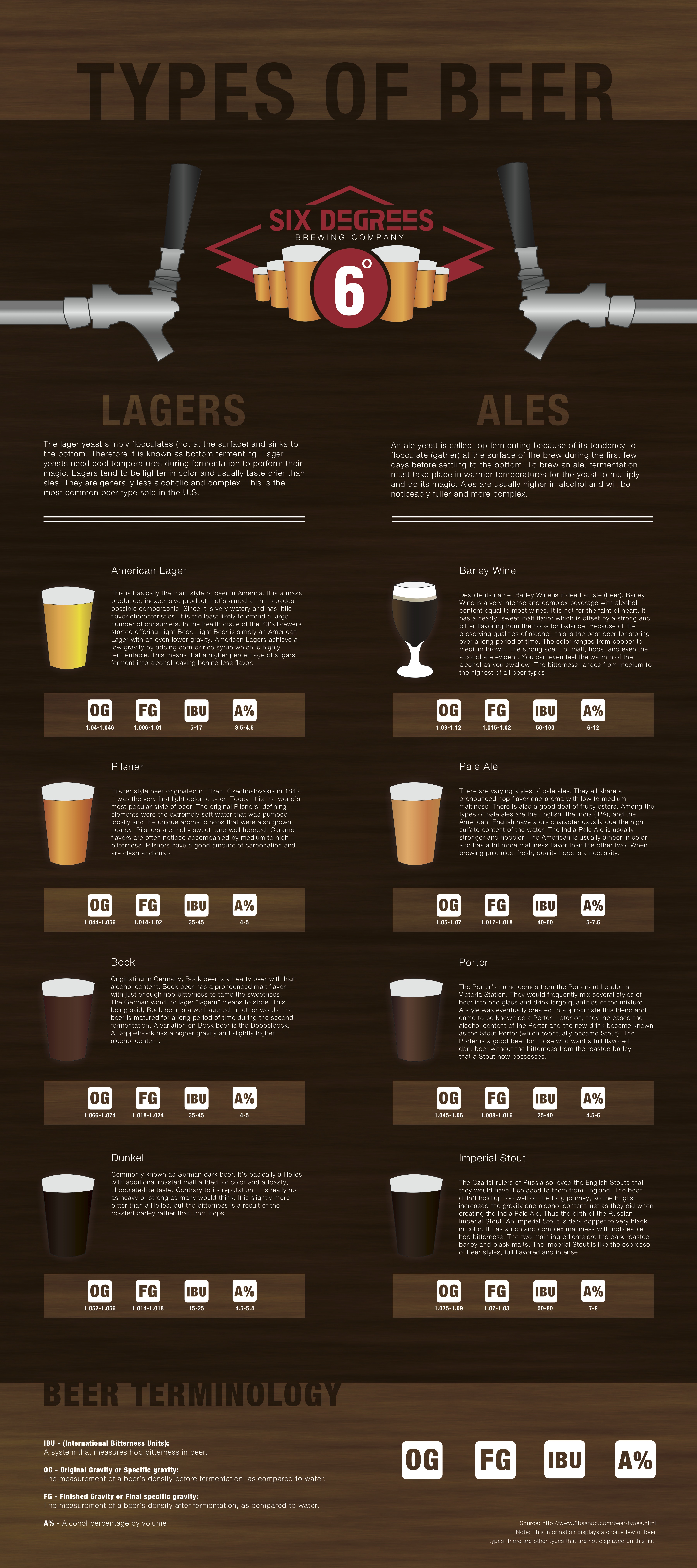
Today’s infographic is entitled Types of Beer, though it shows just eight varieties, four lagers and four ales. It was created by Six Degrees Brewing, a new, in planning brewery, in Rapid City, South Dakota.
Click here to see the infographic full size.
Beer In Ads #1050: Under The Mistletoe
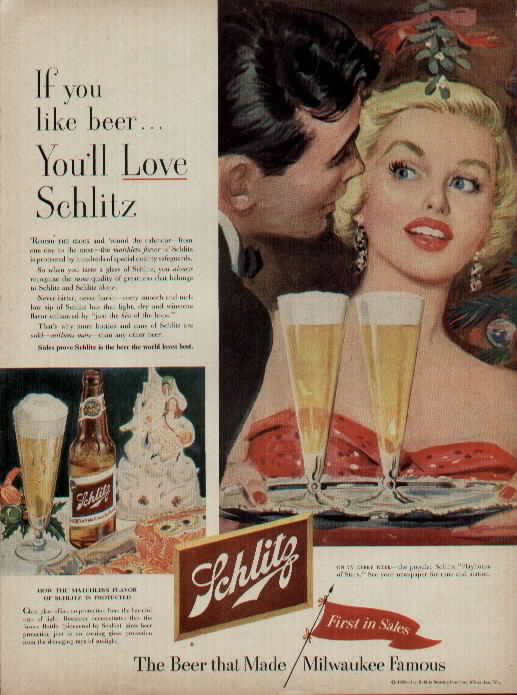
Tuesday’s Christmas Eve ad is for Schlitz, from 1952. It’s a beautiful illustration of an attractive woman carrying a tray with two beers on it caught beneath some mistletoe just as a dashing young man leans in, presumably to exact the kiss demanded of being under the mistletoe. Hoppy Holidays. You can see the artwork alone on my Beer in Art Tumblr.
The Taboo Of Public Drinking

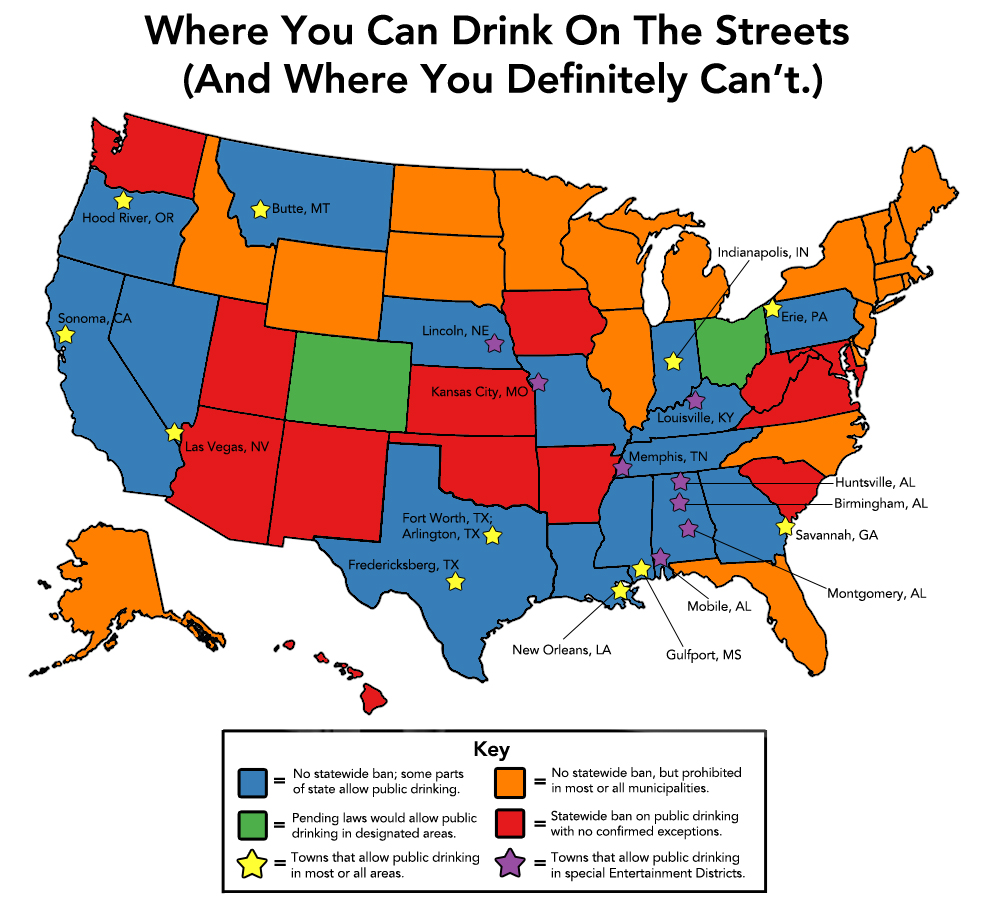
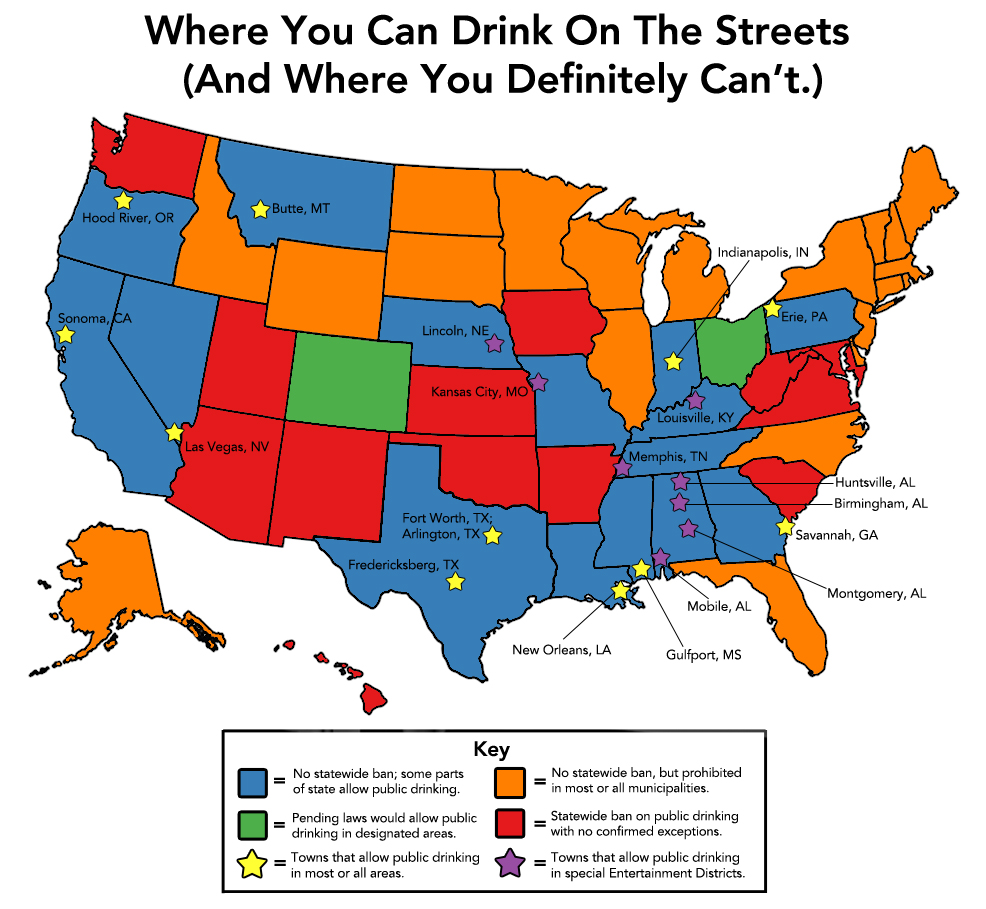
Today’s infographic comes from a story in the HuffPo entitled The Secret History Of The War On Public Drinking, which includes some surprising details. For example, while I think most people believe that drinking in public has been illegal almost forever, ordinances banning public drinking didn’t start being enacted until around 1975. Only about 2% of Americans live in a place which allows public drinking, which is odd when you consider it’s perfectly legal unless a state, town or municipality decides to actively ban it. More backroom mischief by the prohibitionists is more like it. The map below shows where you can and can’t have a beer in your hand in a public place.


Synonyms For Drunk Driving

While no one in their right mind condones driving drunk, a fact utterly lost on prohibitionists like MADD and Alcohol Justice, I thought the latest video PSA from the OLCC (Oregon Liquor Control Commission) was a clever holiday video employing holiday music and lights showing nearly two-dozen synonyms for being drunk. I wonder if they got these from my list of around 5,000 Drunk Words? Please be safe this holiday season.