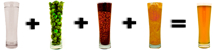
Today’s infographic is a simple illustration showing the basic steps for brewing beer. It was created for a Powerpoint presentation on the Beer Industry by Christian Adeler and Jon Bjornstad in 2011.
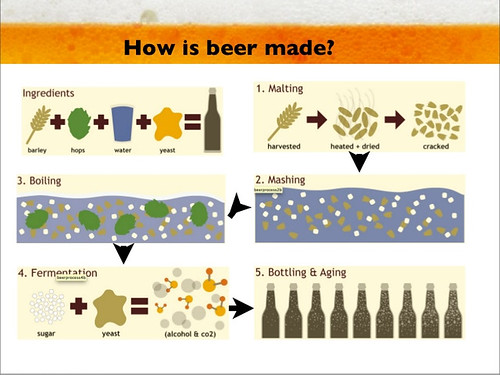

Today’s infographic is a simple illustration showing the basic steps for brewing beer. It was created for a Powerpoint presentation on the Beer Industry by Christian Adeler and Jon Bjornstad in 2011.

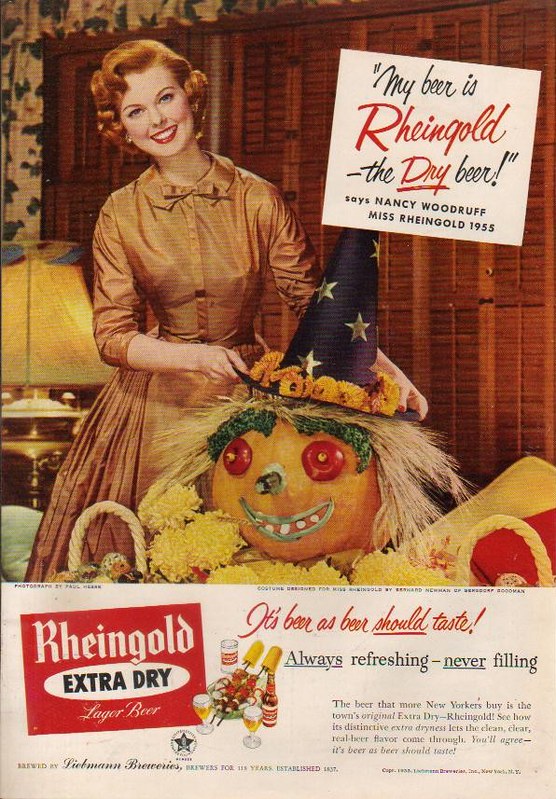
Friday’s ad is for Rheingold Beer, from 1955, and features Miss Rheingold from that year, Nancy Woodruff. The ad shows Miss Rheingold with what must be one of the ugliest Halloween Jack-O-Lantern’s I’ve ever seen. It looks more like a scarecrow than a pumpkin.

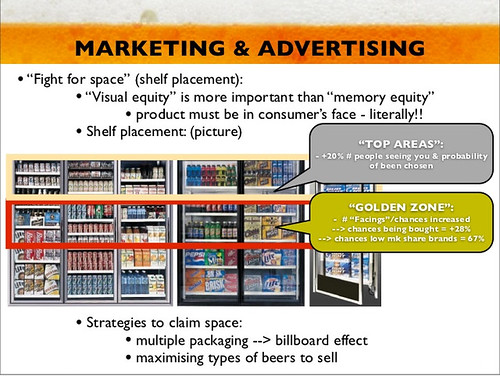
Today’s infographic is titled “Marketing & Advertising,” but it’s really all about shelf placement and the fight for prime real estate on store shelves. It was also created for a Powerpoint presentation on the Beer Industry by Christian Adeler and Jon Bjornstad in 2011. In my experience, craft brewers do pay attention to this, especially the regional brewers, but the big boys have honed it down to a fine science, and use computer software to maximize their efforts.
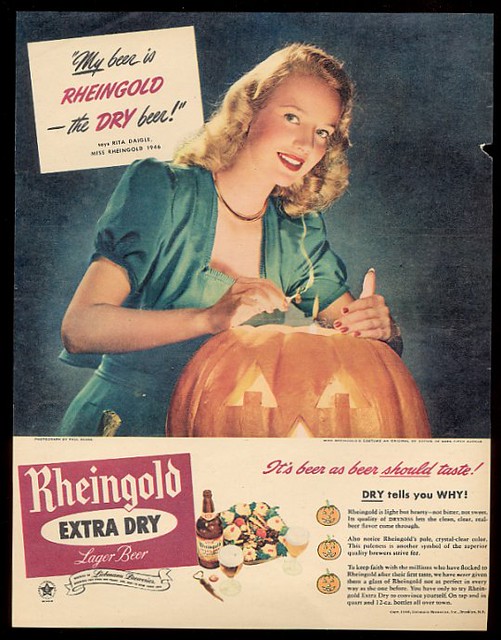
Thursday’s ad is for Rheingold Beer, from 1946, and features Miss Rheingold from that year, Rita Daigle. The ad shows Miss Rheingold looking bewitching as she’s lighting the candle for the Halloween jack-o-lantern. Happy Halloween.

According to a new report by the Beverage Information Group, “the beer industry saw gains in both dollar and volume in 2012 after a three-year downturn.” Their conclusion was that “well-marketed new products and slight improvements in the unemployment rate contributed to the beer industry’s overall growth.” Here’s the group’s press release with additional findings:
Super-premium, Craft, Imported and Flavored Malt Beverages out-performed the industry overall, as there is increasing demand for higher-priced beer. Super-premium and Premium increased 1.6%, and Craft increased 13.7% to reach 185.2 million 2.25-gallon cases. This is the largest increase for Craft beer in more than a decade.
Imported beer also increased for a third year, even though major brands such as Bass, Beck’s and Red Stripe were removed from the category because they are now domestically brewed. This 1% increase is largely due to consumer demand for a wider selection of products.
Innovations in the Light Beer category, such as the launch of Bud Light Platinum, were not enough to turn things around for the category. Light beer declined for the fourth year in a row. Popular and Malt Liquor also lost volume.
Although the beer industry saw positive changes in 2012, challenges still remain. According to the Beer Handbook, the beer industry will still see increases in the higher-priced categories such as Super-premium, Craft and Imported beer. It remains to be seen if these gains will help the beer industry maintain 2012’s positive direction.
“Today’s consumer no longer sees beer as their only drink option,” says Adam Rogers, senior research analyst, Beverage Information Group, Norwalk, Conn. “Spirits and wine marketers have been savvy in targeting consumers with flavored vodkas, rums and whiskies, as well as sweeter wines which have continued to take share away from the beer industry.”
For a mere $790, you can buy a copy of their annual Beer Handbook.


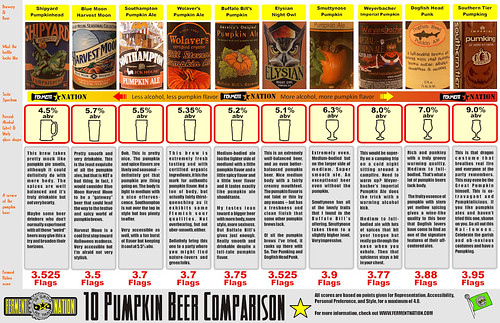
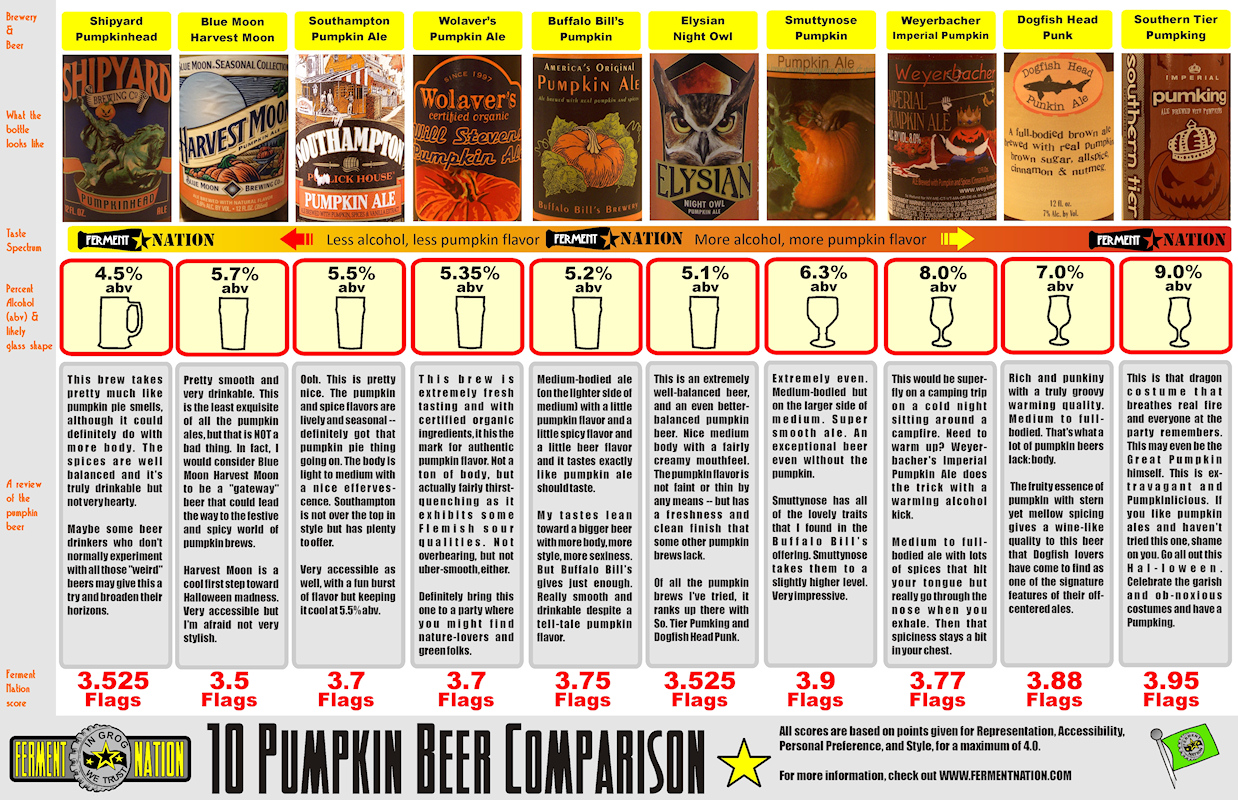
Today’s infographic is a Pumpkin Beer Chart, created in 2009 by Ferment Nation and features ten pumpkin beers.
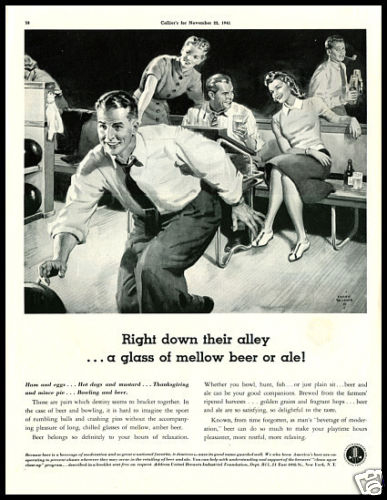
Wednesday’s ad is from 1941, and was for the United States Brewers Foundation, a trade group. Showing two couples bowling with the catchy tagline “Right down their alley … a glass of mellow beer or ale!” Take a look at the guy with the pipe walking by in the background. He looks like he’s checking out the ladies as he’s carrying a pair of beer bottles past their alley.

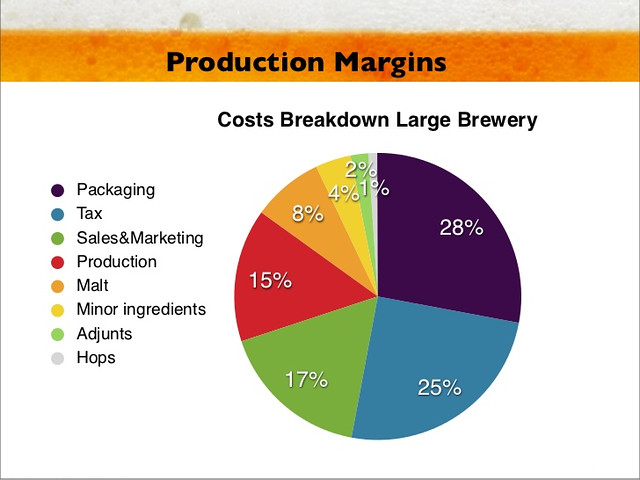
Today’s infographic is titled “Production Margins,” and it’s a pie chart showing the Cost Breakdowns for a Large Breweries. It was created for a Powerpoint presentation on the Beer Industry by Christian Adeler and Jon Bjornstad in 2011. Not surprisingly, the raw materials to make the beer is the lowest percentage, while packaging and taxes eat up over half of the costs alone.

For our 81st Session, our host is Nichole Richard — better known to the beer world as “Nitch” — who writes online at Tasting Nitch. She’s originally from the West Coast and lived in Hawaii, as well, has lived in 15 countries on three different continents, and is currently an expat living in France, and trying her best to “create a craft beer movement among cheap wine drinkers.” Her topic for this session asks bloggers to weigh in on the gender issue — Women in Craft Beer Culture. Are they “scary beer feminists?” Or “a healthy growing demographic?”
Feel free to write about what you want as long as it is beer and woman related!
I would love to see some of our historian beer bloggers give a bit of in depth back ground information on history of women in beer culture. Praise Ninkasi and what not, but were there male brewers before the fall of Rome?
Who did most the brewing in early colonized North America?
How is it that most current African brewers are still housewives while modern brewing is male dominated?
Do a feature on a woman in the beer industry!
Have you inspired your significant other to become beer culture involved? Call it, high five your beer loving wife day.
Are there any men out there who think that women in beer is a bad thing? For religious reasons, women aren’t allowed to tour many Trappist breweries and there are still French chefs who believe that a women on her menstrual cycle cannot make whip cream. (Truth.)
Woman’s palate’s are changing the direction of beer! Are women to blame for the recent increase in fruit beers? …
Are there any women out there who are crusading a flag of femininity while milling malt. Tell us your story!

So two days from now, on Friday, November 1, shake off that post-Halloween hangover and no matter which gender you are, weigh in on the female half of humanity and their role in craft beer culture.
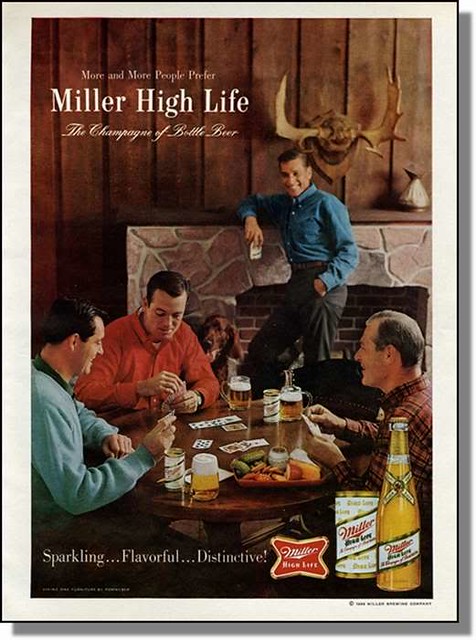
Tuesday’s ad is for Miller High Life, from 1968. In what looks like another hunting lodge, or at least a rec. room, a group of middle-aged men are playing poker, or maybe bridge or even pinochle. But one of them is leaning against the fireplace, by the dog, as if he’s sitting out a hand, or perhaps already folded. The reason I know they’re middle-aged is because nobody else would have dressed like that in 1968, with slicked-down hair, button-down collars and such subdued colors. I don’t think I even realize they still made flannel shirts in the late sixties, although to be fair that turquoise cardigan is rather flamboyant. Sparkling … Flavorful … Distinctive! Indeed.