Brookston Beer Bulletin

Jay R. Brooks on Beer

  • Home
  • About
  • Editorial
  • Birthdays
  • Art & Beer

Socialize

  • Dribbble
  • Email
  • Facebook
  • Flickr
  • GitHub
  • Instagram
  • LinkedIn
  • Pinterest
  • RSS
  • Twitter
  • YouTube

Powered by Genesis

The Top Beer Brand Of 2012

January 4, 2013 By Jay Brooks

ace-metrix
I don’t want to wade neck deep into the “craft vs. crafty” debate — I’m not quite finished digesting it all — so I’m trying to not comment too much about this, yet in this instance, I’m going to at least stick my toe into the murky waters of this issue. (Oh, and a hat tip to Evan Benn for tweeting about this.)

Ace Metrix, a company based in nearby Mountain View, has just released their list of the Top Brands and Ads of 2012. Ace Metrix characterizes themselves as “the new standard in television and video analytics.”

They picked the top brand in fifteen different broad categories. The award does not go to the company with the best product, but to the one that had the best advertising last year, that is whoever received the “highest average Ace Score for their body of work in 2012.” This is best illustrated by reviewing some of the other category “winners.” For example, Olive Garden won for restaurants, so that should tell you something.

In the category “Beverages — Alcoholic” the winner was Blue Moon. You can even view the five Blue Moon commercials that got the highest scores. Now, I like Blue Moon. It’s not a bad beer. It may not be my favorite wit, but unlike many other beers made by big companies, I will drink it if my choices are limited. I know its creator, Keith Villa (who also stars in the commercials), and I’ve judged with him at GABF several times. It’s a great entry level beer, and has been phenomenally successful in that regard and also in marketing itself as not being part of Coors, in the same way that Saturn cars did in setting themselves apart from GM.

But that’s the way of the world, at least in our peculiar pro-corporate brand of capitalism. In brewing, I have to say, things are a lot more transparent than in many other industries. There was also a Geekologie chart of Parent Companies and their Subsidiary Brands, but the site’s been more recently hacked, to get an idea of how literally hundreds of brands are owned by just ten corporations. And I’ll bet dollars to doughnuts that most people weren’t aware of more than a few of those relationships, believing many of those brands to be independent or small companies, if they even cared at all.

Maybe it’s because in the world of beer geekdom we pay so much more attention, but most of the stealth brands like Blue Moon are open secrets. They may not talk about who owns the brands, but the information is out there and available if you bother to look. The thing is, most people don’t. If they like it, they drink it, and they buy it. Period.

Where the trouble comes in, I think, is when doing so infringes on another’s business ethos, or whatever. When small specialty breweries first started popping up, the big guys were initially somewhat helpful but as they began eating into their market share, things started to change. Over the years we’ve seen many attempts, with varying degrees of success, to copy or acquire anything that’s successful. In a sense it’s human nature, or certainly business nature. Do you think it’s an accident that after any successful film or television series, similar shows in the same genre proliferate with alarming alacrity?

But back to the Ace Metrix and their top brands of 2012. In their press release, in a section entitled “Brands of the Year Illuminate Many Notable Themes,” there’s this headline: “Craft Beer and Juice Beat Out Big Beer and Soda Brands.” Here’s the relevant bits about beer:

A changing of the guard was not only seen in the technology category, but also in the beverage category in which Blue Moon usurped the top spot from ‘big beer,’ and Ocean Spray ousted Coca-Cola from the winner’s platform. … Blue Moon swept the Alcoholic Beverage Category with an average Ace Score of 538, beating out big beer brands like Budweiser, Bud Light, Miller Lite and Coors Light, all of which failed to even make the Watch List this year, a stark comparison to 2011.

See the problem? How can Blue Moon have usurped anything from “big beer” when it really is a big beer. And that’s why the Brewers Association had to come out with its recent controversial statement, because even professional business analysts don’t realize who owns what, so what chance do consumers have?

I’m going to steer clear of the BA’s statement itself, at least for now, except to say that I thought the excellent rebuttal by August Schell was heart-wrenching and perfectly illustrated the problems of such statements and definitions. Because those characterizations only matter internally, among insiders and the businesses and professionals working in those industries. And while once upon a time those inner workings remained … well, internal … today almost everything is out in the open, on the internet, and often what might better be private insider discussions become full-blown public debates. Sometimes, it’s simply exhausting.

It’s a bit like beer styles themselves. They only really matter in very rarified situations, like competition judging. In the real world, they matter very little. It’s the same with trying to define beer, or craft beer, or whatever we’re calling it now. I completely understand why the BA needs to define craft beer, because their mission is to promote craft beer. You have to know exactly what and who it is you’re promoting in order to do your job. I get that. From private discussions I had a few years ago with people who were involved in crafting the newer definition over about a year’s time, it was apparently a very contentious process and was extremely difficult because with every changed word, someone was excluded or someone you didn’t think belonged remained. It reminds me a little of a famous quip made by a Supreme Court justice in Jacobellis v. Ohio when, in trying to define hardcore pornography and create an obscenity threshold, Justice Potter Stewart wrote that it was difficult to define, but that “I know it when I see it.”

And that’s the problem, because how you define craft beer is, and should be, different things to different people, with varying priorities and concerns. It may be one thing to the BA, but something else entirely for an average consumer and yet again something more stringent to a hardcore beer geek. The thing is, everybody’s both right and wrong on this one, at least as I see it. When you’re talking about personal preference, it’s ultimately just that: personal. Like pornography or even religion, whatever you believe is correct, for you. Whatever you choose to drink is right for you. I may disagree with your choice, but that’s okay. Happily, they come in these little 12, 16 or 22 oz. bottles and cans, or can be poured into single-serving sizes of glassware, so that we can all just drink what we want, definitions be damned.

Filed Under: Beers, Breweries, Editorial, News, Politics & Law Tagged With: Advertising, Big Brewers, Coors, Packaging

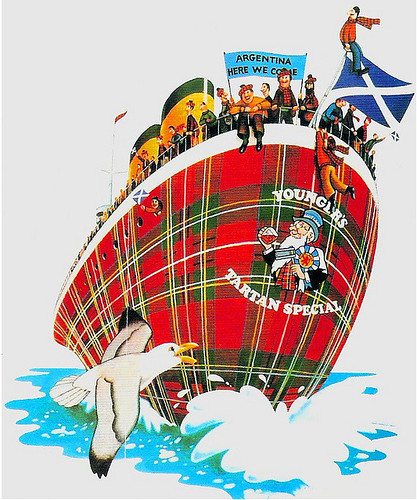
Beer In Ads #774: Argentina Here We Come

January 3, 2013 By Jay Brooks


Thursday’s ad is for the Scottish brand Younger’s Tartan Special, from 1978, when, presumably the beer started to be imported to Argentina. I love the idea of a giant plaid boat, flying the Scottish flag. For some reason this ad reminded me of a scene in the Herman Raucher novel, “Summer of ’42,” where the main character, Hermie, is trying to buy a box of condoms and is thinking as he’s looking over the different packages that whatever color the box happens to be is also the same color as the condom itself. He sees a plaid box and thinks to himself, something along the lines of, “plaid, that’s enough to send a young girl screaming into the night!” It’s funny what sticks in your head. But the idea of a ginormous plaid boat would be quite a sight coming over the horizon.

Youngers-tartan-argentina-1978

Filed Under: Art & Beer, Beers Tagged With: Advertising, History, Scotland

Hopshackles?

January 3, 2013 By Jay Brooks

hopshackles
Regular readers will know how much of a calendar geek I am. Ever since we first moved to Oakland back in 1996, I’ve spent every New Year’s Day morning in line at either of the Pendragon/Pegasus book stores waiting for their amazing calendar sale to begin. They take every calendar that didn’t sell before December 31st from one of their book wholesaler’s warehouses and sell them at 3 for $10, no matter how big or small. We usually buy a few dozen, and have calendars everywhere, including multiple ones in many of the rooms of our home.

One of the page-a-day calendars I picked up this year was “Jeffrey Kacirk’s Forgotten English,” which I thought would be fun, given my love of language and words. It’s based on his book and website. The very first word on January 1 was “hopshackles,” which is one I’ve never heard of.

So a little online research revealed that there’s not much out there about it, actually. Wordnik, from the Century Dictionary and Cyclopedia, has this definition.

n. A shackle or weight used to hobble a horse or other animal.

According to the calendar entry, it was already an obscure word in 1859, when Robert Nare wrote that “what these were, we can only guess,” and he points to the word being used in a 1570 book, “The Scholemaster” [sic]. “Some runners … deserve but the hopshackes.” I think he was talking there about Win Bassett.

So, does it have anything to do with the hops used in beer? Not so much, although the word certainly sounds like it ought to. And apparently, I’m not the only one who thought so, as Nigel Wright named his English brewery, Hopshackle Brewery, after the obscure term, and tells the story of that decision:

Where did the name “Hopshackle” originate from and what does it mean? Strangely enough I first came across the word when watching the popular T.V. programme “Call My Bluff” some years ago. What a cracking name for a brewery I thought should I ever get around to realising a life times ambition! The origin of the word “Hopshackle” is unknown, but it’s transitive verb is to hobble which has several relevant meanings.

Hobble – to walk with an uneven, unsteady or feeble gait; to hinder, perplex or tie together the legs of to prevent escape, kicking, or to regulate pace or stride. Dray horses were hobbled to ensure that they did not waste any of the valuable beer they were delivering

My OED lists the word as obsolete, and the “hop” part of the word as “obscure” and speculate it’s a combining of “hopple” and “hamshackle.” The earliest reference to it is print they have is from 1568. They define it as “a ligament for confining a horse or cow; a hopple or hobble.”

Hopshackle

So I’m glad to see the word may live on at least in the name of a brewery. Because I agree with Nigel Wright, it is a cracking great name that should be brought back from obscurity. But, of course, it’s meaning needs to be updated, modernized and made useful again. So what should “hopshackle” mean, if we’re to bring it back?

Perhaps a previously overly hoppy beer that’s had its bitterness reduced to make a more balanced beer could be said to have “put on the hopshackles.” Or the session IPAs we’re starting to see, as in “Lagunitas’ new DayTime is great for drinking with lunch, because they put on the hopshackles.” Another usage could be a synonym for restrained or balanced, as opposed to extreme beer, like “Stone Brewing’s Enjoy By IPA is a nicely hopshackled beer?

Any other thoughts, idea, suggestions? C’mon people, brainstorm!

Filed Under: Just For Fun, Related Pleasures Tagged With: History, Language

Beer In Ads #773: Beer — The Healthful Refresher

January 2, 2013 By Jay Brooks


Wednesday’s ad is for the Barley and Malt Institue, located in Chicago, Illinois. They remind me a bit of the Beer Belongs series by the U.S. Brewers Foundation, with a beautiful illustration with a ribbon of text and information at the bottom of the ad. What a great tagline: “Beer — The Healthful Refresher brewed with the Goodness of Malt.” The text goes on. “Invigorating! That’s the word for wholesome, refreshing, beer or ale brewed with Barley Malt.”

beer-healthful-refresher-1959

Filed Under: Art & Beer, Beers Tagged With: Advertising, barley, History, Malt

The Beer Monopoly

January 2, 2013 By Jay Brooks

apm
This just drives me crazy for some unknown reason. It happens with alarming frequency that seems to belie a willful ignorance and an amazing ability to act as if the media just woke from a Rip Van Winkle-like nap. The latest culprit is American Public Media, a company that produces public radio programming, including Marketplace, a show that specializes in the world of business. Marketplace is the one that just filed a report on the proposed merger between ABI and Grupo Modelo, the latest in a seemingly unending series of consolidation in the beer commodities market. Entitled Proposed Beer Merger Could Hurt Competition in U.S., here’s part of what the very short report has to say.

Barry Lynn, a fellow at the New America Foundation, argues that over the years, Anheuser Busch-InBev and the world’s second largest beer company, MillerCoors, have created a monopoly.

Really, he “argues?” And it seems like he’s implying that it’s just happened lately, slowly over the years and nobody noticed until now? Maybe I”m reading into that, but that’s how it strikes me. First of all, the “Big Two” — f.k.a. the “Big Three” — have had a monopoly over the beer world for decades, at least since the 1980s, some thirty years. And prior to that, big breweries dominated the beer industry because, well … because that’s all there was: big breweries and regional breweries. I don’t think anyone needs to “argue” that point. I’d say it’s pretty well-settled. I’m not aware of any contrary flat-Earth-like group arguing that there’s no monopoly in the beer industry. But every time there’s a high profile merger, you hear this as if nobody was paying attention until now.

It’s doubly odd because Lynn is apparently an “expert” on monopolies, author of the book Cornered: The New Monopoly Capitalism and the Economics of Destruction, and he also wrote Big Beer, A Moral Market, and Innovation in the Harvard Business Review.

In the latter piece, he expands this theme and claims that “this began to change in the early 1980s, as radical revisions to antitrust law unleashed extreme consolidation in two of the industry’s three tiers. … In brewing, a long series of mergers has reduced the field from more than 48 major brewers in 1981 to two.” But that’s not exactly correct. There weren’t “48 major brewers in 1981.” According to the Beer Institute, who’s kept the number of breweries tally since 1887, there were 38 “traditional breweries” in 1981, along with 10 “specialty brewers.” It’s not the numbers I’m quibbling with, but the characterization that these 48 breweries were somehow equal, or nearly so, by calling them all “major brewers.” I don’t know exactly who the ten were, but it’s a safe bet they included Anchor, New Albion, Sierra Nevada, Boulder, RedHook, none of whom even today, much less in 1981, would be considered “major,” especially when compared to the largest brewers. There was, and is, an enormous difference in the size of these breweries. While there were, of course, a few larger regional breweries still around in 1981, the chasm between the largest and smallest was still dramatic. It sets up a false perception to say that they were all major in 1981 but now only two remain thirty years later. That’s just not what happened.
monopoly-beer
While I don’t recall this term being used, in the 1970s and the very early 80s, there was essentially the “Big 5,” which was the Big 3 plus Pabst and Schlitz. Five companies dominating the industry is hardly much different than three, and still a big difference from the fictional 48. Consolidation of breweries actually began right after Prohibition ended, when many that existed before 1919 never reopened and those that did often struggled mightily. A lot of them were swallowed up quickly by those breweries that enjoyed early post-prohibition success, a pattern that continued from roughly 1934 through the 1980s.

A 1994 study estimated U.S. beer market share by decade of the top 10 beer companies. In 1939, the biggest 10 owned 24% of the market. By 1964, it had more than doubled to 58%. In 1966, worried about what further consolidation would do to the market, the U.S. government intervened to try to keep more consolidation by M&A from happening. They obviously failed. Commenting in 1991, A. M. McGahan, remarked in his piece, “The Emergence of the National Brewing Oligopoly,” that “policy implementation was too late to prevent an oligopoly in the market. The nationwide recognition and brand loyalty earned by the ‘big five’ breweries created momentum, and these firms demonstrated that consolidation was no longer necessary to gain market share. By 1980, the combined production of the ‘big five’ breweries accounted for 75 percent of all domestic beer produced. The top ten largest breweries produced 93 percent of the nation’s beer.”

That 1994 survey largely agrees, estimating that in 1974, the top 10 accounted for 81% of the market and by 1980, their share had risen to 94%, hitting a peak of 98% in 1990. So much for this being a recent phenomenon. The domination of the beer industry by just a few companies is, quite frankly, old hat. Yet this old saw about it having just happened is trotted out every time a new merger occurs. I admit it’s gotten worse, from a sheer numbers point of view now that we’re down to two, but the fact is a near monopoly of the beer market has been with us longer than most of us have been alive.

Later this year, ABI will again go before federal regulators to ask that their purchase of Grupo Modelo be approved. ABI has owned a 50% non-controlling stake in the Mexican beer company for many years, so this would give them control, and the other half of the company. I assume it will sail through. The last time ABI came before the feds was when InBev wanted to buy A-B, and all the government required was that they divest themselves domestically of Labatt’s. Big whoop.

The meteoric rise of — let’s just call it the specialty beer market for now — has created an industry with more breweries than we’ve had in over a century, but even after 35 years only accounts for about 6% of the total market. That percentage has changed only incrementally in all those decades. That there’s a beer monopoly should quite frankly be seen as a given. It’s been with us for a long, long time. So let’s stop pretending with every new merger that this is the one to push us over the edge of decreased competition. As any smaller brewer will tell you, the market has been difficult since the very beginning for every single brewery, especially early on.

The one thing I do agree with Lynn about is this statement about the large beer companies. “They have this remarkable ability to make it seem as if this is the most competitive of marketplaces.” That’s certainly true, as a knowing walk down the average grocery store beer set will prove. So while I’m sure the argument before government regulators will undoubtedly be that competition will not materially be effected by this merger, I agree that it’s hard to see how this latest acquisition will change much. As they say, it’s a little late to close the stable door now that the horse has bolted. But he bolted so long ago that he’s nowhere in sight anymore.

In his Harvard Business Review piece, Lynn suggests that “the threat we face is not only to the variety and quality we all enjoy.” “[C]onsolidation can also threaten the primary outcome of this market — the ability of communities and individuals to manage for themselves this ever so extraordinary commodity.” Again, the fallacy here, IMHO, is that this represents a new threat. The damage has already been done, in fact done so long ago that the wound has healed. Most specialty breweries understand the world they’re trying to do business in, they get that it’s inherently unfair and is unequally balanced, but they’ve figured out how to work within a system that’s been broken almost since it began when the three-tier system was imposed after the repeal of prohibition. [Note: before the heated commentary begins, I admit the three-tier system does work in many ways, and I’m not arguing against it per se, but it has favored larger beer companies and has made life difficult for many smaller ones over the years. There’s no doubt that’s been changing but has more to do with the hard work of countless small brewery employees than any magnanimous sea change by wholesalers.]

Retail and the distribution networks favor consolidation because having to deal with fewer companies is more efficient. That’s why all of the big companies offer a myriad of brand names to give the illusion of choice. When people want choice, it’s easier to pretend to offer just that by creating different packages with very similar stuff inside them, and let advertisers and marketers create preferences. That’s a model that’s worked well in the modern era.

So will this latest merger “hurt competition” in the U.S. beer market? No more than the last one, or the one before that one, or the one prior to the last one, or the one before then, ad infinitum. Is it getting worse? Perhaps, but we’ve had a beer market dominated by just a few big players for such a long, long time that at the very least we should stop pretending this is a new problem that needs addressing with each merger. The beer monopoly has been with us for decades. Whatever solutions there might be to the problems of a consolidating industry — not that I can think of any that have a chance in hell — we should at least be honest about the situation we find ourselves in. Just say know.

You can listen to the entire Marketplace report below.
monopoly-beer

Filed Under: Breweries, News Tagged With: Big Brewers, Business

Beer In Ads #772: Americans Are Going To Eat Better .. Feel Better .. Look Better

January 1, 2013 By Jay Brooks


Tuesday’s ad, the first for 2013, is for Budweiser, from 1945, when World War 2 was at its end and optimism was running high. This one is also quite remarkable, and te text-heavy ad argues that the laboratories of Anheuser-Busch during the war have done great thinks to combat that other scourge of the age; malnutrition. The message is clear. Do your duty and drink Bud, so they can continue their nutritional research. Thank you A-B.

Bud-1945-feel-better

Filed Under: Art & Beer, Beers Tagged With: Advertising, Budweiser, History

Beer In Art Reboot

January 1, 2013 By Jay Brooks

art-beer
Once upon a time — okay, a couple of years ago — each Sunday I posted a work of art featuring beer or some aspect of brewing in my Beer in Art series. Sunday got increasingly busy with the family and it was taking a long time to research each artwork, so I quietly migrated the project to a Tumblr blog, also named Beer in Art. It’s been going strong ever since, and every day, not weekly, I post a new work of beer-themed art. The trade-off is that there isn’t as much information about each piece, but the advantage is more art, seven times as much to be exact. There’s nearly two year’s worth of daily art already there in the archives, stretching back to February 2011, when I made the switch.

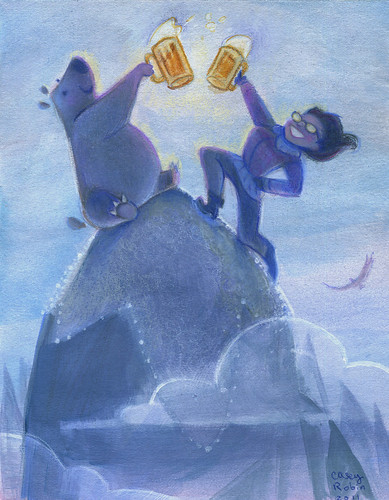
For example, today’s work is by Robin Casey, a California artist, and is appropriately titled “Ring in the New Year … with Beer!” The art runs the gambit from old, traditional works to modern, abstract takes, along with artistic advertising and illustration, clever doodles and t-shirt art, amateur and professional works, from all over the globe, using paint, sculpture and a digital paintbrush; really anything that uses beer or beer’s ingredients as, or in, a work of art. Check it out every day, around Noon, for a new Beer in Art masterpiece.

Robin-new-year-beer

Filed Under: Art & Beer, Beers Tagged With: Blogging, Tumblr

Beer In Ads #771: To Help A Child’s Dream Come True

December 31, 2012 By Jay Brooks


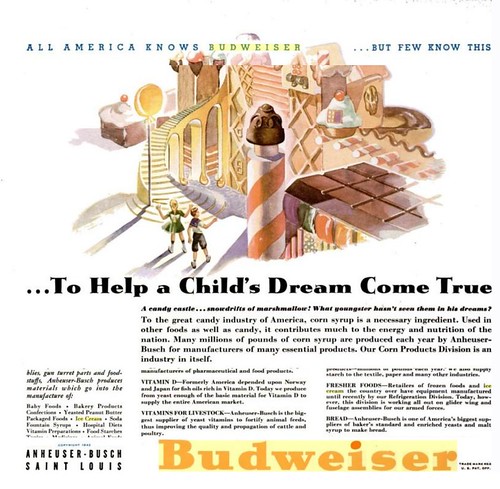
Monday’s ad is also for Budweiser, again from 1942. This one is quite remarkable, and uses corn syrup and the love of candy by children to make its case. Here’s the thinking. “To the great candy industry of America, corn syrup is a necessary ingredient. Used in other foods as well as candy, it contributes much to the energy and nutrition of the nation.” Thus, A-B’s “Corn Products Division” is as wonderful as their beer business. So drink Bud and “Help a Child’s Dream Cone True.”

Bud-1942-kids-dreams

Filed Under: Art & Beer, Beers Tagged With: Advertising, Budweiser, History

The Science Of The Spins

December 31, 2012 By Jay Brooks

spins
Given that today is New Year’s Eve — what I generally refer to as Amateur Drinking Day — I thought this science lesson from Mental Floss on what causes the spins was an appropriate topic. In Why Does Alcohol Cause the Spins?, author Matt Soniak explains that sometimes after an evening’s drinking that the room appears to be spinning out of control. You lie down, but it doesn’t help. No matter what you do, the vertigo persists, causing great discomfort and often the loss of lunch, dinner and everything else that used to be in your stomach. Here’s why.

The spins happen because of an odd effect alcohol has on your ears — specifically, on three tiny, fluid-filled structures called the semicircular canals. Inside each of these canals is a fluid called endolymph and a gelationous structure called the cupula, which is filled with cells covered in fine, hair-like stereocilia.

As you move around, the movement of the endolymph lags behind the more solid cupula, distorting and bending it — and those little hairs. When the hairs bend, the electrical signal they send to your brain is altered, helping you to make sense of the rotations your head experiences on each of the three planes the canals sit on — movements up and down, left and right and backward and forward — and keep your balance.

Booze throws this system out of whack. Alcohol thins the blood, and when boozy blood travels to the inner ear, it creates a density difference between the cupula and the fluid in the canals, and distorts the cupula’s shape. The little hairs bend and send a signal to your brain that tells it you’re rotating when you’re really not, and this illusion of motion makes it seem like the room is spinning.

Some of the things that you most want to do when you’re good and drunk, like lie down and close your eyes, make the sensation worse, since you don’t have any visual or physical cues to counteract the false sense of motion. Looking at a fixed object and keeping your feet planted on the ground can help lessen the effect, but there’s no real way to stop it.

So now you know. The bad news is there’s pretty much nothing you can do about it apart from practicing moderation and drinking plenty of water. If I know I’ll be drinking a lot, I try to eat a hearty meal beforehand, drink a glass of water in between each beer, snack during the party and take some Advil and Vitamin B before going to sleep. Happy New Year everybody.

Maybe this will help; maybe not.

the-spins

Filed Under: Beers, Just For Fun, Related Pleasures Tagged With: Hangovers, Humor, Science

The Magic of Brewing, the Joy of Beer

December 31, 2012 By Jay Brooks

magic
Take a tour of the Suffolk brewery Greene King with head brewer John Bexon hosted by UK beer writer Roger Protz. The video, entitled The Magic of Brewing, the Joy of Beer, runs just under a half-hour and includes a tour of Greene King’s “traditional brew house and fermenting area, taking in the ancient wooden vats where Strong Suffolk is matured.” Enjoy.

Filed Under: Breweries, Just For Fun Tagged With: Science of Brewing, Travel, UK, Video

« Previous Page
Next Page »

Find Something

Northern California Breweries

Please consider purchasing my latest book, California Breweries North, available from Amazon, or ask for it at your local bookstore.

Recent Comments

  • Bob Paolino on Beer Birthday: Grant Johnston
  • Gambrinus on Historic Beer Birthday: A.J. Houghton
  • Ernie Dewing on Historic Beer Birthday: Charles William Bergner 
  • Steve 'Pudgy' De Rose on Historic Beer Birthday: Jacob Schmidt
  • Jay Brooks on Beer Birthday: Bill Owens

Recent Posts

  • Beer In Ads #5219: Good Old Point Special Bock Beer April 12, 2026
  • Beer In Ads #5218: The “Butter-In” Of The Season April 12, 2026
  • Beer In Ads #5217: The King Of All Beers April 11, 2026
  • Historic Beer Birthday: Gambrinus April 11, 2026
  • Beer In Ads #5216: The Finest Bock, As Usual April 11, 2026

BBB Archives

Feedback

Head Quarter
This site is hosted and maintained by H25Q.dev. Any questions or comments for the webmaster can be directed here.