Brookston Beer Bulletin

Jay R. Brooks on Beer

  • Home
  • About
  • Editorial
  • Birthdays
  • Art & Beer

Socialize

  • Dribbble
  • Email
  • Facebook
  • Flickr
  • GitHub
  • Instagram
  • LinkedIn
  • Pinterest
  • RSS
  • Twitter
  • YouTube

Powered by Genesis

The Absurdity Of Binge Drinking Statistics

January 11, 2012 By Jay Brooks

binge-barney
This is one of those things that’s increasingly pissing me off, because it avoids real problems that some people have with alcohol in favor of trying to turn individual problems into an epidemic. It’s not. If anything, overall consumption of alcohol is decreasing. But it’s hard to get funding, finance addiction clinics and raise money to fight the scourge of alcohol if you don’t make the situation sound as dire as possible.

Take binge drinking, for example. ABC News just did a story (thanks to Julia Herz for tweeting it) about a “new” report claiming that 38 million Americans “binge drink an average four times a month.” Their story, entitled CDC: Millions of Americans are Binge Drinkers, details how the CDC is claiming that 1 in 6 “adults binge drinks about four times a month, and on average the largest number of drinks consumed is eight.” Not only that, but this is apparently on the rise. Here’s what the CDC website has to say.

New estimates show that binge drinking is a bigger problem than previously thought. More than 38 million U.S. adults binge drink, about 4 times a month, and on average the largest number of drinks consumed is eight. Binge drinking is defined as consuming four or more drinks for women and five or more drinks for men over a short period of time.

In the ABC report, Dr. Fulton Crews, director of the Center for Alcohol Studies at the University of North Carolina at Chapel Hill is quoted in what must be one of the most out-of-touch statements ever made on this subject. “But most people don’t realize that binge drinking is unhealthy.” Seriously? Is there anyone who hasn’t been bombarded with neo-prohibitionist propaganda, whether it’s our government, MADD, Alcohol Justice or some other anti-alcohol group. My kids started receiving the message literally in kindergarten, before they were even able to process it. There isn’t a man or woman alive who believes that drinking too much is good for you.

What people might not know is that what it means to be a “binge drinker” is not as concrete as these “reports” insist. How binge drinking is defined keeps changing, and always it’s narrowing, pulling more people into the circle of binge drinkers, not because they’re suddenly drinking more, but because how it’s defined has changed. I don’t want to repeat myself too much, but I detailed some of the history of this transformation a couple of years ago, in two posts entitled Inflating Binge Drinking Statistics and Son of Binge Drinking Statistics Inconsistencies. And the year before that I wrote about it in Inventing Binge Drinking. What’s clear is that binge drinking went from something somewhat vague — you knew it when you saw it — to ever more specific definitions, the kind that could be quantified and used to alarm people, and, by no small coincidence, be used by anti-alcohol folks in their propaganda.

So yet again the definition seems to be changing. The actual number of “too many” drinks has been somewhat fixed for the last few years at 5 for a man and 4 for a woman. But what keeps changing is the period of time. Initially it was “in a row,” then “within a few hours.” This latest CDC “report” says “in a sitting” and “over a short period of time,” which conceivably could be almost any length of time. At least the ABC report mentions this inconsistency, noting that the definition of the National Institute on Alcohol Abuse and Alcoholism, says the alcohol must be consumed in “two hours or less.” That works out to a beer every thirty minutes for a woman, and for a man, one every 24 minutes.

But what’s also absent from their definition of binge drinking is weight. The definition of being considered drunk is always expressed as a calculation combining time, the amount of alcohol consumed and the weight of the person drinking it. But binge drinking never takes that into account, apart from dividing up gender, presumably under the premise that men are generally bigger than women. That reality, of course, is not true in every case. And it may be indelicate to say so, but with our obesity issues as a nation, in theory it should be taking us longer to actually get drunk today than it did twenty years ago. But the reality is that a 200-pound man will take longer to get drunk than a 120-pound man. The same amount of alcohol will effect the two differently. So why should both be defined as binge drinkers if one becomes inebriated but the other does not?

And frankly, there’s another elephant in the room that troubles me, but is rarely, if ever, talked about. If you’re an adult and choose to drink 5 beers in a row, are not driving, and are not in any other way putting yourself or others at risk, why shouldn’t you be allowed to go a little crazy once in a while? You are, actually. It’s not illegal. Although neo-prohibitionists might not like it, there’s nothing to stop you from going on a bender if you feel like it. You shouldn’t be made to feel guilty about it. If it gets out of hand, your friends and family will likely step in. If it doesn’t so what? Who are you hurting? But every time these “reports” come out, the implication is that binge drinking is bad no matter what. But not all bingeing is the same, especially as they now define it. The average beer dinner runs to at least five courses (unless Sean Paxton is doing it), meaning that every single person attending such a beer dinner is considered a dangerous “binge drinker” by the CDC and other government agencies. Is that rational or realistic? Of course not. That’s entirely different from a person who bellies up to the bar and downs five shots of rotgut in rapid succession. Yet both are considered equally dangerous and costing society untold millions of dollars. It’s absurd.

Here’s some more of the statistical data, which it should be noted was complied through a telephone poll, from the CDC’s press release:

As reported in this month’s Vital Signs, the CDC found that those who were thought less likely to binge drink actually engage in this behavior more often and consume more drinks when they do. While binge drinking is more common among young adults aged 18–34 years, binge drinkers aged 65 years and older report binge drinking more often—an average of five to six times a month. Similarly, while binge drinking is more common among those with household incomes of $75,000 or more, the largest number of drinks consumed on an occasion is significantly higher among binge drinkers with household incomes less than $25,000—an average of eight to nine drinks per occasion, far beyond the amount thought to induce intoxication.

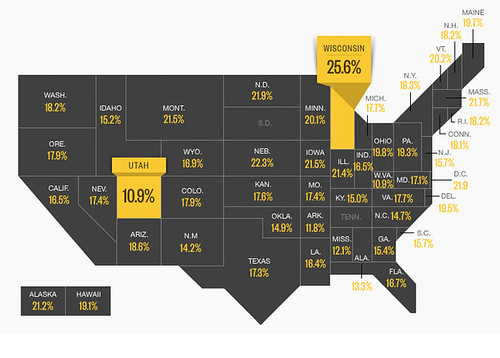
Adult binge drinking is most common in the Midwest, New England, the District of Columbia, Alaska, and Hawaii. On average, however, the number of drinks consumed when binge drinking is highest in the Midwest and southern Mountain states (Arizona, Nevada, New Mexico, and Utah), and in some states— such as Louisiana, Mississippi, and South Carolina—where binge drinking was less common.

But perhaps where this absurdity becomes most evident is in one of the CDC’s suggestions on how to combat binge drinking, which they list under the heading “what you can do.” Here’s the suggestion: “Follow the U.S. Dietary Guidelines on alcohol consumption; if you choose to drink, do so in moderation — no more than one drink per day for women and no more than two drinks per day for men.” Except those are NOT the most recent USDA dietary guidelines. Not even close. The 2010 guidelines “defines ‘low-risk’ drinking as no more than 14 drinks a week for men and 7 drinks a week for women with no more than 4 drinks on any given day for men and 3 drinks a day for women.” So that’s two government agencies that can’t agree on safe levels of consumption, and one that’s essentially lying about it to bolster their own point of view. The UK has had similar problems with their guidelines, when it was revealed a few years ago that their government just made up the safe guidelines, which then became carved in stone for the next twenty or more years, despite being literally plucked out of thin air.

Before the angry comments start flooding in again, I should point out that I don’t believe that binge drinking is always a good idea, or that people should do it all the time. I’m not arguing in favor of it. However, I do believe one does have the right to go on a binge if they feel like it (and as long as they’re being safe and aren’t doing so frequently enough to alarm those people closest to them). I do believe that how the CDC and others define binge drinking is ludicrous and does more harm than good. By making almost everyone a binge drinker through their ever-narrowing definition, they’re avoiding dealing with the serial binge drinkers who really are hurting themselves, and possibly others around them. This does nothing to combat the people who really need help. All it does is demonize all alcohol drinkers, making us all the same, which even the most jaded neo-prohibitionist has to admit, we’re not. It’s not how many drinks one has, or over what period of time, it comes down to how one handles themselves in that situation. If you’re a safe and responsible drinker, none of the rest of that even matters. Drink by example, that’s my new motto.

UPDATE: One of the biggest problems with studies like this is how uncritically they’re reported by the mainstream media. The most common way a press release like this one is used is by taking it and maybe changing around the words slightly but essentially just regurgitating it wholesale, not doing any follow up or critically examining it, and accepting all of it without question. That’s not what journalism should be, but in many cases that’s what it’s become, sad to say. Case in point is The Daily’s piece on it, Binge There, Done That. On the plus side, there’s this cool infographic they created based on the data from the telephone polls that the CDC conducted. On the negative side, there’s no key to the data, but the report mentions that it’s the “percent of the population” that are binge drinkers.
120112-binge-drinking

Filed Under: Editorial, Politics & Law Tagged With: Anti-Alcohol, Prohibitionists, Statistics

Beer In Ads #517: Pouring Carling Black Label

January 10, 2012 By Jay Brooks


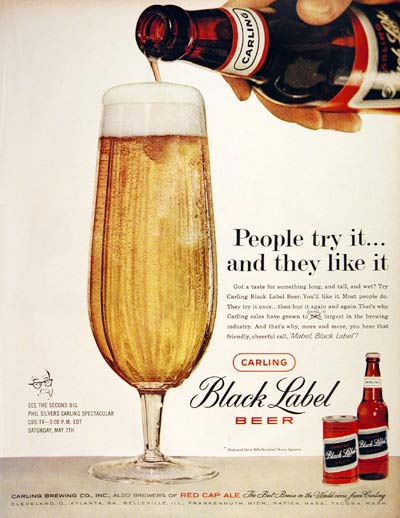
Tuesday’s ad is for Carling Black Label, from 1960, from their “People try it … and they like it” series. The ad simply shows a glass of Carling Black Label being poured into a glass. I’m thirsty. But does that glass look striped? Like it’s a crystal glass with vertical indentations? Hmm. Something is making it look that way, but I can’t quite figure out why.

60carlingblacklabelbeer

Filed Under: Art & Beer, Beers Tagged With: Advertising, History

Beer In Ads #516: Next Time You’re Drinking Beer, Look At The Label

January 9, 2012 By Jay Brooks


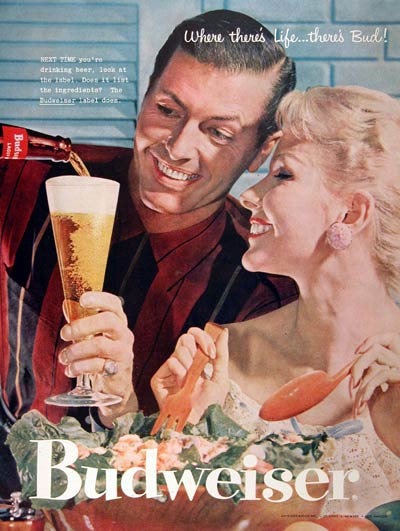
Monday’s ad is for Budwesier, from 1957, from their “Where’s there’s Life … there’s Bud!” series. Showing a couple presumably making dinner as the wife tosses a salad while her husband pours the beer, which she appears to find far more interesting than the salad. But what I really love is the ad copy in the top left-hand corner. “NEXT TIME you’re drinking beer, look at the label. Does it list the ingredients? The Budweiser label does.” Wow, so that means it is better. Barley, rice, hops, yeast and water. And the others that don’t list their ingredients. What do you think they’re using? Grapes? Corn? Well, okay maybe corn.

57budweiser

Filed Under: Art & Beer, Beers Tagged With: Advertising, Budweiser, History

There Are 1,952 Craft Breweries In The United States

January 9, 2012 By Jay Brooks

beer-art-poster
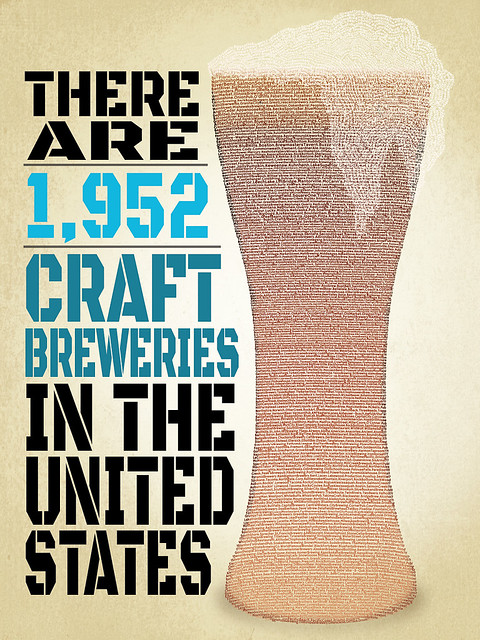
This is a pretty cool piece or artwork that would look great on your wall. Los Angeles-based artist David Odere has created a poster entitled There Are 1,952 Craft Breweries In The United States, in which the glass of beer, head included, contains the names of every one of those 1,952 breweries. The poster is below, but to really get a flavor for it, look at in his website, Factry, where you can zoom in on it to read all of the brewery names. Last time I’d checked, the number was in the high 1800s, but I guess we’ve gone way past 1900 since then. Can hitting 2,000 breweries be very far away at this point? See if you can find your own or the ones in your area. For $20 (plus shipping) you can also but an 18″ x 24″ poster of it.

1952-craft-breweries

And if you love bacon, be sure to check out his other poster, Everything Goes Good with Bacon.

Filed Under: Art & Beer, Breweries, Just For Fun, Related Pleasures Tagged With: California, Gift Ideas, United States

Beer In Art #156: Adriaen Van Ostade’s Ale House Interior

January 8, 2012 By Jay Brooks

art-beer
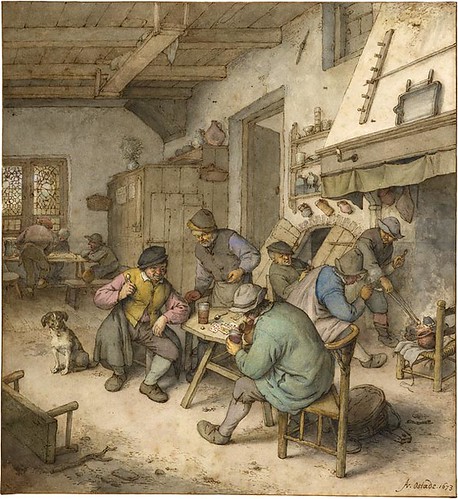
Today’s work of art is by the Dutch artist Adriaen van Ostade, a Golden Age painter of genre scenes. The painting is usually known simply as Ale House Interior though its full title is actually Ale House Interior with Nine Peasants Smoking, Drinking, and Playing Cards or Tric-trac. Completed in 1673, it’s “pen and brown ink, brown wash, watercolor in varying tints of gray, green, yellow, purple, and pink, with some bodycolor, over traces of graphite, on paper; [with a] framing line in brown ink.” Today, the original is in the Morgan Library & Museum in New York City.

ostade-ale-house-interior-1673

Here’s how one source describes the painting:

This magnificent drawing was executed using a very elaborate technique, signed and dated by Van Ostade. In a highly detailed manner, it depicts the interior of a tavern and the different activities going on: a card game, beer drinking, a relaxing smoke by the fireplace. The dress, furniture, accessories and decor are all accurately rendered in this scene of daily life in Holland during the seventeenth century.

To learn more about Adriaen van Ostade, Wikipedia and the J. Paul Getty Museum each have a biography of him, and you can also see links to his works online at ArtCyclopedia. The Web Gallery of Art and the Wikimedia Commons also feature a number of his paintings.

Filed Under: Art & Beer, Beers Tagged With: The Netherlands

Guinness Ad #101: Encore!

January 7, 2012 By Jay Brooks

guinness-toucan
Our 101st Guinness ad is from 1950, and appears to be by an artist named “Victoria.” According to an auction website, it was originally “printed by Mills & Rockleys Ltd., Ipswich.” The ad features a blonde lass in a red dress playing the harp on the Guinness label, while a glass of Guinness awaits her, sitting on a table by her side.

Guinness-encore-500

Filed Under: Art & Beer, Beers Tagged With: Advertising, Guinness, History

Consumer Reports Rates Mainstream Beers

January 7, 2012 By Jay Brooks

consumer-reports
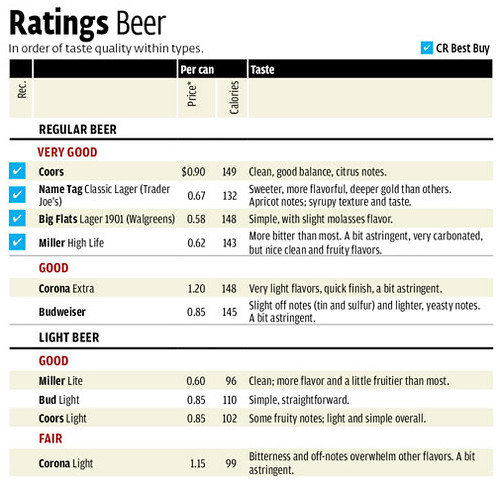
At the end of December, Consumer Reports sent out a press release regarding a beer tasting they’d conducted by an unnamed panel of “experts.” Curious as I was, especially as similar tastings have gone somewhat badly in the past, I held off any judgment until the full report became available, which happened January 3 (though it will be in the February print edition). Here’s the salient parts of the press release, Coors Outscores Bud in Consumer Reports’ Taste Tests of Beer:

Looking to enjoy the last weeks of football season with the perfect brew? Coors regular topped Consumer Reports’ recent taste test of beers, blowing away nine brews including Budweiser and Bud Light. Name Tag and Big Flats — store brands from Trader Joe’s and Walgreens respectively — beat out top-sellers Corona Extra and Budweiser. The full report and Ratings of beer is featured in the February issue of Consumer Reports and online at www.ConsumerReports.org.

To determine the best brews, the experts at Consumer Reports conducted blind taste tests of ten lagers — eight top-selling regular and light beers plus two store brands. Although none of the beers were scored a touchdown, Coors, which scored Very Good but not quite high enough to be rated excellent, came close, standing out for balanced flavors with citrus notes and no off-tastes. In addition to earning the highest marks in Consumer Reports’ tests, Coors, available for $6.45 for a six-pack, was deemed a CR Best Buy along with runners-up Name Tag (Trader Joe’s), Big Flats (Walgreens), and Miller High Life.

When it comes to choosing a beer, taste may be the most important factor to consider, but Consumer Reports tests found that consumers should also keep the following in mind:

  • Regular vs. light. Light beer has 20 to 50 less calories per serving due to lower carbs and slightly less alcohol, but no tested light scored high enough to be very good. Miller Lite, which had more flavor and is a little fruiter than most, was best of the bunch; Corona Light, a bitter brew with traces of tinny and sulfury off-notes was the worst.
  • Price vs. taste. Corona Light costs far more than the higher-rated Miller Lite; and Corona Extra costs about twice as much as three better beers – Name Tag, Big Flats and Miller High Life.
  • Cans vs. bottles. Consumer Reports tasted beer from cans which do a better job than bottles in keeping light, beer’s nemesis, from getting inside. Light can react with beer within weeks or even days to create compounds similar to those a skunk uses to defend itself.

The complete beer Ratings are available in the February issue of Consumer Reports and online at www.ConsumerReports.org starting January 3.

So now they’re out, let’s look a little closer.

On the Plus Side:

  • They used cans for their tasting because they “do a better job than bottles in keeping light, beer’s nemesis, from getting inside.”
  • They included private label, contract beers.

To be fair, I had to stretch to find something positive. While there are advantages to cans, a fresh beer in a bottle or can that’s been well-maintained and cared for should be indistinguishable, and since (one hopes) they poured the beer into a glass first it should really make no difference. And then, of course, limiting the tasting to beer in cans arbitrarily leaves out a lot of good beer, though they left out more than enough on their own.

CR-beer-ratings-feb-2012

On the Minus Side:

  • Only 10 Beers (6 regular, 4 low-calorie)? Really, that’s not very representative of the market. Just sticking to the big guys, there’s no MGD or PBR. There’s no Yuengling. And at this point, to ignore the national craft brewers like Sam Adams, Sierra Nevada and New Belgium seems like a big disservice to their readers. Yes, BMC represent the majority of beer sold, but they’re no longer the only game in town. By ignoring other beers, Consumer Reports is in a sense helping to maintain the status quo. In their world, it’s as if the decline of big brands and the rise of craft beer is not even happening.
  • As I said before, this kind of tasting does not help their readers. I don’t know the exact demographics of Consumer Reports subscribers, but it seems fair to say they’re not the sort of people who buy whatever’s cheapest or whatever’s on sale. They care about what they’re buying. They want the best value or the best quality products. Otherwise, why bother reading a publication that’s supposedly dedicated to those principles. So by ignoring quality and choosing beers to rate based purely on popularity, they’re not telling their readers about quality beers that may be more expensive, but given how much more flavorful they are might be the better value. Of anyone, Consumer Reports should know that price is not the primary factor in determining value.
  • Sorry to keep beating a dead horse, but also by not going beyond the three most popular domestic brands and one import, Consumer Reports missed an opportunity to tell their audience looking for guidance why cheaper isn’t always better. That buying full-flavored beers means drinking less, but enjoying it more. Instead, they fell back on what they’ve always done; dumbed it down and went for numbers over intangibles, price over value, the big over the smaller. Pathetic.
  • I don’t know who their so-called “experts” included, but calling Big Flats “very good” in my mind calls into question their credentials or experience. Because Big Flats, when we tried it at one of my Philopotes Society meetings, was all but undrinkable. And not just by me, but by the entire assembled group, who included experienced judges and brewers that I’ve conducted tastings with for years. Swill, to be kind. And my experience with the others makes me wonder by what standards they were judging the beers. At what temperature were they served? Did they discuss the beers and come to a consensus or merely assign them scores and let the numbers speak for themselves. In order to have your results taken seriously, I think at the very least the methodology used has to be disclosed so the rankings can be placed in that context. There’s no key that explains the difference between a “very good” beer and merely a “good” one, or what the others ratings might be, such as below “good” or above “very good.” I could never in good conscience call Corona a “good” beer. And Budweiser may be a well-made beer, but it lacks that key ingredient I look for in my beer: flavor.
  • Indeed, all of the beers on the list are very lightly flavored beers. Most judges, even experienced ones, would have a hard time distinguishing them blind. I realize that sometimes you have to judge such beers, but I think it would be difficult to rate Coors, Name Tag, Big Flats and Miller High Life as being essentially the same, all “very good.” That seems like a stretch. And at any rate, why bother rating beers that are so much alike and whose sales have more to do with advertising and brand loyalty than taste? Is any loyal Bud fan going to be swayed by this tasting and suddenly switch to Coors? Beer just isn’t like a new refrigerator or toaster.
  • I concur that there are no “very good” or above light beers, but I’d have a hard time calling any of these “good,” either. But that’s perhaps a personal preference. I find all low-calorie light beers an abomination, a slap in the face to good beer everywhere. They have no business even existing, let alone being best-sellers. They’re a triumph of advertising and marketing over good sense and taste.

So it seems to me that Consumer Reports, a well-respected publication, really booted this one and did very little, if anything, to educate their readers and give them some truly useful information about what beers to try. From their choices of which beers to rate and the way in which they rated them, there’s very little here to change anyone’s mind about which beer to choose, or indeed how to choose a good beer in the first place.

Filed Under: Beers, Editorial, News, Reviews Tagged With: Mainstream Coverage

Beer In Ads #515: Curl Your Hand Around A Frosty Glass Of Pleasure

January 6, 2012 By Jay Brooks


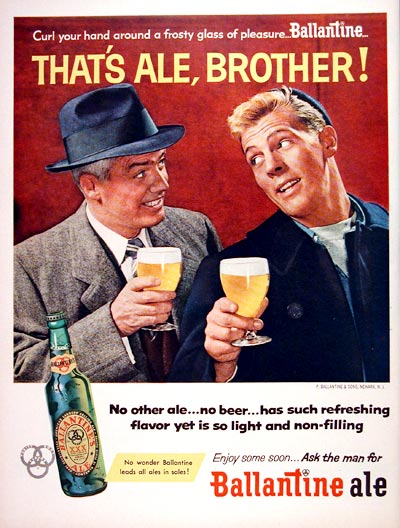
Friday’s ad is for Ballantine Ale, from 1956. Showing an ambiguous pair of dudes eyeing one another, with frosty glasses of pleasure curled around each hand, who are saying — in unison, perhaps? — “That’s Ale, Brother!” And then there’s this great copy below. “No other ale … no beer … has such refreshing flavor yet is so light and non-filling.”

56ballantineale

Filed Under: Art & Beer, Beers Tagged With: Advertising, Ballantine, History

Session #59: I Almost Always Drink Beer, But When I Don’t ….

January 6, 2012 By Jay Brooks

gin-and-tonic-2
Our 59th Session is something of a departure, as the topic could just as properly be about beverages other than beer as beer itself. Our host, Mario Rubio from Brewed For Thought was looking to branch out of beer and explore our other liquid passions. Seizing upon a suggestion I made regarding the Dos Equis pitchman — a.k.a. The Most Interesting Man in the World — who’s fond of remarking “I don’t always drink beer, but when I do….,” Mario turned it on his head, and is asking us to opine about the opposite, as in “I Almost Always Drink Beer, But When I Don’t….” But I’ll let him explain:

With the New Year looming and a month of Christmas and Holiday parties to enjoy there are plenty of opportunities to get into a different beverage besides beer, alcoholic or otherwise. It was with this in mind that I was reminded of a conversation I had one day with Jay Brooks. Looking for advice on how to squeeze some blood from this stone of beer blogging, Jay told me a lot of writers have to look outside of beer to help make a complete income. Upon bringing this up as a Session topic he even offered up a much better title than I would have thought up.

So as we are all incredibly interesting people, and almost always drink beer, let’s talk about what we drink when not drinking beer. Maybe your passion for coffee rivals that of craft beer, or it could be another alcoholic beverage such as scotch. My daughter being a root beer fan would appreciate her dad reviewing a few fizzy sodas. Maybe you have a drink that takes the edge off the beer, be it hair of the dog or a palate cleanser during the evening.

Beer cocktails, wines, ciders, meads, you name it as long as it’s not beer. Try to tie it in with craft beer in some way for extra credit. Be creative and I’ll see you guys in the new year.

session_logo_all_text_200

This one was generally pretty easy for me. In addition to beer, I’m obsessed with a number of other beverages, though some are non-alcoholic. For example, I love unsweetened Iced Tea. Love it. It’s my caffeine delivery system of choice and I drink at least a liter bottle of Tejava — my favorite pre-packaged brand, hands down — each and every day, and usually more. I’m also rather fond of good lemonade, which is harder to find than one might suppose. I don’t really drink any soda — that stuff is really unhealthy — but I will have the occasional root beer or birch beer, which is a bit of nostalgia for me. A-Treat sodas from Philly were what we had around the house growing up, and apart from the Grapefruit Dry, root beer and birch beer were my favorites. A lot of the folk fairs my parents took me to had demonstrations of how they were made in the old days, which I found endlessly fascinating. I also confess to drinking quite a lot of water, especially when I’m also drinking a lot of beer.

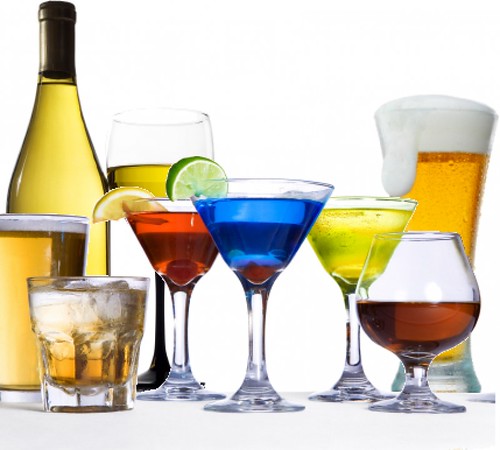
alcoholic-range
But as for other alcoholic beverages, I am a self-avowed cross-drinker. I do like wine, though to tend to favor big reds and champagne, which I have a weakness for. The more delicate whites are usually lost on me, but I won’t dismiss them out of hand. I just don’t know a great deal about them, apart from what I like which I decide purely on sensory considerations and find wine ratings even more useless than beer ones. They’re perhaps a necessary evil, and one I have to live with, but they’re often so subjective that they’re often meaningless.

I like single malt whisky and many other spirits, but again my knowledge of them is rather thin. I’ve attended a number of whisky tasting events and dinners, and always had a great time, but find that I rarely reach for a bottle when I’m at home. I like tequila, but it does not like me. As a result of some bad experiences when I was younger, I never ever touch the stuff. I’m also not a huge fan of rum, ouzo, brandy or many other similar liquors and liqueurs. I like vodka and absinthe well enough, though usually only in small doses.

Hands down, my favorite non-beer, alcoholic drink — especially after drinking a lot of beer — is gin. I especially find that a gin and tonic cleanses my palette like nothing else can. I prefer Bombay Sapphire, of the common gins, and Anchor’s Junipero Gin, when I can find it; though in truth I’m not too picky as long as it’s not a rotgut bottom-of-the-barrel variety. There’s nothing quite like it after a day’s beer judging to reset my mind and body for the evening.

Gin-Tonic

Filed Under: Just For Fun, Related Pleasures, The Session Tagged With: Cocktails, Craft Spirits

Beer In Ads #514: If You Like Beer, You’ll Love Schlitz

January 5, 2012 By Jay Brooks


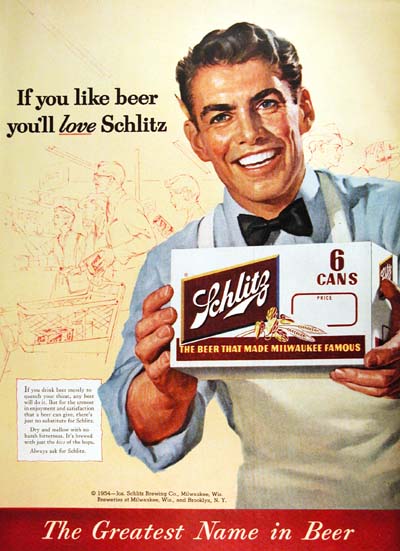
Thursday’s ad is for Schlitz, from 1954. Here’s another way-too-happy looking salesman, with teeth so white I can almost see my reflection. Frankly — no pun intended — he looks a lot like Frank Sinatra. Perhaps that’s what ol’ blues eyes would have been doing had he not made it as a singer: selling Schlitz as a retail grocery clerk.

54schlitz

Filed Under: Art & Beer, Beers Tagged With: Advertising, History, Schlitz

« Previous Page
Next Page »

Find Something

Northern California Breweries

Please consider purchasing my latest book, California Breweries North, available from Amazon, or ask for it at your local bookstore.

Recent Comments

  • Bob Paolino on Beer Birthday: Grant Johnston
  • Gambrinus on Historic Beer Birthday: A.J. Houghton
  • Ernie Dewing on Historic Beer Birthday: Charles William Bergner 
  • Steve 'Pudgy' De Rose on Historic Beer Birthday: Jacob Schmidt
  • Jay Brooks on Beer Birthday: Bill Owens

Recent Posts

  • Beer In Ads #5224: Harvard Bock Beer April 16, 2026
  • Historic Beer Birthday: William H. Biner April 16, 2026
  • Historic Beer Birthday: Alan Eames April 16, 2026
  • Historic Beer Birthday: Mathias Leinenkugel April 16, 2026
  • Historic Beer Birthday: Emil Schandein April 16, 2026

BBB Archives

Feedback

Head Quarter
This site is hosted and maintained by H25Q.dev. Any questions or comments for the webmaster can be directed here.