Brookston Beer Bulletin

Jay R. Brooks on Beer

  • Home
  • About
  • Editorial
  • Birthdays
  • Art & Beer

Socialize

  • Dribbble
  • Email
  • Facebook
  • Flickr
  • GitHub
  • Instagram
  • LinkedIn
  • Pinterest
  • RSS
  • Twitter
  • YouTube

Powered by Genesis

Guinness Ad #66: See What Big Chief Toucan Can Do

April 30, 2011 By Jay Brooks

guinness-toucan
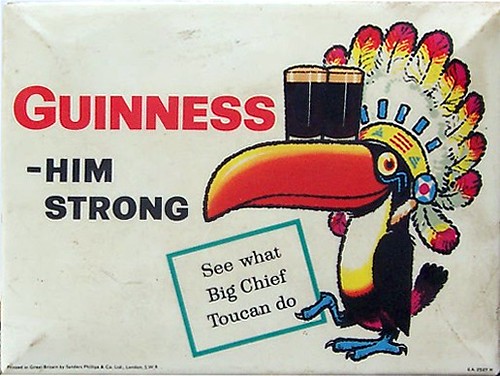
Our 66th Guinness ad is an odd one, obviously from a time when sensitivities toward Native Americans weren’t particularly high. That cringeworthy tagline “— Him Strong,” while obviously referring to Guinness, nonetheless seems wrong by today’s standards. And it’s not helped by the iconic Toucan wearing the headdress with the slogan “See What Big Chief Toucan Can Do.” Still, it was a different time.
Guinness-him-strong-2

Filed Under: Art & Beer, Beers Tagged With: Advertising, Guinness, History

Louisiana Beer

April 30, 2011 By Jay Brooks

louisiana
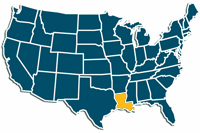
Today in 1812, Louisiana became the 18th state.

Louisiana
State_Louisiana

Louisiana Breweries

  • Abita Brewing
  • Bayou Teche Brewery
  • Big Easy Brewing
  • BJ’s Restaurant and Brewery
  • Covington Brewhouse
  • Crescent City Brewhouse
  • Gordon Biersch Brewing
  • Heiner Brau
  • New Orleans Lager & Ale Brewing Company
  • Parish Brewing
  • Tin Roof Brewing

Louisiana Brewery Guides

  • Beer Advocate
  • Beer Me
  • Rate Beer

Guild: None Known

State Agency: Louisiana Office of Alcohol and Tobacco Control

Other Trade Groups: Beer Industry League of Louisiana

maps-la

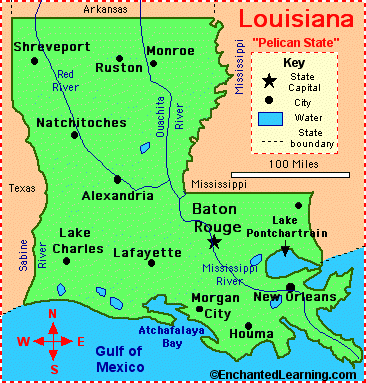
  • Capital: Baton Rouge
  • Largest Cities: New Orleans, Baton Rouge, Shreveport, LaFayette, Lake Charles
  • Population: 4,468,976; 22nd
  • Area: 51843 sq.mi., 31st
  • Nickname: Pelican State
  • Statehood: 18th, April 30, 1812

m-louisiana

  • Alcohol Legalized: April 13, 1933
  • Number of Breweries: 6
  • Rank: 43rd
  • Beer Production: 3,849,482
  • Production Rank: 18th
  • Beer Per Capita: 27.1 Gallons

louisiana

Package Mix:

  • Bottles: 40.8%
  • Cans: 55.6%
  • Kegs: 3.4%

Beer Taxes:

  • Per Gallon: $0.32
  • Per Case: $0.73
  • Tax Per Barrel (24/12 Case): $10.00
  • Draught Tax Per Barrel (in Kegs): $10.00
  • * Municipalities and counties may assess a tax of up to $1.50 per barrel

Economic Impact (2010):

  • From Brewing: $36,209,782
  • Direct Impact: $868,936,804
  • Supplier Impact: $394,401,774
  • Induced Economic Impact: $848,102,310
  • Total Impact: $2,111,440,888

Legal Restrictions:

  • Control State: No
  • Sale Hours: On Premises: No state imposed restrictions on on-premise hours. “24 hour” bars are common in New Orleans and in Jefferson Parish. Some municipalities and parishes require on-premise service to stop at 2:00 am.
    Off Premises: No restrictions on hours of package sales statewide.
  • Grocery Store Sales: Yes
  • Notes: Packaged alcoholic beverages of any strength may be sold in supermarkets, drug stores, gas stations, and convenience stores 24 hours a day. Local municipalities may not restrict this. As a result, dedicated “liquor stores” are mostly specialty stores in larger cities, and some supermarkets have large selections of liquors and wines, and compete on the basis of liquor prices and selection.

    Alcohol can be consumed in plastic cups in the streets of New Orleans and taken from club-to-club if the establishment allows it. Otherwise it depends on the locality. Most parishes other than Orleans Parish do not permit alcoholic beverages served at on-premise establishments to be taken from the premises. However, many parishes and municipalities permit consumption of packaged beverages (for example, cans of beer) on the street, as long as the packaging is concealed. Glass bottles on the streets are prohibited. One can enter most bars at 18 years of age but must be 21 years old to purchase or consume alcohol.

louisiana-map

Data complied, in part, from the Beer Institute’s Brewer’s Almanac 2010, Beer Serves America, the Brewers Association, Wikipedia and my World Factbook. If you see I’m missing a brewery link, please be so kind as to drop me a note or simply comment on this post. Thanks.

For the remaining states, see Brewing Links: United States.

Filed Under: Beers, Breweries Tagged With: Louisiana

Beer In Ads #359: The Stroh’s Picnic

April 29, 2011 By Jay Brooks

ad-billboard
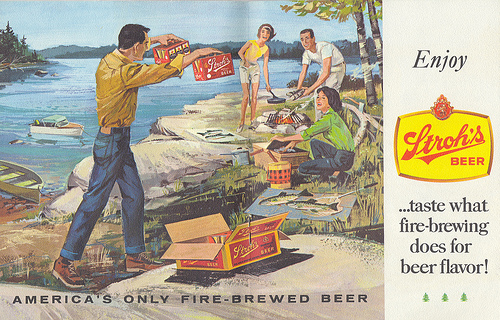
Friday’s ad is for Stroh’s and shows two couples at an idyllic lakeside spot enjoying a picnic lunch. But it wasn’t quite right, not until one of them showed up with a case of Stroh’s, “America’s Only Fire Brewed Beer.”

strohs-picnic

Filed Under: Art & Beer, Beers Tagged With: Advertising, History

The Science Of Manipulation: New Study Comparing Underage Drinking Riddled With Problems

April 28, 2011 By Jay Brooks

scientist-mad
Join Together and the Partnership For a Drugfree America yesterday sent out an item in their e-mail blast entitled Teens Who Drink with Adult Supervision Have More Drinking Problems, Study Finds. Alarming, right? Likewise, the Seattle Post-Intelligencer’s went even farther with this misleading headline: UW study: Teens don’t need parents as ‘drinking buddies’.

But do these headlines accurately convey what the study actually found? Unsurprisingly, no. Not even close. Naturally, most news organizations don’t really care about the news or how accurately they portray it. Many of the reporters do, I should hasten to add, but the companies themselves and people that run them, not so much. It’s one of those open secrets that they’re businesses and what they care about is revenue. Advertising. Making money. They cynically refer to the empty spots in their papers where there is no advertising as “news holes.” That’s not necessarily a criticism. They do, I realize, have to make a profit. But it’s important to remember that they understand that fear, danger and making people uneasy sells far more papers than telling us everything’s hunky dory. “If it bleeds, it leads” is another well-known news axiom. Headlines are designed to pull in readers, to make them want to read the article. As a result, the more salacious or fearful the headline is, the more likely we’ll be persuaded to read the paper (and see all that glorious advertising that surrounds it).

The people who are against alcohol and have their own agenda to advance — those pesky neo-prohibitionists — also know how the world works and create studies that can be used to advance their cause. Lying with statistics is perhaps one of the oldest forms of propaganda. It’s certainly one of the most effective, because people tend to believe “studies” created in academia. They get them published in so-called scientific or academic journals, which while they have the imprimatur of accuracy, are often not as accurate as they first appear to be. Firstly, there’s just the law of large numbers, with an estimated 50 million such papers having been published since anybody started tracking these things, around 1665. Then how many are truly accurate or are based on legitimate premises or science? A 2009 Scottish study (and yes, I see the irony in relying on a study to discuss the inaccuracy of studies) entitled How Many Scientists Fabricate and Falsify Research? A Systematic Review and Meta-Analysis of Survey Data revealed that a weighted average of nearly 2% “of scientists admitted to have fabricated, falsified or modified data or results,” and “up to 33.7% admitted other questionable research practices.” Worse still, when surveying their colleagues’ practices, scientists believed 14.2% of them falsified papers, “and up to 72% [engaged in] other questionable research practices.” At just one university, “81% were ‘willing to select, omit or fabricate data to win a grant or publish a paper.'” The point is that journal articles are hardly as sacrosanct as the media would have us believe. Common sense is still required. Asking about the agenda, where the money or support came from or how the study was conducted often reveals surprising results, yet the supposedly fair and balanced media more often takes them unquestioningly at face value, especially if they advance a particular agenda or can be used to scare people into reading an article.

In this case, the headlines state quite emphatically that if you drink along with your underage kids that more problems will ensue for your children. How did they arrive at that conclusion? According to the articles that conclusion was reached when “[r]esearchers looked at 1,945 adolescents in Washington state and Australia and compared two approaches to underage drinking: Zero-tolerance attitudes and ‘harm minimization.'” Join Together added that “[t]hey chose to include teens from both the U.S. and Australia because the two countries have different attitudes about teens and drinking.” And they further described the differences like this. “While the U.S. Surgeon General recently issued a call to action promoting a zero-tolerance position toward youth alcohol use, in Australia surveys indicate that 30 percent to 50 percent of teen drinkers get alcohol from their parents.”

So from that, the two articles conclude the following:

The study found that by ninth grade, 71 percent of Australian teens and 45 percent of U.S. teens used alcohol. More than a third (36 percent) of Australian students reported having experienced harmful consequences resulting from alcohol use, compared with 21 percent of U.S. teens.

“Providing opportunities for drinking in supervised contexts did not inhibit alcohol use or harmful use in either state,” the researchers wrote. They recommend that policies should not encourage parents to drink with their children and parents should not allow their children to drink under their supervision.

“Findings challenge the harm-minimization position that supervised alcohol use or early-age alcohol use will reduce the development of adolescent alcohol problems,” the researchers wrote.

But let’s look at the study itself, Influence of Family Factors and Supervised Alcohol Use on Adolescent Alcohol Use and Harms: Similarities Between Youth in Different Alcohol Policy Contexts. According to the Abstract, their objective was the following:

Harm-minimization policies suggest that alcohol use is a part of normal adolescent development and that parents should supervise their children’s use to encourage responsible drinking. Zero-tolerance policies suggest that all underage alcohol use should be discouraged. This article compared hypotheses derived from harm-minimization and zero-tolerance policies regarding the influence of family context and supervised drinking on adolescent alcohol use and related harms among adolescents in Washington State, USA, and Victoria, Australia, two states that have respectively adopted zero-tolerance and harm-minimization policies

And while I’ll agree that that sounds reasonable, comparing just two makes it an us vs. them scenario. And why Australia? The claim is that it’s because of the two policy differences, but there are, of course, other ones. For example, Australian youths become adults at 18 and that includes the ability to legally buy and consume alcohol, unlike here in the U.S., where we have essentially two levels of adulthood and our youth must wait until they’re 21 to legally imbibe. Then there’s the drinking culture. Here in the U.S., we’re ranked 13th in per capita alcohol consumption, drinking about 81.6 litres (21.5 gallons per year, or roughly 230 12 oz. bottles or 9.5 cases per year). Australia, by contrast, is ranked 5th and consumes 104.7 litres (27.6 gallons, or roughly 295 12 oz. bottles or 12.3 cases per year). By percentage, the difference is that Americans, on average, drink about three-quarters of what Australians do.

I can’t help but believe that choosing just two so disparate drinking cultures, with no control, essentially created a false dichotomy, an either or situation. It seems to me, a survey or multiple nations would be far more revealing.

The so-called “harmful consequences” were self-reported and included “loss of control (“not able to stop drinking once you had started”) and social conflict (“trouble at school the next day,” “arguments with your family,” and “become violent and get into a fight”). Other alcohol-related consequences were “got injured or had an accident,” “had sex with someone, which you later regretted,” “got so drunk you were sick or passed out,” and “were unable to remember the night before because you had been drinking (blackouts).” Just under 3% of the kids had their answers discounted because they were considered to be dishonest, which given the subject matter seems quite low, to me at least. But that aside, many of the behaviors listed, except of course the ones directly related to drinking (“loss of control” and “blackouts”) don’t require alcohol to be fairly common in adolescence. As a result, it seems to me that causality doesn’t necessarily have to be in the alcohol. Any of those experiences could have happened with or without alcohol. Young teenagers could even experience something similar to a “loss of control” without alcohol — I know my friends and I sometimes did at that age. Alcohol could cause such behaviors, or exacerbate them, but it seems to me it shouldn’t be a given that the two are conclusively linked to one another.

Predictably, the prevalence of alcohol use behavior in both states increased over time between seventh and ninth grades. Lifetime alcohol use by seventh grade among Victoria students was significantly higher than among Washington students (59% vs. 39%). By eighth grade, drinking in adult supervised settings was reported by two thirds of students in Victoria and 35% of Washington youth. By ninth grade, rates of alcohol use had increased to 71% in Victoria and 45% in Washington. More than a third of Victoria students (36%) also reported having experienced any harmful consequences resulting from their alcohol use, compared

What’s also not in the reports of the study is that the kids studied were 7th graders — 12 and 13-years olds — who were then followed over the subsequent three years. So another problem with that data is that an 8th grader in the U.S. is seven years from the minimum drinking age whereas an Australian is only three years from being allowed to legally drink. That, I think, would change any parents’ decision to educate their child about alcohol, and especially when and how they’d educate them regardless of the ages being the same. It would also go a long way in explaining the results.

Another issue I see is that the general terms “favorable parental attitudes toward alcohol use” and “adult-supervised alcohol use” is never really defined, suggesting it has only a general meaning that avoids any nuanced difference. For example, I think there’s a big difference between an alcoholic who lets their kids drink because they don’t care or don’t see any possible harm and a parent who carefully tries to educate their kids about responsible drinking. One might just allow drinking in the household without limit while the other’s goal would be to sample their kids and model behavior to show that moderation and enjoyment is the key. Those are two very different approaches that would both fall under the umbrella of “favorable parental attitudes toward alcohol use” and “adult-supervised alcohol use” as far as the study is concerned.

In the summary discussion, the researchers concluded that “although harm-minimization perspectives contend that youth drinking in adult-supervised settings is protective against future harmful use, we found that adult supervised drinking in both states resulted in higher levels of harmful alcohol use.” But even in their own discussion of the study’s limitations, they admit that the lack of specificity of which adult was doing the supervising and the problems inherent in adolescents self-reporting and further contend that “a more concrete
measure asking about parents or guardians overseeing youth alcohol use may have yielded different results.”

Though not mentioned specifically, they never even bring up or account for the nature and type of the adult supervision, and for me that’s the most important factor. Because it’s not just that adults should allow their children to drink in their presence. They should use such opportunities to educate and teach them about alcohol. Merely allowing such behavior I would contend, is reckless and even counter-productive and on that point, I agree with the premise of the study. But their methods do nothing to make that all-important distinction, which is the crux of the issue, at least to my way of thinking.

And while I do doubt the sincerity of the researchers and the study itself, the media and especially the anti-alcohol groups will use the study to their own ends and gloss over the study’s own admitted limitations. As the headlines make clear, they’re not interested in accurately portraying the study’s results. Few people will go to the trouble of actually reading it, and will take it at face value, never questioning the results. Especially egregious is lead researcher Barbara McMorris’ quote that “[k]ids need parents to be parents and not drinking buddies.” Did anyone suggest otherwise? Ever? No, but characterizing any adult supervised drinking as being a “drinking buddy” makes her intentions somewhat suspect. Because raising a child to be an independent and productive adult member of society is not merely saying no. We saw how well that worked when Nancy Reagen tried it in the 80s. Sometimes we have to show them the way, teach them the difference between good and bad in a way that’s not just black and white. Things are rarely all-good or all-bad, and alcohol is a prime example. Saying adults shouldn’t be allowed to educate their children about alcohol robs them of the ability of doing their job. And pushing a zero-tolerance policy with this faulty “study” does nothing to further the goal of parents’ raising responsible adults.

So when the study concludes that their “[f]indings challenge the harm-minimization position that supervised alcohol use or early-age alcohol use will reduce the development of adolescent alcohol problems” and in the final sentence they claim that the “[r]esults from the current study provide consistent support for parents adopting a ‘no-use’ standard if they want to reduce harmful alcohol use among their adolescents,” I have to question their motives. Because those statements are essentially false. That conclusion is sound only if you ignore the manner in which the parents supervise their children, and seems to assume there is no positive way to educate your children about alcohol under supervision. I, myself, wouldn’t want to start that process in the 7th grade, but by high school, I think every child should be taught about a great many things that our schools don’t tackle. And that leaves it to every parent to prepare their children for adulthood, including teaching them about the use of alcohol. Saying the only way to prepare them for becoming an adult is to make sure they never drink the stuff all but insures they’ll binge drink the first chance they get, whether as a freshman in college or whenever they’re unsupervised. There’s nothing like a taboo to create demand. And that strikes me as irresponsible. That strikes me as the science of manipulation.

mad_scientist

Filed Under: Editorial, News, Politics & Law Tagged With: Prohibitionists, Science, Statistics

Beer In Ads #358: Miller’s Six-Bottle Man

April 28, 2011 By Jay Brooks

ad-billboard
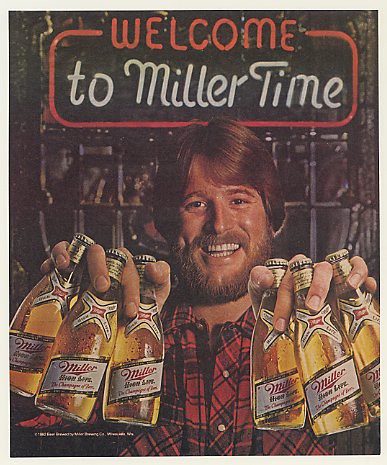
Thursday’s ad is also from 1983, but is for Miller Brewing. The ad welcomes us to “Miller Time” and features a bearded man in a plaid shirt (at first I thought he might be a lumberjack, but alas it doesn’t look like flannel) holding six bottles of Miller High Life in both hands, that is three bottles per hand. That’s a pretty impressive feat, especially when you consider he’s holding them in such a way that every label is facing us.

miller83bottlesman

Filed Under: Art & Beer, Beers Tagged With: Advertising, History, Miller Brewing

Maryland Beer

April 28, 2011 By Jay Brooks

maryland
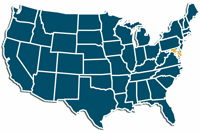
Today in 1788, Maryland became the 7th state.

Maryland
State_Maryland

Maryland Breweries

  • Baltimore-Washington Beer Works
  • Bare Bones Grill and Brewery
  • Barley and Hops Grill and Microbrewery
  • Bawlmer Craft Beers
  • Baying Hound Aleworks
  • Brewer’s Art
  • Burley Oak Craft Brewery
  • Clay Pipe Brewing
  • Clipper City Brewing
  • DuClaw Brewing
  • Eastern Shore Brewing
  • Ellicott Mills Brewing
  • Flying Barrel
  • Flying Dog Brewing
  • Fordham Brewing
  • Franklin’s Restaurant, Brewery & General Store
  • Gordon Biersch Brewing
  • Growlers
  • Hook & Ladder Brewing
  • Johansson’s Dining House & Microbrewery
  • Mad Hop Brews
  • Pratt Street Ale House
  • Rock Bottom Restaurant & Brewery — Bethesda
  • Rocky Run Tap & Grill
  • Ruddy Duck Brewery & Grill
  • Ryleigh’s Brew Pub and Raw Bar
  • Stillwater Artisanal Ales
  • Washingtonian’s Brewing Co.
  • White Marsh Brewing

Maryland Brewery Guides

  • Beer Advocate
  • Beer Me
  • Rate Beer

Guild: Brewers Association of Maryland

State Agency: Maryland Alcohol and Tobacco Tax Bureau

maps-md

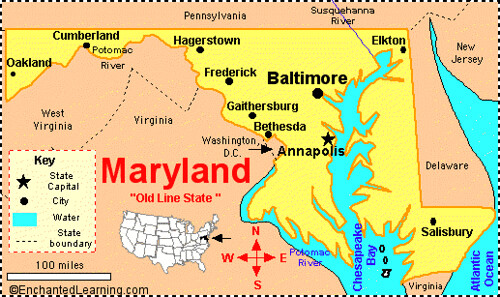
  • Capital: Annapolis
  • Largest Cities:Baltimore, Frederick, Gaithersburg, Bowie, Rockville
  • Population: 5,296,486; 19th
  • Area: 12407 sq.mi., 42nd
  • Nickname: Old Line State
  • Statehood: 7th, April 28, 1788

m-maryland-2

  • Alcohol Legalized: December 5, 1933
  • Number of Breweries: 23
  • Rank: 22nd
  • Beer Production: 3,343,296
  • Production Rank: 25th
  • Beer Per Capita: 18.4 Gallons

maryland

Package Mix:

  • Bottles: 45.3%
  • Cans: 44.2%
  • Kegs: 4.9%

Beer Taxes:

  • Per Gallon: $0.09
  • Per Case: $0.20
  • Tax Per Barrel (24/12 Case): $2.79
  • Draught Tax Per Barrel (in Kegs): $2.79

Economic Impact (2010):

  • From Brewing: $41,776,563
  • Direct Impact: $940,459,495
  • Supplier Impact: $453,776,947
  • Induced Economic Impact: $948,842,606
  • Total Impact: $2,343,079,048

Legal Restrictions:

  • Control State: Variable by locality
  • Sale Hours: Variable by locality
  • Grocery Store Sales: Variable by locality
  • Notes: Baltimore County prohibits the sale on Sunday in some areas.
    Montgomery County, Somerset County, Wicomico County, and Worcester County are alcoholic beverage control counties.
    Garrett County prohibits the sale on Sunday except in some areas.
    The sale of alcohol at grocery and convenience stores varies by county.
    There are no dry counties, but some individual voting districts within counties restrict or prohibit alcohol on a local-option basis.

maryland-map

Data complied, in part, from the Beer Institute’s Brewer’s Almanac 2010, Beer Serves America, the Brewers Association, Wikipedia and my World Factbook. If you see I’m missing a brewery link, please be so kind as to drop me a note or simply comment on this post. Thanks.

For the remaining states, see Brewing Links: United States.

Filed Under: Beers, Breweries Tagged With: Maryland

Beer In Ads #357: Grolsch Tulips

April 27, 2011 By Jay Brooks

ad-billboard
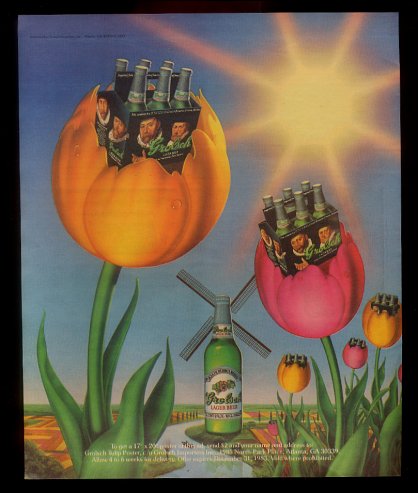
Wednesday’s ad is a relatively new ad, from 1983. It’s for the Dutch beer Grolsch, showing six-packs growing out of the national flower of the Netherlands: tulips. Clearly, I’m buying the wrong bulbs.

Grolsch-1983

Filed Under: Art & Beer, Beers Tagged With: Advertising, History, The Netherlands

Oh, The Horror!

April 27, 2011 By Jay Brooks

humor
Watch in horror as several pallets of beer miss their calling to be imbibed and enjoyed and instead end up creating a river of beer inside a warehouse at an undisclosed location. The only clue is that the language of alarm heard in the background does not sound like English. Apart from that, it’s anybody’s guess. Oh, the horror!

Filed Under: Beers, Just For Fun Tagged With: Bottles, Humor, Video

Beer In Ads #356: World’s Most Famous Taste In Beer

April 26, 2011 By Jay Brooks

ad-billboard
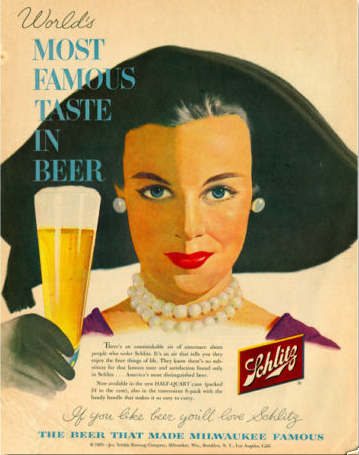
Tuesday’s ad is a Schlitz ad, and though it looks older, at least to me, it’s from 1955. With a boastful tagline. “World’s Most Famous Taste In Beer.” I love the illustration of the sophisticated woman in a big black hat, thick red lips and those big blue eyes staring back at us, pilsner glass in hand.

Schlitz-1955

Filed Under: Art & Beer, Beers Tagged With: Advertising, History, Schlitz

Beer In Ads #355: Biere Gallia

April 25, 2011 By Jay Brooks

ad-billboard
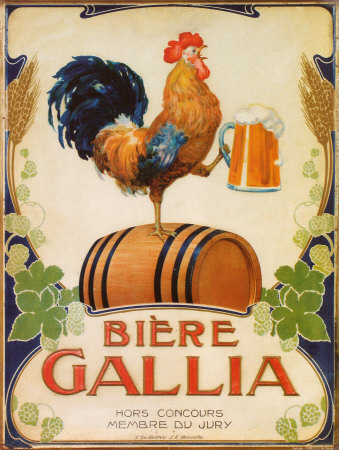
Monday’s ad is for an old French brewery, Brasserie de Gallia. The original brewery was founded before 1878 but rechristened New Gallia in 1890, when it moved to Paris. It struggled after World War 2, and eventually closed in 1968. But last year it was relaunched as Gallia Paris. I’m not sure when the ad is from, but 1950s or before seems like a safe bet.

biere-gallia

Filed Under: Art & Beer, Beers Tagged With: Advertising, France, History

« Previous Page
Next Page »

Find Something

Northern California Breweries

Please consider purchasing my latest book, California Breweries North, available from Amazon, or ask for it at your local bookstore.

Recent Comments

  • Bob Paolino on Beer Birthday: Grant Johnston
  • Gambrinus on Historic Beer Birthday: A.J. Houghton
  • Ernie Dewing on Historic Beer Birthday: Charles William Bergner 
  • Steve 'Pudgy' De Rose on Historic Beer Birthday: Jacob Schmidt
  • Jay Brooks on Beer Birthday: Bill Owens

Recent Posts

  • Historic Beer Birthday: John Friedrich Wiessner Jr. April 5, 2026
  • Beer Birthday: Steve Wagner April 5, 2026
  • Beer In Ads #5206: For The Feast Of Easter April 5, 2026
  • Historic Beer Birthday: Hew Ainslie April 5, 2026
  • Historic Beer Birthday: Robert Leo Hulseman April 5, 2026

BBB Archives

Feedback

Head Quarter
This site is hosted and maintained by H25Q.dev. Any questions or comments for the webmaster can be directed here.