
Our 70th Guinness ad is from the “Guinness For Strength” stable, the strength in this one is the ability to carry sixteen sheep on your back after downing a pint of Guinness.
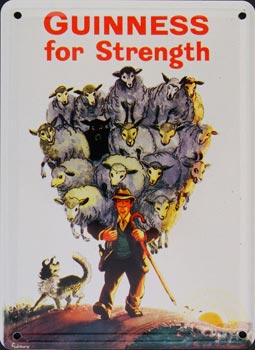

Our 70th Guinness ad is from the “Guinness For Strength” stable, the strength in this one is the ability to carry sixteen sheep on your back after downing a pint of Guinness.

Another gem I found in the digital archives of the Library of Congress is this series of photos and illustrations used in a pamphlet made around 1900 by the Joseph Schlitz Brewing Co. The title of the pamphlet was “Schlitz, the beer that made Milwaukee famous.” Each of the photos in the Library of Congress were made from the original negatives and the photos depict the brewery in Milwaukee, Wisconsin. Today, Pabst owns the Schlitz brands and re-introduced it in bottles in 2008.
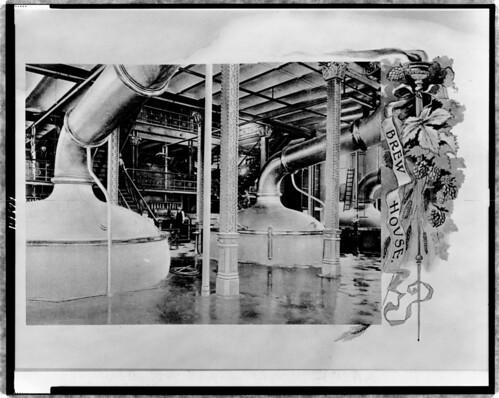
The Brewhouse. Original caption: “View in brewery of Schlitz Brewing Company, Milwaukee, Wisconsin.”
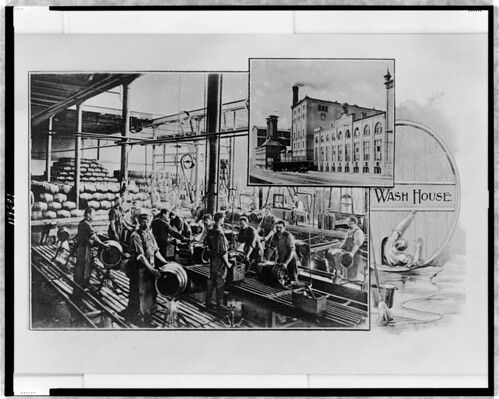
The Wash House. Original caption: “Men washing kegs in brewery of Schlitz Brewing Company, Milwaukee, Wisconsin, and insert of exterior of the building.”
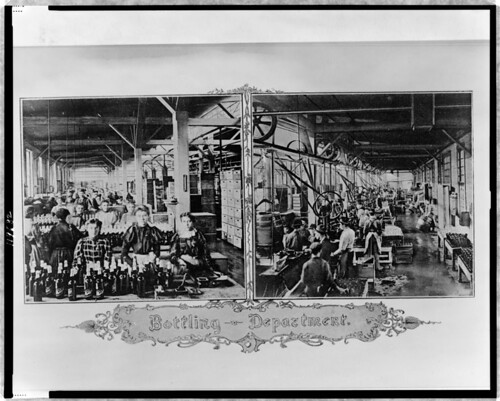
The Bottling Department. Original caption: “Two views of men and women working in bottling department of brewery of Schlitz, Milwaukee, Wisconsin.”
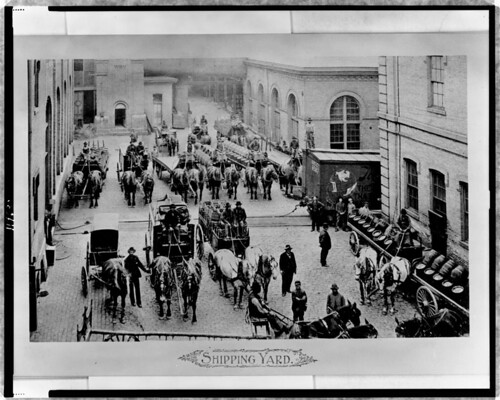
The Shipping Yard. Original caption: “Kegs of beer being transported on horse-drawn wagons at brewery of Schlitz Brewing Company, Milwaukee, Wisconsin.”

Friday’s ad is our last Ballantine for the week. This one is from 1947 and shows the California gold rush. But when the gold shows up in the prospector’s pan, it’s the Ballantine three rings symbol.


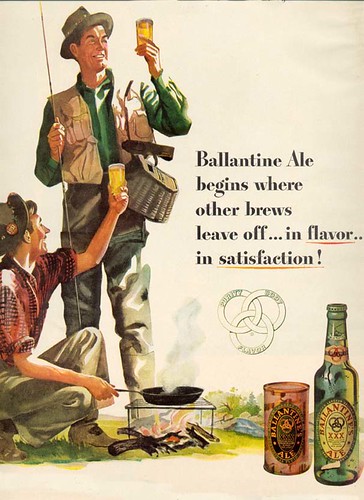
Thursday’s ad is another Ballantine Ale ad, probably from the late 1940s or 50s. Featuring a pair of dudes on a fishing and/or camping trip holding up their glasses of Ballantine Ale. The tagline is a great one, too. “Ballantine Ale begin where other brews leave off … in flavor … in satisfaction!”
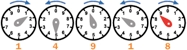
I was watching a documentary today about the Library of Congress and they talked about how the library is digitizing their collection, so I took a look at the website and discovered this little gem from 1937. Post-prohibition, apparently our government experimented with different methods for ensuring that breweries paid the correct amount of taxes. The “beer meter” was one such device they came up with, shown below.
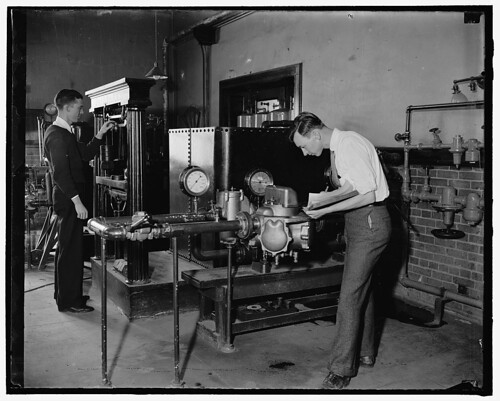
The caption below is cut off in the original in the library’s collection, which is why it ends mid-sentence.
And now a beer meter. Washington, D.C., May 1. To aid Uncle Same in collecting the tax on the millions of barrels of beer brewed in this country every year, the National Bureau of Standards has designed a master beer meter for use of the alcohol unit of the Bureau of Internal Revenue, U.S. Treasury. Government inspectors employ this master meter in checking the accuracy of the brewery beer meter to determine the volume of beer brewed. In the photograph the large tank receives the liquid [after passing] thru the meter where it is weighed to get [the] true volume. Carl F. Stoneburner is reading ….

Today is the 25th birthday — how is that possible? — of Sarah Huska. Sarah is the program administrator for the Cicerone Certification Program that Ray Daniels founded. I got to meet Sarah while I was in Chicago for CBC last year, at the Siebel open house. You can also read much more about Sarah at her featured beer tweeter interview/profile at Drink with the Wench. Join me in wishing Sarah a very happy birthday.

Sarah with Ray Daniels at the Cicerone booth at last year’s CBC in Chicago.
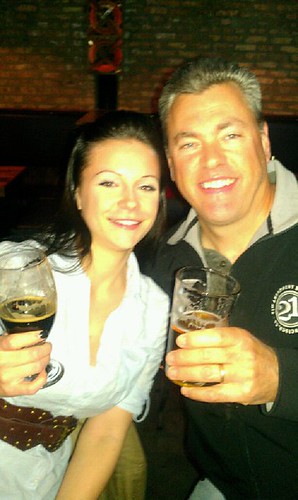
Sarah with Nico Freccia, from 21st Amendment.

Sarah, building a bridge with Nicole Erny, also with the Cicerone program, and Justin Crossley of the Brewing Network trying to cross it.

A bottle of New Glarus and AleSmith? That must have been one great evening.
[Note: all photos purloined from Facebook.]
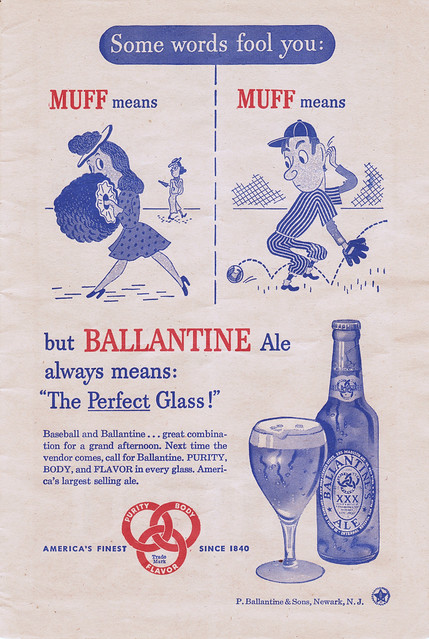
Wednesday’s ad is a Ballantine Ale ad from 1947. The ad is a fun little lesson on language, how the word “muff” can have different meanings. It ends on a nice twist, how the word “Ballantine Ale always means: ‘The Perfect Glass!'”

You’ve probably heard this old saw your whole life, same as me, that “beer kills brain cells.” According to an item in this month’s Maxim, it turns out it just isn’t true. While alcohol can damage “neurons in the cerebellum that are responsible for motor control and memory, which helps create the impaired feeling we call … drunkenness,” the good news is that they will recover, and that “alcohol definitely won’t ‘kill’ them.” Although the supporting evidence is not given, the short snippet does say it’s supported by “numerous studies.” Whew, that’s a relief.

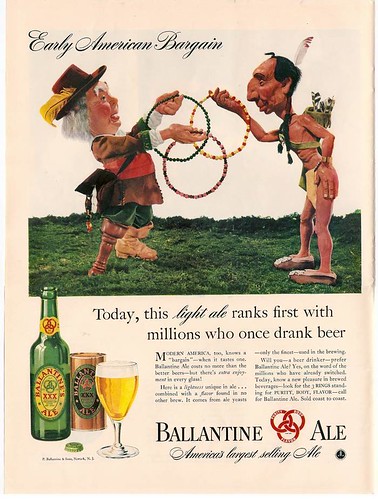
Tuesday’s ad is also Ballantine Ale, I think it’s going to be a Ballantine week. Today is also the anniversary of Peter Minuit buying the island of Manhattan in 1626 for the equivalent of around $24 (or more like $72 in today’s money) worth of “cloth, beads, hatchets, and other odds and ends.” At the time, the good were worth around 60 Dutch guilders, or about 1-1/2 lbs. of silver. Check out the Straight Dope for the … well, the straight dope. The ad depicts the scene with the humorous tagline “Early American Bargain.”

A recent book on beer and homebrewing, entitled Beer Craft appears to include the clever use of graphics, and in particular infographics, the best of which which are able to convey a great deal of information in a economical amount of space. Written by William Bostwick and Jessi Rymill, one of their charts was chosen by Fast Company’s Co.Design as the Infographic of the Day a few days ago. The infographic shows the number of breweries in America, along with total beer production, from 1800-2010.
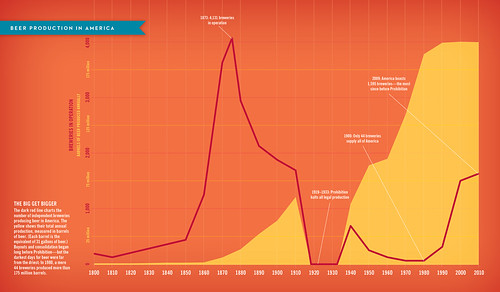
At the beginning (of the timeline, at least) there were only around 200 breweries. Rum, and other spirits, were king, and the U.S. boasted 14,000 distilleries. The advent of pilsner in 1842, along with a wave of German and European immigration, helped along by the industrial revolution, saw the number of breweries steadily increase until around 1850, when all hell broke loose. At that point, the rise of breweries in America can only be described as meteoric. When the dust settled two decades later, the number of breweries peaked in 1873 at 4,131. Consolidation, and other facts, cut the number in half by 1900 and another score of years later the number was zero, thanks to the anti-alcohol zealots who pushed through Prohibition in 1919.
Even once Prohibition ended thirteen years later, the brewing scene never recovered to anything approaching its glory days of the late 19th century. Both the business world and the world in general had changed considerably — especially after World War II — and anti-alcohol factions never admitted defeat, but merely changed tactics and continued to attack alcohol using different strategies that continue right through to the present day.
The low point is around 1980, when a mere 44 breweries made a staggering amount of beer, most of it tasting exactly the same. Since that time, total production of beer has risen only slightly, but more promisingly, the number of breweries has exploded with the microbrewery revolution that began in 1976 (and which had its origins in 1965 San Francisco). Today, we’re at nearly 1,800 breweries, the largest number since the turn of the last century. And according to the Brewers Association’s crack brewery detective, Erin Fay Glass, there are roughly 600 new breweries in various stages of their start-up phases. At the rate things are going, we should hit 2,000 breweries in America pretty soon, and quite possibly before the end of next year. Yea, beer!