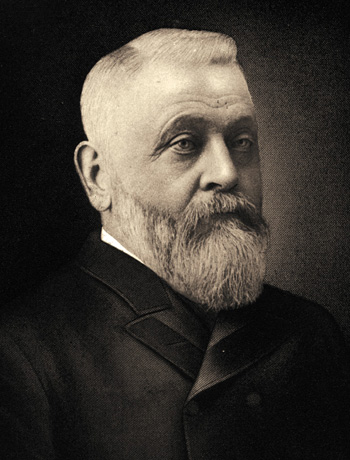
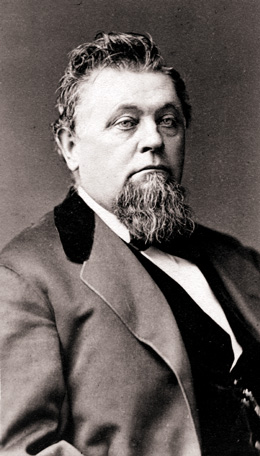
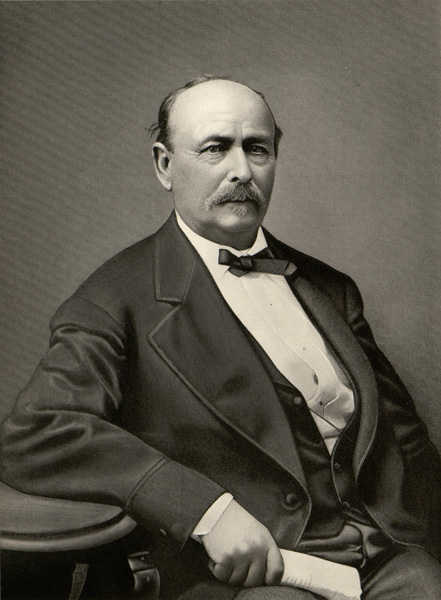
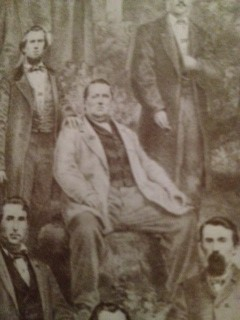
Today is the birthday of Carl Adolf Riebeck (September 27, 1821-January 28, 1883). He was primarily an industrialist and mining entrepreneur from Clausthal, Germany. According to Wikipedia, “Riebeck later became the wealthiest citizen of Halle, operating the Riebecksche brewery, Leipziger Brauhaus zu Reudnitz, in the Saxon Reudnitz,” which today is part of the town of Leipzig. As far as I can tell, the brewery is still around, but there’s some confusion (at least to me) as to what happened to it. One source claims that today it’s owned by the Radeberger Group while another seems to say it’s part of Braugold, but I’ll explore that in more depth below. At any rate, he and his family operated the brewery during his lifetime.

This biography is from a defunct German website profiling German Industrialists, and I used Google Translate to convert it to English:
The largest square in Saxony-Anhalt’s largest city, Halle, is named after Carl Adolf Riebeck. Why did you choose this name? Carl Adolf Riebeck was born in poor conditions, his ancestors had all been miners. He started casting ore at the age of 10 and soon entered the mine. The village school gave him little, he could hardly write properly right throughout his life.
The poor payroll conditions led him to seek his fortune outside the home area at the age of eighteen. So he came to Zeitz and Weissenfels. Riebeck soon became Steiger and later Bohrmeister. Why he again worked as a riser in a small pit after his return in 1847, which was a social decline, is unclear. In 1847 he married, in the marriage 6 sons and 3 daughters were born. During the Revolution of 1848/49, he served a one-year prison sentence, which he probably got for criminal offenses (tax evasion?) And then went back to central Germany.
There he got a higher position in the “Saxon-Thuringian joint stock company for brown coal utilization,” a state-owned company. He got to know the area very well and received in 1855 the position of a mountain inspector. Another ascent rejected the board. In particular, it was said that a former convict, who could barely write, had no business on the board. Riebeck then concealed a very rich coal discovery and bought the area in 1858 itself. This was the beginning of an unprecedented career.
At that time there were already several companies in the area that produced tar and other distillation products. His own first facilities in Gosserau (Weißenfels district) consisted of devices that had been sorted out by other companies. The bad machines and his low capital meant that his company did not want to get ahead. Only when he managed to borrow 20,000 Taler from a Halle bank, the company could flourish.
In return, he offered to pay a thaler for every hundred pounds of tar sold. After a few years, Riebeck was able to repay both the loan amount and the interest. One of the foundations for wealth was the law that was then in effect at the Weißenfelser Revier,
Gradually, he bought almost all lignite recycling companies in the area around Halle and Weißenfels. Riebeck realized early on that the high-bituminous coal that he had initially processed would run out and expand his production range. In the 1860s, it increasingly relied on two pillars: the smoldering of bitumen-rich coal and the production of briquettes from bituminous coal. In addition, his company produced tar, which he sold to Bitterfeld for further processing. Increasingly, he had the technique and procedures scientifically justified. The introduction of scientifically supported industry-related research is one of its pioneering achievements.With his money Riebeck was also a major landowner in the area around Halle, he owned several manors and participated in the still existing brewery in Reudnitz (today part of Leipzig).
Because he rejected the struggle of social democracy for the improvement of working and living conditions, he introduced social measures far in advance of Bismarck’s social legislation (sickness and disability funds, foundations, etc.). He wanted to show that a social democracy was not needed to achieve improvements, but that it was much easier and without disputes about the patriarchal benevolence of the entrepreneur possible.
In just under 25 years, Riebeck has gone from the propertyless to the richest citizen of Halle, to the largest landowner in the district of Weissenfels and to the Prussian Council of Commerce. He was always a pure practitioner in his activity, who was suspicious of everything that was theoretical and theoretical. This he also remained in view of the successes that resulted from working with chemists of the University of Halle. Riebeck was able to compensate for his lack of school education with the help of handicraft talent and a sense for the technical.
When Riebeck died, he owned 15 coal mines, three mineral oil factories, 31 smolderies, 27 briquette presses and 13 brickworks, as well as a brewery and a handful of manors.
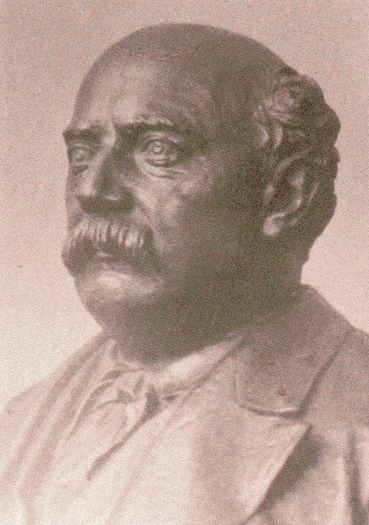
This account of his personal life is from his Wikipedia page:
Riebeck was born into a mining family from Clausthal. In 1827, his father, Steiger, a mine surveyor’s assistant, moved with his family to Harzgerode to work in the Lower Harzironstone mines in Anhalt.
In 1847, Riebeck married Maria Renk ( 1825-1873 ). From this marriage 7 children were born, of which three survived to adulthood. Of these 7 children, only two were sons, Emil Riebeck and Paul Riebeck. His daughter Margaret (1864-1904) married General Reinhard Gottlob Georg Heinrich Freiherr von Scheffer-Boyadel, who was knighted in 1890. His daughter Maria married geoscientist Herbert Credner in 1872.
In 1877, Riebeck married his second wife, Emilie Balthasar, producing two children.

And the same Wikipedia page details his career:
Riebeck eventually left school to begin working in 1835 as a pit boy and later as Lehrhäuer in Harzgerode’s Albertine ironstone mine. At the age of 18, he left the Harz mountains to work in the brown coal mines of Zeitz and Weissenfels. He attended a mining school in Eisleben and qualified to become a mining foreman.
After an accident, Riebeck was sentenced to one year of imprisonment for criminal breach of duty, which he served between 1848 and 1849. After his release, he found a job at Sächsisch-Thüringischen Aktiengesellschaft, that excavated brown coal. In 1856 he was promoted to the post of mining inspector.
He resigned in 1858 after realizing that he would not be considered for a higher position. He bought brown coal mines in the area of Bitterfeld und Weißenfels and soon began mining operations. Riebeck borrowed money to invest in the upgrade of coal technology as well as distillation units for the production of paraffin, mineral oil and tar.
The petroleum factories of Gosserau, Webau, Reußen bei Theißen and Oberröblingen became the foundation of Riebeck’s empire.
Within a few years, Riebeck acquired refining plants and briquette factories in Hall, Schwelereien, Whiterock and Bitterfeld. He developed brown coal mining into a large scale industry within Saxony and Thuringia.Riebeck later became the wealthiest citizen of Halle, operating the Riebecksche brewery, Leipziger Brauhaus zu Reudnitz, in the Saxon Reudnitz and some manors.
Even before social legislation was created, he provided social security measures for his workers.

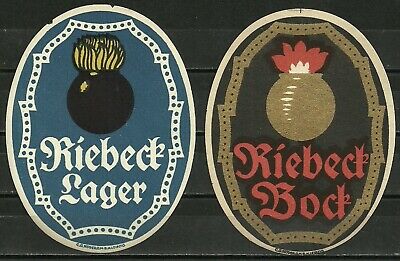
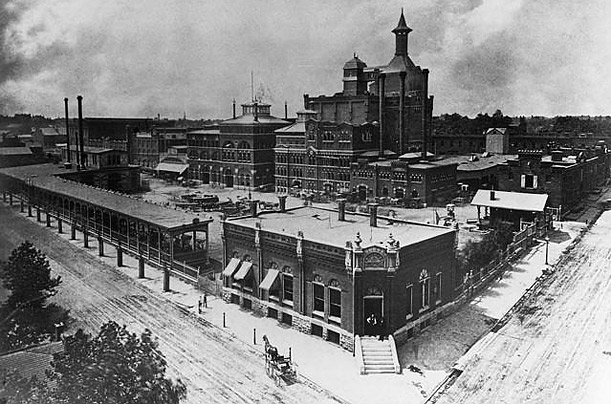
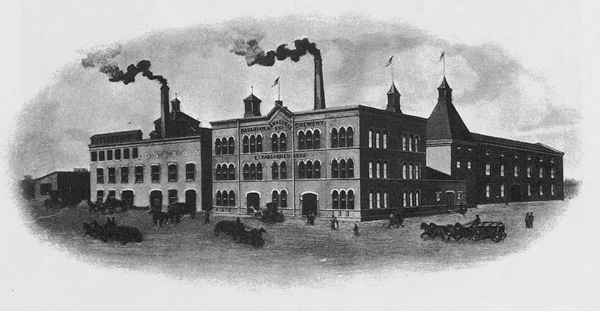
As for the brewery, it was founded in 1862 and Riebeck bought it out of bankruptcy in 1871, and turned it around. Here’s one account of its history according to the Leipzig Brauhaus in Reudnitz Wikipedia page, which also concludes that today is owned by the Radeberger Group.
The history of the brewery goes back to the year 1862, when
Adolf Schröder founded the Leipzig beer brewery in Reudnitz in the suburb of Reudnitz, which had not yet been incorporated into Leipzig. As early as 1871, the bankruptcy-ripe enterprise was sold to the industrialist
Carl Adolf Riebeck and some citizens of Leipzig.Under the leadership of Riebecks, the development of the brewery began to become the most important in Saxony and the fourth largest in the
German Reich. In 1887, this was renamed Riebeck & Comp. trading companies converted into a stock corporation. On the threshold of the 20th century, the company owned the most modern brewing equipment in Europe and the largest brewhouse in the world. The company acquired the Altenburger Aktienbrauerei and the brewery Gottlieb Büchner in Erfurt.The company also acquired the majority of shares in the Kiesel-Haberland brewery in Finsterwalde , the Vereinsbrauerei in Döbeln, the Heßberg brewery in Heßberg , the Pfannenberg brewery in Zerbst, the Partuschke brewery in Torgau and the Kürsten brewery in Arnstadt.
Furthermore, the Riebeck & Comp. AG at the Aktienbrauerei Neustadt-Magdeburg AG (62.4%), the Vereinsbrauerei AG Greiz (74%), the Reichsquelle brewery AG Mühlhausen(40%), the Bürgerliches Brauhaus AG Saalfeld (66.23%), the Vereinsbrauerei AG Zwickau (58.3%), the Vereinsbrauerei AG Apolda (72%), the Bergbrauerei AG Riesa (74%), the Aktienbrauerei Greußen ( 70%), the brewery Hack AG Meiningen (40%), the brewery Krostitz (74%), the Germania brewery AG Oschersleben , the export beer brewery AG Peter Königsee, the town
brewery AG Wurzen and the monastery brewery AG Stadtroda.
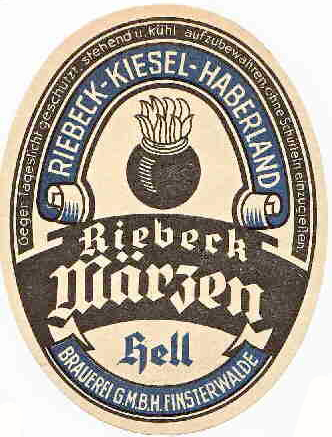
By air strikes more than half of the brewery building was destroyed during the Second World War. In 1946, the nationalization of the company, which henceforth operated as VEB Riebeck brewery, later as VEB Landes-brewery. At the same time, the gradual reconstruction of brewery facilities began. In 1959, the brewery with other breweries, including the former brewery VEB Westquell as former brewery CW Naumann in Plagwitz, together to combine VEB Sachsenbräu. In 1968, the formation of the VEB Getränkekombinat Leipzig, whose parent company was the VEB Sachsenbräu followed.

After the political change in the GDR, the Combine was dissolved.
The brewery now appeared with the new brand “Reudnitzer.” In 1991, the Dortmund-based beverage company Brau und Brunnen AG took over the company and renamed it to Leipziger Brauhaus Reudnitz GmbH. For the modernization of the production plants, Brau und Brunnen AG invested about the equivalent of approx. 50 million euros.In 1993, a fully automated brewhouse was inaugurated. Due to economic difficulties of the parent company was the Reudnitzer brewery with its 170 jobs in 1997 threatened by the closure. It could be averted by massive citizen protests.
In 2005, the brewery was sold to the Radeberger Group of the Oetker Group. In the same year, a new bottling plant with a capacity of up to 60,000 bottles per hour was installed. With the elimination of the last brewed products Reudnitzer Pilsner and Reudnitzer Ur-Bock 2012 ended the beer brand Reudnitzer. The Leipziger Brauhaus zu Reudnitz GmbH is removed from the trade register. The production facilities are used to produce Sternburg beer.

However, on the Wikipedia page for Braugold, they tell a different story of the path that the Riebeck brewery took.
In 1920 the [Braugold] brewery acquired Baumann Buchner AG. At the same time the brewery merged with Leipzig Riebeck Brauerei AG, founded by Carl Adolf Riebeck. In 1921 the reorganized brewery produced 2.5 million gallons of beer.
After the end of World War II, the brewery was transferred to public ownership in 1948. With the entry of the trademark Braugold the brewery in 1956 received its current name. In 1967, the production of today’s best-selling beer brewing Pilsner special gold began. 1969 was formed by the merger of nine breweries in the district of Erfurt VEB Kombinat drinks Erfurt. The Braugold brewery was the parent company and seat of the line of the combine.
After the turn and the associated end of the beverages combine the Braugold brewery was first adopted by the Lich private brewery in 1990. In 1996 it was taken over by the successor to the former owner, the Riebeck group, which included at that time the brewery in Eisenach and the Wernesgrüner brewery. On 1 January 2011 took over the beverage group Forest Hoff Braugold Brewery.
In the fall of 2010, production in the Erfurt was halted for all seven types of beer, as the largely run-down brewery building did not allow for economical production. The actual brewing and bottling is now done in a brewery in Braunschweig.