Brookston Beer Bulletin

Jay R. Brooks on Beer

  • Home
  • About
  • Editorial
  • Birthdays
  • Art & Beer

Socialize

  • Dribbble
  • Email
  • Facebook
  • Flickr
  • GitHub
  • Instagram
  • LinkedIn
  • Pinterest
  • RSS
  • Twitter
  • YouTube

Powered by Genesis

Patent No. PP13311P2: Hop plant named ‘Millennium-Late’

December 3, 2015 By Jay Brooks

patent-logo
Today in 2002, US Patent PP13311 P2 was issued, an invention of Eugene G. Probasco, assigned to John I. Haas, Inc., for his “Hop plant named ‘Millennium-Late.'” Here’s the Abstract:

A new and distinct triploid hop, Humulus lupulus, plant named ‘Millennium-Late’ selected from the progeny of tetraploid ‘Nugget’×proprietary line No. ‘833-53M’, characterized by a high percentage of alpha-acids, a higher alpha/beta ratio, significantly higher percentages of humulene and caryophyllene, coupled with a high yield and resistance to powdery mildew. Harvest maturity is late, similar to ‘Nugget’ and following ‘Galena’ by about 1 week.

A few weeks before, also in 2002, Probasco was also granted Patent Nos. PP13128P2, PP13129P2 & PP13132P2: Millennium Hops, specifically for Millennium-48, Millennium-MiddleLate and Millennium-44.

Untitled

Untitled

Filed Under: Beers, Just For Fun, Politics & Law, Related Pleasures Tagged With: History, Hops, Law, Patent

Beer In Ads #1747: Ringing The Bell

December 2, 2015 By Jay Brooks


Wednesday’s ad is for Rheingold Beer, from 1946, and features Miss Rheingold from that year, Rita Daigle. Dressed up at a fancy dude ranch, she’s ringing the dinner bell, with an appetizer of Rheingold beer. Which is apparently “beer as beer should taste.”

Rhaingold-1946-dinner-bell

Filed Under: Art & Beer, Beers Tagged With: Advertising, History, Rheingold

Patent No. 20100304005A1: Pouring Spoon For Producing Layered Beverages

December 2, 2015 By Jay Brooks

patent-logo
Today in 2010, US Patent 20100304005 A1 was issued, an invention of James M. Beale, for his “Pouring Spoon For Producing Layered Beverages.” Here’s the Abstract:

A pouring spoon (301) is provided which comprises a bowl (303) and a handle attached to said bowl. The handle has first (321), second (323) and third (325) segments, wherein said second segment is attached to said first segment by way of a first bend (322), wherein said second segment is attached to said third segment by way of a second bend (324), and wherein said third segment is attached to said bowl by way of a third bend (326).

Untitled
Untitled
Untitled

Filed Under: Beers, Just For Fun, Politics & Law, Related Pleasures Tagged With: Glassware, History, Law, Patent

Patent No. 2620064A: Hop Stem Remover

December 2, 2015 By Jay Brooks

patent-logo
Today in 1952, US Patent 2620064 A was issued, an invention of Edouard Thys, for his “Hop Stem Remover.” There’s no Abstract, although in the description it includes this summary:

This invention is directed to, and it is an object to provide, a novel apparatus for removing free stems or twigs from hops during the course of `processing the latter after harvest; the hops having been detached from but remaining intermingled with such stems or twigs.

Another object of the invention is to provide a hop `stem remover which is operative to remove both forked or crooked and straight stems from the hops; straight stems being the most difficult to separate from the hops.

A further object of the invention is to provide a hop stem remover which includes a novel assembly of a table, a foraminous conveyor having a run thereof working along the top of the table, and a feeder positioned to deliver mixed hops and stems or twigs on the conveyor; the stems or twigs remaining on. the conveyor, while the hops pass through the forminations onto the table. whence they feed to one edge of the latter and discharge downwardly therefrom.

Untitled
Untitled

Filed Under: Beers, Just For Fun, Politics & Law, Related Pleasures Tagged With: Brewing Equipment, History, Hops, Law, Patent

Patent No. 714703A: Beer-Cooler

December 2, 2015 By Jay Brooks

patent-logo
Today in 1902, US Patent 714703 A was issued, an invention of Frank Ibert, for his “Beer-Cooler.” There’s no Abstract, although in the description it includes this summary:

This invention relates to a beer-cooler which thoroughly utilizes the temperature of the cooling medium and effects a rapid and cleanly cooling of the beer.

Untitled

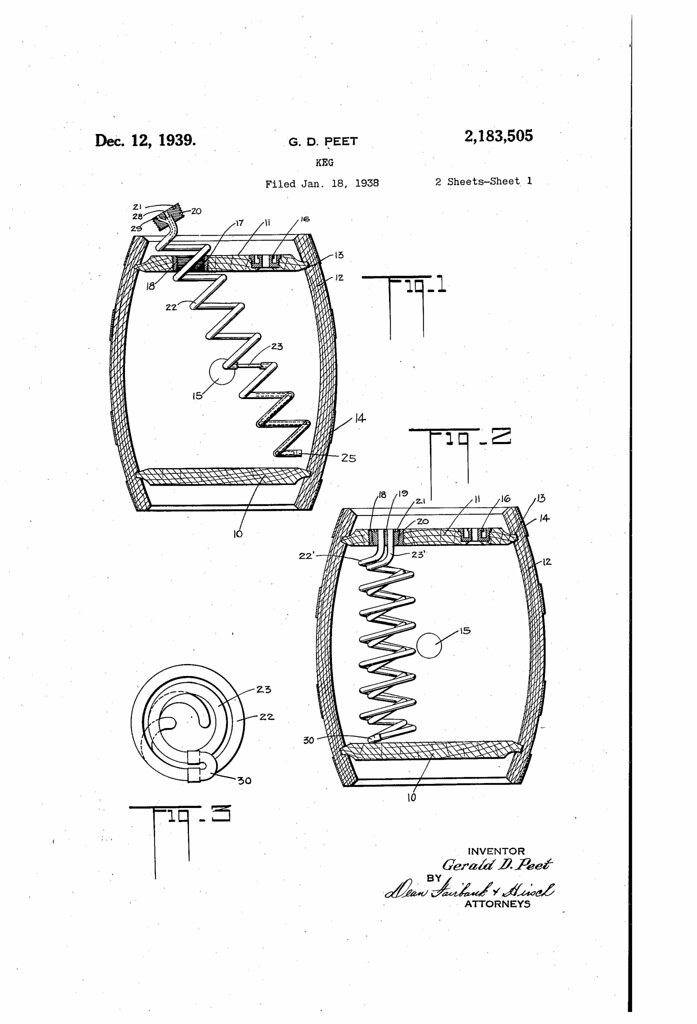
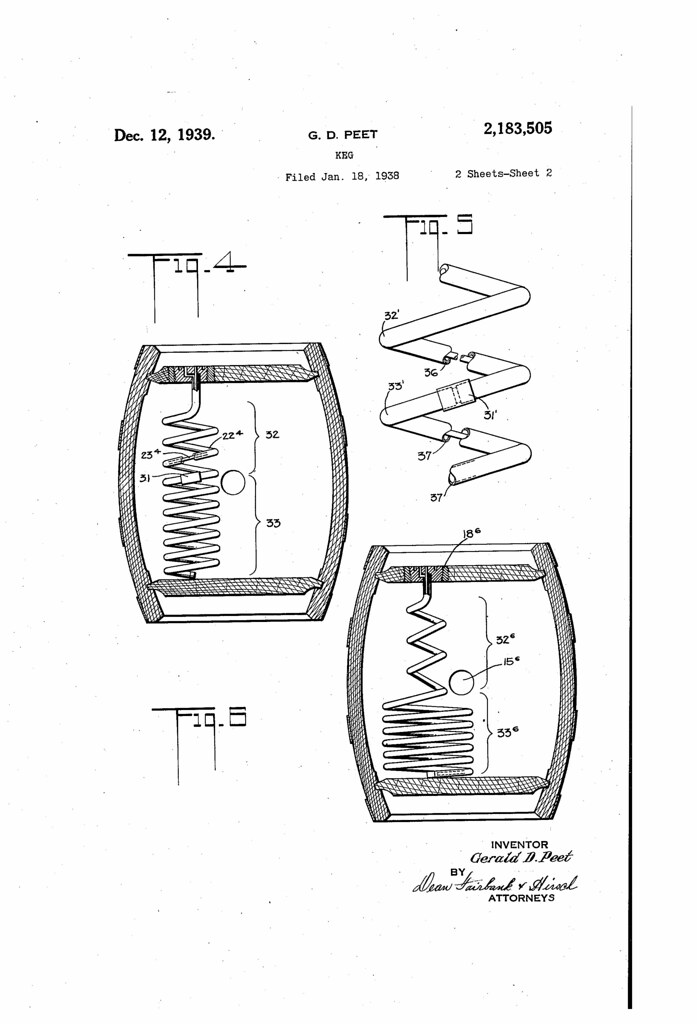
Filed Under: Beers, Just For Fun, Politics & Law, Related Pleasures Tagged With: History, Kegs, Law, Patent

Beer In Ads #1746: When Do English Majors Say Budweiser?

December 1, 2015 By Jay Brooks


Tuesday’s ad is still another one for Budweiser, again from the late 2000s. Although it’s a recent ad, it has a more vintage feel, and is part of a series that was created for college market newspapers. This one shows a caricature of geeky brain — you can tell he’s smart because he’s wearing glasses and uses a fountain pen — up close, and the thoughts in his head that lead him to drink a beer.

bud-when-do-math-majors

Filed Under: Art & Beer, Beers Tagged With: Advertising, Budweiser, History

Patent No. 3544329A: Electrolysis Of Fermented Beverages

December 1, 2015 By Jay Brooks

patent-logo
Today in 1970, US Patent 3544329 A was issued, an invention of Erik Johannes Helm and Richard Stanley Wrey Thorne, for their “Electrolysis of Fermented Beverages.” There’s no Abstract, although in the description it includes this summary:

This invention relates to a method and means for the improvement of the flavour of fermented beverages, such as beers, ciders, and wines, by elimination of hydrogen sulphide produced during fermentation.

Hydrogen sulphide is a normal product of yeast metabolism; during fermentation of beverages such as beer it is produced from cysteine by desulphuration and from inorganic sulphate by reduction, and probably from other precursors as well. It is well known to brewers that beer, and particularly newly fermented beer, for this reason often contains so much hydrogen sulphide as seriously to impair its avour, and especially its aroma. Generally speaking, this circumstance applies both to bottom-fermented beers (pilsner and lager types) and to top-fermented beers (ale and stout types).

This hydrogen sulphide may disappear during the maturation of beer, a process which consists essentially of a slow secondary fermentation, the hydrogen sulphide being swept out of the beer by the slowly evolving carbon dioxide. In practice, however, it is often found that for one reason or another the finished beer still retains a sensible concentration of hydrogen sulphide; particularly in the case of pilsner type beers this residual hydrogen sulphide may be sucient to detract from the delicacy of their llavoun The concentration of hydrogen sulphide in iinished beers may vary from inappreciable traces up to about 0.06 p.p.m. Its presence is already perceptible at a concentration of about 0.005 p.p.m.; at this level it is hardly perceived as such, but rather as modifying the general beer aroma. At 0.005 to 0.02 p.p.m. its odour has been described as yeasty or sulphury, i.e. more or less abnormal and undesirable. At about 0.05 p.p.m. it is recognizable as the characteristic hydrogen sulphide stench. Thus, while very low concentrations of hydrogen sulphide, say, less than 0.005 p.p.m. may not be objectionable in beer, and may even contribute a desirable element to its aroma, higher levels than this are definitely undesirable and perceived as a defect.

Accordingly, a process for the elimination of hydrogen sulphide from beer or its reduction to an imperceptible level, a process which might help to abbreviate the economically expensive secondary fermentation, is much to be desired.

The extremely low solubility product of copper sulphide suggests that a very simple means to this end might be to dose small quantities of, for example copper sulphate into beer so as to precipitate all of its hydrogen sulphide in the form of copper sulphide which would be subsequently removed during the regular beer ltration prior to bottling. However, the fact that beers normally contain traces of copper of the order of 0.1 p.p.m. or more which are as a rule more than equivalent to the amount of hydrogen sulphide to be removed, Without any such removal actually taking place, suggests that the problem is not quite so simple as it may at rst sight appear. It is true that the addition of an excess of copper sulphate to beer, of the order of l p.p.m. of copper, does indeed remove all perceptible hydrogen sulphide from it, but the relatively high concentration of residual copper remaining in the beer constitutes such a technical disadvantage that this procedure could not be seriously advocated for practical use. The drawback attaching to soluble copper in beer is that it rather drastically reduces the stability (shelflife) of the beer: copper accelerates the precipitation of proteinaceous material from the beer, rendering it cloudy and unsaleable. Presumably, the small amount of copper normally present in beer is already complexed to proteinaceous material in the beer so that it is unavailable for precipitating the hydrogen sulphide. Similarly, the excessive amount of copper sulphate which is necessary to eliminate hydrogen sulphide from beer must be attributed to most of the copper immediately being complexed, only a minor amount being available to react with the hydrogen sulphide.

The present invention comprises dosing suitably small quantities of copper into beer by means of electrolytic dissolution. Trials have shown that by this procedure the hydrogen sulphide may be removed from beer without causing any appreciable increase in its copper content.

According to this invention, beer, during the course of its passage to the filter, is passed between two electrodes of electrolytic copper, or between two electrodes one of which, the anode, is ot electrolytic copper. By the application of a suitable electromotive force across the electrodes copper passes into solution into the beer; the concentration of copper so dissolved depends only upon (a) the quantity of electricity passing through the beer (measured by the product of current strength and time), and (b) the velocity of the beer flowing past the electrodes. Copper dissolution is therefore precisely controllable by regulating current strength in relation to beer velocity.

Untitled

Filed Under: Beers, Breweries, Just For Fun, Politics & Law, Related Pleasures Tagged With: Brewing Equipment, History, Law, Patent, Science of Brewing

Beer In Ads #1745: When Do Music Majors Say Budweiser?

November 30, 2015 By Jay Brooks


Monday’s ad is still another one for Budweiser, again from the late 2000s. Although it’s a recent ad, it has a more vintage feel, and is part of a series that was created for college market newspapers. This one shows a caricature of composer Ludwig van Beethoven‘s head up close, and the thoughts in his head that lead him to drink a beer.

bud-when-do-music-majors

Filed Under: Art & Beer, Beers Tagged With: Advertising, Budweiser, History, Music

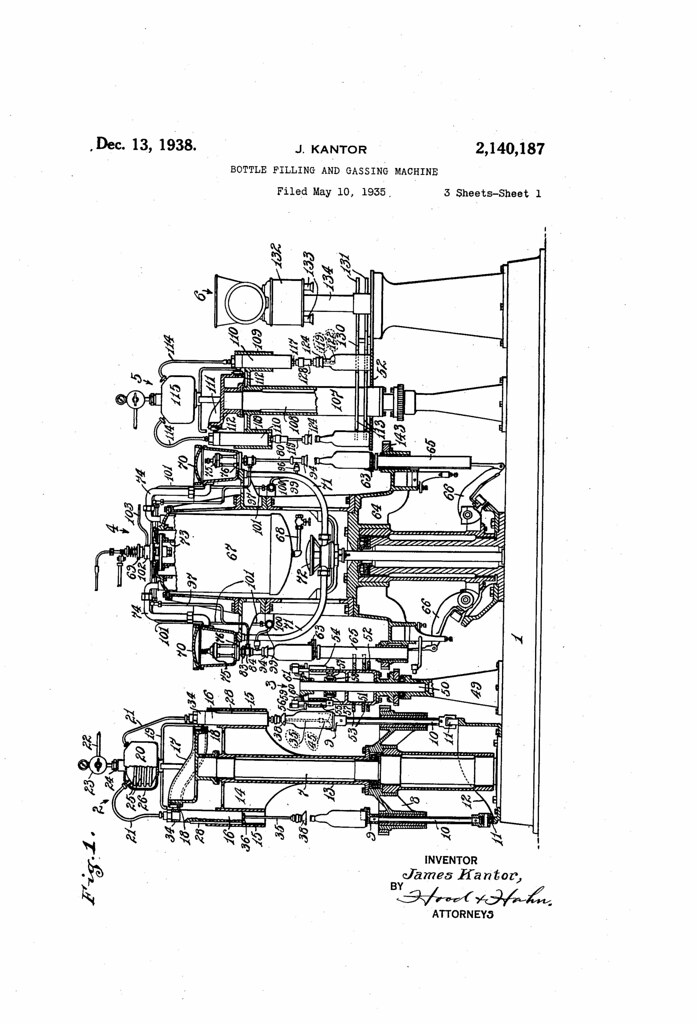
Patent No. 4361080A: Floor For Lautering Vessels

November 30, 2015 By Jay Brooks

patent-logo
Today in 1982, US Patent 4361080 A was issued, an invention of David K. Smith, Nigel Harlow, and Samuel W. Maxfield, for their “Floor For Lautering Vessels.” Here’s the Abstract:

Disclosed is a real floor for a lauter tun comprising a plurality of elongated linear troughs, each trough extending unobstructed across the bottom of the vessel and each forming a relatively shallow upward opening V-shape. The elements making up the floor are shaped to provide the lauter tun floor with a circular profile.

Untitled
Untitled

Filed Under: Beers, Breweries, Just For Fun, Politics & Law, Related Pleasures Tagged With: Brewing Equipment, History, Law, Patent, Science of Brewing

Patent No. 1162515A: Process For Treating Cement Beer-Fermenting Tanks

November 30, 2015 By Jay Brooks

patent-logo
Today in 1915, US Patent 1162515 A was issued, an invention of Frank W. Rickers, assigned to the Schaefer Brewing Co., for his “Process For Treating Cement Beer-Fermenting Tanks.” There’s no Abstract, although in the description it includes this summary:

The object of the present invention is the production of a beer fermenting tank constructed of hydraulic cement or cement concrete or reinforced cement concrete which shall avoid the disadvantages incident to those previously constructed, and which shall be economical to construct, and which shall be substantially permanent when constructed.

Untitled

Filed Under: Beers, Breweries, Just For Fun, Politics & Law, Related Pleasures Tagged With: Brewing Equipment, History, Law, Patent

« Previous Page
Next Page »

Find Something

Northern California Breweries

Please consider purchasing my latest book, California Breweries North, available from Amazon, or ask for it at your local bookstore.

Recent Comments

  • Bob Paolino on Beer Birthday: Grant Johnston
  • Gambrinus on Historic Beer Birthday: A.J. Houghton
  • Ernie Dewing on Historic Beer Birthday: Charles William Bergner 
  • Steve 'Pudgy' De Rose on Historic Beer Birthday: Jacob Schmidt
  • Jay Brooks on Beer Birthday: Bill Owens

Recent Posts

  • Beer Birthday: Mario Celotto August 23, 2026
  • Historic Beer Birthday: George W.C. Oland August 23, 2026
  • Historic Beer Birthday: Carl Funke August 22, 2026
  • Historic Beer Birthday: Benedict Sigg August 22, 2026
  • Beer In Ads #5327: Bock Bier, A Oldbairisch Dirndl Un a luschdiger Bua August 21, 2026

BBB Archives

Feedback

Head Quarter
This site is hosted and maintained by H25Q.dev. Any questions or comments for the webmaster can be directed here.