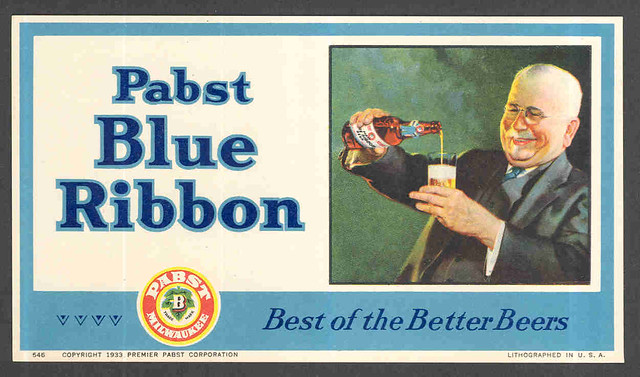
Thursday’s ad is for Budweiser, from 1961. That’s quite a cheese spread she has going, there’s obviously a party about to happen. Good thing she has half quarts on hand. This party’s going to be off the hook.

By Jay Brooks
By Jay Brooks

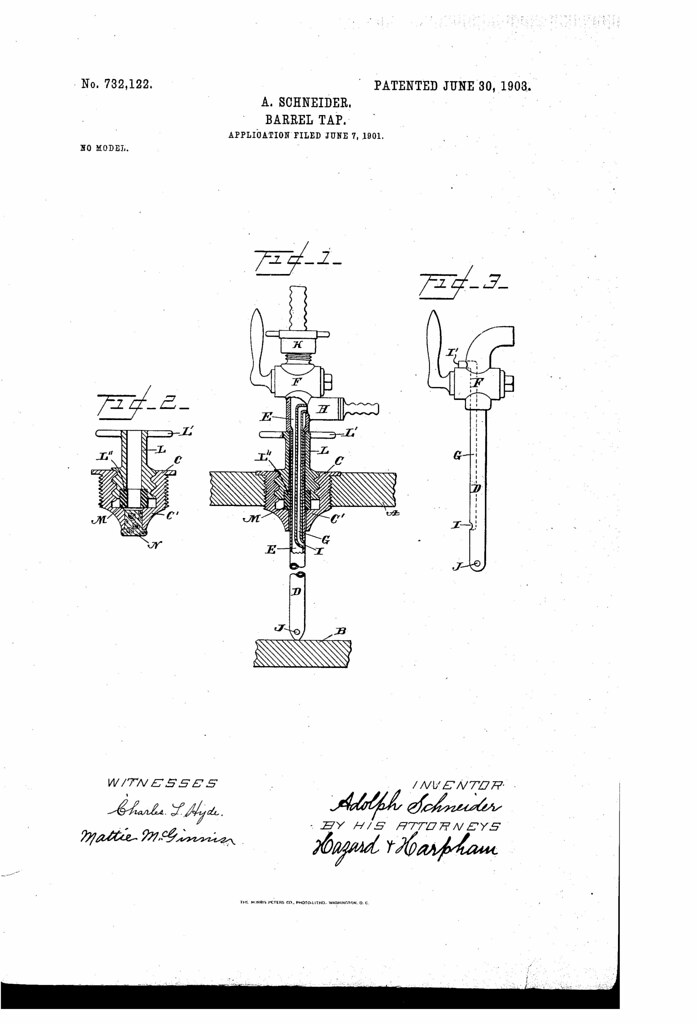
Today in 1912, US Patent 1029727 A was issued, an invention of George Stroh, for his “Tap.” There’s no Abstract, although in the description it includes this summary:
This invention relates to taps and bushings and more particularly to that class wherein the bushing is permanently secured in a beer keg or barrel. and-a tap, so called, is arranged for coupling therewith. In such devices it is desirable that the tap be so constructed that it may be readily coupled with the bushing, and -a tight joint made therewith without the use of tools, as the coupling of the parts is usually effected when the barrel or keg is in a store room or cellar or other dark place and as the help available is usually unskilled. Furthermore it is of great advantage to have the tap constitute a single structure bodily removable from the bushing, and so arranged that the packing rings and like parts which form an essential feature of the device are not readily lost.
This invention relates more particularly to a construction of a tap sleeve whereby the coupling with a barrel bushing is readily effected by the use of the hand alone and whereby there are no loose tap parts which may be shaken off or otherwise displaced.

By Jay Brooks

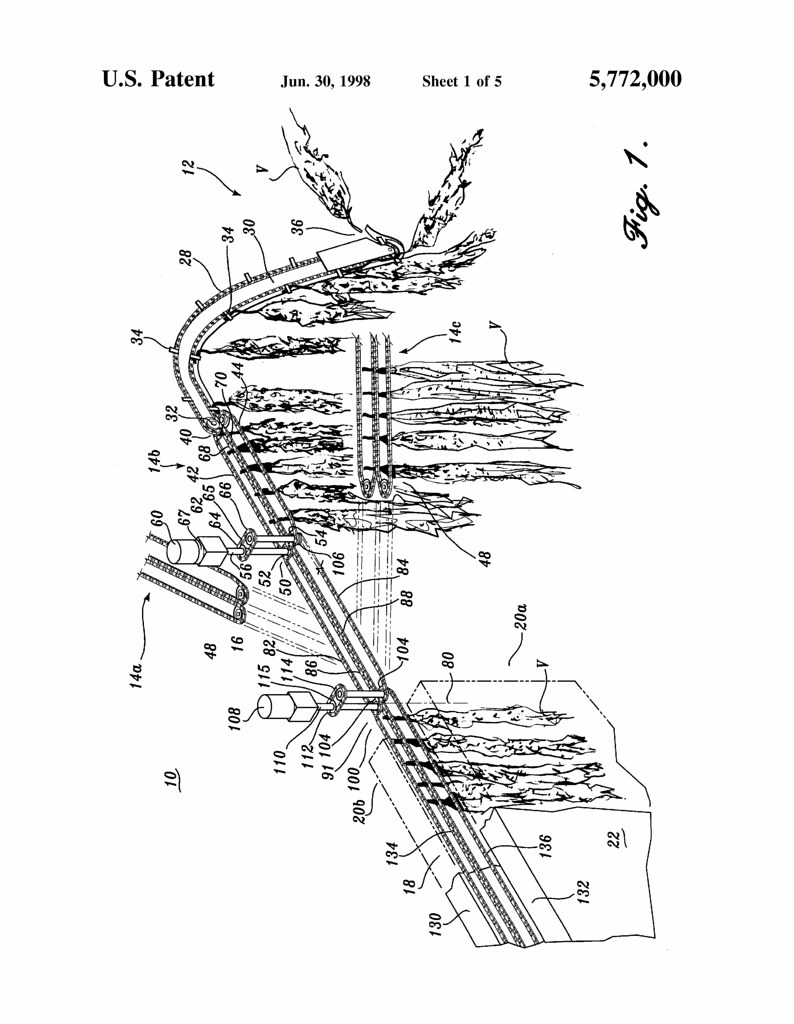
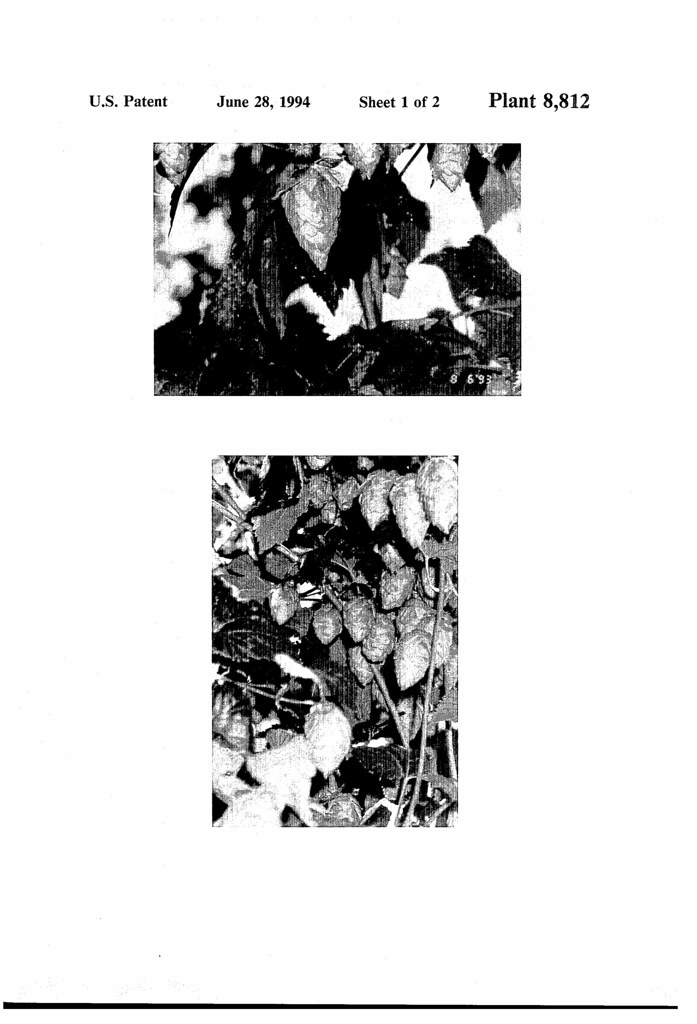
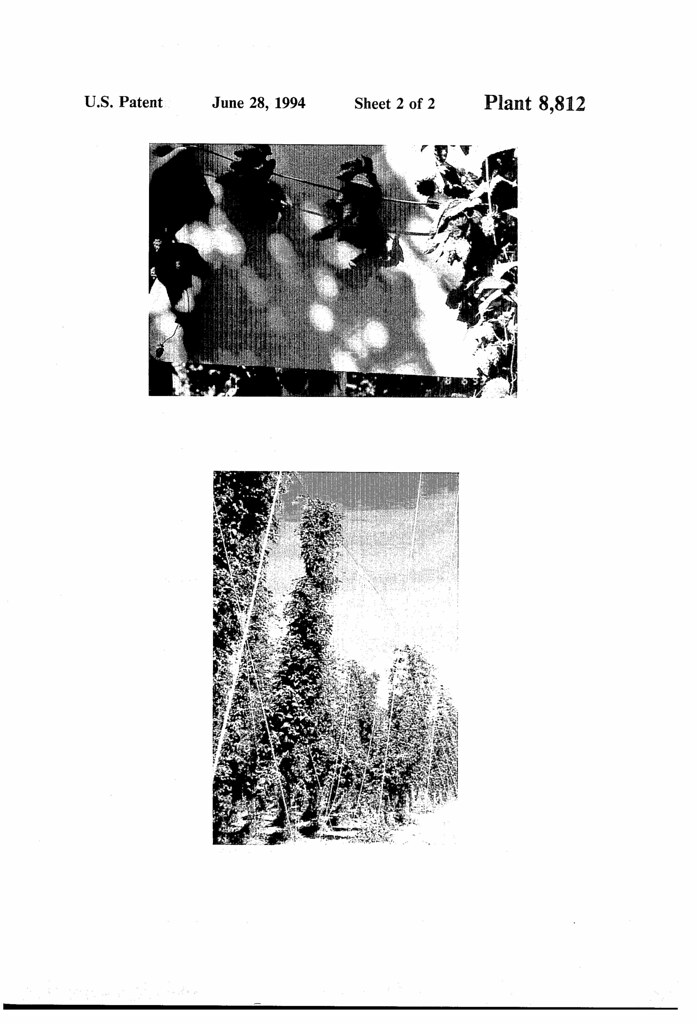
Today in 1895, US Patent 541431 A was issued, an invention of Charlon E. Easton, for his “Hop-Picker.” There’s no Abstract, although in the description it includes this summary:
My invention relates to machines for picking hops-that is, a machine for picking each strobile or oatkin from the vine,and the object of the invention is to produce a machine that will remove the catkins from the vine or stem thoroughly, rapidly, and without injury.


By Jay Brooks

Wednesday’s ad is for Schlitz, from 1960. “One of the Real Joys of Good Living” is apparently waking up at 11:45 p.m., putting on your robe and going downstairs to make a sandwich and have a beer for a late night snack. Hilarious, I’m usually still up well past midnight, but I do wish I had that robe.

By Jay Brooks

Today in 1941, US Patent 2245650 A was issued, an invention of Ovie N. Christopherson, for his “Grain Separating Machine.” There’s no Abstract, but it’s described generally as and “invention provid[ing] an improved highly efficient machine for the separation of various grains or seeds according to their thickness or transverse diameter,” making two claims:
1. In a separating machine, a separating screen, means for simultaneously imparting to said screen endwise reciprocating and transverse movements, said screen having elongated slots extended in the direction of its longitudinal reciprocating movement, the transverse movement thereof :being crosswise of the direction of said slots.
2. The structure defined in claim 1 in which said screen is in the form of a rotary drum and the transverse movement thereof being in a constant direction.

By Jay Brooks

Today in 1975, US Patent 3889725 A was issued, an invention of Werner Heckmann, Heinz Jordan, Uwe Knabe, Karl Plock, Karl Quest, Friedrich Rademacher, and Dieter Unger, assigned to Holstein & Kappert Maschf, for their “Method of Filling Beer Cans or the Like.” Here’s the Abstract:
The supported devices in an apparatus which fills beer cans orbit about a vertical axis and have upright housings supporting cylindrical centering members which carry deformable gaskets for the mouths of cans. Such cans are supported by a conveyor which orbits with the filling devices and is movable up and down or is held against vertical movement during rotation with the filling devices. The introduction of liquid into the cans takes place subsequent to introduction of a compressed gas, and such gas can be used to bias the gaskets against the mouths of cans during filling. When the filling of a can is completed, the pressure in its interior is increased to facilitate separation from the respective gasket. That supply of beer which remains in a channel of the housing on closing of the beer-admitting valve can be expelled in response to expansion of gas in a chamber which receives such gas by way of the container and is sealed from the container by beer in the channel. The expansion of gas in the chamber takes place in response to opening of a valve which reduces the pressure of gas above the body of liquid in the container.


By Jay Brooks

Today in 1913, US Patent 1065233 A was issued, an invention of Friedrick Gittinger, for his “Keg-Tapping Device.” There’s no Abstract, although in the description it includes this summary:
My invention relates to devices for tapping kegs and barrels, and has especial reference to devices for tapping kegs of beer, and has for its object’ the provision of an improved construction of tapping devices comprising a bung having an integral web provided with an opening and segment-al slots, rotatable valve members mounted on the two sides of said web and secured together for simultaneous rotation over said segmental slots, and a nozzle member adapted to enter and be locked in engagement with said bung and provided with means for rotating the valve members when moving into locking position.


By Jay Brooks

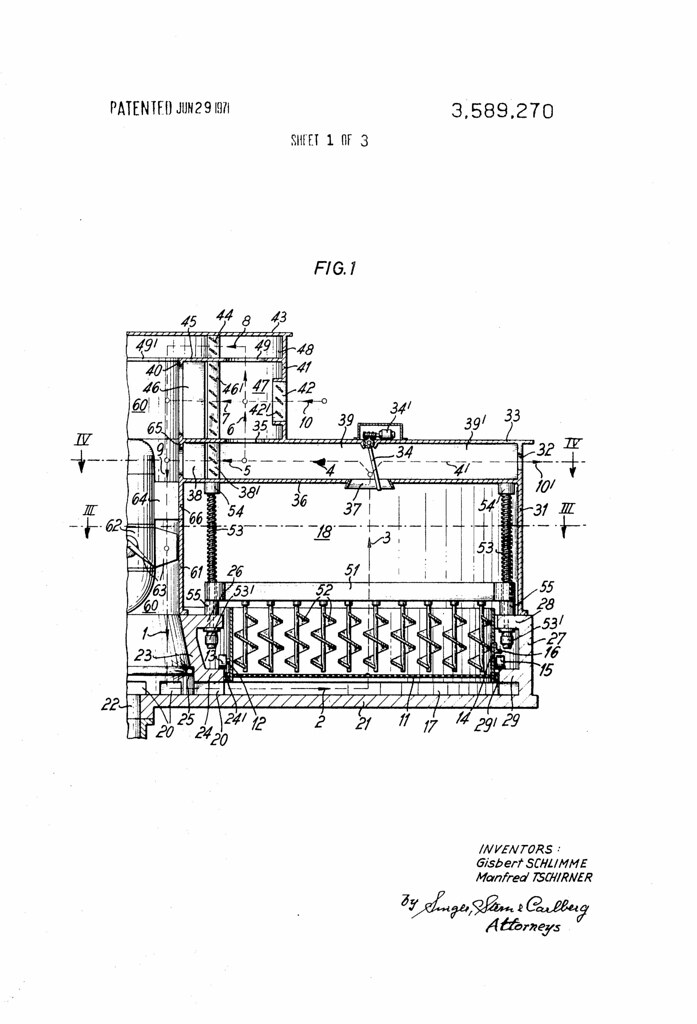
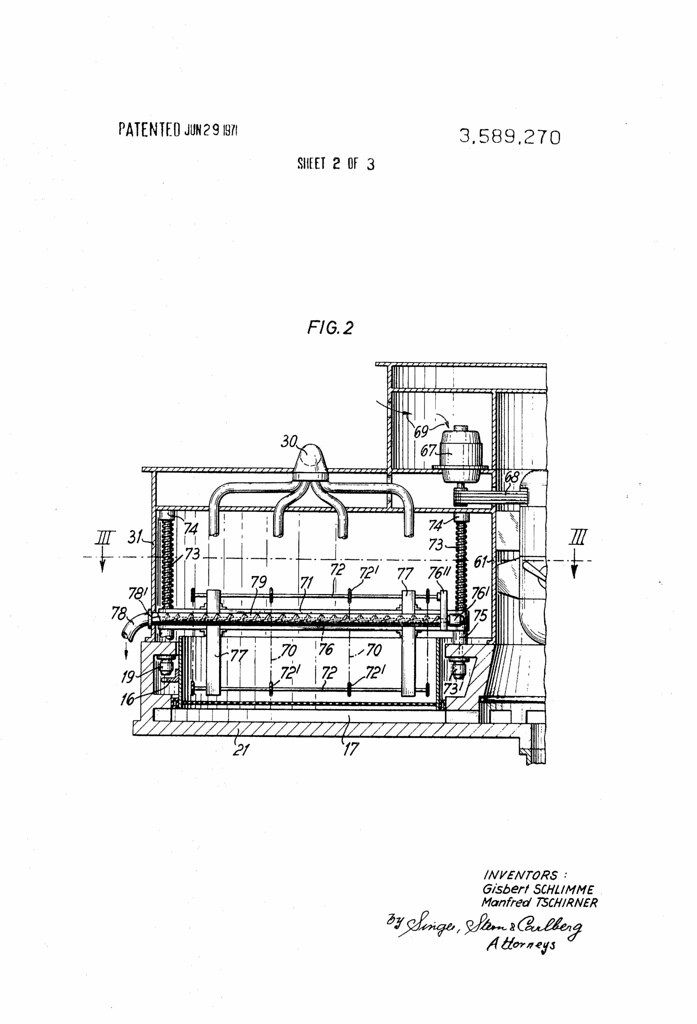
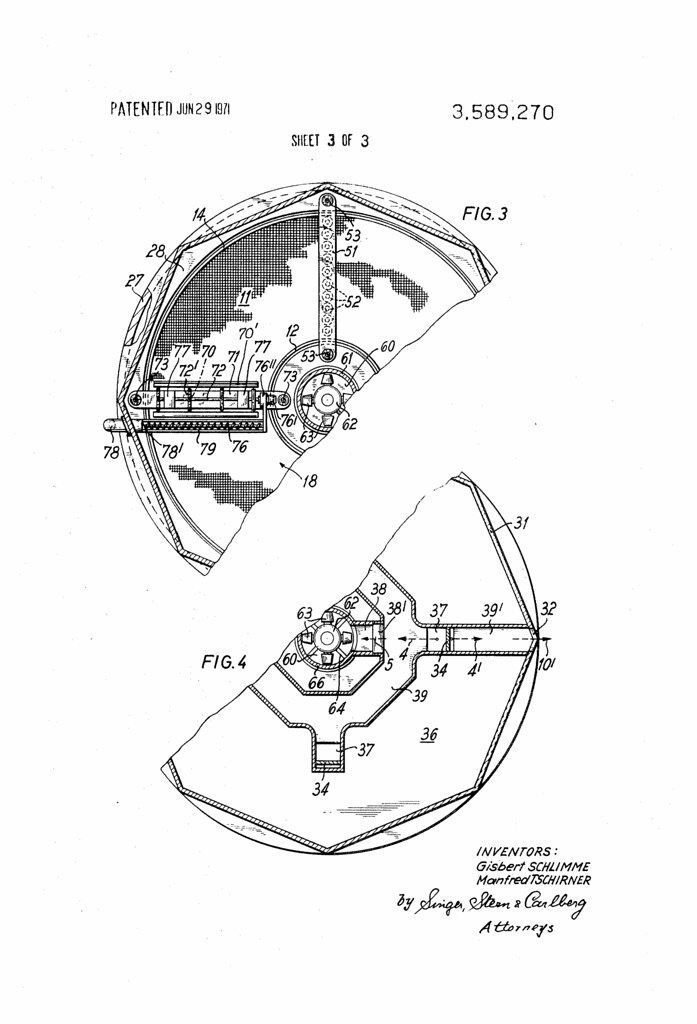
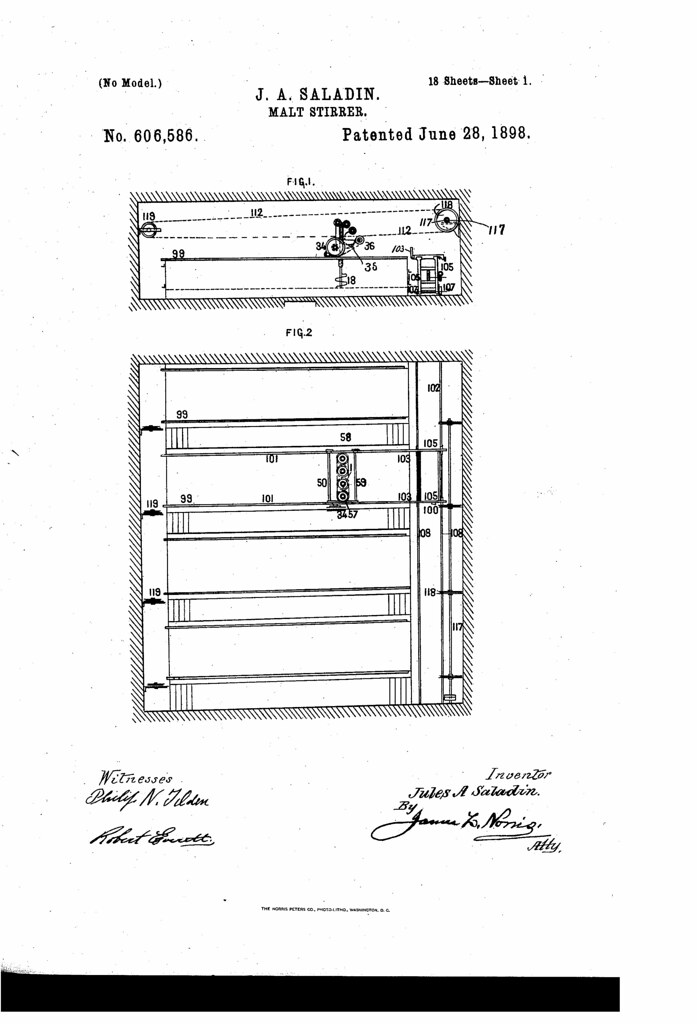
Today in 1969, US Patent 3450600 A was issued, an invention of James Richard Allan Pollack, Alan Aldred Pool, and Graham John Ellis, assigned to Arthur Guinness Sons & Co. Dublin, The Irish Mallsters Association, and Rimer Mfg. Co. Ltd., for their “Malting Apparatus In Series.” There’s no Abstract, although in the description it includes this summary:
[This invention is an] Apparatus for malting steeped cereal grain comprising two vessels one of which is a malting vessel and the other a storage vessel. The internal surface of the malting vessel converges downwardly toward the outlet. Sweeper means within the malting vessel is gyrationally mounted adjacent the outlet, grain engaging means provided on the sweeper, and the sweeper is adapted to sweep over substantially the whole area of the convergent surface for loosening the grain to be discharged. Means associated with the malting vessel for adjusting temperature, humidity, and rate of air flow therein to condition the cereal grain. First transfer means for conveying grain discharged from the malting vessel to the storage vessel. Second transfer means associated with the storage vessel for returning to the inlet means of the malting vessel grain discharged from the storage vessel.


By Jay Brooks

Tuesday’s ad is for St. Benno-Bier, from 1913. Today’s is the feast day for St. Benno, who is a patron saint for Munich, Germany, as well as the patron of Dresden-Meissen, anglers and weavers. In 1913, Munich’s Löwenbräu brewery had a beer named for St. Benno and advertised it with this cool, but strange, poster.

By Jay Brooks

Today in 1914, US Patent 1099910 A was issued, an invention of William J. Bocker and Hermenia A. Bocker, for their “Beer-Cooler.” There’s no Abstract, although in the description it includes this summary:
Our invention relates to improvements in beer coolers, and more particularly to that type of cooler used in connection with dispensing apparatus.
In beer coolers now in use, the beer is caused to run through a coil or coils of pipe with which ice is in direct contact for cooling the beer while it is passing through the coil or coils, but coolers of this kind are objectionable for the reason that they cannot be readily cleaned without resorting to the use of steam forcibly passed through the coil or coils thereof and also for the reason that the beer cannot be maintained at an even temperature.
It is the object of our invention to overcome the above mentioned objections, and to do so in a simple, efficacious and inexpensive manner. To this end the invention consists in the provision of a cooling chamber for the re! caption of a keg or kegs of beer which extends up into the dispensing bar and which is equipped with an ice receptacle which is adapted to contain ice and maintain the temperature evenly at every point within said cooling chamber and in directing the dispensing pipe or pipes from the beer keg or kegs directly to the dispensing faucet or faucets Without leading them out of said cooling chamber.
Our invention further consists in so arranging the dispensing pipe or pipes that they are easily accessible and readily cleaned internally by passing a brush or any other suitable tool through the same, said pipe or pipes being in a straight line to permit of such action.