Our 92nd Guinness ad features the iconic seal carrying two trays of food, urging thirsty Guinness drinkers to “Have a Snack” as he balances a pint of Guinness on his nose. “My Goodness: indeed.
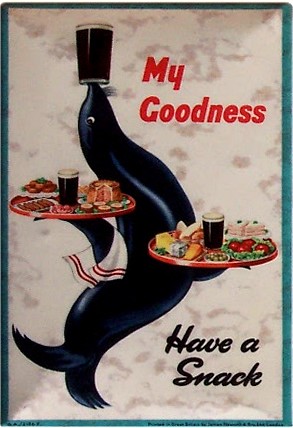

Our 92nd Guinness ad features the iconic seal carrying two trays of food, urging thirsty Guinness drinkers to “Have a Snack” as he balances a pint of Guinness on his nose. “My Goodness: indeed.

Friday’s ad is a 1960 ad for Budweiser cans, showing the “Smart way to buy Bud … Pick a Pair.” The ads shows a housewife, oddly backlit, picking up a six-pack of Bud cans.

Thursday’s ad is a 1942 ad for Ballantine. Given that it’s the middle of World War 2, showing off new American technologies such as this beautiful new train engine — my son Porter would be salivating over it — makes sense, especially with that forward looking tagline: “How American it is … to want something better.”

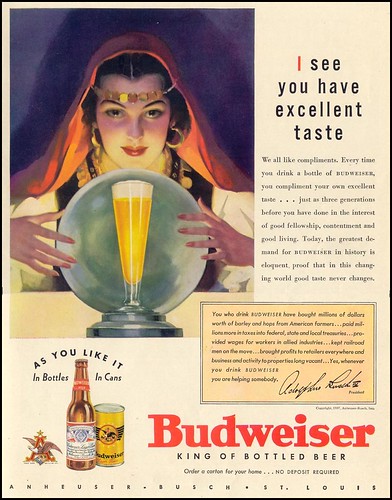
Wednesday’s ad is a pre-war 1937 ad for Budweiser. A stylized pin-up fortune teller is peering into her crystal ball containing a crystal beer. Seeing the Budweiser, she declares “I see you have excellent taste.” See, I knew those fortune tellers were fakes.
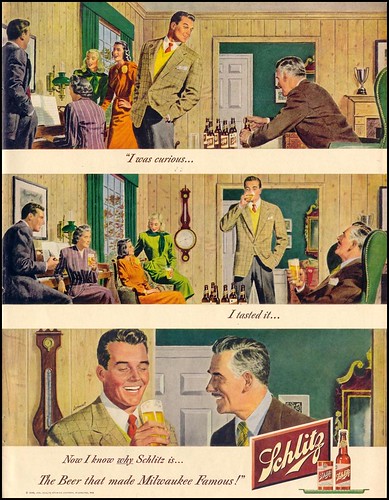
Tuesday’s ad is a 1948 ad for Schlitz. It’s part of the “I was curious” series, this one showing a buttoned-down young being schooled by an older gentlemen (father-in-law perhaps?) on what beer to drink. He certainly seemed to prefer drinking to listening to the woman playing the piano.
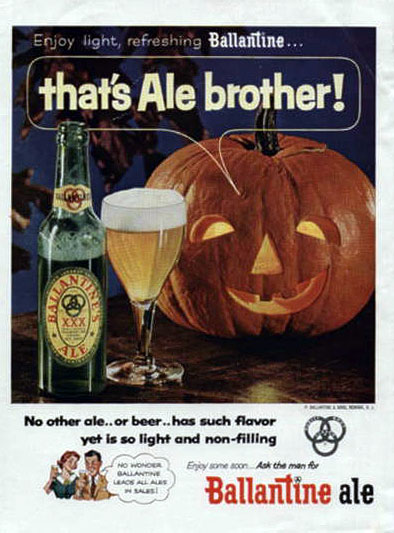
Monday’s ad is a 1955 Halloween ad for Ballantine Ale. Showing an apparently impressed jack-o-lantern who just tried some beer, he’s declaring “that Ale brother!”

As tomorrow is Halloween, this week’s works of art involves the supernatural as well as beer. It’s from around 1639 and was painted by Judith Leyster, one of three significant Dutch Golden Age female artists. It’s known by various titles, The Last Drop, the Gay Cavalier and the Merry Drinkers. Whatever you call it, the original is at the Philadelphia Museum of Art.
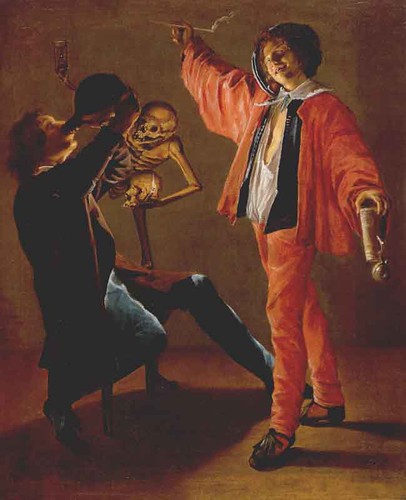
The museum describes the painting:
The costume that the standing figure wears over his clothes suggests that the setting is vastenavond, the night before the beginning of Lent, when people frequently went on binges in order to prepare themselves for fasting and abstinence. This painting speculates on the consequences of such overindulgence. In their dissipated state, the gay cavalier and his companion ignore the menacing presence of the skeleton, which bears an ominous hourglass in one bony hand and a skull in the other.
But another art critic had this to say:
This candle-lit cabaret scene depicts beer drinkers engaged in a drinking competition of sorts. The use of shadow and contrasts in light is pronounced and is reminiscent of Caravaggio. Although the scene is a merry one, Death, symbolized by the skeleton, is present to encourage their excesses, marking them for an all too obvious fate. The setting is magnificently constructed and the lively treatment owes much to Frans Hals. The allegory is striking in the contrast it depicts between the carefree frolickings of the figures and the tragedy awaiting them.
So it seems not everyone agrees about what’s going on in the painting, but it seemed appropriate for Halloween because of the skeleton and the spectre of death it represents.
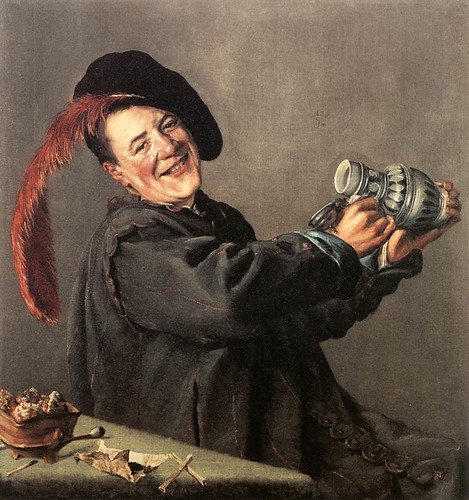
Leyster painted a number of portraits and genre paintings, and at least one more with beer. Below is The Merry Drinker, from 1630.
Unfortunately, she stopped painting after she married. Of course, it was the 17th century. You can read her biography at Wikipedia and at the National Museum
of Women in the Arts. And you can see more of her paintings at ArtCyclopedia, Olga’s Gallery, the Web Gallery of Art and the WikiMedia Gallery.
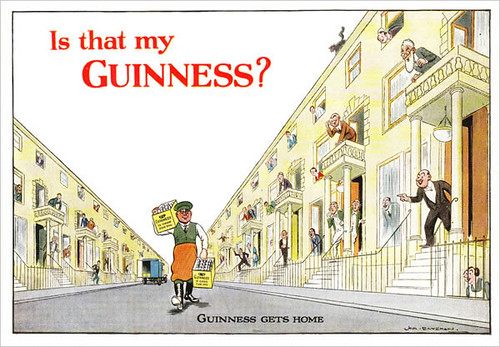
Our 91st Guinness ad apparently is advertising home delivery, or at least being available at home, by featuring a deliveryman walking down a residential street with a couple of cases of Guinness while virtually everyone living there is out on the front porch, balcony or window wondering aloud; “Is that my Guinness?” At the bottom of the ad it reads “Guinness gets home.”
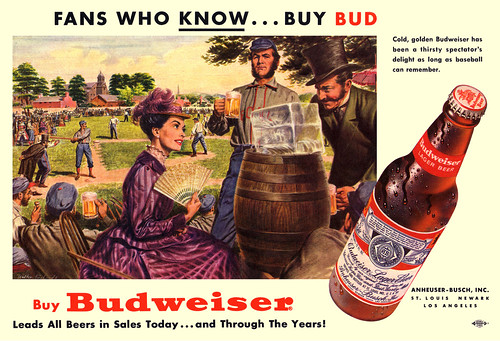
Friday’s ad, in honor of the St. Louis Cardinal’s world series victory earlier tonight, is a Budweiser ad that appeared on the Cardinals scorecard in 1954. With the tagline “Fans Who KNow … Buy Bud,” the scene is a baseball game in the late 1800s. I love the block of ice sitting on top of the wooden keg to keep the beer cold.
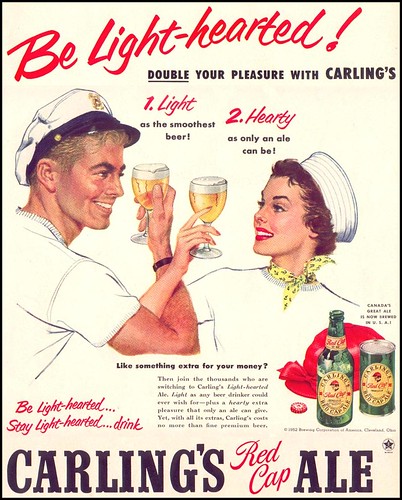
Thursday’s ad is for Canada’s Carling’s Red Cap Ale, from 1952. The nautical couple romantically drinking their ale — light and hearty — are “having something extra for [their] money.” And I love that slogan. “Be Light-hearted … Stay Light-hearted … drink Carling’s Red Cap Ale.” Priceless.