
Tuesday’s ad is for Amstel beer, before they added the “light.” It’s from 1961 and also has KLM Airlines as a part of the ad, perhaps a partnership ad. It would appear they were trying to position Amstel as a high-end premium beer.
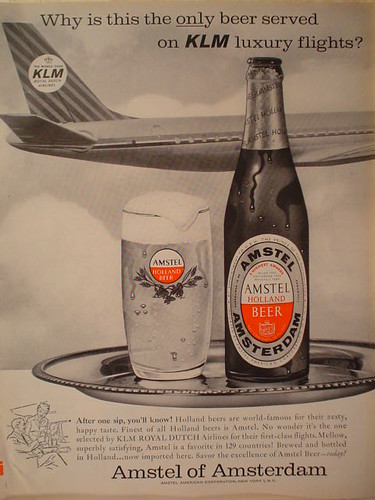

Tuesday’s ad is for Amstel beer, before they added the “light.” It’s from 1961 and also has KLM Airlines as a part of the ad, perhaps a partnership ad. It would appear they were trying to position Amstel as a high-end premium beer.
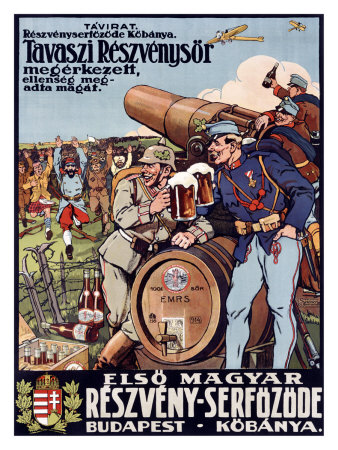
Monday’s ad is from Részvény Serfözöde, a Budapest, Hungary brewery. The illustration was done by Paul Foldes. I’m not entirely sure when it was done. I chose it because today is Memorial Day, and the idea depicted that beer could end a war is an attractive one. I believe the scene’s supposed to be during World War I.
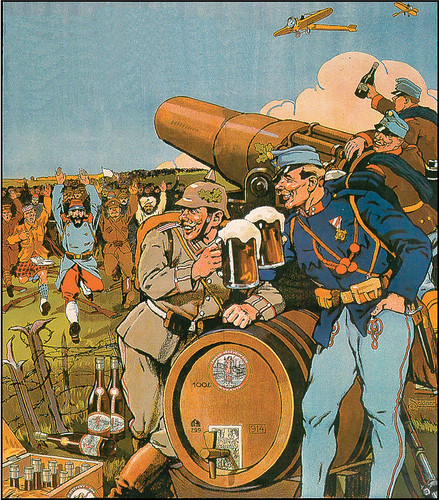
And below is a detail of the artwork from the ad.

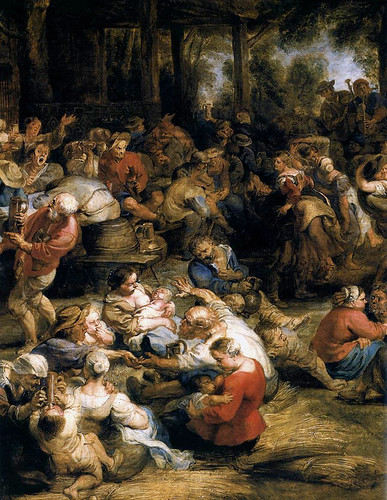
Today’s work of art is by one the most famous artists to ever paint: Peter Paul Rubens. Rubens “was a prolific seventeenth-century Flemish Baroque painter, and a proponent of an extravagant Baroque style that emphasized movement, color, and sensuality. He is well-known for his Counter-Reformation altarpieces, portraits, landscapes, and history paintings of mythological and allegorical subjects.” Today’s painting was done toward the end of his life, around 1635-38, though others believe he may have started it much earlier in 1620, but then returned to it later. It’s known as the Village Fête, and sometimes as the Village Wedding.
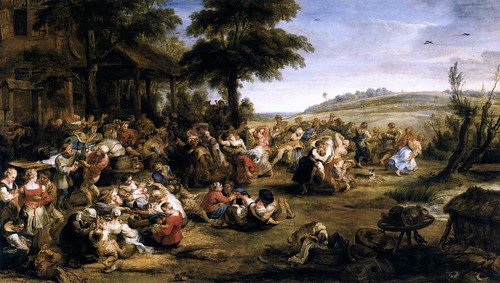
The paintings hangs in the Louvre, which describes it as follows:
The picture, painted late in the artist’s life, around 1635-38, is manifestly neo-Bruegelian in inspiration. The pig’s snout poking out of the sty on the right is an ancient symbol of gluttony (gula). According to those who date the picture in the 1620s, the landscape was painted before the figures, which are in Rubens’ late lyrical style.
This monumental picture, also called the Village Wedding, is in the northern tradition of depictions of village fêtes. Pioneered by Pieter Bruegel, the enormous popularity of this genre contributed to the renown of the Flemish School. These compositions often had a moral message, denouncing the baseness of the human condition by showing it in all its excesses. However, even though a pig’s snout — a symbol of gluttony — can be seen poking out of the sty in the foreground, denouncing vices was not Rubens’ main preoccupation.
While there’s dancing going on on the right half of the painting, the lower left is consumed with drinking beer. You can see it better in the detail of the painting below.
You can see all of Ruben’s works online at the Complete Works or Peter Paul Rubens. There’s also a biography on Wikipedia, and more information at the Web Museum, the Art Archive , ArtCyclopedia and Olga’s Gallery.

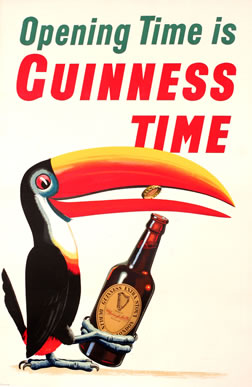
Our 20th Guinness poster by John Gilroy features the iconic toucan, who’s just opened his bottle of Guinness with his impressive beak. The tagline reads “Opening Time is Guinness Time.”
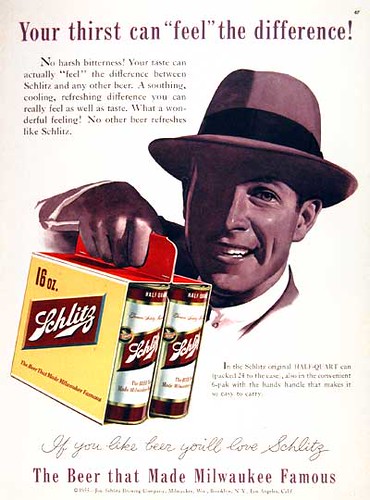
Friday’s ad is another one for Schlitz, from 1955. The slogan is “Your Thirst Can ‘Feel’ the Difference!” at the top and on the bottom of the ad it’s “If you like beer you’ll love Schlitz.” I love the happy looking man in the gray flannel suit holding the very colorful six-pack of 16 oz. bomber cans.
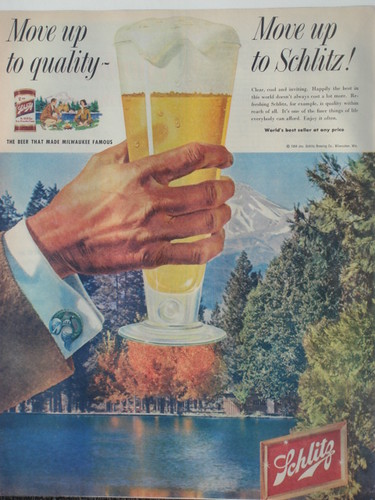
Thursday’s ad is for Schlitz, I think from the late 1950s. The slogan, “Move up to quality — Move up to Schlitz!” Is it just me or is that hand the reason they now use hand models? And check out the swanky cuff link of a fish the guy is wearing.
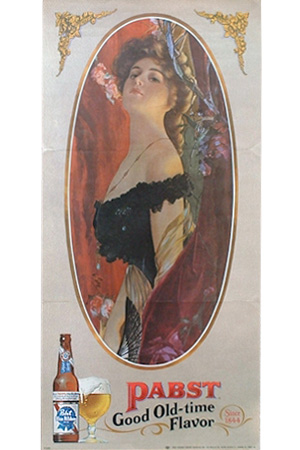
Wednesday’s ad is for Pabst, since they’ve been in the news lately. Since the ad is so retro, trying to evoke an earlier time, I can’t be sure when exactly it was created, though my wild guess is sometime between the 1950s and 70s. But it’s certainly meant to mimic the ads of the later 1800s.
Tuesday’s ad is for an Italian brewer, Birra Metzger, from Torino. They were founded in 1848 but closed in 1975. The ad is from the 1920s.

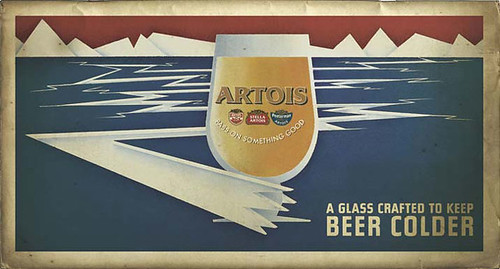
Monday’s ad is either an old ad, or one made to look that way. I can’t be sure. My money’s on old, but who knows. It’s for Artois and is crowing about their new glass designed to keep the beer colder. The glass also has the slogan “Pass On Something Good” across it.
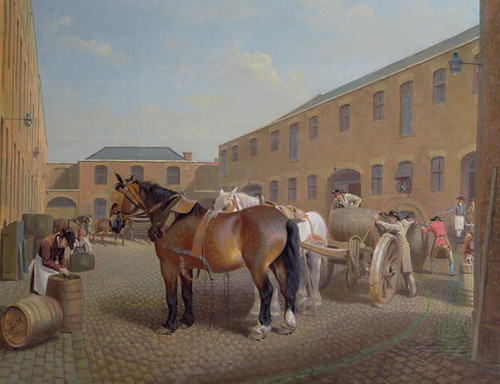
Today’s works of art are from the 18th century by a fairly minor artist: George Garrard, who was born in London and lived from May 31, 1760 to October 8, 1826. The first painting below is entitled Loading the Drays at Whitbread Brewery, Chiswell Street, London, and was painted in 1783.
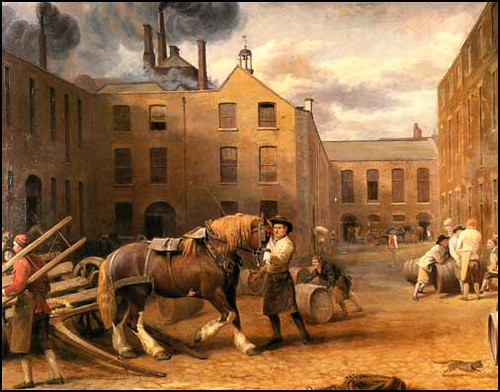
The second, below here, is known as Whitbread Brewery in Chiswell Street and was painted the previous year, 1792. Wikipedia has a little more information about an engraving of it. “A painted engraving of Whitbread Brewery in Chiswell Street London in 1792. It it also titled ‘A View from the East-End of the Brewery Chiswell Street, The famous Whitbread Brewery. A carthorse is being backed into a dray.'”
Here’s some biographical information about Garrard, from Answers.com:
George Garrard (b London, 31 May 1760; d London, 8 Oct 1826). English painter and sculptor. After serving an apprenticeship with Sawrey Gilpin, later his father-in-law, Garrard became a student at the Royal Academy Schools, London, in 1778, exhibiting his first sporting picture there in 1781. Though his occasional genre paintings were better received than his many animal subjects (Sir Joshua Reynolds purchased his View of a Brew-house Yard from the Academy exhibition of 1784), he initially determined to practise as a sporting artist, probably on the advice of the notorious sportsman Colonel Thomas Thornton (1755-1823) for whom he had worked in the 1780s.
You can see a few more of Garrard’s paintings at Bridgeman and also at the Tate Museum.
