Brookston Beer Bulletin

Jay R. Brooks on Beer

  • Home
  • About
  • Editorial
  • Birthdays
  • Art & Beer

Socialize

  • Dribbble
  • Email
  • Facebook
  • Flickr
  • GitHub
  • Instagram
  • LinkedIn
  • Pinterest
  • RSS
  • Twitter
  • YouTube

Powered by Genesis

Beer In Ads #5055: Weihnachts Bock Monk

August 17, 2025 By Jay Brooks

Last year I decided to concentrate on Bock ads. Bock, of course, may have originated in Germany, in the town of Einbeck. Because many 19th century American breweries were founded by German immigrants, they offered a bock at certain times of the year, be it Spring, Easter, Lent, Christmas, or what have you. In a sense they were some of the first seasonal beers. “The style was later adopted in Bavaria by Munich brewers in the 17th century. Due to their Bavarian accent, citizens of Munich pronounced ‘Einbeck’ as ‘ein Bock’ (a billy goat), and thus the beer became known as ‘Bock.’ A goat often appears on bottle labels.” And presumably because they were special releases, many breweries went all out promoting them with beautiful artwork on posters and other advertising.

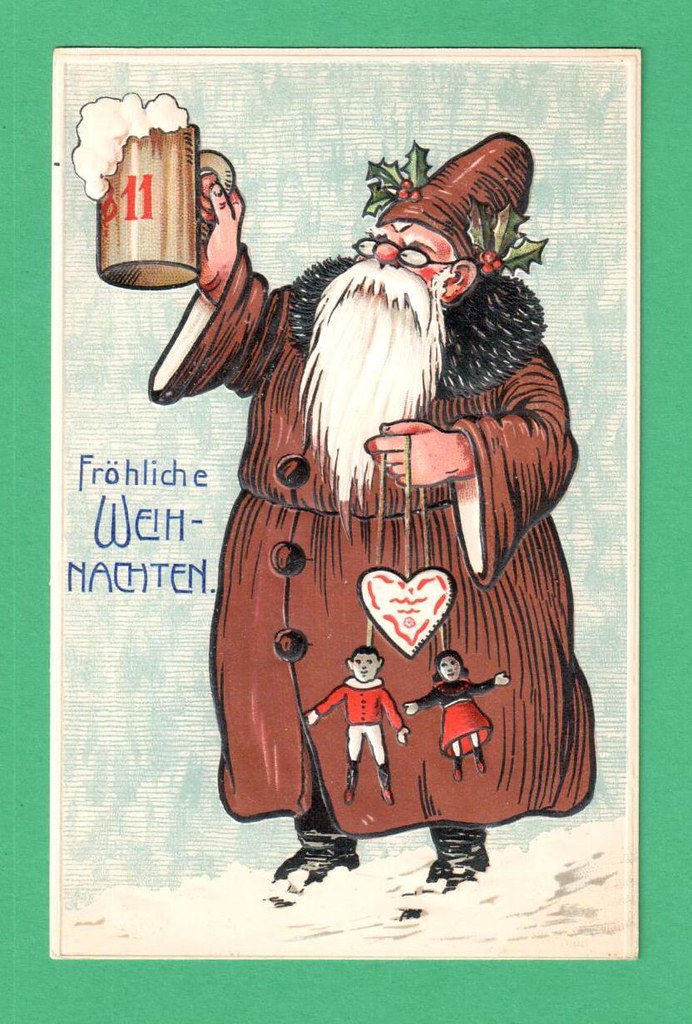
Sunday’s poster is for Falken Schaffhauser’s Weihnachts Bock, and was published in 1931. This one was made for the Bierbrauerei Falken Schaffhausen, or Falcon Brewery, of Schaffhausen, Switzerland. The brewery was founded in 1799, and is still in business today, and is “considered the only independent brewery in the Schaffhausen region,” and is Switzerland’s 5th largest brewery. This one is for their Schaffhauser Weihnachts Bock (Christmas or WInter Bock) and shows a monk taking a walk in the snow. Of course, he took a mug with him because you never know if you’ll run across a keg of bock in the wilderness. It was created by Swiss artist Arnold Oechslin.

Filed Under: Art & Beer, Beers, Breweries, Just For Fun Tagged With: Advertising, Bock, History, Switzerland

Historic Beer Birthday: Johann Casper Bruckmann

August 17, 2025 By Jay Brooks

Today is the birthday of Johann (“John”) Casper Bruckmann (August 17, 1829-August 12, 1887). He was born in “Berka von der Hainich, Wartburgkreis, Thuringia, Germany.” the son of Hartmann Bru(e)ckmann and Christina Maria Braun.

In 1856, with his brother, Frederick Bruckmann, he founded the Cumminsville Brewery, of Cincinnati, Ohio, which was also known as the Frederick Bruckmann Brewery, but by 1872 was called the John C. Bruckmann Brewing Co., although still also known as the Cumminsville Brewery.

Filed Under: Birthdays, Breweries, Just For Fun Tagged With: Germany, History, Ohio

Historic Beer Birthday: Emile A.H. Seipgens

August 16, 2025 By Jay Brooks

netherlands
Today is the birthday of Emile Anton Hubert Seipgens (August 16, 1837-June 25, 1896). Seipgens was born in Roermond, the Netherlands. He was the son of a brewer, and after school and some failed jobs, joined his father at the brewery in 1856. By 1859, he was running the brewery along with his brother. But apparently he wasn’t happy there, and in 1874 decided to pursue his dream of becoming a writer. Throughout his life, he wrote poetry, novels, plays and much more.

Seipgens

Here’s a translated biography of his literary career, from Literary Zutphen:

Emile (Anton Hubert) Seipgens, born August 16, 1837 in Roermond, from 1876 until 1883 teacher of German at the Rijks HBS in Zutphen. He founded a literary reading companion for his disciples and was a member of the “Circle of scientific maintenance. He lived Nieuwstad A128-2. Seipgens was an outspoken Limburg author. His work – theater, novels and novellas village – is invariably located in Limburg, and sometimes – his songs – even written in Limburg dialect. Some of his best known and most read titles he wrote in his Zutphense period: The chaplain Bardelo (1880), from Limburg. Novellas and Sketches (1881). In this period made ​​Seipgens, who was first trained to be a priest, then was brewer, then teacher, to eventually become a writer, definitively separated from the Catholic Church. He started on the assembly line to write stories, which he published in magazines such as The Guide , Netherlands and Elsevier . One of those stories, Rooien Hannes , had worked to folk drama and staged by the Netherlands Tooneel great success. Later titles are: In and around the small town (1887), along Maas and Trench (1890), The Killer Star (1892), Jean, ‘t Stumpke, Hawioe-Ho (1893), The Zûpers of Bliënbèèk (1894) and A wild Rosary (1894). In 1892 Seipgens secretary of the Society of Dutch Literature in Leiden, and in that place he died 1896. Posthumously published yet his novel on June 25, Daniel (1897) and the beam A Immortellenkrans (1897). Seipgens, which is one of the earliest naturalists of the Netherlands became completely into oblivion, until the late 70s of the last century actually was a small revival. Which among other things led to reprint the novel The chaplain Bardelo and stories in and around the small town , and to the publication of his biography, written by Peter Nissen: Emile Anton Hubert Seipgens (1837-1896). Of brewer’s son to literary (1987), and the placing of a memorial stone at Seipgens birthplace. But this revival was short-lived. If Emile Seipgens remembered voortleeft, it will have to be on the legend of the rovershoofdman Johann Bückler based ‘operabouffe’ Schinderhannes (1864), which to this day in Roermond is staged!
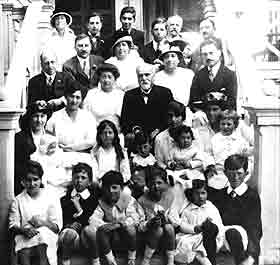
Seipgens1

And here’s another account from “The Humour of Holland,” published in 1894.

Seipgens-bio

Seipgens2

Filed Under: Birthdays Tagged With: History, Literature, The Netherlands

Historic Beer Birthday: Johan Kjeldahl

August 16, 2025 By Jay Brooks

carlsberg-crown
Today is the birthday of Johan Gustav Christoffer Thorsager Kjeldahl (August 16, 1849-July 18, 1900) He was a Danish chemist who developed a method for determining the amount of nitrogen in certain organic compounds using a laboratory technique which was named the Kjeldahl method after him.

Kjeldahl worked in Copenhagen at the Carlsberg Laboratory, associated with Carlsberg Brewery, where he was head of the Chemistry department from 1876 to 1900.

He was given the job to determine the amount of protein in the grain used in the malt industry. Less protein meant more beer. Kjeldahl found the answer was in developing a technique to determine nitrogen with accuracy but existing methods in analytical chemistry related to proteins and biochemistry at the time were far from accurate.

Haslund_Johan_Kjeld
A painting by Otto Haslund of Johan Kjeldahl.

His discovery became known as the Kjeldahl Method

Kjeldahl's_distillation

The method consists of heating a substance with sulphuric acid, which decomposes the organic substance by oxidation to liberate the reduced nitrogen as ammonium sulphate. In this step potassium sulphate is added to increase the boiling point of the medium (from 337 °C to 373 °C) . Chemical decomposition of the sample is complete when the initially very dark-coloured medium has become clear and colourless.

The solution is then distilled with a small quantity of sodium hydroxide, which converts the ammonium salt to ammonia. The amount of ammonia present, and thus the amount of nitrogen present in the sample, is determined by back titration. The end of the condenser is dipped into a solution of boric acid. The ammonia reacts with the acid and the remainder of the acid is then titrated with a sodium carbonate solution by way of a methyl orange pH indicator.
In practice, this analysis is largely automated; specific catalysts accelerate the decomposition. Originally, the catalyst of choice was mercuric oxide. However, while it was very effective, health concerns resulted in it being replaced by cupric sulfate. Cupric sulfate was not as efficient as mercuric oxide, and yielded lower protein results. It was soon supplemented with titanium dioxide, which is currently the approved catalyst in all of the methods of analysis for protein in the Official Methods and Recommended Practices of AOAC International.

And Velp Scientifica also has an explanation of his method, which is still in use today.

Kjeldahl (center) in his laboratory.

Filed Under: Birthdays, Just For Fun, Related Pleasures Tagged With: Carlsberg, Denmark, History, Science, Science of Brewing

Beer In Ads #5054: Alpine Bock Beer Festival

August 15, 2025 By Jay Brooks

Last year I decided to concentrate on Bock ads. Bock, of course, may have originated in Germany, in the town of Einbeck. Because many 19th century American breweries were founded by German immigrants, they offered a bock at certain times of the year, be it Spring, Easter, Lent, Christmas, or what have you. In a sense they were some of the first seasonal beers. “The style was later adopted in Bavaria by Munich brewers in the 17th century. Due to their Bavarian accent, citizens of Munich pronounced ‘Einbeck’ as ‘ein Bock’ (a billy goat), and thus the beer became known as ‘Bock.’ A goat often appears on bottle labels.” And presumably because they were special releases, many breweries went all out promoting them with beautiful artwork on posters and other advertising.

Friday’s ad is not for a specific Bock Beer, but for an upcoming Bock Beer Festival at the Alpine Village Beer Garden, and was published on August 15, 1969. This one is for the Alpine Village in Torrance, California, which was originally founded in 1968. They had Bavarian Dances every weekend, but the Bock Beer Festival took place on august 17. Unfortunately, it closed during Covid, but has recently been designated as culturally significant and saved from demolition. This ad for the event ran in The Daily Breeze, of Hermosa Beach, California.

Filed Under: Art & Beer, Beers, Events, Just For Fun Tagged With: Advertising, Bock, California, History

Historic Beer Birthday: Christian Benjamin Feigenspan

August 15, 2025 By Jay Brooks

feigenspan
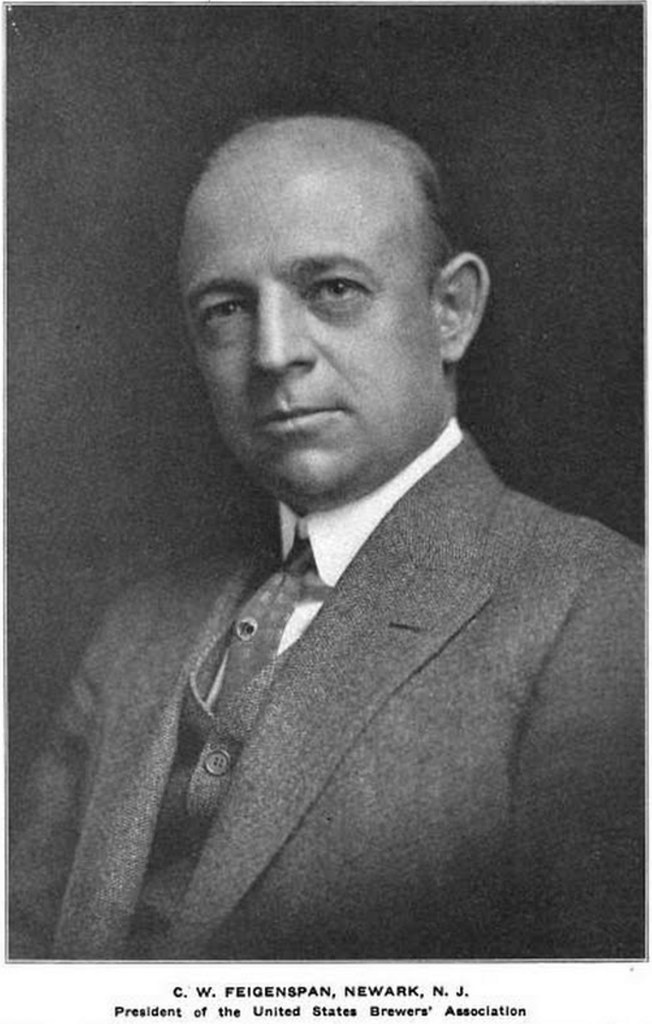
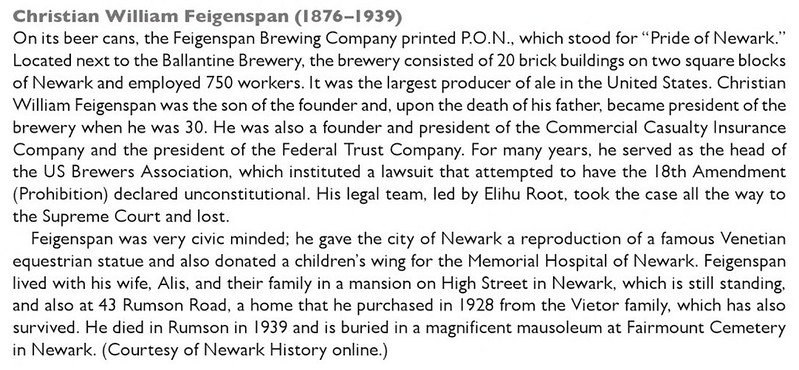
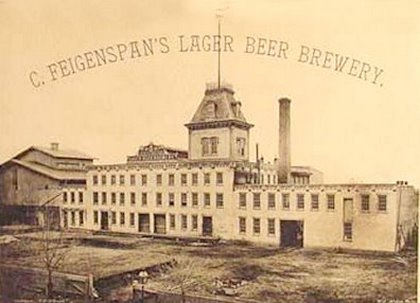
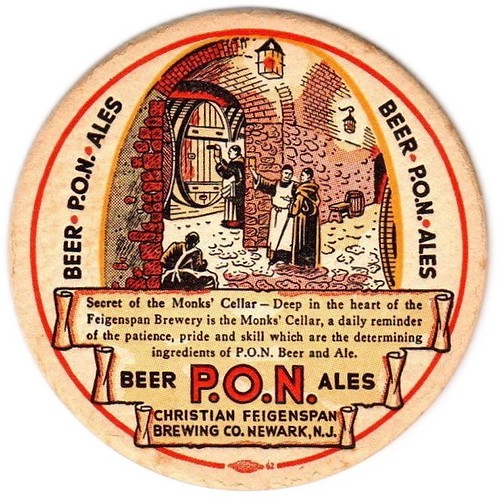
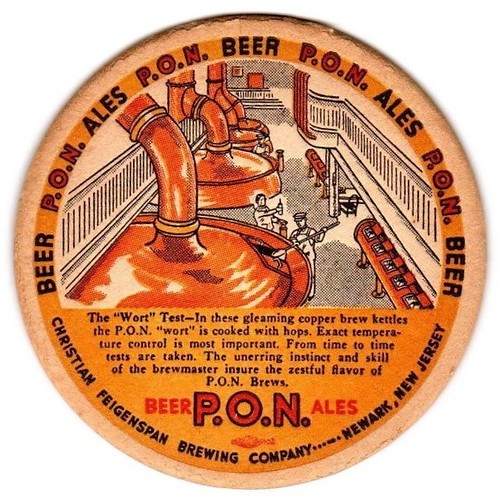
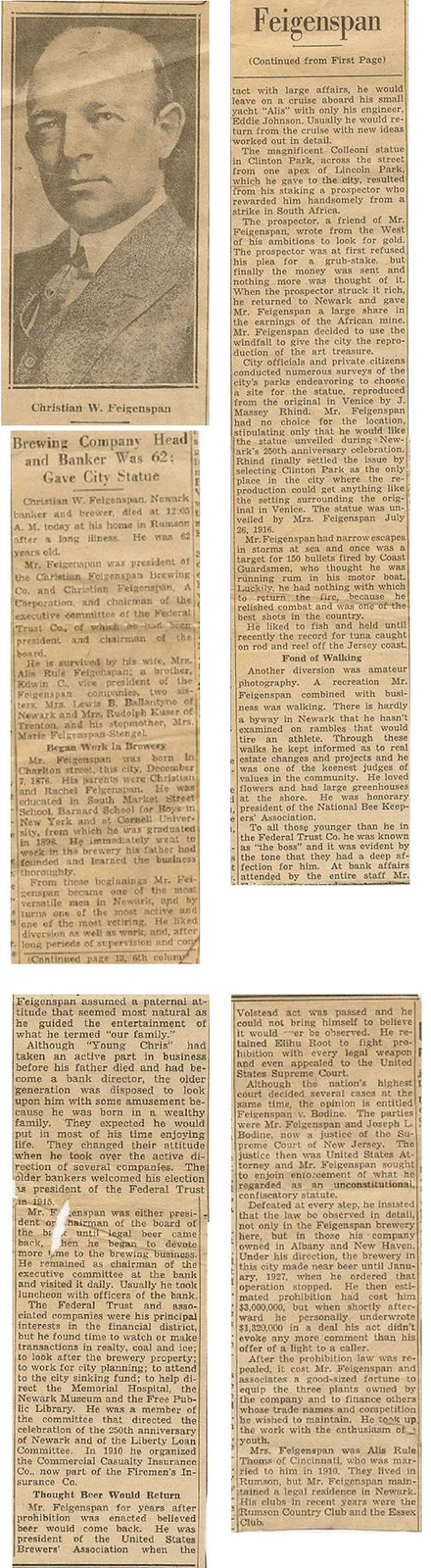
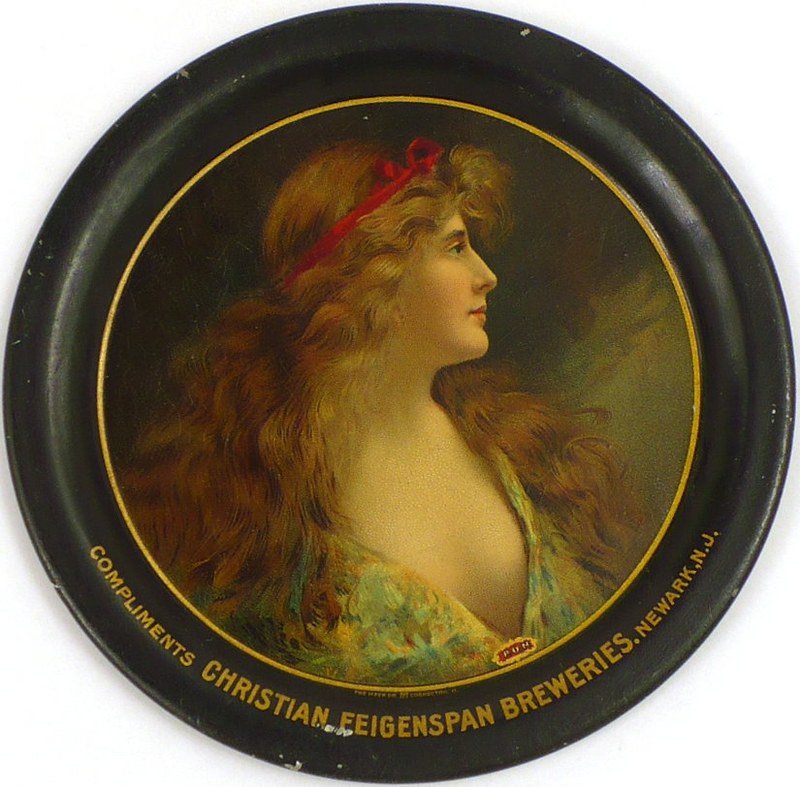
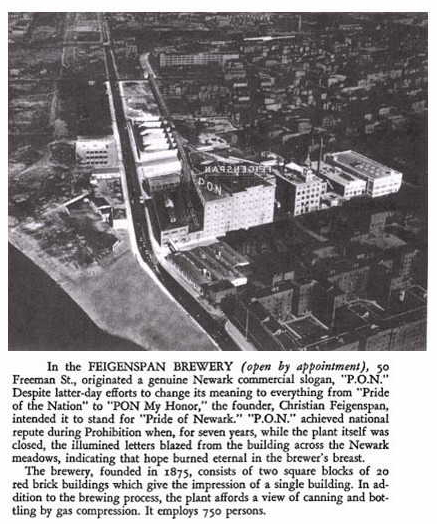
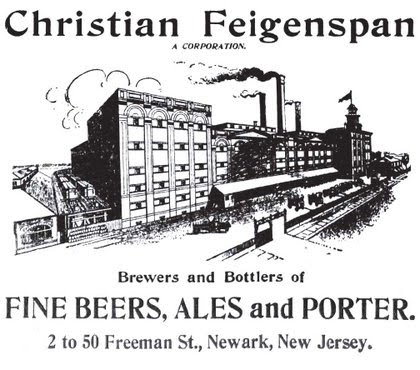
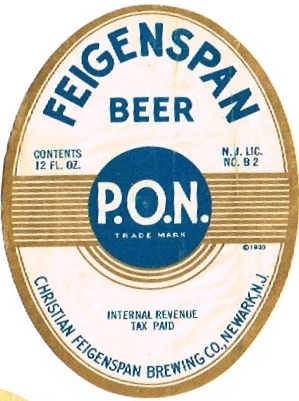
Today is the birthday of Christian Benjamin Feigenspan (August 15, 1844-April 10, 1899). He was born in Thuringia, Germany but moved his family to New Jersey and founded the C. Feigenspan Brewing Company of Newark in 1875, though at least one source says 1868. When he died in 1899, his son Christian William Feigenspan took over management of the brewery, which remained in business through prohibition, but was bought by Ballantine in 1943.

Christian-Benjamin-Feigenspan

There’s surprisingly little biographical information about Christian Benjamin Feigenspan, but here’s some history of his brewery:

In 1875 the Christian Feigenspan Brewing Company was founded at 49 Charlton St., at the former Laible brewery where he had previously been a superintendent. He would also marry Rachel Laible.

In 1878, he reportedly built a brewery on Belmont Street, and as late as 1886 a facility at 54 Belmont would be listed as the “Feigenspan Bottling Establishment”.

In 1880, Christian Feiganspan took over the Charles Kolb lager beer brewery (founded 1866) on Freeman Street. (Altho’, an 1873 map of Newark shows the property owned by a “Lenz Geyer Company”. There was a “Geyer” who was another Newark brewer who owned an “Enterprise Brewery” on Orange St.)

An 1884 fire would, reportedly, burn the brewery to the ground for a loss of $300,000.

By 1909, the firm would be advertising that “…Feigenspan Breweries are the largest producers of Ale in the United States!” (click on barrel above for text of ad) in an apparent dig at their much larger next door neighbor, P. Ballantine & Sons. Ballantine’s Lager Beer sales having by then accounted for 3/4 of their total production.

Possibly because of WWI era restrictions on the allowable alcohol level of beer (set at a mere 2.75%), Feigenspan entered into Prohibition with 4,000 barrels of aging ale in its cellar. In 1927, the ale would make the news as they tried to sell it. One story in July had it going to Heinz in Pittsburgh to be made into malt vinegar, but follow up articles say that in early November the ale was simply dumped into the sewer “…and thence into the Passaic River”.

Sadly, it would not be the first beer dumped by Feigenspan, which had one of the first four licenses to brew “medicinal beer” at the start of Prohibition. “Medicinal beer” was soon outlawed by the “Anti-Beer” law, and the brewery had to dump 600 cases of “real beer” (4.5% alcohol) in March of 1922.

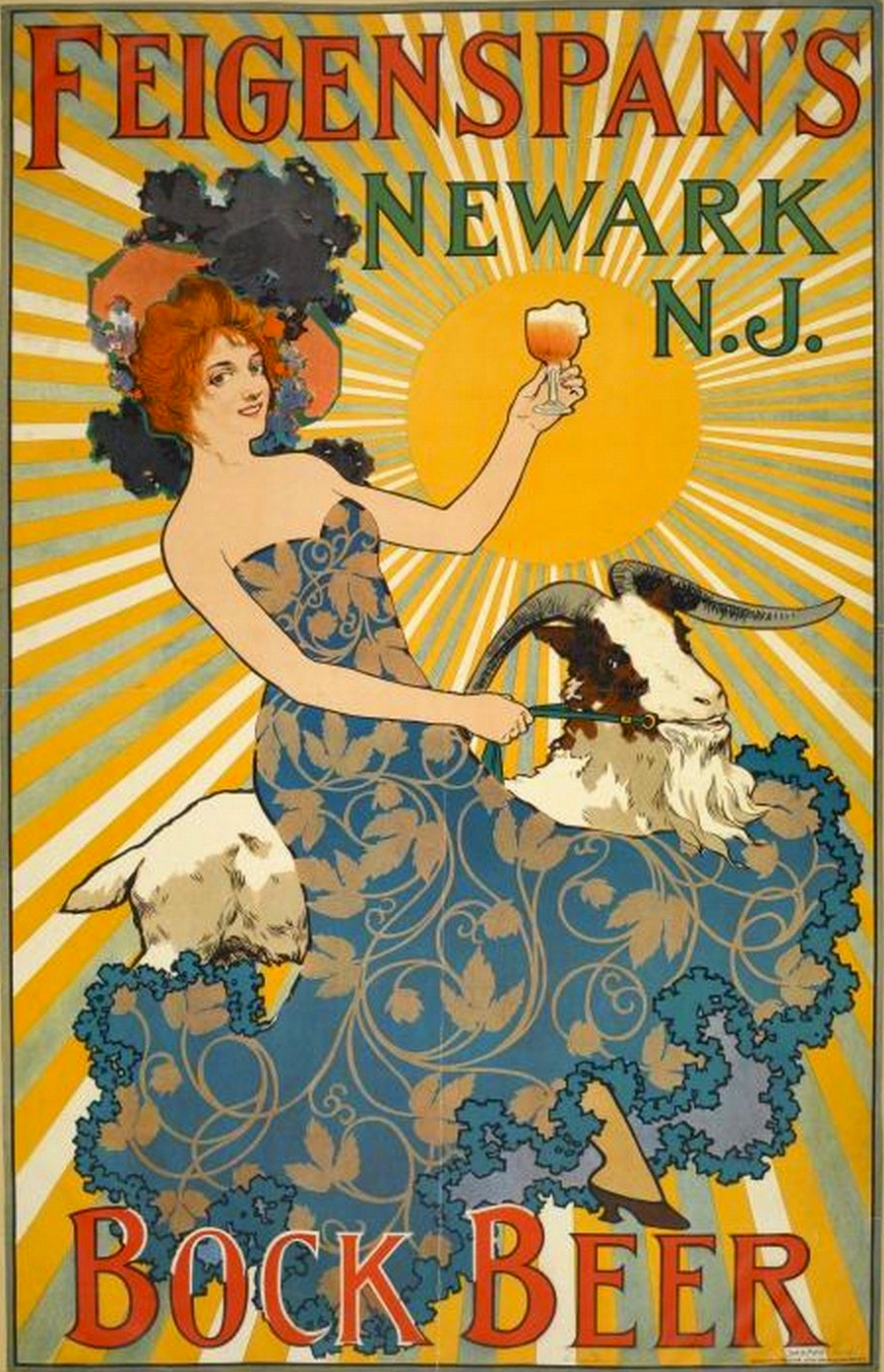
Feigenspan-bock-1900

Christian-Feigenspan-Breweries-Tip-Trays-3-6-inches-Christian-Feigenspan-Inc--Pre-Prohibition

Filed Under: Birthdays, Breweries, Just For Fun Tagged With: Germany, History, New Jersey

Beer In Ads #5053: Stiegl Golden Bock Beer

August 14, 2025 By Jay Brooks

Last year I decided to concentrate on Bock ads. Bock, of course, may have originated in Germany, in the town of Einbeck. Because many 19th century American breweries were founded by German immigrants, they offered a bock at certain times of the year, be it Spring, Easter, Lent, Christmas, or what have you. In a sense they were some of the first seasonal beers. “The style was later adopted in Bavaria by Munich brewers in the 17th century. Due to their Bavarian accent, citizens of Munich pronounced ‘Einbeck’ as ‘ein Bock’ (a billy goat), and thus the beer became known as ‘Bock.’ A goat often appears on bottle labels.” And presumably because they were special releases, many breweries went all out promoting them with beautiful artwork on posters and other advertising.

Thursday’s ad is for Stiegl Golden Bock Beer, which was published on August 14, 1982. This one is for the Stiegl Brauerei of Salzburg, Austria, which was originally founded in 1492. This ad for the imported beer ran in The Chicago Tribune, of Chicago, Illinois.

Filed Under: Art & Beer, Beers, Breweries, Just For Fun Tagged With: Advertising, Austria, Bock, Chicago, History, Illinois

Beer In Ads #5052: New South Brewery Bock Beer

August 13, 2025 By Jay Brooks

Last year I decided to concentrate on Bock ads. Bock, of course, may have originated in Germany, in the town of Einbeck. Because many 19th century American breweries were founded by German immigrants, they offered a bock at certain times of the year, be it Spring, Easter, Lent, Christmas, or what have you. In a sense they were some of the first seasonal beers. “The style was later adopted in Bavaria by Munich brewers in the 17th century. Due to their Bavarian accent, citizens of Munich pronounced ‘Einbeck’ as ‘ein Bock’ (a billy goat), and thus the beer became known as ‘Bock.’ A goat often appears on bottle labels.” And presumably because they were special releases, many breweries went all out promoting them with beautiful artwork on posters and other advertising.

Wednesday’s ad is for New South Bock Beer, which was published on August 13, 1914. This one is for the New South Brewery & Ice Co. of Middlesboro, Kentucky, which was originally founded in 1891. They also had a second brewery located in Atlanta, Georgia, which is undoubtedly why this ad ran in The Atlanta Journal, also of Atlanta, Georgia.

Filed Under: Art & Beer, Beers, Breweries, Just For Fun Tagged With: Advertising, Bock, History

Historic Beer Birthday: Anders Jöns Ångström

August 13, 2025 By Jay Brooks

dark-side-of-moon
Today is the birthday of Anders Jöns Ångström (August 13, 1814–June 21, 1874). He “was a Swedish physicist and one of the founders of the science of spectroscopy.” The Ångström unit (1 Å = 10−10 m) in which the wavelengths of light and interatomic spacings in condensed matter are sometimes measured are named after him. Various types of spectroscopy are employed in the brewing industry.

Anders-Angstrom

Here’s a partial biography of Ångström from Wikipedia:

Anders Jonas Ångström was born in Medelpad to Johan Ångström, and schooled in Härnösand. He moved to Uppsala in 1833 and was educated at Uppsala University, where in 1839 he became docent in physics. In 1842 he went to the Stockholm Observatory to gain experience in practical astronomical work, and the following year he was appointed keeper of the Uppsala Astronomical Observatory.

Intrigued by terrestrial magnetism he recorded observations of fluctuations in magnetic intensity in various parts of Sweden, and was charged by the Stockholm Academy of Sciences with the task, not completed until shortly before his death, of working out the magnetic data obtained by HSwMS Eugenie on her voyage around the world in 1851 to 1853.

In 1858, he succeeded Adolph Ferdinand Svanberg in the chair of physics at Uppsala. His most important work was concerned with heat conduction and spectroscopy. In his optical researches, Optiska Undersökningar, presented to the Royal Swedish Academy of Sciences in 1853, he not only pointed out that the electric spark yields two superposed spectra, one from the metal of the electrode and the other from the gas in which it passes, but deduced from Leonhard Euler’s theory of resonance that an incandescent gas emits luminous rays of the same refrangibility as those it can absorb. This statement, as Sir Edward Sabine remarked when awarding him the Rumford medal of the Royal Society in 1872, contains a fundamental principle of spectrum analysis, and though overlooked for a number of years it entitles him to rank as one of the founders of spectroscopy.

Anders_Ångström_painting

This is the general definition of spectroscopy from Wikipedia:

Spectroscopy is the study of the interaction between matter and electromagnetic radiation. Historically, spectroscopy originated through the study of visible light dispersed according to its wavelength, by a prism. Later the concept was expanded greatly to include any interaction with radiative energy as a function of its wavelength or frequency. Spectroscopic data are often represented by an emission spectrum, a plot of the response of interest as a function of wavelength or frequency.

This abstract from the 2006 paper “Applications of Vibrational Spectroscopy in Brewing” gives an overview of their use by brewers.

The purpose of this chapter is to compile the literature concerning the applications of near‐infrared (NIR), mid‐infrared and Raman spectroscopy in the brewing industry. All these three techniques share the advantages that they are rapid, can be noninvasive and allow direct observation of specific molecular species. As for barley, many researchers have used the NIR reflectance on whole grains in malt evaluation. The NIR determination of α/β‐acids and hop storage index in baled hop samples is reported. NIR spectrophotometric methods have been developed for the determination of yeast concentration and activity in beer making. In addition to the applications in the laboratory of quality control, the overview concerns also the applications of infrared and Raman spectroscopy in monitoring of operation and process control at the essential steps of mashing and wort fermentation in brewery. The results obtained with a short wave NIR spectrophotometer are presented in comparison with long wave NIR spectrophotometers.

Brewers use spectrometers to measure a number of QC items throughout the brewing process.

Cover_Table1

To get a sense of how much spectrometers are used, this article promoting StellarNet, a company selling them, entitled Spectroscopy Prospects Brewing, is pretty thorough.

NIR-spectrometer-Beer

Filed Under: Birthdays, Just For Fun, Related Pleasures Tagged With: History, Science, Science of Brewing, Sweden

Historic Beer Birthday: Lilly Anheuser

August 13, 2025 By Jay Brooks

a-b
Today is the birthday of Lilly Anheuser (August 13, 1844-February 25, 1928). She was born in Mainz-Bingener Landkreis, in Rheinland-Pfalz, Germany, one of three daughters of Eberhard Anheuser. Eberhard was originally a soap and candle maker, but had had also invested in the Bavarian Brewery Company, in St. Louis, Missouri. When it went through financial troubles in 1860, he took over control of it, buying out the other creditors, and renaming it Eberhard Anheuser and Company. “Lilly married Adolphus Busch, a brewery supply salesman, in a double wedding with Anna Anheuser (Lilly’s older sister) and Ulrich Busch (Adolphus’ brother) in 1861.” Her husband was running the brewery even before her father died in 1880, and the year before, 1879, the corporation was renamed the Anheuser-Busch Brewing Association to reflect the reality of Busch’s leadership role.

lily-anheuser

Here’s a short biography from Find-a-Grave:

Lilly was one of six children of Eberhard and Dorothea Anheuser. She and her family lived in Cincinnati, Ohio for a time before moving to St Louis, Missouri.

Lilly, who was blonde and called “curly Head” was courted by and married to Adolphus Busch, who sold brewery supplies at the time, to her father at the E. Anheuser Brewing Company. She was married to Adolphus in a double wedding; her sister Anna married Ulrich Busch on March 11, 1861. Anna was dark and known for her sophistication.
Lilly was the mother of thirteen children. Nine lived to adulthood. Along with her social life, Lilly cooked for her husband and to an extent remained a “house wife.”

With the success of the Brewery, She and her husband and children traveled extensively. They owned Villas in Germany. Both were confiscated by Hitler. They traveled by private train car. A favorite group of homes for them was Ivy Wall, and The Blossoms, Busch Gardens in Pasadena,CA. They had an estate in Cooperstown, NY, and Germany.

Upon reaching their fiftieth wedding anniversary, Lilly and Adolphus presented a home to each of their children.
One was given a French chateau manner on a farm near St. Louis once owned by General U.S. Grant. It is now known as Grant’s Farm and is open to the public. Other Children were given homes in St Louis, New York, Berlin, Germany, Chicago,IL,and Stuttgart, Germany.

It was reported Lilly was given a gold Crown by her husband to commemorate their golden Anniversary. Amidst the celebration was sadness because the health of her husband was failing. He passed away at Villa Lilly, in Germany with Lilly at his side.

lilly-anheuser-mid

The Anheuser-Busch website gives this account:

Eberhard Anheuser, who left Germany in 1843, settling first in Cincinnati and before moving to St. Louis. Trained as a soap manufacturer, he eventually went on to own the largest soap and candle company in St. Louis. Although he had no brewing experience, he became part owner of the Bavarian Brewery, which had first opened its doors in 1852. By 1860, Anheuser had bought out the other investors and the brewery’s name was changed to E. Anheuser & Co.

Adolphus Busch was born in 1839, the second youngest of 22 children. At age 18, he made his way to St. Louis via New Orleans and the Mississippi River. Adolphus began working as a clerk on the riverfront and by the time he was 21, he had a partnership in a brewing supply business.

It was through this enterprise that Adolphus Busch met Eberhard Anheuser, and soon Adolphus was introduced to Eberhard’s daughter, Lilly. In 1861, Adolphus Busch and Lilly Anheuser were married, and shortly after that, Adolphus went to work for his father-in-law. He later purchased half ownership in the brewery, becoming a partner.

lilly-anheuser-photo
Lilly Anheuser later in life.

In 1897, famed Swedish artist Anders Zorn painted portraits of Lilly Anheuser and her husband Adolphus Busch. They were recently sold through the auction house Christie’s. The winning bid for Busch’s portrait was $207,750 and Lilly’s went for $123,750.

Zorn-lilly-anheuser-1897
A portrait of Lily Anheuser, painted by Anders Zorn in 1897.

Filed Under: Birthdays, Just For Fun Tagged With: Anheuser-Busch, Germany, History, Missouri

« Previous Page
Next Page »

Find Something

Northern California Breweries

Please consider purchasing my latest book, California Breweries North, available from Amazon, or ask for it at your local bookstore.

Recent Comments

  • Bob Paolino on Beer Birthday: Grant Johnston
  • Gambrinus on Historic Beer Birthday: A.J. Houghton
  • Ernie Dewing on Historic Beer Birthday: Charles William Bergner 
  • Steve 'Pudgy' De Rose on Historic Beer Birthday: Jacob Schmidt
  • Jay Brooks on Beer Birthday: Bill Owens

Recent Posts

  • Beer Birthday: Wagner Falci June 10, 2026
  • Beer In Ads #5264: Bock-Bier Brauerei Hülsmann Eickel June 9, 2026
  • Historic Beer Birthday: Prosper Cocquyt June 9, 2026
  • Beer Birthday: Todd Ashman June 9, 2026
  • Historic Beer Birthday: Edmund Resch June 9, 2026

BBB Archives

Feedback

Head Quarter
This site is hosted and maintained by H25Q.dev. Any questions or comments for the webmaster can be directed here.