Brookston Beer Bulletin

Jay R. Brooks on Beer

  • Home
  • About
  • Editorial
  • Birthdays
  • Art & Beer

Socialize

  • Dribbble
  • Email
  • Facebook
  • Flickr
  • GitHub
  • Instagram
  • LinkedIn
  • Pinterest
  • RSS
  • Twitter
  • YouTube

Powered by Genesis

Historic Beer Birthday: William Bass

March 2, 2025 By Jay Brooks

bass
Today is the birthday of William Bass (1717-March 2, 1787). Since the exact date of his birth is uncertain, in fact some sources give his birth year as 1721, the best date we have for him is when he died. For most of his life he worked as a general carrier, and moved to Burton-upon-Trent with his bride shortly after they married when he was 39, in 1756. His business increasingly involved carrying beer, and sensing an opportunity, he saved his money for many years. When he was sixty, in 1777, he founded the Bass Brewery

This is a short biography of Bass from the Local History of Burton upon Trent:

William’s father died when he was just fifteen. The eldest son, John, succeeded his father as plumber and glazier, leaving William to look after the running of the small-holding. Eventually, John and William established a carrier business and by 1754, they were operating a bi-directional service between Manchester and London but the following year, William gained complete control over the carrying business with his brother preferring to concentrate on the original established business so that he could remain in Hinckley.

In 1756, William married Mary Gibbons, the daughter of a London publican close who ran the ‘Red Lion’ close to the London depot. They chose to make their home in Burton upon Trent because it was mid-way en route from Manchester and London, was a growing industrial and commercial centre, and was positioned on the new, under construction Trunk canal.

From Burton, he carried felt hats, which had a strong manufacturing presence in Burton, together with spades, axes, screws and hardware predominantly for Thomas Thornewill’s works in New Street but also for other Burton manufacturers such as Richard Green. Increasingly, he was also shipping casks of beer from Burton’s steadily growing brewery trade for the likes of Charles Leeson, William Musgrave, Samuel Sketchley, Joseph Clay, Thomas Lovatt and Henry Evans.

Living in a modest house in Wetmore, William’s first of two sons, Michael Thomas was born in 1759. As a well established carrier proprietor, in 1765, William Bass was able to lease a large new house in High Street.

He entered brewing relatively late in life, aged 60, by selling his transportation business to the Pickford family and using the funds to purchase a Town House in High Street, with a brewery and malthouse on adjoining land, seeing brewing as providing a better future business for his two sons.

The Bass Brewery catered mainly for the domestic market, but in 1784 he started to export ale directly to the Baltic (Russia) via Hull. After his death, he was succeeded in the business by his sons William and Michael and in 1795 Michael took sole control.


Bassetching
This etching, from 1882, is the earliest known image showing the completed new buildings together with the original one on the left.


Here is his entry from Wikipedia:

The exact origins of William Bass, the founder of the brewery are not clear, but a scholarly account of the history of the Bass brewery shows that in the 1720s he was living with his parents, John and Ann Bass, and his two brothers, John and Thomas, in Hinckley, Leicestershire.

His father, a plumber and glazier, died when William was 15, after which he carried on a carrier business with his older brother John in Hinckley, Leicestershire. In 1756 William married Mary Gibbons, daughter of a London publican who ran the Red Lion Inn close to the London depot. They chose Burton-upon-Trent as their home because it was midway between Manchester and London, was a growing industrial-commercial centre, and was ideally positioned on the new Trunk canal, continuing his business there as a carrier of beer, his chief client being Benjamin Printon, a local brewer.

By 1777, aged 60, he had saved some money, and, seeing the growing demand for Burton beer, he entered the brewing business. He bought a town house in the High Street, which contained a brewery and malthouse on adjoining land. Burton was already a thriving brewing town with several breweries exploiting the growing export beer trade via the Trent Navigation and Hull to the Baltic ports in Russia, mainly Saint Petersburg. He established the Bass Brewery and catered mainly for the domestic market, but in 1784 he started to export ale directly to Russia.

After his death, he was succeeded in the business by his sons William and Michael, and in 1795 Michael took sole control.
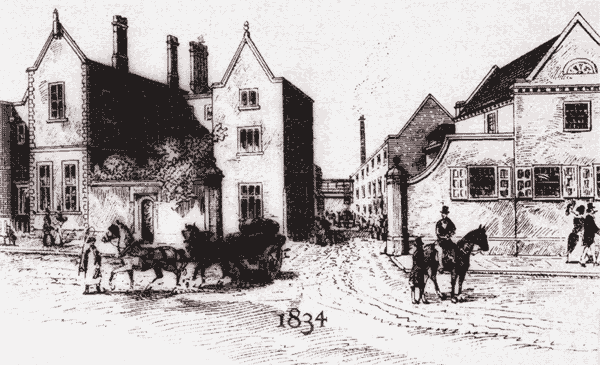
 

BassHouse1834
The Bass Town House, as would have looked in 1834.


And here’s part of the early history of the Bass Brewery he founded:

Prior to establishing a brewery, William Bass transported ale for brewer Benjamin Printon. Bass sold this carrier business to the Pickford family, using the funds to establish Bass & Co Brewery in 1777 as one of the first breweries in Burton-upon-Trent.

Early in the company’s history, Bass was exporting bottled beer around the world, serving the Baltic region through the port of Hull. Growing demand led his son Michael Thomas Bass (senior), to build a second brewery in Burton in 1799 in partnership with John Ratcliff. The water produced from local boreholes became popular with brewers, with 30 operating there by the mid-19th century. His son, Michael Thomas Bass, succeeded on his father’s death in 1827, renewed the Ratcliff partnership, brought in John Gretton, and created ‘Bass, Ratcliff and Gretton.’
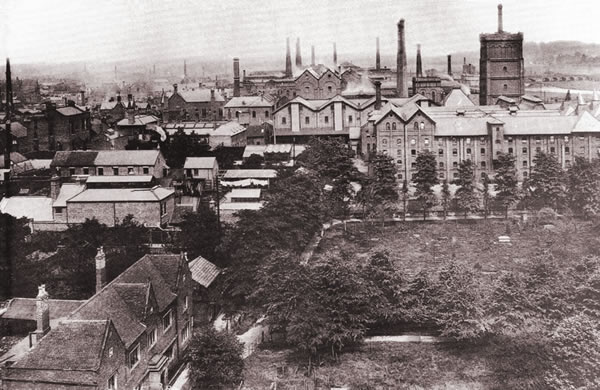
 

BassBrewery


And this is from a Burton-on-Trent history website:

William Bass, born in 1717, was the second son of three sons of William Bass who ran a moderately successful plumbing and glaziery business and small-holding in Hinkley.

William’s father died when he was just fifteen. The eldest son, John, succeeded his father as plumber and glazier, leaving William to look after the running of the small-holding. Eventually, John and William established a carrier business and by 1754, they were operating a bi-directional service between Manchester and London but the following year, William gained complete control over the carrying business with his brother preferring to concentrate on the original established business so that he could remain in Hinckley.

In 1756, William married Mary Gibbons, the daughter of a London publican close who ran the ‘Red Lion’ close to the London depot. They chose to make their home in Burton upon Trent because it was mid-way en route from Manchester and London, was a growing industrial and commercial centre, and was positioned on the new, under construction Trunk canal.

From Burton, he carried felt hats, which had a strong manufacturing presence in Burton, together with spades, axes, screws and hardware predominantly for Thomas Thornewill’s works in New Street but also for other Burton manufacturers such as Richard Green. Increasingly, he was also shipping casks of beer from Burton’s steadily growing brewery trade for the likes of Charles Leeson, William Musgrave, Samuel Sketchley, Joseph Clay, Thomas Lovatt and Henry Evans.

Living in a modest house in Wetmore, William’s first of two sons, Michael Thomas was born in 1759. As a well established carrier proprietor, in 1765, William Bass was able to lease a large new house in High Street.

He entered brewing relatively late in life, aged 60, by selling his transportation business to the Pickford family and using the funds to purchase a Town House in High Street, with a brewery and malthouse on adjoining land, seeing brewing as providing a better future business for his two sons.

The Bass Brewery catered mainly for the domestic market, but in 1784 he started to export ale directly to the Baltic (Russia) via Hull. After his death, he was succeeded in the business by his sons William and Michael and in 1795 Michael took sole control.
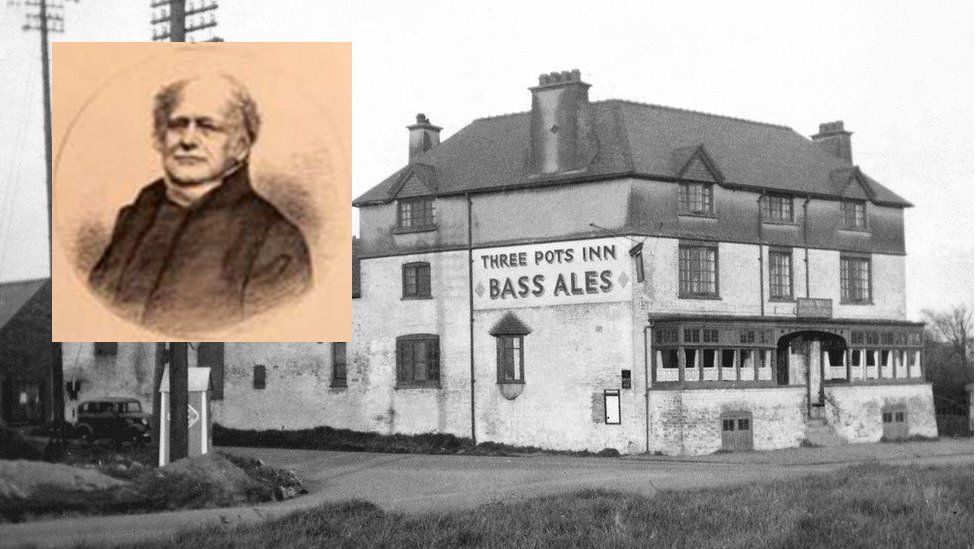
William Bass and one of the firm’s earliest pubs in Hinckley

Filed Under: Birthdays, Just For Fun Tagged With: England, Great Britain, History

Beer In Ads #4896: Centlivre Bock

March 1, 2025 By Jay Brooks

Last year I decided to concentrate on Bock ads. Bock, of course, originated in Germany, in the town of Einbeck. Because many 19th century American breweries were founded by German immigrants, they offered a bock at certain times of the year, be it Spring, Easter, Lent, Christmas, or what have you. In a sense they were some of the first seasonal beers. “The style was later adopted in Bavaria by Munich brewers in the 17th century. Due to their Bavarian accent, citizens of Munich pronounced ‘Einbeck’ as ‘ein Bock’ (a billy goat), and thus the beer became known as ‘Bock.’ A goat often appears on bottle labels.” And presumably because they were special releases, many breweries went all out promoting them with beautiful artwork on posters and other advertising.

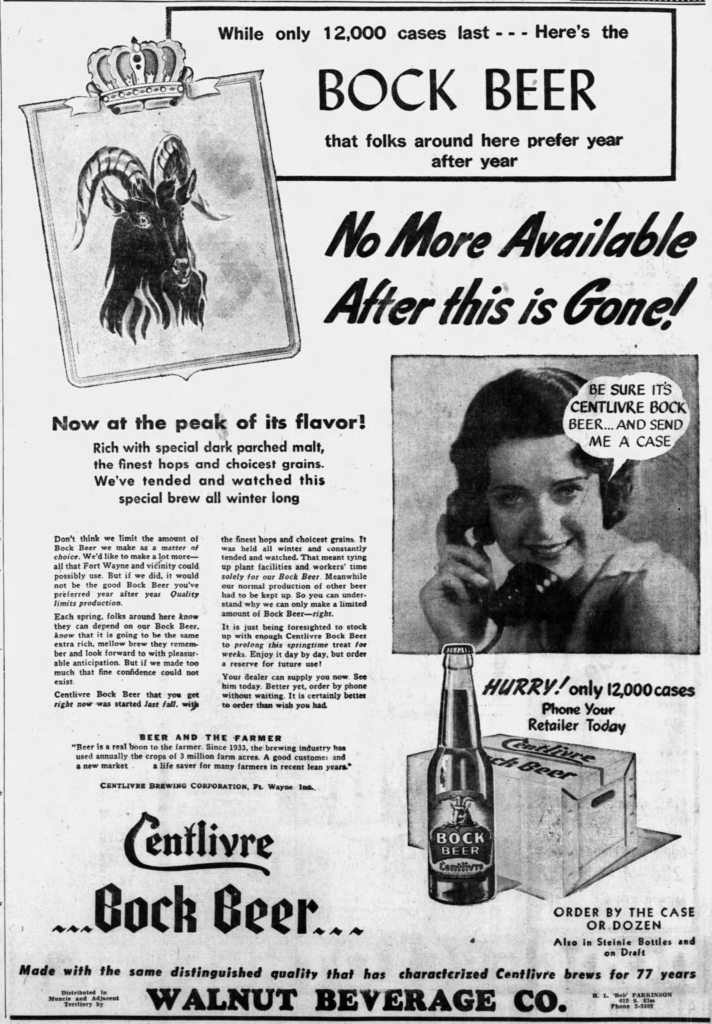
Saturday’s ad is is for Centlivre Bock, and is from March 1, 1940. The brewery was the C.L. Centlivre Brewing Co. of Fort Wayne, Indiana, which was founded in 1862 by Charles l. Centlivre. It went through several name changes until 1970, when it closed, however it was recently relaunched by the Centlivre family as Centlivre Beer. It’s a busy ad with a lot going on, but they definitely leaned into being a limited run. “Only 12,000 cases!”

Filed Under: Art & Beer, Beers, Breweries, Just For Fun Tagged With: Advertising, Bock, History, Indiana

Beer In Ads #4895: Pschorr-Braü Mai Bock

February 28, 2025 By Jay Brooks

Last year I decided to concentrate on Bock ads. Bock, of course, originated in Germany, in the town of Einbeck. Because many 19th century American breweries were founded by German immigrants, they offered a bock at certain times of the year, be it Spring, Easter, Lent, Christmas, or what have you. In a sense they were some of the first seasonal beers. “The style was later adopted in Bavaria by Munich brewers in the 17th century. Due to their Bavarian accent, citizens of Munich pronounced ‘Einbeck’ as ‘ein Bock’ (a billy goat), and thus the beer became known as ‘Bock.’ A goat often appears on bottle labels.” And presumably because they were special releases, many breweries went all out promoting them with beautiful artwork on posters and other advertising.

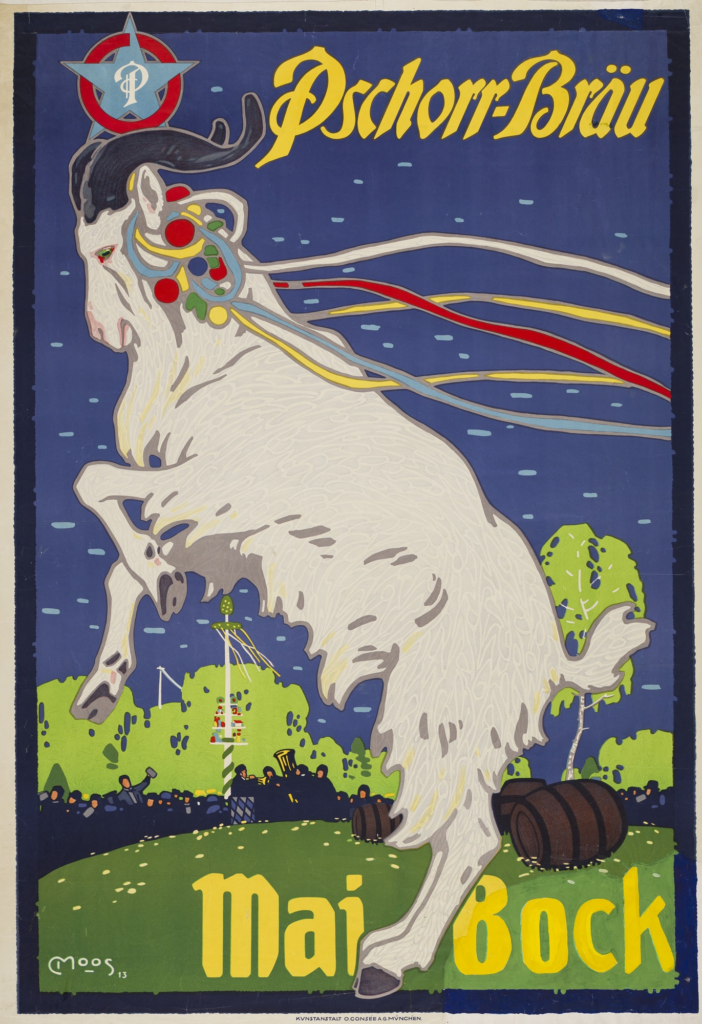
Friday’s ad is is for Pschorr-Braü Mai Bock, and is from 1913. At that time, it was the Pschorr-Bräu, but after a merger in 1972 with the Hacker Brewery it became known as the Hacker-Pschorr Brewery. This poster was created by Carl Moos, a well-known German-Swiss graphic artist, who was best known for his travel and skiing posters.

Filed Under: Art & Beer, Beers, Breweries, Just For Fun Tagged With: Advertising, Bock, Germany, History, Switzerland

Beer In Ads #4894: Piel’s Light Bock

February 27, 2025 By Jay Brooks

Last year I decided to concentrate on Bock ads. Bock, of course, originated in Germany, in the town of Einbeck. Because many 19th century American breweries were founded by German immigrants, they offered a bock at certain times of the year, be it Spring, Easter, Lent, Christmas, or what have you. In a sense they were some of the first seasonal beers. “The style was later adopted in Bavaria by Munich brewers in the 17th century. Due to their Bavarian accent, citizens of Munich pronounced ‘Einbeck’ as ‘ein Bock’ (a billy goat), and thus the beer became known as ‘Bock.’ A goat often appears on bottle labels.” And presumably because they were special releases, many breweries went all out promoting them with beautiful artwork on posters and other advertising.

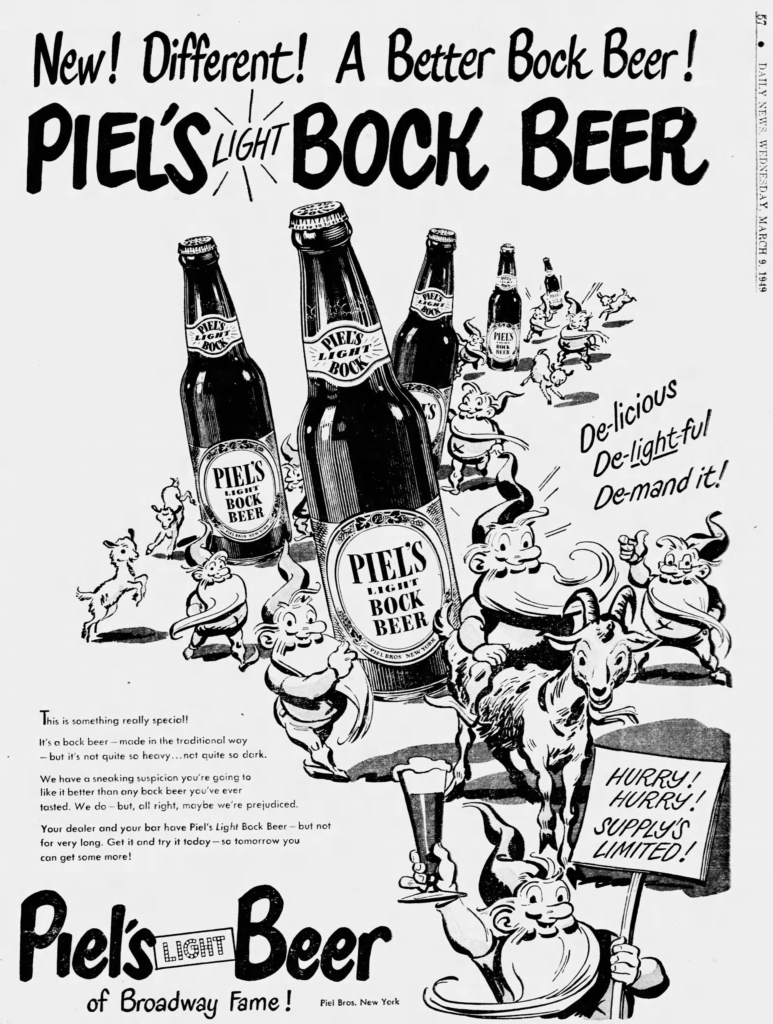
Thursday’s ad is is for Piel’s Light Bock Beer, and is from March of 1949. While I’m aware of lighter colored bocks not being uncommon, this is the first time I’ve seen one advertised as a “light bock.” Piel’s Brewing was founded in 1883 in Brooklyn, but by the 1960s they started closing breweries and by 1973 they were all shut down, and the brand sold to another conglomerate. The brand tried to restart in 2018, but it must not have lasted long because of their new social channels ar dormant. I do quite love the gnomes with the goats.

Filed Under: Art & Beer, Beers, Just For Fun Tagged With: Advertising, Bock, History, New York

Beer In Ads #4893: National Bock Beer Fight

February 26, 2025 By Jay Brooks

Last year I decided to concentrate on Bock ads. Bock, of course, originated in Germany, in the town of Einbeck. Because many 19th century American breweries were founded by German immigrants, they offered a bock at certain times of the year, be it Spring, Easter, Lent, Christmas, or what have you. In a sense they were some of the first seasonal beers. “The style was later adopted in Bavaria by Munich brewers in the 17th century. Due to their Bavarian accent, citizens of Munich pronounced ‘Einbeck’ as ‘ein Bock’ (a billy goat), and thus the beer became known as ‘Bock.’ A goat often appears on bottle labels.” And presumably because they were special releases, many breweries went all out promoting them with beautiful artwork on posters and other advertising.

Tuesday’s ad is depicts a goat fight, apparently to the death, as the victor head butts the other goat over the ledge of a cliff. Standing behind and watching this epic battle are personifications of the major nations of the time, all with mugs of Bock beer in their hands. The Library of Congress mentions a connection to the F. Klemm Brewery of Baltimore, Maryland, although it’s fairly subtle and not all obvious. In the bottom right-hand corner is the following text, quite tiny: “Published by F. Klemm, No. 429 Central Ave., Baltimore, MD.” The chromolithograph was created in 1878. The lithographer was A. Hoen & Co., of 75 Second St., in Baltimore, Maryland. “A. Hoen & Co. was a Baltimore, Maryland-based lithography firm founded by Edward Weber in the 1840s as E. Weber & Company. When August Hoen took it over following Weber’s death, he changed the name and built the company into one of the most prominent in the industry at the time.”

Filed Under: Art & Beer, Beers, Just For Fun Tagged With: Advertising, Baltimore, Bock, History, Maryland

Beer In Ads #4892: Neuweiler’s Bock Beer

February 25, 2025 By Jay Brooks

Last year I decided to concentrate on Bock ads. Bock, of course, originated in Germany, in the town of Einbeck. Because many 19th century American breweries were founded by German immigrants, they offered a bock at certain times of the year, be it Spring, Easter, Lent, Christmas, or what have you. In a sense they were some of the first seasonal beers. “The style was later adopted in Bavaria by Munich brewers in the 17th century. Due to their Bavarian accent, citizens of Munich pronounced ‘Einbeck’ as ‘ein Bock’ (a billy goat), and thus the beer became known as ‘Bock.’ A goat often appears on bottle labels.” And presumably because they were special releases, many breweries went all out promoting them with beautiful artwork on posters and other advertising.

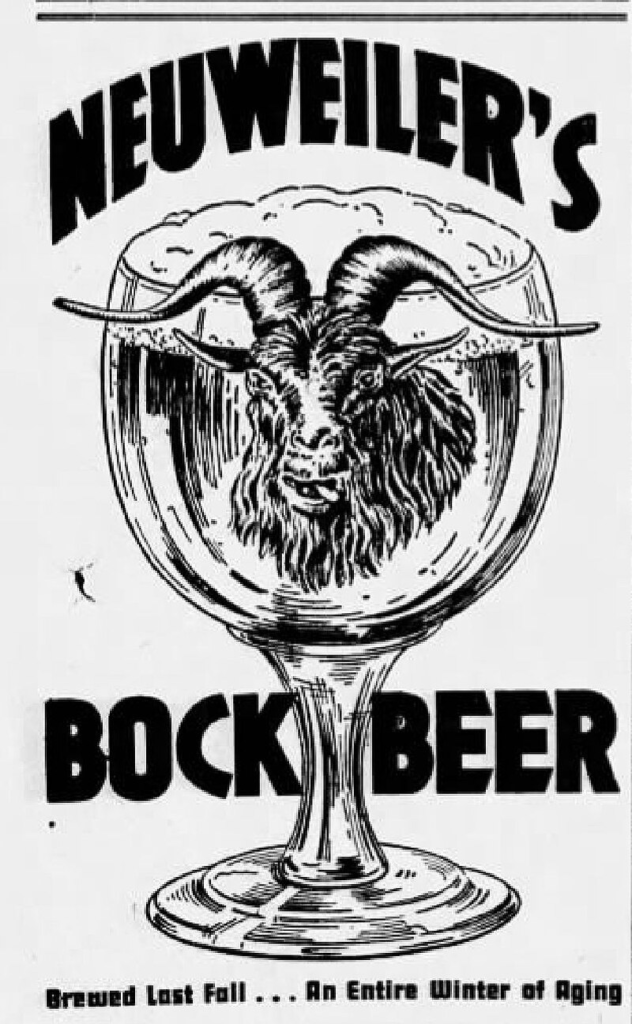
Tuesday’s ad is for “Neuweiler’s Bock Beer,” and was created in 1939. Neuweiler Brewery was located in Allentown, Pennsylvania and was founded in 1900. It closed in 1968.

Filed Under: Art & Beer, Beers, Breweries, Just For Fun Tagged With: Advertising, Bock, History, Pennsylvania

Beer In Ads #4891: American Brewing Co. Bock Beer

February 24, 2025 By Jay Brooks

Last year I decided to concentrate on Bock ads. Bock, of course, originated in Germany, in the town of Einbeck. Because many 19th century American breweries were founded by German immigrants, they offered a bock at certain times of the year, be it Spring, Easter, Lent, Christmas, or what have you. In a sense they were some of the first seasonal beers. “The style was later adopted in Bavaria by Munich brewers in the 17th century. Due to their Bavarian accent, citizens of Munich pronounced ‘Einbeck’ as ‘ein Bock’ (a billy goat), and thus the beer became known as ‘Bock.’ A goat often appears on bottle labels.” And presumably because they were special releases, many breweries went all out promoting them with beautiful artwork on posters and other advertising.

Monday’s ad is for “American Brewing Co. Bock Beer,” and the chromolithograph was created in 1890. The American Brewing Company was located in St. Louis, Missouri, and was founded in 1857 as the Excelsior Brewery by Charles Hoelzle. In 1890, it was bought by Oscar Henry Jr. and Hugo Koehler.

Filed Under: Art & Beer, Beers, Breweries, Just For Fun Tagged With: Advertising, Bock, History, Missouri, St. Louis

Beer In Ads #4890: Daufer Bock

February 23, 2025 By Jay Brooks

Last year I decided to concentrate on Bock ads. Bock, of course, originated in Germany, in the town of Einbeck. Because many 19th century American breweries were founded by German immigrants, they offered a bock at certain times of the year, be it Spring, Easter, Lent, Christmas, or what have you. In a sense they were some of the first seasonal beers. “The style was later adopted in Bavaria by Munich brewers in the 17th century. Due to their Bavarian accent, citizens of Munich pronounced ‘Einbeck’ as ‘ein Bock’ (a billy goat), and thus the beer became known as ‘Bock.’ A goat often appears on bottle labels.” And presumably because they were special releases, many breweries went all out promoting them with beautiful artwork on posters and other advertising.

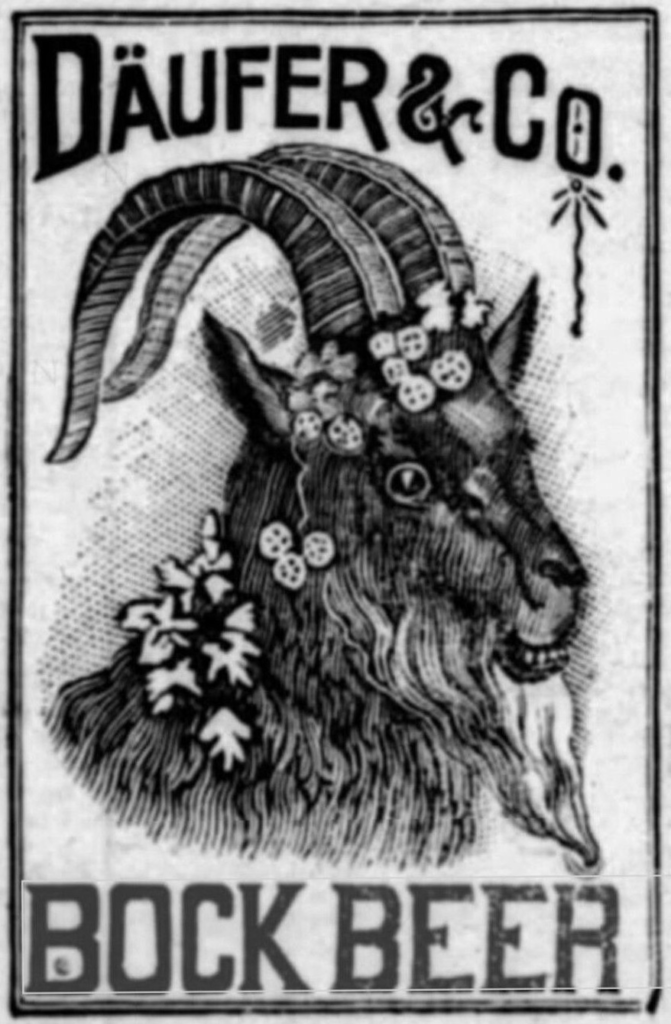
Sunday’s ad is for “Daufer & Co. Bock Beer,” and was created in 1934. Daufer & Co. was located in Allentown, Pennsylvania from 1860 until 1938, although it was known by a variety of names over that time period.

Filed Under: Art & Beer, Beers, Breweries, Just For Fun Tagged With: Advertising, Bock, History, Pennsylvania

Beer In Ads #4889: Boylston Bock In Color

February 22, 2025 By Jay Brooks

Last year I decided to concentrate on Bock ads. Bock, of course, originated in Germany, in the town of Einbeck. Because many 19th century American breweries were founded by German immigrants, they offered a bock at certain times of the year, be it Spring, Easter, Lent, Christmas, or what have you. In a sense they were some of the first seasonal beers. “The style was later adopted in Bavaria by Munich brewers in the 17th century. Due to their Bavarian accent, citizens of Munich pronounced ‘Einbeck’ as ‘ein Bock’ (a billy goat), and thus the beer became known as ‘Bock.’ A goat often appears on bottle labels.” And presumably because they were special releases, many breweries went all out promoting them with beautiful artwork on posters and other advertising.

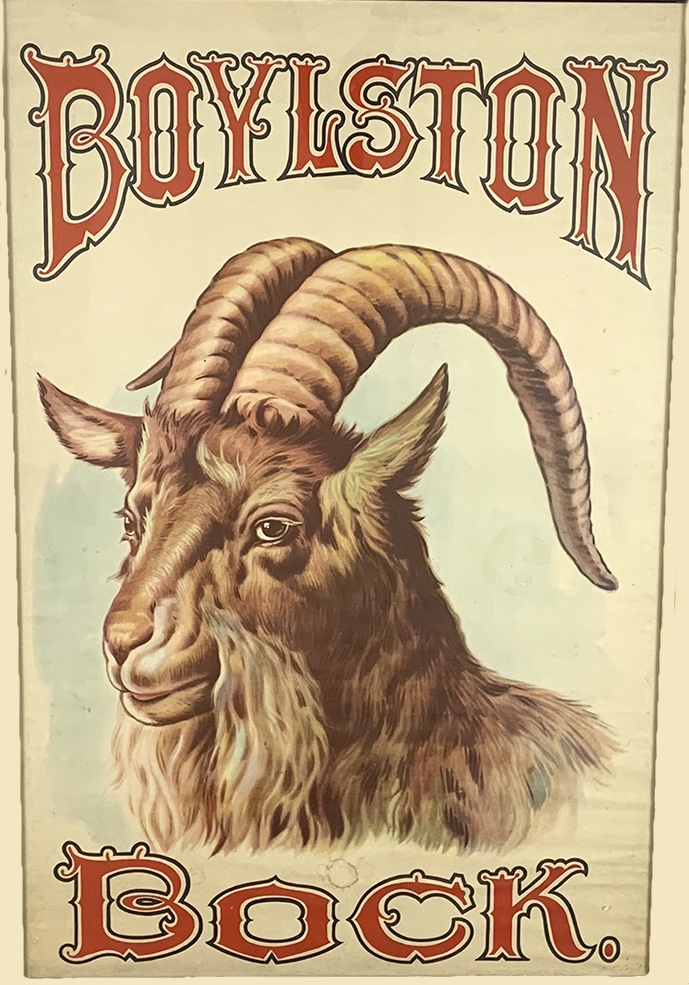
Saturday’s ad for “Boylston Bock,” was created in the 1930s, and is a colorized reproduction of yesterday’s poster. which was originally from around 1890. The Boylston Brewery was located in Boston, Massachusetts. The originaly lithographer was Donaldson Litho. of Newport, Kentucky, but this reproduction was done by Erie Lithograph & Printing of Pennsylvania, who are best known for their circus posters. One of its most prominent artists was “John Seyschab [who] studied art in his native Nuremberg, Germany, before coming to Erie and Erie Lithograph in 1917.”

Filed Under: Art & Beer, Beers, Breweries, Just For Fun Tagged With: Advertising, Bock, Boston, History, Massachusetts

Beer In Ads #4888: Boylston Bock

February 21, 2025 By Jay Brooks

Last year I decided to concentrate on Bock ads. Bock, of course, originated in Germany, in the town of Einbeck. Because many 19th century American breweries were founded by German immigrants, they offered a bock at certain times of the year, be it Spring, Easter, Lent, Christmas, or what have you. In a sense they were some of the first seasonal beers. “The style was later adopted in Bavaria by Munich brewers in the 17th century. Due to their Bavarian accent, citizens of Munich pronounced ‘Einbeck’ as ‘ein Bock’ (a billy goat), and thus the beer became known as ‘Bock.’ A goat often appears on bottle labels.” And presumably because they were special releases, many breweries went all out promoting them with beautiful artwork on posters and other advertising.

Friday’s ad for “Boylston Bock,” was created sometime before 1918, and most likely around 1890, plus or minus, known as both the Boylston Brewery and Haffenreffer & Co., which were their trade names from their founding in 1870 until Prohibition. The brewery was located in Boston, Massachusetts. The lithographer was Donaldson Litho. of Newport, Kentucky.

Filed Under: Art & Beer, Beers, Breweries, Just For Fun Tagged With: Advertising, Bock, History, Massachusetts

« Previous Page
Next Page »

Find Something

Northern California Breweries

Please consider purchasing my latest book, California Breweries North, available from Amazon, or ask for it at your local bookstore.

Recent Comments

  • Bob Paolino on Beer Birthday: Grant Johnston
  • Gambrinus on Historic Beer Birthday: A.J. Houghton
  • Ernie Dewing on Historic Beer Birthday: Charles William Bergner 
  • Steve 'Pudgy' De Rose on Historic Beer Birthday: Jacob Schmidt
  • Jay Brooks on Beer Birthday: Bill Owens

Recent Posts

  • Historic Beer Birthday: John Welde March 2, 2026
  • Beer In Ads #5139: Two Famous Figures Join To Bring You Genuine Braumeister Bock Beer March 2, 2026
  • Historic Beer Birthday: Carl Jacobsen March 2, 2026
  • Beer In Ads #5138: The Event Of The Year: Jax Bock Beer March 2, 2026
  • Historic Beer Birthday: Anthony Durkin March 1, 2026

BBB Archives

Feedback

Head Quarter
This site is hosted and maintained by H25Q.dev. Any questions or comments for the webmaster can be directed here.