Brookston Beer Bulletin

Jay R. Brooks on Beer

  • Home
  • About
  • Editorial
  • Birthdays
  • Art & Beer

Socialize

  • Dribbble
  • Email
  • Facebook
  • Flickr
  • GitHub
  • Instagram
  • LinkedIn
  • Pinterest
  • RSS
  • Twitter
  • YouTube

Powered by Genesis

Historic Beer Birthday: Eugene Hack

November 18, 2025 By Jay Brooks

hack-and-simon
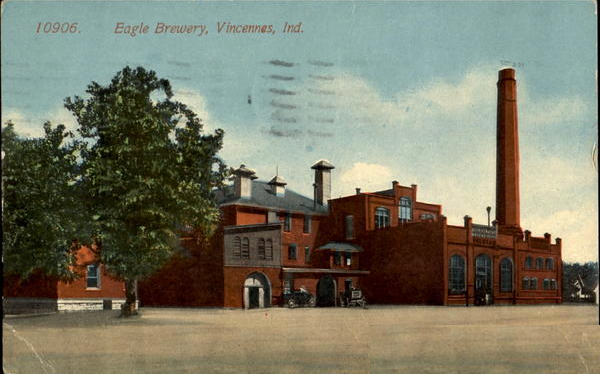
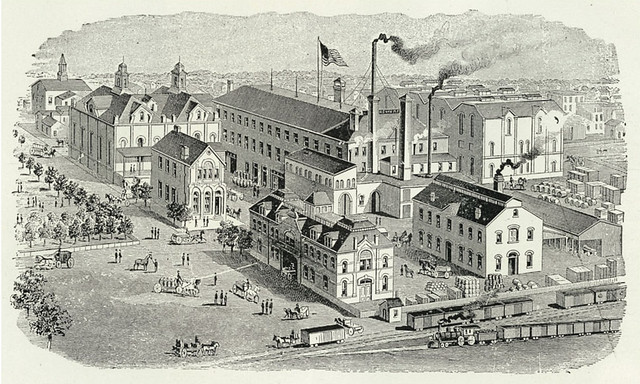
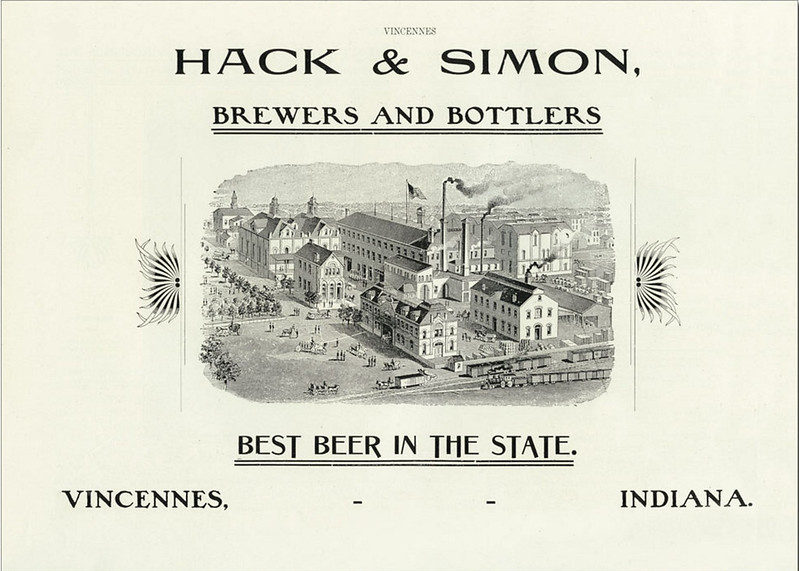
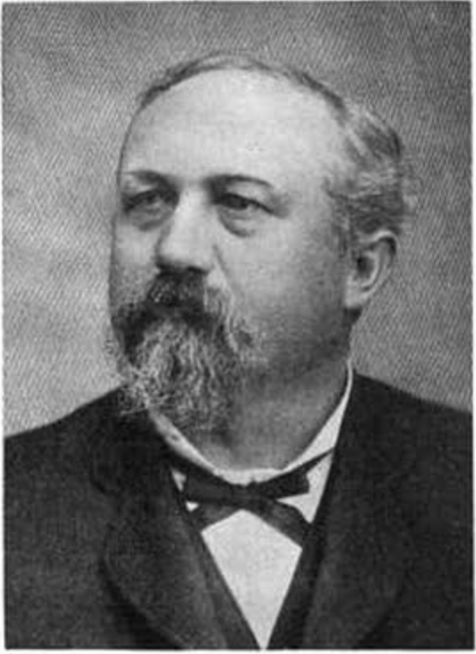
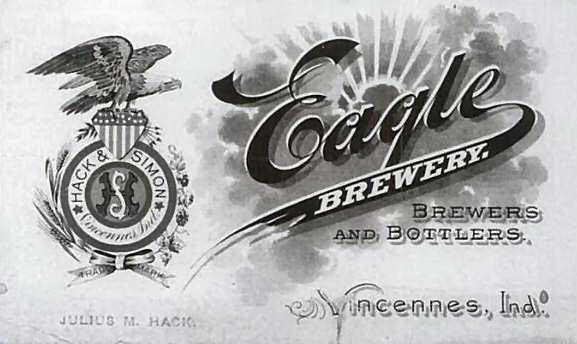
Today is the birthday of Eugene Hack (November 18, 1840-June 12, 1916). He was born in Wurtenburg, Germany, but emigrated to Indiana and settled in Vincennes in 1868. In 1875, he and a partner, Anton Simon, bought a small brewery in Vincennes, Indiana from John Ebner, who had established in 1859. They continued to call it the Eagle Brewery, although it was also referred to as the Hack & Simon Eagle Brewery, though in 1918, its official name became the Hack & Simon Brewery, until closed by prohibition. The brewery briefly reopened after prohibition as the Old Vincennes Brewery Inc., but they appear to have never actually brewed any beer, before closing for good in 1934.

Eugene-Hack-photo
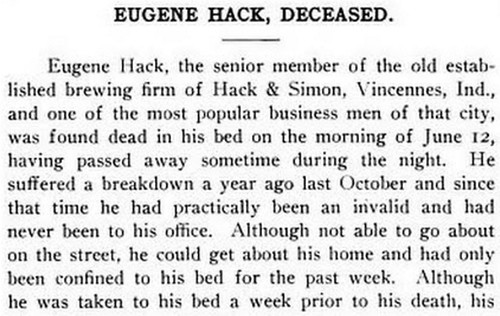
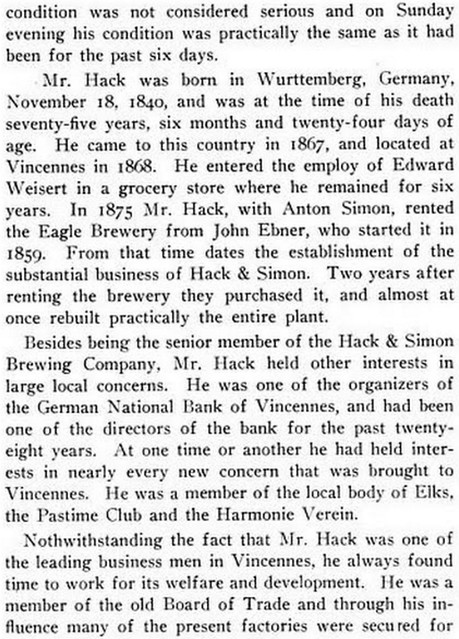
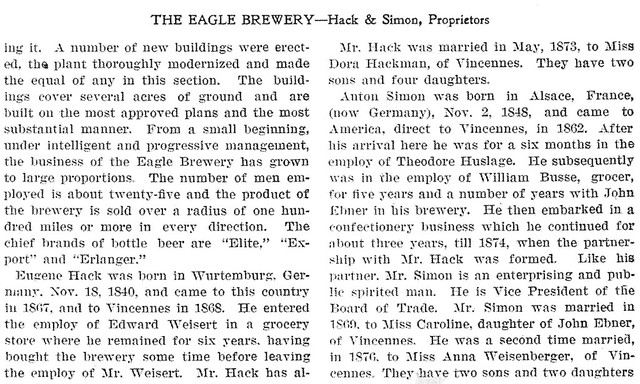
Here’s Hack’s obituary, from the Brewers Journal, Volume 47, published in 1916:

Eugene-Hack-obit-1
Eugene-Hack-obit-2
Eagle-brewery-postcard-color
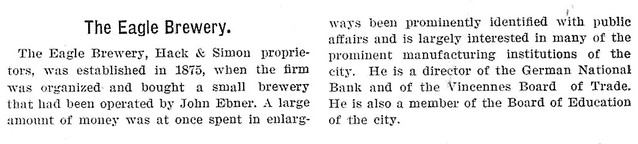
And this account is from “Vincennes in Picture and Story: History of the Old Town, Appearance of the New,” written by J.P. Hodge, and originally published in 1902.

Eagle-history-1
eagle-brewery-indiana
Eagle-history-2

eagle-brewery-logo

In 1859 the Eagle Brewery was established by John Ebner on Indianapolis Avenue in Vincennes, Indiana. It operated under his management until 1875 when it was sold to Eugene Hack and Anton Simon. They kept the name and added an eagle logo identifying their flagship brand. Hack and Simon successfully operated the brewery for decades. They were producing 18,000 barrels of beer a year and maintained five wagons and twelve head of horses for their local trade. In time they established five refrigerated beer depots in towns in Indiana and Illinois. The brewery was shut down by Indiana prohibitionary laws in 1918 and apparently not reopened in 1934 after Repeal.
Eagle-Brewery-blotter
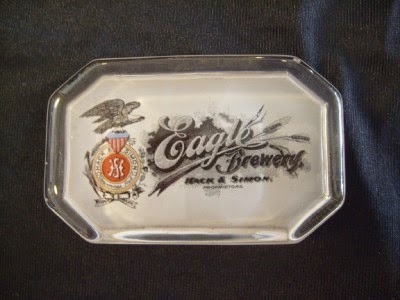
A brewery paperweight.
hack-and-simon-poster

Filed Under: Birthdays, Breweries, Just For Fun Tagged With: Germany, History, Indiana

Historic Beer Birthday: Anton Simon

November 2, 2025 By Jay Brooks

hack-and-simon
Today is the birthday of Anton Simon (November 2, 1848-March 27, 1927). He was born in Alsace, France, but moved to Vincennes, Indiana when he was fourteen, in 1862. After working in a series of jobs, in 1875, he and a partner, Eugene Hack, bought a small brewery in Vincennes, Indiana from John Ebner, who had established in 1859. They continued to call it the Eagle Brewery, although it was also referred to as the Hack & Simon Eagle Brewery, though in 1918, its official name became the Hack & Simon Brewery, until closed by prohibition. The brewery briefly reopened after prohibition as the Old Vincennes Brewery Inc., but they appear to have never actually brewed any beer, before closing for good in 1934.

Anton-Simon
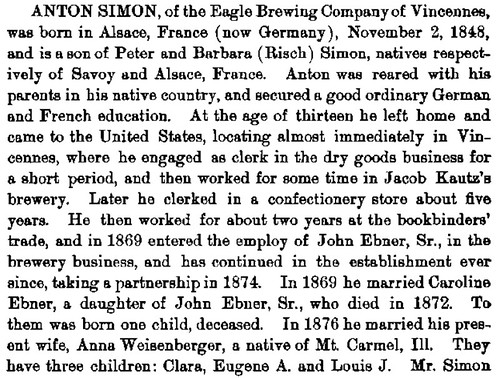
Here’s a biography of Simon from History of Knox and Daviess Counties, Indiana, by Goodspeed Brothers, published in 1886:

anton-simon-bio-1
anton-simon-bio-2
Eagle-brewery-postcard-color
And this account is from “Vincennes in Picture and Story: History of the Old Town, Appearance of the New,” written by J.P. Hodge, and originally published in 1902. There’s a short biography of Simon in the final paragraphs.

Eagle-history-1
eagle-brewery-indiana
Eagle-history-2

eagle-brewery-logo
In 1859 the Eagle Brewery was established by John Ebner on Indianapolis Avenue in Vincennes, Indiana. It operated under his management until 1875 when it was sold to Eugene Hack and Anton Simon. They kept the name and added an eagle logo identifying their flagship brand. Hack and Simon successfully operated the brewery for decades. They were producing 18,000 barrels of beer a year and maintained five wagons and twelve head of horses for their local trade. In time they established five refrigerated beer depots in towns in Indiana and Illinois. The brewery was shut down by Indiana prohibitionary laws in 1918 and apparently not reopened in 1934 after Repeal.

Eagle-Brewery-blotter
A brewery paperweight.
hack-and-simon-poster

Filed Under: Birthdays, Breweries, Just For Fun Tagged With: History, Indiana

Historic Beer Birthday: Paul Reising

October 7, 2025 By Jay Brooks

paul-reising
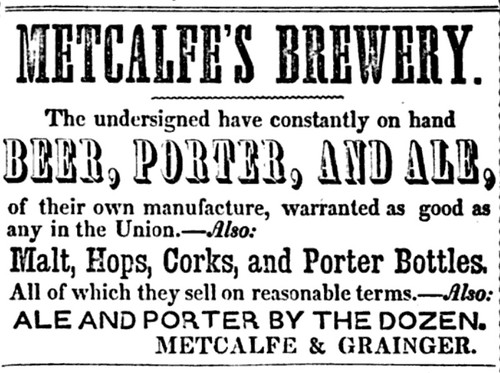
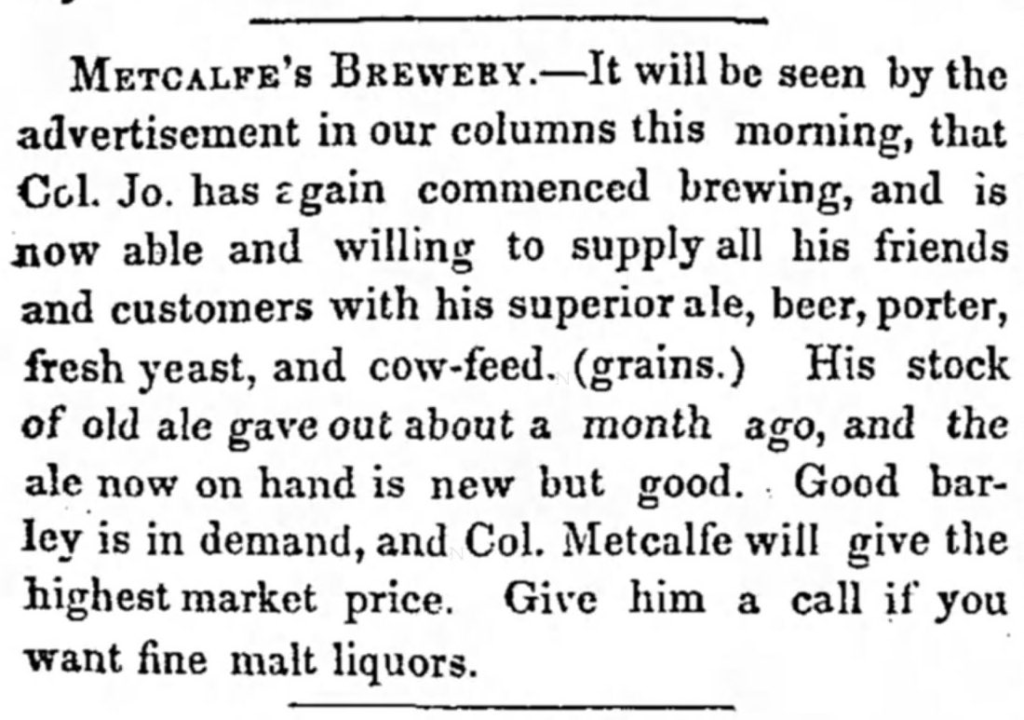
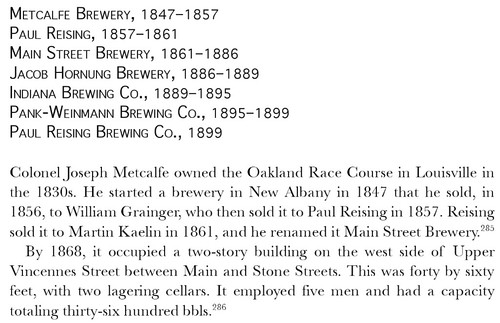
Today is the birthday of Paul Reising (October 7, 1819-January 30, 1879). He was born in Bavaria, Germany, but moved to the United States when he was 35, in 1854. In 1857, he bought the City Brewery of New Albany, Indiana, from Joseph Metcalfe, and renamed it the Paul Reising & Co. Brewery, and a few years later the Paul Reising Brewing Co. It kept going after his death in 1879, but the business declared bankruptcy in 1915, and was sold.

paul-reising-brewery

This account is from a History Forum:

Paul Reising was born in the village of Hoerstein, Bavaria in 1819. He married Susanna Stadtmueller, also a native of Hoerstein in 1842 and came to America on board the ship Juventa bound from Havre de Grace to New York in 1854 (for more information on him and his family see Paul Reising Family History).

He purchased the City Brewery in New Albany in 1861. When he purchased it, it was a mere 20×60 feet with a capacity of 1500 barrels of beer annually. In 1873 the Paul Reising Brewing Company was incorporated with a capital stock of $100,000. By 1891, the capacity had been increased to 12000 barrels. Fred Kistner, Reising’s son-in-law was to have inherited the brewery, but he predeceased Reising and the brewery was sold to John Meyer. By 1913 the president of the company was H. L. Meinhardt. In 1914 financial disaster overtook the company, when some apparently bad beer was distributed without quality control. The company was forced into bankruptcy in 1915.

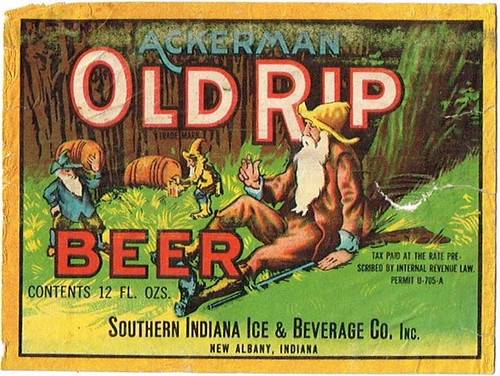
After the bankruptcy the company was sold to Michael Schrick, and was eventually renamed the Southern Indiana Ice and Beverage Company during Prohibition. This company closed in 1935. The old brewery site was reopened as the Polar Ice Company. This was razed in 1969 when the Holiday Inn which occupies this location now was constructed. No Brewery buildings remain.

Reisling-brewers
Employees of the Paul Riesing Brewery.

This brief history of the brewery is from “100 Years of Brewing:”

reising-history

Reising-rathskeller-brew

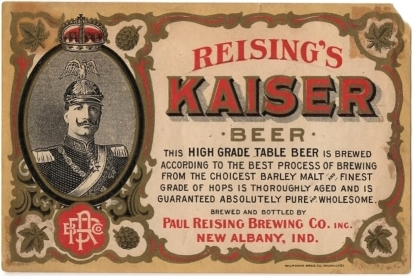
Reisings-Kaiser-Beer-Labels-Paul-Reising-Brewing-Co-Inc_31932-1

Filed Under: Birthdays, Breweries, Just For Fun Tagged With: Bavaria, Germany, History, Indiana

Historic Beer Birthday: Louis Centlivre

September 27, 2025 By Jay Brooks

old-crown
Today is the birthday of Louis Alphonse Centlivre (September 27, 1857-February 15, 1942). He was born in Dubuque, Iowa, and was the son of C.L. Centlivre, who founded the C.L. Centlivre Brewing Company with his brother, Frank. It was also known as the French Brewery and much later as the Old Crown Brewery.

Louis-Alphonse-Centlivre
The brewery was first known as the French Brewery when it was founded in 1862, but Charles L. Centlivre’s name was associated with it from the very beginning. In 1893, the name was formally changed to the C.L. Centlivre Brewing Co., which it remained until it was shut down in 1918 by the Indiana State Prohibition, two years before it was national. During Prohibition the brewery was called Centlivre Ice & Storage Co. After repeal in 1933, it was rebranded as the Centlivre Brewing Corp., until 1961, when it was changed to the Old Crown Brewing Co. That was still its name when it closed for good in 1973.

FW-Centlivre-Employees
This biography of Louis is from “Men of Progress, Indiana: A Selected List of Biographical Sketches,” edited by William Cumback and Jacob Beckwith Maynard:

Louis-Centlivre-1
Louis-Centlivre-2
FW-Centlivre-Postcard
Louis-Centlivre-3
old-reliable
Louis-Centlivre-4

c-l-centlivre-brewery

This account of Centlivre is from an unnamed printed source at the Allen County Public Library in Fort Wayne, Indiana:

Louis-A-Centlivre

Louis-Centlivre

centlivre-nickel-plate

Filed Under: Birthdays, Breweries, Just For Fun Tagged With: History, Indiana

Historic Beer Birthday: C.L. Centlivre

September 27, 2025 By Jay Brooks

old-crown
Today is the birthday of C.L. Centlivre (September 27, 1827-January 13, 1894). Centlivre was born in France, and settle in Fort Wayne, Indiana, where he founded the C.L. Centlivre Brewing Company with his brother, Frank. It was also known as the French Brewery and much later as the Old Crown Brewery.

The Wikipedia page for the Old Crown Brewing Corporation includes this short biography:

Charles Louis Centlivre was born in Dannemarie, Haut-Rhin, France, September 27, 1827. He was trained as a cooper (profession) and initially came to America in 1847, having settled in New Orleans, Louisiana. After a cholera epidemic he returned to France, returning to America via New York City with his father and two brothers. After living in Massillon, Ohio and working as a cooper in Louisville, Ohio, he founded a brewery in McGregor, Iowa in 1850 and operated it until he came to Fort Wayne, Indiana in 1862 and founded the C. L. Centlivre Brewing Company with his brother, Frank. He died in 1894 at the age of 67.

A statute of Centlivre that used to be on the brewery but now resides above a Fort Wayne restaurant.

The brewery was first known as the French Brewery when it was founded in 1862, but Charles L. Centlivre’s name was associated with it from the very beginning. In 1893, the name was formally changed to the C.L. Centlivre Brewing Co., which it remained until it was shut down in 1918 by the Indiana State Prohibition, two years before it was national. During Prohibition the brewery was called Centlivre Ice & Storage Co. After repeal in 1933, it was rebranded as the Centlivre Brewing Corp., until 1961, when it was changed to the Old Crown Brewing Co.. That was still its name when it closed for good in 1973.

Here’s a biography from “The Pictorial History of Fort Wayne,” published in 1917.

c-l-centlivre-brewery

The website Fort Wayne Beer has a great account of the history of the Centlivre Brewery.

CHARLES LOUIS CENTLIVRE was french, Monsieur Centlivre (His surname has been anglicized to rhyme with “river”) was born in 1827 in Lutran, a small town in the northeast of France about nine miles from the German border and 90 miles south of the 349-year-old Kronenbourg Brewery in Strasbourg. When he was 12, his family father, stepmother, five siblings and a stepbrother-moved to neighboring Valdieu, where he apparently apprenticed as a cooper.

BON…JOUR AMERICA

Charles, along with his sister Celestine and stepbrother Henri Tonkeul sailed from France and arrived in the Port of New Orleans on December 24, 1850. Charles and Henri would soon relocate to Louisville, OH near Canton (now home of the NFL Hall of Fame), where they reportedly met up with other relatives, and where Charles found work as a cooper. In 1854 they were joined by Charles’ father, stepmother and younger siblings. It was here that Centlivre wed Marie Houma ire, a young French woman who spoke no English. The newlyweds had met by accident on a train reroute to Louisville. Marie had boarded the wrong train; she was supposed to be heading to Louisville, Kentucky’ Late in 1854 or early 1855, Charles and Marie moved to McGregor, Iowa, where he purchased some land. McGregor, located on the Mississippi, was becoming a hub where grain from Iowa and Minnesota was transported across the river and sent on to Milwaukee via railroad; by the 1870s it had become the busiest shipping port west of Chicago. A number of family members also moved to Iowa, including Centlivre’s brothers Francois and Denis, sister Celestine and his father Louis. Marie gave birth to their first two children, Amelia and Louis, in Iowa. Charles met Christian Magnus, a German emigrant and brewer, while in Dubuque County, Iowa. Magnus helped Centlivre start a brewery in Twin Springs, Iowa about 1857 and served as its foreman until 1858. Magnus was known to age beer in caves, which may be how Centlivre learned to lager beer. Also while in Twin Springs, Centlivre declared his intent to become a United States citizen. More than a brewer, Charles L. Centlivre was an entrepreneur, and while in Fort Wayne, Indiana, possibly to visit his stepbrother Henri Tonkeul, (Tonkel Road still exists in Fort Wayne), he saw a greater business potential than existed in Iowa. Fort Wayne had a large German population, a total population at the time of about 10,000, rail service connecting Fort Wayne to Chicago and Pittsburgh and three rivers from which to draw water and ice for brewing. In February 1862 he purchased 320 acres in Fort Wayne from Rufus French.

THE FRENCH BREWERY

It was here that Charles, his father, and his brother Frank literally built a primitive Brewhouse with their own hands. Located next to the St. Mary’s river on Lima Plank Road, now known as Spy Run Avenue, the French Brewery opened on September 27, 1862. By 1864 all the Centlivre property in Iowa would be sold. Charles’ brother Denis relocated to southwestern Wisconsin and established the Platteville Brewery in the town of the same name. In Fort Wayne, the French Brewery grew in both size and popularity, and the Centlivre’s continued to purchase land there to expand the brewery and other ventures. A malting plant was installed at the brewery in 1868. In 1869 Louis Centlivre had a deed drawn up that granted his son 80 additional acres of land and all the buildings and stock contained thereon. For nine years the Centlivre family, which numbered as many as nine, lived in a section of the brewery until a family home was built in 1871. With the 1871 Chicago fire and the destruction of many Chicago breweries, Charles saw an opportunity to recruit Peter Nussbaum as Brewmaster at the French Brewery. Nussbaum, who had learned his craft in Luxembourg, accepted the position. Until his arrival, the only products of the French Brewery were French Lager and Excelsior. Nussbaum added XX Brand, Bohemian, Munchener, and Kaiser to the brewery’s menu. Centlivre Special and Nickel Plate replaced the latter two. Nussbaum served as a Brewmaster for the Centlivre brewery for 37 years and worked for three generations of the family. Less than half a mile south of the brewery is Nussbaum Street, where “Herr Nussbaum” lived. Centlivre was continually improving his brewing facilities. He erected a new bottling plant, one of the first in the area, in 1876. Two years later, the brewery received Fort Wayne’s first artificial refrigeration units. The French Brewery produced approximately 500 barrels of beer in its first year of operation. By 1880, popularity and expansion ramped that number up to 20,000 barrels annually. In the late 1870s and early 1880s the Centlivre family turned 28 acres along Spy Run Ave. into Centlivre Park, a place for families to gather and enjoy picnics, sports and music. Rowboats could be rented for $1.00 a day, and, of course, Centlivre Beer was available for a modest price.

The Centlivre’s had a strong interest in boating. Charles’ son Joseph rowed competitively until he developed typhoid after his skiff was swamped during a race in the Detroit River. Joseph died in September 1882; just four years later Marie Centlivre passed after a brief illness. By the mid- 1880s Charles Centlivre was preparing his remaining sons to run the brewery. Charles F. was a delivery clerk and then superintendent of the bottling works; Louis Alphonse worked as the brewery manager. Daughter Amelia’s husband, John Reuss, became the French Brewery’s corporate secretary and treasurer. In spring 1887 construction of the C. L. Centlivre Street Railway Co. began. Two rail cars would replace the old horse-drawn trolleys that took people to Centlivre Park. The line also played a role in the brewery’s business, as it carried beer deliveries to the Nickel Plate Railroad station and saloons downtown. Later that year the family celebrated another milestone. On August 6, Charles Louis Centlivre, now 60 years old, became a naturalized U.S. citizen.

Also, Hoosier Beer has some additional information about the brewery’s history.

centlivre-nickel-plate

Here’s another short account from Field Tripper:

In 1862 a French immigrant, Charles L. Centlivre, established one of Fort Wayne’s most well-known industries on the west bank of the St. Joseph River, just north of where the State Street Bridge crosses the river. Known initially as the “French Brewery,” Centlivre’s enterprise, along with the Berghoff Brewery on the east side of town, made Fort Wayne a leading beer producer in the Midwest by the end of the nineteenth century. Employees of the brewery honored the founder by placing a statue of Charles Centlivre on top of the factory building. The brewery ceased operations in 1974, and the business-related buildings were subsequently razed. The 1888 Queen Anne–style Charles Centlivre residence that appears in this view could still be seen as of 2000 on Spy Run Avenue north of the intersection with State Street. A used car lot, as of 2000, occupied the site where the brewery once stood.

Filed Under: Birthdays, Breweries, Just For Fun Tagged With: France, History, Indiana

Beer In Ads #5049: Get Your Quarts From LaCorte’s

August 10, 2025 By Jay Brooks

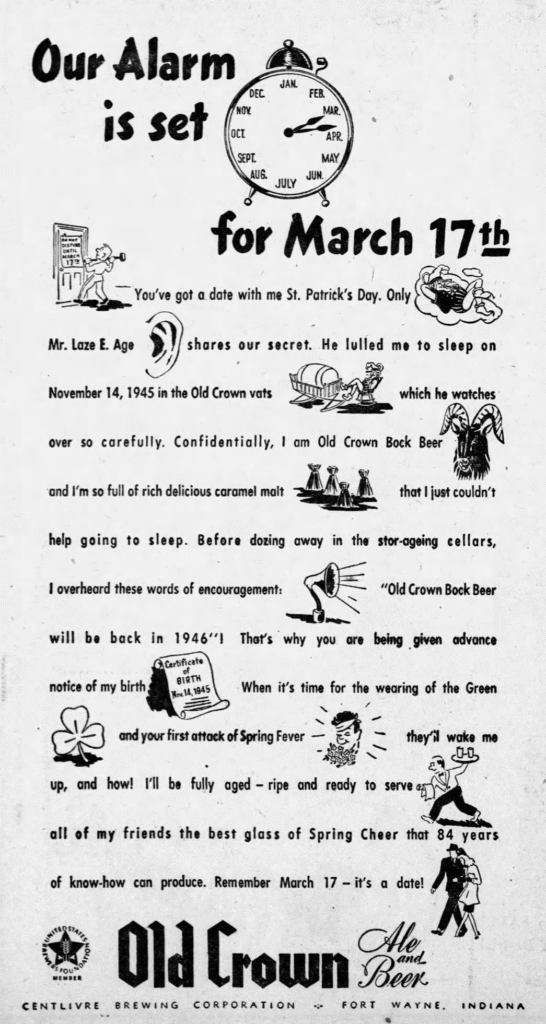
Last year I decided to concentrate on Bock ads. Bock, of course, may have originated in Germany, in the town of Einbeck. Because many 19th century American breweries were founded by German immigrants, they offered a bock at certain times of the year, be it Spring, Easter, Lent, Christmas, or what have you. In a sense they were some of the first seasonal beers. “The style was later adopted in Bavaria by Munich brewers in the 17th century. Due to their Bavarian accent, citizens of Munich pronounced ‘Einbeck’ as ‘ein Bock’ (a billy goat), and thus the beer became known as ‘Bock.’ A goat often appears on bottle labels.” And presumably because they were special releases, many breweries went all out promoting them with beautiful artwork on posters and other advertising.

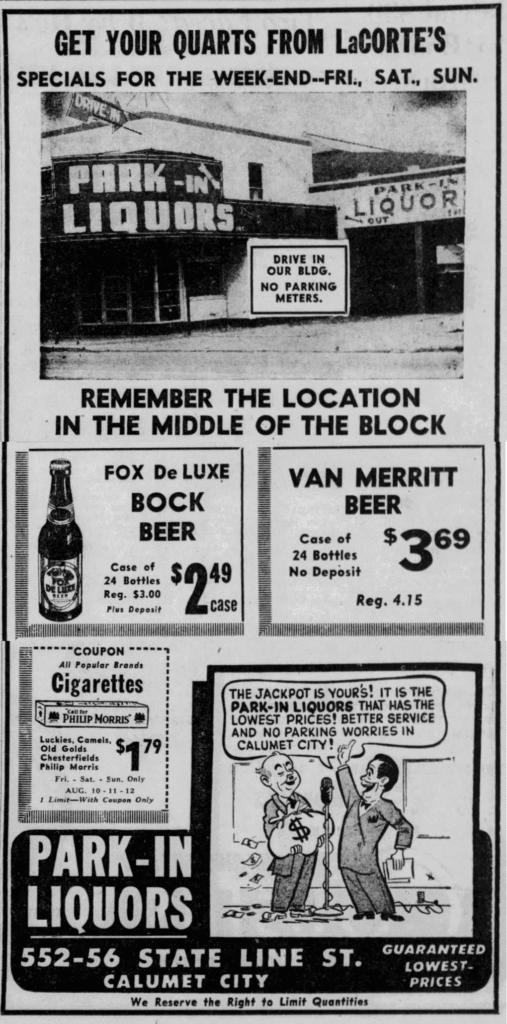
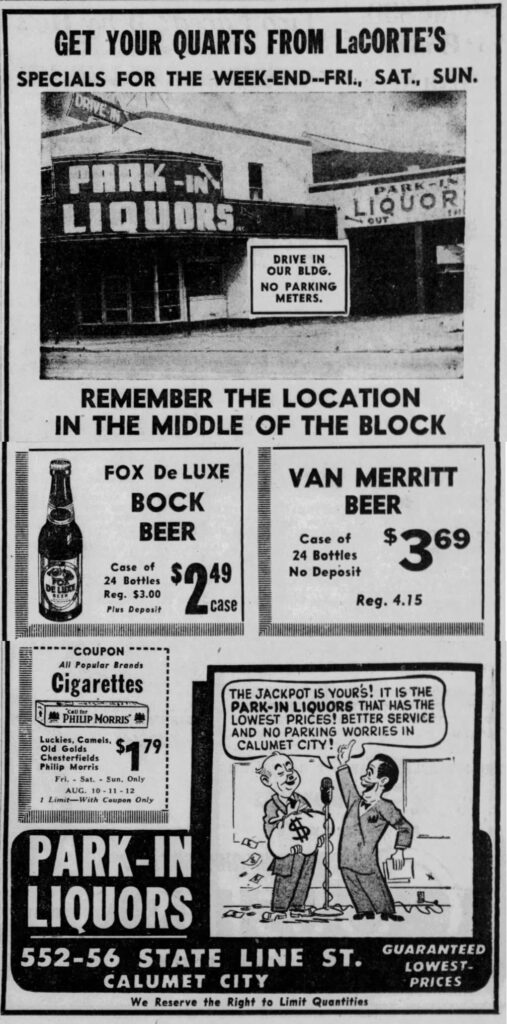
Sunday’s ad is for Fox De Luxe Bock Beer, which was published on August 10, 1951, though strictly speaking it was for a liquor store called LaCorte’s Park-In Liquors, located at 552-56 State Line St., in Calumet City, Illinois. [I checked, it appears to be the site of a Wendy’s today.] The ad was actually advertising a variety of alcohol, some twelve different products, but I cut them all out except the one bock beer and its neighbor. The bock is from the Peter Fox Brewing Co. of Chicago, Illinois, which was originally founded in 1896 as the Hoffman Bros. This ad ran in The Hammond Times, an afternoon paper serving Hammond, Whiting, and East Chicago, Indiana, though now is headquartered in Munster, and it just a few miles (less than 4) from the liquor store.

Filed Under: Art & Beer, Beers, Breweries, Just For Fun Tagged With: Advertising, Bock, History, Illinois, Indiana

Beer In Ads #4951: You’ve Never Really Tasted Bock Beer Until You Try Sterling Bock!

April 25, 2025 By Jay Brooks

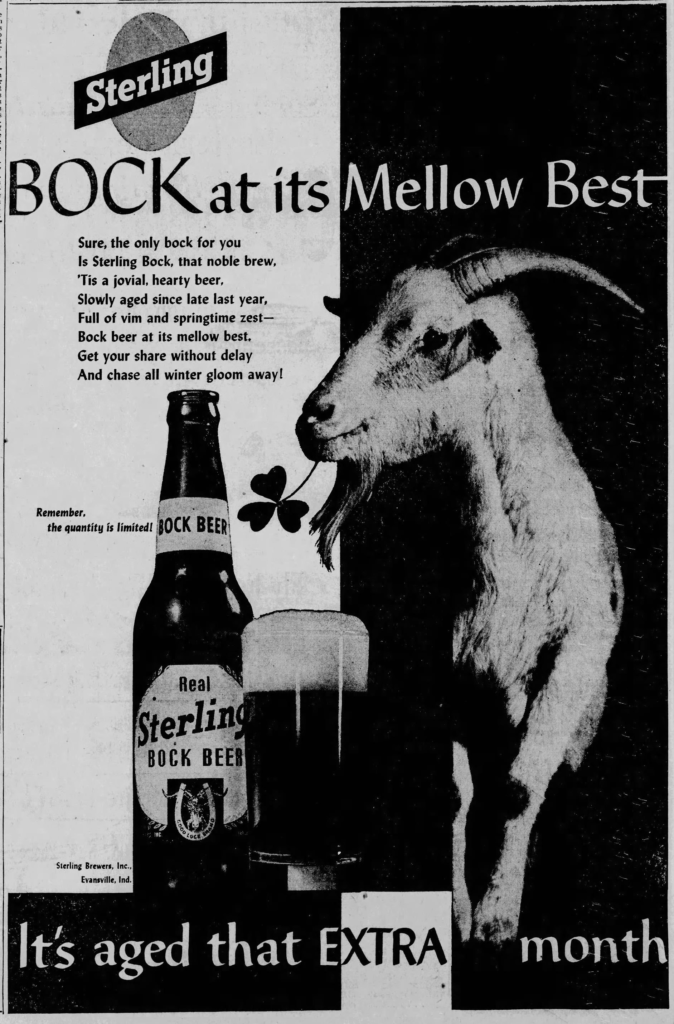
Last year I decided to concentrate on Bock ads. Bock, of course, may have originated in Germany, in the town of Einbeck. Because many 19th century American breweries were founded by German immigrants, they offered a bock at certain times of the year, be it Spring, Easter, Lent, Christmas, or what have you. In a sense they were some of the first seasonal beers. “The style was later adopted in Bavaria by Munich brewers in the 17th century. Due to their Bavarian accent, citizens of Munich pronounced ‘Einbeck’ as ‘ein Bock’ (a billy goat), and thus the beer became known as ‘Bock.’ A goat often appears on bottle labels.” And presumably because they were special releases, many breweries went all out promoting them with beautiful artwork on posters and other advertising.

Friday’s ad is for Sterling Bock Beer and was published April 25, 1934. The brewery was the Sterling Brewery of Evansville, Indiana, which was founded in 1880. This ad ran in The Herald and Review, of Decatur, Illinois. The headline is pretty funny, “You’ve Never Really Tasted Bock Beer Until You Try Sterling Bock!,” but I’m more amused by the motto in the black bat at he bottom, which states: “Sterling The Costly Made Beer.”

Filed Under: Art & Beer, Beers, Breweries, Just For Fun Tagged With: Advertising, Bock, History, Indiana

Historic Beer Birthday: Henry Becker

April 19, 2025 By Jay Brooks

indiana

Today is the birthday of Henry Becker (April 19, 1851-April 20, 1906). He was born in Bavaria, and emigrated to the U.S. when he was 21, coming first to New Orleans, and two years later settling in Terre Haute, Indiana. At some point, he became involved with the Seventh Street Brewery, which had been founded in 1848 (although another source seems to dispute that believing they are unrelated and that Becker’s was founded independently in the 1870s, which actually makes some sense to me). Its name was changed to the Terre Haute Weiss Beer Brewery in 1898 (if related to Seventh Street), but after Becker’s death in 1906, his son took it over, renaming it the Henry J. Becker Brewery. Becker’s son then sold it two years later, in 1908. The buyer, Charles J. Graf, closed it for the good the same year.
Henry-Becker-obit-abr
Obituary of Becker from the American Brewers’ Review in 1906.

There’s very little information I could find on Becker or his brewery. It appears to have been very small, with capacity below 500 bbl, making it something of a proto-nano in its day. I could also not find any photos of Becker or the brewery and no breweriana whatsoever, aprt from the bottle below, which must be from between 1906-09. One unusual fact I did find is that they brewed a Berliner Weiss.

henry-becker-bottle

Filed Under: Birthdays, Breweries, Just For Fun Tagged With: Bavaria, Germany, Indiana

Beer In Ads #4920: Kamm’s Bock Is Back

March 25, 2025 By Jay Brooks

Last year I decided to concentrate on Bock ads. Bock, of course, originated in Germany, in the town of Einbeck. Because many 19th century American breweries were founded by German immigrants, they offered a bock at certain times of the year, be it Spring, Easter, Lent, Christmas, or what have you. In a sense they were some of the first seasonal beers. “The style was later adopted in Bavaria by Munich brewers in the 17th century. Due to their Bavarian accent, citizens of Munich pronounced ‘Einbeck’ as ‘ein Bock’ (a billy goat), and thus the beer became known as ‘Bock.’ A goat often appears on bottle labels.” And presumably because they were special releases, many breweries went all out promoting them with beautiful artwork on posters and other advertising.

Tuesday’s ad is for Kamm’s Bock Beer and was published March 25, 1937. The brewery was the Kamm & Schellinger Co. of Mishawaka, Indiana, which was originally founded around 1853 by John Wagner and then purcgased by Adolph Kamm and Clemens Dick in 1870, though it became the K&S Brewery in 1887 when Kamm bought out Dick and it was incorporated by Adolph Kamm and his brother-in-law Nicholas Schellinger and it remained in business like that until 1951, when it was closed by the Kamm family. This ad ran in the South Bend Tribune, of South Bend, Indiana, and includes the headline: “Kamm’s Bock is back —.”

Filed Under: Art & Beer, Beers, Breweries, Just For Fun Tagged With: Advertising, Bock, History, Indiana

Beer In Ads #4896: Centlivre Bock

March 1, 2025 By Jay Brooks

Last year I decided to concentrate on Bock ads. Bock, of course, originated in Germany, in the town of Einbeck. Because many 19th century American breweries were founded by German immigrants, they offered a bock at certain times of the year, be it Spring, Easter, Lent, Christmas, or what have you. In a sense they were some of the first seasonal beers. “The style was later adopted in Bavaria by Munich brewers in the 17th century. Due to their Bavarian accent, citizens of Munich pronounced ‘Einbeck’ as ‘ein Bock’ (a billy goat), and thus the beer became known as ‘Bock.’ A goat often appears on bottle labels.” And presumably because they were special releases, many breweries went all out promoting them with beautiful artwork on posters and other advertising.

Saturday’s ad is is for Centlivre Bock, and is from March 1, 1940. The brewery was the C.L. Centlivre Brewing Co. of Fort Wayne, Indiana, which was founded in 1862 by Charles l. Centlivre. It went through several name changes until 1970, when it closed, however it was recently relaunched by the Centlivre family as Centlivre Beer. It’s a busy ad with a lot going on, but they definitely leaned into being a limited run. “Only 12,000 cases!”

Filed Under: Art & Beer, Beers, Breweries, Just For Fun Tagged With: Advertising, Bock, History, Indiana

« Previous Page
Next Page »

Find Something

Northern California Breweries

Please consider purchasing my latest book, California Breweries North, available from Amazon, or ask for it at your local bookstore.

Recent Comments

  • Bob Paolino on Beer Birthday: Grant Johnston
  • Gambrinus on Historic Beer Birthday: A.J. Houghton
  • Ernie Dewing on Historic Beer Birthday: Charles William Bergner 
  • Steve 'Pudgy' De Rose on Historic Beer Birthday: Jacob Schmidt
  • Jay Brooks on Beer Birthday: Bill Owens

Recent Posts

  • Beer In Ads #5223: You Have Exhausted Our Goat April 16, 2026
  • Historic Beer Birthday: William Leonard Hoerber April 15, 2026
  • Historic Beer Birthday: Richard Katzenmayer April 15, 2026
  • Historic Beer Birthday: August Krug April 15, 2026
  • Historic Beer Birthday: William Cullen April 15, 2026

BBB Archives

Feedback

Head Quarter
This site is hosted and maintained by H25Q.dev. Any questions or comments for the webmaster can be directed here.