Brookston Beer Bulletin

Jay R. Brooks on Beer

  • Home
  • About
  • Editorial
  • Birthdays
  • Art & Beer

Socialize

  • Dribbble
  • Email
  • Facebook
  • Flickr
  • GitHub
  • Instagram
  • LinkedIn
  • Pinterest
  • RSS
  • Twitter
  • YouTube

Powered by Genesis

Archie Comics Tapped To Teach Kids About Underage Drinking

March 22, 2011 By Jay Brooks

archie
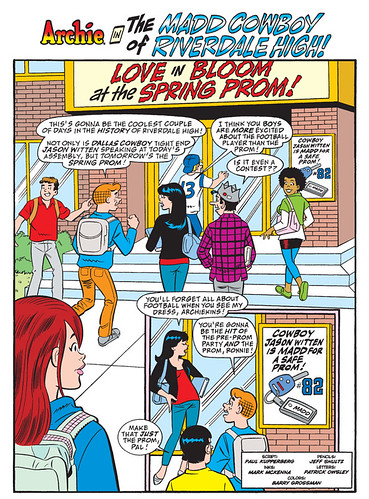
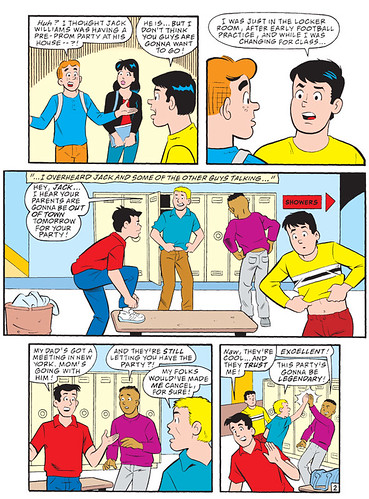
The neo-prohibitionist organization MADD today sent out a press release announcing that they’ve partnered with Archie Comics “to raise awareness about underage drinking.” The new issue of Double Digest #217 hits the comic book stores tomorrow, and features an 8-page story entitled The Madd Cowboy of Riverdale High. Below are a few sample pages.
Archie-217_8

Archie-217_9

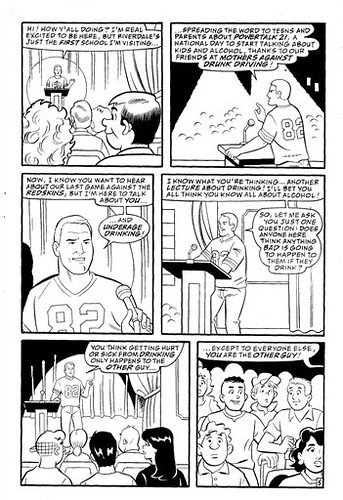
The “Cowboy” part of the title is for Dallas Cowboy tight end Jason Witten, who appears as himself to speak to Archie and his classmates in an assembly. He’s specifically promoting MADD and their Power 21, which will take place April 21 and is touted as a “national event that seeks to have parents talking to their children about underage drinking.”
Archie-217_10
Believe it or not, I’m not entirely against this latest effort by MADD, although I don’t believe the goal should be to completely eliminate underage drinking — an impossibility, in my experience — but should instead focus on figuring out an effective way to allow parents to educate their kids about drinking alcohol as they grow from teens to young adults. In my opinion, that would go a long way toward encouraging responsible behavior and reducing drunk driving and binge drinking. Though to be honest, by the time that message might have been relevant to me as a child, I was done reading Archie Comics. I’m not sure what their main demographic is, but my guess would be pre-teens, around 8-11 or 12.

Filed Under: Beers, News, Politics & Law Tagged With: Comics, Prohibitionists

More Absurdity From The Lunatic Fringe

March 7, 2011 By Jay Brooks

nut
In another missive from the increasingly well-named Professor David Nutt, today in the UK Guardian he announed that There is no such thing as a safe level of alcohol consumption and then proceeded to claim that the reasons he believes that “the idea that drinking small amounts of alcohol will do you no harm is a myth” are fourfold:

  1. Alcohol is a toxin that kills cells.
  2. Although most people do not become addicted to alcohol on their first drink, a small proportion do.
  3. The supposed cardiovascular benefits of a low level of alcohol intake in some middle-aged men cannot be taken as proof that alcohol is beneficial.
  4. For all other diseases associated with alcohol there is no evidence of any benefit of low alcohol intake.

He elaborates slightly more on each of these, though not much more, and then follows up those grand sweeping pronouncements with the following:

“Hopefully these observations will help bring some honesty to the debate about alcohol.”

That’s one of those comically-spit-out-your-drink sort of statements, because what he just said was nowhere near honest. It would almost be funny except that mainstream media in Great Britain keep giving him a bully pulpit to proselytize from and people seem genuinely uncritical of what he has to say, which is even more baffling. Some of the comments to the Guardian article from supporters are downright scary, as they seem to believe he has science and evidence to support his wackadoodle claims. He doesn’t. Last year, when he proclaimed, to equal fanfare, that beer is more dangerous than heroin, his scientific evidence consisted of gathering together a group of like-minded individuals (that is people already predisposed against alcohol), many of whom were members of the made-up organization he started after the UK government sacked him — The Independent Scientific Committee on Drugs — and they sat together in a room one weekend and assigned arbitrary numbers for the amount of harm to society for various drugs based on their life experience, no actual data necessary. That’s what passes for science, and that they got the previously respected Lancet to publish it is downright bewildering.

Just a few thoughts about what’s wrong with every one of his four “proofs,” off the top of my head. At least I’m admitting I’m not researching these.

1. Sure, 100% rubbing alcohol will kill you. It’s 200 proof. Most chemical substances, compounds, etc. will kill you in sufficient doses. Most of the medicines we use to treat diseases will kill you if the dose is too high. That’s why they have warning labels and are doled out by doctors and pharmacists with specific instructions of how many, and when to start and stop taking them. For alcohol, we have the TTB and various state agencies to perform that role. Even things that are good for us become bad for us in higher doses — red meat, salt, vitamins, bacon (well, maybe not bacon). If we got rid of everything in the world with the potential to kill us, we’d be left with pretty much nothing.

2. Since Nutt claims we can’t predict who will become addicted to alcohol with the very first taste, then he suggests “any exposure to alcohol runs the risk of producing addiction in some users.” And that differs from everything else how? Assuming his anecdotal “evidence” that such immediate addiction is even possible — which seems unlikely at best — it’s hardly a basis for public policy. Not everybody reacted well to penicillin when it was introduced; should we have left all those people with diseases who could be cured by penicillin die just because less than 1% had an adverse reaction to it? This is just a post hoc fallacy of the worst kind.

3. Saying that the cardiovascular benefits are not proof ignores the many, many, many other studies that show positive health benefits for a myriad range of health concerns. The big enchilada, of course, is the numerous studies that show that total mortality is improved by the moderate consumption of alcohol; that is you’ll most likely live longer if you drink moderately than if you either don’t drink at all or drink too much. And a recent study seems to suggest that given a choice, drinking too much instead of abstaining will still lead to a better result. The FDA in its most recent dietary guidelines acknowledges this fact, yet Nutt completely ignores it and every other study that doesn’t fit his world view. Singling out one study to bash — his straw man — is about as dishonest a way to “bring some honesty to the debate” as I can imagine.

4. He concludes by just dismissing the vast body of medical and health studies that do in fact conclude there are health benefits to the moderate consumption of alcohol. He does this apparently by simply pretending they don’t exist, saying “there is no evidence of any benefit of low alcohol intake.” But just saying there are no benefits in the face of a mountain of contrary evidence is not, as his supporters seem to believe, scientific proof of any kind. It’s just the opposite, in fact.

I’m all for an honest debate about the positives and negatives surrounding alcohol, but if this is what passes for “honesty,” I think I’ll have to wait a little longer for that conversation.

Filed Under: Beers, Editorial, News, Politics & Law Tagged With: Prohibitionists, UK

Wisconsin Historian Compares Current State Politics To Prohibition

March 6, 2011 By Jay Brooks

wisconsin
Here’s an interesting op-ed piece by Wisconsin historian John Gurda entitled Smashing ‘Demon Government’ in which he examines the many parallels between the current political climate in his state and the temperance movement that led to Prohibition. Thanks to Wisconsin Bulletin reader Jason H. for sending me the link. Subtitled “Walker’s small-government zeal resembles that of the prohibitionists,” here’s a few choice excerpts below:

MJS prohibition

In its moral fervor, its contempt for compromise, its demographic base and even its strategies, today’s new right is the philosophical first cousin of prohibitionism.

Consider a few of the parallels. The prohibitionists went after “Demon Rum,” while the tea party attacks Demon Government. The Anti-Saloon League preached that barrooms were destroying America’s moral fiber, while the new right declares that onerous taxation and excessive regulation are doing precisely the same thing. Carrie Nation smashed whiskey barrels, while today’s conservatives want to smash the welfare state. Addiction to spending, they might argue, is ultimately as destructive as addiction to alcohol.

Like the temperance movement of the last century, the tea party draws heavy support from Protestant evangelicals such as Walker himself, and their political playbook is a throwback as well. The prohibitionists were media-savvy opportunists, taking advantage of every opening to advance their cause.

When the United States entered World War I, they wasted no time demonizing beer as “Kaiser brew” and even accused Milwaukee’s producers of spreading “German propaganda.” When food shortages loomed during the conflict, the dry lobby convinced Congress to divert America’s grain supply from breweries and distilleries to less objectionable industries. The result was “wartime prohibition,” a supposedly temporary measure that went into effect in 1919 and soon gave way to the 18th Amendment. The national drought would last for 14 years.

It’s worth noting that America wasn’t alone in using the conflict of World War I to push anti-alcohol agendas. Like-minded measures in several countries led to similar alcohol prohibitions, many of which lasted far longer than ours, such as Australia, Canada, Finland, Hungry, Iceland, New Zealand, Norway and Russia. In each of those nations, temperance groups took advantage of wartime circumstances to push their plans on the rest of the populace in their respective places.

In much the same way that prohibitionists turned World War I to their advantage, the current crop of conservatives is making political hay from another temporary phenomenon: the global economic recession. The need for fiscal austerity has rarely been more obvious, but it’s being used as a pretext for advancing the new right’s legislative agenda.

We’re seeing that happen in most, if not every state, with anti-alcohol groups turning our nation’s economic adversity into an opportunity to raise taxes on beer, already the most heavily taxed consumer good (along with tobacco). The Marin Institute has even created propaganda showing the “worst” ten states, with “worst” meaning the states with the lowest taxes on beer, completely out of context and with no understanding whatsoever of why each individual’s states excise taxes are set where they are. Shortly after Governor Walker created Wisconsin’s deficit by giving tax cuts to the wealthy, Michele Simon of the Marin Institute tweeted that beer should make up the difference. “Dear Gov. Walker: Wisconsin has not raised its beer tax since 1969. At .06/gallon, among lowest in nation. Just one of many ideas.” If that’s not what Gurda was talking about, I don’t know what is. That’s using a grave political situation to further an unrelated agenda.

Walker began with a demand that public employees pay more for their pensions and health insurance – a necessary step to which they have agreed – and then proposed to strip them of their collective bargaining rights. That’s an epic non sequitur that makes sense only when you invoke tea party logic: If taxes are bad, then the people we pay with tax dollars must be brought to heel, even if it means freezing a new teacher at first-year wages until retirement.

But the new right’s agenda goes far beyond public employee unions. With solid majorities in the state Legislature, Walker first declared a budget emergency and then cut taxes by $140 million, which is equivalent to taking blood from a patient with severe anemia. In last week’s budget message, he pronounced the patient so sick that amputations are necessary. Walker’s juggernaut of tax cuts and service cuts, combined with his no-bid privatization plans, trends in one direction and one direction only: dismantling government one line item at a time, regardless of the consequences.

It is here, finally, that prohibitionism and tea party conservatism find common ground: Both are ideologies. They represent fixed, blinkered views of the world that focus on single issues and dismiss all other positions as either incomplete or simply wrong-headed. Get rid of alcohol, the prohibitionists promised, and the U.S. would become a nation of the righteous and a beacon of prosperity to the world. Just cut government to a minimum, the new right contends, and you will usher in a brave new era of freedom and opportunity.

And that’s how I see all of the neo-prohibitionist and anti-alcohol groups, as “ideologies.” All of the anti-alcohol groups that I’m aware of do everything in their power to punish alcohol companies because of their perceived sins and because they want to tell you and me how to live our lives. They do so without thinking through the consequences and overall use an “ends justify the means approach,” especially in the way they frame and distort their propaganda. Simply put, I believe that they think they know better than everybody else, there’s a certain smugness in their position; in its unwavering certainty, their righteousness that borders on religious fervor.

They’re convinced that there’s no free will, people are incapable of ignoring advertising, or knowing their limits when drinking. And while there are a few tragic figures who may fit that description, they’re the tiny minority that such groups are fixated on to make their case. The vast majority who drink alcohol do so responsibly and in moderation. Most people take personal responsibility for their actions, as they should. But personal responsibility rarely, if ever, figures into alcohol abuse if you listen only to anti-alcohol rhetoric and propaganda. It’s always the fault of the alcohol itself, and usually beer because it plays better to the people with money who fund such organizations (they drink wine after all). An op-ed piece in the UK Telegraph by Brendan O’Neil recently shed a light on the class issue in anti-alcohol efforts. If they’re not going after the children, then they’re preying on the weak-minded with the most effective advertising the world has ever wrought. Earlier this year, the hue and cry was because there were 3.5 minutes of beer commercial during the nearly four hours of the Super Bowl and — gasp — the little kiddies might see it.

But anti-alcohol rhetoric single-mindedly focuses on only the negative. I’ve never heard any of them say one word that was positive about any alcohol company. Even when Anheuser-Busch packaged cans of water and sent then to earthquake-ravaged Haiti, one anti-alcohol group criticized them for the deed, because they put their logo on the cans and sent out a press release (oh, the horror). Let no good deed go unpunished, indeed. That alone should convince us they’re idealogues.

I suspect they might say the same of me, but I understand and acknowledge that there are some people who should not drink. That such people can and do cause problems for themselves and often the people around them. I don’t write about it very much because I don’t have to; there’s plenty of lopsided anti-alcohol rhetoric already. I’m just trying to balance the conversation, though more often than not I feel like the lone voice in the wilderness.

But back to Wisconsin. My wife is a political news junkie, and she informs me that a careful reading of the facts reveals that Scott Walker’s entire political career has been in service to a single ideology: union busting. He apparently promised that was not his agenda throughout his campaign for governor, and the media swallowed that wholesale with few examining or reporting the discrepancy between what he said while campaigning and his entire career leading up to that point. In that, there’s yet another parallel between the new prohibitionists and the new political conservatives. Most mainstream news media also take the side of the well-funded anti-alcohol groups and parrot their propaganda without questioning it or providing any meaningful views from the other side of this debate.

As to Gurda’s comparisons, I think he’s right about anti-alcohol groups’ unwillingness to compromise and being self-righteous with “blinkered views of the world that focus on single issues and dismiss all other positions as either incomplete or simply wrong-headed.” That’s certainly been my experience. So as if there wasn’t enough reasons to support the protesters in Wisconsin, if this political test case is successful, not only will we see more unions busted in other states, but I suspect anti-alcohol groups are also closely watching this to see how they might use the same bullying tactics in furtherance of their own agenda. And that may be the scariest prospect of all. As usual, I’m with the Green Bay Packers on this one.

Filed Under: Beers, Editorial, News, Politics & Law Tagged With: History, Law, Prohibitionists, Wisconsin

Former MADD Chapter President Caught Driving Drunk

February 25, 2011 By Jay Brooks

drunk-driving
I don’t want to make light of this, or even make too much out of it, because everyone makes mistakes. Hell, even the head of the OLCC resigned after getting a DUI in April 2006. But I still feel it has to be pointed out (and thanks to Rob for the tip).

The Gainesville Sun is reporting that Debra Oberlin was arrested last week and charged with a DUI. Oberlin is the former President of the Gainesville, Florida chapter of the neo-prohibitionist Mothers Against Drunk Driving (MADD). She was the President of the local chapter for three years in the 1990s before it was disbanded for “lack of financial support” in 1996.

But she didn’t just go a little bit over the line, she sprinted past it. Like most states, Florida’s BAC level is 0.08. Oberlin blew a .234 and a .239, while claiming to have had just four beers. The police report indicates she was observed “driving erratically on Northwest 19th Street, swerving and crossing lanes.” That’s the type of drunk driver even the most ardent supporter of alcohol doesn’t want on the road.

Filed Under: Editorial, News, Politics & Law Tagged With: Florida, Prohibitionists

Marin Institute Attacks State Beer Taxes … Again

February 16, 2011 By Jay Brooks

Marin-I
Daniel Defoe observed in 1726 that nothing was more certain than death and taxes, and sadly, that still holds true nearly three centuries later. It seems more likely that we’ll lick that immortality problem before taxes ever become a thing of the past. And few taxes are more certain to be under attack than alcohol taxes, a favorite target of the anti-alcohol groups, whose incessant calls for their increase have only grown louder as the economy is in free fall. Because what you want to do in a sinking economy is make it harder for one of the few industries doing well to keep people employed, paying taxes and in business.

But that’s never stopped them before and it’s not stopping them now, as the latest shot over the bow from my friends at the Marin Institute was a press release today, Twelve States Stuck at Bottom of Beer Tax Barrel. It announces their new interactive map of Neglected and Outdated State Beer Taxes.

Here’s the entirety of the press release:

SAN FRANCISCO, Feb. 16, 2011 /PRNewswire-USNewswire/ — Marin Institute, the alcohol industry watchdog, launched its Neglected & Outdated Beer Taxes Map today. This new interactive tool helps those who want to raise beer tax rates to balance state budgets or erase deficits.

“Just point your cursor at a state and you can see the your current beer tax rate, the year of your last tax increase, and the loss of revenue from inflation,” said Bruce Lee Livingston, Marin Institute executive director and CEO. “We show the twelve states that have hit the bottom of the barrel in beer tax revenues and are the most overdue for an increase.”

The beer tax map quickly reveals states suffering the most from Big Beer’s influence. These are states that have beer taxes stuck at absurdly low rates set as long ago as the 1940s, and even the 1930s. “With almost every state struggling to find new dollars to fund critical programs, policymakers need to stop leaving beer tax revenue on the table,” said Sarah Mart, research and policy manager at Marin Institute.

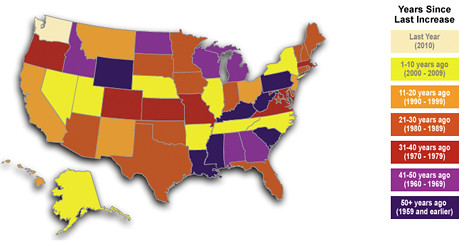
The web site shows the twelve states with the “worst” beer tax rates in the nation, the “bottom of the beer barrel”: Georgia, Idaho, Kentucky, Louisiana, Michigan, Mississippi, Missouri, North Dakota, Pennsylvania, West Virginia, Wisconsin, and Wyoming. Six states (Kentucky, Louisiana, Mississippi, Pennsylvania, West Virginia, and Wyoming) have not raised their beer tax in 50 years or more.

The worst state is Wyoming, which has the distinction of the lowest tax rate – $0.02 per gallon – set in 1935, during FDR’s first term. Factoring for inflation, the value of Wyoming’s beer tax has decreased 94%. A simple 5 cents per drink increase in the state’s beer tax would yield $7.75 million in new revenue. Considering that Wyoming’s annual budget shortfalls are projected to hit $5 million by 2013, a modest beer tax increase would erase all budget shortfalls in the state, reduce drinking, and increase health and safety a little.

The map shows that in 47 states, the decrease in real value of the beer tax due to inflation ranges from 25 percent to more than 75 percent. “This is such a lose-lose scenario for the states,” added Mart. “States are losing revenue and cutting essential programs, especially those which mitigate alcohol-related harm, while the beer companies reap higher and higher profits. It’s time for states to stop their race to the bottom and raise beer taxes.”

And here’s their colorful map of beer taxes and when they were last raised, minus the interactivity. The interactive version you can see on their website.

mi-beer-taxes-date

But there are so many things wrong with their arguments that it’s hard to know where to begin. So I’ll start by being petty. Look at the first two words of the press release: “SAN FRANCISCO.” The Marin Institute is NOT in San Francisco, but in San Rafael, which is just north of the city in Marin County, hence their name. I’m sure that they used the more familiar San Francisco because nationwide, and especially worldwide, no one’s heard of San Rafael, but I can’t help but ponder that if they can’t even be accurate about where they’re located, what does that say about their commitment to the truth in more substantive issues?

First, let’s assume everything they say is correct (it’s not, but just for the sake of argument). The amounts realized according to their table of the states with the lowest taxes if their state excise taxes were increased by “10 cents a drink” ranges from $15.3 to $333 million, or an average of about $123 million per state. But state deficits are in the billions, with a “b.” The Center on Budget and Policy Priorities estimates around $350 billion. Even if you added up all twelve states, the additional taxes would be less than $1.5 billion, less than half a percent of the total (not a perfect number, but still indicative of the problem). The point is that raising the state excise taxes on alcohol comes no where close to doing anything meaningful about the budget shortfalls facing all but four or five of the states. All it does is punish and weaken one of the few functioning industries in a distressed economy.

Next, let’s talk about the idea that taxes should parallel inflation and be raised to match those levels. If that is indeed a public policy goal, shouldn’t it be applied across the board? If we accept that taxes should be raised every time inflation inches ever higher, then shouldn’t ALL taxes do likewise? Singling out the alcohol industry for such treatment is, again, just punishing one industry because one of their “watchdogs” doesn’t like them, despite all protestations to the contrary. I don’t want my taxes to go up anymore than I suspect you do, but if we need more money as a state, country and society, than I don’t see any other fair way to raise more money. Any scheme that falls disproportionally on any industry is de facto unfair to solve a problem that effects all of society. We should have done away with tax breaks for the rich, but that couldn’t even be talked about, much less implemented. Instead, let’s suggest the heavily regressive taxes on alcohol punish the poor even more than they already do.

The other unanswered question is how high to raise excise taxes and for how long? And while there’s no amount proposed at this time, since they’re merely providing the tools to sow discontent in individual states, I believe that’s because there’s really no amount too high for the anti-alcohol groups. Though unstated, it seems implicit in their rhetoric that no amount is enough and they’ll never be satisfied. I’ve never seen a discussion of what amount they might consider fair enough, or might balance the amount with their ability to stay in business (which is the only way companies could continue to actually pay their taxes). Is there an amount that might satisfy such organizations? If so, I’ve never seen it. Then, if fixing the economy is truly the aim of their proposals, should such taxes only be imposed as a temporary measure until the crisis is over? If you didn’t laugh when you read that, you don’t realize that taxes are almost never repealed, only imposed or increased. What I think this exposes is that this is simply a way to use current circumstances to harm the alcohol companies and make it harder for them to stay in business, falling especially hard on the small brewers.

What’s also conveniently left out of their argument, as always, is the current amount of taxes paid by alcohol producers. There’s more taxes paid on every bottle of beer than any other consumer good save tobacco. Those two products are the only remaining items that pay excise taxes, at both the federal and state level. And while I think most would agree that smoking offers no health benefits, beer (and alcohol more generally) in moderation most definitely does. If you drink one or two beers a day, the odds are you’ll live longer than either a teetotaler or a binge drinker.

I’ve tackled this before, so if you want background on the issue of beer taxes, see Abe Lincoln On Beer & Politics and Here We Go Again: Beer & Taxes.

How much does the brewing industry pay? As of 2008, business and personal taxes accounted for $35,283,148,850, consumption taxes account for another $11,172,946,867; or a total of $46,256,095,717 annually. The total economic impact of the beer industry alone pumps $198,152,918,964 into the national economy each year. And all those figures are not including wine and spirits which would push it significantly higher.

I think Defoe’s quote needs modifying to reflect modern society, adding that few things are more certain than anti-alcohol groups using a recession to further their own narrow agenda of making the alcohol industry pay for their perceived sins. I think I need one of Moonlight Brewing‘s tastiest beers, their black lager, Death & Taxes.

Filed Under: Editorial, News, Politics & Law Tagged With: Press Release, Prohibitionists, Taxes

When Did Valentine’s Day Become A Drinking Holiday?

February 11, 2011 By Jay Brooks

valentines
This just struck me as odd. The now neo-prohibitionist MADD is urging people to give the gift of being a designated driver for Valentine’s Day. I certainly think it’s always a good idea to have a DD, but associating this idea with Valentine’s Day, one of the few remaining non-drinking holidays, seems opportunistic in the way that they incessantly accuse the alcohol companies of exploiting holidays. See, it’s all about the love. Uh, huh.

In fact, it’s so much about the love that they’ve even trademarked the phrases “Give the Gift of a Designated Driver™” and “Tonight, I’m DD”™ lest they fall into the wrong hands. So be careful, if you actually use the phrase “Tonight, I’m DD”™ you may have to send them a quarter.

Filed Under: Beers, Editorial, Politics & Law Tagged With: Holidays, Prohibitionists

When Zero Tolerance Makes Zero Sense

February 1, 2011 By Jay Brooks

cheerleader
There was a little item in the Brickbats section of Reason magazine for February about a high school cheerleader in Ohio who was suspended for two games. Why, you may ask? Because school officials found a photo of her on Facebook holding a beer at a family wedding. According to her own Mother, she wasn’t drinking it, just holding it. No matter, her school insists that even holding a bottle of beer violates their no-alcohol policy.

Where to begin? All by itself, it’s a rather absurd and silly incident, but what it represents is, I believe, much larger. It’s a little sad that school officials, with all the budget cuts schools are facing, even have time and the inclination to troll Facebook looking for school policy violations. But if it was at a family wedding, not a kegger, and her Mom was okay with whatever was going on (holding it for another adult?) and assures us nothing sinister was occurring, frankly that should have been the end of it. It should matter that it wasn’t even on school property, at a private, family event but believe it or not courts have actually ruled that schools can regulate a student’s behavior outside of school, which as a parent I find both frightening and infuriating. That’s not their job, it’s my job. Period. Education is their job.

But that’s the sort of nonsense zero tolerance causes. It ignores circumstances and common sense, creating results that have little to do with the spirit of the policy. It punishes the innocent indiscriminately, which could even lead to issues with authority for the students on the receiving end of such unjust treatment. Is that really the lesson we want to teach our children? Follow the letter of the law no matter how ridiculous or suffer the consequences. Don’t think for yourself or interpret, just obediently do what you’re told. No exceptions.

In theory, such a policy would mean I can’t ask my son to help carry groceries if one of the bags contain alcohol. (Or for my brethren in less fortunate states, where even beer in grocery stores is too dangerous and not permitted, how about carrying the beer from the state store or beer distributor.) Is that rational? Does it serve some higher purpose of education? Or does it further the demonization of alcohol and our already irrational fear of it? And what does it say about who controls our own children, when a school can override a parent’s choice of discipline. Parents have the ultimate responsibility for their child’s upbringing and welfare, but the school has the final say?

But there’s obviously nothing rational about alcohol in our society, as this incident so clearly reveals. Whenever it’s about beer, you can be sure decades of one-sided propaganda will create absurdist zero tolerance laws and policies that makes sense only to Franz Kafka.

Filed Under: Beers, Editorial, News, Politics & Law Tagged With: Law, Prohibitionists

John Stuart Mill On “Sin Taxes” & Prohibition

January 18, 2011 By Jay Brooks

philosophy
The British philosopher John Stuart Mill was, besides being “particularly ill” on “half a pint of shandy,” a big proponent of the concept of free will, as the song says. In his book On Liberty, he also argues in favor free speech and, 150 years ago, was against minimum alcohol pricing as if it were today, which is why I bring it up.

In today’s UK newspaper, The Telegraph, British writer Brendan O’Neill argues convincingly against minimum pricing on alcohol in a piece entitled ‘Minimum alcohol pricing’ is a Sin Tax designed to punish poor people for the crime of getting hammered.

The British government has been discussing minimum alcohol pricing for a number of years as a way of stopping binge drinking, defined as uselessly there as here. O’Neill sees it rather differently, as “an assault on a certain kind of boozing, the kind indulged by the less well-off who prefer to drink lager or cider and let their hair down rather than quaff chardonnay and discuss Tunisia. The very term “binge drinking” — and bear in mind that, for a man, binge drinking means downing a paltry four pints in a night — is designed to conjure up images of the non-wine-drinking classes, who swig on bottles of beer with no sense of control or decorum; who scoff and down and binge rather than sip. Them, not Us.”

And that brings us back around to John Stuart Mill. I hadn’t seen these quotes before, but they’re brilliant. In On Liberty, he addressed this very issue by calling such price hikes a de facto “sin tax” because, then as now, it’s a regressive tax that punishes the poor for not behaving as some people might want them to.

Here’s what he wrote:

“Every increase of cost is a prohibition, to those whose means do not come up to the augmented price.”

And:

“To tax stimulants for the sole purpose of making them more difficult to be obtained is a measure differing only in degree from their entire prohibition, and would be justifiable only if that were justifiable.”

As O’Neill concludes, that’s simply “prohibition through the backdoor, targeted at those whom the political classes consider to be reckless and self-destructive.” On this side of the pond, it’s all that moralizing plus anti-alcohol groups trying to convince us it’s about safety and “the children” and saying that raising the price will fix all our problems, and the economy to boot. Problem is, it never works. It’s just another attempt at Prohibition. Prohibition Lite, perhaps, but the aims are the same.

Filed Under: Editorial, Just For Fun, News, Politics & Law Tagged With: Philosophy, Prohibitionists, UK

The Results Of Targeting Alcohol?

January 16, 2011 By Jay Brooks

target-alcohol
There’s a debate going right now about whether images and rhetoric that are extreme and potentially violent in nature can be responsible for actions taken by the people who view them. Obviously, the recent tragedy in Tuscon, Arizona is what sparked this debate, but it’s nothing new. Some people who are against people having legal access to abortions have painted the physicians who perform them as evil murderers and other people who have heard that message and internalized it have murdered abortion doctors. It’s happened more than once. If you’ve studied semiotics, you understand that at a minimum symbols and signs have power. Almost everything is a sign, both words and symbols, that is they mean something, often different things to different groups of people depending on how they’re framed or used. Dean Rader, in the San Francisco Chronicle, had an interesting piece applying semiotics to the events prior to, and leading up to, the Tuscon incident and assassination attempt in Palin, Crosshairs, and Semiotics: The Signs of the Times.

I bring this up because anti-alcohol and neo-prohibitionist groups have been painting alcohol as a great sin and inherently evil literally for decades. That includes both harmful propaganda and rhetoric along with graphic symbols, such as the banner used by one group showing a bottle of beer as a syringe, attempting to equate beer with heroin. The result of that, I believe, is that the average person does believe that drinking is a “sin” and that people cannot be trusted not to abuse it so therefore it must be highly regulated, taxed, demonized and marginalized. The other thing that such an incessant parade of propaganda might cause is the incident that occurred near Milwaukee, Wisconsin on Friday afternoon.

According to the Milwaukee Journal Sentinnel, an unidentified 32-year old man with a metal pipe several feet long and two inches in diameter walked up to a beer delivery truck making its rounds at Mid-Town Groceries and ordered him to stop delivering the beer. When the deliveryman continued doing his job, our wingnut began smashing the beer, and spent about thirty minutes destroying roughly $2,000 worth of beer — possibly Milwaukee’s Best. While he took pipe to beer can — and the intrepid deliveryman tried to get him to stop without getting beaned with a big metal pipe — he ranted about the evils of alcohol, and “scolded the deliverymen for bringing what he called ‘poison’ into his neighborhood.”

beer-terrorism

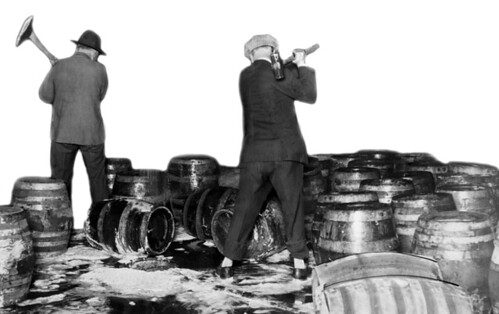
That’s the same tactic Carry Nation employed, smashing up bars — private property — with a hatchet just because she didn’t like what they were doing. It’s something she was celebrated for, but it’s still vandalism and without trying to sound overly dramatic, terrorism. My OED defines terrorism as “the use of violence and intimidation in the pursuit of political aims” and Merriam-Webster calls it “the systematic use of terror especially as a means of coercion.” Whether wielding a hatchet or a lead pipe, it’s using violence to promote your ideas and get your way.

Where did the Milwaukee man get the idea that beer is “poison” and it was acceptable behavior to smash someone else’s property? To me, that’s a great question we’ll probably never know the answer to, because this story’s not quite big enough news that we’ll likely see a follow-up report. Did these ideas infect him through years of neo-prohibitionist propaganda? Through the subtler, but no less effective, way in which so many take it for granted, thanks to our policies and laws, that drinking is “sinful” and that demonizing it only appropriate? With anti-alcohol propaganda so pervasive it seems quite unlikely to me that he came to this notion on his own. I take it for granted that he is indeed a lone wingnut and no neo-prohibitionist group will claim him as one of their own. But it makes you wonder. Rhetoric and symbols are powerful weapons that can influence just about anything, so why not a violent hatred for alcohol and the people who deliver it?

Filed Under: Editorial, Events, News, Politics & Law Tagged With: Prohibitionists

Our Kids Ain’t Learning Too Good

January 12, 2011 By Jay Brooks

Marin-I
Did you know that words can have more than one meaning? Pretty elementary stuff, you’d think. Unless, of course, you can use ignorance to create propaganda for your cause. This one might be funny, if it wasn’t presented so seriously. I can almost understand that the kids of Roseburg, Oregon might be confused, but their parents and the Marin Institute should feel at least a little embarrassed.

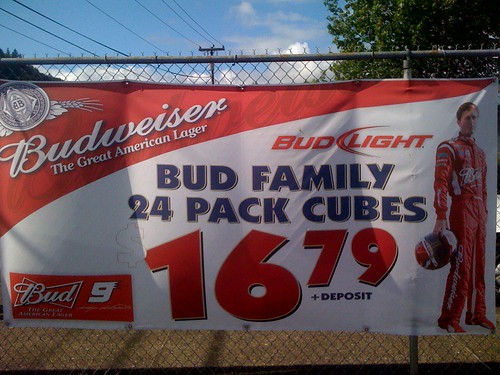
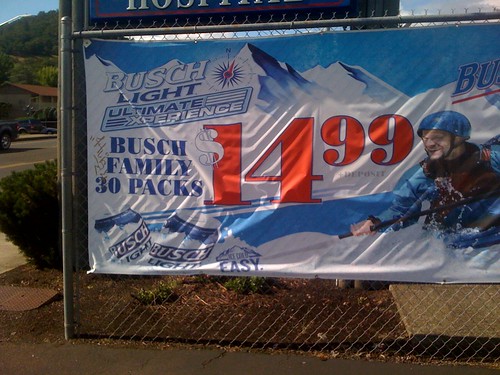
Here’s what happened. The Marin Institute today accused Anheuser-Busch InBev of targeting families by advertising “Family Packs” of beer for sale around the town of Roseburg. A youth group there, apparently confused, sent photos of the ads to the Marin Institute who promptly went on the attack.

Bud-Family

Here’s some of the rhetoric inspired by these ads:

“We knew that the Anheuser-Busch InBev marketing team was willing to stoop low, but this time they’ve really outdone themselves.”

“Cheaper than Capri Sun, it makes a perfect addition to a brownbag lunch for preschoolers and teenagers alike!”

Busch-Family

And here’s the final volley:

How does Anheuser-Busch InBev think they can get away with this? Maybe they figure if they keep it in local communities, next to your kids’ school (as opposed to say, on national TV during the Super Bowl), they won’t get caught. All the while, of course, proclaiming all the wonderful work they do to counter underage drinking with useless educational brochures. Sorry, Bud – you’re not fooling anyone.

Except that ABI isn’t advertising “Family Packs,” they’re advertising “24 Pack Cubes” and “30 Packs” of the “Bud Family” and “Busch Family.” Notice in the Bud ad, the two statements are on separate lines, “Bud Family” on one line, then “24 Pack Cubes” on the second. By “Bud Family,” ABI means the family of products under the “Budweiser label, which are:

The Bud Family

  • Budweiser
  • Bud Light
  • Budweiser Select
  • Bud Light Lime
  • Bud Light Golden Wheat

In the Busch ad, it’s on three lines. In this case, it includes the following beers:

The Busch Family

  • Busch
  • Busch Light
  • Busch Ice

Nobody’s trying to fool anybody. The ads are pretty clear if you know how to read and understand what words mean in context. Somebody really needs to buy the Marin Institute a copy of Eat, Shoots & Leaves. I don’t know the ages of the kids in the local “youth group,” so I can forgive them, but at some point an adult they encountered should have had enough book learning to point this out to them.

As to the fact that they accuse ABI of being “willing to stoop low” and declare “this time they’ve really outdone themselves,” all I can do is shake my head and think — yet again — this is such a perfect example of “the pot calling the [brew] kettle black.”

Filed Under: Breweries, Editorial, News, Politics & Law Tagged With: Oregon, Prohibitionists

« Previous Page
Next Page »

Find Something

Northern California Breweries

Please consider purchasing my latest book, California Breweries North, available from Amazon, or ask for it at your local bookstore.

Recent Comments

  • Ernie Dewing on Historic Beer Birthday: Charles William Bergner 
  • Steve 'Pudgy' De Rose on Historic Beer Birthday: Jacob Schmidt
  • Jay Brooks on Beer Birthday: Bill Owens
  • Steve 'Pudgy' De Rose on Beer Birthday: Charles Finkel
  • Steve 'Pudgy' De Rose on Beer Birthday: Bill Owens

Recent Posts

  • Historic Beer Birthday: Charles Engel February 11, 2026
  • Historic Beer Birthday: Daniel Jung February 11, 2026
  • Beer In Ads #5198: Back Again! Wiedemann’s Genuine Bock Beer February 10, 2026
  • Historic Beer Birthday: Jacob Hammel February 10, 2026
  • Historic Beer Birthday: John Kauffman February 10, 2026

BBB Archives

Feedback

Head Quarter
This site is hosted and maintained by H25Q.dev. Any questions or comments for the webmaster can be directed here.