Brookston Beer Bulletin

Jay R. Brooks on Beer

  • Home
  • About
  • Editorial
  • Birthdays
  • Art & Beer

Socialize

  • Dribbble
  • Email
  • Facebook
  • Flickr
  • GitHub
  • Instagram
  • LinkedIn
  • Pinterest
  • RSS
  • Twitter
  • YouTube

Powered by Genesis

Patent No. 20140072691A1: Method And Device For Adding Hops In Beer Manufacture, And Also Hop Product

March 13, 2016 By Jay Brooks

patent-logo
Today in 2014, US Patent 20140072691 A1 was issued, an invention of Ludwig Scheller, Rudolf Michel, and Patrick Bahns, for their “Method and Device for Adding Hops in Beer Manufacture, and Also Hop Product.” Here’s the Abstract:

The invention relates to a method for adding hops in beer manufacture, having the following process steps; a) separation of a sub-quantity (07 a) of water and/or wort (07) and/or beer as an aqueous fluid, b) addition of hop extract (10) in liquid or pasty form to the separated aqueous fluid (07 a), c) production of a macroemulsion (13) of the hop extract by emulsifying the hop extract (10) in the aqueous fluid (07 a), d) increasing the pressure in the macroemulsion (13) of the hop extract to a feed pressure of in particular higher than 100 bar, e) production of a microemulsion (17) of the hop extract by feeding the pressurized macroemulsion (13) through a gap or a valve (16) or by feeding the pressurized macroemulsion against a baffle plate, f) at least partial return of the microemulsion (17) of the hop extract to the beer manufacturing process.

US20140072691A1-20140313-D00000

Filed Under: Beers, Just For Fun, Politics & Law, Related Pleasures Tagged With: Brewing Equipment, History, Hops, Law, Patent, Science of Brewing

Patent No. 3870810A: Inhibiting Beer Gushing

March 11, 2016 By Jay Brooks

patent-logo
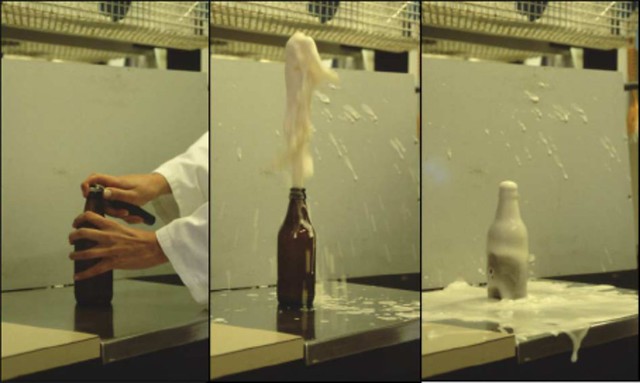
Today in 1975, US Patent 3870810 A was issued, an invention of Anthony Martin Humphrey, for his “Inhibiting Beer Gushing.” Here’s the Abstract:

The present invention provides a method for reducing the tendency of beer to gush by incorporating in the beer 1 to 20 percent based on the weight of iso- alpha -acids in the finished beer of an unsaturated fatty acid having from 10 to 20 carbon atoms. The invention includes hop extracts containing said unsaturated fatty acid and also includes methods of making said extracts.

gushing

Filed Under: Beers, Just For Fun, Politics & Law, Related Pleasures Tagged With: Bottles, History, Law, Packaging, Patent, Science of Brewing

Patent No. 4729900A: Foam-Stabilized Malt Beverage

March 8, 2016 By Jay Brooks

patent-logo
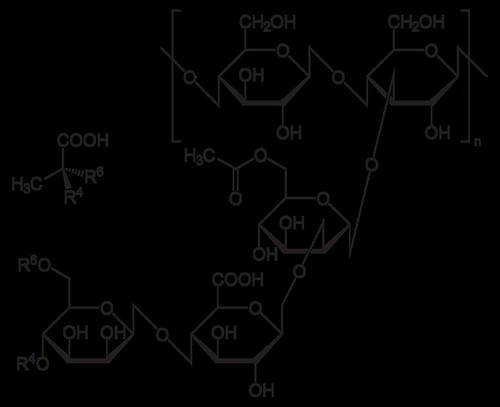
Today in 1988, US Patent 4729900 A was issued, an invention of Kenneth Clare, Margaret A. Lawson, and Walter Bryden, assigned to Merck & Co., Inc., for their “Foam-Stabilized Malt Beverage.” There’s no Abstract, although in the description it includes this summary:

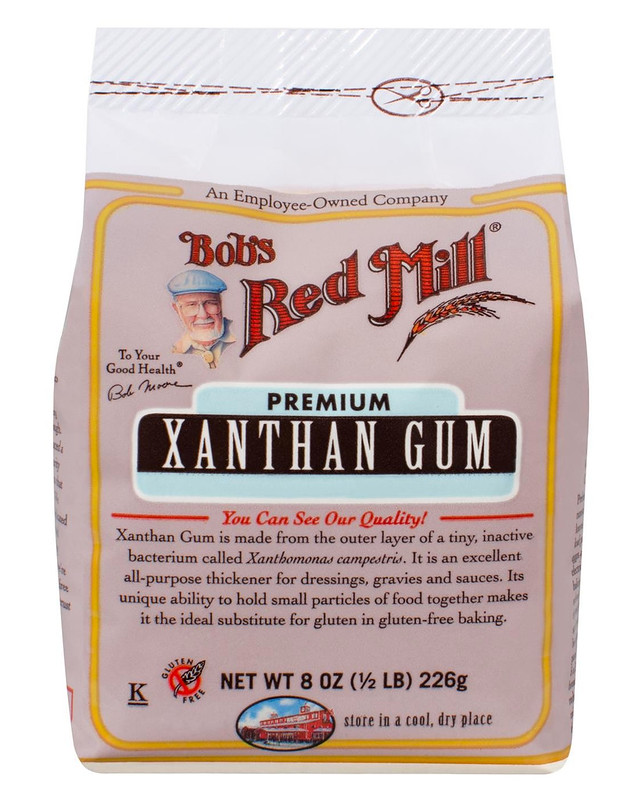
A fermented malt beverage having improved foam stability and desirable lace, cling, and clarity is described. The beverage is stabilized by adding 5-400 ppm by weight of combined xanthan gum and a cold-water soluble protein.

Xanthan-Gum

Here’s a better explanation, from the application:

BACKGROUND OF THE INVENTION

A number of malt beverages or beers will produce a relatively good foam immediately after pouring, but the foams so produced are not as persistent as is usually desired by the consumers of such products. In addition, consumers desire a beer possessing a foam that will “cling” to the insides of a glass or mug in an attractive “lacy” pattern. Lace and cling are difficult to achieve in the presence of slight contaminant levels of surfactants or detergents on the glassware, as occurs when beer mugs or glasses are handwashed and quickly rinsed prior to use. A further requirement is that the beer exhibit good clarity to the consumer, i.e., the absence of any noticeable “haze”.

Propylene glycol alginate (PGA), heteropolysaccharide S-10 (see U.S. Pat. No. 3,966,976) and cellulose ether (see U.S. Pat. No. 3,669,00) are additives known to stabilize beer foam.

However, continuing research is being conducted in an effort to discover new polymers, additives, and polymer combinations which may be more economical and which can be utilized to impart improved foam stability, lace and clarity to fermented malt beverages while avoiding attendant “haze” levels.

Xanthan gum as an extender or thickener in the food industry is well described in the literature. Also well known in the art is the use of collagen hydrolysates, derived from animal skin, in the preparation of hair care preparation, shampoos and skin care preparations. Collagen derivatives have been used in the brewing process as fining agents. Further, gelatin hydrolysates are well known in the pharmaceutical industry as tablet excipients used in granulating and binding operations during tablet manufacture. However, there are no general references to such compositions in combination being disclosed for specifically improving foam stability and properties of fermented malt beverages.

SUMMARY OF THE INVENTION

It has now been found that the foam retention and lace/cling properties of a fermented malt beverage can be stabilized while minimizing haze formation by adding a combination of xanthan gum and cold-water soluble protein to the beverage in a combined amount sufficient to result in a final concentration in the beverage in the range of about 5-400 ppm, by weight. The proteins useful in the invention include, inter alia, collagen, gelatin, or milk protein hydrolysates, having a number average molecular weight of 900-12,000, which can be used in a weight ratio of 1:4 to 4:1 of xanthan gum/protein.

Xanthan-Gum

Filed Under: Beers, Breweries, Just For Fun, Politics & Law, Related Pleasures Tagged With: History, Law, Patent, Science of Brewing

Patent No. 254565A: Improvement In Process Of Preparing A Combined Extract Of Hops And Malt

March 7, 2016 By Jay Brooks

patent-logo
Today in 1882, US Patent 254565 A was issued, an invention of Samuel R. Percy and Walter S. Wells, for their “Improvement in Process of Preparing a Combined Extract of Hops and Malt.” There’s no Abstract, although in the description it includes this summary:

The object of our invention is to produce a combined extract of hops and malt in which the essential principles of both substances shall be so concentrated as to be more easy of manipulation, less bulky in storage, and capable of indefinite preservation in their original purity and strength.

US254565-0

Filed Under: Beers, Breweries, Just For Fun, Politics & Law, Related Pleasures Tagged With: History, Law, Patent, Science of Brewing

Patent No. 1017086A: Process Of Removing Alcohol From And Purifying Beer

February 13, 2016 By Jay Brooks

patent-logo
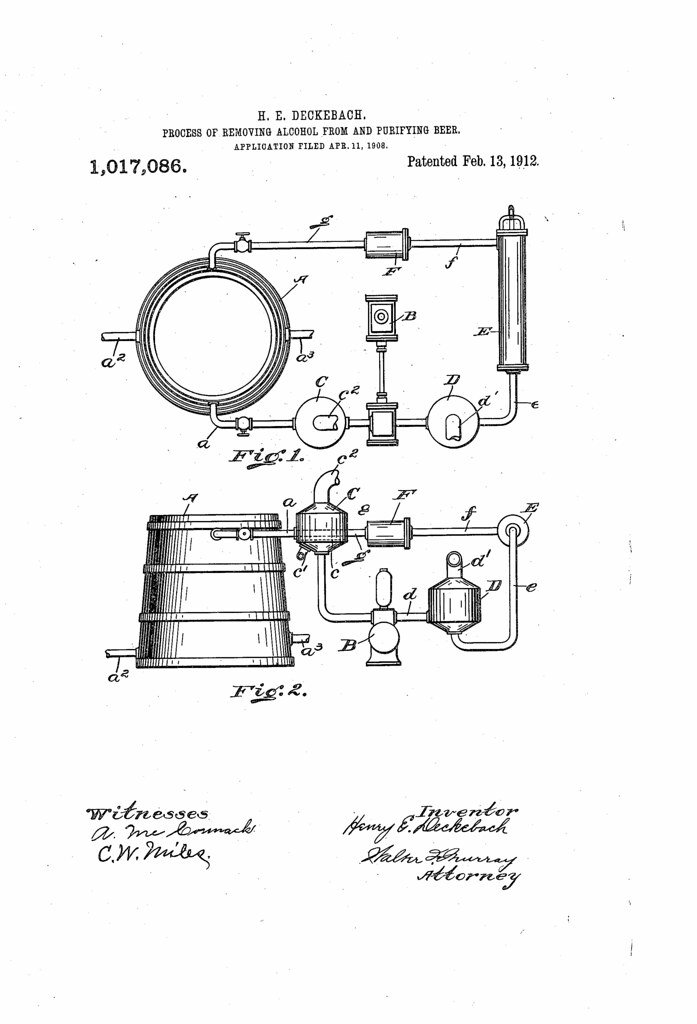
Today in 1912, US Patent 1017086 A was issued, an invention of Henry E. Deckebach, for his “Process of Removing Alcohol From and Purifying Beer.” There’s no Abstract, although in the description it includes this summary:

The process of treating beer consisting of withdrawing it from the fermenting tub, passing heated, compressed air through it, carrying off the air, sending the beer a strainer, returning it from the strainer to the fermenting tub, and continuing the circulation until the beer has been lowered to the desired temperature.

US1017086-0

Filed Under: Beers, Breweries, Just For Fun, Politics & Law, Related Pleasures Tagged With: History, Law, Patent, Science of Brewing

Patent No. 1171306A: Method Of Dealcoholizing Beer

February 8, 2016 By Jay Brooks

patent-logo
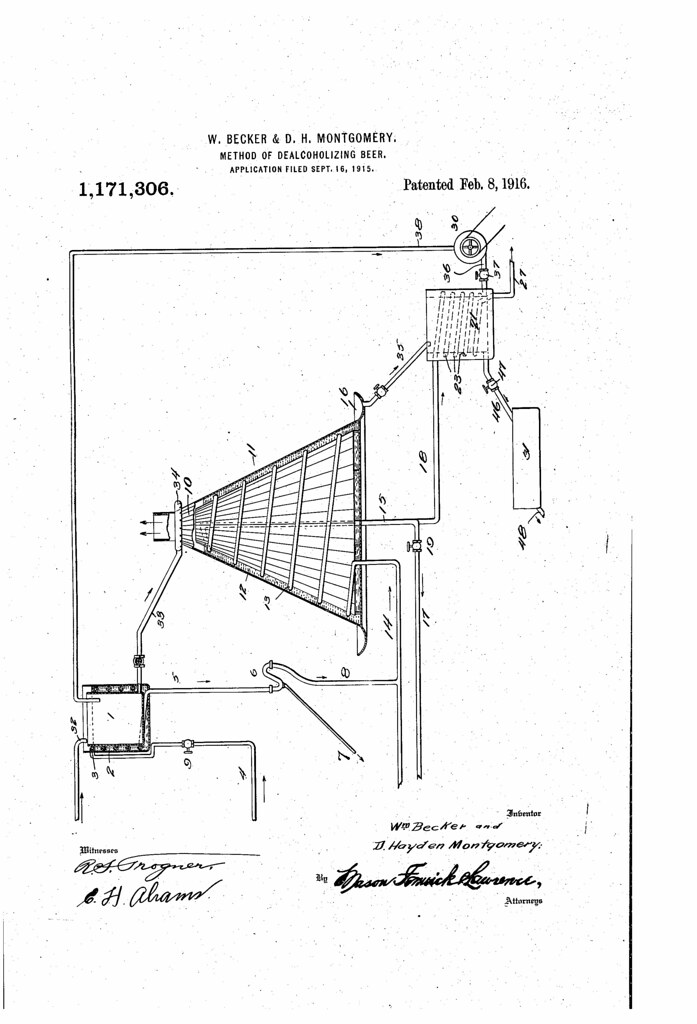
Today in 1916, US Patent 1171306 A was issued, an invention of William Becker and Daniel Hayden Montgomery, for their “Method of Dealcoholizing Beer.” There’s no Abstract, although in the description it includes this summary:

What we claim is:

1. The herein described method of dealcoholizing beverages, the same consisting in raising the temperature of a charge of such beverage to substantially 167 F., then converting the charge into spray to permit it to give off its alcohol, then raising the charge a ain to a temperature no higher than at rst, then repeating this process, and finally cooling the product and conducting it to a point of storage.

2. The herein described method of dealcoholizing beverages, the same consisting in raising the temperature of a charge of such beverage to not over 167 F., then spraying the’ charge into a sheet and subjecting the sheet to substantially the same temperature to permit it to give off its alcohol, then collecting the charge and raising it again to substantially the same temperature, then repeating this process, and finally cooling the product and conducting it to a point of storage.

3. The herein described. method of dealcoholizing beverages, the-same consisting in raising the temperature of a charge of such beverage to not over 167 F., then spraying the charge into a sheet and subjecting the sheet to substantially the same temperature to permit it to give off its alcohol, then collecting the treated beverage, cooling it, and finally conducting it to a point of storage.

4. The herein described method of dealcoholizing beverages, the same consisting in spraying the beverage, collecting the spray into a flowing sheet and subjecting it to heat to raise its temperature to not over 167 F. and cause it to give off the alcohol, then collecting the beverage without its alcohol vapors and again heating it to substantially the same temperature, then pumping it back and retreating it, and finally conveying the de-alcoholized beverage to a point of storage.

Must have been pretty important given Prohibition was about to start in just a few years.
US1171306-0

Filed Under: Beers, Breweries, Just For Fun, Politics & Law, Related Pleasures Tagged With: History, Law, Non-Alcoholic, Patent, Science of Brewing

Patent No. 3425839A: Continuous Beer Making Process Wherein The Wort And Yeast Are Separated By A Porous Partition

February 4, 2016 By Jay Brooks

patent-logo
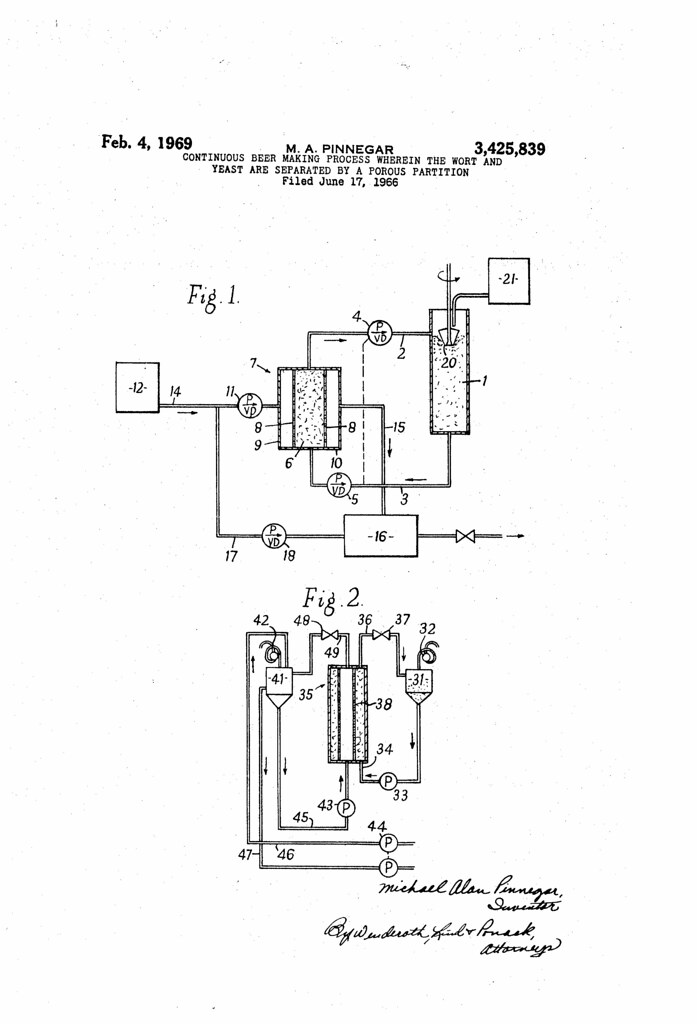
Today in 1969, US Patent 3425839 A was issued, an invention of Michael Alan Pinnegar, assigned to Brewing Patents Ltd., for his “Continuous Beer Making Process Wherein the Wort and Yeast Are Separated by a Porous Partition.” There’s no Abstract, although in the description it includes this summary:

A potable beer is produced by circulating a body of yeast-containing liquor on one side of a partition and maintaining a moving body of wort on the opposite side of the partition. The partition is porous and has a pore size small enough to effectively bar the passage of yeast cells, but allows the passage of the soluble constituents of the wort and the soluble products resulting from the fermentation of the wort by the yeast.

The present invention relates to the production of potable beer by the fermentation of brewers wort by yeast in a continuous fermentation process. The term continuous fermentation process is used herein to refer to a fermentation process, in which brewers Wort is introduced in a stream into a fermentation zone. The stream of wort can be introduced at either constant or varying rates and may be continuous or discontinuous in the sense of being interrupted at constant or varying intervals. However in the generally preferred procedure brewers wort is introduced into the fermentation zone at a substantially constant rate over a substantial period of time e.g. not less than five days.

US3425839-0

Filed Under: Beers, Breweries, Just For Fun, Politics & Law, Related Pleasures Tagged With: Brewing Equipment, History, Law, Patent, Science of Brewing

Patent No. 878136A: Brew-House Equipment

February 4, 2016 By Jay Brooks

patent-logo
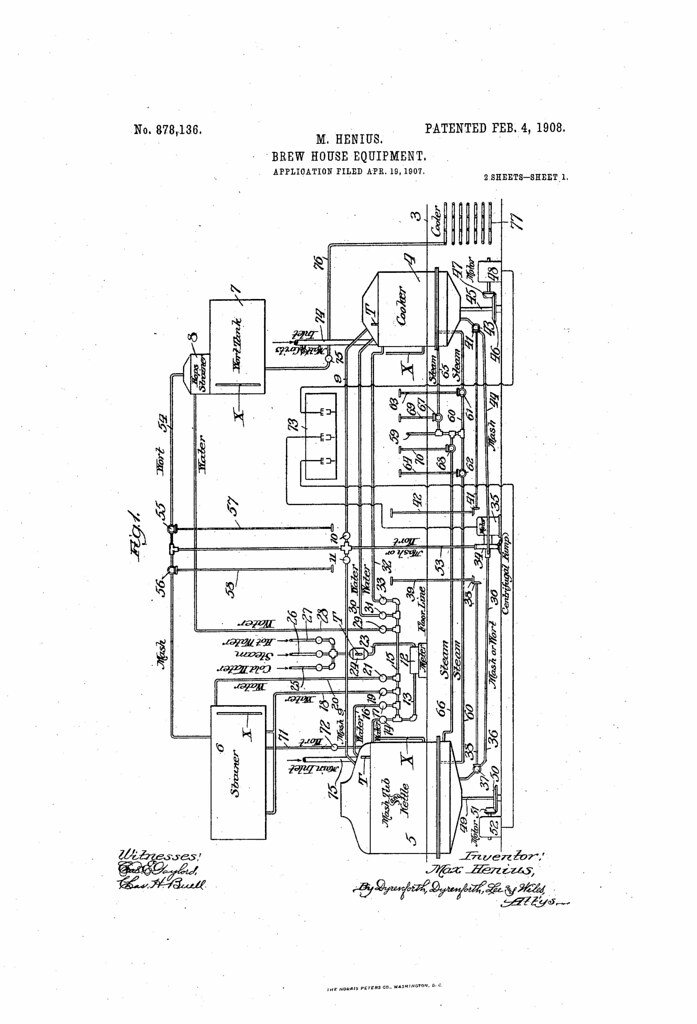
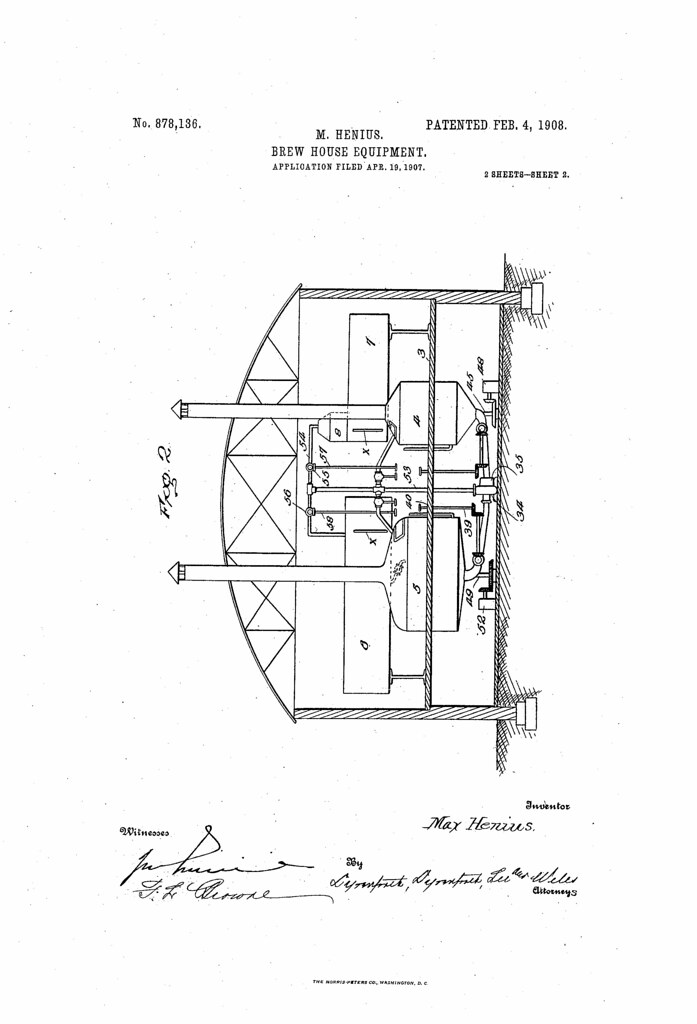
Today in 1908, US Patent 878136 A was issued, an invention of Max Henius, for his “Brew-House Equipment.” There’s no Abstract, although in the description it includes this summary:

The gist of my invention lies in centering about a single point on the brew-house floor, on which the entire apparatus employed in producing the wort is located, all the controlling means for governing and inspecting the operation of the different parts, whereby all such means are rendered conveniently accessible to the manipulation and view of a single operator whose position of duty is at such centering point.

US878136-0
US878136-1

Filed Under: Beers, Breweries, Just For Fun, Politics & Law, Related Pleasures Tagged With: Brewing Equipment, History, Law, Patent, Science of Brewing

U. Penn Students Win Prize For 9 Times Faster Brewing Process

February 3, 2016 By Jay Brooks

u-penn
I tend to be skeptical of anyone who claims to be able to shorten the brewing process, especially by up to nine times, since brewing is a pretty time-honored process, improved little by little over the centuries. And generally speaking, speeding up fermentation has rarely resulted in better beer. Of course, there was that flourish of decades beginning with the industrial revolution that speeded up that process considerably, but since then things have slowed down to a more manageable pace. But that’s exactly what got the winners of this year’s Y-Prize, from the University of Pennsylvania, the grand prize $10,000, “for developing a process that speeds up the fermentation process in beer production by up to nine times — while maintaining alcohol quality and composition.”

The three winners, Alexander David, Shashwata Narain and Siddharth Shah, are students in the Wharton School and the School of Engineering and Applied Science. They’ll received “$10,000 and the rights to commercialize the technology through their company,” which they’ve named “Fermento.”

Y-Prize-2016-Winners-Fermento
The Fermento Team: Alexander David, Shashwata Narain and Siddharth Shah

From UPenn:

The Fermento team selected microfluidic fabrication technology developed by Assistant Professor of Bioengineering David Issadore as the basis of their application.

The alcohol in beer is the product of yeast, which metabolically converts sugar found in barley and other grains into ethanol. This fermentation process typically occur in large batch reactors, where a concoction of boiled and strained grain liquid, known as wort, is left mixed with a carefully controlled amount of yeast.

This stage is one of the major bottlenecks of beer production. It can take up to three weeks, as maintaining the correct amount of yeast is a delicate balance.

“There is only a certain amount of yeast cells one can directly add to a batch reactor,” Narain says, “because overpopulation causes physiological stress on the yeast cells, which in turn reduces reaction rate. It takes time for yeast cells to grow and reach a critical mass to produce enough beer. Moreover, the concentration of sugar available to yeast cells is limited because in a large batch solutions, yeast cells don’t consistently interact with sugar molecules.”

Capable of delivering precisely controlled amounts of liquids to exact locations in a conveyer-belt fashion, microfluidics present a possible solution to both of these challenges. Yeast and wort can be introduced to one another in microdroplets, providing the optimal ratio for fermentation each time.

“Microdroplets to speed up fermentation have been tried in labs, but none of the technologies so far are scalable,” Narain says. “This patented technology actually makes the process industrially scalable for the first time, and in a financially feasible manner.”

So who knows. According to another report, “[t]heir advisors include executives from some of the biggest brewers in the world: MillerCoors, Anheuser-Busch InBev, Biocon India and Heineken. And say what you will about them, but those beer companies employ brewers who know how to make beer. So there may be something to it. It will be interesting to see what becomes of the idea.

Filed Under: Beers, Breweries, Just For Fun, News, Related Pleasures Tagged With: Awards, Pennsylvania, Science, Science of Brewing

Patent No. 20090028999A1: Beer Brewing Kit And Brewing Method To Prepare Wort For The Kit

January 29, 2016 By Jay Brooks

patent-logo
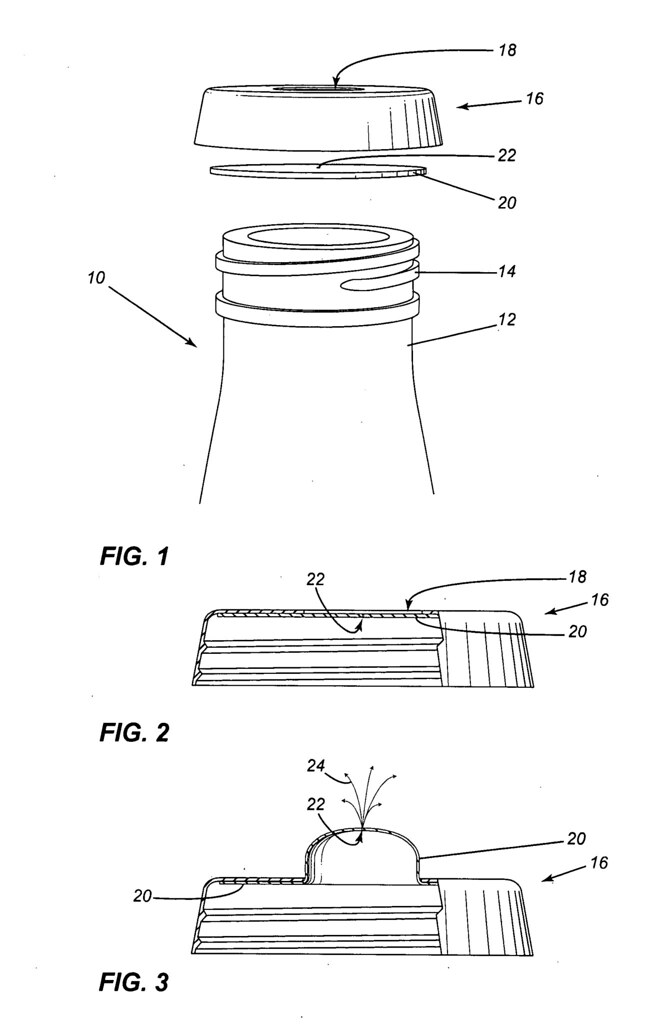
Today in 2009, US Patent 20090028999 A1 was issued, an invention of Klaus U. Melisch and Stefan Riedelsheimer, for their “Beer Brewing Kit and Brewing Method to Prepare Wort for the Kit.” Here’s the Abstract:

A kit for home brewed beer which comprises a bottle, wort substantially filling the bottle, and a cap which has venting means to permit escape of gas from the bottle when pressure therein exceeds a predetermined value. There is also disclosed a brewing method wherein lactic acid is added to the wort to reduce the pH to level 4.6 and a predetermined amount of yeast is added to the wort to cause a short fermentation while maintaining the alcohol level below 0.5% by volume.

US20090028999A1-20090129-D00001

Filed Under: Beers, Breweries, Just For Fun, Politics & Law, Related Pleasures Tagged With: History, Homebrewing, Law, Patent, Science of Brewing

« Previous Page
Next Page »

Find Something

Northern California Breweries

Please consider purchasing my latest book, California Breweries North, available from Amazon, or ask for it at your local bookstore.

Recent Comments

  • Ernie Dewing on Historic Beer Birthday: Charles William Bergner 
  • Steve 'Pudgy' De Rose on Historic Beer Birthday: Jacob Schmidt
  • Jay Brooks on Beer Birthday: Bill Owens
  • Steve 'Pudgy' De Rose on Beer Birthday: Charles Finkel
  • Steve 'Pudgy' De Rose on Beer Birthday: Bill Owens

Recent Posts

  • Historic Beer Birthday: Philip Zorn February 21, 2026
  • Historic Beer Birthday: Rudolph J. Schaefer February 21, 2026
  • Beer Birthday: Kate Bernot February 21, 2026
  • Historic Beer Birthday: William J. Lemp February 21, 2026
  • Beer Birthday: Sayre Piotrkowski February 21, 2026

BBB Archives

Feedback

Head Quarter
This site is hosted and maintained by H25Q.dev. Any questions or comments for the webmaster can be directed here.